Google Unveils Gemini 4 Hydrogen? Google DeepMind officially introduced Gemini 4 Hydrogen on November 12, 2026, positioning the model as a cost-efficient, high-throughput system for everyday software engineering and multi-step agentic workflows, as detailed in the official Google DeepMind Announcement. As software teams increasingly deploy autonomous agents to navigate repositories and run tests, relying exclusively on large frontier reasoning models creates noticeable latency and compounding API expenses. While deep architectural reasoning remains essential for complex system design, routine engineering tasks such as writing localized edits, running test harnesses, and parsing build logs require rapid execution. Hydrogen is designed to serve both as a standalone tool for high-volume development and as an execution engine paired with frontier models in multi-model routing pipelines.
Core Industry Realignment: Google Unveils Gemini 4 Hydrogen for High-Throughput Workflows
At a Glance
- Google DeepMind introduced Gemini 4 Hydrogen as a high-throughput model designed to handle routine coding, repository Q&A, and agentic workflows at lower latency than frontier tiers.
- The model operates within a unified 1,048,576-token context window shared across inputs and outputs, with pricing listed at $1.50 per million input tokens and $7.50 per million output tokens.
- Availability spans Google AI Studio, the Gemini API, Android Studio, Google Search, and enterprise platforms, with access tiers varying between free consumer plans and paid developer workspaces.
The operational demands of software engineering workflows have evolved beyond single-prompt code completion. Modern agentic setups often trigger dozens of autonomous steps, including reading directory structures, inspecting dependency trees, proposing patches, and executing regression tests. When developers route every routine action through frontier reasoning models, task execution slows down significantly. In iterative environments, even moderate latency on individual tool calls can accumulate into lengthy delays across automated development cycles.
Industry discussions surrounding the launch reflect a growing recognition that model specialization is critical for production scalability. Rather than treating a single general-purpose model as the default choice for every development task, teams are evaluating tiered architectures. In these configurations, high-capacity reasoning models manage system design and ambiguous problem framing, while dedicated execution models handle repetitive codebase operations. Google designed Hydrogen to address this operational tier, offering immediate developer availability through standard API endpoints and programmatic environments.
Benchmark Analysis and Technical Boundaries of Gemini 4 Hydrogen
Google describes Hydrogen as adapted from Gemini 4 Carbon. However, published technical documentation does not disclose specific internal details regarding weight-transfer mechanisms, tokenizer architecture, or distillation pipelines. Technical evaluations must therefore focus on observable benchmark data, documented context boundaries, and reported operational constraints rather than inferred internal mechanics.
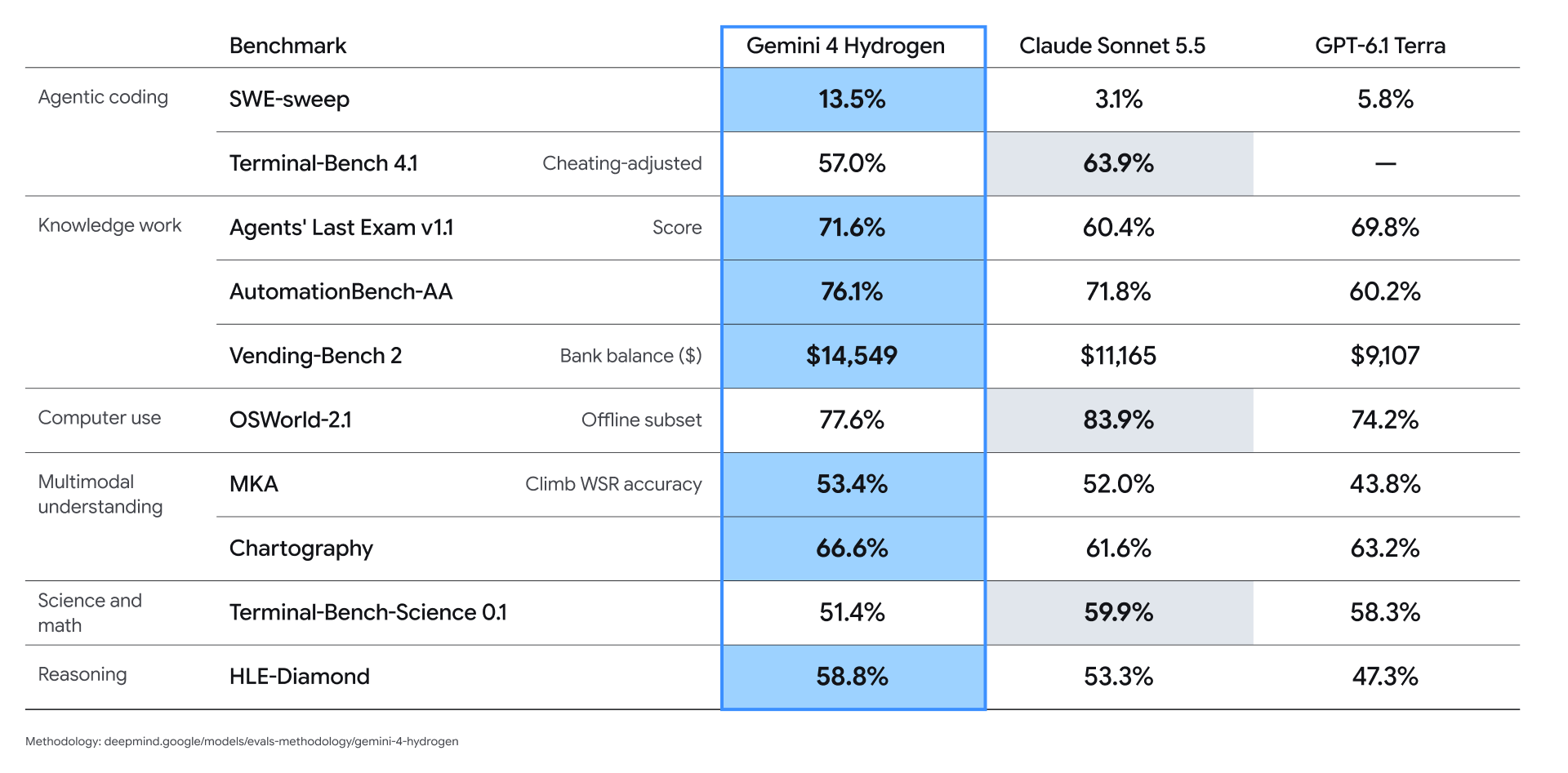
In standard evaluations reported in the Gemini 4 Hydrogen Model Card, Hydrogen demonstrates clear performance differences across task categories. On the SWE-sweep benchmark for issue resolution, Google reported a 13.5% resolution rate for Hydrogen, compared to 3.1% for Claude Sonnet 5.5 and 5.8% for GPT-6.1 Terra under the specified evaluation conditions. Conversely, on Terminal-Bench 4.1 under cheating-adjusted parameters, Hydrogen achieved 57.0%, which improves substantially upon Gemini 3.8 Flash (18.2%) but trails Claude Sonnet 5.5, which recorded 63.9%. On the independent Artificial Analysis Intelligence Index, Hydrogen scored 51 at its default high thinking setting and 54 at its xhigh setting, compared to 50 for the flagship Gemini 4 Argon.
A critical architectural consideration is the model’s context capacity, as documented in the Google Cloud Model Documentation. Hydrogen provides a unified context ceiling of 1,048,576 tokens that is shared across all inputs and outputs. This means that extensive input files reduce the remaining token capacity available for model outputs. A single foreground segment supports up to 65,536 output tokens. Longer generation uses supported continuation mechanisms, including SDK-managed continuation, a custom continuation-token loop, or server-managed background execution where available. All segments remain subject to the shared context limit. Output tokens encompass internal reasoning tokens, generated tool requests, and visible text.
[Multi-Model Orchestrator Architecture in Google Antigravity]
                         ┌────────────────────────┐
                         │  Gemini 4 Carbon/Argon │ (Architectural Planning & Complex Reasoning)
                         └───────────┬────────────┘
                                     │ Task Delegation & Plan Review
                                     ▼
                         ┌────────────────────────┐
                         │   Gemini 4 Hydrogen    │ (Parallel Code Generation & Tool Calling)
                         └───────────┬────────────┘
                                     │ Structured Tool Invocations
                                     ▼
                [ Local Runtime / Test Suites / File System ]
To balance latency and analytical depth, Hydrogen incorporates four configurable reasoning levels: low, medium, high (default), and xhigh. Lower settings reduce response latency for simple syntactic adjustments, while higher levels allocate more internal reasoning tokens to evaluate edge cases. Developers should note that documented limitations remain: the model has a knowledge cutoff of March 2026, can experience occasional timeouts during heavy background processing, and may produce hallucinations or over-refusals on ambiguous prompts.
Decoupled Systems and Multi-Model Orchestration Trade-offs
Multi-model orchestration allows development platforms to split engineering workflows across distinct model tiers. In this pattern, complex system modeling and security evaluations are delegated to frontier reasoning models, while concrete code edits and test assertions are assigned to fast execution models.
Google evaluated this approach using the experimental Orchestrator in Google Antigravity. In testing on Terminal-Bench 4.0, Google reported that dynamic switching between Carbon and Hydrogen achieved task success rates close to Carbon while consuming 24% less quota and completing tasks 19% faster than running Carbon alone. Google also reported early partner tests showing 2×–2.8× faster execution and 12%–23% lower token usage than Gemini 3.8 Flash on selected workflows. For example, Box reported approximately 2× faster execution and 12% fewer tokens on complex document and table tasks. These vendor-reported examples reflect specific integration settings and do not represent controlled estimates of savings across all production deployments.
| System Component | Representative Tooling | Defined Responsibility | Operational Scope and Limitations |
|---|---|---|---|
| System Coordinator | Gemini 4 Carbon / Argon | High-level architecture design, cross-repository planning, complex logic evaluation | High reasoning capacity; incurs higher per-token costs and longer generation latency |
| Execution Engine | Gemini 4 Hydrogen | Localized code generation, automated file edits, rapid tool-calling loops | High generation throughput; can operate standalone or under a coordinator |
| Verification Gate | Unit Test Harnesses / Static Linters | Deterministic rule checking, syntax validation, regression testing | Checks defined assertions and static rules; assurance depends on test quality, coverage, and independent review |
Evaluating a multi-model architecture requires engineering teams to balance system complexity against execution efficiency. While dynamic model routing can lower token expenditures on repetitive tasks, it introduces orchestration overhead, state-synchronization challenges across sub-agents, and dependency on routing classifiers. Engineering teams must measure these trade-offs against their own task distributions, repository structures, and API latency requirements.
Engineering Implementation and Workflow Governance Checklists
Integrating Gemini 4 Hydrogen into automated developer toolchains requires clear execution boundaries, token monitoring, and defensive agent governance.
Developer Implementation Checklist
- Align Thinking Levels to Operational Tasks: Configure reasoning effort parameters according to workload complexity. Reserve
xhighfor complex algorithmic edge cases, maintainhighas the standard baseline for repository navigation, and usemediumorlowfor latency-sensitive tasks like code reformatting or simple documentation lookup. - Structure Parallel Tool Interfaces: Design tool definitions to accept batched arguments where supported by the runtime, enabling worker agents to request multiple file inspections or syntax checks in consolidated requests rather than sequential round-trips.
- Decouple Model Generation from Execution: Ensure that models propose tool invocations and code modifications as structured data, while an isolated client runtime or containerized test runner executes commands and returns execution results and reproducible evidence where possible.
Enterprise Governance Checklist
- Establish Session Logging: Log tool requests, execution results, permission decisions, code changes, test outcomes, and available model summaries. Do not treat reasoning summaries as complete or faithful execution traces.
- Apply Layered Security Controls: Treat external documentation, issue trackers, and pull request comments as untrusted input. While Hydrogen demonstrated a 2.3x resilience improvement on the Gray Swan indirect prompt injection benchmark, automated input sanitization and execution permission gates remain necessary.
- Monitor Cumulative Token Consumption: Track input tokens and billable output tokens, including thinking tokens, using the selected API’s usage fields. Do not add thinking tokens again when they are already included in the billed output total.
Frequently Asked Questions (FAQ)
How does Gemini 4 Hydrogen compare with Carbon and Argon in production workloads?
What are the four thinking levels and when should developers use xhigh?
How does the flat pricing model operate across the one million token context window?
Key Takeaways for Engineering Teams
Deploying autonomous coding tools in production environments requires development teams to look beyond frontier benchmark scores and focus on the economics of iterative tool execution. Routing every routine code modification through high-latency reasoning models introduces unnecessary operational delays and budget inflation. At the same time, managing execution latency and task success rates requires realistic expectations about benchmark scores and error-recovery behaviors.
By establishing tiered architectures that combine high-capacity reasoning models with fast, predictable execution engines, engineering organizations can scale automated development workflows sustainably. Teams that implement disciplined multi-model routing, structured testing boundaries, and rigorous input validation will be best positioned to build robust, maintainable AI-assisted software pipelines.
References
-
Google DeepMind. Introducing Gemini 4 Hydrogen. Official Announcement.
-
Google DeepMind. Gemini 4 Hydrogen Model Card. Technical Specification and Safety Report.
-
Google Cloud. Gemini 4 Hydrogen Model Documentation. Technical Reference.
-
Google Antigravity. Gemini 4 Hydrogen in Google Antigravity. Multi-Model Orchestration Overview.
-
Artificial Analysis. Gemini 4 Hydrogen Intelligence and Latency Benchmark. Independent AI Evaluation.
-
Ars Technica. Google Rolls Out Gemini 4 Hydrogen, Finally Replacing 3.8 Flash. Technical Analysis.
Share this article