OpenAI Brings ChatGPT Ads to India? OpenAI has officially begun rolling out sponsored advertisements to eligible adult users on ChatGPT Free and Go tiers in India, marking a major commercial milestone as the company expands its revenue base ahead of a potential IPO. As generative artificial intelligence models shift from simple answer engines to interactive decision assistants, advertising models are experiencing rapid architectural evolution. Historically, digital ads relied on search-engine keyword bidding and passive display placements. Today, because conversational interfaces engage users during active consideration and research phases, promotional messages are moving directly into conversational dialog streams.
The Commercial Expansion: Why OpenAI Brings ChatGPT Ads to India
At a Glance
- OpenAI expanded ChatGPT Ads to India on August 27, 2026, serving eligible adult users on the Free and Go tiers across desktop and mobile interfaces.
- The rollout starts with 50 initial partner brands through non-exclusive agency collaborations with WPP and Omnicom, supported by a self-serve Ads Manager with daily budgets starting at 725 Indian rupees.
- ChatGPT Plus, Pro, Business, Enterprise, and Education plans remain completely ad-free, with strict policies prohibiting ads next to sensitive or regulated topics.
The expansion of monetization into consumer AI chats reflects mounting financial pressure across the industry. Operating massive frontier model clusters incurs substantial infrastructure overhead. While subscription tiers provide recurring revenue, compute costs for hundreds of millions of non-paying users demand additional monetization channels. India represents one of OpenAI’s largest user markets, counting over 100 million weekly active users, many of whom utilize free access or the low-cost Go subscription tier.
To capture value from this demographic, the company has structured an entry-level commercial tier. According to reporting by TechCrunch, OpenAI previously cultivated this market by offering affordable subscription promotions and advertising during major sports tournaments. Introducing sponsored messages allows the platform to monetize high-frequency conversational traffic without raising subscription barriers.
This commercial milestone explains why deploying ChatGPT Ads in India serves as a key indicator for the company’s financial roadmap. Financial disclosures reported in industry outlets indicate that the organization recorded 6.7 billion dollars in revenue for the second quarter of 2026. Deploying self-serve ad infrastructure provides a pathway toward broader enterprise revenue targets, positioning conversational interactions as a new advertising revenue surface.
The Shift in User Intent: Conversational Prompts vs. Traditional Search Queries
At the interaction layer, conversational advertising differs fundamentally from traditional search-engine results. Standard search queries are typically brief and fragmented, prompting search engines to return ranked lists of external hyperlinks. In contrast, users engage in multi-turn dialogues with conversational models, evaluating trade-offs, refining parameters, and formulating purchasing decisions in real time.
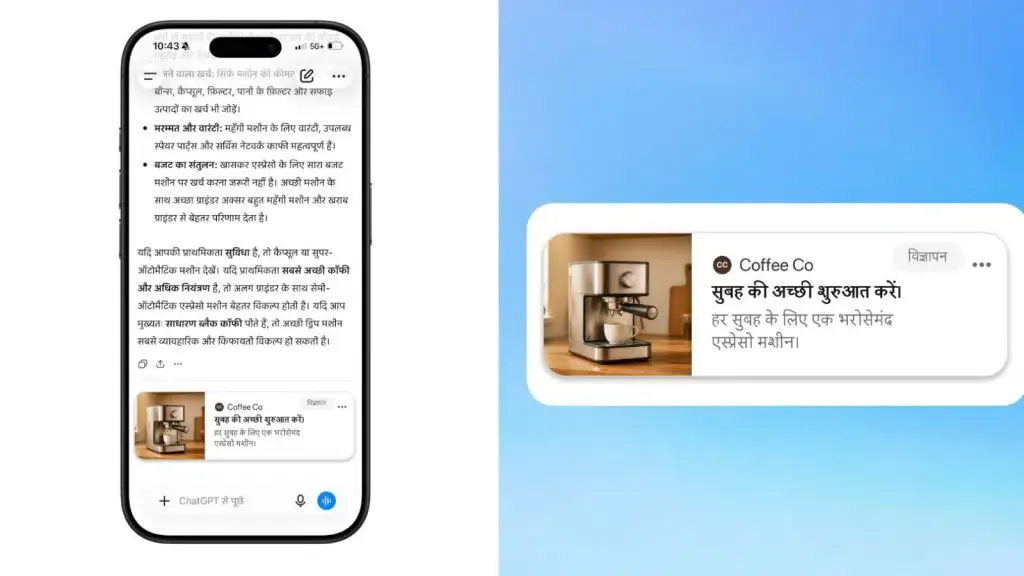
According to OpenAI’s official advertising documentation, sponsored units are rendered as distinct, labeled boxes positioned directly beneath relevant AI responses. OpenAI uses conversational intent internally to determine ad relevance, while advertisers receive aggregate campaign performance metrics—such as impressions, clicks, click-through rates, and conversion counts—without gaining access to private chat transcripts, personal account details, or conversation histories, as also noted in The Indian Express analysis.
The Intent Funnel: Interactive Dialogues vs. Static Landing Pages
Traditional search advertising funnels users from a static query to an external website. Conversational marketing, however, embeds contextual brand prompts directly within the user’s discovery stream. The diagram below illustrates how conversational advertising alters the user acquisition pathway:
[Traditional Search Engine Ad Funnel]
  Keyword Query ──> Search Engine Result Page (Sponsored Links) ──> Web Landing Page ──> Standard Tracking

[Conversational AI Ad Journey]
  Multi-turn Dialogue ──> High-Intent Moment ──> Sponsored Prompt / Link ──> App Store Boundary ──> First Launch
When a user interacts with a sponsored prompt in a conversational interface, the interaction may direct them to a web landing page or encourage them to download a native mobile application. In mobile acquisition campaigns, browser-side cookies and arbitrary URL state do not automatically become first-launch state inside a newly installed native application, requiring structured parameter pass-through workflows for downstream measurement.
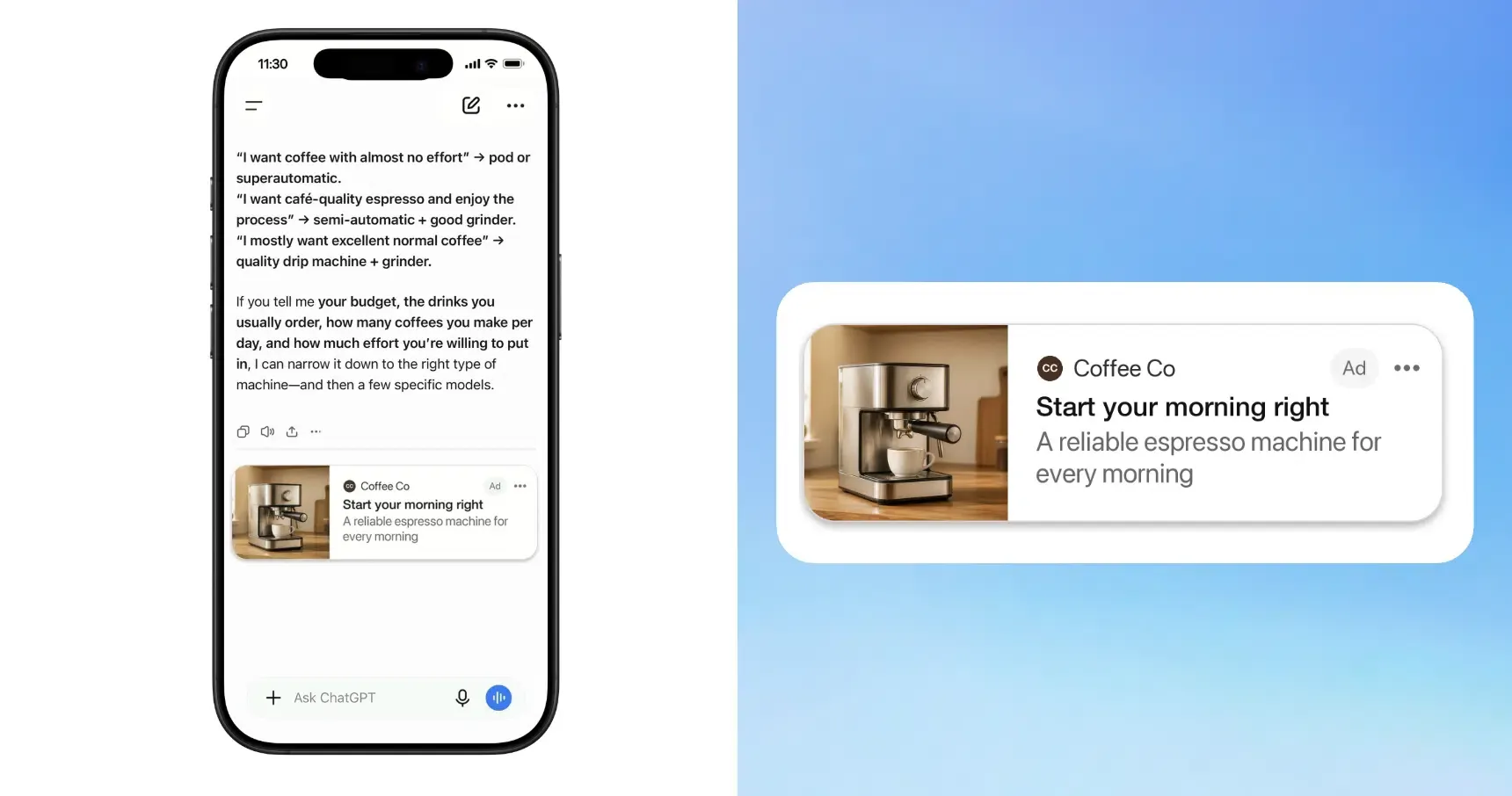
This architectural shift demonstrates that conversational ad units capture intent at high-context moments. Capitalizing on this intent across mobile app campaigns requires downstream attribution systems capable of preserving advertiser-defined parameters across the installation journey.
Build vs. Buy: Managing Campaign Parameters Across Conversational Ad Funnels
As performance marketers allocate budget to conversational ad platforms, managing campaign metadata across user touchpoints requires appropriate tracking infrastructure. OpenAI’s Ads Manager natively tracks platform-level impressions, clicks, spend, and supported conversion events, while also allowing advertisers to append standard tracking parameters such as UTM tags to destination URLs. However, when an acquisition journey leads prospective users from an ad click through an app store to install a native mobile app, engineering teams face a choice between building custom parameter-matching services or adopting dedicated mobile measurement tools.
Architectural Evaluation: Custom Build vs. Standardized SDK
Constructing an in-house attribution engine requires engineering teams to build custom URL generation services, manage parameter-matching databases, and maintain mobile SDK integrations across iOS and Android updates. While this approach grants complete internal control, it demands ongoing engineering overhead. Conversely, deploying a standardized, pre-built measurement SDK provides cross-platform parameter preservation and reduces the amount of custom infrastructure teams need to maintain.
The table below outlines how different attribution methodologies handle campaign context across conversational ad touchpoints and mobile installation boundaries:
| Solution | Platform Coverage | Install-Boundary Context | Engineering Ownership | Maintenance Burden | Best Fit |
|---|---|---|---|---|---|
| OpenAI Ads Manager | Native ChatGPT Interface | Platform-defined conversion tracking | Managed via OpenAI Platform | None (Built-in) | Measuring ChatGPT ad delivery, clicks, and configured post-click conversions |
| Standard Web Analytics (UTM) | Web Browsers | No generic custom parameter restoration | Managed via Analytics Tool | Low | Standard web landing pages where post-install mobile app routing is not required |
| In-house Parameter Matching | Custom (Android/iOS) | Supported via Custom Backend | Complete Internal Control | High (Ongoing Maintenance) | Enterprise architectures with dedicated internal engineering teams |
| Deferred Deep Linking SDK | Multi-Platform (Android/iOS/Web) | Supported via Parameter Restoration | Managed via Standard SDK | Low (Pre-built Integration) | Performance acquisition campaigns passing custom creative or referral tags into mobile apps |
For performance marketers running acquisition campaigns that lead from web touchpoints into mobile apps, specialized platforms such as Adjust, AppsFlyer, Branch, and OpoInstall provide dedicated deferred deep linking capabilities. For instance, OpoInstall documents server-assisted parameter restoration workflows where advertiser-defined campaign IDs, creative tags, or referral parameters can be recovered by the Android or iOS SDK after installation. If the advertiser attaches an eligible destination parameter to the promotional link, the mobile application can retrieve the restored parameter through the supported SDK workflow to configure the intended onboarding flow, supporting consistent measurement continuity across marketing channels.
Integration Checklists: Operationalizing Conversational Ads in Performance Marketing
To successfully operationalize conversational ad campaigns, growth and engineering teams can establish structured integration workflows that connect conversational touchpoints with downstream attribution.
Developer Implementation Checklist
- Configure Parameter Integrity Protection: Apply appropriate signing or server-side validation where campaign parameters affect user rewards, referral credits, or sensitive routing decisions.
- Integrate Required Attribution SDKs: Embed supported attribution or deferred-linking SDKs within the native mobile application to listen for restored campaign parameters upon first launch.
- Implement Dynamic Onboarding Routing: Program the destination application to read incoming campaign identifiers and route new users to the specific product catalog or promotional flow associated with the ad.
Product & Growth Strategy Checklist
- Define Contextual Intent Taxonomies: Structure ad campaigns around conversational decision stages rather than broad keyword categories, aligning creative copy with specific user research intent.
- Audit Install Boundary Continuity: Verify deep link and deferred deep linking flows across multiple mobile devices to confirm that advertiser-defined parameters survive the app store transition.
- Monitor Cohort ROAS Metrics: Compare user retention and lifetime value from conversational ad placements against traditional search and social channels, utilizing both OpenAI Ads Manager reporting and downstream mobile analytics.
By pairing conversational ad placements with reliable parameter-passing frameworks, organizations can engage users during active decision-making while maintaining clear visibility into customer acquisition performance.
अक्सर पूछे जाने वाले प्रश्न (FAQ)
ChatGPT में विज्ञापन कौन देखेगा, और कौन से टियर विज्ञापन-मुक्त रहेंगे?
क्या विज्ञापनदाताओं को निजी चैट वार्तालाप या उपयोगकर्ता व्यक्तिगत डेटा तक पहुंच मिलती है?
संवादात्मक AI विज्ञापन अभियानों के लिए डिफर्ड डीप लिंकिंग कब उपयोगी होती है?
Key Takeaways for Engineering Teams
The expansion of sponsored placements inside conversational AI interfaces represents a notable evolution in digital advertising. As consumers increasingly use conversational assistants to research products and make commercial decisions, marketing budgets will follow these high-intent interactions.
To maximize the return on conversational ad spend, engineering and growth teams may benefit from connecting conversational entry points with robust downstream measurement. Implementing server-assisted parameter restoration, dynamic parameter pass-through frameworks, and structured deep linking will help organizations scale user acquisition while maintaining accurate attribution across modern marketing funnels.
References
-
OpenAI. Ads in ChatGPT: The Basics. https://help.openai.com/en/articles/20001207-ads-in-chatgpt-the-basics
-
OpenAI. Ads in ChatGPT. https://help.openai.com/en/articles/20001047
-
TechCrunch. OpenAI to Start Showing Ads on ChatGPT’s Free and Go Tiers in India. https://techcrunch.com/2026/08/27/openai-chatgpt-ads-india-pilot/
-
The Indian Express. Ads in ChatGPT to Roll Out Across India: Who Will See Them, What It Means for OpenAI. https://indianexpress.com/article/technology/artificial-intelligence/chatgpt-ads-india-launch-open-ai-10557434/
-
Business Standard. OpenAI to Start Showing Ads to ChatGPT Free, Go Users in India. https://www.business-standard.com/technology/artificial-intelligence/openai-to-start-showing-ads-to-chatgpt-free-go-users-in-india-126082701281_1.html
Share this article