DeepSeek Users Report 40K-Character Input and Daily Caps? User screenshots and Chinese media reports since November 15, 2026 indicate that some users on DeepSeek’s free consumer mobile app and web interface are encountering new restrictions: single-text inputs capped near 40,000 Chinese characters, lockouts on resuming inactive long conversations, and daily usage limit prompts. On its official API changelog and status page reviewed as of November 17, 2026, DeepSeek has not published an announcement confirming these consumer restrictions or defining unified rules, while its public status page showed all tracked services operating as expected without explaining the reported user prompts.
What Users Report on DeepSeek’s App and Web Interface
At a Glance
- User feedback compiled by media since November 15 describes three constraints on free consumer chat: a roughly 40,000-character single-input limit, cutoffs on resuming inactive long conversations, and daily usage limit notices.
- Reported inactivity cutoffs vary across screenshots—some citing seven days without active interaction and others citing 72 hours—and DeepSeek has not published unified consumer quota terms.
- DeepSeek’s prepaid developer API follows a separate set of documented rules reviewed on November 17, 2026, including account-level concurrency caps and peak/off-peak token pricing, though public records do not establish immunity from capacity delays.
Reports from IT Home, Qianjiang Evening News, and Lianhe Zaobao summarize a consistent pattern across shared consumer chat screenshots. Users attempting to paste long documents or source code report hitting a single-input limit of roughly 40,000 Chinese characters. Other users report that older multi-turn threads can no longer be resumed, displaying notices that cite insufficient computing capacity and advise starting a new conversation or exporting existing history.
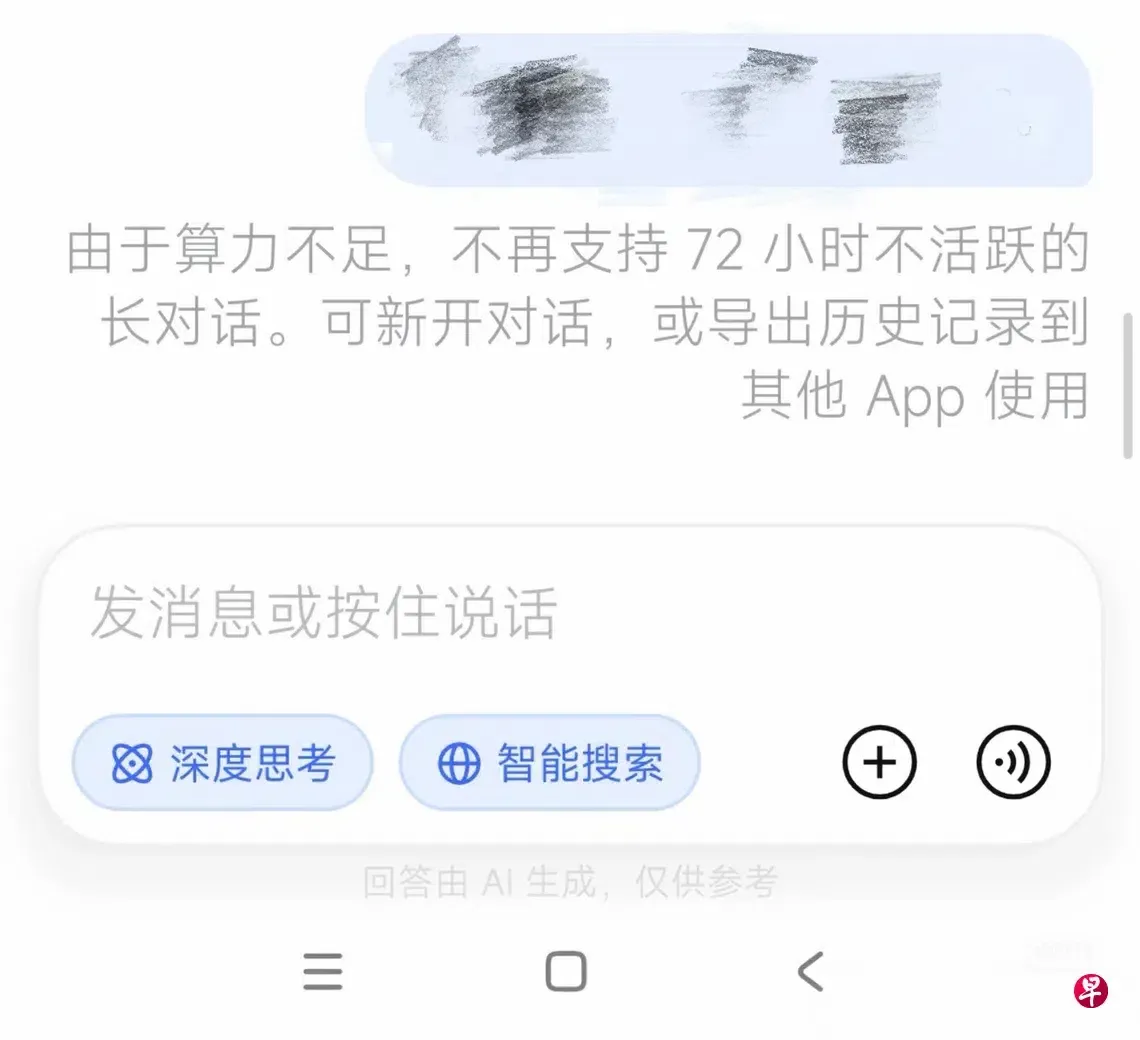
Media summaries also describe daily conversation quota prompts referencing busy servers when usage reaches an undisclosed threshold. Across user screenshots, reported inactivity rules are not uniform—some notices cite seven days of inactivity while others cite 72 hours. Because multiple outlets appear to summarize overlapping waves of social media screenshots, these reports confirm that users are seeing restrictions, but do not establish full rollout scope, account eligibility, or whether the rules are temporary.
When users hit these reported consumer limits, the interface prompts them to export chats rather than presenting a paid upgrade button. Earlier developer commentary circulated by Pandaily also noted front-end quota-polling code referencing an unannounced "Coding Plan" on chat.deepseek.com, though users examining visible snippets reported seeing no subscription prices or checkout flows. Existing public evidence neither links that front-end code to the reported consumer caps nor rules out future monetization changes.
What Public Records Show—and Leave Unexplained
Separating observable public records from unverified explanations clarifies what is currently known:
- User notices vs. official disclosures: While shared user screenshots mention “insufficient computing capacity” and “busy servers,” DeepSeek has not published an engineering explanation or formal consumer quota policy detailing the trigger conditions.
- Status page indicators: When reviewed on November 17, 2026, DeepSeek Status listed all tracked services as operational, displaying component uptime metrics including
99.74%forDeepSeek V4 Pro API,99.55%forDeepSeek V4.1 Flash API, and99.83%and99.56%across separateChat ServiceandChatserviceentries (while media coverage noted partial disruptions in October and November 2026). An operational status indicator reflects only the checks tracked on that page; it does not establish why consumer usage prompts appear or rule out localized throttling. - Prior capacity pricing: DeepSeek’s Change Log documents that peak and off-peak API pricing took effect in August 2026 to encourage off-peak scheduling, and media reports noted a temporary pause on API top-ups in February 2025. Public records do not directly link those prior API measures to the November consumer chat reports.
- Distinct technical layers: In large language model systems, saved conversation histories, active session state, and inference key-value (KV) caches are separate components. DeepSeek has not disclosed whether consumer thread cutoffs relate to cache management, database retention rules, or request scheduling.
Comparing Consumer Chat Rules With Published DeepSeek API Specifications
Unlike undocumented consumer limits, DeepSeek’s developer platform publishes explicit API specifications. On November 13, 2026, DeepSeek announced in its Change Log that it was adding integrated app-style tools—web search, deep thinking search, file input, URL reading, and model safety checks—specifically to deepseek-flash across its Messages, Responses, and Chat Completions APIs, alongside standalone Search, Fetch, OCR, ASR, and TTS endpoints.
DeepSeek also open-sourced deepseek-ai/chat-demo under the MIT license, providing a static browser demonstration client that connects directly to https://api.deepseek.com with a caller’s API key (defaulting to deepseek-flash) and supports importing exported DeepSeek chat ZIP archives.
Public API Documentation and Consumer User Reports — Reviewed November 17, 2026
| Interface / Client | Documented or Reported Limits | Data & Storage Behavior | Operational & Governance Caveats |
|---|---|---|---|
| Free Consumer App & Web | User reports cite ~40,000-character input cap, 72h/7d idle cutoffs, and daily quota prompts | Histories remain tied to consumer accounts unless exported | Unconfirmed in official docs; no consumer subscription tier announced |
| DeepSeek Platform API | 1M unified context window (input + output); 384K max output; 2,500 (deepseek-flash) / 500 (deepseek-v4-pro) account concurrency |
Optional user_id isolates content safety, KV cache, and scheduling per Rate Limit & Isolation |
Exceeding concurrency returns HTTP 429; connection closes if inference has not started after 10 minutes; user_id does not replace app authentication |
MIT chat-demo Client |
Inherits the caller’s API account limits and model caps | Stores API keys in localStorage and conversations and original attachments in IndexedDB; sends prompts to API service |
Static demonstration client, not an enterprise-governed system; ZIP import replaces all local conversations and attachments after confirmation and validation |
Developers reviewing the API specifications on Models & Pricing, the Messages API reference, and the Change Log (reviewed November 17, 2026) should note four key boundaries:
- Continued V4 Pro availability: In its September 10, 2026 changelog entry, DeepSeek stated it would continue providing
DeepSeek V4 Pro(deepseek-v4-pro) API services after September 14, 2026 with billing unchanged, while legacyV4 Flashaliases route toDeepSeek-V4.1-Flash-1017(deepseek-flash). Vision input is supported ondeepseek-flashand unsupported ondeepseek-v4-pro. - Context ceiling and thinking-token accounting: Both models share a
1Munified context window counting input and output tokens together, with a published384Kmaximum output; actual request limits remain constrained by the model ceiling, API parameters (max_output_tokensin the Responses API ormax_tokensin the Messages API), and remaining context capacity. Reasoning/thinking tokens—andsafety_tokenswhensafety_checkis high—are already included in billedoutput_tokensand must not be added again as a separate charge. - Peak and off-peak rates: Per 1M tokens,
deepseek-flashlists$0.006peak /$0.003off-peak (cache hit),$0.30/$0.15(cache miss), and$1.20/$0.60(output), whiledeepseek-v4-prolists$0.044/$0.022,$1.32/$0.66, and$3.96/$1.98, plus per-use Search and Fetch charges. Off-peak rates (50% of peak) apply outside01:00–04:00and06:00–10:00UTC on weekdays excluding Chinese public holidays. Fixed unit rates do not yield fixed session bills as context and reasoning length grow. - No guarantee against capacity delays: Documented API concurrency limits apply per account rather than proving physically separate hardware from consumer chat or guaranteeing zero service interruptions.
Practical Export and Migration Considerations for Teams
Users and technical teams affected by consumer-tier input restrictions or inactive conversation lockouts can evaluate the following operational practices:
- Export consumer histories early and check archive contents: Back up critical long threads from the consumer app or web interface before hitting 72-hour or seven-day inactivity lockouts, and inspect exported files directly to verify whether any needed attachments are preserved.
- Account for
chat-demoexport and overwrite behavior: Per thedeepseek-ai/chat-demoREADME,chat-demoexports include conversations and locally available original images while excluding API keys, settings, and original non-image attachments. Meanwhile, importing a ZIP archive intochat-demoreplaces all existing local conversations and attachments after confirmation and validation, does not guarantee full restoration of original runtime states or non-image attachments, and deleting local browser chats does not delete files already uploaded to the API service. - Build resilient API request handling: Teams evaluating API migration should implement exponential backoff for
HTTP 429errors, handle server-side connection closures when inference has not started within 10 minutes, keep static prompt prefixes consistent for KV cache efficiency, and useuser_idstrictly for documented safety and scheduling isolation rather than application authentication.
Frequently Asked Questions (FAQ)
Did DeepSeek confirm the 40,000-character input limit and daily chat quota?
Do the consumer app and web limits also apply to the DeepSeek API?
Why did some users see a 7-day inactivity rule while others saw 72 hours?
Does the unannounced "Coding Plan" code mean DeepSeek is launching a paid consumer subscription?
Key Takeaways
Reported 40K-Character Input and Daily Caps on DeepSeek’s free app and web interface underscore the operational uncertainty of unmonetized consumer AI services, even when public status dashboards read normal and no formal policy notice is issued. Users with important multi-turn workflows face potential disruptions if inactive threads lock without advance documentation.
For developers and technical teams assessing alternatives, DeepSeek’s November 13 API expansion and MIT-licensed chat-demo client offer documented concurrency caps, user_id isolation, and transparent per-token pricing. Still, teams should treat those specifications as bounded operational rules rather than guaranteed reliability—verifying exported archive contents carefully, avoiding unintended overwrites during chat-demo imports, and building fallback and timeout handling into production pipelines.
References
- DeepSeek API Docs. Change Log. Official release notes for November 13, 2026 (
deepseek-flashintegrated app tools) and September 10, 2026 (continuedDeepSeek V4 ProAPI availability), reviewed November 17, 2026. - DeepSeek API Docs. Models & Pricing. Official context window,
384Kmax output, peak/off-peak schedule, and per-token rates, reviewed November 17, 2026. - DeepSeek API Docs. Messages API. Official parameter and token accounting specification (
max_tokens,thinking_tokens,safety_tokens), reviewed November 17, 2026. - DeepSeek API Docs. Rate Limit & Isolation. Official account concurrency caps (
2,500/500),user_idisolation, and 10-minute pre-inference connection timeout, reviewed November 17, 2026. - DeepSeek API Docs. KV Cache Guide. Official documentation on prefix context caching and billing impact, reviewed November 17, 2026.
- DeepSeek AI (GitHub). deepseek-ai/chat-demo. Official MIT-licensed static chat client repository,
IndexedDB/localStoragebehavior, export scope, and ZIP import replacement rules, reviewed November 17, 2026. - DeepSeek. DeepSeek Status. Official system status and component uptime metrics displayed when reviewed November 17, 2026.
- Pandaily. DeepSeek’s Web Code Shows Quota Management Pointing to a ‘Coding Plan’, but No Plan Is Announced. Secondary media reference cited in coverage of web front-end quota code (full page text not independently retrieved in review).
- Lianhe Zaobao. DeepSeek usage limits over computing shortages raise doubts about sustainability of free service. Independent reporting and user-shared screenshot of the 72-hour inactivity notice.
- IT Home. DeepSeek App and Web Reportedly Impose Quota Limits. Regional technology reporting on consumer chat notices.
- Qianjiang Evening News. DeepSeek Consumer Quota and Status Page Comparison. Regional reporting contrasting user quota prompts with normal status indicators.
Share this article