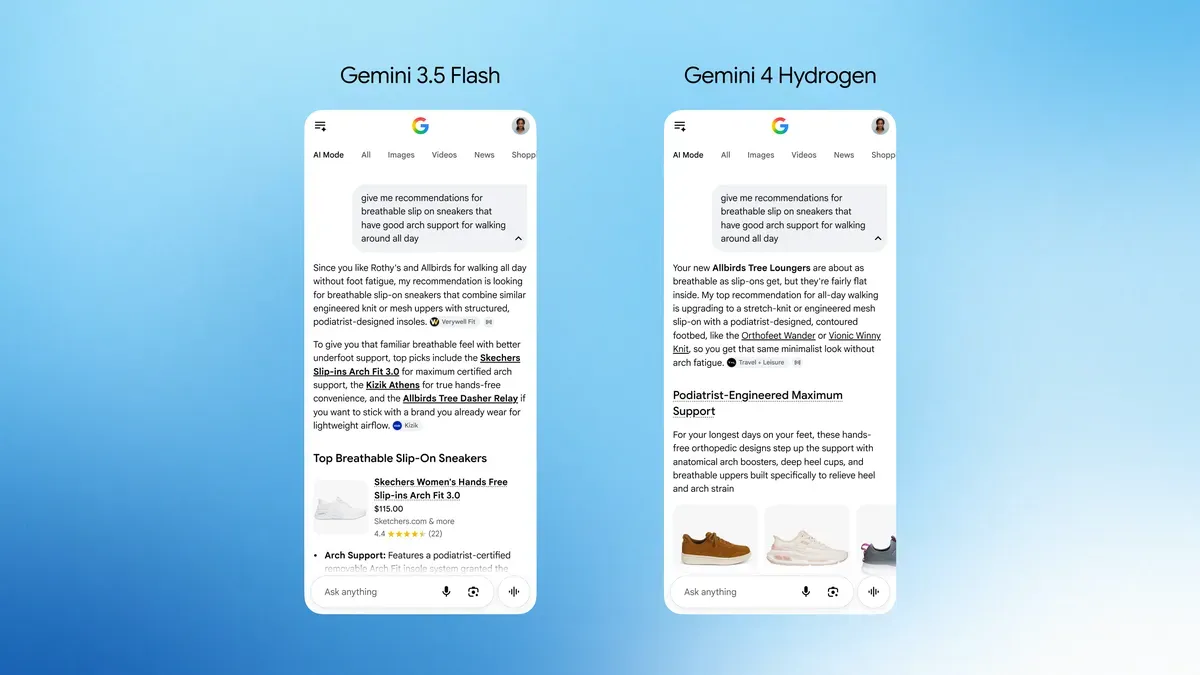
Google Search Deploys Gemini 4 Hydrogen Globally? On November 12, 2026, Google rolled out Gemini 4 Hydrogen across Google Search for all users worldwide, with the official Google Search announcement by VP of Product Robby Stein calling it Google’s largest Search model upgrade to date, while reporting on Stein’s launch comments notes that Hydrogen serves as the default model in AI Mode and is used for the hardest questions in AI Overviews. The update focuses on multi-part intent parsing, expanded query fan-out linking, adaptive visual layouts, and richer multilingual nuance across supported AI Mode languages, while leaving core Search indexing requirements unchanged alongside Google’s previously introduced dedicated generative AI impression reporting.
What Changed in Google Search With Gemini 4 Hydrogen
At a Glance
-
Google deployed Gemini 4 Hydrogen globally in Search on November 12, 2026, using it as the default model in AI Mode for all users and for the hardest questions in AI Overviews according to launch coverage.
-
Google’s Search announcement highlights four improvements: multi-part intent parsing, expanded query fan-out with broader outbound linking, adaptive visual responses, and richer multilingual AI Mode understanding.
-
Site owners require no special AI markup to qualify as supporting links, can separate Search crawling (
Googlebot) from snippet input rules (nosnippet,max-snippet,data-nosnippet) and training controls (Google-Extended), and can track AI impressions in Search Console’s dedicated generative AI reports.
In its November 12 Search post, Google framed the upgrade around conversational, multi-constraint prompts that previously forced users to run sequential searches. Rather than dropping secondary modifiers or tripping over typos, Search uses deeper instruction following and tool calling to address multiple requirements in one response.
Google highlighted four changes across the Search experience:
-
Nuanced Intent Parsing: Search handles multi-part questions, difficult typos, and narrow constraints in a natural flow of thought.
-
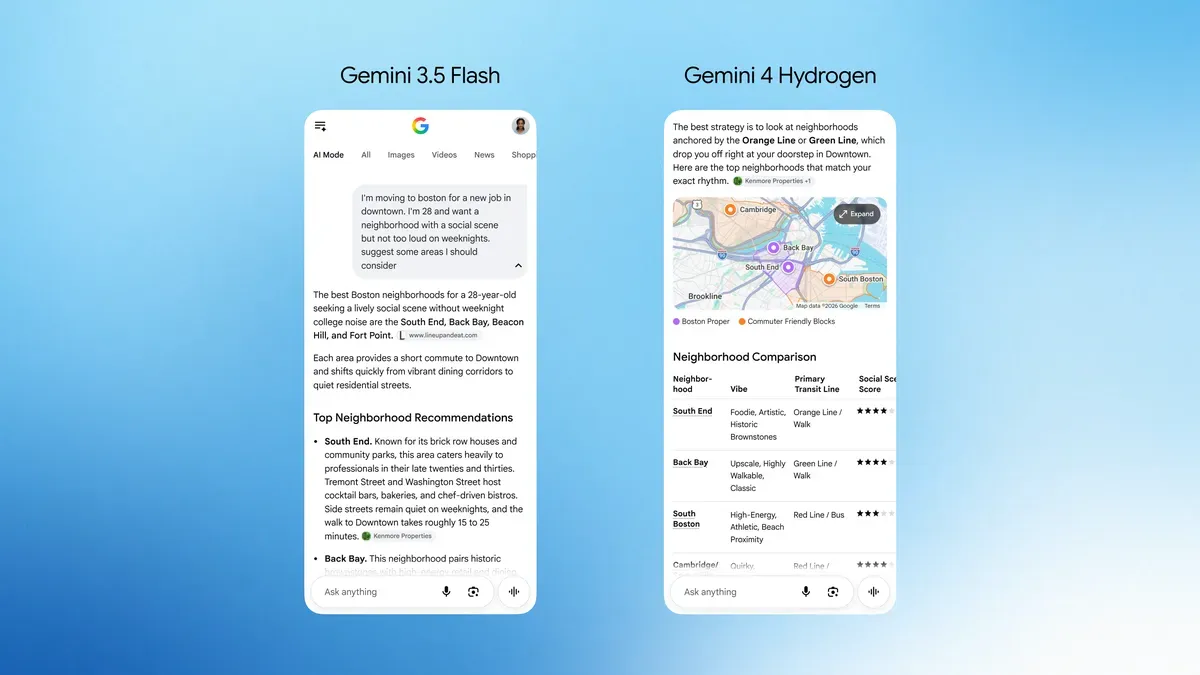
Expanded Query Fan-Out and Linking: Google states that Hydrogen’s reasoning strengthens query fan-out—issuing simultaneous subtopic searches—to connect users with a wider range of helpful websites they might not have discovered directly.
-
Adaptive Visual Responses: Search renders dynamic visual layouts, including images, comparison tables, and custom interactive elements, tailored to the query at Search speed.
-
Richer Multilingual AI Mode Support: Google reports improved comprehension and response nuance across all supported AI Mode languages, though it did not publish per-language evaluation scores.
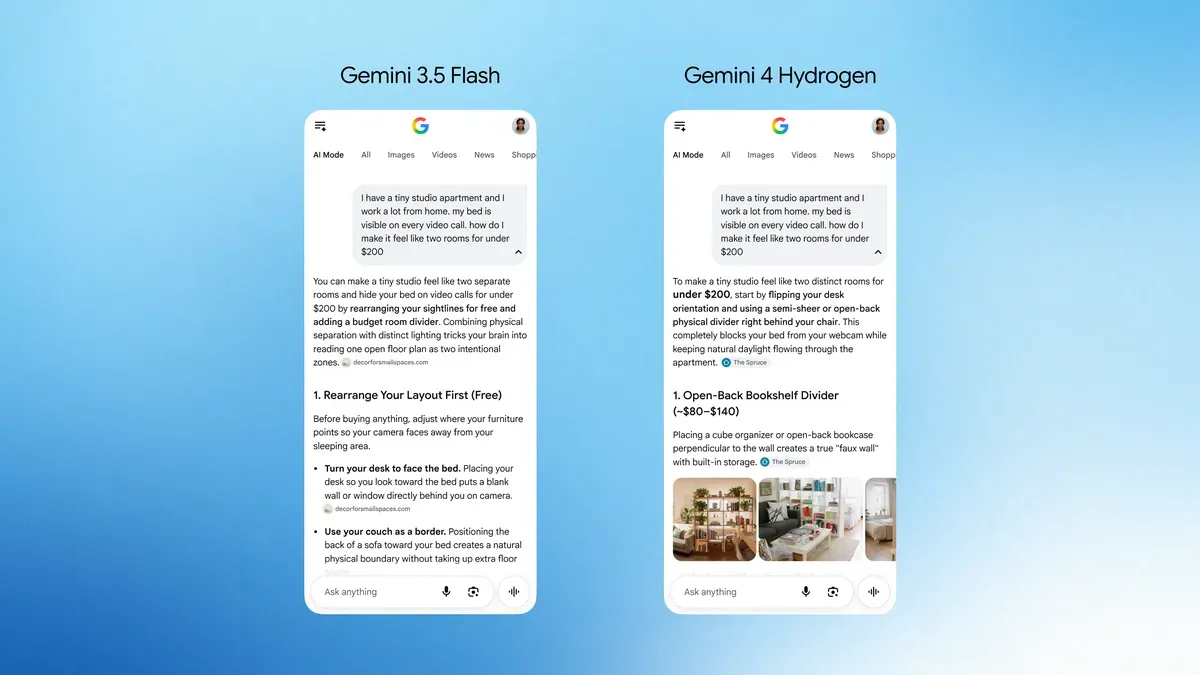
The deployment also distinguishes between AI Mode and standard AI Overviews. According to 9to5Google’s launch report summarizing Stein’s briefing, Hydrogen is now the default model for AI Mode across global users, whereas AI Overviews call on Hydrogen specifically for the hardest questions rather than every overview trigger.
Query Fan-Out Mechanics and Underlying Model Context
To understand how this upgrade interacts with website discovery, site owners must look at Google’s documented retrieval workflow. As explained in Google Search Central’s AI features guide, both AI Overviews and AI Mode may apply a query fan-out technique that breaks a complex prompt into related subtopics and issues multiple searches across web indexes and eligible data sources to assemble a grounded response.
Conceptual Responsibility Model: Query Fan-Out and Synthesis Flow
The table below presents a Conceptual Responsibility Model summarizing the stages documented across Google’s Search announcement and Search Central guidance; it is an illustrative overview rather than an official internal Google Search system topology.
| Workflow Stage | Illustrative Responsibilities | Documented Boundary |
|---|---|---|
| Intent Parsing | Parses multi-part user prompts, typos, and specific constraints | Handled by Gemini 4 Hydrogen in AI Mode and for hard AI Overviews per launch reporting |
| Subtopic Query Fan-Out | Issues multiple related sub-queries across web indexes and eligible data sources | Public documentation does not disclose a fixed routing split across source types |
| Candidate Filtering & Synthesis | Evaluates indexed, snippet-eligible pages under Search ranking and preview rules to generate text, tables, and supporting links | Meeting technical requirements establishes eligibility, not guaranteed inclusion |
Because fan-out decomposes a single prompt into narrower sub-queries, pages addressing specific subtopic constraints—such as compatibility details, regional availability, or structured product specs—may enter the candidate link pool alongside established domains, though Google does not indicate preferential treatment by site size.
Underlying Model Context and API Boundaries
In Google DeepMind’s November 12 model announcement, Gemini 4 Hydrogen (gemini-4-hydrogen) serves as the speed-focused upgrade from Gemini 3.8 Flash. At its default high thinking level, Google reports that Hydrogen finishes standalone model tasks 2.5 times faster than Gemini 3.8 Flash, reduces fabricated claims by more than 5x in Google’s evaluations, and scores 57.0% versus 18.2% on Terminal-Bench 4.1 under a Cheating-adjusted evaluation condition (where Google’s benchmark chart lists Claude Sonnet 5.5 at 63.9%). On Artificial Analysis’s Intelligence Index reviewed as of November 16, 2026, Hydrogen scores 54 at xhigh (and 51 at high in Google’s launch summary, versus 50 for Gemini 4 Argon at high).
Developers calling the Gemini API directly face a 1,048,576-token unified context window shared across input, thinking, and output tokens at $1.50 per million input tokens and $7.50 per million output tokens including thinking tokens, per AI Studio documentation. Those API figures describe developer endpoints and cannot be reverse-inferred as Google Search’s internal context budget, retrieval depth, or end-to-end page rendering latency.
Crawling, Snippet Controls, and Search Console Reporting
Deploying Gemini 4 Hydrogen inside Google Search does not alter Google’s technical inclusion requirements or introduce new proprietary AI markup. Google Search Central confirms that pages need only be indexed and eligible to show a snippet in Google Search to qualify as supporting links in AI Overviews and AI Mode.
Publishers manage crawling, indexing, snippet input, and non-Search model training through separate mechanisms, each with defined technical limits.
| Control or Reporting Mechanism | Documented Scope and Function | Operational Boundary |
|---|---|---|
robots.txt (Googlebot) |
Manages whether Googlebot can crawl URLs for Search indexing, AI Mode, and AI Overviews per Google’s robots.txt guide |
Controls crawl access and load, not guaranteed de-indexing; disallowed URLs can still be indexed from external links without crawling, and Googlebot must crawl a URL to read noindex |
Page-Level noindex (meta / X-Robots-Tag) |
Prevents an indexed page, PDF, or media resource from appearing in Google Search results, AI Overviews, and AI Mode | Requires Googlebot crawl access to discover the tag; cannot take effect if blocked by robots.txt |
Page-Level nosnippet / max-snippet |
Limits or suppresses textual snippets across Search surfaces and prevents or caps content use as a direct input for AI Overviews and AI Mode per Google’s robots meta tag specifications | max-snippet:0 is equivalent to nosnippet; some separately supplied structured data and specifically permitted uses follow different limits, and the directives are not documented as a universal exclusion switch for all citation links |
Element-Level data-nosnippet |
Excludes specific span, div, or section HTML blocks from Search snippets |
Rendering is not guaranteed before extraction, JavaScript toggling should be avoided, and some separately supplied structured data inside data-nosnippet follows different limits |
Google-Extended Token |
Controls content use for training future Gemini models powering Gemini Apps and the Vertex AI API for Gemini, plus prompt-time grounding in Gemini Apps and Grounding with Google Search on Vertex AI per Google’s common crawlers guide | Does not block Googlebot crawling, Search inclusion, or Search AI features; Google also notes planned early-2027 support for the AIPREF signal |
| Search Console Reporting | Provides both overall "Web" traffic tracking and dedicated Search Generative AI performance reports (rolled out globally by August 31, 2026) |
Dedicated AI views report impressions by page, country, device (for Search), and date, while overall clicks and impressions remain included in "Web"; the cited announcement does not document separate AI-only clicks, CTR, conversions, or Hydrogen-level reporting |
Because the global Search rollout began on November 12, 2026, the sources cited here do not establish whether net organic click-through rates rise or fall across industries. Site owners should interpret early post-launch fluctuations cautiously and compare dedicated Search Console generative AI impression trends alongside overall "Web" click patterns and web analytics conversions.
Practical Governance Checklist for SEO and Engineering Teams
Engineering, SEO, and analytics teams should separate platform technical controls from editorial clarity practices before modifying site architecture.
-
Audit Crawling vs. De-Indexing Rules (Platform Requirement): Confirm that
robots.txtis used to manageGooglebotcrawl access and load. For pages intended for removal from Search, verify that accessiblenoindexmeta tags orX-Robots-Tagheaders are used withoutrobots.txtblocks preventing discovery. -
Verify Direct-Input Snippet Controls (Platform Requirement): Check whether
nosnippet,max-snippet, or static HTMLdata-nosnippetattributes are correctly deployed and visible toGooglebotvia Search Console’s URL Inspection tool on sensitive sections. -
Align
Google-ExtendedPolicy With Content Governance (Platform Requirement): Confirm thatGoogle-Extendedrules reflect organizational policy for Gemini Apps and Vertex AI training and grounding, noting that this token does not affect Search inclusion. -
Track Generative AI Impressions Alongside
"Web"Clicks (Editorial Best Practice): Review Search Console’s dedicated generative AI performance report (available globally since August 31, 2026) for URL-level AI impressions while monitoring overall"Web"clicks and downstream analytics conversions. -
Keep Critical Subtopic Content Crawlable and Clear (Editorial Best Practice): Ensure key product specifications, compatibility matrices, and constraints exist in accessible text and valid HTML that Googlebot can fetch and render, treating structured clarity as good editorial practice rather than a citation guarantee.
Frequently Asked Questions (FAQ)
Does Gemini 4 Hydrogen power all Google Search results and AI Overviews?
How does query fan-out affect which websites get linked in AI Mode?
Do websites need special schema or new crawler tags for Gemini 4 Hydrogen in Search?
How can site owners measure traffic from AI Mode and AI Overviews?
Key Takeaways for Engineering Teams
Google’s global deployment of Gemini 4 Hydrogen in Search pushes multi-part query decomposition, visual tables, and subtopic fan-out linking into everyday AI Mode searches and complex AI Overviews. While standalone model evaluations show gains over Gemini 3.8 Flash, Search visibility still depends on foundational crawlability, indexing permissions, and snippet eligibility rather than speculative AI markup.
For SEO, product, and web engineering teams, the practical next steps are verifying that robots.txt, noindex, nosnippet, and Google-Extended directives reflect actual business intent and baselining Search Console’s dedicated generative AI impression report alongside overall "Web" click trends following the November 12 rollout.
References
-
Google Blog. Google Search gets a major upgrade with Gemini 4 Hydrogen. Official Search Announcement by Robby Stein, November 12, 2026.
-
Google DeepMind Blog. Introducing Gemini 4 Hydrogen. Official Model Announcement by Koray Kavukcuoglu, November 12, 2026 (updated November 13, 2026).
-
Google AI Studio Documentation. What’s new in Gemini 4 Hydrogen. Official Developer Specifications.
-
Google Search Central. AI Features and Your Website. Official Site Owner Documentation.
-
Google Search Central. Robots.txt Introduction and Guide. Official Crawling Documentation.
-
Google Search Central. Robots Meta Tags, data-nosnippet, and X-Robots-Tag Specifications. Official Indexing and Snippet Documentation.
-
Google Search Central Blog. Introducing Search Generative AI performance reports in Search Console. Official Search Console Reporting Announcement, June 3, 2026 (global rollout note August 31, 2026).
-
Google Search Central. Google’s common crawlers. Official Crawler and
Google-ExtendedDocumentation. -
9to5Google. Google announces Gemini 4 Hydrogen with ‘significant leaps’ in speed, intelligence. Independent Launch Coverage by Abner Li, November 12, 2026.
-
Artificial Analysis. Gemini 4 Hydrogen Intelligence Index and Model Evaluation. Independent Model Benchmark Reference.
Share this article