Google Marketing Platform Drop in November 2026: What Changed? On November 18, 2026, Google announced its November Google Marketing Platform Drop, expanding Display & Video 360 with Google Audiences in Spotify across the U.S. and India, programmatic Pinterest inventory, Vertical Video Unification highlights, and Loblaw Advance closed-loop SKU-level measurement in Canada alongside Search Ads 360 bidding guidance. Detailed in Google’s official announcement, the updates center on bringing fragmented audio, social, vertical video, and retail media channels into a unified buying and measurement workflow ahead of holiday shopping demand.
Core Updates in the November Google Marketing Platform Drop
At a Glance
- Display & Video 360 buyers in the U.S. and India can now apply Google Audiences across Spotify’s video and audio ad inventory.
- Advertisers in Display & Video 360 gained programmatic access to Pinterest video and display inventory alongside high-intent Pinterest audiences, plus Loblaw Advance retail audiences and closed-loop SKU-level measurement in Canada.
- Alongside the Display & Video 360 updates, Search Ads 360 highlighted its “Fuel It, Power It, Maximize It” bidding combination guidance, while Google Ads published a companion November Demand Gen Drop on the same day.
Rather than introducing a single standalone product, the November Google Marketing Platform Drop bundles inventory integrations, vertical video consolidation, and retail measurement connections inside Display & Video 360 and Search Ads 360. This release follows the first Google Marketing Platform Drop published in October 2026, continuing Google’s monthly cadence of packaged enterprise advertising updates.

| Update Component | Platform Surface | Regional or Access Scope | Stated Capability |
|---|---|---|---|
| Google Audiences in Spotify | Display & Video 360 | U.S. and India buyers | Apply Google Audiences across Spotify video and audio inventory |
| Programmatic Pinterest Inventory | Display & Video 360 | Programmatic DV360 advertisers | Access Pinterest video and display inventory with high-intent audiences |
| Vertical Video Unification | Display & Video 360 | Supported DV360 video campaigns | Consolidate vertical video buying across inventory sources |
| Loblaw Advance Integration | DV360 Commerce Media Suite | Canada (available by request) | Activate Loblaw Advance audiences and closed-loop SKU-level sales measurement |
| Search Ads 360 Best Practices | Search Ads 360 | General advertiser guidance | “Fuel It, Power It, Maximize It” advanced bidding combination formula |
Display & Video 360 Inventory, Vertical Video, and Commerce Media
On the audience and inventory side, the November drop addresses two distinct consumption environments inside Display & Video 360: audio/video streaming on Spotify (scoped explicitly to U.S. and India buyers) and visual planning on Pinterest. Connecting Google Audiences to Spotify inventory and bringing Pinterest’s programmatic video and display supply into Display & Video 360 helps media buyers reduce operational separation between these media buys within Display & Video 360.
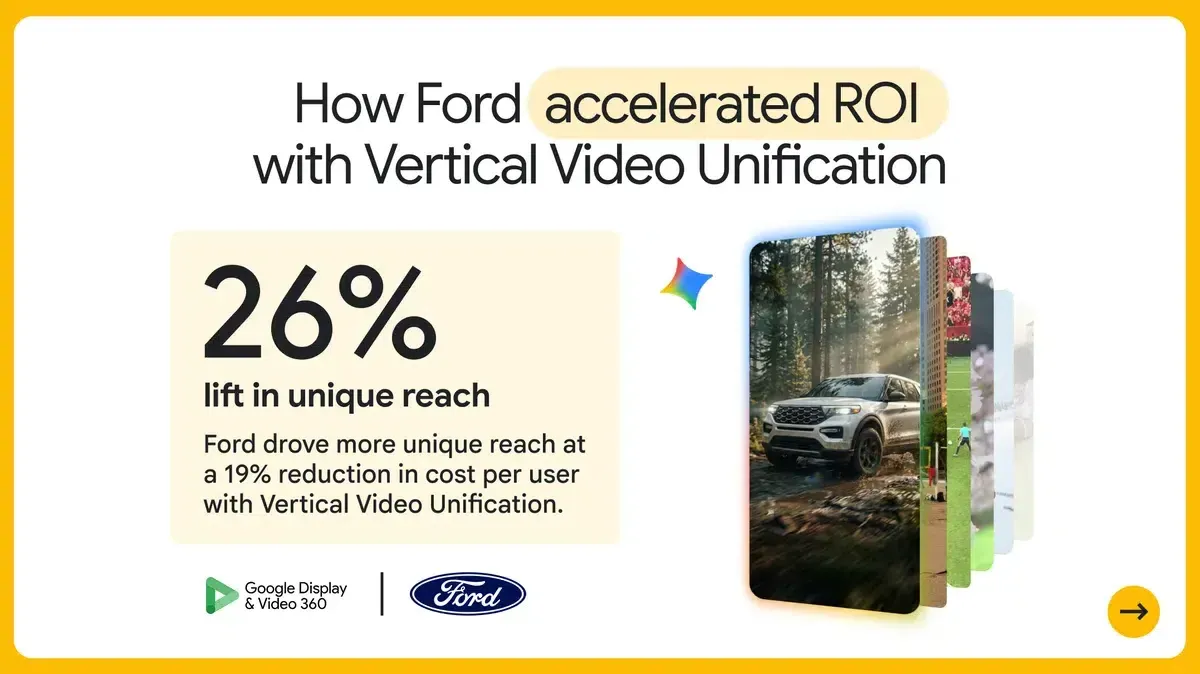
Google also pointed to Vertical Video Unification as a core lever for incremental reach. According to a Google-published advertiser case study in the announcement, Ford Motors achieved a 26% lift in unique reach and a 19% reduction in cost per unique user using Vertical Video Unification. As with any single-brand case study, those figures reflect one advertiser’s reported campaign outcome under specific campaign settings rather than a guaranteed benchmark across all industries or budgets.
In retail media, the November drop highlights Loblaw’s integration into Google’s Commerce Media Suite inside Display & Video 360, joining existing retail partners such as Walmart Connect and Costco. According to an October 27, 2026 announcement from Loblaw Advance detailing the collaboration with Google and RainBarrel, Loblaw became the first Canadian retailer integrated into the Commerce Media Suite. That integration provides nearly 400 pre-built Loblaw Advance audience segments (as well as custom audiences) activatable across YouTube, Display, and Connected TV inventory in Display & Video 360, paired with closed-loop, SKU-level measurement available by request.

For Search Ads 360 users, Google did not announce a new software release in this section; instead, it promoted best-practice guidance around its “Fuel It, Power It, Maximize It” framework for combining automated bidding strategies ahead of seasonal demand spikes.
Companion November Updates in Google Ads Demand Gen
On the same day, November 18, 2026, Google Ads published a companion update—November’s Demand Gen Drop—focused on YouTube shopping and creator amplification rather than Display & Video 360 programmatic buying. While Demand Gen sits under Google Ads rather than the enterprise Google Marketing Platform 360 suite, performance teams often coordinate both tools during peak retail periods.
The Demand Gen Drop highlighted four operational capabilities for YouTube commerce campaigns:
- Catalog Product Feeds: Activating Merchant Center feeds directly on YouTube; in a Google-published case study, Petco reported a 6% lift in purchase intent, a 71% increase in store visits, and a 30% boost in overall Omni ROAS.
- Accelerated YouTube Checkout: Supporting checkout links and Universal Commerce Protocol-enabled checkout flows from YouTube.
- Creator and Affiliate Partnerships Boost: Amplifying creator endorsements via Creator partnerships boost (with Javvy Coffee reporting 50% higher conversion rates) and affiliate partnerships boost (with Shopee reporting a 9x average ROI in Google-published case materials).
- Seasonality Adjustments: Newly supported with Smart Bidding (Target CPA or Target ROAS) in Demand Gen campaigns. According to Google Ads Help documentation, seasonality adjustments are intended strictly for short 1–7 day promotional events where advertisers anticipate major shifts in conversion rates, as Smart Bidding already accounts for routine seasonal fluctuations.
Conceptual Responsibility Model for Omnichannel Measurement
Google’s November updates describe new partner inventory connections and closed-loop SKU measurement options, but Google has not published internal architectural schematics detailing how Display & Video 360, RainBarrel, Loblaw Advance, or Spotify exchange identity or match sales records internally. The table below represents a Conceptual Responsibility Model (general system boundaries for comparable enterprise media and retail measurement stacks, rather than an official reconstruction of Google’s internal backend).
| System Component | Illustrative Responsibilities | Documented Scope in November 2026 Announcements |
|---|---|---|
| Programmatic Buying Layer (DV360 / SA360) | Manages campaign budgets, frequency capping, bidding combinations, and cross-publisher ad delivery | Unifies Spotify (U.S./India), Pinterest, YouTube, Display, and CTV media buys |
| Retail & Audience Data Partners | Supplies privacy-scoped shopper segments and offline/online SKU transaction records | Includes Loblaw Advance (~400 segments in Canada via RainBarrel), Walmart, and Costco |
| Commerce Feed & Checkout Layer | Synchronizes product catalog metadata, pricing, and supported checkout destination endpoints | Uses Merchant Center product feeds, checkout links, and Universal Commerce Protocol |
| Advertiser Governance & Attribution Review | Defines conversion counting rules, validates baseline vs. seasonal lift, and audits incremental ROI | Requires teams to verify account-level availability and regional eligibility before deployment |
For analytics and engineering teams, the practical implication is that retail media and programmatic video consolidation increasingly relies on platform-mediated partner integrations and privacy-scoped data connections rather than client-side third-party cookies. However, because closed-loop SKU measurement remains tied to specific retail partners and regional availability, advertisers still face fragmented reporting when reconciling non-participating channels alongside Commerce Media Suite partners.
Operational Checklist for Holiday Marketing and Analytics Teams
Before modifying active holiday budgets or bidding models based on the November Google Marketing Platform Drop, marketing operations and analytics teams can review the following practical checks:
- Verify Regional and Account Eligibility: Confirm whether Display & Video 360 seats have active access to U.S. or India Spotify inventory and whether Loblaw Advance access in Canada has been requested and provisioned.
- Separate Case Study Metrics From Baseline Forecasts: Treat vendor-published results—such as Ford Motors’ 26% unique reach lift or Shopee’s 9x ROI—as single-advertiser reference points rather than baseline media plan assumptions.
- Reserve Seasonality Adjustments for Short Windows: Apply Demand Gen Smart Bidding seasonality adjustments only to brief promotional spikes where expected conversion rate shifts are well-grounded, avoiding broad multi-week overrides that can distort automated bidding calibration.
- Align Conversion Definitions Across Suites: Ensure product feeds, checkout links, and retail SKU attribution windows in Display & Video 360 and Google Ads use consistent transaction definitions before comparing omnichannel ROAS.
Frequently Asked Questions (FAQ)
What is included in the November 2026 Google Marketing Platform Drop?
Who can use the new Spotify and Loblaw integrations in Display & Video 360?
Does the November Drop introduce new mobile app install attribution features?
How does the Demand Gen Drop relate to Google Marketing Platform?
Key Takeaways for Marketing and Engineering Teams
The November 2026 Google Marketing Platform Drop reflects Google’s ongoing effort to turn Display & Video 360 into a consolidated buying and measurement layer across third-party streaming audio, social discovery, vertical video, and retail media networks. By pairing Pinterest and regional Spotify supply with retail SKU-level measurement from partners like Loblaw Advance, Google aims to reduce channel-by-channel fragmentation during peak seasonal spending.
At the same time, feature availability remains segmented by region, partner network, and request-based provisioning. Marketing operations and measurement teams evaluating these updates should verify regional eligibility within their own DV360 and Google Ads accounts, distinguish single-advertiser case studies from expected baseline returns, and maintain clear conversion definitions across programmatic, search, and retail media reporting.
References
- Google Marketing Platform Blog. Drive your best ROI reaching new holiday shoppers with November’s Google Marketing Platform Drop. Primary official November 18, 2026 announcement.
- Loblaw Advance / CNW. Loblaw Advance announces retail media integration with Google in Canada. Official October 27, 2026 retail media integration press release detailing RainBarrel collaboration and nearly 400 audience segments.
- Google Marketing Platform Blog. Introducing Vertical Video Unification with Display & Video 360. Official feature overview referenced in the November Drop.
- Google Marketing Platform Blog. Explore new ways to drive your best ROI with the first Google Marketing Platform Drop. Prior October 2026 GMP Drop announcement.
- Google Marketing Platform Blog. We’re bringing Walmart Connect to Display & Video 360. Official Commerce Media Suite partner integration context.
- Google Ads & Commerce Blog. Win the holiday shopping season with November’s Demand Gen Drop. Companion November 18, 2026 Demand Gen updates hub.
- Google Ads Help. About seasonality adjustments. Official documentation on 1–7 day promotional Smart Bidding seasonality usage.
- Google Merchant Center Help. Checkout links and Universal Commerce Protocol. Official documentation referenced in the November Demand Gen Drop.
Share this article