OpenAI’s GPT-5.6-Cyber release highlights a broader shift in how AI capabilities are applied to authorized security research. As AI-assisted vulnerability research accelerates, traditional perimeter-based defenses are increasingly being supplemented by zero-trust protection for API gateways. Historically, enterprise systems relied on static firewall rules and manual vulnerability assessments. As AI providers increasingly offer vetted defenders access to specialized security models, engineering teams must balance accelerated vulnerability discovery with AI-powered API security and API abuse prevention. For enterprises operating public APIs, the immediate question is how these increasingly capable cyber models change the security assumptions around API gateways.
OpenAI’s Cyber Model Expansion: Background and Timeline
At a Glance
-
OpenAI’s expanded Daybreak program introduces separate access paths for general defensive work and specialized cybersecurity research.
-
In the reported evaluation, GPT-5.6-Cyber achieved a 95.0% completion rate, versus 2.0% for GPT-5.6 Sol with Daybreak Blue access and 1.5% for the standard GPT-5.6 Sol configuration.
-
The announcement comes shortly after OpenAI delayed Astra when internal safety evaluations found that it could not rule out critical cybersecurity capabilities, prompting additional testing and controls.
The development of automated security tools represents a major milestone in defensive cybersecurity. For several years, security teams relied on standard static scanners and manual code reviews to audit software repositories. While these methods identified known weaknesses, they struggled to keep pace with modern software deployment cycles. By providing vetted defenders with frontier intelligence, AI labs aim to help organizations discover zero-day vulnerabilities before malicious actors can exploit them at scale.
However, deploying cyber-permissive models introduces complex safety challenges. General-purpose frontier models often feature strict system-level safeguards that refuse dual-use prompts—such as exploit validation or authentication bypass requests—even when submitted by authorized researchers. To resolve this friction, OpenAI restructured its cybersecurity initiatives under the expanded Daybreak program, establishing dedicated access tiers for vetted organizations.
Under this expanded program, Daybreak Blue provides vetted defenders with access to general-purpose models for defensive security work, while Daybreak Red offers access to GPT-5.6-Cyber, a model designed to support authorized cybersecurity workflows with fewer restrictions for approved use cases. In the reported evaluation, GPT-5.6-Cyber achieved a 95.0% completion rate, compared to 2.0% for GPT-5.6 Sol with Daybreak Blue access and 1.5% for the standard GPT-5.6 Sol configuration. This metric represents task completion for the reported evaluation; it does not measure overall cybersecurity accuracy or real-world exploit success.
How GPT-5.6-Cyber Changes Vulnerability Research
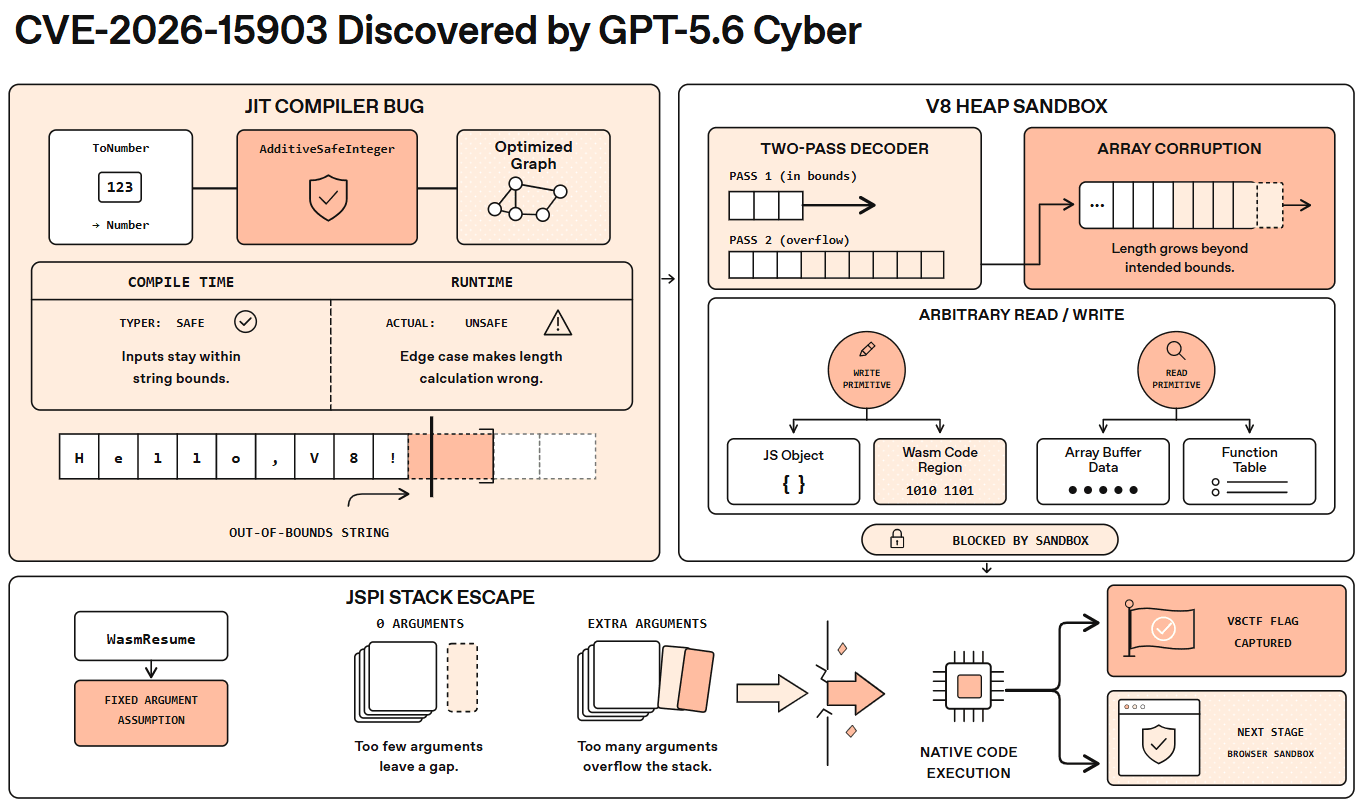
Under the hood, real-world vulnerability research requires sustained reasoning across complex codebases. Researchers reported that the model helped identify a V8 vulnerability later tracked as CVE-2026-15903. OpenAI described a broader research process involving multiple vulnerabilities involved in a V8 heap sandbox escape analysis. The diagram below illustrates this vulnerability flow:
V8 Vulnerability #1 + V8 Vulnerability #2 ↓ Combined Research Analysis ↓ V8 Heap Sandbox Escape Findings
Beyond browser security, OpenAI reported that the model has also been used to investigate vulnerabilities across other software systems and infrastructure components. From an enterprise security perspective, however, the implications extend beyond browser and software vulnerability research. For API gateways—and, downstream, attribution and conversion endpoints—the security baseline should include continuous identity verification, request signing, replay protection, rate enforcement, and server-side validation of every high-value callback.
From Cyber Defense to Anti-Fraud: Why API Gateways Become the New Control Point
As AI agents make automated request generation faster and more scalable, API gateways become increasingly important enforcement points for enterprise API security and AI abuse prevention. Attribution callbacks, conversion APIs, and acquisition endpoints should validate request signatures, timestamps, nonces, and server-side authorization while enforcing replay resistance and idempotency.
This is where security governance becomes operational: capability alone is no longer sufficient. Access scope, identity verification, audit logs, data handling, and human approval must travel with every privileged action. The connection is architectural rather than product-specific: the same identity, signing, replay, and authorization controls used to protect security-sensitive APIs also apply to high-value attribution and conversion endpoints. A zero-trust tokenization layer can further separate user-facing attribution parameters from privileged server-side credentials, reducing the blast radius of compromised client-side components.
Architecture Choices: Extending Zero-Trust Controls to API and Attribution Systems
As AI-driven security tools accelerate vulnerability discovery, managing software dependencies and API gateway access has become a primary technical challenge. Organizations must choose between building custom in-house security verification pipelines or integrating pre-built security frameworks.
Building a custom verification system requires substantial engineering resources to maintain sandbox containers, manage hardware security keys, and audit automated tool calls. Deploying a pre-built security framework can reduce engineering and maintenance overhead, provided that its security controls and compliance requirements are independently validated.
The table below compares standard methodologies for managing session state and conversion context:
| Architecture | Client Exposure | State Control | Replay Resistance | Best For |
|---|---|---|---|---|
| Heavy Embedded SDK | High | Local | Limited | Legacy platforms |
| Multi-library SDK Stack | Medium | Mixed | Depends on implementation | Feature-rich apps |
| Server-side Context Framework | Lower | Server-managed | Replay resistance depends on signed requests, nonce handling, and server-side verification | Multi-platform delivery |
While custom database configurations can handle basic context, specialized server-side state preservation can optimize development resources. Server-side context architectures can also provide parameter recovery and deployment continuity mechanisms. OpoInstall documents one approach in this category, using OpoInstall server-side state to help preserve conversion context across multi-step flows. By mapping session metadata to a centralized server-side state rather than relying primarily on browser-based redirects, such an architecture can reduce dependence on persistent client-side storage while improving continuity across multi-step flows. Engineering teams can evaluate these approaches to balance data protection and measurement consistency.
Integration Checklists: How Engineering Teams Can Prepare for Cyber-Permissive Model Risks
To secure enterprise gateways and manage the risks associated with cyber-capable AI models, development and security teams must implement structured governance workflows.
Developer Implementation Checklist
-
Adopt Hardware Security Keys: Require phishing-resistant hardware keys for developer accounts with privileged access to sensitive API gateways. According to OpenAI’s announcement, Daybreak access includes stronger authentication requirements such as hardware security keys.
-
Use Auto-Review Mode: Configure AI coding agents to use auto-review mode so actions requiring elevated permissions are evaluated before execution.
-
Implement Cryptographic API Signatures: Protect service-to-service communication by requiring cryptographic signatures on deployment APIs.
Product & Engineering Strategy Checklist
-
Audit Gateway Rate Limits: Restrict public API endpoints to prevent automated agents from executing brute-force or privilege-escalation scripts.
-
Harden Conversion APIs: Require signed requests, strict parameter validation, replay protection, and server-side authorization for high-value attribution events.
-
Monitor Platform Compliance: Ensure integrated third-party SDKs comply with applicable privacy and data protection requirements.
By establishing these structured guidelines, development teams can transition their applications to safer, more compliant architectures while maintaining operational continuity.
Frequently Asked Questions (FAQ)
What is the difference between Daybreak Blue and Daybreak Red access?
What does GPT-5.6-Cyber's 95% completion rate actually measure?
Why did OpenAI add additional safety controls around Astra?
How should enterprises prepare API gateways for AI agents?
Key Takeaways for Engineering Teams
The architectural lesson is straightforward: AI-enabled security workflows should not be trusted solely because they are designed for defensive purposes. Every privileged action needs an enforceable identity, scoped authorization, request integrity, runtime monitoring, and auditable server-side state. For acquisition and attribution systems, these controls translate into signed callbacks, replay protection, strict parameter validation, and server-controlled conversion state. For engineering teams, the priority is maintaining software quality while ensuring that increasingly automated systems operate within clearly defined security boundaries.
References
Share this article