What is IDFA and how does it affect iOS attribution? The Identifier for Advertisers (IDFA) is Apple’s resettable advertising identifier used by iOS apps and advertising platforms for authorized advertising measurement and attribution when users grant tracking permission. When users deny ATT permission, apps cannot access the IDFA, shifting advertisers toward privacy-preserving attribution methods.
IDFA (Identifier for Advertisers) is Apple’s resettable advertising identifier for iOS advertising measurement. Apple’s App Tracking Transparency (ATT) framework changed IDFA access from default system availability to user-authorized access, shifting mobile attribution from deterministic cross-app matching toward privacy-preserving measurement frameworks.
| Term | Definition | Related Concept |
|---|---|---|
| IDFA | A resettable advertising identifier provided by Apple for authorized advertising measurement. | App Tracking Transparency |
| App Tracking Transparency | Apple’s privacy framework requiring explicit opt-in for IDFA access. | ATTrackingManager |
| SKAdNetwork | Apple’s aggregated, privacy-preserving ad attribution framework. | Conversion Value |
| Deferred Deep Linking | Technology that restores contextual campaign parameters on first app launch without reading advertising identifiers. | Contextual Parameter Restoration |
Short Answer
The Identifier for Advertisers (IDFA) is Apple’s resettable advertising identifier used for ad measurement. Under the App Tracking Transparency (ATT) framework, accessing the IDFA requires explicit user consent. When users decline tracking, the IDFA value becomes unavailable, shifting iOS measurement toward SKAdNetwork and first-party contextual attribution.
What Is IDFA and Why Did Apple Restrict Its Access Under ATT
The Historical Role of IDFA in Mobile Attribution
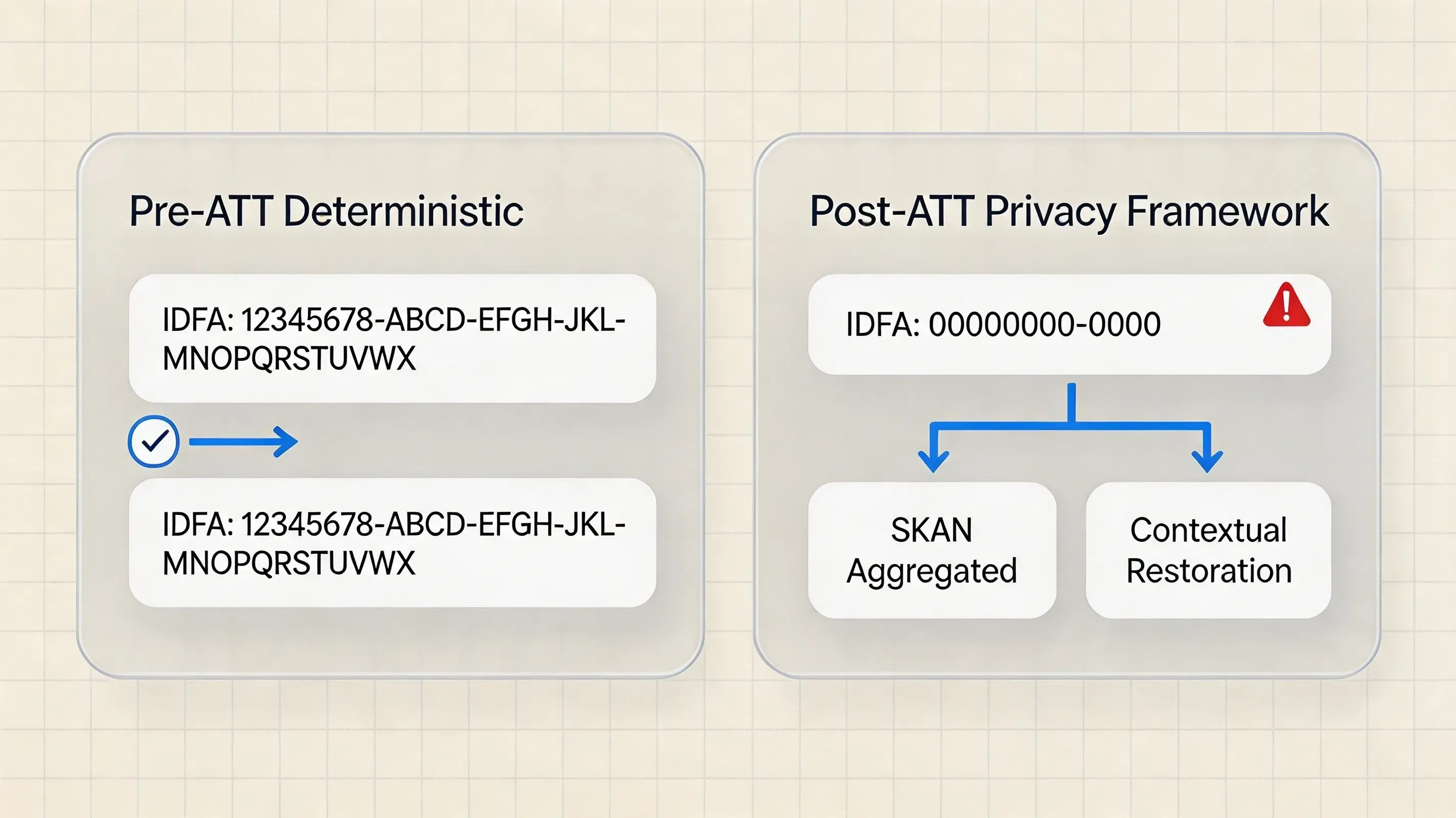
Historically, mobile advertising networks relied on the Identifier for Advertisers (IDFA) as the primary deterministic matching key across the iOS ecosystem. When an ad click occurred within a publisher app, the ad network recorded the user’s IDFA string alongside campaign metadata. Upon store redirection, installation, and initial app launch, the embedded measurement SDK extracted the same IDFA string from the device and transmitted it to an attribution server.
By executing an exact string comparison (
The Introduction of App Tracking Transparency in iOS 14.5
With the release of iOS 14.5 and the App Tracking Transparency (ATT) framework, Apple restructured privacy enforcement across iOS and iPadOS. Under ATT, accessing the IDFA is classified as “tracking,” requiring applications to prompt users for explicit authorization before the identifier can be retrieved programmatically.
If an application attempts to query the IDFA without user consent, or if the user selects “Ask App Not to Track,” the system returns a zeroed identifier value:
00000000-0000-0000-0000-000000000000
Because a significant portion of users decline ATT permission, deterministic IDFA matching collapsed across the majority of iOS paid media traffic, breaking traditional user-level campaign measurement.
Understanding the ATTrackingManager Authorization States
Operating system access to the IDFA is governed by the ATTrackingManager class within Apple’s AppTrackingTransparency framework. Developers query the system state via ATTrackingManager.trackingAuthorizationStatus, which returns one of four discrete enum states:
-
authorized: The user granted explicit permission to track. The application can query the real IDFA string viaASIdentifierManager.shared().advertisingIdentifier. -
denied: The user explicitly declined tracking in the ATT system prompt, or global tracking was disabled in system settings. The advertising identifier returns a zeroed advertising identifier value. -
restricted: Access to advertising identifiers is restricted at the operating system level (e.g., system policies or parental controls). -
notDetermined: The user has not yet been presented with the ATT permission prompt. Access to the IDFA remains blocked until authorization is requested and granted.
How Does App Tracking Transparency Impact Deterministic iOS Attribution
The Collapse of Cross-App Tracking
When an iOS user declines the ATT prompt, the attribution pipeline loses the primary deterministic key needed to join pre-install ad engagements with post-install application events. If User A clicks an ad in Publisher App X and installs Advertiser App Y, neither application can use the IDFA for attribution unless user authorization is granted.
Because receiving permission across both endpoints occurs in a minor fraction of instances, deterministic cross-app tracking fails for the vast majority of user acquisition channels. Advertisers can no longer trace individual user journeys from specific ad creatives directly to post-install lifetime value (LTV) records using advertising identifiers.
The Danger of Non-Compliant Fingerprinting
Facing broken IDFA pipelines, some advertisers attempted to deploy probabilistic device fingerprinting—combining IP addresses, User-Agent strings, system uptime, and device configurations to construct pseudo-identifiers. However, Apple’s App Store Review Guidelines (Section 5.1.2) explicitly prohibit tracking users without permission, regardless of the underlying technical method.
Apple reviews applications and evaluates submitted code and behavior for attempts to bypass ATT consent. Applications detected harvesting device properties to bypass ATT consent risk immediate App Store submission rejection or account suspension. Consequently, sustainable iOS measurement architectures must adopt privacy-preserving first-party methodologies rather than non-compliant fingerprinting techniques.
Privacy-Preserving Measurement Alternatives
To maintain iOS campaign visibility without violating Apple guidelines, mobile measurement architectures adopt a dual-layer approach:
-
Aggregated On-Device Attribution: Utilizing Apple’s native SKAdNetwork (SKAN) framework to receive aggregated, privacy-isolated conversion postbacks from Apple’s attribution system.
-
First-Party Contextual Restoration: Employing deferred deep linking via Web JS SDKs to pass dynamic marketing parameters (such as campaign IDs or referral tokens) directly through the installation flow without reading advertising identifiers.
Deferred deep linking does not replace Apple’s IDFA or SKAdNetwork. It complements Apple’s privacy-preserving attribution ecosystem by restoring first-party marketing context. Deferred deep linking preserves first-party marketing context rather than recreating user-level tracking. Mobile measurement platforms such as OpoInstall provide contextual parameter restoration to restore first-party campaign context while adhering strictly to iOS privacy requirements.
Structural Comparison: IDFA vs SKAdNetwork vs Deferred Deep Linking
Comparative Analysis of Pre-ATT IDFA Matching vs Modern Privacy Measurement Frameworks
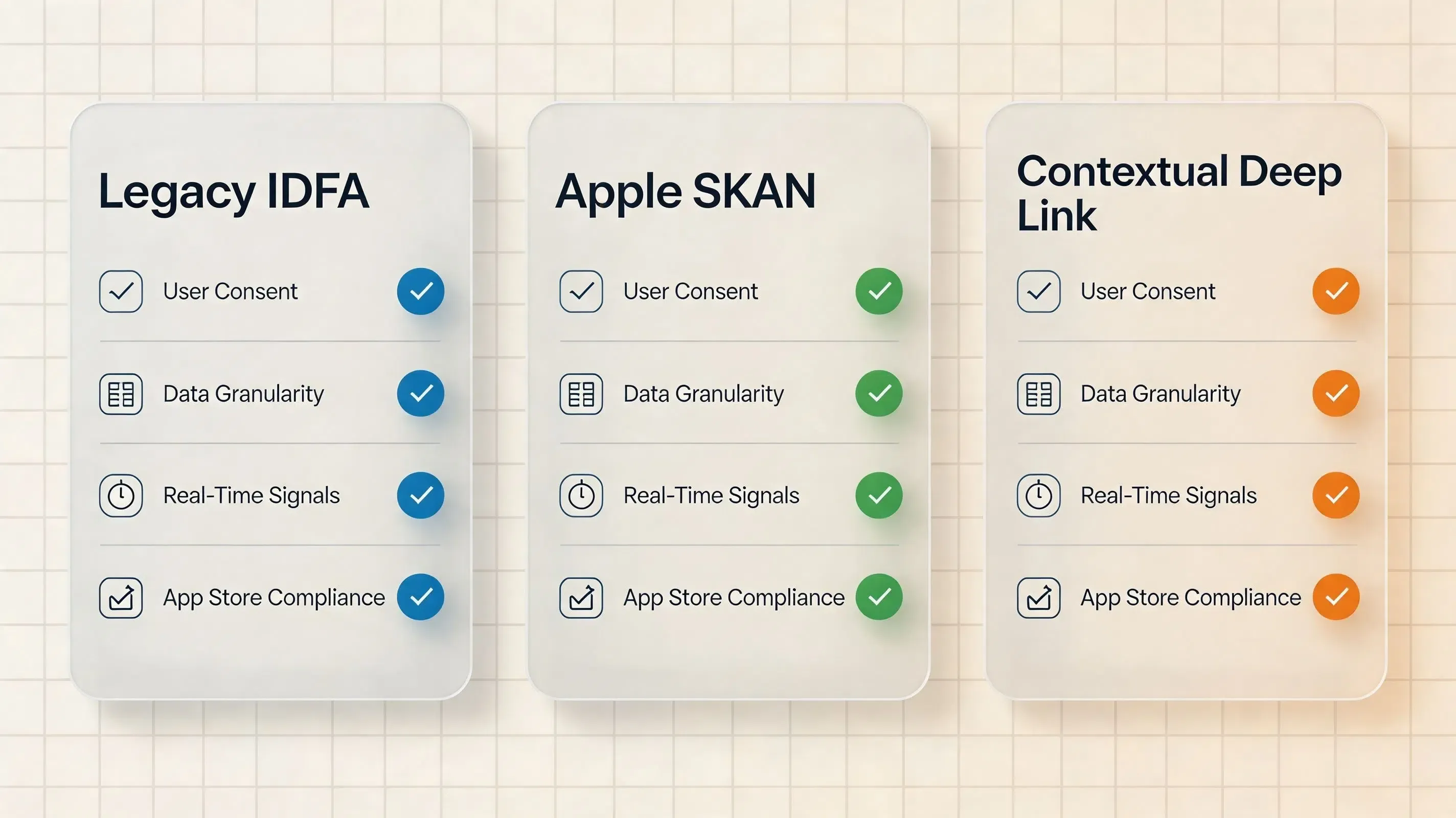
Transitioning away from deterministic advertising identifiers requires understanding the operational trade-offs between legacy IDFA tracking, Apple’s native SKAdNetwork, and first-party contextual parameter restoration.
The table below contrasts key functional dimensions across these three measurement models:
| Measurement Dimension | Legacy IDFA Tracking | Apple SKAdNetwork (SKAN) | Contextual Deferred Deep Linking |
|---|---|---|---|
| User Identifiers | Deterministic IDFA string | Anonymous / Aggregated | First-party contextual tokens |
| User Consent Required | Explicit ATT Opt-In (authorized) |
None (Privacy-preserving) | No IDFA access required for first-party contextual parameters |
| Data Granularity | User-level event telemetry | Aggregated conversion values | Campaign and referral context |
| Real-Time Availability | Instant S2S postback dispatch | Delayed 24-to-48 hour postback windows | Instant post-install parameter restoration |
| App Store Compliance | Requires ATT authorization | Fully compliant native Apple framework | Fully compliant first-party web-to-app flow |
Evaluating Data Granularity, User Consent Requirements, and Technical Limits
While legacy IDFA tracking provided unrestricted user-level granularity, its dependence on explicit user consent makes it unviable as a primary strategy. SKAdNetwork is Apple’s privacy-preserving attribution framework designed to support compliant ad measurement without exposing user-level identifiers, enforcing privacy-preserving reporting limitations and delayed attribution signals. SKAdNetwork 4 introduced hierarchical conversion values (coarse and fine-grained), source identifiers introduced in place of the previous campaign identifier field, and multiple postback windows to improve campaign measurement while preserving user privacy.
Contextual deferred deep linking complements SKAdNetwork by capturing non-sensitive marketing parameters (such as inviter IDs or campaign referral tokens) at the moment of web click. When the user installs and opens the app, the client SDK retrieves these contextual parameters, restoring campaign attribution without accessing restricted advertising identifiers.
Developers building iOS attribution pipelines can reference iOS attribution SDK documentation for integration details.
Technical Implementation of Privacy-Preserving iOS Attribution
Requesting ATT Authorization via ATTrackingManager
To query the IDFA legally when user consent is desired, iOS developers must configure the NSUserTrackingUsageDescription key in their Info.plist file, explaining why tracking permission is requested.
Developers invoke requestTrackingAuthorization(completionHandler:) programmatically, typically after an onboarding flow where the value of authorization is communicated to the user.
Standardizing ATT Authorization and SKAN Event Schemas
To process iOS attribution signals reliably, backend event collectors accept both SKAdNetwork postback payloads and client-side contextual event payloads.
Developers can reference the raw data export documentation for technical field definitions regarding S2S raw log schemas and event payloads.
The schema below illustrates an example iOS attribution event JSON schema. Note: This is a conceptual example only and not an Apple or OpoInstall API specification:
```json
{
“example_only”: true,
“event_type”: “ios_attribution_event”,
“app_id”: “com.example.iosapp”,
“device_context”: {
“os_version”: “17.4”,
“model”: “iPhone15,2”,
“att_status”: “denied”,
“idfa_access_status”: “unavailable”
},
“contextual_attribution”: {
“channel_code”: “ios_privacy_campaign”,
“campaign_id”: “cmp_ios_search_01”,
“referral_token”: “ref_token_88776655”,
“attribution_method”: “contextual_deferred_deep_link”
},
“skan_metadata”: {
“skan_version”: “4.0”,
“postback_sequence_index”: 1
}
}
How to Maintain Campaign Visibility Using Contextual Parameter Restoration
Bypassing the IDFA Opt-In Bottleneck: How First-Party Web-to-App Context Passing Functions
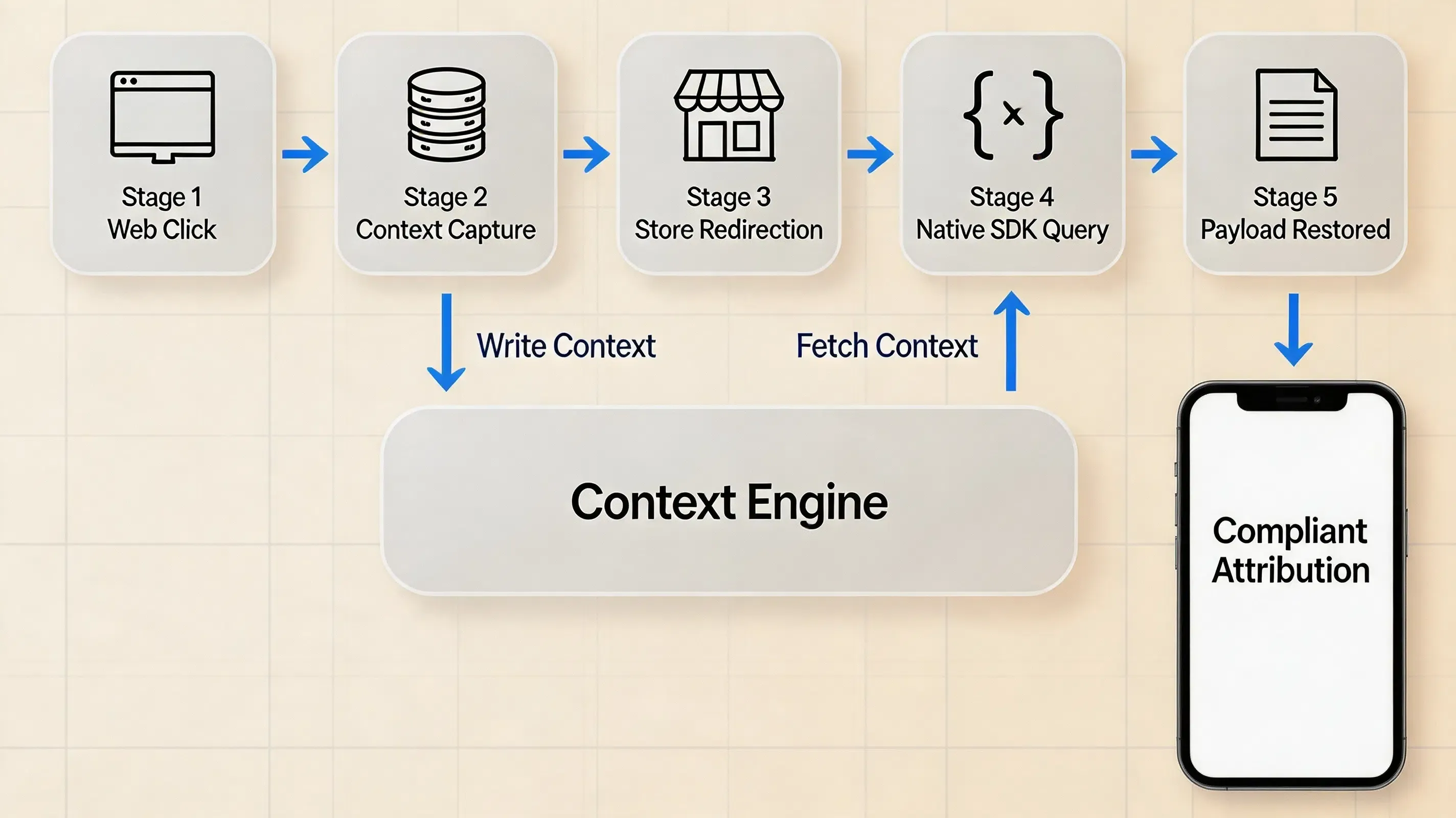
When paid ad campaigns drive traffic to a mobile web landing page before directing users to the App Store, attribution context can be preserved without reading advertising identifiers. First-party app links and deferred deep linking flows allow developers to preserve campaign context without accessing restricted advertising identifiers. The Web JS SDK captures dynamic query parameters (such as channelCode, campaignID, or shareCode) directly from the landing page URL query string.
Upon user redirection to the App Store, the Web SDK caches these parameters on the attribution server alongside session metadata. When the user installs and launches the app for the first time, the mobile SDK queries the attribution engine to retrieve the cached contextual parameters.
Restoring Dynamic Payloads Post-Install via Contextual Web-to-App Flows
Some first-party attribution flows use privacy-preserving web-to-app parameter passing mechanisms supported by the operating system and app ecosystem to restore contextual campaign tokens without accessing restricted advertising identifiers. During web redirection, the Web JS SDK appends a referral token to the referral flow.
Upon initial application launch, the native mobile SDK reads the contextual parameters, resolves the contextual referral payload, and executes the getInstallParam callback handler. This first-party parameter restoration process operates entirely within first-party app boundaries, passing referral keys without accessing cross-app tracking identifiers.
│
▼
│
▼
│
▼
(Compliant Attribution Without IDFA Access)
How to Audit iOS Ad Spend Without Relying on Device Identifiers
Transitioning from User-Level Granularity to Cohort-Based Performance Measurement
As user-level deterministic identifiers become unavailable across iOS, performance marketing teams must transition from individual user tracking to cohort-based campaign measurement.
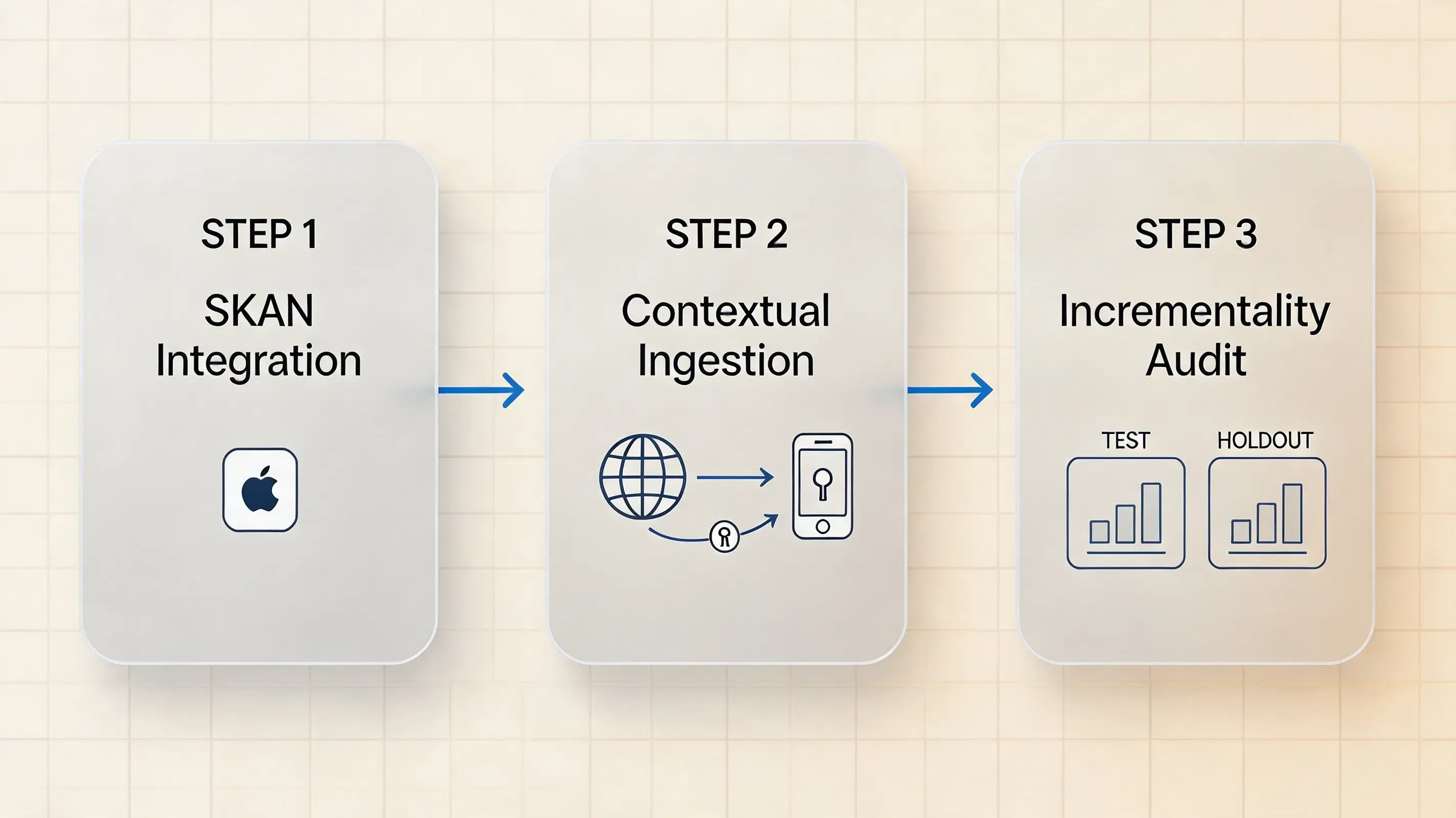
Instead of tracking User X through every in-app milestone, analysts evaluate campaign cohorts aggregated by acquisition source, referral token, or SKAN campaign ID. Comparing aggregate Day-1, Day-7, and Day-30 revenue across campaign cohorts provides the necessary dataset to calculate campaign ROAS without requiring individual device tracking.
Auditing Incremental Lift Across Paid Channels on iOS
To verify whether paid iOS campaigns generate true business growth or merely claim organic installations, advertisers execute incrementality testing using holdout groups.
By withholding ads from a randomized control group and measuring the conversion delta against the exposed treatment group, marketers isolate true incremental lift. Combining incrementality measurement with contextual deferred deep linking provides a robust framework for evaluating iOS ad spend efficiency in a post-IDFA landscape.
Frequently Asked Questions (FAQ)
What is IDFA and how does it affect iOS attribution?
How does IDFA differ from SKAdNetwork?
Does ATT disable IDFA completely?
What replaced IDFA after ATT?
Why did Apple introduce ATT for IDFA?
Is IDFA still available on iOS?
Can SKAdNetwork replace IDFA on iOS?
Can apps track users without IDFA on iOS?
What happens when a user declines the ATT prompt on iOS?
How does contextual deferred deep linking maintain attribution without IDFA?
Key Takeaways
-
Privacy-First Era: Apple’s ATT framework renders deterministic IDFA tracking unviable for the majority of iOS traffic due to low consent rates.
-
Compliance Risks: Non-compliant device fingerprinting violates App Store Review Guidelines and risks application rejection or account suspension.
-
First-Party Restoration: Combining native SKAdNetwork measurement with contextual deferred deep linking enables high-precision iOS campaign attribution while maintaining complete privacy compliance.
Summary and Decision Framework
Navigating IDFA tracking changes requires mobile growth teams to adopt privacy-preserving measurement frameworks. Relying solely on legacy deterministic device IDs is no longer viable under Apple’s App Tracking Transparency framework.
To maintain iOS attribution accuracy, engineering and marketing teams must combine Apple’s native SKAdNetwork framework with first-party contextual parameters. This approach enables compliant campaign measurement without relying on restricted identifiers.
Developers implementing mobile attribution pipelines can reference the OpoInstall mobile attribution implementation reference or register an account on the OpoInstall developer console for SDK integration and event delivery workflows.
Related Topics
-
Related Articles:
-
What Is Multi-Touch Attribution in Mobile Marketing?
-
How Mobile Measurement Partners Work
-
SKAdNetwork vs MMP Attribution
-
Incrementality Testing for App User Acquisition
-
-
Concepts: IDFA, App Tracking Transparency, SKAdNetwork, Contextual Deferred Deep Linking, Privacy-Preserving Attribution
-
Technologies: ATTrackingManager, Server-to-Server Postback, Web JS SDK
-
Standards: Apple App Store Review Guidelines Section 5.1.2, W3C Fetch API Specifications, OWASP Mobile Security Guidance
-
APIs: Mobile attribution event logging APIs, Apple ATTrackingManager API, Apple SKAdNetwork Postback API
-
Official Documentation & References:
Share this article