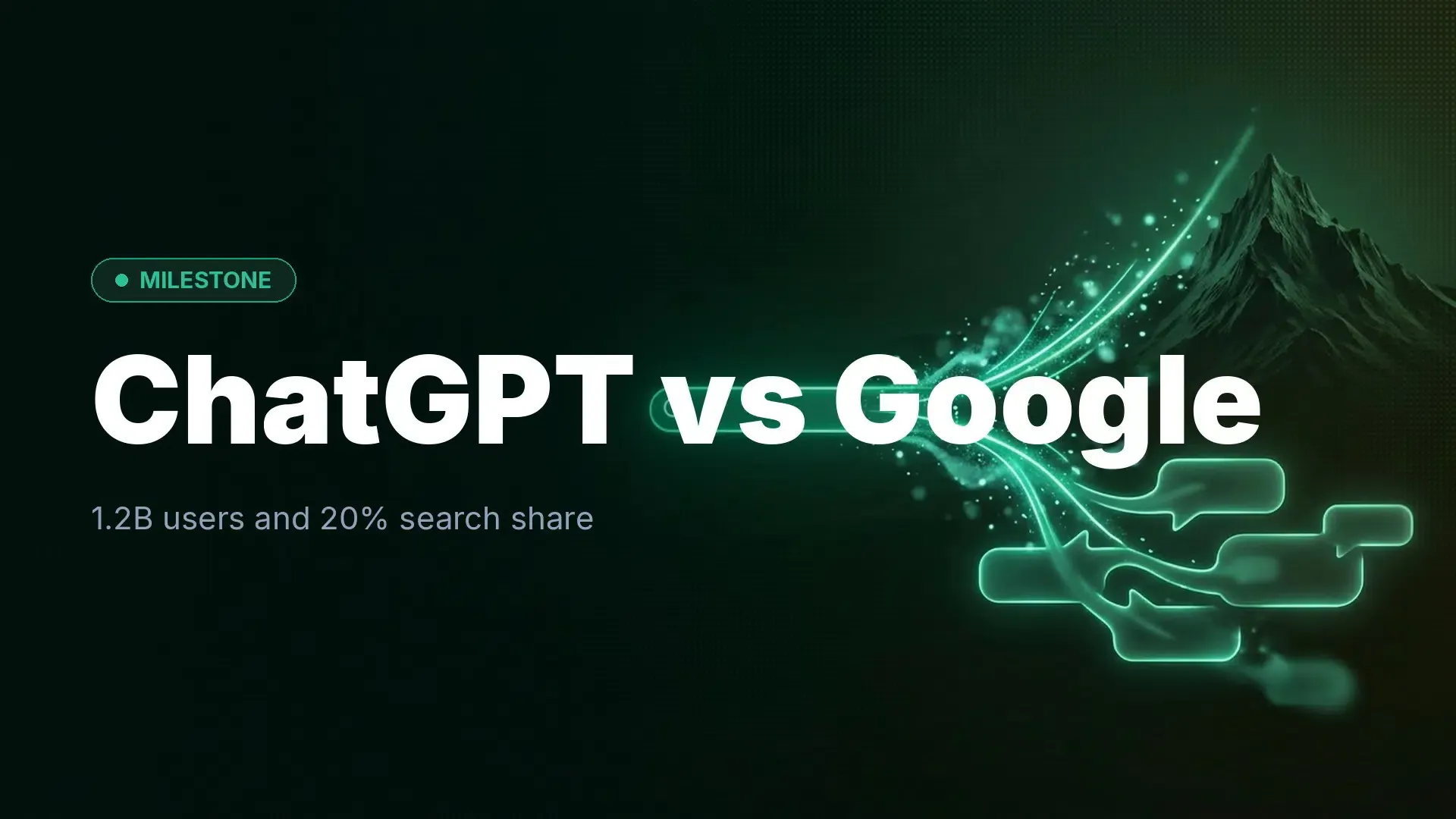
What does ChatGPT’s reported weekly audience tell growth teams? In a wide-ranging discussion in New York, OpenAI consumer product lead Adam Fry described how ChatGPT expanded to 1.2 billion weekly active users (WAUs) and stated that its search-like query volume now equals approximately one-fifth of Google’s volume. OpenAI had already disclosed 1.2 billion weekly users in its September 29 DevDay recap, but Fry’s comments in an interview with Big Technology published on November 3 provide fresh detail on how user engagement, voice adoption, and web retrieval are developing. For digital product managers and growth analysts, these disclosures offer a rare internal view into conversational AI scale, though the metrics also highlight significant differences between internal query activity and outbound web traffic.
Reconciling the 1.2 Billion User Milestone and Product Growth Timeline
At a Glance
- Platform disclosures describe ChatGPT serving 1.2 billion weekly active users, with company leadership citing an expansion of 200 million users over a two-month span.
- Company comparisons state that ChatGPT search queries requiring web retrieval equal roughly twenty percent of Google’s query volume.
- Engagement across multimodal features expanded, with weekly voice users reaching 250 million across dictation and conversational modes, and image generation reaching 1.5 billion creations per week.
Understanding the reported scale of ChatGPT requires reconciling platform disclosures across different periods. OpenAI previously reported reaching 400 million weekly active users in February 2025, climbing past 800 million by October 2025. The company noted that weekly usage had reached 1 billion users in an official update published on August 6, 2026, before recording the 1.2 billion milestone in its DevDay recap on September 29, 2026. In the subsequent New York interview, Adam Fry described the recent trajectory as adding approximately 200 million active participants across a 60-day window, characterizing the expansion rate as roughly 100 million users every 30 days.
These company-reported metrics differ in scope and methodology from third-party mobile intelligence data. Sensor Tower reported that the standalone ChatGPT mobile app reached one billion monthly active users (MAUs) in May 2026. While monthly active app metrics estimate unique active users of the mobile app over a thirty-day window, OpenAI’s internal 1.2 billion figure reflects the company’s reported weekly audience across its consumer products.
Technical Analysis: How OpenAI Defines and Measures Search Query Volume
The statement that ChatGPT processes roughly 20% of Google’s search volume provides a company-stated comparison against the incumbent search engine. However, evaluating this metric requires examining how OpenAI classifies search activity.
According to Adam Fry’s remarks in the Big Technology interview with Adam Fry, OpenAI counts a search when a user asks a question that requires ChatGPT to access external web data. Unlike a conventional search engine where each entered keyword generates a dedicated results page, a single conversational exchange can involve multiple questions requiring fresh web retrieval. Early user interactions concentrated heavily on programming assistance, text editing, and creative ideation—tasks that seldom required external search. Over time, user queries expanded into real-time subjects such as current events, financial asset tracking, and travel planning, increasing the proportion of prompts that initiate web retrieval.
The diagram below outlines illustrative user journeys contrasting conventional search engine navigation with conversational search retrieval:
[Traditional Web Search Paradigm]
  User Query ──> Search Results Page ──> Outbound Link Click ──> Website Referral Traffic

[Conversational Search Paradigm]
  User Prompt ──> Multi-Source Web Retrieval ──> In-Chat Synthesis ──> Answer Consumed Directly
                                                               (External Click Optional)
This distinction explains why query volume does not correspond directly to outbound website traffic. While OpenAI estimates its query activity at one-fifth of Google’s volume, third-party analytics data indicates that clicks sent from AI chatbots to publisher websites represent a very different volume profile. Data from analytics providers such as Statcounter tracks platform distribution within the AI chatbot referral category, while broader industry benchmarks show that traditional search engines continue to generate the vast majority of all outbound web traffic. Rather than directing users primarily through external links, conversational interfaces often synthesize source material directly on-screen, answering informational intent within the session.
Multimodal Engagement: Voice Mode and Image Generation at Scale
Beyond text-based information retrieval, company leadership outlined engagement figures across voice and visual tools. Voice input reached 250 million weekly active users, a figure that includes both voice dictation input and real-time conversational voice mode. This represents roughly 20% of ChatGPT’s reported weekly user base, indicating that voice features have gained regular adoption among a notable segment of users.
Simultaneously, the platform reported that image generation reached 1.5 billion creations per week. Delivering audio and visual processing requires distinct computing resources compared with text completion. Operating real-time voice sessions with low latency and handling continuous image generation place substantial demands on server infrastructure. In discussion of resource requirements, Fry described Dots as compute-heavy and said OpenAI aims to reduce its computing requirements over time.
What the Metrics Mean for Digital Discovery and Growth Teams
For digital marketers, user acquisition teams, and software architects, the expansion of conversational search highlights new considerations for measuring online visibility. When search-like tasks occur inside conversational interfaces, traditional click-based tracking tools observe different signals.
When a user asks an AI assistant for software comparisons or brand recommendations, the answer is generated directly within the conversation. If that user subsequently visits the recommended service days later without clicking a direct link, web analytics platforms often categorize the arrival as direct traffic or an organic brand search, in line with channel definitions documented in Google Analytics documentation. In these unrecorded discovery scenarios, the original conversational touchpoint does not generate a standard HTTP referrer, meaning click-based attribution reports do not capture the early influence of the AI interaction.
The table below contrasts traditional search engines with conversational AI platforms across key measurement dimensions:
| Metric Dimension | What It Describes | What It Does Not Establish |
|---|---|---|
| Weekly Active Users (1.2B WAUs) | The number of unique individuals interacting with the platform over a seven-day window | The total number of independent web searchers or exclusive search users |
| Search-Like Query Volume (~20% of Google) | User questions that cause the conversational model to perform live web retrieval | Outbound referral traffic delivered to publisher and brand websites |
| On-Screen Content Synthesis | Direct informational answers compiled from multiple web sources within the chat | Commercial conversion rates or user preference for traditional search links |
| Unlinked Brand Recommendations | Brand awareness and consideration occurring inside conversational sessions | Trackable multi-touch conversion paths in standard click-based analytics |
| Structured Plain-Text Visibility | Clear, crawlable technical details and documentation available to web parsers | Guaranteed citation, inclusion, or favorable ranking in AI-generated answers |
To navigate this environment, marketing and growth teams should distinguish between search-like query volume and trackable referral traffic. Improving plain-text clarity on public documentation can help AI models interpret product details accurately, but teams should recognize that conversational visibility will not automatically produce equivalent volumes of direct website clicks.
Frequently Asked Questions (FAQ)
What is the difference between ChatGPT weekly active users and traditional monthly active users?
How does OpenAI define a search query within ChatGPT?
Does ChatGPT search volume mean it has captured twenty percent of the search engine market?
Practical Implications for Engineering and Growth Teams
The reported milestone of 1.2 billion weekly active users demonstrates that conversational AI has become a widespread method for finding information. However, engineering and growth teams should differentiate between user engagement within conversational platforms and outbound referral traffic to external websites. Because conversational engines frequently synthesize answers on-screen, external clicks need not scale in direct proportion to conversational user growth.
Organizations adapting to this landscape should ensure that product descriptions, technical documentation, and pricing details are available in clear, crawlable text so automated models can interpret them accurately. At the same time, growth teams should evaluate digital discovery through broader measurement approaches rather than relying solely on last-click referral data.
For app teams, a separate, observable problem begins when a user follows a tagged link to an installation page. Depending on platform support, teams can evaluate an in-house flow or a service such as OpoInstall to pass captured campaign parameters through installation to first launch. This supports a defined click-to-app journey; it does not reveal earlier AI recommendations that produced no recorded touchpoint.
References & Authoritative Sources
-
Big Technology Interview with Adam Fry - Primary interview disclosing ChatGPT search volume comparisons, weekly active user growth, voice usage, and search counting methodology.
-
OpenAI DevDay 2026 Recap - Corporate announcement confirming the 1.2 billion weekly active user figure and platform developer updates.
-
OpenAI Official Post on Sol Model Updates - Official company release noting 1 billion weekly users as of August 2026.
-
Sensor Tower State of AI Mobile Report - Independent mobile market analysis documenting the ChatGPT mobile app reaching one billion monthly active users.
-
Search Engine Journal Reporting on OpenAI Search Volume - Industry reporting examining the comparison between OpenAI query volume and traditional search.
-
Google Analytics Documentation on Traffic Acquisition - Technical documentation defining default channel groupings, direct traffic, and organic search classification.
-
OpoInstall Product Documentation - SDK Integration Guide - Vendor documentation describing parameter collection via Web SDK and retrieval via Native SDK upon first application launch.
Share this article