How to identify fake in-app events in conversion tracking? Identifying fake in-app events requires auditing event-specific latency baselines against raw timestamps, consuming security-layer request authentication statuses, and filtering suspicious execution patterns in ingestion streams.
Fake in-app event fraud occurs when automated scripts, modified app instances, or unauthenticated API payloads transmit invalid or potentially synthetic conversion signals to attribution servers. By auditing raw event telemetry, establishing empirical Click-to-Event-Time (CTET) latency baselines, and consuming request authentication verdicts from dedicated ingestion security layers, engineering teams can classify and filter invalid event streams before they enter downstream measurement or optimization feeds.
| Term | Definition | Related Entity | Search Intent Role |
|---|---|---|---|
| Conversion Tracking | The systematic logging and processing of post-install user milestones. | Raw Data Stream | Informational / Technical |
| Click-to-Event-Time | An article-defined derived metric measuring latency between touchpoint and event receive time. | Event Anomaly Engine | Technical / Informational |
| Ad Fraud | The deliberate manipulation of performance metrics using non-human traffic or spoofed payloads. | In-App Event Spoofing | Informational / Security |
Anatomy of Fake In-App Event Fraud in Conversion Tracking Pipelines
The Commercial Incentive: CPA Event Payouts vs CPI Install Arbitrage
Mobile performance marketing campaigns frequently rely on Cost-Per-Action (CPA) frameworks, where publishers earn revenue only when an acquired user reaches designated downstream milestones. These post-install milestones—such as finishing an account registration, completing an onboarding sequence, initiating a subscription trial, or completing a first in-app purchase—carry substantially higher payout rates than simple app installs.
This financial structure creates strong economic incentives for malicious actors to simulate post-install engagement. Rather than generating high volumes of low-value app downloads, automated scripts emulate specific high-value conversion milestones to extract CPA commissions. If an event ingestion pipeline accepts these spoofed events without structural validation, advertisers disburse commissions for non-existent commercial activity while overvaluing non-performing traffic sources.
Threat Vectors: Unauthenticated S2S API Requests, Modified Clients, and Scripted Automations
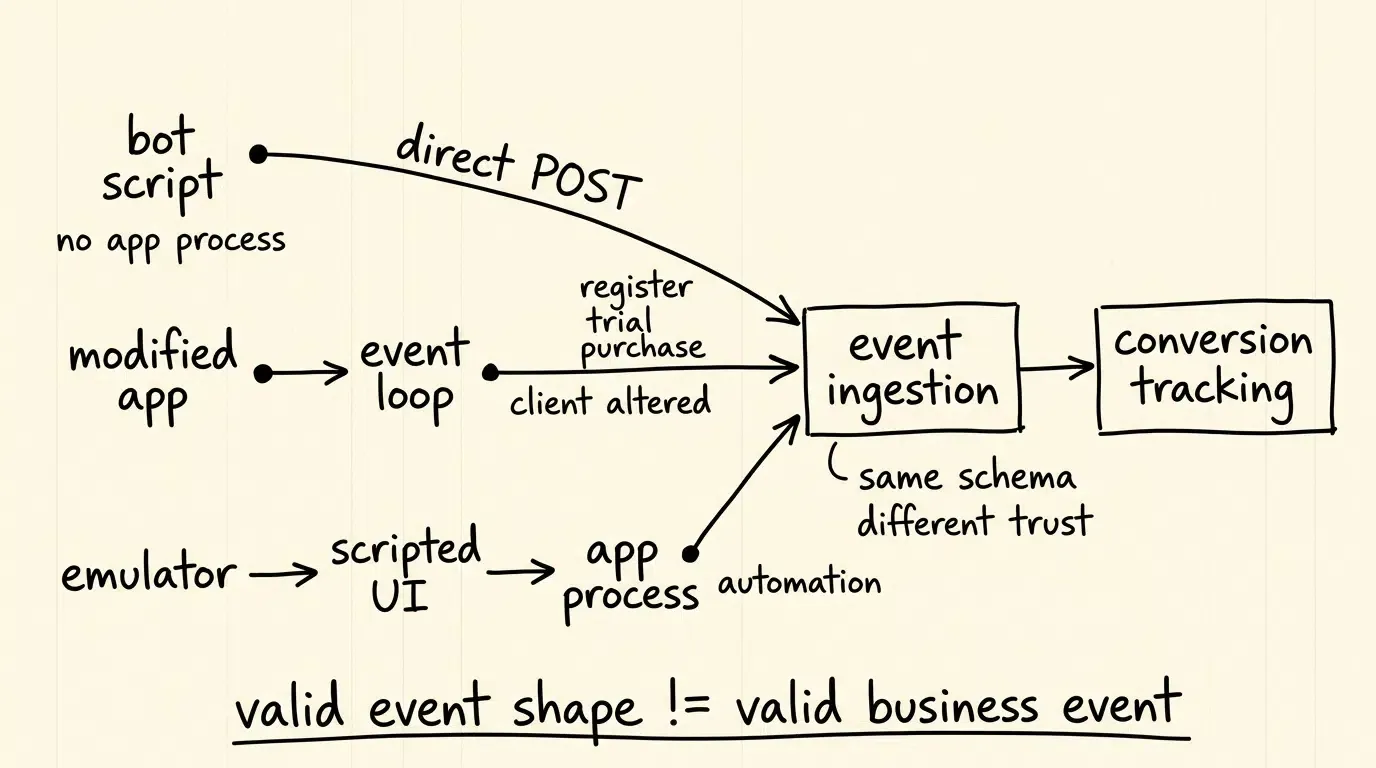
Fraudulent in-app events enter conversion tracking pipelines primarily through three technical vectors:
- Direct API Ingestion Spoofing: Attackers inspect mobile application network traffic using local proxy tools to identify event ingestion endpoints, HTTP header requirements, and JSON payload parameters. In weakly authenticated integrations, automated server-side scripts transmit synthetic event requests directly to ingestion endpoints without launching an application process or executing client-side code.
- Modified Client Application Binaries: Attackers decompile, alter, and repackage client application packages to bypass internal controls or inject automated event-dispatching loops. These modified clients run on physical devices or virtualization environments, generating valid operating system telemetry while executing automated event calls.
- Emulator and Scripted Device Automation: Virtualized mobile environments run automated instances controlled by UI scripting frameworks. While application code executes within an actual operating system process, user interaction sequences, input speed, and execution latency reflect programmatic automation scripts rather than human interaction.
The Threat Model Boundary: Why Client-Held Symmetric Secrets Cannot Guarantee Request Legitimacy
A critical security limitation in mobile conversion tracking is the assumption that embedding a shared symmetric key (such as an HMAC secret) inside a mobile client binary guarantees payload authenticity. In standard mobile threat models, client binaries execute within an untrusted environment. Attackers can extract client-held symmetric keys through static reverse engineering, dynamic memory inspection, or runtime hooking frameworks.
As highlighted in the OWASP Mobile Application Security Testing Guide (MASTG), symmetric cryptographic keys stored within client applications can be compromised, allowing an attacker to generate valid message authentication codes (MACs) for arbitrarily forged payloads. Consequently, client-held keys provide only defense-in-depth against casual tampering; they do not serve as an absolute root of trust against sophisticated SDK spoofing.
To achieve robust request-authenticity inputs, modern architectures rely on distinct platform-level attestation mechanisms:
- Google Play Integrity: Standard requests return platform-issued integrity tokens that can be cryptographically bound to application request data through
requestHash, with Google-managed automatic replay protection enforced during token verification. - Apple App Attest: Leverages an attested, device-generated key pair, server-issued one-time challenges, and signed client assertions evaluated against assertion counters to bind sensitive requests to a validated application instance.
Crucially, while these services provide platform-originated evidence regarding application binary integrity, device state, or request binding, neither mechanism proves that the underlying business conversion was physically executed by a genuine human user.
Downstream Contamination: How Invalid Event Postbacks Misalign Ad Network Optimization Bidders
Beyond unearned publisher payouts, unvalidated event spoofing degrades programmatic ad campaign optimization. Programmatic ad platforms use real-time conversion postbacks to train automated bidding algorithms, such as App Event Optimization (AEO) or Target Cost-Per-Action (tCPA).
Invalid conversion signals can degrade optimization-input quality where partner bidding systems consume those conversions; the detailed bidding-feedback mechanics and budget allocation dynamics are covered in Article #68. Filtering or withholding policy-ineligible event signals reduces the exposure of invalid positive signals to downstream optimization systems.
Defining Click-to-Event-Time as an Event-Specific Derived Latency Metric
Defining Derived Timing Delta: CTET Equals Event Receive Time Minus Click Recorded Time
In this article, Click-to-Event-Time (CTET) is operationally defined using the server receive boundary, representing click-to-event-receive latency rather than an infallible measurement of the exact physical user execution moment. Mathematically, CTET for an event
Where
Distinguishing Server-Authoritative Timestamps from Client-Reported Event Clocks
Accurate latency evaluation requires strict technical separation between client-reported timestamps (
Relying exclusively on client-reported timestamps allows spoofing scripts to inject arbitrary historical timestamps, making an automated event appear to have occurred hours or days after an ad click. Ingestion gateways must assign an immutable server timestamp (
Handling Offline Event Queueing: Differentiating Queued Network Batches from Real-Time Anomalies
Applications designed for intermittent connectivity queue post-install events locally when network access is unavailable. Once the device re-establishes an active connection, the client uploads the accumulated telemetry in an aggregated batch.
If an attribution engine evaluates batch-uploaded events strictly against the server receive timestamp (
Evaluating Latency Scope: Acquisition Install Engagements vs Re-Engagement Click Contexts
The analytical scope of CTET depends entirely on the attribution context. For new user acquisition,
Because retargeting bypasses store downloads and OS installation processes, the baseline latency for post-click in-app actions is substantially shorter than in acquisition workflows. Latency anomaly engines must dynamically adjust baseline models based on campaign type to prevent misclassifying valid retargeting conversions as anomalies.
Technical Framework for Empirical CTET Latency Baseline Auditing
Ingesting Unprocessed Telemetry Streams for Baseline Calibration
Constructing an effective CTET anomaly evaluation framework requires unaggregated telemetry ingestion. Client SDKs transmit event triggers along with session context to edge ingestion gateways.
Teams can consult current OpoInstall documentation for available attribution and SDK integration capabilities; the event-ingestion pipelines and 5-layer structures outlined in this article represent reference architectures and recommended implementation patterns rather than documented production API contracts.
Establishing Event-Specific and Campaign-Calibrated Latency Distributions
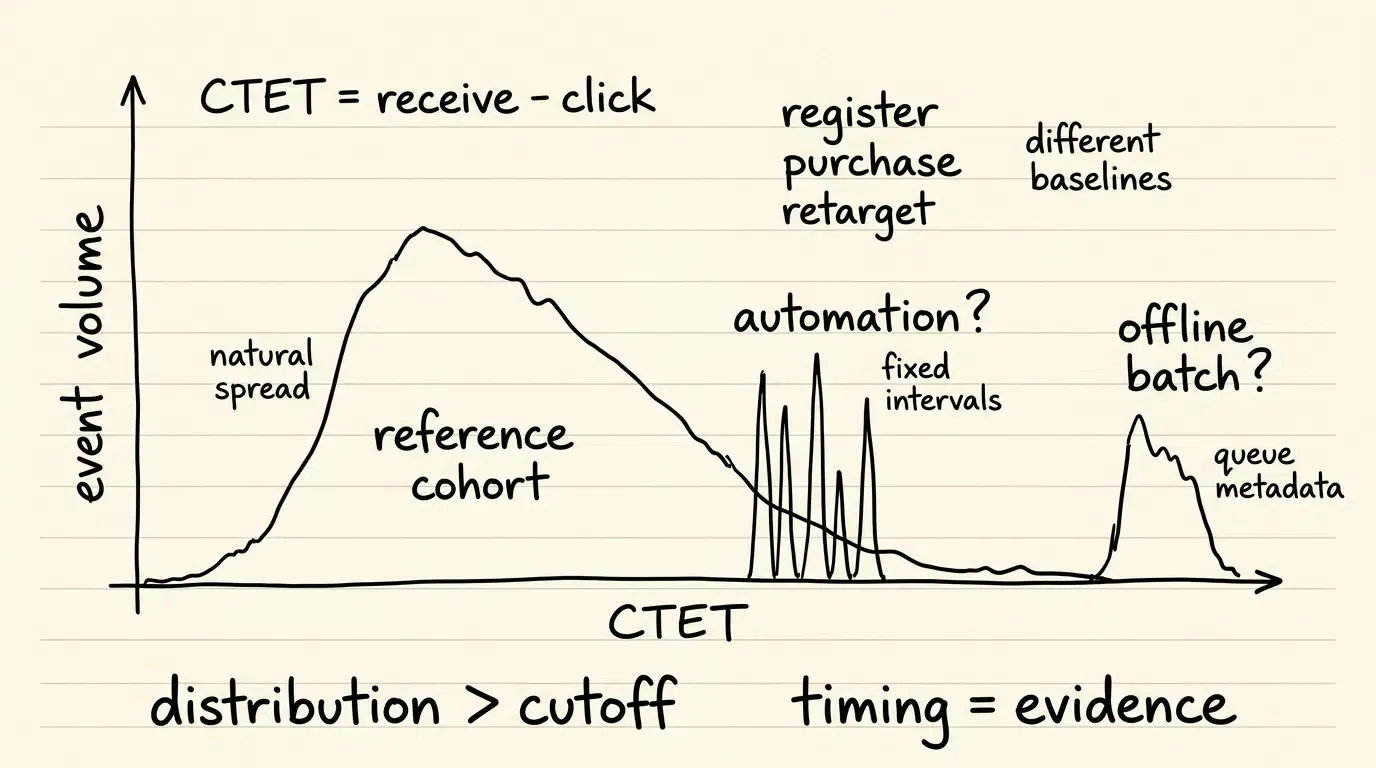
Human interaction with mobile applications produces variable latency patterns depending on the specific event milestone. Registering an account typically requires less time than completing an identity verification workflow or reaching a high milestone in a mobile application.
Rather than enforcing arbitrary, universal latency thresholds across all events, engineering teams must establish empirical latency baselines for each specific event type. These baselines are calculated by analyzing historical conversion distributions across validated low-risk historical cohorts within specific campaign types and geographic regions.
Empirical Latency Baseline Calibration Model:

Policy-Qualified Reference Cohort CTET Distribution (Heterogeneous Latency Spread):
Volume |        /\
       |       /  \
       |      /    \________  (Empirical Quantile Distribution)
       +-----------------------------------> Time Elapsed

Unnatural Latency Clustering (Potential Automation Indicator):
Volume |   |      |      |
       |   |      |      |
       |   |      |      |    (Static Interval Spikes: Flagged for Audit)
       +-----------------------------------> Fixed Time Intervals
Treating Latency Deviations as Diagnostic Evidence Rather Than Universal Cutoffs
An event falling into an unusually early quantile or low-probability tail of the calibrated baseline distribution warrants investigation. Rather than assuming Gaussian distributions or treating values below the baseline mean as anomalies—which naturally accounts for a large portion of legitimate traffic—production systems evaluate empirical lower quantiles or robust standardized residuals.
Automatic hard-blocking based solely on a static timing cutoff risks dropping legitimate fast-converting users, such as users on high-speed connections or those completing one-tap account authentications. Latency scores should act as one weighted diagnostic factor within a multi-metric disposition engine rather than definitive proof of fraud.
Visualizing the Ingestion, Verification, and Disposition Pipeline
The workflow diagram below illustrates how raw event telemetry moves through edge ingestion, interacts with security verification inputs, evaluates latency against empirical baselines, and executes policy disposition:
[Ad Engagement Click Recorded (T_click)] ──> [Mobile App In-App Event Occurs]
             │                                            │
             ▼                                            ▼
  Server Logged Timestamp                   Client Transmits Event Request
             │                                            │
             └──────────────────────┬─────────────────────┘
                                    │
                                    ▼
                       [Edge Ingestion Gateway]
                                    │
                                    ├─► Ingest Security Verdict (Article #65)
                                    │   (Authentication Status, App Attest / Play Integrity)
                                    │
                                    ├─► Latency Audit Engine (Article #69)
                                    │   (Compute CTET Delta vs. Calibrated Baseline)
                                    │
                                    ▼
               [5-Layer Event Disposition Reference Model]
                                    │
                  ┌─────────────────┴─────────────────┐
                  ▼                                   ▼
  [Policy-Eligible Event Disposition]     [Anomalous Event Disposition]
  (Recorded & Postback Eligible)          (Flagged, Suppressed, or Dropped)
Integrating Shared Security Verifications and Replay Resistance Inputs
Consuming Request Authentication Verdicts from Dedicated Ingestion Security Layers
Request-authentication and replay-resistance controls should be implemented by the shared ingestion-security layer described in Article #65. This article consumes the resulting verification status as one event-risk input.
Rather than attempting to duplicate cryptographic verification, nonce storage, or replay protection within the latency engine, conversion pipelines ingest upstream security flags. This architectural separation ensures that transport security and cryptographic integrity remain decoupled from functional business event processing.
Addressing Client-Side Key Storage Limits: Relying on Platform Integrity Assertions
Given that client-held symmetric keys cannot guarantee immunity from reverse engineering, modern mobile architectures rely on platform-level attestation frameworks.
Google Play Integrity Standard requests provide platform-issued integrity tokens that can be bound to request data through requestHash, while Apple App Attest uses attested application-instance keys, server challenges, and signed assertions. Both mechanisms provide platform-originated security evidence, but neither proves that the underlying business conversion was human-generated. Detailed implementation of payload signing, key lifecycle management, and replay defense protocols is covered in Article #65.
To obtain client SDK builds featuring standard telemetry controls, engineering teams can consult the SDK integration resources.
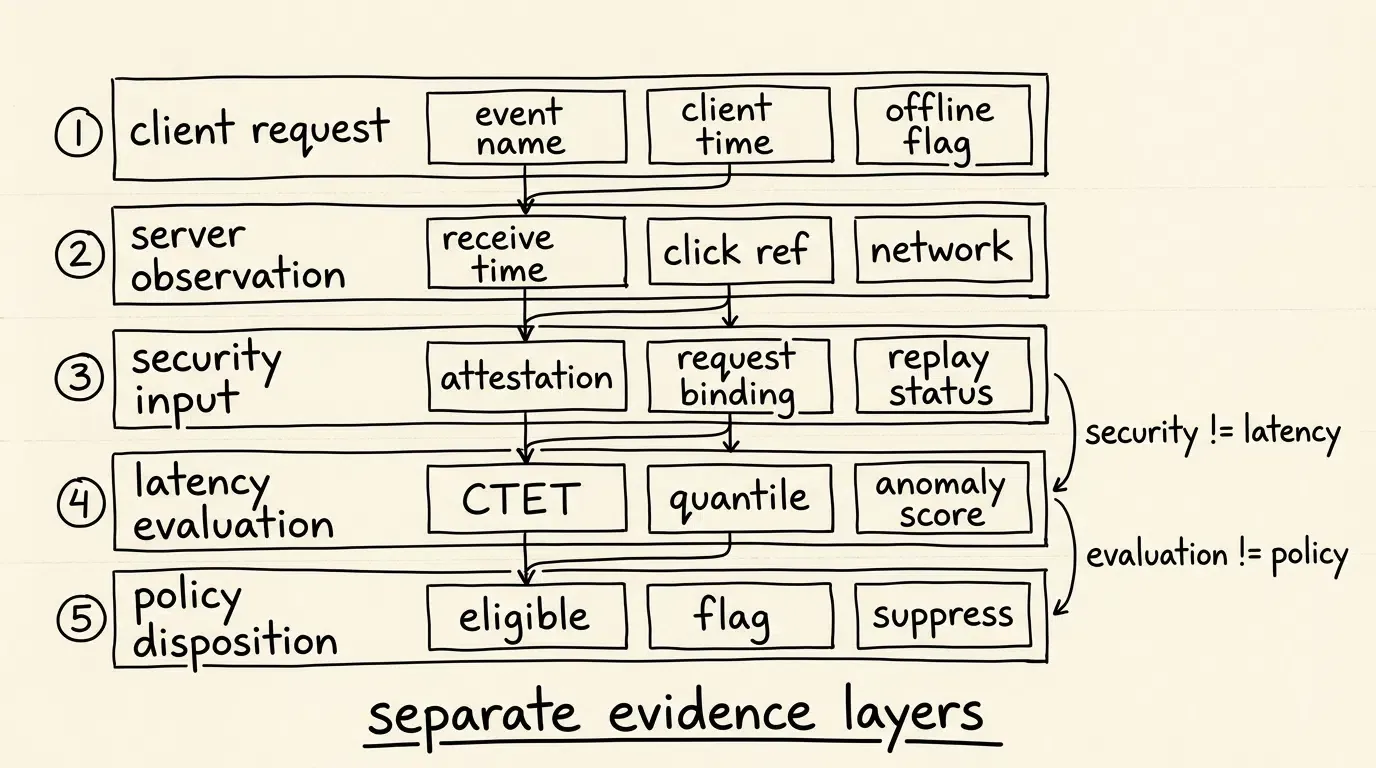
Structuring the 5-Layer Event Disposition Schema
To ensure auditability and maintain clear technical separation between client-submitted telemetry, server observations, security inputs, latency evaluations, and policy outcomes, event records should adhere to a structured 5-layer reference schema.
The schema placeholder below illustrates an event verification record where each stage of the analysis pipeline is cleanly isolated for a single platform target:
{
  "reference_architecture": true,
  "event_disposition_record": {
    "layer_1_client_request": {
      "platform": "Android",
      "app_id": "com.example.application",
      "client_event_id": "evt_checkout_99812",
      "event_name": "checkout_completed",
      "event_value_cents": 1999,
      "currency": "USD",
      "client_reported_timestamp_ms": 1785985965120,
      "session_token": "sess_8832a10c-58cc-4372-a567-0e02b2c3d479",
      "offline_queued_flag": false
    },
    "layer_2_server_observation": {
      "server_authoritative_timestamp_utc": "2026-08-06T03:12:45.120Z",
      "ingestion_edge_node_id": "edge_us_east_04",
      "click_reference_timestamp_utc": "2026-08-06T03:10:00.000Z",
      "network_asn": "AS7018",
      "request_ip_classification": "residential_isp"
    },
    "layer_3_security_layer_input": {
      "security_layer_article_reference": "Article #65",
      "platform_integrity_evaluation_status": "verified_platform_integrity",
      "attestation_provider": "google_play_integrity",
      "attestation_verdict": "MEETS_DEVICE_INTEGRITY",
      "request_binding_status": "matched_request_hash",
      "replay_protection_mode": "play_integrity_standard_managed",
      "derived_replay_risk_status": "low_risk"
    },
    "layer_4_latency_evaluation": {
      "baseline_model_type": "empirical_quantile_model",
      "calculated_ctet_seconds": 165.12,
      "empirical_quantile_rank": 0.42,
      "illustrative_baseline_mean_seconds": 180.0,
      "illustrative_baseline_stddev_seconds": 45.0,
      "latency_anomaly_score": 0.08,
      "latency_evaluation_verdict": "within_expected_distribution_range"
    },
    "layer_5_policy_disposition": {
      "attribution_decision_source": "upstream_attribution_engine",
      "disposition_state": "policy_eligible_and_processed",
      "attribution_status": "attributed_to_click",
      "ad_network_postback_eligible": true,
      "reason_codes": [
        "PLATFORM_INTEGRITY_CHECK_PASSED",
        "CTET_LATENCY_NORMAL"
      ]
    }
  }
}
Executing Edge Disposition Policies: Silent Drop, Audit Flagging, and Selective Suppressed Postbacks
Once an event payload is evaluated through the disposition engine, the system applies one of three primary enforcement policies:
- Policy-Eligible and Processed: The event meets latency baseline criteria and carries a verified security authentication status. The event is recorded in reporting databases and becomes eligible for configured downstream reporting or partner postback handling.
- Flagged for Audit: The event exhibits mild timing deviations or unusual network context but carries a valid security status. The event is logged in reporting dashboards with an anomaly flag for review, while ad network postbacks can be conditionally withheld based on partner configuration.
- Suppressed or Dropped: The event fails platform authentication checks or exhibits high-confidence multi-signal anomalies or impossible event-sequence states. The request is dropped at the edge to prevent database pollution.
Event Anomaly Indicators and Empirical Evaluation Matrix
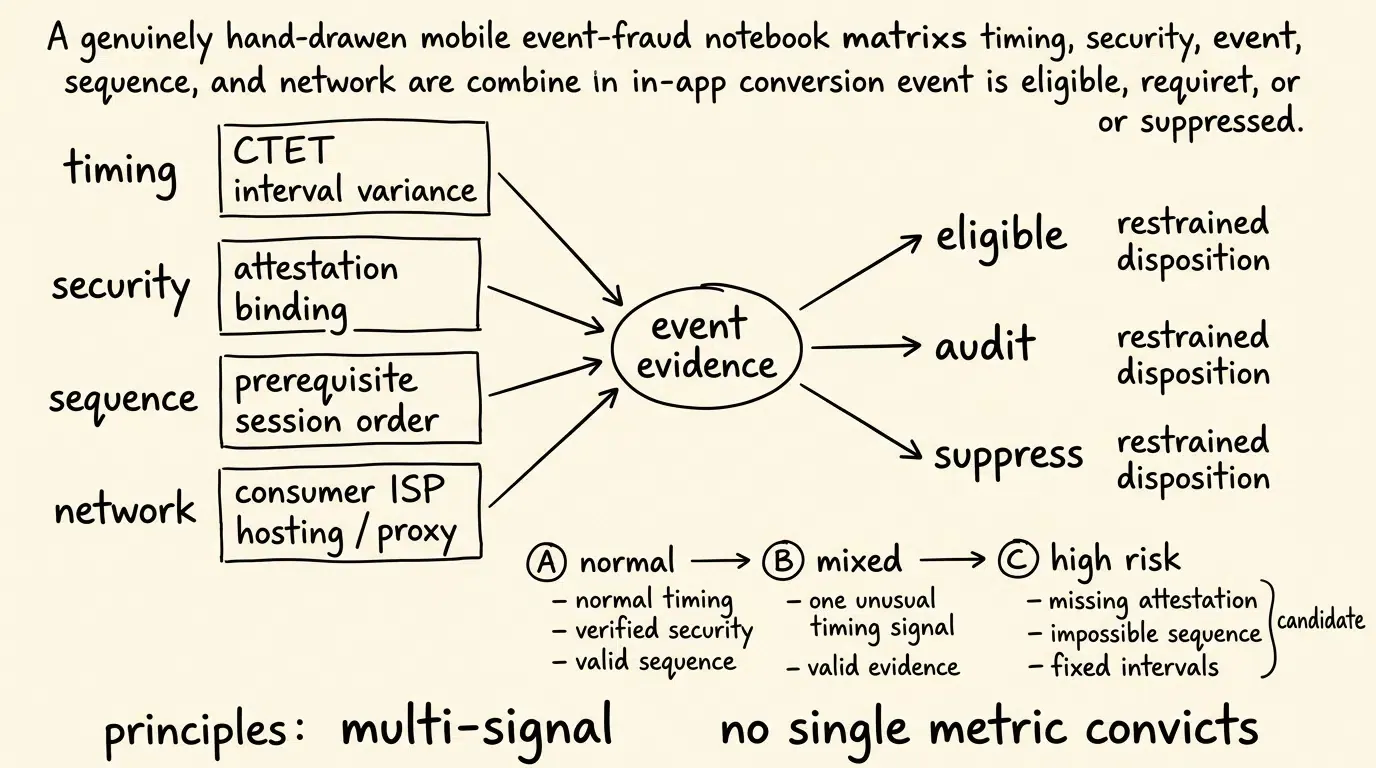
Multi-Dimensional Telemetry: Evaluating Latency, Network Context, and Security Signals
Accurate anomaly detection relies on evaluating multiple telemetry dimensions concurrently. Combining latency deltas with network infrastructure properties and platform security verdicts minimizes false positives while identifying sophisticated automated spoofing attempts.
Configuring Diagnostic Indicators for Anomaly Investigation
The matrix below outlines key telemetry indicators, potential anomaly signals, and diagnostic evaluation actions for conversion tracking pipelines:
| Telemetry Dimension | Expected Baseline Signal | Potential Anomaly Indicator | Diagnostic Evaluation Action |
|---|---|---|---|
| CTET Latency Delta | Within empirical lower/upper quantiles | Observed latency falls within anomalous lower-tail region | Flag for CTET anomaly audit; cross-check offline batch status |
| Authentication Status | Verified via platform attestation / S2S key | Unverified signature or missing attestation | Mark as unauthenticated request; reject if policy requires |
| Interval Variance | Natural dispersion across user sessions | Unnatural spike clustering at exact intervals | Inspect for automated timer loop automation |
| Network Context | Distributed across consumer ISPs | Concentrated hosting or proxy infrastructure | Cross-reference with network intelligence signals |
| Sequence Logic | Preceded by logical prerequisites (e.g. Install) | Conversion event without antecedent session | Flag as orphan event payload; inspect attribution chain |
When to Apply Automated Event Filtering and Disposition Policies
Suitable Conditions for Automated Filtering
Automated event filtering rules deliver maximum protective value under specific operational conditions:
- Active Cost-Per-Action (CPA) Campaigns: Marketing programs offering monetary payouts for post-install milestones, which attract targeted spoofing scripts.
- Programmatic Ad Network Optimization Pipelines: Campaigns feeding event signals back to ad network auto-bidders, where invalid signals can distort bidding algorithms.
- High-Volume Ingestion Architectures: Environments processing large event volumes where manual auditing is unfeasible.
Unsuitable Conditions for Aggressive Hard-Blocking
Applying aggressive automated hard-blocking without empirical calibration can cause operational issues in specific contexts:
- Newly Deployed Apps or Features: Applications lacking historical baseline data, where rigid latency rules might misclassify legitimate early user engagement.
- Offline-First App Environments: Applications that queue legitimate user events locally during offline usage and upload them in batches upon reconnecting.
Common Pitfalls in Conversion Anomaly Management
- Pitfall 1: Relying on a Single Universal Latency Cutoff: Applying a static time limit across all campaigns creates false positives across varied user environments and retargeting campaigns. Latency baselines must be calibrated per event type and campaign context.
- Pitfall 2: Assuming Client-Held Symmetric Keys Guarantee Request Authenticity: Storing an HMAC secret key inside a client binary does not prevent SDK spoofing, as attackers can extract client keys using reverse-engineering tools. High-assurance verification requires platform integrity assertions and server-side validation.
Frequently Asked Questions (FAQ)
How do spoofed in-app events bypass basic client-side conversion tracking?
Why should event latency thresholds be established empirically rather than using fixed cutoffs?
How does event-level anomaly filtering protect downstream ad network bidding signals?
Summary and Decision Framework
Identifying and filtering fake in-app events requires an empirical, multi-layered diagnostic framework rather than reliance on client-side secrets or static latency cutoffs. Protecting conversion data pipelines relies on separating client request payloads from server-authoritative timestamps, consuming robust request-authentication verdicts from dedicated security layers, and auditing event latency against empirically calibrated baselines.
As mobile ecosystems evolve, engineering teams must deploy ingestion architectures that validate platform integrity assertions while maintaining clean separation between security, timing evaluation, and policy enforcement. Integrating empirical baseline checks with structured disposition rules enables mobile applications to maintain clean conversion datasets and improve confidence in ROAS measurement.
To evaluate how raw event auditing and anomaly evaluation can secure your conversion tracking infrastructure, review the mobile conversion tracking documentation, consult the mobile attribution implementation reference, or log into the OpoInstall developer console to review available cheating-monitoring and anomaly-reporting controls.
Related Materials
-
Concepts: Click-to-Event-Time, Derived Latency Metrics, In-App Event Spoofing, Event Disposition Policy
-
Technologies: Raw Telemetry Ingestion, Platform Integrity APIs, 5-Layer Event Schemas, Anomaly Engine
-
Standards: RFC 2104 HMAC Specification & Shared-Secret Limits, OWASP MASTG Testing Cryptography Guidance
-
APIs: Event Ingestion Interfaces (Reference Architecture), Google Play Integrity Standard Requests, Apple App Attest API
-
Official Documentation & References:
Share this article