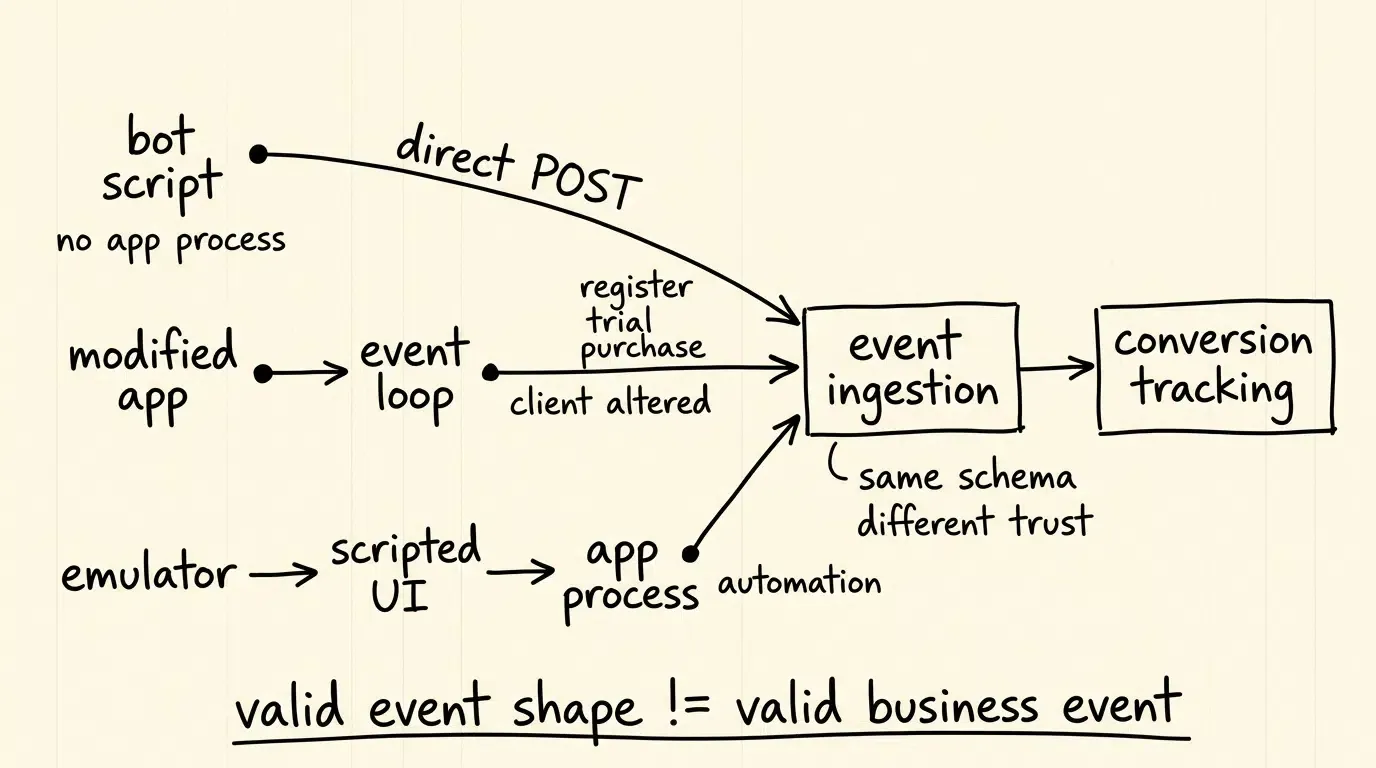
Apple challenges Epic contempt ruling at Supreme Court? On September 14, 2026, Apple filed its opening merits brief with the Supreme Court of the United States in Apple Inc. v. Epic Games, Inc. (No. 25-1311), asking the high court to reverse or vacate a civil contempt judgment that penalized the company for its anti-steering compliance framework. Rather than relitigating the underlying 2021 antitrust ruling, the appeal focuses on the procedural limits of the judicial contempt power: specifically, whether the Ninth Circuit erred by holding a party in civil contempt based on the unstated “spirit” of an injunction rather than its explicit text. For mobile software architects, billing engineers, and user acquisition teams, the legal dispute over App-to-Web Payment Routing carries significant architectural relevance. As developers deploy external payment flows to offer alternative purchasing mechanisms outside standard in-app purchases (IAP), engineering teams must design resilient, bi-directional routing pipelines—providing dependable return-context handling so that the native app can rehydrate authoritative transaction state from backend billing services via Universal Links.
The Supreme Court Appeal: The Contempt Power and the 75-Word Injunction
The dispute before the Supreme Court centers on the legal standard required to impose civil contempt under Federal Rule of Civil Procedure 65(d) and established federal equity jurisprudence.
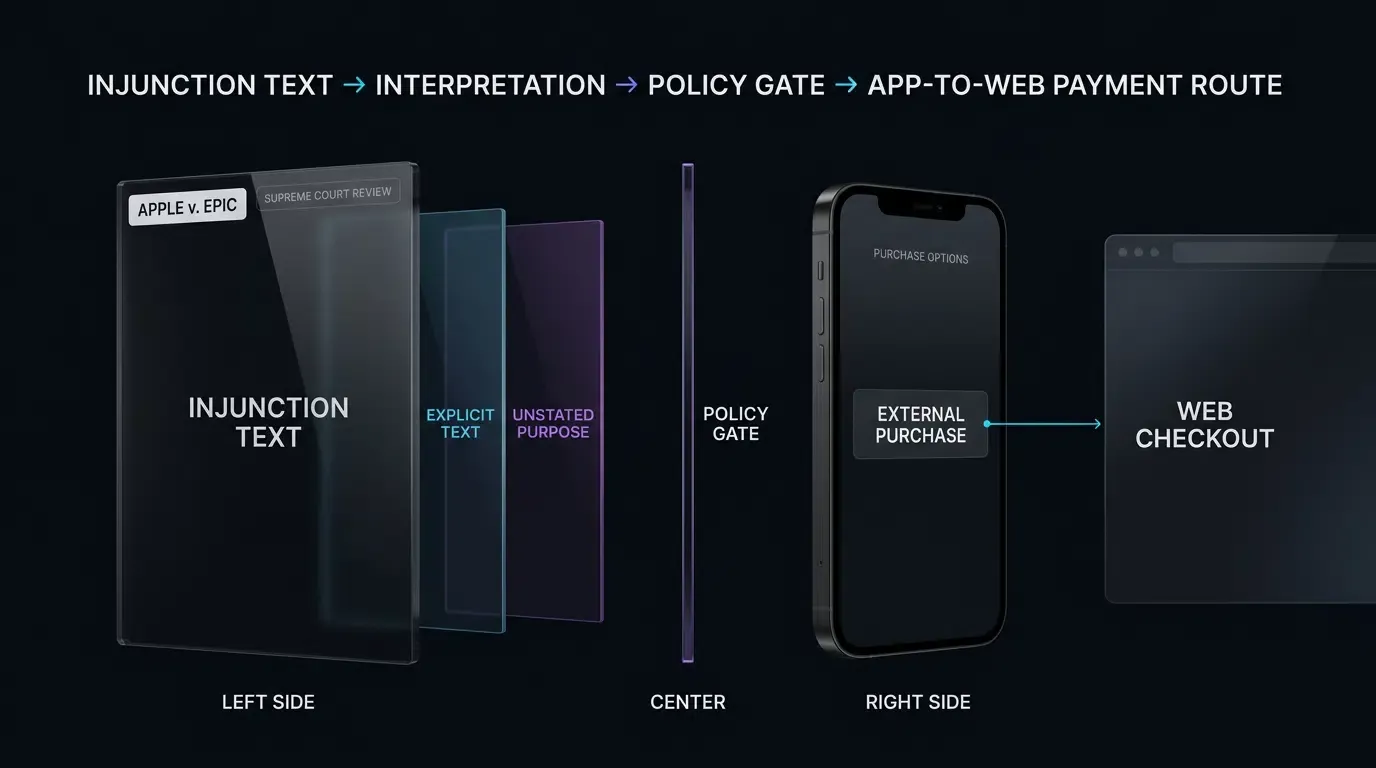
In September 2021, the U.S. District Court for the Northern District of California ruled that Apple was not an illegal monopolist under federal antitrust statutes, but concluded that its developer guidelines prohibiting steering violated California’s Unfair Competition Law (UCL) by creating informational harm. To remedy that violation, the district court issued a 75-word permanent injunction prohibiting Apple from barring developers from including in their apps “buttons, external links, or other calls to action that direct customers to purchasing mechanisms, in addition to In-App Purchasing.”
At a Glance
- Supreme Court Merits Brief Filed: On September 14, 2026, Apple filed its opening brief on writ of certiorari in Apple Inc. v. Epic Games, Inc. (No. 25-1311), challenging the Ninth Circuit’s use of an injunction’s “spirit” to justify civil contempt.
- The Core Question Presented: The Supreme Court granted review solely on Question 1: whether civil contempt may be grounded on an injunction’s unstated purpose when the order is silent as to the conduct at issue, or whether contempt requires explicit notice under the long-standing “no fair ground of doubt” standard (Taggart v. Lorenzen).
- The Operational Trigger: The contempt citation stemmed from Apple’s January 2024 compliance plan, which permitted external purchase links but instituted a 12% to 27% commission on downstream link-out transactions within seven days, while regulating button presentation.
- Appeals Court Disposition: The Ninth Circuit affirmed the contempt finding under its “spirit” doctrine but vacated the district court’s permanent ban on link-out commissions, remanding for fee reconsideration. While district court remand proceedings remain underway, Apple’s appeal seeks to vacate the contempt judgment and its attendant remand instructions entirely.
According to filings detailed by MacRumors and AppleInsider, Apple’s brief, prepared by Gregory G. Garre of Latham & Watkins, argues that the original 75-word injunction was silent regarding link-out commissions and specific button styles. Apple eliminated its categorical ban on steering, established its External Purchase Link guidelines, and permitted developers to include external links. When Epic challenged the commission and design requirements, the lower courts found Apple in civil contempt for frustrating the decree’s broader competitive goals.
Apple contends that untethering civil contempt from unambiguous textual commands violates Rule 65(d)'s specificity requirement and deprives regulated parties of fair notice. According to the official Supreme Court Docket, Epic Games is scheduled to file its response brief on November 13, 2026, with oral arguments to follow on a timetable set by the Court in 2027.
Epic v. Apple Anti-Steering Litigation Timeline
| Date / Period | Procedural Event | Operational Context |
|---|---|---|
| September 10, 2021 | District Court Ruling | UCL injunction bars Apple from prohibiting link-outs |
| January 16, 2024 | Compliance Plan Filed | Apple introduces External Purchase Link rules |
| April 30, 2025 | Civil Contempt Order | District court finds Apple in contempt; bars fees |
| December 11, 2025 | Ninth Circuit Ruling | Affirms contempt under “spirit”; vacates 0% fee rule |
| June 30, 2026 | Supreme Court Review | Certiorari granted limited to civil contempt (Q1) |
| September 14, 2026 | Opening Merits Brief | Apple files merits brief in Supreme Court (No. 25-1311) |
| November 13, 2026 | Response Brief Due | Epic Games scheduled to file response brief |
Engineering the App-to-Web Payment Loop
Regardless of how the Supreme Court resolves the procedural boundaries of civil contempt, the practical reality for engineering organizations is established: developers can implement external purchase links to direct users toward web checkouts. However, executing this handoff requires distinguishing between storefront-specific frameworks and the general requirements of mobile web checkout engineering.
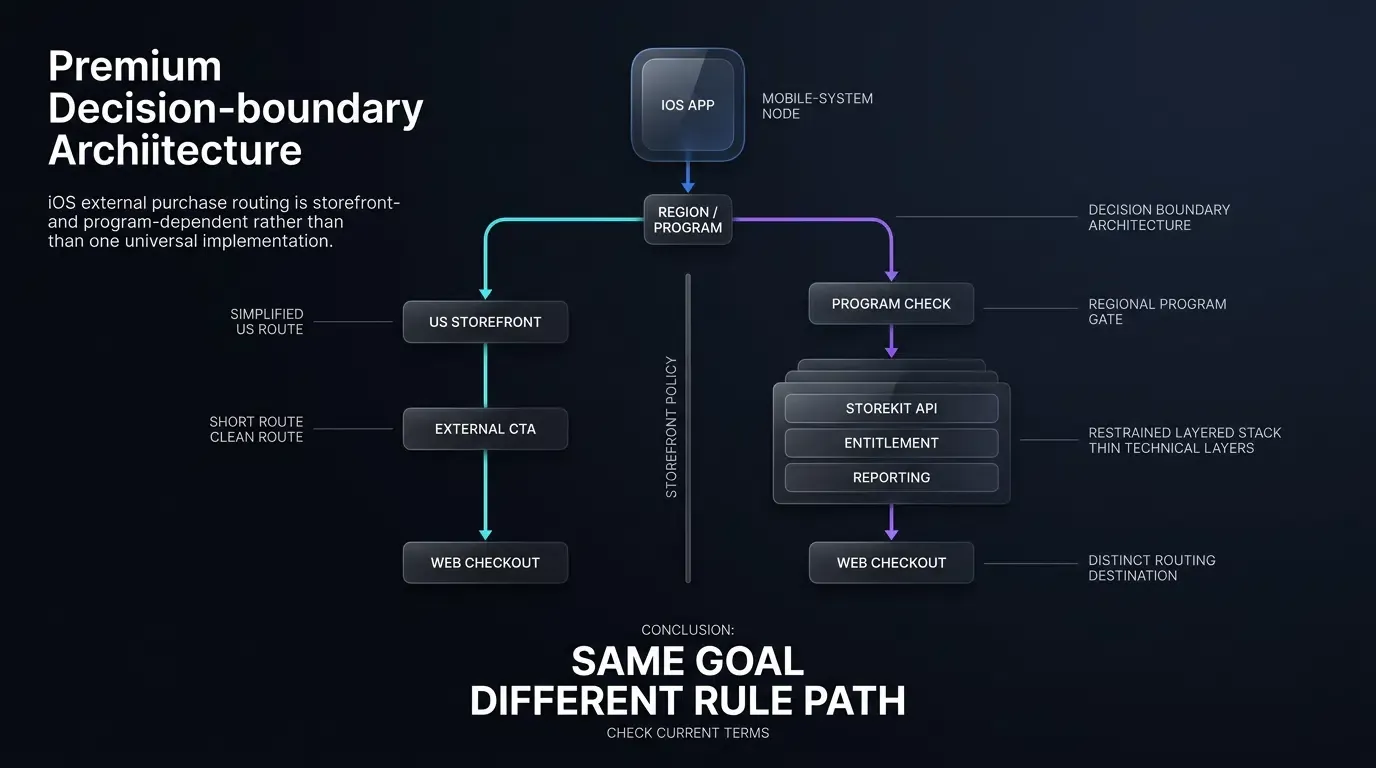
Storefront Frameworks: US Policy vs. Regional StoreKit External-Purchase Frameworks
A common architectural misconception is that all external payment links rely on identical system APIs. Developers must decouple their implementations based on storefront geography and applicable programs:
- US Storefront Framework: Following the 2021 injunction, the Apple App Store Review Guidelines permit apps on the United States storefront to include buttons, external links, or other calls to action directing users to purchasing mechanisms outside IAP without requiring the specialized StoreKit External Purchase Link Entitlement profile. Commercial terms, tier assessments, and reporting mechanisms remain governed by applicable developer agreements.
- Regional StoreKit External-Purchase Frameworks: Outside the US, implementation models vary by jurisdiction and Apple program. Certain storefronts (such as select European Economic Area or Russia external-link programs) utilize specific StoreKit entitlements where invoking
ExternalPurchaseLink.open()presents a continuation sheet and appends an Apple-generated external purchase token to the URL for auditing. Other jurisdictions and programs—such as South Korea alternative billing or evolving EU business terms—employ distinct StoreKit APIs, notice sheets, and reporting pipelines. Furthermore, in the EU, Apple has announced a transition to unified business terms effective October 1, 2026, meaning entitlement, API, commission, and reporting requirements must be evaluated against the developer’s applicable storefront and agreement at implementation time.
Building the Bi-Directional Web Checkout Loop
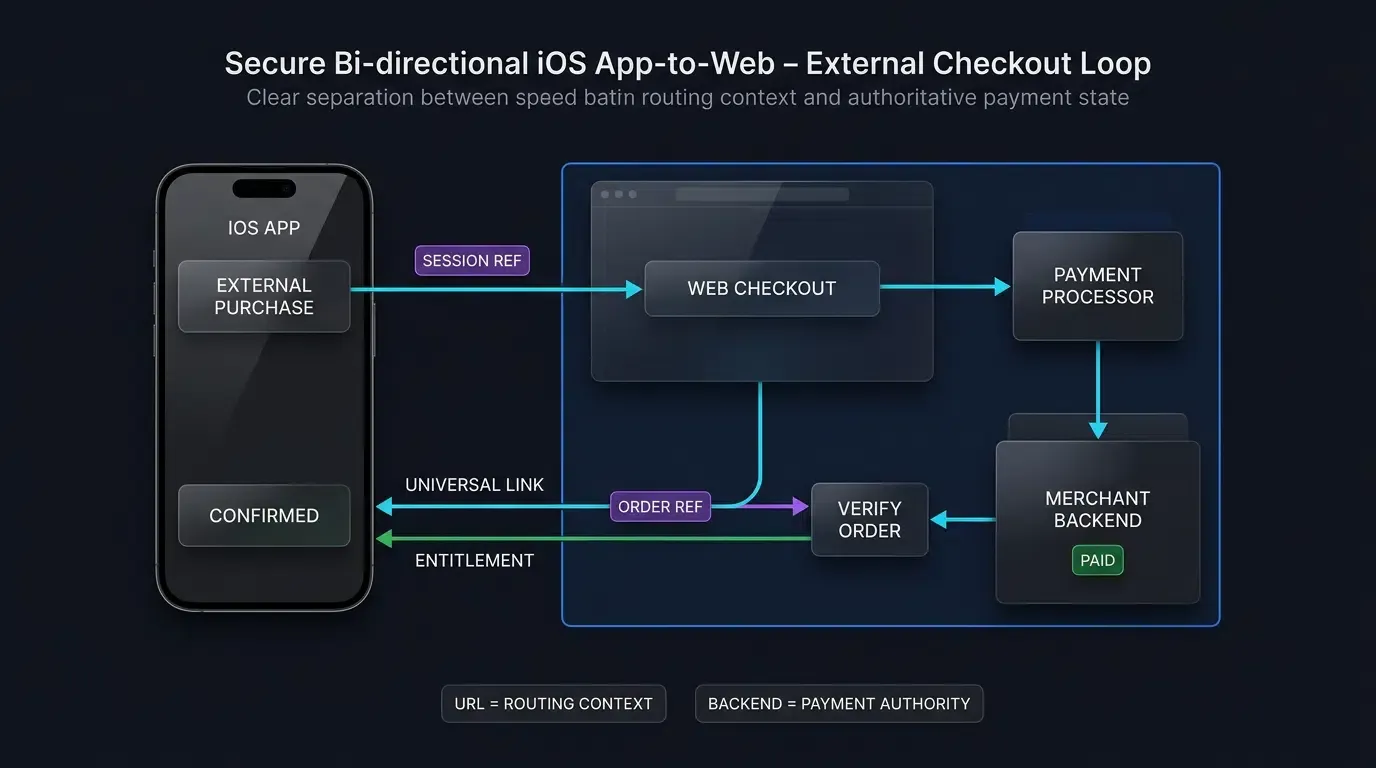
The following architecture illustrates a generic, merchant-designed external link flow. In storefronts governed by specialized platform programs, region-specific StoreKit APIs may replace or wrap the outbound-dispatch step where required.
- Outbound Browser Dispatch: The application presents an eligible call to action or link button. Upon user interaction, the app dispatches the external URL using standard system handlers (or StoreKit sheets where mandated by regional entitlement APIs). The application appends an opaque, short-lived checkout session reference (e.g.,
https://checkout.example.com/pay?session_ref=chk_99182) to correlate the user’s intent. Sensitive personal data or raw account credentials must never be passed in plaintext URL query strings. - Web-Side Transaction Processing: The web payment gateway ingests the session reference, handles customer authentication, and executes payment processing through an external payment service provider (such as Stripe or Adyen).
- Merchant Backend Confirmation: Once the external processor confirms the payment, the merchant backend marks the order as fulfilled in its authoritative database and records a completion receipt.
- Inbound Return Navigation (Universal Links): Upon payment finalization, the web completion page offers or initiates a return flow to the native app using verified Apple Universal Links (e.g.,
https://checkout.example.com/payment-complete?order_ref=ord_8812). - On-Device Scene Processing & Entitlement Refresh: The operating system intercepts the HTTPS Universal Link and delivers the payload to
UIWindowSceneDelegateviascene(_:continue:)orscene(_:willConnectTo:options:). The native application parses the opaque order reference, queries its backend over an authenticated API to verify transaction ownership, and updates user entitlements accordingly.
+-------------------------------------------------------------------------+
|                  BI-DIRECTIONAL APP-TO-WEB PAYMENT PIPELINE             |
+-------------------------------------------------------------------------+
|                                                                         |
|  [ Native iOS App: User Selects External Purchase Option ]              |
|         |                                                               |
|         |-- (Dispatches Outbound Link via UIApplication.shared.open)    |
|         v                                                               |
|  [ Safari / Default Web Browser: Opens Checkout Portal ]                |
|  URL: https://checkout.example.com/pay?session_ref=CHK_99182            |
|         |                                                               |
|         v                                                               |
|  [ Web Payment Gateway: Processes External Transaction ]                |
|         |                                                               |
|         |-- (Merchant Backend Confirms Payment & Records Receipt)       |
|         v                                                               |
|  [ Web Completion Page: Initiates Verified Universal Link Return Flow ] |
|  URL: https://checkout.example.com/payment-complete?order_ref=ORD_8812  |
|         |                                                               |
|         v                                                               |
|  [ iOS Intercepts HTTPS Domain Association (AASA Validated) ]           |
|         |                                                               |
|         +---------------------------------------+                       |
|         | (App Running in Memory)               | (App Cold Launch)     |
|         v                                       v                       |
|  [ scene(_:continue:) ]                 [ scene(_:willConnectTo:) ]     |
|         |                                       |                       |
|         +-------------------+-------------------+                       |
|                             |                                           |
|                             v                                           |
|  [ App Queries Merchant Backend to Rehydrate Authoritative Entitlement ]|
|                             |                                           |
|                             v                                           |
|  [ Scene Hierarchy Displays Confirmation Screen & Unlocks Digital Item ]|
|                                                                         |
+-------------------------------------------------------------------------+
This architecture reinforces an essential security boundary: URL query parameters must never serve as authoritative proof of purchase. An incoming Universal Link provides return-routing context; authoritative digital fulfillment must always be rehydrated directly from the merchant’s backend billing services.
// Illustrative Swift implementation demonstrating secure return routing from an external web checkout.
// Validates incoming Universal Links within UIWindowSceneDelegate, parses opaque order references,
// and queries authoritative backend billing services to update entitlements without relying on browser cookies.

import UIKit

struct CheckoutCompletionPayload {
    let orderRef: String
}

final class PaymentReturnRouter {
    static let shared = PaymentReturnRouter()

    // Whitelisted host to enforce defense-in-depth routing boundaries
    private let authorizedHost = "checkout.example.com"
    private let authorizedPathPrefix = "/payment-complete"

    private init() {}

    /// Parses and validates the incoming Universal Link to extract non-authoritative payment completion hints
    func parseReturnURL(_ url: URL) -> CheckoutCompletionPayload? {
        guard let components = URLComponents(url: url, resolvingAgainstBaseURL: true),
              components.scheme == "https",
              components.host == authorizedHost,
              components.path.hasPrefix(authorizedPathPrefix),
              let queryItems = components.queryItems else {
            return nil
        }

        guard let orderRef = queryItems.first(where: { $0.name == "order_ref" })?.value else {
            return nil
        }

        return CheckoutCompletionPayload(orderRef: orderRef)
    }

    /// Directs view hierarchy navigation and delegates authoritative transaction validation to the backend
    func handlePaymentCompletion(payload: CheckoutCompletionPayload, in window: UIWindow?) {
        // Note: URL query parameters do not serve as proof of purchase.
        // The native app queries authoritative backend services over an authenticated channel regardless of query parameters.
        BackendBillingService.shared.verifyExternalOrder(orderRef: payload.orderRef) { result in
            DispatchQueue.main.async {
                guard let nav = window?.rootViewController as? UINavigationController else { return }

                switch result {
                case .success(let orderState):
                    if orderState.isPaid {
                        let successVC = OrderSuccessViewController(orderRef: payload.orderRef, entitlements: orderState.entitlements)
                        nav.pushViewController(successVC, animated: true)
                    } else {
                        let pendingVC = OrderPendingViewController(orderRef: payload.orderRef)
                        nav.pushViewController(pendingVC, animated: true)
                    }
                case .failure(let error):
                    print("Authoritative order verification failed: \(error.localizedDescription)")
                    let failureVC = OrderFailureViewController()
                    nav.pushViewController(failureVC, animated: true)
                }
            }
        }
    }
}

// UIWindowSceneDelegate capturing Universal Link delivery across cold-launch and warm-session lifecycles
class SceneDelegate: UIResponder, UIWindowSceneDelegate {
    var window: UIWindow?

    // Scenario 1: Connecting a scene during launch or activation when returned from Safari
    func scene(_ scene: UIScene, willConnectTo session: UISceneSession, options connectionOptions: UIScene.ConnectionOptions) {
        guard let windowScene = scene as? UIWindowScene else { return }

        let window = UIWindow(windowScene: windowScene)
        let navigationController = UINavigationController(rootViewController: StorefrontViewController())
        window.rootViewController = navigationController
        self.window = window
        window.makeKeyAndVisible()

        if let userActivity = connectionOptions.userActivities.first(where: { $0.activityType == NSUserActivityTypeBrowsingWeb }),
           let incomingURL = userActivity.webpageURL,
           let payload = PaymentReturnRouter.shared.parseReturnURL(incomingURL) {
            PaymentReturnRouter.shared.handlePaymentCompletion(payload: payload, in: window)
        }
    }

    // Scenario 2: Delivering a Universal Link to an existing scene already running or suspended in memory
    func scene(_ scene: UIScene, continue userActivity: NSUserActivity) {
        guard userActivity.activityType == NSUserActivityTypeBrowsingWeb,
              let incomingURL = userActivity.webpageURL,
              let payload = PaymentReturnRouter.shared.parseReturnURL(incomingURL) else {
            return
        }

        PaymentReturnRouter.shared.handlePaymentCompletion(payload: payload, in: self.window)
    }
}

struct OrderState {
    let isPaid: Bool
    let entitlements: [String]
}

// Stubs representing application view controller hierarchy and billing services
final class BackendBillingService {
    static let shared = BackendBillingService()
    private init() {}

    func verifyExternalOrder(orderRef: String, completion: @escaping (Result<OrderState, Error>) -> Void) {
        // Queries merchant backend over secure API to confirm transaction state and entitlement eligibility
        completion(.success(OrderState(isPaid: true, entitlements: ["unlimited_access", "premium_tier"])))
    }
}

class StorefrontViewController: UIViewController {
    override func viewDidLoad() {
        super.viewDidLoad()
        title = "Storefront"
        view.backgroundColor = .systemBackground
    }
}

class OrderSuccessViewController: UIViewController {
    let orderRef: String
    let entitlements: [String]

    init(orderRef: String, entitlements: [String]) {
        self.orderRef = orderRef
        self.entitlements = entitlements
        super.init(nibName: nil, bundle: nil)
    }

    required init?(coder: NSCoder) { fatalError("init(coder:) has not been implemented") }

    override func viewDidLoad() {
        super.viewDidLoad()
        title = "Order Confirmed"
        view.backgroundColor = .systemGroupedBackground
    }
}

class OrderPendingViewController: UIViewController {
    let orderRef: String
    init(orderRef: String) {
        self.orderRef = orderRef
        super.init(nibName: nil, bundle: nil)
    }
    required init?(coder: NSCoder) { fatalError("init(coder:) has not been implemented") }
    override func viewDidLoad() {
        super.viewDidLoad()
        title = "Order Processing"
        view.backgroundColor = .secondarySystemBackground
    }
}

class OrderFailureViewController: UIViewController {
    override func viewDidLoad() {
        super.viewDidLoad()
        title = "Payment Failed"
        view.backgroundColor = .systemGroupedBackground
    }
}
Downstream Mobile Acquisition and the Install Boundary
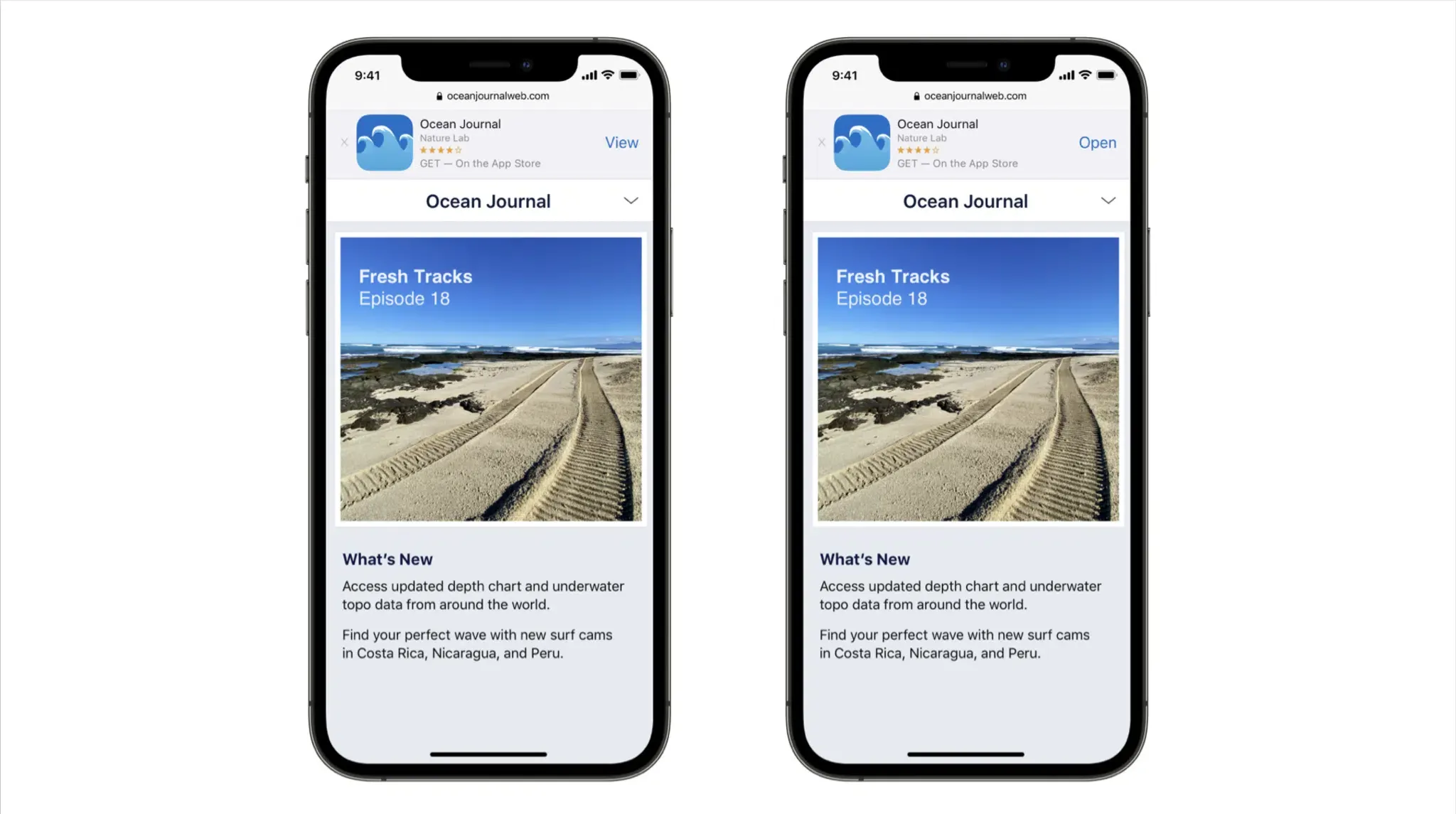
While App-to-Web routing governs existing users exiting an installed app to complete a transaction, digital merchants frequently confront the inverse operational challenge: acquiring new customers on the open web and transitioning them into a native mobile application.
In multi-channel marketing campaigns, prospective users frequently encounter web storefronts or promotional landing pages via social media, content marketing, or web search ads. On these web landing pages, a customer may register an account, configure a subscription, or select a promotion before installing the native app.
+-------------------------------------------------------------------------+
|             SEPARATE DOWNSTREAM MOBILE ACQUISITION JOURNEY              |
+-------------------------------------------------------------------------+
|                                                                         |
|  [ External Touchpoint: Web Storefront / Promotional Landing Page ]     |
|  Captured Context: ?campaign_id=fall_sale&promo_code=SAVE20&sku=8831     |
|         |                                                               |
|         v                                                               |
|  [ User Interacts with Campaign / Clicks "Get Mobile App" CTA ]         |
|         |                                                               |
|         v                                                               |
|  [ Redirect to Apple App Store ]                                        |
|         |                                                               |
|         v                                                               |
|  [ THE INSTALL BOUNDARY: Standard App Store Download Flow Does Not      |
|    Automatically Reconstruct Arbitrary Web Context on First Launch ]    |
|         |                                                               |
|         v                                                               |
|  [ User Launches App for First Time (Cold Boot) ]                       |
|  Default Behavior: Generic home screen; web campaign context dropped.   |
|         |                                                               |
|         v                                                               |
|  [ Deferred Deep Linking Engine: Server-Assisted Signal Matching ]      |
|         |                                                               |
|         v                                                               |
|  [ Eligible Context Restored: App Routes to Login or Product Claim ]    |
|         |                                                               |
|         v                                                               |
|  [ App Authenticates User & Backend Confirms Entitlements Separately ]   |
|                                                                         |
+-------------------------------------------------------------------------+
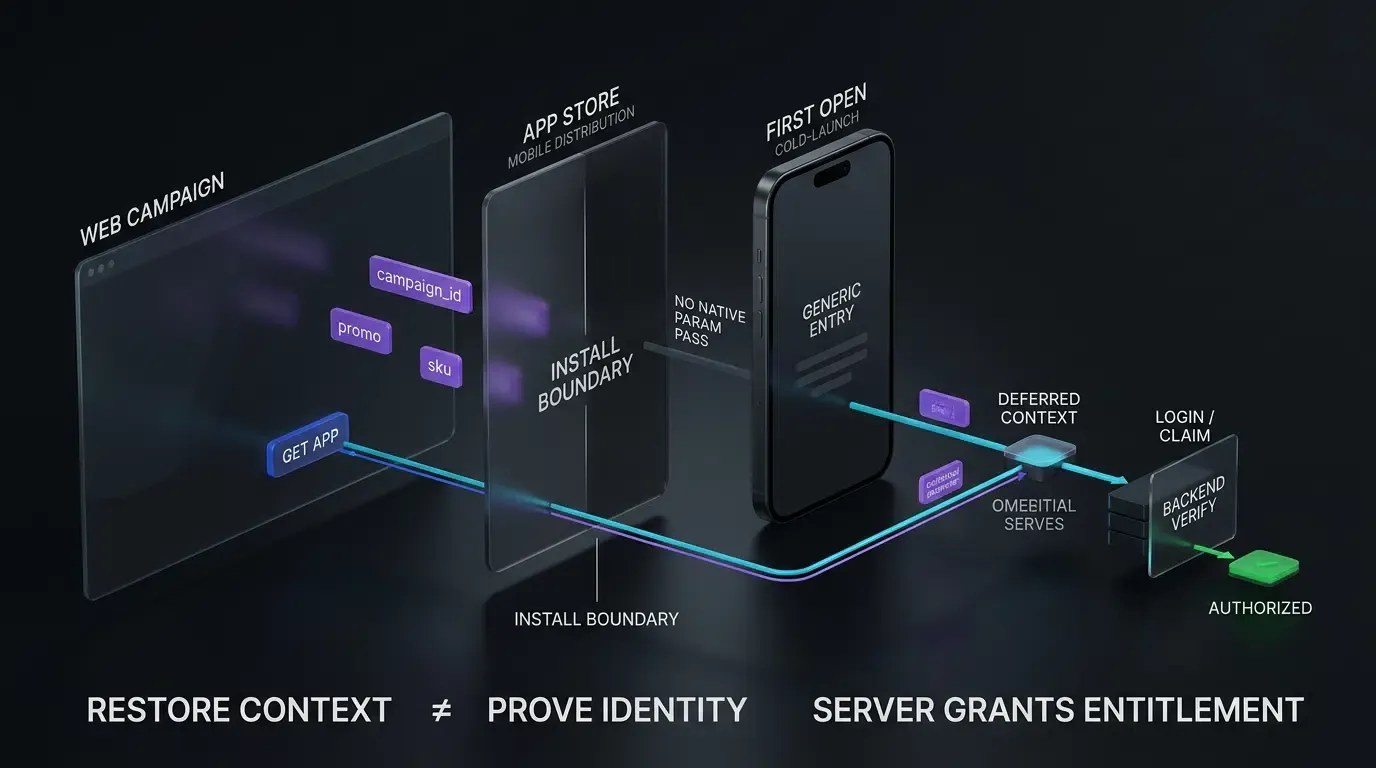
When an uninstalled user navigates from a mobile web storefront to the App Store, standard operating system distribution channels do not pass arbitrary web query parameters—such as campaign tags, affiliate tokens, or pending order references—into the newly installed application binary. On initial cold launch, the application cannot natively identify which specific promotional campaign or web catalog item motivated the download.
To bridge this installation boundary, engineering teams evaluate several link-handling frameworks across the customer journey:
| Routing Architecture | Target App State | Parameter Preservation Across Install | Operational Ownership Model |
|---|---|---|---|
| Custom URI Schemes | Target App Installed | No native destination when app is absent; requires explicit fallback handling | Application-owned (High maintenance overhead) |
| Verified Universal Links | Target App Installed | Resolves to fallback web page; does not natively reconstruct arbitrary web context after store download | Domain + Application-owned (Requires AASA hosting) |
| Region-Specific StoreKit External Purchase APIs | Target App Installed | Depends on storefront and program; certain flows require Apple entitlements, system disclosures, tokens, and/or reporting | Platform-managed (Subject to regional program rules) |
| Deferred Deep Linking (DDL) | Target App Absent | Restores eligible pre-install parameters on first cold boot | SDK-assisted (Managed attribution and routing engine) |
In production mobile architectures, development teams deploy Deferred Deep Linking frameworks such as Branch, AppsFlyer, Adjust, or Opoinstall. A platform like Opoinstall records eligible pre-install web click metadata—such as marketing campaign identifiers or product SKU references—before the user transitions to the App Store.
Upon the application’s initial cold boot, the client SDK queries the attribution backend to match the first-launch instance with the prior web click session. According to official platform documentation on the Opoinstall homepage, this deferred parameter pass-through framework can restore parameters on first launch in up to 98% of eligible instances, providing an automated alternative to manual promotional-code entry or generic first-launch navigation.
Maintaining precise architectural boundaries is vital: Deferred deep linking does not authenticate user accounts, prove payment ownership, or bypass platform review policies. It restores non-authoritative pre-install context (such as an order reference or referral tag), enabling the application to guide the user to the appropriate login or redemption screen, where backend identity verification and entitlement unlocking must be performed independently.
Frequently Asked Questions (FAQ)
What is the primary issue the Supreme Court agreed to decide in *Apple v. Epic Games*?
Does every external purchase link on iOS require the StoreKit External Purchase Link Entitlement?
How do mobile applications maintain state when returning from an external web checkout?
Strategic Guidance for Mobile Engineering Teams
The Supreme Court’s review of Apple v. Epic Games highlights the persistent legal and regulatory evolution governing mobile application marketplaces. However, software architects and billing engineers cannot afford to treat payment routing as an afterthought pending judicial outcomes.
Engineering organizations operating global iOS applications should anchor their systems around three architectural principles:
-
Decouple Regional Payment Logic: Separate payment routing implementations between standard US external linking rules and region-specific StoreKit entitlement frameworks to ensure compliance across diverse legal storefronts.
-
Harden Inbound Universal Link Callbacks: Build resilient Universal Link handlers within
UIWindowSceneDelegatethat validate expected schemes, hosts, and paths, treating incoming query parameters as routing hints rather than authoritative transaction receipts. -
Isolate Attribution Context from Payment Authority: Utilize Deferred Deep Linking to preserve user intent across app installation funnels, while ensuring that account authentication and digital entitlement unlocking remain strictly enforced by secure, authoritative backend services.
References
-
Supreme Court of the United States. (2026). Docket for No. 25-1311, Apple Inc., Petitioner v. Epic Games, Inc..
-
Supreme Court of the United States. (2026). Brief for Petitioner Apple Inc., No. 25-1311.
-
United States Court of Appeals for the Ninth Circuit. (2025). Epic Games, Inc. v. Apple, Inc., No. 25-2935, 161 F.4th 1162.
-
Apple Developer. (2026). App Store Review Guidelines. Apple Documentation.
-
Apple Developer. (2026). StoreKit External Purchase Link Entitlement. Apple Documentation.
-
Apple Developer. (2026). Supporting Universal Links in your app. Apple Documentation.
-
Apple Developer. (2026). Managing your app’s life cycle with UIWindowScene. Apple Documentation.
-
MacRumors. (2026). Apple Asks Supreme Court to Throw Out App Store Contempt Ruling.
-
AppleInsider. (2026). Apple standing its ground in Epic’s App Store fee suit.
-
Opoinstall. (2026). Deferred Deep Linking and Parameterized App Installation Overview.
Share this article