Google Sets Jan 2027 Android Developer Verification? Google has confirmed that it will begin enforcing its Android Developer Verification requirement globally in January 2027, starting with seven major app distributors before gradually expanding to additional countries and all installation sources on certified Android devices over the following months. Announced on November 19, 2026 by Matthew Forsythe, Director of Product Management for Android App Safety, on the Android Developers Blog, the rollout builds on regional protections that went live on September 30, 2026 across participating stores in Brazil, Indonesia, Singapore, and Thailand. Under the policy, developers distributing outside Google Play—including via OEM storefronts, open-source repositories, and direct APK downloads—must verify their identity and register their package names and signing keys to maintain standard installation behavior.
Rollout Timeline and Distributor Scope for Android Developer Verification
At a Glance
- Global rollout begins in January 2027 with seven participating distributors—Google Play, Samsung Galaxy Store, Honor, Oppo, Xiaomi, Transsion, and Vivo—while Google states protections will expand across additional stores, countries, and installation sources over the following months; Google’s distributor guide lists March 1, 2027 as the target readiness milestone for broader store enforcement.
- Google reports that millions of apps have been registered since March 2026, covering more than 99% of global Android app installs, though unregistered packages outside Play will face installation blocks unless users enable a buried 24-hour bypass flow.
- Following developer feedback, Google raised the sharing cap for its free limited-distribution tier to 50 authorized devices and shipped two automation APIs alongside formal guides for open-source registries and third-party app stores.
Google first introduced the Android Developer Verification initiative in August 2025, framing identity registration as an accountability layer intended to make it harder for malicious actors to repeatedly distribute harmful packages after takedowns. While Google Play developers have already undergone identity verification workflows, the new framework extends package-level registration across non-Play distribution channels on certified Android devices.
According to Ars Technica, the underlying system verifier service has already been deployed to Google-certified devices running Android 8 Oreo or later—covering the vast majority of certified handsets globally, while leaving uncertified devices unaffected. On September 30, 2026, user protections went live across participating storefronts in Brazil, Indonesia, Singapore, and Thailand. With the initial regional rollout now live, Google confirmed that global enforcement will roll out in phases beginning in January 2027.

Google’s resources for app distributors set March 1, 2027 as the target readiness milestone for participating third-party storefronts to reflect that verification is in effect. Meanwhile, Google’s November 19 rollout announcement states that protections will continue expanding gradually across remaining countries and all installation sources on certified devices over several months following the January 2027 launch.
| Rollout Milestone | Verified Scope | Effective Timing |
|---|---|---|
| Program Announcement | Identity verification and package registration policy introduced | August 2025 |
| Open Developer Registration | Registration opened globally across developers | March 2026 |
| Limited Distribution & Bypass Launch | Free student/hobbyist tier and 24-hour Advanced Flow introduced | August 2026 |
| Regional Rollout Activation | Activated for participating stores in Brazil, Indonesia, Singapore, and Thailand | September 30, 2026 |
| Global Seven-Distributor Launch | Rollout begins across Google Play, Galaxy Store, Honor, Oppo, Xiaomi, Transsion, and Vivo | January 2027 |
| Broader Store Readiness | Target readiness milestone for participating third-party app distributors | March 1, 2027 (Target) |
| All Installation Sources | Gradual expansion across remaining countries and all installation sources on certified devices | Subsequent months (2027) |
Technical Registration Mechanics and Identity Discrepancies
At the technical layer, Google’s open-source registration documentation and distributor guides specify that registering an app binds a unique package name and the SHA-256 certificate fingerprint of its signing key to a verified Android Developer Console or Google Play Console account. Google states that registering an individual application takes under ten minutes and that the company is verifying developer identity rather than reviewing the content of off-Play binaries.
For commercial and general distribution, Ars Technica reports that full verification requires government-issued identification and a $25 registration fee. Ars Technica also notes that while popular app IDs are cached directly on devices for offline checks, sideloading less common packages may require an active network connection to Google’s servers to confirm registration status before installation proceeds.
Regarding jurisdictional exclusions, Google’s verification FAQ states that while developers located in comprehensively sanctioned countries cannot complete Android developer verification due to legal restrictions, verification checks do not run on certified Android devices physically located in those countries. As a result, users physically located inside sanctioned jurisdictions can continue installing apps without verification checks.
Limited Distribution Tier and Reported Cap Discrepancy
To avoid blocking classroom projects and personal prototypes, Google introduced limited distribution accounts in August 2026. These accounts are free and do not require government ID verification, though they still require a Google Account with 2-Step Verification and a Google payments profile holding the developer’s legal name and address. App sharing under this tier uses a device-authorization handshake via QR codes or links.
Public sources reflect a minor discrepancy in how the pre-expansion cap is described:
- Official Google Documentation: While Google’s standalone limited-distribution guide and earlier FAQ entries previously documented a 20-device ceiling, Google’s November 19, 2026 rollout announcement explicitly states that the sharing limit has been expanded “from 20 to 50 authorized devices.”
- Secondary Media Reporting: Reporting from Ars Technica described the adjustment as an increase from an initial cap of “25 total installs to 50 installs.”
Google has not published a reconciliation explaining the different initial baseline figures cited by external outlets, though both sources confirm the updated ceiling stands at 50 devices or installs.
Automation APIs and Store Re-Signing Friction
For organizations managing large catalogs or third-party distribution pipelines, manual console entry introduces operational friction. To address this, Google released two programmatic interfaces documented in its distributor resources:
- Android Developer ID Status API: Allows storefronts and distributors to audit existing app catalogs by querying whether a specific package name and SHA-256 signing certificate fingerprint are already registered.
- Android Developer Console API: Uses OAuth 2.0 delegation so participating storefronts or open-source repositories can register package names and store-managed signing keys directly on behalf of verified developers.
The signing-key detail is particularly consequential for cross-store and open-source distribution. As explained in Google’s open-source app registration guide, if an open-source repository or third-party store re-signs an APK using its own platform key rather than the developer’s original key, the developer must either extract and register the store-signed SHA-256 fingerprint or rely on the repository’s Console API integration. Otherwise, the device verifier will treat the re-signed package as unregistered.
User Bypass Paths, Exemptions, and Open-Ecosystem Trade-offs
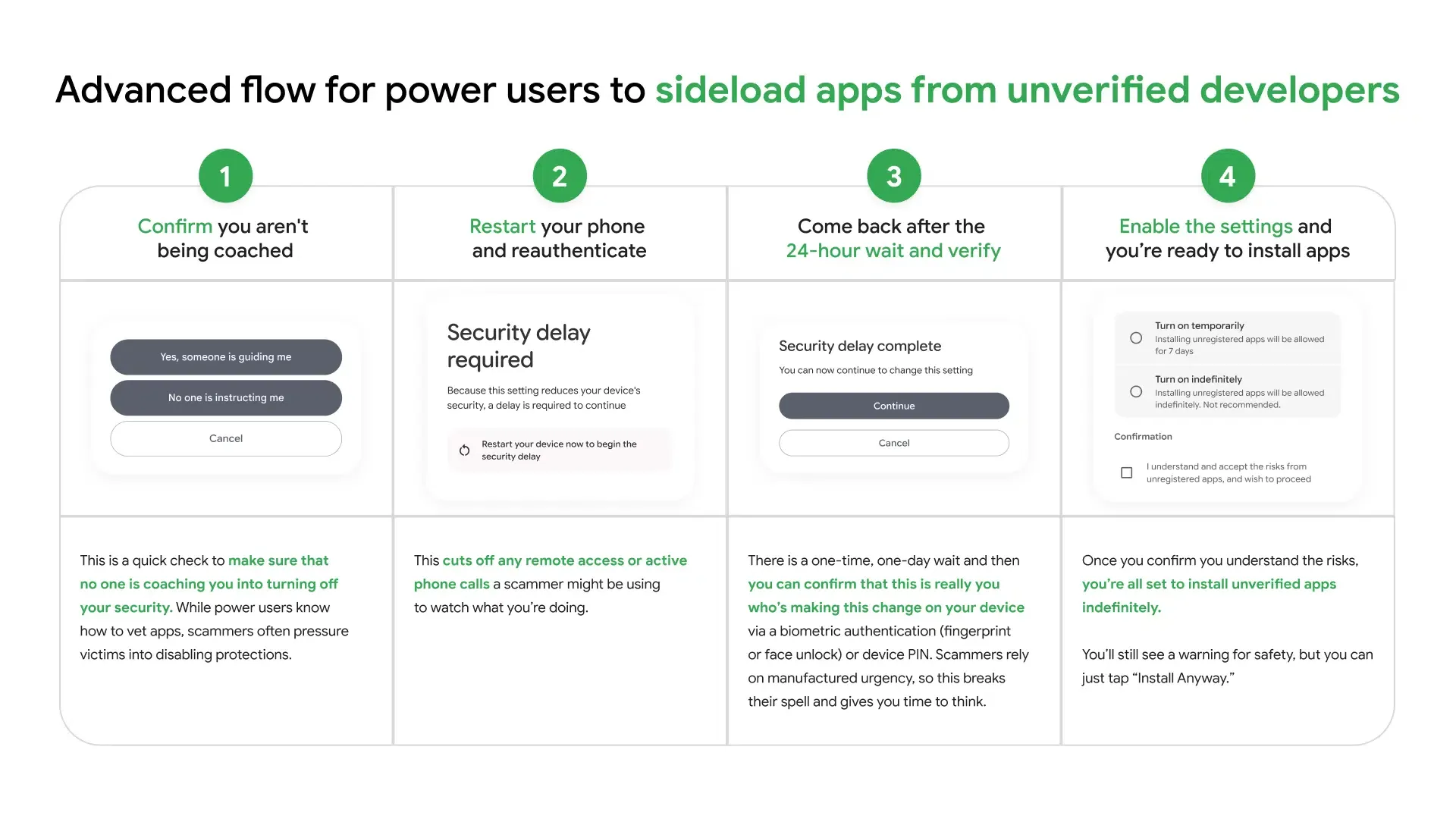
Despite framing the program as a response to social-engineering malware, Google faced pushback from open-source maintainers and power users over restrictions on sideloading. In response, the company shipped an opt-out mechanism documented in Android Help and its verification FAQ known as the Advanced Flow.
Under the Advanced Flow, experienced users can allow installations from unverified developers, but the workflow introduces deliberate friction. According to Ars Technica’s walkthrough and Google’s support documentation, users must unlock Developer Options, enable the unverified-packages toggle, confirm via device PIN that they are not acting under coercion, reboot the handset, and wait through a mandatory 24-hour security delay before choosing temporary or indefinite unverified installs.
Google’s verification FAQ also confirms explicit scope boundaries where verification checks do not block installation:
- Android Debug Bridge (ADB): Developer installs executed over ADB remain exempt from package registration checks on certified devices.
- Enterprise Managed Devices: Private applications deployed through an organization’s managed device store do not require verification, though Google recommends registering them.
- Uncertified Devices: Uncertified Android devices are outside the system verifier’s scope.
Multi-Channel Distribution Responsibilities After Android Developer Verification
When enforcement expands across installation sources in 2027, teams distributing Android software across Google Play, the six partner OEM stores, and direct Web-to-APK landing pages face a clearer separation between installation eligibility and post-install context delivery. Passing Google’s package-and-key verification clears the developer-verification layer without triggering the 24-hour Advanced Flow, while other platform, store, and compatibility checks may still apply., yet distribution verification itself does not carry marketing campaign tags, referral codes, or destination deep-link states into the newly launched app.
Conceptual Responsibility Model (Non-Official Architecture)
Note: The diagram and table below present a Conceptual Responsibility Model illustrating how multi-channel Android distribution stacks separate verification, delivery, and parameter handoff; this is not an official Google internal implementation topology.
[ Developer Build & Registry ]
  Sign APK (SHA-256 Key) ──> Register Package + Key Fingerprint (Play / Developer Console)
                                       │
                                       ▼
[ Multi-Channel Distribution ]
  Google Play / 6 OEM Stores / Direct Web APK ──> Device Verifier Check (Certified Android 8+)
                                       │
                                       ▼
[ Post-Install Context Layer ]
  Parameter SDK (e.g., OpoInstall) ──> Delivers Web Params at First Launch ──> App Backend Validates
Teams shipping across Google Play and non-Play Android storefronts benefit from assigning distinct engineering responsibilities across each layer rather than conflating store compliance with attribution:
| Component | Illustrative Responsibilities | Scope & Limitations |
|---|---|---|
| Android Developer Console / Play Console | Binds verified developer identity to package names and SHA-256 signing fingerprints; provides ID Status and Console APIs | Establishes installation accountability only; does not handle referral attribution or in-app routing |
| App Distributors (Play & 6 OEM Stores) | Audits submitted packages, manages store-side re-signing if applicable, and surfaces listing status | Enforces store-specific distribution rules; Play Install Referrer is limited to Google Play installs |
| Parameter Pass-Through SDK (e.g., OpoInstall) | Passes supported web promotional, invite, or room parameters across installation to first app launch | Functions strictly as an installation parameter pass-through framework; does not verify developer identity, bypass Android verification, authenticate users, or validate IAP |
| Developer Business Backend | Authenticates users, validates receipts, enforces anti-abuse rules, and binds delivered parameters to user records | Serves as the single source of truth for account state, entitlements, and campaign reconciliation |
Because Google Play’s native Install Referrer API applies only to Play Store installs, teams running Web-to-APK campaigns or distributing across Honor, Oppo, Xiaomi, Transsion, Vivo, and Samsung Galaxy Store may pair compliant package registration with a separate installation parameter pass-through layer such as OpoInstall to recover invite or campaign context upon first launch—provided the underlying APK and its channel-specific signing key have first been properly registered under Google’s verification rules.
Engineering Checklist for Multi-Store and Direct APK Teams
Engineering and release teams distributing Android packages outside Google Play should audit their release pipelines before the January 2027 rollout begins:
- Audit Off-Play Package Signatures: For apps distributed via both Google Play and OEM stores or direct website downloads, confirm in Play Console that every active package name and SHA-256 signing certificate—including any store-re-signed keys—is registered.
- Integrate ID Status Checks in CI/CD: Connect release automation to the Android Developer ID Status API to catch unregistered build variants or rotated signing keys before distribution.
- Account for Store Re-Signing Workflows: If distributing through third-party stores or open-source repositories that re-sign binaries, extract the final distributor-signed SHA-256 fingerprint or grant OAuth 2.0 delegation via the Android Developer Console API.
- Separate Verification From Parameter Delivery: Treat identity registration as a prerequisite for installation eligibility on certified devices, while keeping parameter delivery, receipt validation, and user authentication isolated in dedicated backend and SDK layers.
Frequently Asked Questions (FAQ)
Will Android developer verification completely block APK sideloading?
Do Google Play developers need to register anything if they only publish on Play?
How do open-source repositories and third-party stores handle APK re-signing?
Is the free hobbyist account capped at 20, 25, or 50 devices?
Key Takeaways for Engineering Teams
Google’s January 2027 global rollout of Android Developer Verification signals a structural transition in how Android handles software provenance across non-Play channels. By partnering with Google Play, Samsung Galaxy Store, Honor, Oppo, Xiaomi, Transsion, and Vivo at launch—beginning in January and expanding across additional stores and installation sources on certified devices over subsequent months—Google is tying basic installability to cryptographic key registration and verified developer identity.
For mobile engineering and release teams, the immediate operational priority is key hygiene rather than code rewriting. Auditing every active package name, tracking store-managed re-signing fingerprints across OEM and open-source channels, and integrating status APIs into continuous integration pipelines will determine whether off-Play distribution channels remain frictionless as enforcement goes live.
References
-
Android Developers Blog. Expanding Android developer verification in 2027. Primary official rollout announcement (Nov 19, 2026).
-
Android Developers Blog. Elevating Android security with developer verification. Initial official program announcement (Aug 2025).
-
Android Developers. Resources for app distributors | Android developer verification. Official technical documentation on target store readiness and automation APIs.
-
Android Developers. Register your app on open-source repositories | Android developer verification. Official guide on package names, SHA-256 fingerprints, and store re-signing.
-
Android Developers. Register for limited distribution on Android devices. Official specification for free student and hobbyist limited-distribution accounts.
-
Android Developers. Frequently asked questions | Android developer verification. Official policy documentation covering ADB, enterprise exemptions, sanctioned regions, and Advanced Flow.
-
Android Help. Allow app installs from unverified developers. Official end-user support guide for the 24-hour Advanced Flow bypass.
-
Ars Technica. Google will launch Android app verification requirement globally in January 2027. Independent reporting on Android 8+ verifier deployment, $25 fee, and offline caching caveats (Nov 20, 2026).
-
Ars Technica. Google details new 24-hour process to sideload unverified Android apps. Independent walkthrough of the 24-hour Advanced Flow opt-out mechanism.
-
OpoInstall Documentation. OpoInstall Official Technical Documentation. Reference specification for installation parameter pass-through frameworks.
Share this article