What is an API and how does it connect MMPs with ad networks? An Application Programming Interface (API) is a defined software interface that enables Mobile Measurement Partners (MMPs) to securely transmit attributed conversion postbacks to advertising networks via standardized HTTP Server-to-Server (S2S) requests.
An Application Programming Interface (API) is a defined interface through which software components exchange data or request functionality. In mobile attribution, HTTP-based APIs enable independent Mobile Measurement Partners (MMPs) to transmit validated conversion signals directly to ad network endpoints via automated Server-to-Server (S2S) postbacks, supporting closed-loop campaign measurement and algorithmic budget optimization.
| Term | Definition | Related Entity | Search Intent Role |
|---|---|---|---|
| API Definition | A formal specification of interface contracts and data models for programmatic communication. | RESTful Web Services | Informational / Technical |
| Server Postback | An event-triggered server-to-server HTTP request delivering attribution or conversion data. | Webhook Callback | Technical / Informational |
| Mobile Measurement Partner | An independent attribution provider that deduplicates touchpoints and calculates conversion credit. | Attribution Engine | Commercial / Informational |
Understanding the Core Definition of an API in Mobile Marketing
Deconstructing the Acronym: Application Programming Interfaces as Universal Software Connectors
An Application Programming Interface (API) functions as an architectural contract between independent software platforms. Rather than requiring distinct systems to understand each other’s internal database designs or memory structures, an API defines the methods, data models, and interaction rules through which software components exchange information.
In mobile advertising, platforms operate across heterogeneous environments. Advertising platforms (such as programmatic demand-side platforms or ad networks) primarily have visibility into impressions and clicks served within their own publisher inventories; mobile applications execute inside isolated operating system sandboxes (iOS and Android); and Mobile Measurement Partners (MMPs) operate centralized data aggregation clusters.
APIs serve as the universal communication fabric across these layers. In client development, APIs expose local method signatures that applications call directly. Across cloud environments, network-based APIs—predominantly web APIs utilizing HTTP semantics—enable independent cloud backends to transmit event records programmatically.
How Server-to-Server Postbacks Reduce Dependence on Client-Side Reporting
Historically, mobile web advertising relied heavily on client-side tracking pixels and multi-hop HTTP 302 redirect chains. When a user tapped an advertisement, their mobile browser executed sequential redirects across tracking servers before reaching the destination store.
This legacy approach introduced operational vulnerabilities:
- Cumulative Latency and Drop-Off: Sequential HTTP redirects introduce additional network round-trips (DNS resolution, TLS handshakes, and cellular latency), increasing user drop-off before reaching the app store.
- Cookie Restrictions and Sandbox Isolation: Modern mobile browsers enforce strict third-party cookie restrictions and intelligent tracking prevention policies, stripping stateful identifier cookies during redirect navigation.
- Ad-Blocking Interception: Client-side tracking pixels executing within webviews or mobile browsers are susceptible to browser-level tracking protection and network filtering rules.
- Volatile Mobile Connectivity: Cellular handover between cell towers or brief connectivity drops during a client-side redirect chain can disrupt tracking requests before delivery completes.
Direct Server-to-Server (S2S) postbacks address these limitations in the reporting phase. While tracking links are still utilized during the initial click phase to capture campaign parameters and forward the user to the store, conversion event reporting is shifted from the client device to cloud backends. By transmitting attribution data directly between server clusters over dedicated network connections, S2S postbacks reduce reliance on client-side browser execution for conversion reporting.
The Technical Boundary: Differentiating In-App Client SDKs from Ingestion and Egress Web APIs
Attribution data architectures separate client-side instrumentation from cloud data routing:
- Client-Side Mobile SDKs: Embedded within the application binary, libraries such as the iOS or Android SDK interact with native operating system lifecycles. They capture local installation signals, listen for cold-start events, parse incoming launch intents, and transmit session telemetry to the attribution backend.
- Ingestion Web APIs: Hosted by the attribution provider, these HTTP endpoints receive raw interaction signals. They log incoming tracking link clicks from web browsers and accept event queues dispatched by the mobile client SDK over HTTPS.
- Egress S2S Web APIs (Postbacks): Cloud-to-cloud interfaces where the attribution platform acts as an HTTP client, programmatically dispatching validated conversion signals out to the ingestion APIs of participating ad networks, demand-side platforms (DSPs), and customer data platforms (CDPs).
How Does a Server to Server Postback Architecture Function
The Mechanics of Webhook Callbacks: Event-Driven HTTP Requests Across Cloud Boundaries
A server postback functions architecturally as an event-driven webhook callback. Rather than requiring an ad network to poll the measurement platform continuously with repetitive queries asking whether an install occurred, the attribution engine executes proactive, event-driven HTTP dispatches.
When a downstream conversion event is confirmed and attributed to a specific ad campaign, the attribution platform constructs an outbound HTTP request (transmitting via POST or GET based on the partner’s API specification) containing structured conversion parameters. This request transmits across the public internet via secure TLS connections to a pre-configured receiving endpoint hosted by the ad network.
Network Topology: How the Mobile Measurement Partner Sits Between Publishers and Ad Networks
In mobile marketing, the measurement partner acts as an independent data clearinghouse. Individual ad networks possess visibility only into the impressions and clicks served within their own publisher properties; they lack visibility into competitor traffic or downstream application retention.
The measurement partner ingests click signals across all media partners, attributes the conversion using deterministic or probabilistic logic, and fires outbound S2S postbacks to the winning ad network. Non-winning networks may receive secondary postbacks (such as non-attributed conversion notifications) depending on agreed privacy constraints and campaign configurations.
Payload Delivery Protocols: Utilizing Standard HTTP Methods over Secure TLS Channels
Postback transmissions adhere to established internet protocol specifications (IETF RFC 9110 HTTP Semantics). While historical systems frequently used HTTP GET requests with URL-encoded query strings, modern production architectures increasingly utilize HTTP POST requests transmitting structured JSON payloads:
- Transport Security: Production postback endpoints should enforce HTTPS using modern TLS configurations (such as TLS 1.2 or TLS 1.3) supported by both communicating parties, adhering to the receiving partner’s transport security requirements.
- HTTP Request Verbs: POST requests carry structured contextual payloads within the request body, avoiding URL length limitations associated with legacy GET query strings. GET requests remain widely supported across legacy ad network endpoints where parameters are appended as query string macros.
- Standardized Header Attributes: Postback requests include standard metadata headers, such as
Content-Type: application/jsonorapplication/x-www-form-urlencoded, and authorization tokens for sender verification.
How Attribution Platforms Orchestrate Programmatic S2S Postback Workflows
A representative MMP attribution architecture evaluates incoming conversion events against eligible engagement records, applies attribution and deduplication rules, and maps permitted event fields to configured partner-specific payloads. Once an installation or in-app purchase resolves, the postback dispatcher matches the attribution result against configured partner schemas and delivers the data to external partner APIs.
Actual delivery latency and internal queue architectures depend on the provider, platform load, and network conditions.
The following architectural diagram illustrates the end-to-end data pipeline from initial ad engagement to downstream S2S postback dispatch:
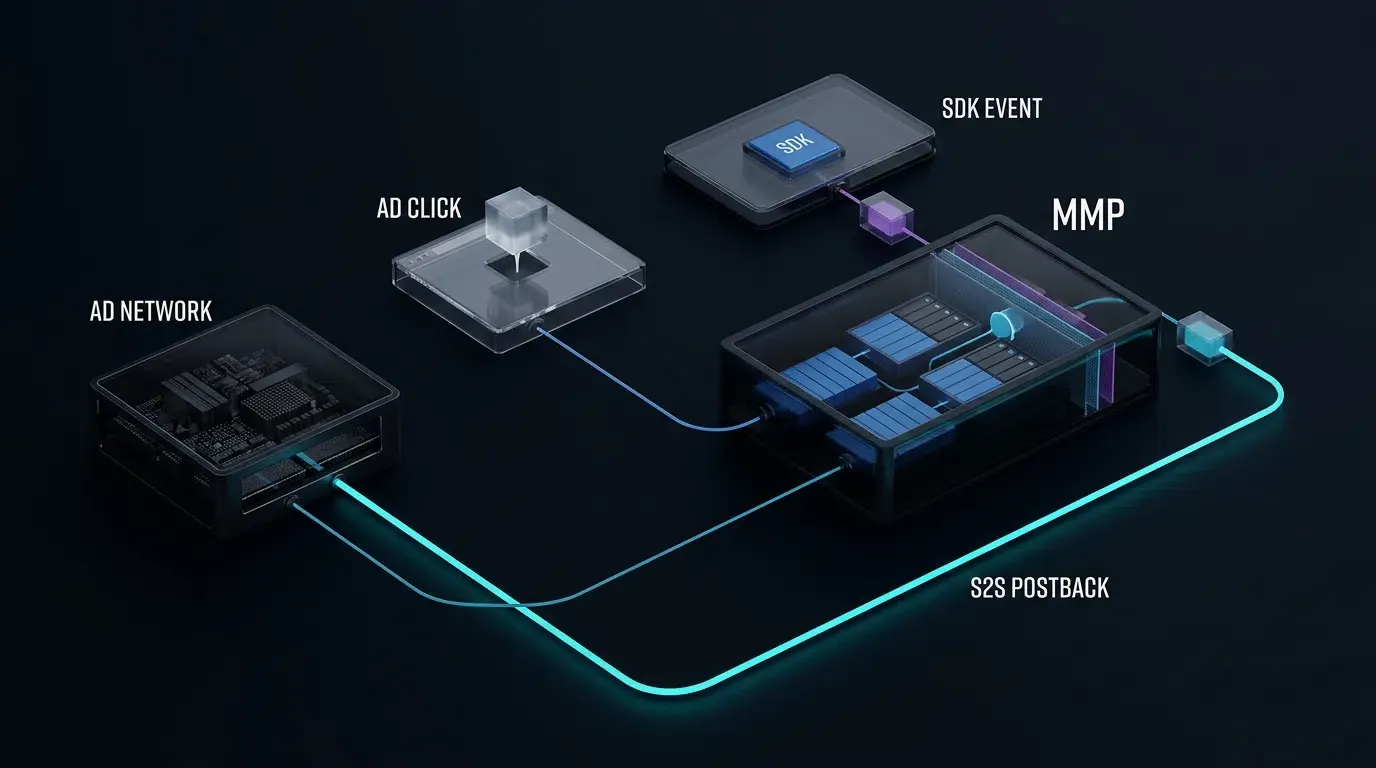
[Ad Network / DSP] ──(1. Ad Click with Click ID)──> [Tracking URL] ──(Redirect)──> [App Store / Google Play]
                                                           │                                    │
                                              (Click Ingestion)                                 ▼
                                                           ▼                             [Installed App]
[Ad Network Endpoint] <──(4. S2S Postback)── [MMP Attribution Engine] <──(3. SDK Telemetry)───────┘
                                                   │
                                        (Deduplication & Matching)
The Chronological Lifecycle of an Attribution API Call
Phase 1: Capturing Ingestion Context via Dynamic Tracking URLs and Query Strings
The postback lifecycle begins when an end user taps an ad displayed within an external application or mobile website. The ad network serves a dynamic tracking link pointing to the attribution platform’s ingestion cluster.
During this interaction, the ad network’s ad server dynamically interpolates campaign parameters into the tracking URL’s query string:
click_id: A unique transaction token generated by the ad network (e.g.,click_id=9876543210_abc).campaign_id: The internal identifier denoting the marketing campaign structure.publisher_id/site_id: Identifiers denoting the specific app or website placement that displayed the ad.
The attribution server ingests this HTTP request, logs the query parameters into an event store, attaches a timestamp, and redirects the user’s browser to the target destination (such as the Apple App Store or Google Play Store).
Phase 2: Client SDK Event Telemetry and Server-Side Attribution Reconciliation
Following installation, the user opens the mobile application. The embedded mobile client SDK initializes and packages initial session telemetry into a JSON event payload transmitted over HTTPS back to the attribution platform’s ingestion cluster.
The attribution engine extracts the incoming mobile activation parameters and queries its database to identify preceding touchpoints recorded within the active attribution lookback window. The attribution algorithm evaluates touchpoint timestamps, validates click integrity, and assigns conversion credit to the qualifying advertising touchpoint.
Phase 3: Formatting and Assembling the Downstream Conversion Postback Payload
Once attribution resolves, the postback generation worker formats the payload according to the specific data schema required by the winning ad network:
- A unique, stable
event_idis assigned to the postback record to facilitate downstream delivery deduplication. - The original
click_idis retrieved from the initial touchpoint record and mapped into the payload to allow the ad network to reconcile the install against the click. - Timestamps are normalized into standardized ISO 8601 strings (e.g.,
2026-11-16T07:56:00Z). - In-app event metadata—such as currency codes and purchase amounts—are formatted into destination types.
Phase 4: Executing the HTTPS Transmission and Evaluating Server Response Headers
The attribution engine establishes an outbound HTTPS connection to the destination ad network’s ingestion API endpoint and transmits the payload.
Upon dispatch, the worker monitors the HTTP response status code returned by the destination server to determine whether delivery succeeded or requires retry scheduling:
| HTTP Status | General Semantics | Recommended Action |
|---|---|---|
| 200 OK | Request succeeded. | Evaluate partner-specific acknowledgment and response body. |
| 201 Created | Resource created. | Confirm delivery under the partner’s API contract. |
| 202 Accepted | Accepted for processing; processing incomplete. | Record acceptance and follow the partner’s completion policy. |
| 204 No Content | Request succeeded without response content. | Confirm delivery according to the partner’s contract. |
| 400 / 422 | Invalid request or unprocessable content. | Review payload and schema before retrying; do not loop automatically. |
| 401 / 403 | Authentication or authorization issue. | Resolve credential or permission problems. |
| 429 | Rate limit exceeded. | Follow partner retry policy and honor Retry-After header when provided. |
| 500 / 502 / 503 / 504 | Server or gateway error. | Retry only when permitted and safe under the delivery contract. |
An HTTP 200 or 202 response confirms transport receipt at the destination server; it does not guarantee that the ad network’s downstream machine learning systems have completed attribution matching or campaign optimization.
Data Schemas and Key Fields in Conversion Postback Payloads
Structural Breakdown of a Production Attribution Postback Request
Production postback payloads follow standardized JSON structural schemas or URL parameter mappings. Every payload binds the initial ad engagement context to downstream user conversion actions.
Developers can consult the OpoInstall documentation center for comprehensive endpoint configuration guidelines, parameter dictionaries, and raw data export specifications.
Schema Boundary Note: The following JSON Schema illustrates a representative, application-defined conversion postback payload. It is not an official OpoInstall or ad network API specification. Required fields, data types, and authentication requirements depend on the receiving partner.
{
  "$schema": "https://json-schema.org/draft/2020-12/schema",
  "title": "IllustrativeConversionPostback",
  "type": "object",
  "required": [
    "event_id",
    "event_name",
    "event_timestamp"
  ],
  "properties": {
    "event_id": {
      "type": "string",
      "minLength": 1,
      "description": "Unique transaction event identifier used by receiving systems for idempotent deduplication."
    },
    "click_id": {
      "type": ["string", "null"],
      "description": "Unique transaction click identifier returned to the ad network; nullable for organic or view-through events."
    },
    "campaign_id": {
      "type": ["string", "null"],
      "description": "Marketing campaign identifier provided during initial click ingestion."
    },
    "event_name": {
      "type": "string",
      "minLength": 1,
      "description": "Category of conversion event being attributed (e.g., install, registration, purchase)."
    },
    "event_timestamp": {
      "type": "string",
      "format": "date-time",
      "description": "ISO 8601 timestamp denoting when the event occurred. Note that strict UTC enforcement depends on schema validator configuration."
    },
    "conversion_value": {
      "type": "number",
      "description": "Monetary value associated with the event (e.g., checkout revenue)."
    },
    "currency": {
      "type": "string",
      "pattern": "^[A-Z]{3}$",
      "description": "Three-letter currency format conforming to ISO 4217 syntax."
    },
    "attribution_provider": {
      "type": "string",
      "description": "Designation of the measurement partner generating the postback."
    }
  },
  "dependentRequired": {
    "conversion_value": ["currency"]
  }
}
Representative HTTP Request and Response Wire Artifact
The following illustrative HTTP request and response interaction demonstrates the wire-level transmission of an event-driven postback.
Protocol Note: These are simplified HTTP request and response examples. Message-framing headers (such as
Content-Length) are omitted for readability and are normally generated by the HTTP client and server runtime.
POST /v1/conversions HTTP/1.1
Host: partner-adnetwork.example.com
Content-Type: application/json
Authorization: Bearer <example_token>
User-Agent: Attribution-Postback-Dispatcher/2.0

{
  "event_id": "evt_9876543210_abc",
  "click_id": "click_123456789_xyz",
  "campaign_id": "cmp_spring_sale",
  "event_name": "purchase",
  "event_timestamp": "2026-11-16T07:56:00Z",
  "conversion_value": 29.99,
  "currency": "USD",
  "attribution_provider": "OpoInstall"
}
HTTP/1.1 202 Accepted
Content-Type: application/json
Date: Mon, 16 Nov 2026 07:56:01 GMT

{
  "event_id": "evt_9876543210_abc",
  "status": "accepted",
  "message": "Conversion event queued for downstream attribution"
}
Mapping Vital Field Entities: Click Identifiers, Event Identifiers, and Conversion Values
Every field within the postback payload fulfills an analytical role:
event_id: A stable, unique event identifier generated by the attribution system. Unlikeclick_id, which remains identical across all conversions stemming from a single click,event_iduniquely identifies each distinct installation, registration, or purchase event, allowing the receiving ad network to execute delivery deduplication.click_id: The primary stateless bridge linking an eligible downstream conversion to the original ad click record. While standard in click-through attribution,click_idmay be null or absent in organic conversions, view-through attributions, or privacy-preserving aggregate postbacks.event_timestamp: Establishes precise temporal ordering, enabling ad networks to calculate conversion timing and optimize campaign attribution models.conversion_valueandcurrency: Communicates revenue generated by in-app actions, feeding Value-Based Bidding (VBB) algorithms that adjust programmatic bids for high-LTV user segments.
Managing Data Schema Discrepancies Across Multiple Media Buying Networks
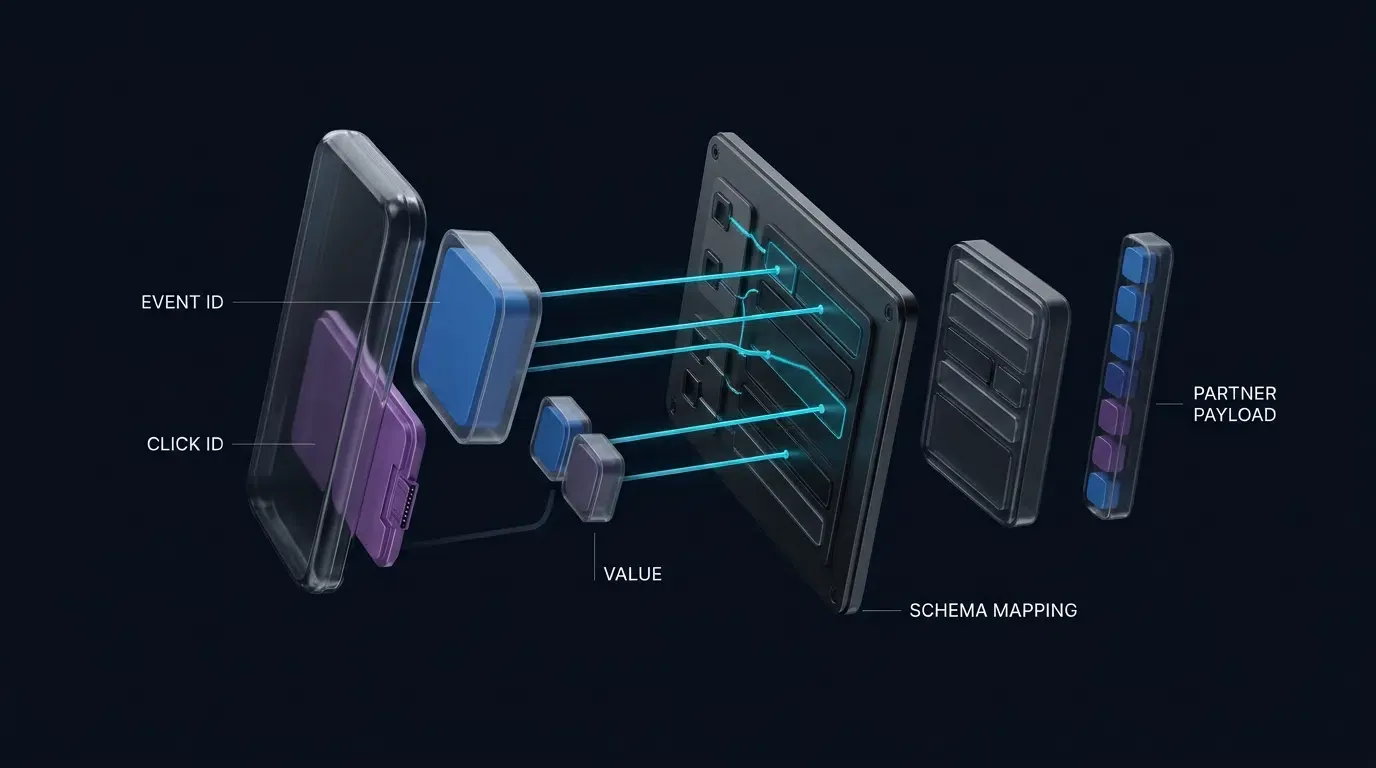
Different advertising networks enforce divergent parameter naming conventions. While one network expects the click identifier under the key click_id, another may require clickid, sub_id, or tx_id.
To resolve these discrepancies, enterprise attribution platforms maintain modular macro-templating systems. Marketing teams configure postback templates within the management dashboard, mapping internal measurement tokens (e.g., {click_id}) to the exact field names demanded by each advertising partner’s API documentation without writing custom backend code.
Why Real-Time API Communication Matters for Ad Bidding Algorithms
Feeding Machine Learning Feedback Loops: The Operational Impact of Reporting Latency
Modern ad buying across platforms like Google Ads, Meta, and TikTok relies heavily on automated bid optimization algorithms (such as Target Cost-Per-Acquisition or Target Return on Ad Spend). These bidding engines dynamically evaluate auction signals, calculating conversion probabilities for ad placements.
Delayed conversion reporting may reduce the freshness of feedback available to automated bidding systems:
- Low-Latency Feedback: When conversion postbacks transmit in a timely manner, bidding engines incorporate conversion signals more quickly, which can support more responsive bid adjustments for converting publisher segments.
- Delayed Feedback: When postbacks stall in batch processing queues, bidding models operate on older data. Reporting delays introduce lag in bidding updates, which may reduce campaign optimization responsiveness depending on conversion volume and model cadence.
The Cold-Start Dilemma in Programmatic Campaigns
When launching a new mobile advertising campaign, programmatic optimization algorithms enter an exploratory learning phase. During this window, the system distributes ad spend across wide publisher inventories to discover converting demographics.
Delayed conversion reporting may reduce the freshness of feedback available to automated bidding systems. Timely delivery can support more responsive optimization, but learning duration and campaign performance also depend on conversion volume, user conversion cycles, historical data, attribution settings, and the advertising platform’s processing cadence.
Distinguishing Delay Types Across the Attribution Pipeline
Understanding delivery timing requires breaking down the distinct sources of latency across the user journey:
| Delay Component | Operational Source | Description |
|---|---|---|
| Conversion Delay | User behavior | Time elapsed between initial ad click and the user completing the conversion event. |
| Attribution Processing Delay | MMP infrastructure | Time required to ingest SDK telemetry, execute deduplication, and assign conversion credit. |
| Postback Delivery Latency | Network transport | Time required to establish HTTPS connections and dispatch the HTTP request to the partner endpoint. |
| Privacy-Imposed Delay | Operating system policies | Mandatory randomized reporting delays enforced by privacy frameworks. |
| Partner Processing Delay | Ad network infrastructure | Time required by the ad network to ingest, validate, and incorporate the postback into bidding models. |
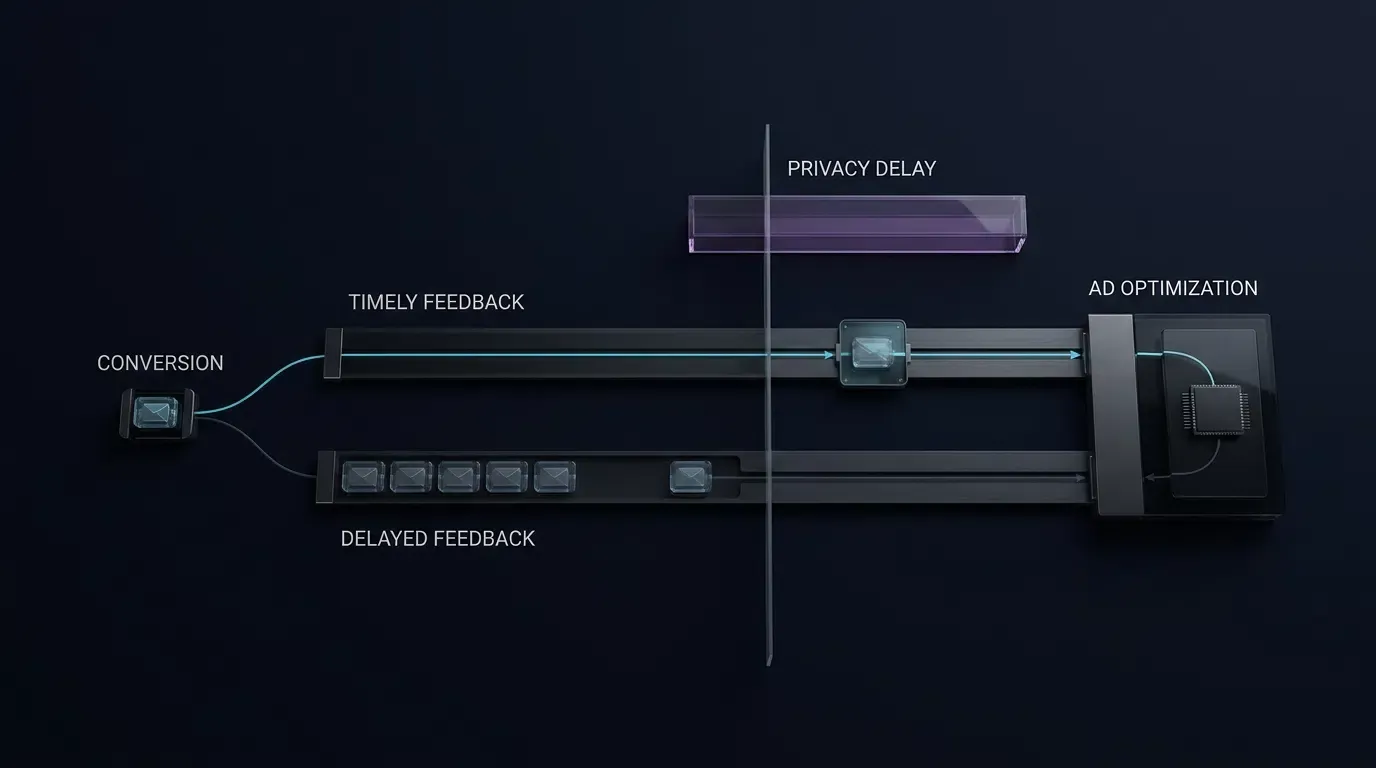
Privacy-preserving attribution frameworks may impose randomized reporting delays. For example, Apple AdAttributionKit applies a 24–48-hour random delay to the first install postback and a 24–144-hour delay to eligible subsequent postbacks after the applicable conversion window closes or is locked. These privacy-imposed delays are governed by platform operating system specifications and cannot be reduced by optimizing server-side network infrastructure.
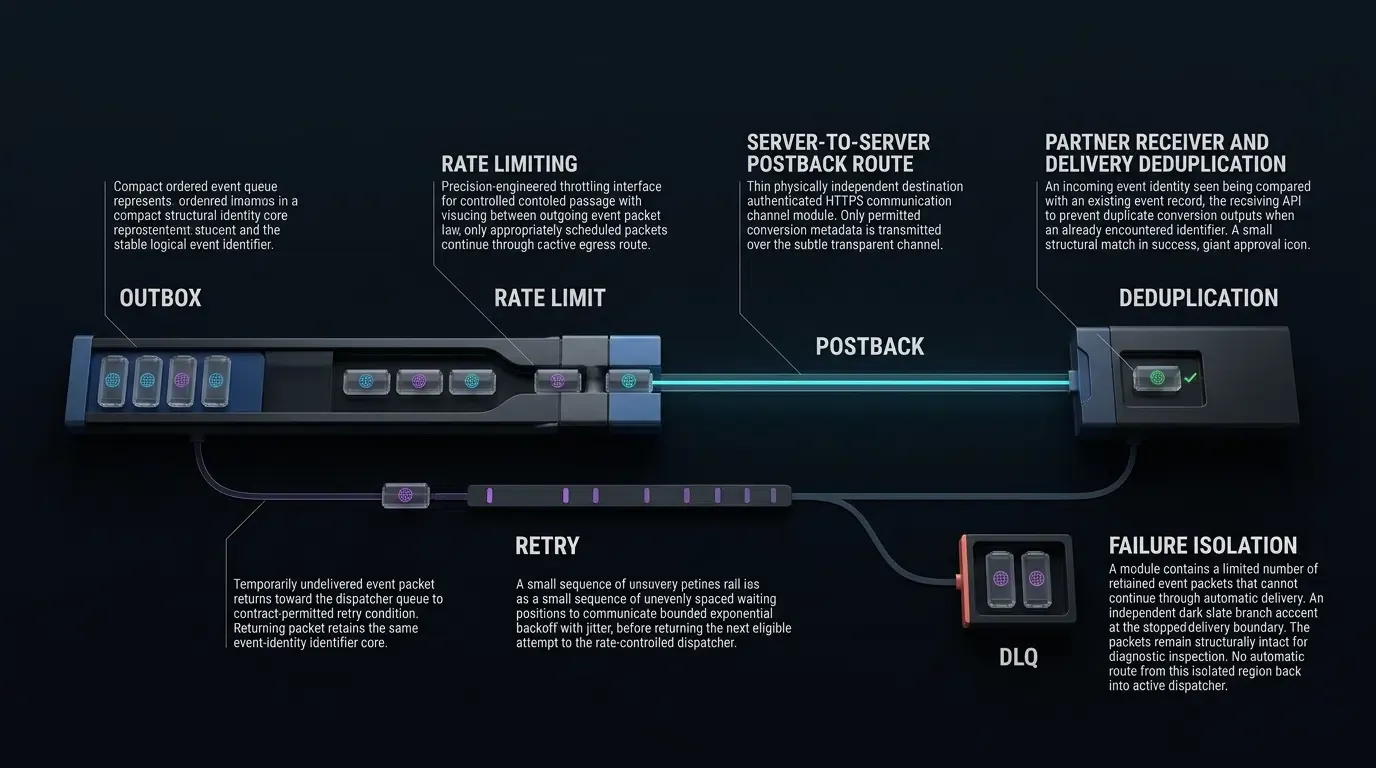
Handling Network Retries and Failures: Exponential Backoff and Idempotent Deduplication
Public cloud network links are subject to intermittent packet loss, server restarts, and routing maintenance. Attribution backends maintain resilient retry architectures to prevent lost conversion signals:
-
Bounded Exponential Backoff with Jitter: If an ad network API endpoint returns an HTTP 503 Service Unavailable, network timeout, or rate-limiting response, the postback is scheduled for retry using a bounded full-jitter model:
d_n \sim U\left(0, \; \min(d_{\max}, \; d_0 \times 2^n)\right) Where
d_0 represents the initial base delay,d_{\max} represents the local backoff cap, and randomized jitter prevents synchronized retry waves from overwhelming recovering ad servers. Partner-specifiedRetry-Afterresponse headers take precedence over local backoff calculations. -
Delivery Retry Window: The retry system continues attempting delivery over a defined retry horizon according to provider policy. For example, Adjust documents up to six retries over 24 hours under specific failure conditions, while AppsFlyer documents up to four additional retries at 15-minute intervals when postback retry is active. If all retry attempts fail, the event routes to a dead-letter queue (DLQ) for diagnostic review.
-
Idempotency and Deduplication Layers: Distinction must be maintained between attribution deduplication (ensuring the MMP attributes a conversion only once) and delivery deduplication (ensuring the ad network handles retried HTTP requests safely). Retries should reuse the same stable event identifier (
event_id) or partner-supported idempotency key. Where the receiving API supports deduplication, repeated delivery attempts can be recognized as the same logical event. Automatic retries of non-idempotent requests must follow the partner’s documented delivery contract.
Ensuring High Availability and Rate-Limiting Compliance Across Enterprise Egress Pipes
High-volume attribution platforms dispatch large volumes of outbound postbacks per second. Without throttling mechanisms, this egress volume can overwhelm receiving ad network endpoints, triggering HTTP 429 Too Many Requests responses.
Production attribution architectures incorporate token bucket or leaky bucket rate-limiting algorithms at the egress gateway. The platform caps outbound request velocity to match the published rate limits of each ad network API, honoring partner-specified Retry-After response headers when throttled.
Comparative Analysis of Client Side SDK Calls versus Server Postbacks
Evaluating Operational Trade-offs: Network Overhead, Security, Privacy, and Data Granularity
Designing modern mobile marketing architectures requires selecting the appropriate communication channel for each operational objective. Relying exclusively on client-side tracking creates bloated application binaries and fragile network dependencies, while relying solely on server APIs introduces complexity in capturing initial device states.
The table below contrasts client-side SDK invocations with Server-to-Server (S2S) postback APIs across essential architectural dimensions:
| Feature Dimension | Client-Side SDK Invocation | Server-to-Server (S2S) Postback API |
|---|---|---|
| Execution Environment | Client device operating system (Android / iOS) | Distributed cloud server infrastructure |
| Communication Protocol | Local binary method calls and internal SDK queues | Outbound HTTPS requests (JSON POST or URL GET) |
| Network Latency Impact | Dependent on device cellular/Wi-Fi connection | High-throughput data center network interconnects |
| Vulnerability to Tampering | Subject to client-side inspection and reverse-engineering | Protected by server authorization tokens and network controls |
| Primary Architectural Role | Capturing in-app lifecycle events and UI routing | Transmitting conversion data to ad networks and BI platforms |
Engineering teams seeking to integrate client-side event tracking alongside backend postback pipelines can access the OpoInstall SDK download center for native mobile SDK libraries and configuration documentation.
Privacy Compliance and Data Governance in Server Communications
Server-to-server delivery transfers data between cloud infrastructures, but does not bypass operating system consent frameworks (such as Apple App Tracking Transparency), regional privacy regulations, or partner data-sharing policies. Only data permissible under applicable user consent states may be transmitted across postback pipes.
Attribution systems should apply appropriate privacy filtering before postback generation, transmitting only the fields permitted by applicable platform policies, legal requirements, and partner data-sharing agreements.
Frequently Asked Questions (FAQ)
What is the difference between an API and an SDK in mobile attribution?
How do ad networks verify the authenticity of an incoming postback API request?
What happens if an ad network server fails to receive an attribution postback?
Summary and Decision Framework
Server-to-Server APIs represent the foundational communication backbone of modern mobile advertising, transforming raw client-side installations into actionable attribution data for advertising networks. By removing reporting dependencies from client browsers and native webviews, programmatic S2S postbacks improve the consistency with which conversion signals reach ad bidding algorithms.
As global privacy regulations and operating system sandboxes continue restricting client-side tracking identifiers, the importance of robust server-side APIs will increase. Engineering and marketing teams that build standardized, privacy-compliant server postback pipelines establish reliable measurement loops, reduce avoidable data discrepancies, and support user acquisition campaign optimization across acquisition channels.
Teams preparing to configure automated attribution postbacks and campaign tracking links can create an account on the OpoInstall developer console or review the mobile attribution implementation reference for detailed architecture guidelines.
Related Materials
-
Concepts: Application Programming Interface, Server-to-Server Postback, Mobile Measurement Partner, Webhook Pipeline, Event Idempotency
-
Technologies: RESTful Web Services, HTTPS over TLS, Message Queuing Architectures, Dynamic Tracking URLs
-
Standards: IETF RFC 9110 HTTP Semantics, IETF RFC 9112 HTTP/1.1, JSON Schema Draft 2020-12
-
APIs: OpoInstall Event Ingestion and Postback Documentation, Meta Conversions API, Google Ads Offline Conversion API
-
Official Documentation & References:
Share this article