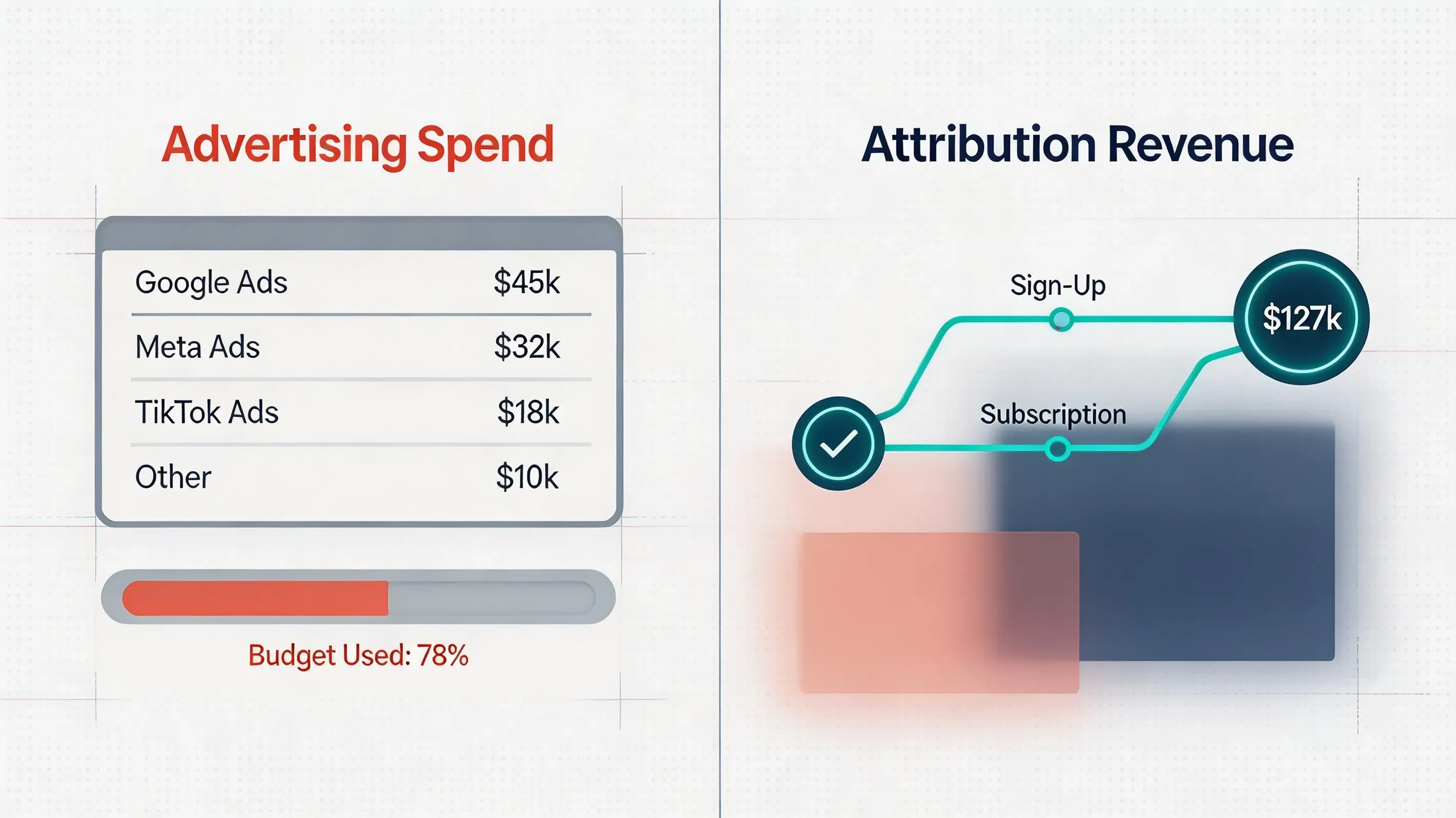
How does an MMP calculate mobile app ROI? An MMP calculates ROI by comparing attributed revenue from acquired users against advertising spend, using install attribution and post-install conversion data to connect marketing costs with financial outcomes. As mobile acquisition spans multiple ad networks and organic channels, advertisers use MMP data to resolve duplicate conversion claims and calculate campaign-level ROI.
In simple terms, an MMP calculates mobile app ROI by following this formula:
$$\text{ROI} = \frac{\text{Attributed Revenue} - \text{Advertising Spend}}{\text{Advertising Spend}} \times 100%$$
The MMP connects paid acquisition costs with verified installs and post-install revenue events to determine whether an advertising campaign generates positive financial returns.
Key Takeaways
- ROI calculation: Links campaign spend with attributed revenue to evaluate overall profitability.
- Install deduplication: Removes duplicate conversion claims across overlapping advertising channels.
- Revenue mapping: Connects in-app purchases, subscriptions, and ad revenue with original acquisition sources.
- Conversion postbacks: Sends verified events back to advertising platforms for automated campaign optimization.
What Is a Mobile Measurement Partner?
Mobile attribution is the process of connecting app installs and conversion events with their acquisition sources. An MMP provides the infrastructure required to perform this attribution across multiple advertising channels.
Mobile measurement partners calculate campaign performance by linking ad clicks, verified installs, and post-install revenue events into a unified attribution model.
Common MMP platforms include AppsFlyer, Adjust, and Branch, which specialize in enterprise ad spend aggregation and attribution reporting. Specialized SDK providers can support post-install parameter restoration and event tracking workflows that feed into these analytics engines.
What Data Does an MMP Use to Calculate ROI?
To evaluate campaign profitability, an MMP collects and correlates data across the entire user acquisition lifecycle. Calculating Return on Investment (ROI) requires aggregating data from advertising APIs, client-side event listeners, and backend event pipelines.
An MMP requires five core data inputs:
- Campaign Ad Spend: Cost metrics pulled via network APIs, including Cost Per Click (CPC), Cost Per Mille (CPM), and aggregate campaign expenditure.
- Click and Impression Signals: Pre-install user engagement tokens, including click timestamps, publisher IDs, and dynamic campaign parameters.
- Verified App Installs: Installation events and first-launch signals recorded by the mobile SDK upon application boot.
- In-App Revenue Events: Post-install transaction payloads, including purchase amounts, item categories, and subscription renewal IDs.
- Attribution Signals: Consent-compliant identifiers, device signals, or privacy-preserving conversion tokens.
How Does an MMP Calculate ROI Step by Step?
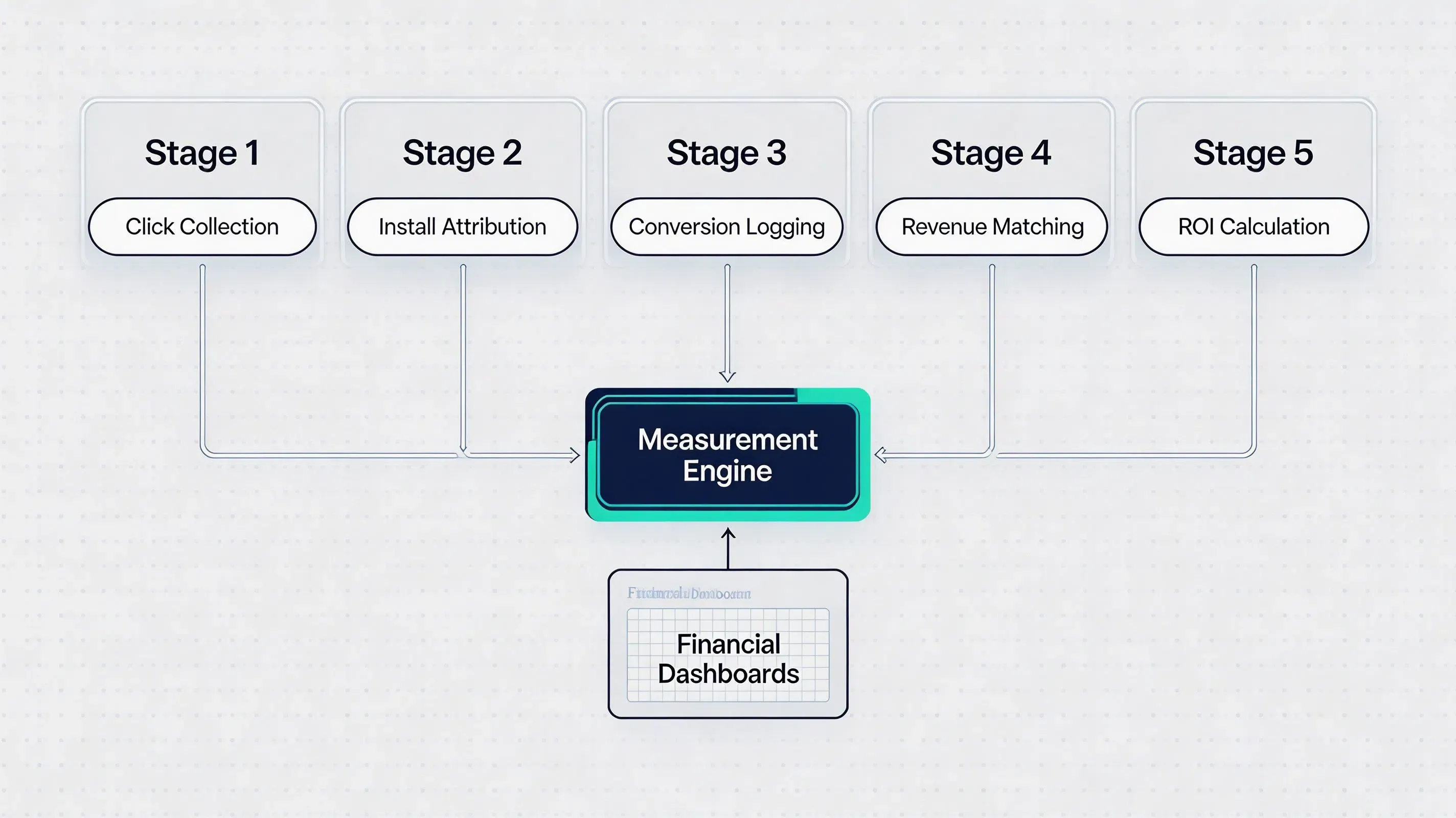
Calculating campaign Return on Investment (ROI) requires connecting front-end marketing expenditure with back-end revenue realization. An MMP evaluates campaign profitability through a structured, five-step calculation pipeline:
- Click Collection: The user interacts with an ad link. The campaign parameters and click tokens are logged by the attribution server.
- Install Attribution: Upon first launch, the mobile SDK queries the matching engine to resolve installation source using native store attribution APIs and restore campaign context through deferred deep linking.
- Conversion Event Logging: As acquired users make purchases or renew subscriptions, the client library logs conversion events.
- Revenue Matching: The attribution engine maps post-install monetary transactions back to the attributed acquisition source over defined attribution windows (Day 7, Day 30, and Day 90 cohorts).
- ROI Calculation: The platform aggregates attributed revenue, subtracts total campaign spend, and calculates net channel profitability.
To support this calculation pipeline, the measurement infrastructure structures data inputs according to their operational function:
| Input Data | Primary Source | Function in ROI Calculation |
|---|---|---|
| Ad Spend | Network Reporting APIs | Establishes baseline campaign cost |
| Install Events | Native SDK Listener | Attributes verified user acquisition |
| Revenue Events | In-App Purchase Pipeline | Tracks post-install monetary conversion |
| Postback Feedback | S2S Webhook Engine | Returns conversion signals to ad networks |
Understanding ROAS, CAC, and LTV Metrics
Raw install counts fail to indicate campaign profitability. By linking attributed installation events directly to financial outcomes, growth teams evaluate short-term channel efficiency versus long-term customer value using three distinct metrics:
- Return on Ad Spend (ROAS): Measures gross revenue generated per ad dollar spent across specific attribution windows:
$$\text{ROAS}_t = \frac{\text{Attributed Cohort Revenue at Day } t}{\text{Campaign Ad Spend}} \times 100%$$ - Customer Acquisition Cost (CAC) Normalization: Normalizes user acquisition expenditure by dividing total network cost by deduplicated, verified installations:
$$\text{CAC} = \frac{\text{Total Campaign Spend}}{\text{Deduplicated Verified Installs}}$$ - Lifetime Value (LTV) and Payback Period: Attribution windows determine how long after an install an MMP can associate revenue with the original marketing source. By mapping cumulative cohort revenue across Day 7, Day 30, and Day 90 windows, finance teams compare acquisition cost with lifetime value (LTV) and determine exact payback periods.
How MMPs Attribute Revenue to Calculate ROI
Connecting post-install transactions back to original ad engagements requires an automated multi-step revenue matching sequence:
Ad Spend Ingestion ──> Install Attribution ──> In-App Event Logging ──> Revenue Matching ──> ROI Calculation
To illustrate how user transactions aggregate into campaign-level profitability, consider the channel audit below:
| Campaign Metric | Network A (Paid SAN) | Network B (Paid DSP) | Influencer Program | Total Campaign |
|---|---|---|---|---|
| Media Spend | $6,000 | $3,000 | $1,000 | $10,000 |
| Self-Reported Installs | 4,000 | 2,500 | 1,000 | 7,500 (Inflated) |
| MMP Deduplicated Installs | 2,800 | 1,400 | 800 | 5,000 (Verified) |
| Effective CAC | $2.14 | $2.14 | $1.25 | $2.00 |
| Attributed Revenue (Day 30) | $21,000 | $9,000 | $5,000 | $35,000 |
| Campaign ROAS | 350% | 300% | 500% | 350% |
| Campaign Net ROI | +250% | +200% | +400% | +250% |
How MMPs Improve ROI Accuracy
Without independent attribution, advertisers may calculate incorrect ROI because:
- Multiple ad networks may claim credit for the same installation.
- Organic users may be mixed with paid user acquisition cohorts.
- Post-install revenue events may not be linked to original acquisition sources.
- Ad fraud and suspicious installs may inflate campaign performance metrics.
An MMP creates an independent measurement layer that standardizes attribution rules across channels. Advanced measurement models may also evaluate incremental revenue to distinguish true marketing impact from organic baseline growth, ensuring acquisition costs match verified financial returns.
How MMP Attribution Connects Ad Clicks With App Revenue
The attribution workflow consists of four core stages: 1. Click collection, 2. Install matching, 3. Conversion validation, and 4. Network feedback. An automated attribution pipeline streams installation and engagement signals sequentially across browser, store, native application, and data warehouse environments:
[Ad Click] ──> [Ad Network] ──> [App Store] ──> [App Launch]
                                                     │
                                                     ▼
[Ad Platform Optimization] <── [S2S Postback] <── [MMP Server] <── [Revenue Event]
This multi-platform sequence ensures that attribution parameters are securely recorded, matched, and routed back to ad networks to optimize programmatic bidding algorithms.
Why Self-Attributing Networks Create ROI Measurement Conflicts
Mobile advertising relies heavily on major self-attributing networks (SANs) such as Meta and Google. SANs operate closed data ecosystems where they internally measure and attribute conversions without exposing raw click logs to external parties. When an advertiser runs campaigns across multiple ad networks simultaneously, SAN attribution often leads to severe ROI measurement conflicts.
Because each SAN evaluates user touchpoints independently, multiple ad networks may claim credit for the same user installation. Calculating ROI based on un-deduplicated network dashboards leads to inflated conversion numbers and inaccurate spend allocation.
An independent MMP acts as an impartial measurement layer that resolves these conflicts. The attribution platform receives engagement signals from all integrated channels, applies a single, unified attribution window, and assigns conversion credit based on configured attribution rules. This deduplication prevents duplicate conversion charging caused by overlapping attribution claims and maintains a clean data foundation for ROI calculations.
Self-Attributing Networks vs. Independent MMPs
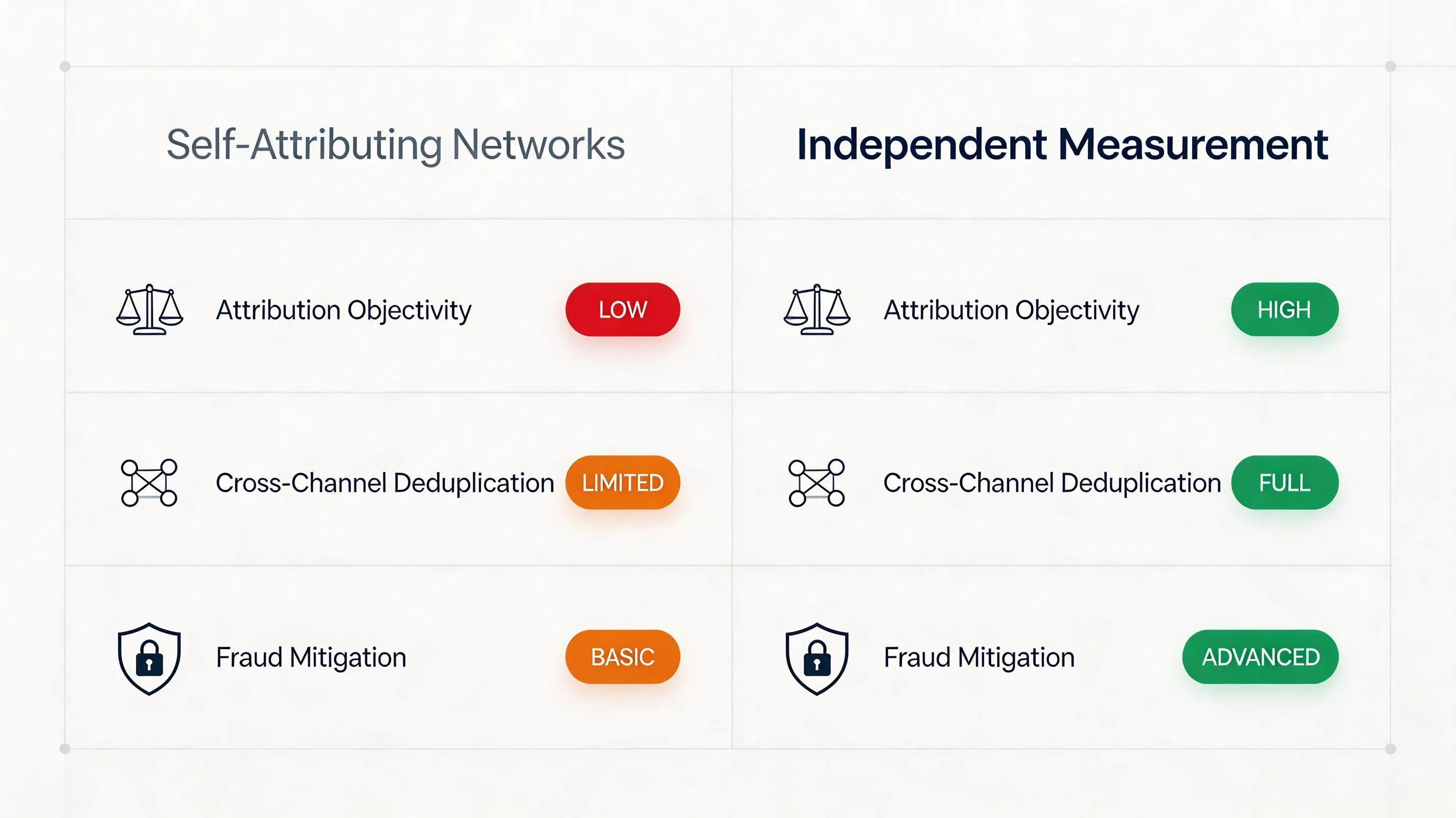
Different mobile measurement architectures offer varying levels of attribution objectivity, fraud protection, and integration complexity. The comparison below summarizes key operational differences:
| Attribute | Self-Attributing Networks | Custom In-House Scripts | Independent MMPs |
|---|---|---|---|
| Representative Platforms | Meta, Google | Proprietary SQL Scripts | AppsFlyer, Adjust, Branch, OpoInstall |
| Attribution Objectivity | Low (Internal measurement) | Moderate (Maintenance heavy) | High (Impartial third party) |
| Cross-Channel Deduplication | Limited to platform-owned ecosystem | High (Requires custom APIs) | High (Automated across networks) |
| Fraud Mitigation | Limited to platform scope | Low (Custom engineering required) | High (Real-time S2S verification) |
| Integration Complexity | Minimal (Network native) | High (Requires ongoing updates) | Moderate (SDK + partner integrations) |
Android and iOS Attribution Measurement Differences
Mobile attribution workflows must adapt to OS-level technical specifications and privacy frameworks on Android and iOS:
Android Runtime Integration and Play Referrer
On Android, the client library communicates with Google Play’s Install Referrer service to retrieve installation attribution parameters provided during the Google Play installation flow. The SDK retrieves Google Play Install Referrer parameters as a deterministic attribution signal when available within the supported Google Play installation flow.
iOS Runtime Integration and SKAdNetwork
On iOS, modern attribution implementations reconcile Universal Links with Apple’s privacy-preserving SKAdNetwork (SKAN) framework. SKAdNetwork provides privacy-preserving conversion postbacks that MMPs and ad networks process through supported integrations.
To handle deferred deep linking compliantly under Apple’s App Tracking Transparency (ATT) rules, the mobile SDK queries attribution servers asynchronously on cold boot without collecting restricted device identifiers (IDFA) unless explicit user permission is granted.
Technical Implementation: How MMPs Send Attribution Events
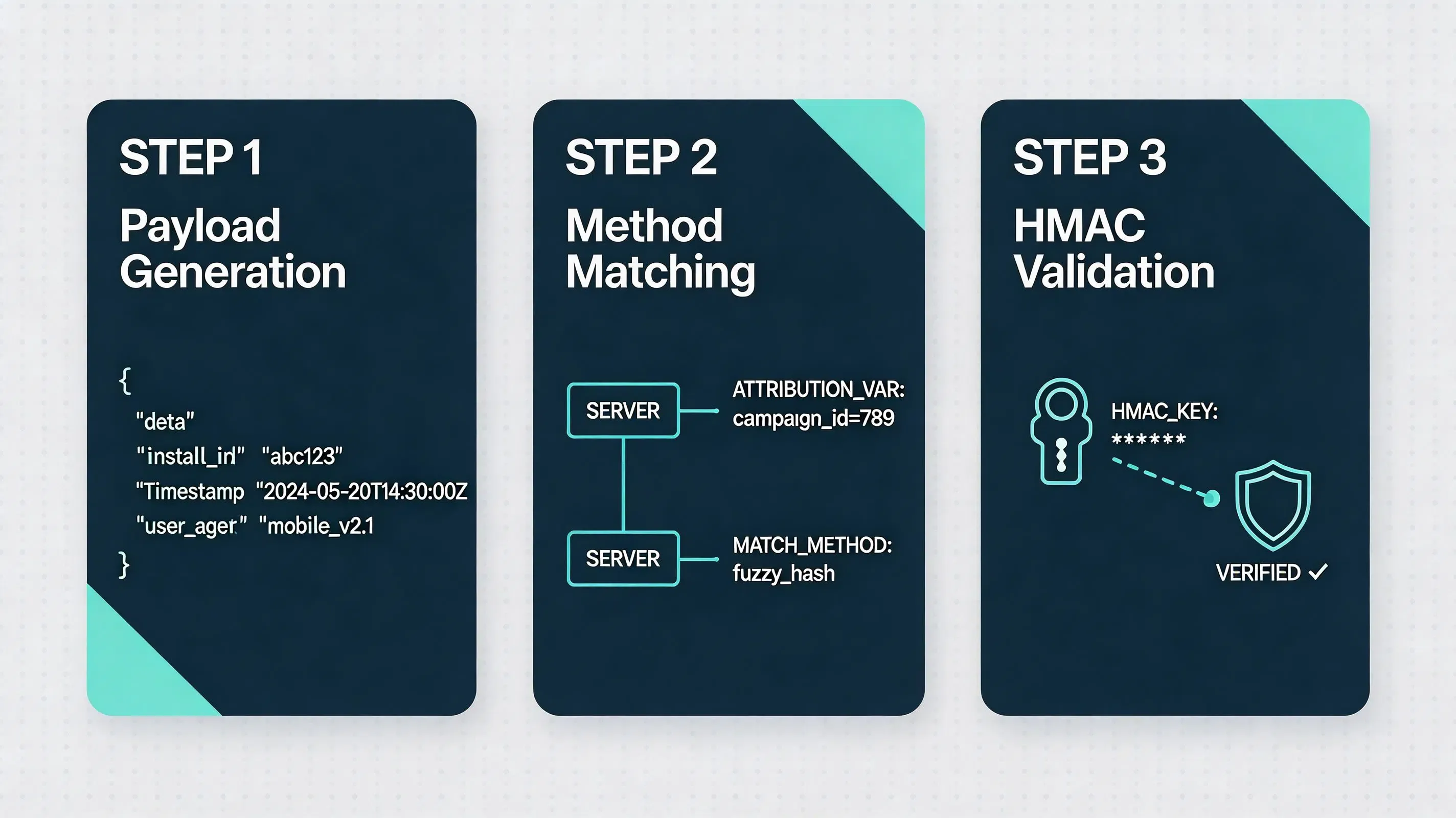
To transmit verified conversion events to external advertising networks and internal BI databases, engineering teams configure Server-to-Server (S2S) webhooks. The attribution platform generates a real-time HTTP POST request whenever an app install or in-app conversion is validated.
The webhook payload should be formatted using a standardized JSON schema containing core attribution fields:
click_id: The unique transaction identifier generated by the ad network upon link click.install_timestamp: Unix epoch timestamp recording the exact moment of native SDK initialization.match_method: The specific matching mechanism used (e.g.,install_referrer,universal_link, orSKAdNetwork).advertising_id: A consent-dependent advertising identifier or privacy-compliant device signal.
To protect internal databases from payload injection or spoofed conversion requests, the receiving backend server validates the HMAC signature attached to the postback header, adhering to IETF RFC 2104 (HMAC Specification).
Example: Campaign-Level ROI Calculation in Practice
Hypothetical Scenario: Mobile E-Commerce Application Integration
Challenge
A mobile e-commerce platform ran simultaneous acquisition campaigns across three paid ad networks and an influencer sharing program. The internal marketing team showed a measurable gap between network-reported installs and internal activation records, indicating duplicate self-attribution and click-spamming exploits.
Implementation
The engineering team integrated an attribution SDK to collect purchase events and configured S2S postbacks to stream raw attribution payloads directly to their analytics warehouse. The client-side integration and SDK download packages can be accessed via the OpoInstall SDK download.
A typical S2S postback contains attribution identifiers, conversion timestamps, revenue values, and verification headers:
// File path: schemas/s2s_postback_conversion_schema.json
{
  "event_type": "in_app_purchase",
  "click_id": "clk_8832a90d4",
  "campaign_id": "summer_promo_2026",
  "install_timestamp": 1784731200,
  "conversion_timestamp": 1784734800,
  "match_method": "install_referrer",
  "revenue": {
    "amount": 49.99,
    "currency": "USD"
  },
  "device_context": {
    "platform": "android",
    "os_version": "14.0",
    "app_version": "2.4.1"
  }
}
// File path: headers/s2s_postback_headers.http
POST /api/v1/attribution-webhook HTTP/1.1
Host: analytics.example.com
Content-Type: application/json
X-Webhook-Signature: 2c26b46b68ffc68ff99b453c1d30413413422d706483bfa0f98a5e886266e7ae
X-Webhook-Timestamp: 1784734800
X-Webhook-Nonce: non_8f93a02c81

// Server-side verification logic:
// Signature = HMAC-SHA256(Payload + Timestamp + Nonce, SharedSecret)
Expected Outcomes
This implementation demonstrates how unified deduplication mitigates ad spend waste. The simulated deployment showed that duplicate network claims could be identified and rejected during backend verification, ensuring ad platforms were credited only for unique, non-overlapping conversion events.
Lessons Learned
- Centralize attribution before paying ad networks: Utilizing an independent measurement platform prevents multiple SANs from charging for the same installation.
- Enforce S2S postback verification: Validating conversion tokens server-side prevents unauthorized conversion requests and payload tampering.
- Monitor click-to-install latency: Short install time windows help identify automated bot clicks before budget allocation.
Frequently Asked Questions
How does an MMP calculate ROI from mobile campaigns?
What is the ROI formula used by MMP platforms?
Can an MMP calculate ROI without revenue data?
What metrics does an MMP use to measure ROI?
How is MMP ROI different from Firebase Analytics?
Does an MMP track users?
What is a self-attributing network?
How do I migrate to OpoInstall for independent install attribution?
Summary and Decision Framework
Choose an independent MMP integration when your mobile acquisition strategy matches the following functional criteria:
- ✓ Campaign Budgets Span Multiple Paid Channels: You run ads across multiple ad networks and require unified deduplication to avoid double-paying.
- ✓ Referral Rewards Require Automated Attribution: Onboarding workflows require instant, non-fraudulent bonus processing without manual team reviews.
- ✓ Data Engineering Needs Raw Event Streams: Analytics teams require raw attribution payloads streamed directly into first-party data warehouses via S2S webhooks.
- ✓ First-Party Privacy Compliance Is Mandatory: Attribution tracking must operate strictly within Apple ATT and Google privacy guidelines without collecting restricted hardware IDs.
In these scenarios, integrating an independent mobile measurement SDK provides a secure, highly scalable attribution model. Modern MMPs bridge the gap between web sharing links, ad networks, and native app installs, enabling growth teams to measure true campaign ROI. Platforms such as AppsFlyer, Adjust, Branch, and other attribution providers implement similar measurement architectures.
Entity Glossary
| Entity | Definition | Related Concepts |
|---|---|---|
| Mobile Measurement Partner (MMP) | An independent analytics provider that deduplicates and attributes mobile app installations. | Mobile Attribution |
| Mobile Attribution | The process of linking app installs and conversions to marketing sources. | Mobile Measurement |
| ROI | Financial metric comparing attributed revenue against acquisition cost. | Financial Analytics |
| ROAS | Revenue generated directly per dollar of advertising spend. | Ad Performance |
| CAC | The total customer acquisition cost required to secure a verified installation. | Unit Economics |
| LTV | Expected gross revenue generated by a user cohort during their customer lifecycle. | User Monetization |
| Self-Attributing Network (SAN) | An ad platform that internally attributes its own conversions without exposing raw click data. | Ad Network |
| S2S Webhook | A server-to-server communication protocol used to transmit real-time conversion callbacks. | Server Architecture |
| Google Play Install Referrer | A native Android API provided by Google to securely pass installation campaign parameters. | Play Services |
| SKAdNetwork | Apple’s privacy-preserving, aggregated ad attribution measurement framework. | Mobile Attribution |
Related Materials
Related Concepts
- Deferred Deep Linking: The programmatic restoration of target parameters across the application store installation boundary.
- Referral Fraud Detection: Security mechanisms designed to identify and block simulated app installation requests.
Related Technologies
- Universal Links: Apple’s native deep linking standard connecting HTTP URLs to native application screens.
- App Links: Google’s verified deep linking protocol handling custom web URLs on Android.
- Install Referrer: The native mechanism provided by Android to securely pass campaign parameters from Google Play.
Standards Referenced
- IETF RFC 2104: The HMAC keyed-hash message authentication code standard for message verification.
Primary APIs
getInstallParam: The native mobile SDK method utilized to query and retrieve custom installation parameters from the OpoInstall servers.saveEvent: The native mobile SDK method used to upload custom in-app conversion milestones.
Official Documentation / References
- Apple App Tracking Transparency Framework Guidelines
- Apple SKAdNetwork Documentation
- Google Play Services Install Referrer API Specification
- Apple Universal Links Guidelines
- Android App Links Integration Guide
- IETF RFC 2104 HMAC Specification
- OWASP Mobile Security Testing Guide
- Google Firebase Dynamic Links Deprecation FAQ
- OpoInstall Blog Resource Center
Share this article