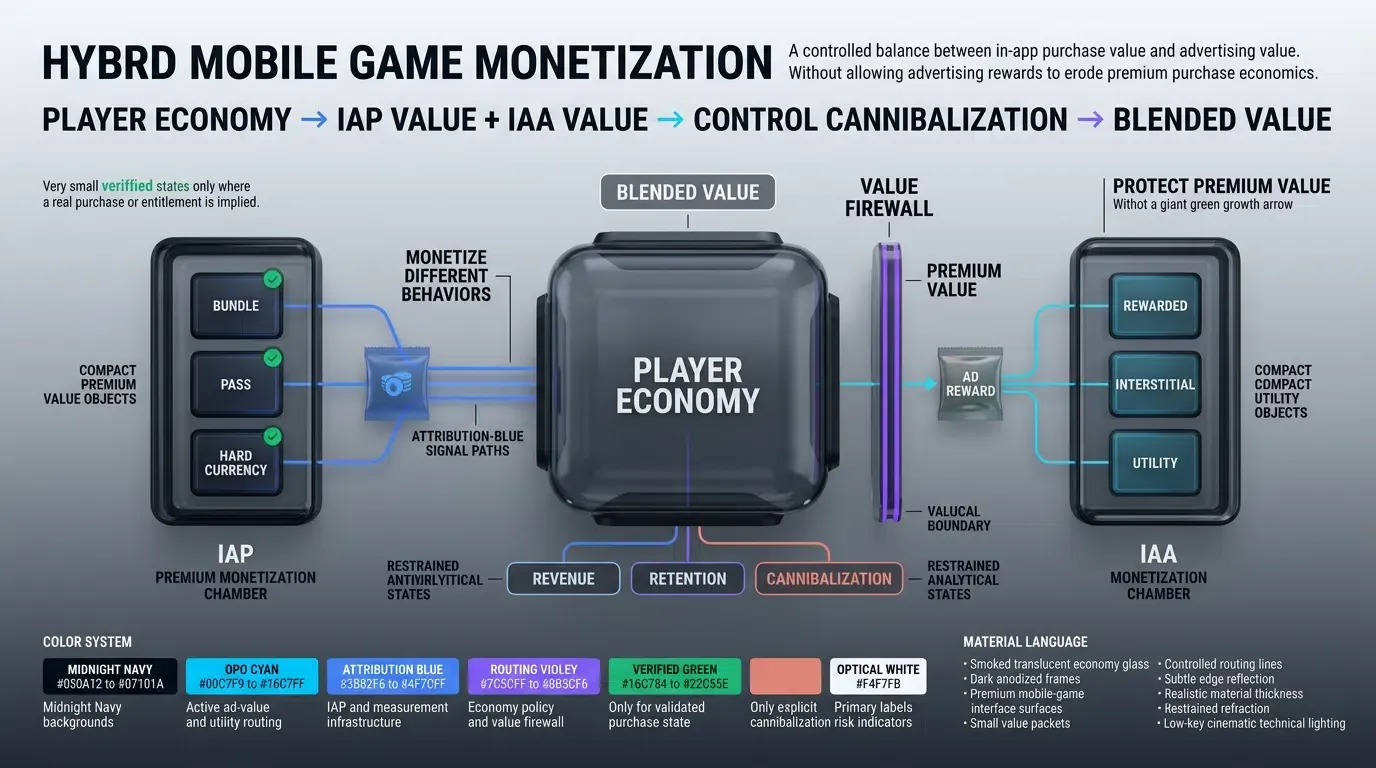
What is hybrid monetization and why is it popular in mobile games? Hybrid monetization is the strategic integration of in-app purchases and programmatic ads, rising in popularity because it unlocks revenue across both paying and non-paying player cohorts while managing the risk of cannibalizing premium spend.
Hybrid monetization is a commercial framework that combines multiple revenue streams—primarily In-App Purchases (IAP) and In-App Advertising (IAA)—within a unified mobile game economy. By deploying behavioral player segmentation, game studios customize monetization touchpoints, serving opt-in rewarded video to non-paying players while testing ad suppression for paying cohorts with the goal of improving blended lifetime value without degrading long-term engagement.
| Term | Definition | Related Entity | Search Intent Role |
|---|---|---|---|
| Hybrid Monetization | The combined commercial deployment of IAP and in-app advertising. | Game Economy | Informational / Commercial |
| In-App Purchase | Direct digital sales of virtual goods, currency, or content within an app. | Microtransactions | Technical / Informational |
| Ad Monetization | The generation of revenue by serving programmatic ads to players. | IAA Models | Operational / Analytical |
The Strategic Rise of Hybrid Monetization in Modern Mobile Gaming
The Macro Shift: The Convergence of Casual Mechanics and Mid-Core Economies
Mobile gaming monetization has entered an era of structural convergence. Historically, the ecosystem skewed heavily toward two distinct models: hyper-casual titles supported predominantly by high-volume programmatic advertising, and hardcore mid-core titles relying almost exclusively on deep In-App Purchase (IAP) microtransactions.
Over recent publishing cycles, this rigid division has dissolved. Casual puzzle, idle, and action titles have integrated deeper progression meta-systems, guild mechanics, and character collections borrowed from mid-core genres. Concurrently, mid-core and strategy games have introduced rewarded video integrations to monetize casual or non-spending users. Hybrid monetization has become increasingly common across mobile gaming as publishers combine IAP and advertising to diversify revenue, but the optimal revenue mix remains highly dependent on genre, platform, audience, and economy design. Many publishers increasingly treat advertising and microtransactions as complementary rather than mutually exclusive monetization tools designed to monetize different segments of the same player distribution.
Addressing the Revenue Concentration Risk of Single-Model Architectures
Operating a commercial title on a single monetization engine introduces financial concentration risk. Pure IAP games confront the reality that only a small minority of active daily players ever complete a real-money purchase. If user acquisition costs rise or top-tier spenders encounter content plateaus, unit margins compress rapidly. The studio bears server hosting, live operations, and customer support expenses for the entire active player base while extracting commercial value from only a fraction of users.
Conversely, pure ad-driven titles can face diminishing marginal LTV when additional impression opportunities, demand quality, or retention no longer support incremental revenue growth. Hybrid monetization de-risks the game business model by establishing a dual revenue engine: programmatic advertising generates baseline cash flow from non-paying users, while in-app purchases capture uncapped upside from dedicated spenders.
Why Modern Mobile Gamers Expect Flexible, Multi-Modal Progression Paths
Player consumption habits have shifted toward progression flexibility. Many players respond negatively to aggressive paywalls that halt gameplay progress unless a transaction is completed. Similarly, players reject gameplay loops interrupted by intrusive, unskippable commercial advertisements.
Hybrid monetization satisfies player demand for progression agency:
- Time-Rich Players: Players with high engagement but limited discretionary spend can advance steadily by investing time, completing daily quests, and voluntarily watching rewarded video ads.
- Time-Poor Players: Players with limited leisure time can purchase progression acceleration, exclusive cosmetic bundles, or battle passes directly through in-app microtransactions.
By providing alternative paths to access in-game progression, hybrid games build durable retention funnels that keep both paying and non-paying cohorts actively engaged in the shared economy.
See Also: Hybrid Monetization ──> Mobile Attribution Model
Why Did Single Monetization Models Fail Under Rising User Acquisition Costs
The Pure IAP Wall: Escalating CPIs Breaking Payback on the Non-Paying Majority
User acquisition across major mobile advertising networks has become substantially more competitive. Privacy changes reduced deterministic targeting and measurement options, while competition, creative costs, and auction dynamics contributed to higher acquisition costs across primary gaming markets.
Illustrative scenario: In a simplified, hypothetical IAP-only game economy with an assumed 2% payer conversion rate and an assumed $3.00 blended Cost-Per-Install (CPI), the effective customer acquisition cost per paying user is:
In this simplified illustrative IAP-only scenario, if the game economy fails to extract more than $150.00 in cumulative net revenue from that converted player, the acquisition cohort operates at a loss. Because the remaining 98% of the cohort generates zero direct revenue, studios face extended payback horizons that strain working capital.
The Pure Ad-Driven Trap: Churn Acceleration and Margin Compression Under Ad Flooding
Faced with escalating acquisition costs, pure ad-funded titles historically attempted to achieve commercial payback by increasing ad density. Developers introduced unskippable interstitials after every level, inserted banner ads within active play areas, and forced video ads into core loops.
This ad-flooding strategy created severe retention decay. Aggressive or poorly timed ad delivery can increase user friction and should be tested against session abandonment, retention, and downstream LTV rather than assumed to have a fixed causal decay curve. When player lifetime is compressed into a few days, cumulative impressions per user remain low despite high session frequency. Pure ad models found themselves squeezed between rising CPIs and declining ad LTV.
The Privacy Multiplier: How Reduced Targeting Determinism Elevated the Value of Diversified Revenue
Platform-level privacy frameworks—such as Apple’s App Tracking Transparency (ATT) and evolving platform privacy sandboxes—fundamentally altered mobile advertising. Ad networks cannot assume unrestricted access to persistent cross-app identifiers to match high-value spenders across commercial networks.
In this aggregated measurement environment, game studios must capture value across every session touchpoint. Having multiple revenue streams provides commercial resilience: when programmatic advertising eCPMs experience seasonal or market-specific demand fluctuations, in-app microtransactions sustain studio revenue. Conversely, when broad user acquisition campaigns acquire casual cohorts with low initial purchase intent, programmatic ad mediation monetizes their engagement immediately.
The Economic Imperative: Transforming Engagement Depth into Blended ARPDAU
Maximizing studio margins requires tracking blended Average Revenue Per Daily Active User (ARPDAU):
Illustrative example: By engineering hybrid loops, studios convert raw engagement depth into incremental ad revenue while testing whether the incremental ad revenue offsets any change in IAP conversion or retention. A title generating $0.12 in daily IAP ARPDAU that adds $0.05 in non-intrusive rewarded ad ARPDAU increases its daily revenue yield by over 40%, directly accelerating marketing payback horizons.
The Cannibalization Dilemma: How Poorly Designed Ads Erode In-App Purchases
The Economic Contamination Risk: When Free Ad Rewards Devalue Direct IAP Store Packs
The central operational risk of hybrid monetization is ad-driven IAP cannibalization. Cannibalization occurs when players who are willing to complete real-money purchases choose instead to fulfill their progression needs entirely through free rewarded advertisements.
Cannibalization is triggered when a game’s reward architecture fails to distinguish between convenience utility and premium content. If a player who would happily spend $1.99 on a hard-currency pack can obtain equivalent purchasing power by watching a small number of rewarded videos, direct microtransaction conversion can decline substantially. The studio exchanges a higher-value direct purchase for fractional programmatic advertising yield, causing revenue leakage.
Establishing Economic Firewalls: Currency Segregation between Soft Rewards and Hard Currencies
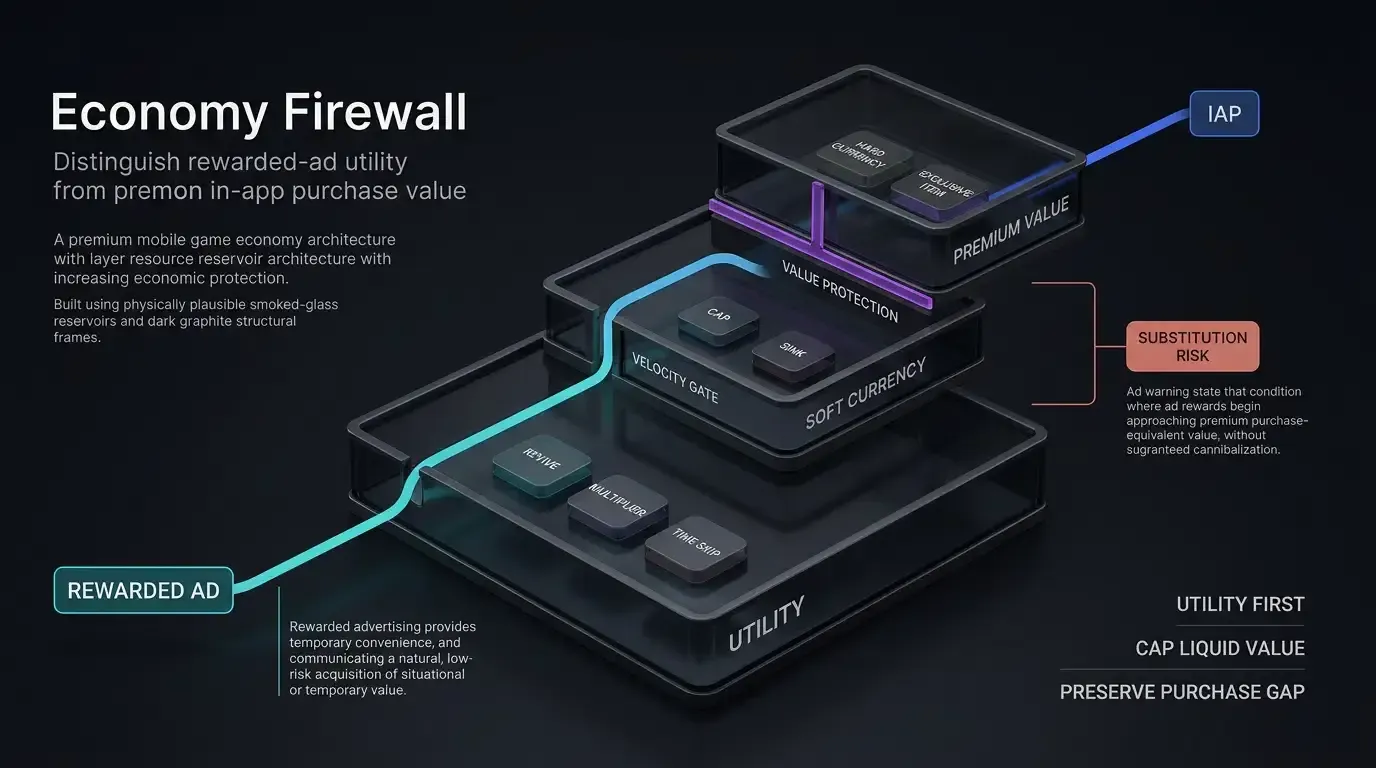
To mitigate ad-driven cannibalization, game economy designers construct structural economic firewalls:
- Premium Hard Currency (Gems, Diamonds, Crystals): Primarily reserved for real-money in-app purchases, unlocking exclusive character summons, permanent cosmetic skins, and premium progression tracks. Premium currency supply from non-purchase sources should be tightly controlled and quantitatively tested against store-pack substitution. If rewarded ads grant premium currency, cap the earning velocity and preserve a meaningful value gap between ad-earned rewards and direct purchase bundles.
- Standard Soft Currency (Gold, Coins, Energy): Awarded through organic gameplay and supplemented by rewarded ad views. Soft currency is utilized for routine operational progression, basic item upgrades, and session refills.
- Convenience Utilities (Timers, Revives, Multipliers): Granted directly through rewarded video views without dispensing liquid currency. Rewarded ads should offer immediate, situational utility—such as a single dungeon revive or doubling resources collected during an offline period—which expires upon use rather than accumulating in the player’s wallet.
Pacing and Depletion Mechanics: Designing Sinks That Absorb Both Ad Rewards and Purchased Items
A sustainable hybrid virtual economy requires robust sinks (depletion mechanisms) capable of draining both ad-generated soft currency and purchase-generated hard currency:
- Exponential Upgrade Scaling: Late-game sinks should preserve meaningful progression choices without allowing unlimited ad-earned currency to erase premium bundle value.
- Daily Ad Reward Caps: Place experiment-defined daily limits on the number of times an individual player can claim specific rewarded ad bonuses (e.g., configuring test limits on daily stamina refills or resource doublers).
- Time-Decaying Buffs: Offer temporary status boosts (e.g., a short-duration attack boost) via rewarded ads. Because the benefit is fleeting, it does not permanently inflate the player’s balance sheet or displace direct store purchases.
The Psychology of Entitlement: Preserving Perceived Value for High-Spending Cohorts
For high-spending cohorts, intrusive advertising can introduce friction into premium gameplay experiences and should be tested against retention, purchase frequency, and session depth.
To protect the perceived value of in-game purchases:
- Premium Recognition: Depending on the title, studios may use premium recognition benefits, distinctive visual badges, or VIP progression tracks to affirm the player’s investment.
- Preserving Challenge Integrity: In competitive PvP or guild-based titles, microtransactions and ad rewards must not bypass competitive balance. Ad rewards and purchases should be designed so they do not undermine the title’s intended competitive-integrity model.
How to Architect Behavioral Player Segmentation for Dynamic Monetization
Moving Beyond Monolithic Rule Sets Toward Dynamic Player Personas
A monolithic monetization model that subjects every player to identical ad loads and store merchandising creates friction. High-spending players become annoyed by interruptive ads, while non-spending grinders become frustrated by prominent store paywalls they will never purchase.
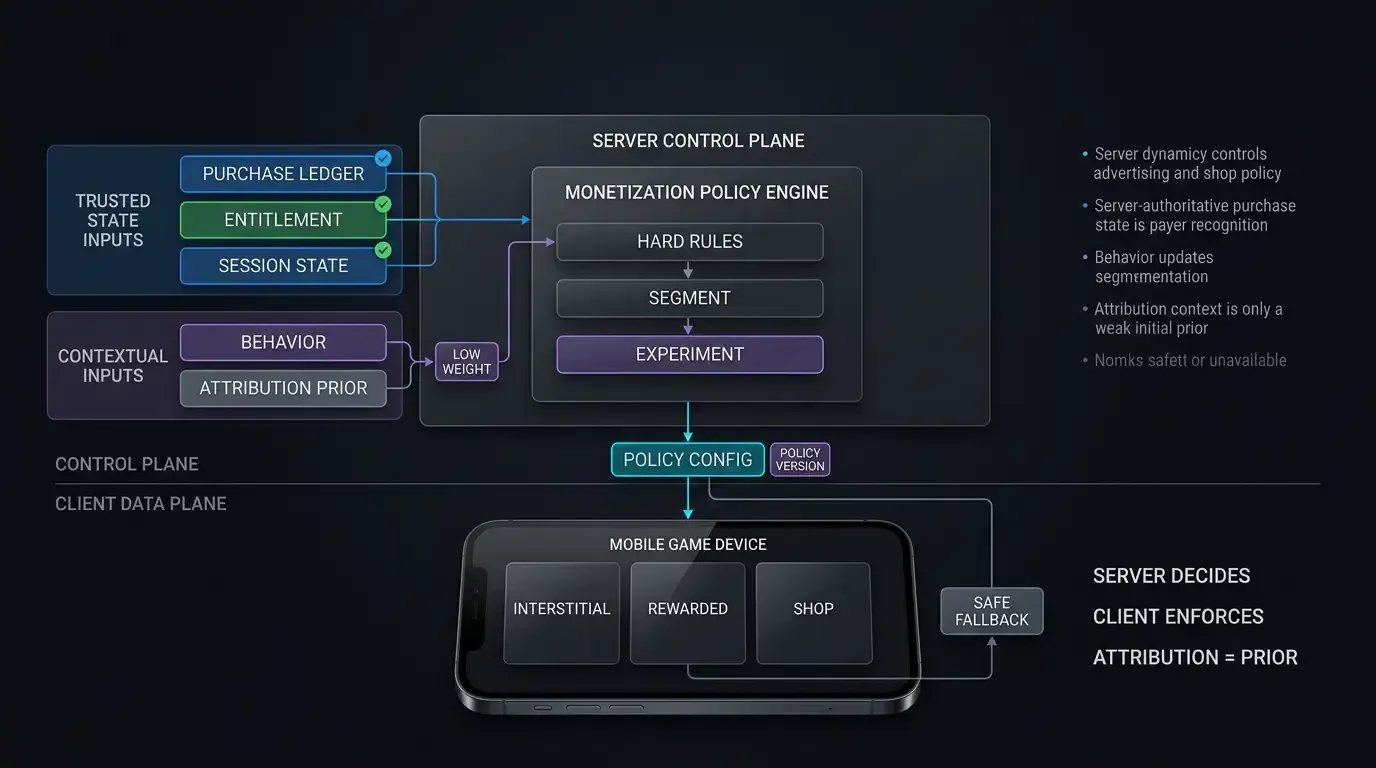
Modern hybrid monetization architectures deploy dynamic player segmentation engines. By evaluating real-time behavioral telemetry, verified account transaction history, and session patterns, the game client dynamically adjusts monetization rules, presenting customized interfaces and ad delivery cadences tailored to specific player personas.
Persona Tier 1: High-Value Payers ── Ad Suppression and Premium Live-Ops
High-value spenders drive the majority of IAP revenue in many F2P titles. The primary operational objective for this tier is maximizing player lifetime, session immersion, and microtransaction retention.
Operational policies for Tier 1:
- Targeted Ad Suppression: Suppress forced interstitial ads for paying cohorts based on verified transaction history and product design. Permanent forced-ad removal should be tied to an explicit ad-free entitlement; ordinary consumable or subscription purchases can trigger configurable temporary suppression or reduced ad load based on experiment results and commercial design.
- Preserved Opt-In Rewarded Access: Keep high-utility rewarded video placements active, ensuring they remain entirely voluntary. Many paying players appreciate convenience revives during challenging content.
- Curated Merchandising: Surface higher-value purchase bundles appropriate to the game’s existing catalog and demonstrated payer behavior, alongside limited-time collection events and VIP progression tracks.
Persona Tier 2: Engaged Non-Payers ── Rewarded Ads, Battle Passes, and Micro-Bundles
Engaged non-payers invest substantial daily session time. They are committed to progression but exhibit price sensitivity.
Operational policies for Tier 2:
- Rewarded Video Priority: Present frequent, high-utility rewarded ad opportunities tied to daily quests, stamina refills, and stage multipliers.
- Low-Barrier Conversion SKUs: Surface entry-level starter bundles or ad-removal entitlements designed to overcome the friction of the first real-money transaction.
- Battle Pass Monetization: Highlight seasonal battle pass tracks that convert daily active gameplay into high-value cosmetic and resource rewards.
Persona Tier 3: Casual or Low-Engagement Users ── High-Viewability Rewarded Video and Paced Interstitials
Casual non-payers demonstrate low session depth, have not yet converted to IAP, and currently exhibit low observed purchase propensity. The operational objective is capturing programmatic advertising yield while maintaining baseline retention.
Operational policies for Tier 3:
- Paced Interstitial Delivery: Display full-screen interstitial ads at natural cognitive transitions between game levels, enforcing tested cooldown timers to prevent fatigue.
- Rewarded Entry Points: Offer rewarded video placements that double level-completion rewards or provide extra attempts.
- Banner and Native Integration: Deploy non-intrusive banner or MREC units on pause menus, level-select screens, and score tally views.
Visualizing the Dynamic Hybrid Monetization Routing and Policy Enforcement Engine
The decision tree below outlines how an integrated game system evaluates players into tailored monetization experiences:
[Player Session Initiated]
           │
           ▼
[Check Hard Entitlement & Safety Constraints]
(Ad-Free Entitlement, Onboarding State, Server-Verified Competitive Match)
           │
           ▼
[Query Server-Authoritative Purchase Ledger]
           │
  ┌────────┴──────────────────────────┐
  ▼                                   ▼
[Verified Payer Identified]   [Non-Payer Evaluated]
  │                                   │
  ├─► Apply Payer Ad Policy           ├─► Apply Engagement Pacing
  ├─► Enable Curated Shop Offers      ├─► Enable Rewarded Video Options
  └─► Preserve Session Immersion      └─► Test Paced Interstitial Cadence
Technical Framework for Dynamic Player Segmentation and Policy Enforcement
Using Acquisition Channel Parameters as Prior Signals for Day-0 Ad Pacing
A player’s initial monetization propensity can correlate with the acquisition channel and marketing creative that generated the install. However, acquisition parameters must be used as weak, testable Day-0 priors only when historical cohort data for the same title demonstrates a stable association with downstream monetization behavior. They should never override observed in-game behavior or be treated as deterministic indicators of an individual player’s willingness to pay.
Attribution context contributes an initial prior:
- Historically Higher-Conversion Cohort Priors: Users acquired from campaigns that historically yield higher purchase conversion can be initialized with relaxed ad loads during early onboarding, with an emphasis on starter store merchandising.
- Neutral Baseline Initialization: Acquisition cohorts without validated predictive lift should start from the neutral/default policy; channel labels alone should not determine ad or IAP treatment.
- Behavioral Override: In-game telemetry (session length, level progression speed, store visits) must rapidly supersede initial channel priors within the player’s earliest sessions.
Developers can reference current SDK integration resources for implementation guidelines on capturing dynamic attribution parameters on first launch.
Dynamic Local Configuration: Modifying Ad Mediation Rules via Server-Driven Game Flags
Hard-coding monetization rules inside client binaries limits operational flexibility. Updating ad frequency caps or changing store merchandising would require submitting client binary updates through app store review cycles.
Resilient architectures utilize server-driven remote configuration:
- Session Handshake: Upon client boot, the game client transmits session-scoped context (account ID, current session metrics, game state) to the game server. Client-reported gameplay state should be treated as a contextual hint rather than an authoritative monetization override; for multiplayer, competitive, or server-managed sessions, ad-safety constraints should be derived from or validated against authoritative server session state before policy evaluation. Authoritative purchase count, verified spend history, entitlement states, and attribution records are joined server-side from trusted database ledgers rather than accepted from client-provided monetary fields.
- Policy Evaluation: The server evaluates the player against hard policy constraints (compliance profiles, active gameplay state), current segmentation rules, and active experiment assignments, returning a structured configuration payload.
- Local SDK Governance: The client game engine parses the JSON payload, configuring ad mediation frequency caps, setting interstitial cooldown intervals, and dynamically enabling or hiding specific ad placements in the scene graph.
Teams can review available cheating monitoring documentation for technical interfaces and telemetry configuration controls.
Structuring the Player Monetization Segment and Ad Policy Configuration Record
To govern client-side ad delivery and in-game shop configurations dynamically, backends dispatch standardized JSON policy schemas.
The schema placeholder below illustrates a reference architecture configuration payload defining the client policy request, verified gameplay state context, hard constraints, player segmentation tiers, experiment context, ad suppression states, and monetization rules:
{
  "reference_architecture": true,
  "illustrative_values": true,
  "player_monetization_segment_record": {
    "client_policy_request": {
      "account_id": "usr_77182901",
      "session_id": "sess_4401_beta",
      "client_app_version": "2.4.1",
      "current_gameplay_state": "main_menu",
      "client_cached_policy_version": "v3_hybrid_rules",
      "request_timestamp_utc": "2026-09-16T07:29:58.850Z"
    },
    "telemetry_metadata": {
      "session_record_id": "seg_rec_2026_0916_4401",
      "timestamp_utc": "2026-09-16T07:30:00.120Z",
      "app_id": "com.example.game.hybrid_rpg",
      "player_account_id": "usr_77182901"
    },
    "gameplay_state_context": {
      "client_reported_state": "main_menu",
      "authoritative_state": "main_menu",
      "state_source": "game_session_server",
      "state_verified": true
    },
    "hard_policy_constraints": {
      "ad_free_entitlement_override": false,
      "onboarding_forced_ads_blocked": true,
      "competitive_session_forced_ads_blocked": false
    },
    "compliance_policy_context": {
      "personalized_monetization_allowed": true,
      "ad_personalization_allowed": true,
      "audience_policy_profile": "general_audience",
      "region_policy_profile": "default"
    },
    "attribution_prior_context": {
      "acquisition_channel": "partner_ad_network_search",
      "campaign_id": "cmp_high_intent_rpg_us",
      "creative_id": "cr_deep_combat_preview",
      "prior_class": "historically_higher_conversion_cohort",
      "prior_weight": 0.15,
      "evidence_source": "historical_cohort_experiment",
      "expires_after_sessions": 3
    },
    "server_authoritative_monetization_state": {
      "data_provenance": "server_verified_purchase_ledger",
      "account_tenure_days": 14,
      "verified_purchases_count": 2,
      "lifetime_spend_gross_usd": 24.98,
      "spend_value_basis": "verified_gross_purchase_value_normalized_usd",
      "payer_status": "active_transactor",
      "explicit_ad_free_entitlement": false,
      "last_purchase_timestamp_utc": "2026-09-14T18:22:10Z"
    },
    "segment_decision": {
      "active_persona_tier": "tier_1_payer_recent",
      "decision_reason_codes": [
        "VERIFIED_PURCHASE_WITHIN_RECENCY_WINDOW",
        "EXPERIMENT_VARIANT_ASSIGNED"
      ],
      "rule_version": "hybrid_seg_v4"
    },
    "experiment_context": {
      "experiment_id": "hybrid_policy_exp_042",
      "variant": "payer_reduced_interstitials_B",
      "assignment_scope": "account",
      "holdout": false
    },
    "policy_lifecycle": {
      "effective_at_utc": "2026-09-16T07:30:00Z",
      "expires_at_utc": "2026-09-17T07:30:00Z",
      "fallback_policy": "safe_default_no_forced_ads_during_onboarding"
    },
    "dynamic_ad_delivery_policy": {
      "forced_interstitials_suppressed": true,
      "persistent_banners_suppressed": true,
      "rewarded_video_placements_enabled": true,
      "interstitial_cooldown_seconds": null,
      "daily_rewarded_ad_limit": 8
    },
    "economy_firewall_and_shop_rules": {
      "soft_currency_rewards_active": true,
      "hard_currency_ad_policy": {
        "mode": "disabled",
        "velocity_cap": null
      },
      "featured_shop_tier": "starter_bundle_reengagement",
      "remove_ads_sku_visible": true
    }
  }
}
Continuous Behavioral Recalibration: Updating Segmentation as In-Game Telemetry Evolves
Attribution priors establish initial segmentation, but real-world player actions must rapidly supersede initial assumptions. A player categorized as a casual non-payer on Day 0 who completes an in-app purchase on Day 3 must instantly transition to an active payer status.
The game backend continuously recalibrates player tiers based on event triggers:
- Immediate Transaction Elevation: Successful server receipt validation immediately triggers an account state update, notifying the client to update ad delivery policies.
- Engagement Velocity Tracking: Non-paying players who surpass high progression thresholds are upgraded to an engaged cohort tier, unlocking advanced rewarded ad placements and targeted battle pass promotions.
Comparative Analysis of Hybrid Monetization Implementation Archetypes
Evaluating Mechanics, Audience Tolerance, and Revenue Mix Across Core Game Verticals
Different mobile game genres maintain distinct economic profiles and player tolerances. Applying a casual puzzle ad cadence to a hardcore strategy game will alienate players and damage monetization.
The table below contrasts primary hybrid monetization archetypes across industry genres:
| Game Vertical Archetype | Common Hybrid Pattern | Primary Ad Integration Point | Primary IAP Revenue Driver | Key Economy Balancing Risk |
|---|---|---|---|---|
| Casual Puzzle / Match-3 | IAP-led or balanced, title-dependent | Rewarded extra moves, lives | Currency packs, unlimited lives | Ad rewards cannibalizing coin purchases |
| Hybrid-Casual Action | Often ad-heavy with growing IAP depth | Rewarded revives, end-stage multipliers | Starter packs, ad-removal entitlements | Over-indexing on ads, depressing retention |
| Mid-Core RPG / Battler | Commonly IAP-led | Selective opt-in stamina refills, dungeon keys | Character summons, exclusive gear | Ads alienating high-spending core players |
| Simulation / Tycoon | Highly title-dependent | Time acceleration, offline earning multipliers | Automation managers, permanent plot unlocks | Soft currency sinks failing to absorb ad rewards |
Analyzing Genre Trade-Offs in Production Environments
In casual puzzle games, rewarded video serves as a natural friction release, allowing players who fail a level to watch an ad for extra moves rather than churning. Mid-core RPGs often benefit from limiting ads primarily to opt-in or low-interruption secondary systems, especially where core payer immersion is commercially important.
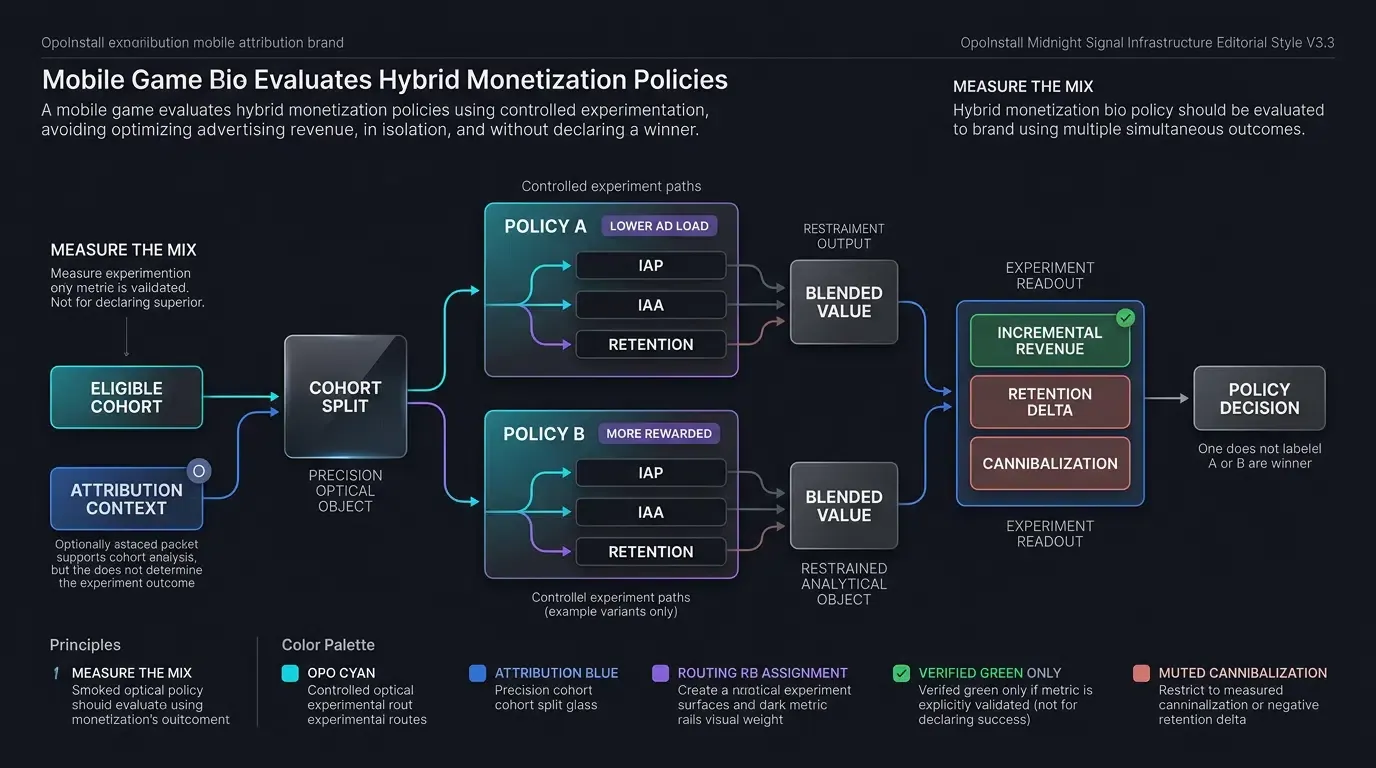
When Should Game Developers Implement Dynamic Ad Suppression Rules
Suitable Conditions for Enforcing Strict Ad Suppression
Game development teams should evaluate enforcing ad suppression rules under specific operational conditions:
- Verified Ad-Free Entitlement Holders: Any account that has purchased a dedicated “Remove Ads” SKU should have all eligible non-rewarded ads permanently disabled.
- Active Transactors: Players with verified real-money purchases can be tested with reduced forced ad frequencies or temporary suppression windows based on recency to preserve lifetime value.
- High-Stakes Gameplay Sessions: During active competitive multiplayer matches, ranked PvP battles, or cooperative raid encounters where an unexpected ad would destroy competitive fairness.
- Initial Tutorial and Onboarding Sequences: During a player’s first sessions before they establish an understanding of core gameplay mechanics.
Unsuitable Conditions for Universal Ad Removal
Completely removing all advertising across an application is unviable in specific scenarios:
- Voluntary Rewarded Video Options: Paying players frequently appreciate the choice to watch rewarded ads for convenience utility (e.g., immediate character revives); suppress forced interstitials while preserving opt-in rewarded opportunities.
- Consumable Purchases Without Explicit Entitlements: Titles where a microtransaction specifically purchased consumable currency rather than an explicit ad-free entitlement should evaluate ad suppression based on recency windows or experiment policies rather than permanent removal.
Common Pitfalls in Hybrid Monetization Implementation
- Pitfall 1: Uncalibrated Hard-Currency Ad Grants: Uncontrolled hard-currency grants through rewarded ads can substitute for direct purchases and should be tested against store conversion.
- Pitfall 2: Static Monolithic Ad Pacing: Applying identical interstitial frequencies across all players causes high churn among sensitive cohorts and leaves yield uncaptured among ad-tolerant users.
- Pitfall 3: Insecure Client-Reported Spend in Segmentation: Trusting client-reported purchase history to configure monetization rules exposes the game to local billing spoofers and unauthorized ad suppression.
Frequently Asked Questions (FAQ)
What is hybrid monetization and why is it popular in mobile games?
How do game developers prevent ads from cannibalizing in-app purchases?
How can attribution parameters help segment players for hybrid monetization?
Summary and Decision Framework
Implementing hybrid monetization requires shifting from blunt, universal ad models toward nuanced, player-centric commercial design. Successfully balancing microtransactions and in-app advertising relies on establishing clear currency segregation, designing non-intrusive rewarded ad loops, and deploying dynamic behavioral segmentation.
By leveraging attribution parameters as initial prior signals and validating purchases server-side, game studios can monetize both spending and non-spending player cohorts while managing cannibalization risk. This balanced framework can improve blended ARPDAU while managing retention and cannibalization risk, building a sustainable mobile gaming business.
To explore how parameter passing and attribution telemetry can power dynamic player segmentation in your title, consult the mobile attribution implementation reference.
Related Materials
-
Concepts: Hybrid Monetization, In-App Purchase, Ad Monetization, Player Segmentation, Ad Cannibalization, ARPDAU
-
Technologies: Attribution SDK, Server-Driven Configuration, Ad Mediation Engine, Telemetry Ingestion
-
Standards: IETF RFC 8259 JSON Data Interchange Format, W3C Mobile Web Best Practices, OWASP Mobile Security
-
APIs: Google Play Billing Library, Apple StoreKit 2 Transaction API, Channel Statistics Interfaces
-
Official Documentation & References:
Share this article