How does fraud detection improve campaign optimization? Fraud detection improves campaign optimization by reducing invalid or suspicious conversion signals before they reach ad network auto-bidders, mitigating the risk that corrupted postbacks misalign machine-learning bidding models.
Campaign optimization in mobile performance marketing is the process of adjusting media bids, target audiences, and publisher allocations to maximize customer acquisition efficiency. When automated bidding algorithms (such as Target CPA or Target ROAS) process corrupted conversion feeds, ad fraud misaligns optimization models, shifting media budgets toward non-human or poached traffic. Implementing real-time fraud detection filters suspicious conversion signals to reduce the risk of machine-learning bidders optimizing toward invalid traffic.
| Term | Definition | Related Entity | Search Intent Role |
|---|---|---|---|
| Campaign Optimization | The systematic tuning of media spend to maximize acquisition ROI. | Performance Marketing | Informational / Commercial |
| Ad Fraud | Invalid traffic, synthetic installs, or poached clicks that corrupt attribution. | Tracking URL | Technical / Informational |
| Real Time Reporting | Low-latency telemetry processing enabling immediate postback controls. | Mobile Measurement Partner | Technical / Informational |
Why Campaign Optimization Fails When Fueled by Fraudulent Conversion Data
The Machine-Learning Feedback Loop: How Automated Bidders Learn from Corrupted Postbacks
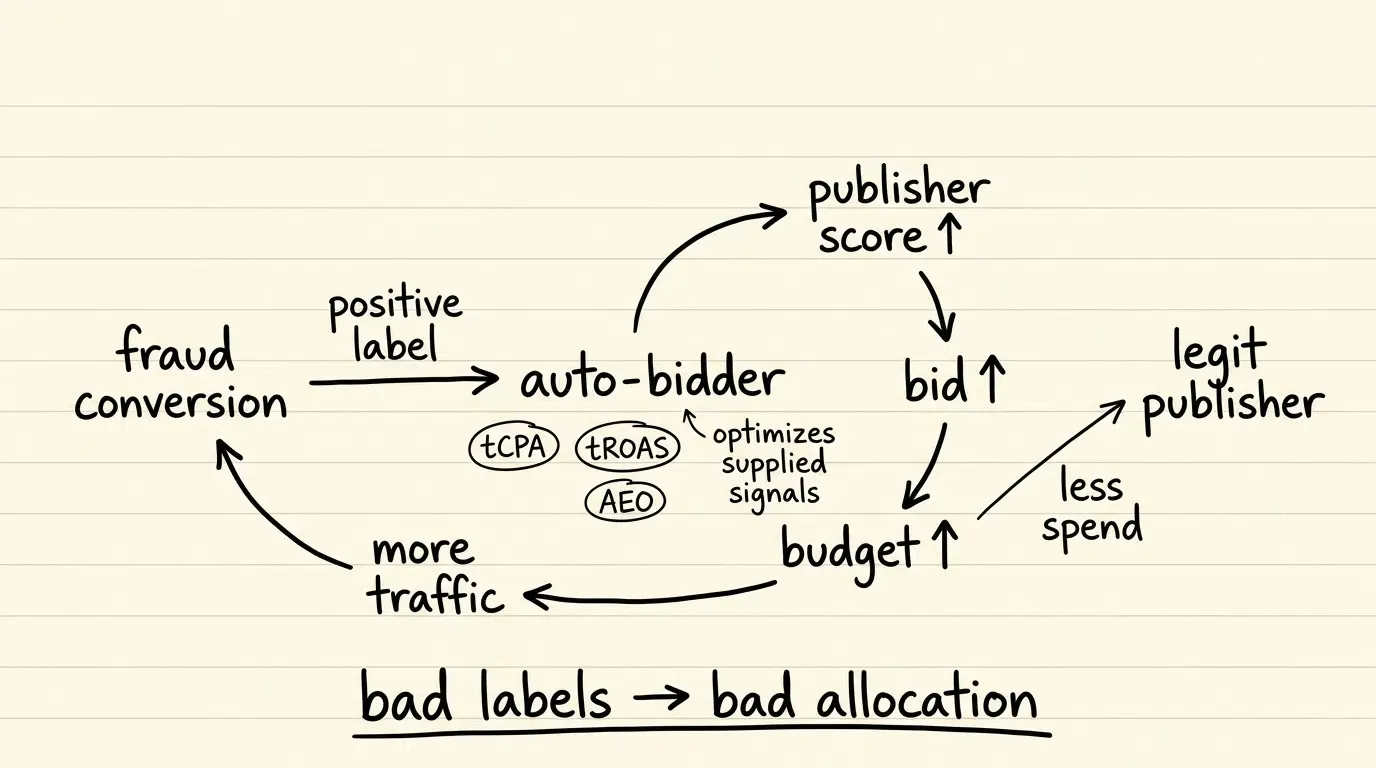
Modern mobile performance marketing relies heavily on programmatic ad networks that utilize automated, machine-learning bidding algorithms. These auto-bidders—operating under frameworks such as Target Cost Per Acquisition (tCPA), Target Return on Ad Spend (tROAS), and App Event Optimization (AEO)—continuously adjust impression bids across publisher sub-IDs.
A critical class of inputs driving automated bidding is the eligible conversion and conversion-value data reported to the advertising platform. Mobile Measurement Partner (MMP) or server-to-server (S2S) postbacks represent one common integration path among several (including platform SDKs, conversion APIs, and first-party web tags). The network’s machine-learning model ingests these conversion signals as training inputs, associating conversions with specific publisher placement features, user demographics, and bidding parameters.
If conversion signals are generated by synthetic fraud (such as SDK spoofing or device farm scripts) or poached from organic traffic (via click injection or click spamming), the auto-bidder receives a toxic training input. The algorithm incorrectly associates the fraudulent publisher placement with high-value traffic, establishing a negative feedback loop that harms campaign performance.
The False Positive Trap: Rewarding Fraudulent Sub-Publishers for Synthetic Installs
When automated bidding models ingest unfiltered conversion postbacks, they fall into a false positive optimization trap. Fraudulent publisher sub-IDs that generate synthetic installs appear, from the ad network’s perspective, to be performing exceptionally well.
Automated bidding algorithms optimize toward the conversion goals, values, and constraints supplied to the platform by the advertiser, rather than an independent measure of human or incremental business value. Consequently, the bidding engine automatically increases bid prices and budget allocations for those fraudulent sub-IDs. Over time, the ad network’s internal optimization logic concentrates campaign spend on bad actors, while legitimate, human-delivering publishers receive lower bids and reduced budget allocations.
Budget Cannibalization: Starving Authentic High-Intent Publishers of Media Capital
The direct consequence of corrupted bidding logic is budget cannibalization. Performance marketing budgets are finite; capital allocated to sub-publishers generating fake installs is withheld from authentic media channels that reach genuine users.
Furthermore, when click spammers poach organic downloads and receive conversion postbacks, the ad network’s bidding algorithm assumes the paid campaign successfully drove those installations. The algorithm then bids aggressively on traffic profiles that mimic organic users, spending capital to re-acquire users who would have downloaded the app without paid advertising exposure.
Developers seeking lightweight client telemetry and attribution SDKs can explore packages via the mobile analytics SDK package.
How Do Unfiltered Conversion Postbacks Pollute Programmatic Bidding Algorithms
Anatomy of Automated Bidding Engines (Target CPA, Target ROAS, App Event Optimization)
Programmatic bidding engines function by evaluating real-time auction requests against high-dimensional probability tables. The equations below represent illustrative economic models designed to explain signal weighting intuition, not the exact proprietary bidding algorithms of specific ad platforms (such as Google Smart Bidding or Meta AEO).
When an impression opportunity becomes available, an illustrative Target CPA bidder estimates the probability of conversion (
In Target ROAS and AEO campaigns, where higher target ROAS requires lower allowable acquisition costs per expected dollar of value, the allowable cost model scales inversely with the target ratio:
When postback signals transmit fake install or fake in-app purchase events,
Illustrative Classification Loss Model: How Postbacks Weight Publisher Probability Tables
Automated bidding engines adjust weight vectors (
To illustrate binary classification learning, the log-loss function
Where
When an invalid install or replayed postback sets
Evaluating Real-Time Signal Control vs. Retrospective Data Exclusions
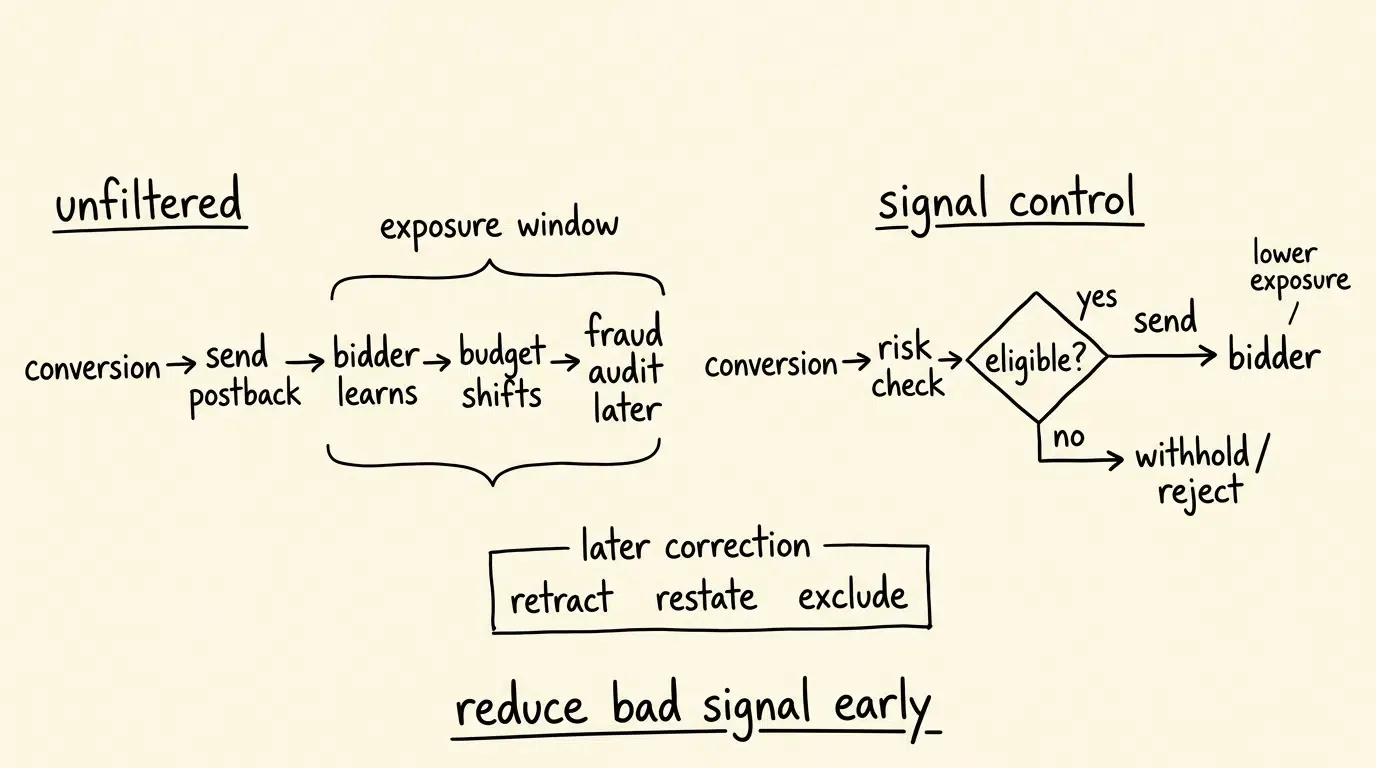
Many advertisers rely on post-campaign reconciliation reports, reviewing traffic quality during periodic or post-campaign reconciliation to negotiate financial clawbacks with ad networks. Real-time fraud filtering reduces the duration during which invalid conversion signals contaminate bidding optimization.
Major ad platforms also provide retrospective conversion adjustment mechanisms—such as Google Ads conversion retractions, restatements, and Data Exclusions—to reduce the impact of past data errors on Smart Bidding models. While retrospective exclusions adjust platform data over time, real-time signal control minimizes the initial window of exposure, protecting active daily budgets before retrospective adjustments are applied.
[Unfiltered Ingestion Pipeline]
  Fake Conversion ──► Conversion Signal Sent ──► Auto-Bidder Trained ──► Bids Increase on Fraud
                                                                                        │
[Purified Ingestion Pipeline]                                                   ▼
  Fake Conversion ──► Signal Control Applied ──► Invalid Signal Withheld ──► Lower Bidder Exposure
The Mechanics of Real-Time Postback Suppression vs Delayed Reporting Audits
Client-Side Ingestion vs. Server-to-Server Postback Gateways
To protect machine-learning bidding models effectively, attribution systems evaluate conversion validity before S2S postbacks leave the measurement boundary:
- Client-Side Ingestion Layer: Captures native application launches, install referrer metadata, and in-app event triggers, performing immediate local validation checks.
- Server-to-Server (S2S) Postback Gateway: Evaluates attribution candidates against real-time risk rules. If the conversion passes anti-fraud verification, the gateway dispatches the S2S postback to the ad network. If the conversion fails validation, the gateway applies configured signal controls.
Enforcing Low-Latency Pre-Postback Anomaly Evaluation
For integrations that support pre-dispatch evaluation, inspecting risk before a positive conversion signal leaves the measurement boundary can minimize the initial exposure window. The attribution gateway evaluates anomaly rules within the latency budget required by the downstream integration, completing evaluation before the postback dispatch window closes.
The gateway evaluates multi-factor risk signals concurrently (see Articles #62, #65, #66, and #67 for detailed analyses of specific detection vectors):
- Timing Inversions: Verifying Click-to-Install-Begin Time (
) against expected sequence order. - IP and Subnet Rate Limits: Checking whether the install IP address or subnet exceeds daily frequency thresholds.
- Device Integrity Attestations: Incorporating platform integrity verdicts (Google Play Integrity or Apple App Attest) as risk inputs.
- MTTI Distribution Alignment: Assessing whether elapsed time deltas align with baseline human launch distributions.
Fraud-Aware Signal Control: Webhook Suppression, Rejection Callbacks, and Signal Annotation
Fraud-aware signal control encompasses several integration-specific disposition modes depending on partner integration specifications and advertiser policies:
- Positive Postback Suppression: Withholding positive conversion webhooks from ad network auto-bidders to prevent synthetic training inputs.
- Rejection Postback Callbacks: Transmitting explicit rejection or blocked-install postbacks with specific fraud reason codes to ad network endpoints (e.g., the AppsFlyer Protect360 integration model).
- Signal Annotation: Tagging conversion webhooks with risk scores for ad network evaluation where explicitly supported by partner contract.
- Retrospective Restatement: Retracting or updating conversion values retroactively in platform management APIs where supported.
[Incoming Conversion Event]
             │
             ▼
 [OpoInstall Anti-Cheat Gateway]
             │
             ├─► [Rule 1: CTIT Inversion Check]  ──► Inversion Detected?   ──┐
             ├─► [Rule 2: Subnet Rate Limit]     ──► IP Capped?             ──┼─► [SIGNAL CONTROL APPLIED]
             ├─► [Rule 3: Device Integrity]      ──► Integrity Risk Found? ──┘   (Lower Bidder Exposure)
             │
             ▼ (All Checks Passed)
 [Fire S2S Postback Webhook to Ad Network] ──► (Partner Receives Policy-Eligible Conversion Signal)
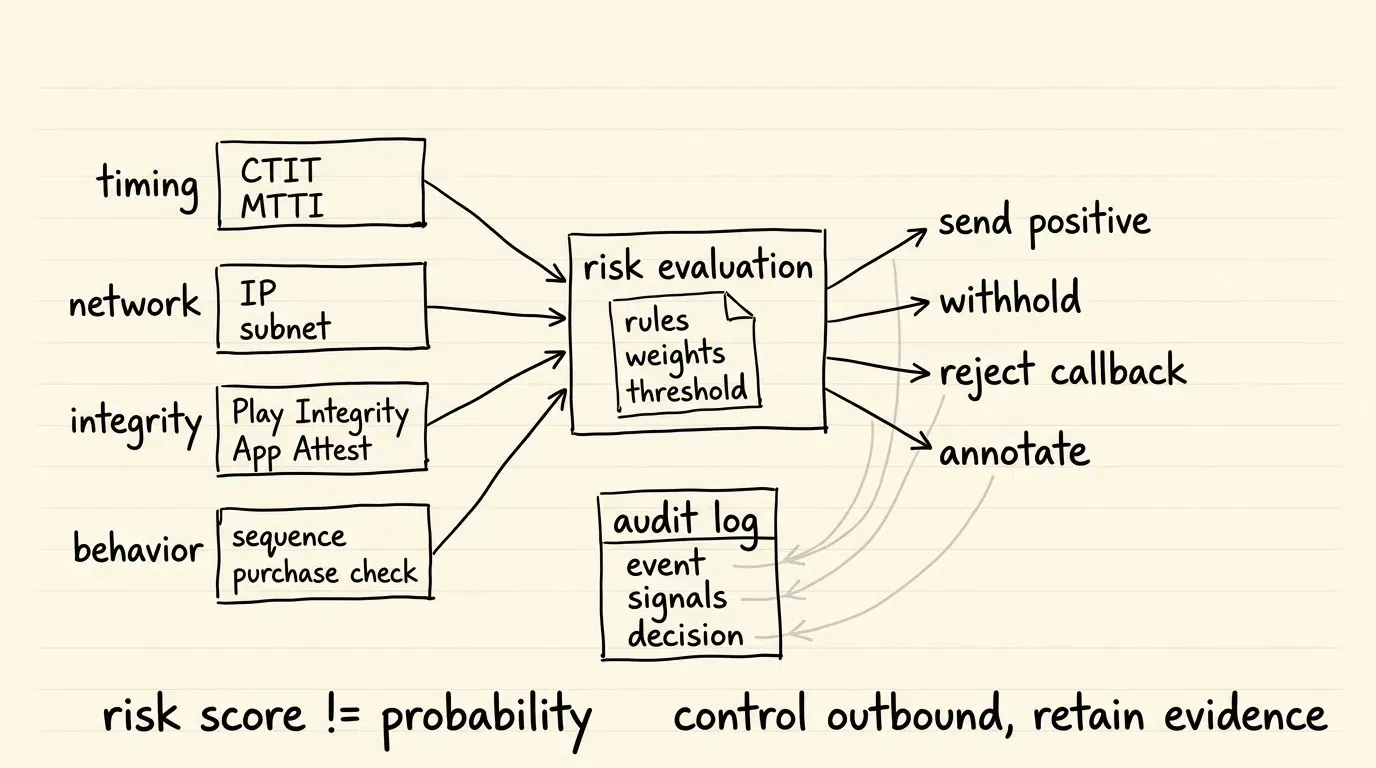
Depending on advertiser configuration, the attribution engine can route the event to an advertiser-defined reconciliation status, which may include unattributed or other policy-specific handling, maintaining internal reporting integrity while withholding positive conversion signals from ad network auto-bidders.
Preserving Ad Network Trust: Maintaining Compliance with Partner Integration Specs
Fraud-aware signal controls should follow each partner’s specific integration requirements; supported disposition modes vary by network, channel type, and measurement contract. Ad networks require accurate conversion data to optimize their systems effectively. Delivering verified, non-fraudulent postbacks improves the long-term health of partner integrations, reduces invoice disputes, and establishes transparent performance baselines between advertisers and media agencies.
How to Protect Machine Learning Bidders Using Real Time Telemetry Signals
Combining Multi-Signal Anomaly Inferences before Postback Dispatch
Single-factor fraud filtering (such as relying solely on an IP blacklist) can generate false positives by misclassifying legitimate shared networks (such as carrier-grade NAT or corporate Wi-Fi). Robust signal control employs multi-signal risk scoring, combining independent telemetry indicators before making a disposition decision:
Where each signal
Filtering Synthetic In-App Events: Protecting App Event Optimization Bidders
As performance marketing incorporates App Event Optimization (AEO) and Target ROAS, fraud can also target downstream event signals. Botnets script fake registration, level completion, or microtransaction events to claim higher CPA bounties.
Real-time signal control can also be applied to in-app event streams, with event-specific validation and disposition rules. By validating event sequence order, checking in-app event latency, and applying transaction-specific verification where applicable before dispatching event postbacks, measurement platforms prevent AEO bidders from over-bidding on non-producing traffic.
Reconciling Real-Time Reporting Feeds with Internal Business Intelligence Ledgers
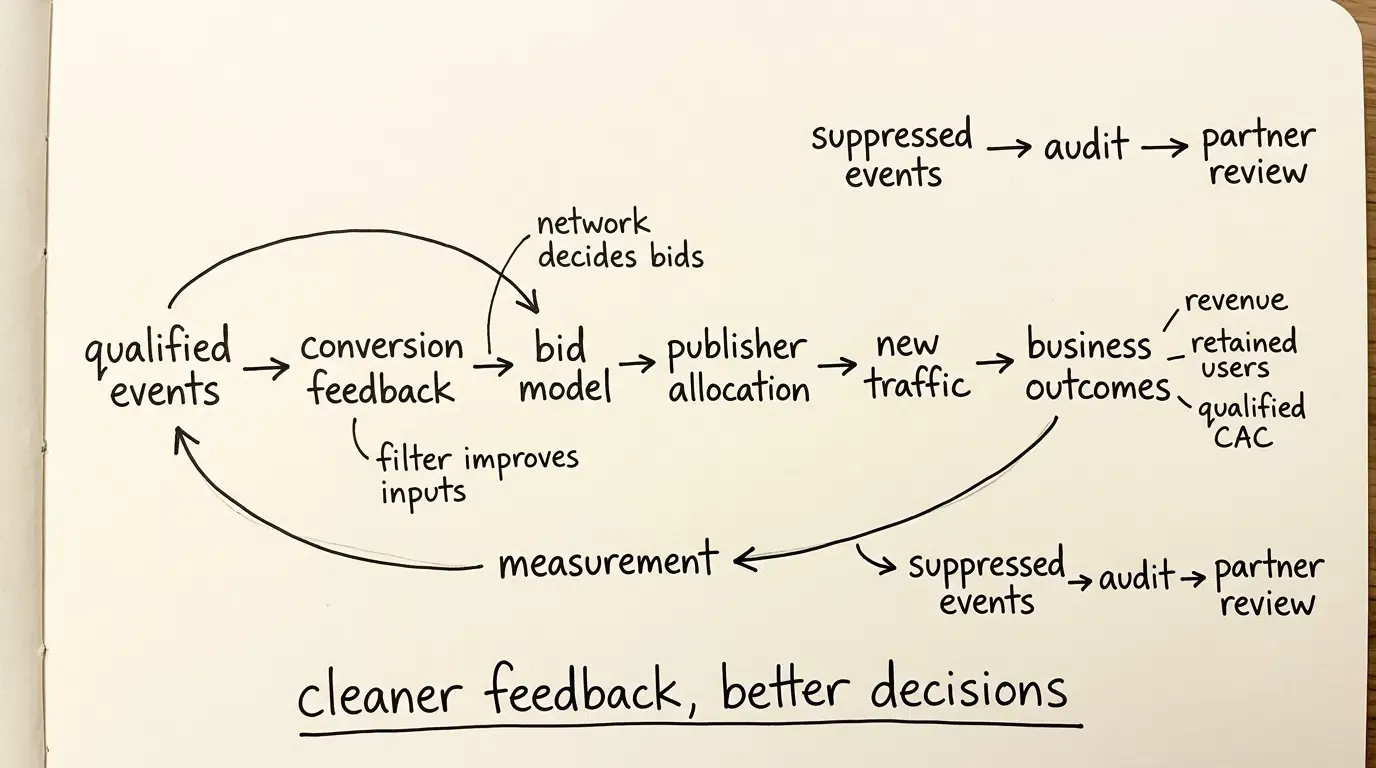
While suppressed postbacks protect ad network auto-bidders, internal business intelligence (BI) data warehouses require complete visibility into both accepted and suppressed conversion attempts.
OpoInstall technical resources discuss real-time rejection workflows and event logging; an internal analytics architecture can preserve both accepted and rejected evaluations in a separate audit stream (positive_conversion_signal_withheld = true, suppression_reason = "ctit_inversion_detected"). This allows internal analytics teams to audit suppressed volume, measure media network quality, and support reconciliation between internal revenue and acquisition records.
Comparative Evaluation of Bidding Algorithm Performance Pre and Post Signal Cleaning
Contrasting Campaign Metrics Across Unfiltered and Real-Time Suppressed Postback Architectures
Cleaning the conversion feedback feed alters campaign performance trajectories across programmatic channels.
The matrix below contrasts campaign outcomes across unfiltered, post-audited, and real-time suppressed postback pipelines:
| Evaluation Dimension | Unfiltered Conversion Pipeline | Retrospective Data Adjustment | Real-Time Signal Control |
|---|---|---|---|
| Bidding Signal Exposure | Greater exposure to invalid conversion signals | Historical influence may be reduced after correction | Minimizes initial exposure window |
| Media Budget Allocation | Budget can shift toward non-producing sub-IDs | Spend may recover as models adapt | May improve allocation toward higher-quality channels |
| Effective Cost Per Retained User | Inflated by non-producing traffic | Requires post-campaign reconciliation | Improved through filtered conversion feeds |
| Partner Reconciliation Burden | Higher investigation and dispute burden | Supports retroactive correction after detection | Earlier disposition and audit evidence |
| Optimization Learning Behavior | Models can incorporate invalid positive labels | Bids and performance may adapt over time | Cleaner eligible inputs where correctly classified |
Evaluating Unit Economics Impact Across Bidding Frameworks
Filtering toxic postbacks stabilizes qualified Customer Acquisition Cost (
In unfiltered campaigns,
How to Configure OpoInstall Cheating Monitoring to Block Toxic Conversion Signals
Structuring Diagnostic Telemetry Payloads for Postback Suppression Audits
Configuring real-time postback suppression requires ingesting structured telemetry that records rule evaluation outcomes, risk scores, and postback dispatch dispositions.
Developers and data engineers can consult the cheating monitoring documentation for technical guidelines on configuring rule thresholds and reviewing anomaly reports.
The JSON payload below demonstrates an illustrative production-oriented telemetry record capturing a real-time postback evaluation decision at the attribution gateway:
```json
{
  "schema_version": "1.2.0",
  "event_id": "evt_postback_suppressed_9a8b7c6d-5e4f-3a2b-1c0d-8f7e6d5c4b3a",
  "event_name": "s2s_postback_eval_completed",
  "evaluation_timestamp_utc": "2026-08-30T22:45:00.120Z",
  "server_received_timestamp_utc": "2026-08-30T22:45:00.850Z",
  "attribution_context": {
    "channel_code": "programmatic_dsp_alpha",
    "publisher_sub_id": "pub_sub_9921_candidate",
    "campaign_id": "cmp_q3_troas_scaling",
    "target_bidding_model": "tROAS",
    "conversion_event_type": "install"
  },
  "anomaly_evaluation": {
    "fraud_vector_classification": "suspected_click_injection",
    "signals_evaluated": [
      "ctit_inversion_detected",
      "subnet_density_anomaly"
    ],
    "risk_score": 0.94,
    "risk_score_scale": "0.0_to_1.0_normalized",
    "risk_score_semantics": "illustrative_policy_score_not_calibrated_probability",
    "risk_model_version": "v2.1_gateway_policy",
    "decision_basis": "configured_postback_suppression_policy"
  },
  "postback_disposition": {
    "outbound_positive_signal_withheld": true,
    "outbound_signal_type": "positive_conversion_event",
    "outbound_signal_status": "withheld",
    "suppression_reason": "ctit_inversion_detected",
    "target_ad_network_endpoint": "https://postback.adnetwork.example/conversion",
    "internal_attribution_disposition": "pending_reconciliation"
  },
  "device_telemetry": {
    "platform": "Android",
    "os_version": "16.0",
    "app_version": "3.2.0",
    "sdk_version": "<installed_sdk_version>",
    "device_risk_key_pseudonymous": "dev_risk_anon_55667788"
  },
  "audit_trail": {
    "partner_signal_disposition_mode": "positive_conversion_not_sent",
    "suppressed_signal_category": "positive_conversion_event",
    "example_only": true
  }
}
Configuring OpoInstall Cheating Monitoring and Postback Controls
Representative monitoring controls documented in related product materials include the following threshold rules; exact rule names and behavior should be verified against the current OpoInstall console and documentation before implementation:
- Click Hijacking Window Period: Configures minimum acceptable MTTI delta thresholds. Installs exhibiting negative CTIT or timing deltas below the configured window trigger anomaly handling according to integration policy.
- Click and Install IP Anomaly Thresholds: Caps allowable click and install frequency per IP address over a 24-hour window, marking excess volume as abnormal IP clicks in Exception Statistics.
- Installation Device Anomaly Thresholds: Tracks repeated installation activity associated with the same internal device identifier, flagging potential repetitive-device anomalies.
- Illustrative Integration Policy Options: Enables teams to configure whether flagged installs trigger postback suppression, rejection callbacks, or risk logging based on partner integration specs.
Recommended Operational Audit Views for a Production Implementation
In production implementations, growth teams manage and audit postback suppression through structured reporting views:
- Real-Time Status Feeds: Displays counts of accepted, withheld, and rejected postbacks, categorized by ad network, campaign ID, and publisher sub-ID.
- Exception Statistics Reports: Provides detailed breakdowns of suppressed events, listing specific rule triggers, IP subnets, device risk keys, and timing deltas.
- Data Export Feeds: Exports structured CSV and JSON logs of suppressed postbacks to support transparent partner quality reviews and invoice reconciliations.
When Are Advanced Anti Fraud Frameworks Necessary for Performance Marketers
Suitable Conditions for Dedicated Postback Suppression Infrastructure
Deploying real-time anti-fraud monitoring and postback suppression delivers high operational return under specific performance marketing conditions:
- Automated Value-Based Bidding Campaigns: Performance marketing programs utilizing tCPA, tROAS, or AEO auto-bidders across open programmatic networks and affiliate brokers.
- High-Budget Acquisition Operations: Campaigns spending substantial monthly budgets where fraud infiltration results in significant wasted media spend.
- Multi-Tier Affiliate and Sub-Publisher Networks: Acquisition channels operating through non-transparent sub-syndication, where publisher quality varies widely.
Unsuitable Conditions for Complex Postback Suppression
This specific external postback-gating architecture may be less applicable in the following scenarios:
- Closed Self-Attributing Networks Exclusively: Marketing campaigns operating 100% of ad spend within closed walled-garden networks (e.g., Apple Search Ads) where the advertising platform owns both measurement and optimization.
- Early Pre-Marketing Prototypes: Early-stage pre-marketing builds operating with zero paid media expenditure.
Common Misconceptions in Campaign Optimization
- Misconception 1: Ad Network Auto-Bidders Automatically Exclude Fraud: Auto-bidders optimize toward the conversion goals and values supplied to the platform; if those inputs materially include invalid events, optimization quality can deteriorate.
- Misconception 2: Retroactive Post-Campaign Clawbacks Repair Bidding Models: Financial clawbacks recover spent capital, but they do not immediately un-train machine-learning models. While platforms support retractions and data exclusions to adjust bidding algorithms over time, real-time signal control minimizes immediate budget exposure during active campaigns.
Frequently Asked Questions (FAQ)
How does fraud detection improve campaign optimization in programmatic advertising?
What is the difference between real-time postback suppression and post-campaign reporting?
How do fake conversion postbacks ruin target CPA and tROAS bidding models?
Summary and Decision Framework
Maximizing campaign optimization and protecting media budgets requires feeding verified conversion signals into automated ad network bidding engines. Allowing fraudulent conversion postbacks to reach programmatic auto-bidders can distort machine-learning optimization models, biasing ad spend toward non-human or poached traffic.
Achieving sustainable campaign optimization relies on transitioning from retroactive post-campaign audits to real-time fraud-aware signal control. By pairing independent attribution measurement with real-time cheating monitoring, platforms like OpoInstall provide the infrastructure required to intercept toxic conversion signals, reduce exposure to invalid optimization signals, and improve campaign decision quality.
To evaluate how unified attribution and real-time cheating monitoring can optimize your performance campaigns, explore the mobile attribution implementation reference or configure your application on the OpoInstall developer console.
Related Materials
-
Concepts: Campaign Optimization, Postback Suppression, Automated Bidding Algorithms, Target CPA (tCPA), Target ROAS (tROAS), Signal Purification
-
Technologies: Cheating Monitoring Engine, Server-to-Server (S2S) Postback Webhooks, Real-Time Telemetry Gateways, Machine-Learning Bidders
-
APIs & Data Interfaces: Attribution Reporting Interfaces, Fraud-Aware Signal Disposition Interfaces, Exception Reporting
-
Official Documentation & References:
Share this article