How to promote a mobile game with zero budget? Promoting a mobile game on little or no paid-media spend requires combining organic distribution with measurable referral loops. Where platform-supported or privacy-compliant deferred referral context is available, studios can restore a server-issued invite token after installation to reduce manual-code friction and route verified players into intended social experiences under server-side authorization.
A mobile game referral campaign is a programmatic growth system that incentivizes existing players to invite new users by dynamically linking social sharing actions to in-game rewards or direct co-op matchmaking. Where platform capabilities allow, compliant deferred referral restoration reduces manual invite codes, enabling the game backend to reconnect an eligible invitee with an inviter, guild, or room after server-side validation.
| Term | Definition | Related Entity | Search Intent Role |
|---|---|---|---|
| Mobile Game Marketing | The commercial promotion and user acquisition strategies deployed for mobile titles. | Growth Marketing | Informational / Commercial |
| Referral Tracking | The programmatic attribution of downstream installs generated by existing users. | Viral Attribution | Technical / Informational |
| K-Factor | The mathematical coefficient measuring the rate of organic viral player growth. | Viral Multiplier | Operational / Decision |
The Commercial Reality of Paid User Acquisition in Mobile Game Marketing
The Escalation of Mobile Paid UA Costs: Why CPI Inflation Strains Indie Budgets
Performance marketing for mobile games has become increasingly capital-intensive. As programmatic ad platforms adapt to platform-level data governance and privacy frameworks, user targeting has become less deterministic. Simultaneously, intense competition across major ad networks has elevated Cost-Per-Install (CPI) bids across casual, mid-core, and puzzle genres.
For independent game studios and early-stage publishing teams operating with limited capital, relying exclusively on paid ad networks presents severe structural challenges. When upfront user acquisition costs exceed early player monetization returns, studios face acute cash-flow compression before game economies can achieve payback. While “zero budget” in marketing contexts refers to operating with little or no direct paid-media spend, establishing organic growth still requires product engineering, live operations, community management, and in-game reward resources.
The Organic Multiplier: Transforming Seed Cohorts into Self-Sustaining Loops
To achieve commercial viability under constrained budgets, game marketing strategies must transition from linear paid acquisition toward self-sustaining organic multipliers. In a linear acquisition model, marketing growth ceases the moment advertising spend is paused: a fixed budget yields a fixed number of installs, producing zero downstream momentum.
An organic multiplier transforms every acquired player—whether sourced from organic store discovery, social channels, community outreach, or modest initial paid tests—into an active acquisition node. When a game implements structured referral mechanics, each active player invites a measurable fraction of secondary users. This dynamic generates secondary, tertiary, and ongoing waves of low-cost referral downloads, multiplying the effective volume of the original seed cohort and significantly reducing blended acquisition costs.
Low-Cost Growth Foundations: ASO, Community Engagement, and Organic Word-of-Mouth
A successful low-cost marketing framework rests on three non-paid pillars:
- App Store Optimization (ASO): Ensuring conversion rates from store page views to downloads are optimized through keyword-rich metadata, localized titles, high-contrast visual iconography, and clear gameplay preview videos.
- Community and Social Infrastructure: Building active player hubs across community platforms (such as Discord, Reddit, and social media channels) where early adopters can interact directly with developers and participate in beta testing cycles.
- Built-In Word-of-Mouth Hooks: Designing shareable gameplay moments—such as high-score replays, rare gacha pulls, custom base designs, or clutch multiplayer victories—that players naturally want to broadcast to their personal networks.
While ASO and community building establish baseline visibility, converting passive word-of-mouth into measurable, high-velocity acquisition requires an automated referral tracking system.
How Do Viral Loops and Referral Systems Drive Organic Game Growth
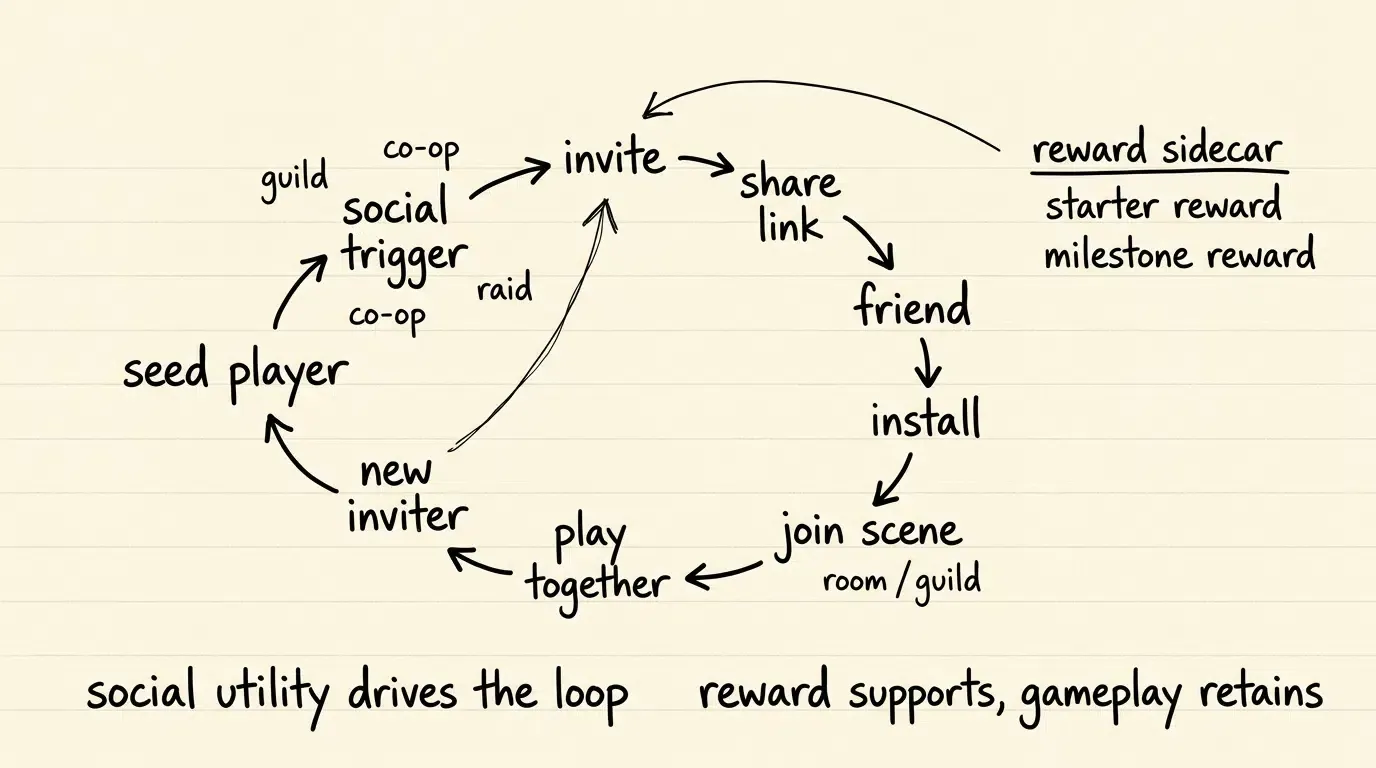
Anatomy of an In-Game Viral Loop: Trigger, Share, Install, and Reciprocate
An in-game viral loop is a closed-loop behavioral sequence that guides players from initial gameplay engagement to outbound peer recruitment:
- Viral Trigger: An active player (Inviter) encounters an in-game event that encourages social sharing (e.g., forming a guild, opening a multiplayer co-op lobby, or unlocking a referral milestone).
- Opaque Token Generation: The game client requests a unique, server-issued referral token from the game backend, embedding it into a dynamic web share link.
- Social Dispatch: The inviter shares the link directly via external social channels or messaging apps (such as WhatsApp, Line, WeChat, or Discord).
- Contextual Landing & Store Routing: The prospective player (Invitee) clicks the link, views a lightweight web landing page showing the inviter’s profile or match room, and proceeds to the platform app store.
- Frictionless Installation & Routing: Upon first launch, the game client retrieves the referral token asynchronously, transmits it to the game server for validation, and automatically executes the authorized routing action (e.g., connecting to the inviter’s room).
- Loop Completion & Reciprocation: The invitee receives onboarding starter resources, experiences core gameplay, and is presented with their own viral sharing opportunities as they progress.
Incentive Architecture: Aligning Social Utility with Virtual Currencies
Designing effective referral incentives requires balancing intrinsic social utility against extrinsic virtual rewards:
- Intrinsic Social Utility: The most powerful referral drivers in gaming are functional. Enabling friends to play together in real-time co-op, form alliances, unlock cooperative raid encounters, or trade in-game resources provides genuine gameplay motivation that often exceeds pure virtual currency rewards.
- Extrinsic Virtual Currency: Offering soft currency, stamina refills, or progression acceleration tokens compensates players for outbound sharing effort. However, extrinsic rewards must be carefully calibrated to avoid destabilizing the in-game economy or encouraging multi-account self-referral farming.
- Cosmetic and Prestige Rewards: Exclusive character skins, unique player badges, or custom lobby titles awarded exclusively through referral milestones tap into player prestige without inflating virtual currency supplies.
Double-Sided Reward Mechanics: Balancing Inviter and Invitee Motivation
Double-sided referral mechanics can improve the attractiveness of the referral loop by providing value to both participants; studios should measure the incremental effect on invite acceptance and qualified referral conversion through controlled tests:
- Inviter Reward: Receives progressive milestone points or social utility tokens once the invited friend installs and completes an initial gameplay milestone (e.g., completing the tutorial or reaching an account level).
- Invitee Reward: Receives an immediate welcome package (e.g., starter currency, premium character trials, or progression boosters) upon their first login, reducing initial onboarding difficulty and accelerating early engagement.
Preventing Economy Inflation: Setting Tiered Ceilings on Referral Rewards
Uncapped referral rewards introduce substantial inflation risks into mobile game economies. Malicious users or automated bot farms can exploit open referral mechanisms to generate unlimited virtual currency, undermining direct in-app purchase (IAP) revenues.
Studios should implement structured economic controls:
- Daily and Lifetime Referral Caps: Limit the number of rewarded referrals an individual account can claim within a 24-hour window and over the lifetime of the account (e.g., establishing illustrative caps such as 5 rewarded invites per day, configured according to game balance).
- Milestone-Gated Payouts: Release high-tier referral rewards only when the invited player achieves meaningful in-game milestones (e.g., completing Chapter 1 or spending 30 minutes in active gameplay), ensuring rewards correlate with genuine player engagement.
- Diminishing Marginal Rewards: Structure reward tiers so that initial referrals grant high utility, while subsequent referrals award cosmetic badges or social recognition rather than liquid in-game currency.
Mathematical Modeling of the Viral K-Factor in Mobile Games
The Classical Viral Coefficient Formula: K Equals Invites Times Conversion Rate
The mathematical engine governing organic referral campaigns is the viral coefficient, universally designated as the
Where:
represents the average number of invitations sent per active player:
represents the conversion rate of each sent invitation (the probability that an invitation results in a verified installation and first launch):
Deconstructing Input Variables: Invites Sent per Player and Invite Conversion Rates
To optimize the
- Increasing Invitation Frequency (
): Improving the visibility of invite buttons, integrating share prompts into natural victory moments, and offering compelling cooperative gameplay modes that require additional participants. - Increasing Invitation Conversion Rate (
): Ensuring web landing pages load rapidly, displaying personalized contextual previews (e.g., “Join Alex’s Level 12 Guild”), and eliminating manual promo code entry during the install-to-launch sequence.
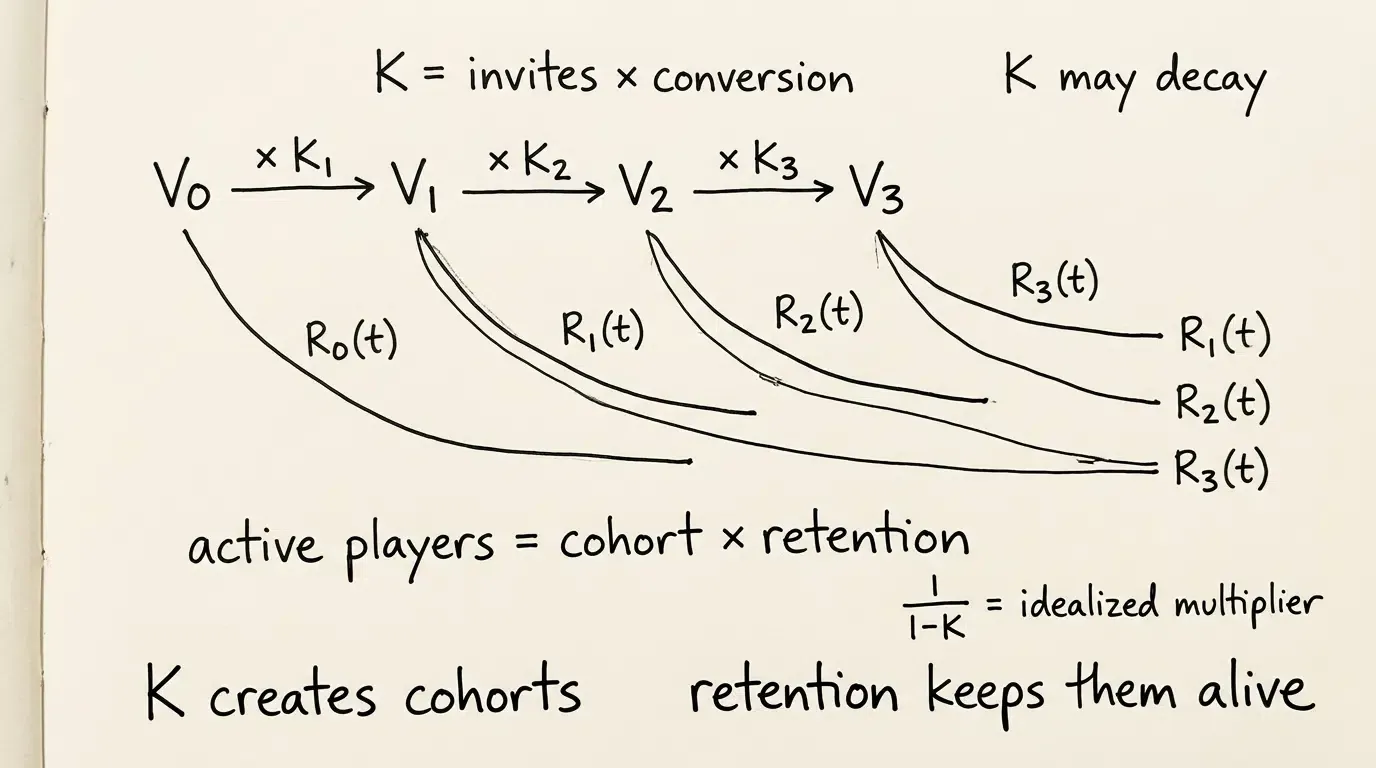
Mathematical Thresholds: Steady State versus Expanding Viral Loops
The value of
- Expanding Viral Loop (
): Each generation of players produces more referred users than the previous generation ( ). The game achieves exponential viral growth. While mathematically possible, sustained is exceptionally rare in commercial mobile gaming. - Steady-State Reproduction (
): Each referral generation reproduces a cohort of approximately the same size ( ) under a simplified generational model. - Decaying Viral Multipliers (
): Each generation produces a smaller cohort than the previous one, eventually tapering off. However, under a simplified, constant- , infinite-generation model with no market saturation, this produces a theoretical referral multiplier ( ):
Where
Theoretical Referral Multiplier under Constant K:
Total Installs
Multiplier (M_v)
|                                        / (K > 1.0: Expanding Viral Growth)
|                                       /
5x|                                     /
|                                    /
3x|                              .–’ (K = 0.67: Multiplier = 3.0x)
2x|                    .--------’     (K = 0.50: Multiplier = 2.0x)
1.5x|         .----------’              (K = 0.33: Multiplier = 1.5x)
1x||________________________________________
0.0      0.2       0.4       0.6       0.8       1.0 (K-Factor)
Calculating Effective Blended Acquisition Costs and Economics
When evaluating referral economics, studios must account for both media spend and the tangible costs of the referral program (such as in-game reward value, server infrastructure, and promotional operations).
The empirical Blended Acquisition Cost per Install (Blended CPI) is defined as:
Under an idealized approximation where referral incentives carry zero marginal cash cost and
This illustrates how an active referral loop compresses acquisition costs by augmenting paid cohorts with low-cost peer referrals.
How Parameter Passing and Deep Linking Eliminate Onboarding Friction
The Friction Penalty: Why Manual Copy-Paste Promo Codes Suppress Conversion
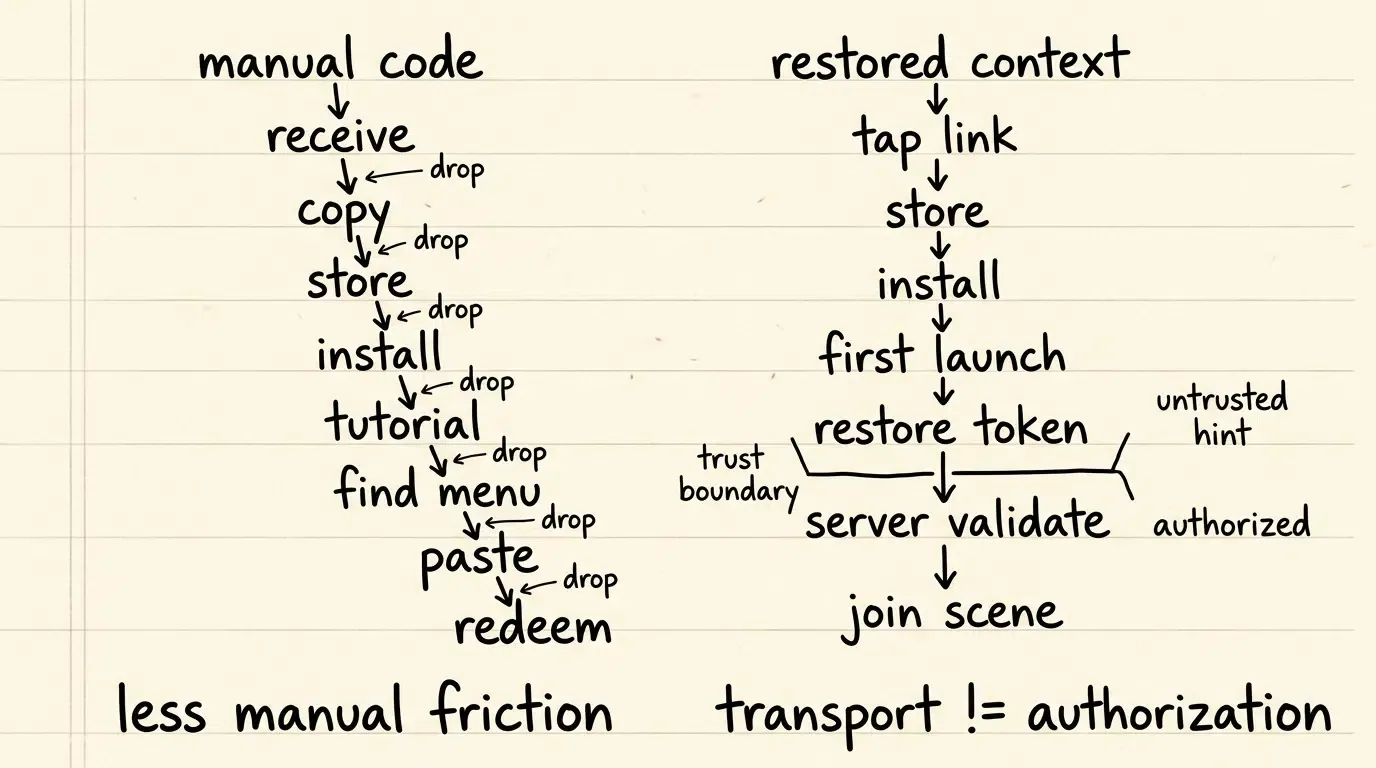
The primary operational point of failure in traditional mobile referral programs is manual code entry. Under legacy systems, Player A shares a static text string (e.g., HERO9921). Player B must copy the string, open the app store, download the application, launch the game, complete the tutorial, locate a settings or redemption menu, and manually paste the code.
Each additional required step can increase abandonment and should be measured in the referral funnel:
- Clipboard Overwrite: Users overwrite their clipboard or lose the string during long app store download times.
- Menu Abandonment: Casual players abandon the referral process when forced to navigate complex in-game settings menus.
- Typographical Errors: Case-sensitive strings generate input errors, causing frustration and abandoned referral claims.
Cumulatively, manual code entry mechanisms cause substantial conversion drop-off, directly depressing the invite conversion rate (
Platform Routing Architectures: App Links, Universal Links, and Store Referrers
Bridging web referral links to native mobile applications requires distinct technical mechanisms depending on whether the app is already installed:
- Installed App Direct Deep Linking: For users who already have the game installed, Android App Links and Apple Universal Links provide verified, direct routing. Clicking a verified HTTPS referral link bypasses the browser and directly opens the game client, passing incoming URL parameters.
- Android Post-Install Attribution (Google Play Install Referrer): For new users installing via Google Play, the platform provides the Google Play Install Referrer API. The attribution system passes referral parameters securely through the store download flow, allowing the app client to retrieve the exact referral URL upon initial launch.
- iOS Post-Install Deferred Context: Universal Links do not natively preserve arbitrary parameters across the App Store installation boundary for uninstalled apps. Deferred context restoration across iOS app installations requires provider-specific, privacy-compliant architectures.
Addressing Privacy Constraints and Eliminating Fingerprinting Heuristics
A critical technical requirement for modern referral architectures is strict compliance with platform privacy policies. Apple App Store guidelines strictly prohibit device fingerprinting—specifically, deriving persistent or probabilistic device identifiers from browser properties, user-agents, IP addresses, or device hardware configurations. Furthermore, mobile operating systems restrict unprompted access to system pasteboards.
Compliant referral architectures must avoid prohibited fingerprinting heuristics. Instead, referral tracking should rely on authorized platform APIs (such as Google Play Install Referrer on Android), first-party server sessions, and compliant contextual attribution pipelines that do not harvest unauthorized device telemetry.
Server-Authoritative Scene Restoration: Turning Restored Tokens into Verified Actions
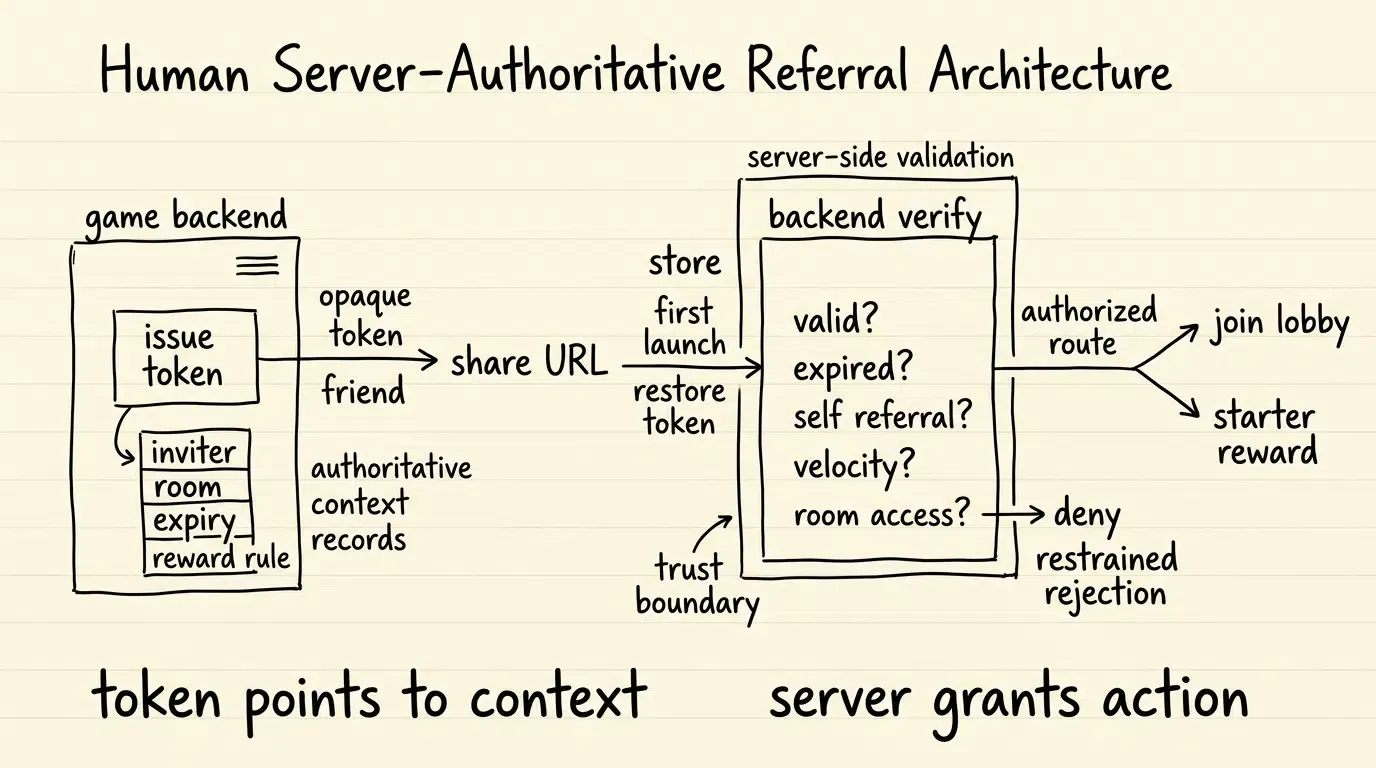
Parameters retrieved upon application launch must be treated strictly as untrusted routing hints. An attacker can manipulate URL query parameters or replay expired referral links. The mobile game client must never grant rewards, join private rooms, or alter guild memberships based solely on client-parsed URL parameters.
The secure scene restoration workflow operates as follows:
- Token Restoration: The client SDK asynchronously retrieves the cached referral payload on startup.
- Server-Side Validation: The game client transmits the opaque invite token (
invite_token) to the game backend. - Authorization & Context Verification: The game server verifies that the token is valid, active, unexpired, and within authorized referral limits. It cross-checks the target room’s existence, capacity, and access rules.
- Authorized Client Navigation: Upon receiving server authorization, the game client executes the scene restoration action (e.g., navigating the player into the private match lobby or applying the starter bundle).
Frictionless Game Referral and Server-Authoritative Restoration Pipeline:
[Player A] ──> Requests Opaque Invite Token (?invite_token=tok_99812)
│
▼
[Share Link Dispatched] ──> Player B Clicks Link & Proceeds to Store
│
▼
[App Store / Google Play] ──> Player B Installs & Launches Game
│
▼
[Client Startup] ──> SDK Retrieves Parameter Payload Asynchronously
│
▼
[Game Backend Verification] ──> Server Validates Token & Authorizes Room/Reward Context
│
▼
[Authorized Scene Restoration] ──> Player B Automatically Joins Player A’s Match Lobby
Technical Framework for Secure Game Referral Tracking
Issuing Opaque Invite Tokens and Verifying Originating Context
To avoid exposing raw inviter, room, or guild identifiers in share URLs, the game backend should issue a cryptographically random opaque invite token and store the authoritative inviter, campaign, room, reward, expiry, and redemption context server-side. Share URLs contain only the opaque token.
After restoration on first launch, the game backend resolves the token and verifies its scope, expiry, redemption policy, inviter eligibility, and target-resource authorization before returning any permitted routing or reward action. A stateless signed-token design is also possible, but its cryptographic implementation is outside this article’s scope.
Asynchronous Client Retrieval and Server Authorization Workflows
In mobile gaming architectures, parameter restoration must never block the main rendering thread or delay initial asset loading. Client SDKs (such as OpoInstall example interfaces like getInstallParam) query the attribution gateway asynchronously during game engine initialization.
Once the parameter callback returns the cached JSON payload, the client dispatches the token to the game’s authoritative session manager. If the user is on Android, the system can leverage Google Play Install Referrer data; on iOS, the client processes available contextual deep-linking tokens in accordance with platform policies.
Developers seeking integration libraries for game engines can consult the SDK integration resources for implementation guidelines.
Structuring the Game Referral Event and Session Payload
To maintain clear technical separation between attribution metadata, multiplayer routing parameters, and reward allocations, game servers utilize structured JSON schemas.
The schema placeholder below illustrates a reference architecture record capturing inviter telemetry, opaque referral tokens, server authorization states, and scene restoration outcomes:
{
  "reference_architecture": true,
  "illustrative_thresholds": true,
  "game_referral_session_record": {
    "telemetry_metadata": {
      "session_record_id": "ref_sess_2026_0911_9921",
      "timestamp_utc": "2026-09-11T06:15:00.000Z",
      "app_id": "com.example.game.coop_rpg",
      "new_user_account_id": "usr_new_772184"
    },
    "inviter_context": {
      "inviter_account_id": "usr_vet_102941",
      "inviter_account_age_days": 42,
      "lifetime_successful_referrals": 4,
      "inviter_risk_tier": "low_risk_trusted_player"
    },
    "restored_referral_token_context": {
      "opaque_invite_token": "tok_d4e1f7a8_99812",
      "token_resolution_status": "resolved_valid",
      "token_expiry_status": "valid",
      "token_scope_status": "authorized",
      "token_redemption_policy": "multi_use_until_expiry",
      "target_game_room_id": "room_dungeon_409",
      "guild_alliance_id": "gld_valiant_77",
      "campaign_source_tag": "in_game_guild_recruit",
      "sharing_platform_reported": "whatsapp"
    },
    "platform_restoration_provenance": {
      "platform": "Android",
      "restoration_method": "google_play_install_referrer",
      "retrieval_mode": "asynchronous_startup_callback",
      "prohibited_fingerprinting_used": false,
      "privacy_profile": "google_play_install_referrer"
    },
    "server_authorization_and_scene_routing": {
      "server_authorization_status": "approved",
      "room_access_authorized": true,
      "target_scene_routed": "Lobby_PrivateRoom_View",
      "double_sided_reward_disposition": {
        "invitee_starter_pack_granted": true,
        "inviter_reward_status": "pending_gameplay_milestone",
        "required_milestone": "complete_chapter_1"
      },
      "anti_abuse_evaluations": {
        "self_referral_check": "passed",
        "velocity_limit_check": "passed",
        "token_reuse_check": "passed"
      }
    }
  }
}
Auditing Viral Nodes and Mitigating Self-Referral Exploits
A comprehensive referral tracking architecture enables analytics teams to identify high-performing viral nodes—active community leaders, guild masters, or creators who drive substantial organic player volume. Identifying these players allows studios to provide custom community support and exclusive in-game recognition.
Simultaneously, automated monitoring systems must audit referral flows to detect malicious abuse:
- Velocity Thresholds: Flagging accounts that generate abnormal volumes of referral installs within short intervals.
- Downstream Engagement Checks: Evaluating whether referred players complete initial gameplay milestones before releasing high-tier inviter rewards.
- Self-Referral Prevention: Using platform-permitted integrity, account, token, and server-side abuse signals to detect likely self-referral or duplicate redemption patterns without constructing prohibited device fingerprints.
Teams can review available cheating monitoring documentation for technical interfaces and viral sharing parameter specifications.
Comparative Analysis of Mobile Game Growth Channels Under Budget Constraints
Evaluating Scalability, Cost Structures, and Technical Overhead Across Acquisition Vectors
Budget-constrained game studios must evaluate user acquisition vectors across capital intensity, technical requirements, and scalability potential.
The table below contrasts primary mobile game growth channels:
| Growth Channel | Capital Requirement | Technical Complexity | Scalability Potential | Primary Operational Bottleneck |
|---|---|---|---|---|
| Paid Ad Networks | High (Direct media spend) | Low to Moderate | High (Capital dependent) | Escalating CPIs and rapid budget exhaustion |
| App Store Optimization | Low (Internal labor) | Moderate (Metadata tuning) | Moderate (Store search capped) | Algorithm shifts and keyword saturation |
| Community / Creator Outreach | Low to Moderate | High (Relationship management) | Moderate to High | Long lead times and unpredictable creator pickup |
| In-Game Referral Loops | Low (Internal development) | Moderate (SDK integration) | Variable to High (Multiplier depends on retention and conversion) | Dependent on baseline retention and social depth |
Balancing Organic Virality Against Paid Acceleration
While in-game referral loops provide attractive acquisition economics, they require an initial seed cohort of active players to generate momentum.
A capital-efficient growth strategy combines channels sequentially:
- Baseline Setup: Maximize ASO and community outreach to establish an initial organic player baseline (
). - Referral Integration: Deploy lower-friction, double-sided referral mechanics and server-authorized parameter passing to maximize the organic
-factor. - Targeted Paid Acceleration: Deploy small, highly focused paid ad tests to inject fresh seed cohorts into high-performing viral loops, multiplying the return on every marketing dollar spent.
When Should Game Studios Rely on Referral Loops as a Primary Growth Driver
Suitable Conditions for Prioritizing In-Game Referral Campaigns
Game studios should prioritize in-game referral programs under specific design conditions:
- Multiplayer and Cooperative Gameplay: Titles where playing alongside friends directly improves the core experience (e.g., co-op RPGs, team brawlers, card battle games, social party games).
- Guild and Alliance Meta-Systems: Strategy and mid-core games where player organizations actively recruit members to maintain competitive strength.
- Healthy Baseline Retention: Titles exhibiting stable early engagement metrics benchmarked against their genre, ensuring newly recruited players remain active.
- Shareable Gameplay Moments: Games featuring personalized, broadcastable events (e.g., custom dungeon designs, match replays, or rare achievement unlocks).
Unsuitable Conditions for Viral Referral Models
Relying primarily on viral referral loops is ineffective in specific game contexts:
- Pure Single-Player Narrative Games: Story-driven or atmospheric puzzle games lacking natural social, competitive, or cooperative interaction points.
- Early Prototypes with Poor Retention: Games with unvalidated core loops where new players churn rapidly; viral mechanics cannot fix a broken retention funnel.
- Hyper-Casual Titles with Short Lifecycles: Games designed for transient sessions where players lack incentive to organize or invite peers.
Common Misconceptions in Mobile Game Referral Marketing
- Misconception 1: Extrinsic Rewards Can Compensate for Weak Gameplay: Offering virtual gold or diamonds will not drive sustained virality if the underlying game lacks engagement. Virality amplifies existing player enthusiasm; it cannot manufacture fun.
- Misconception 2: Manual Promo Codes Are Acceptable for Casual Players: Assuming players will manually copy and paste alphanumeric strings ignores mobile UX friction. Every manual step reduces invite conversion rates.
- Misconception 3: Virality Operates Independently of Retention: A referral program only compounds growth if newly acquired players remain active long enough to invite their own peer network.
Frequently Asked Questions (FAQ)
How can indie game developers promote a mobile game with no budget?
What is a good viral K-factor for mobile games?
Why do traditional referral promo codes fail in mobile game onboarding?
Summary and Decision Framework
Promoting a mobile game under budget constraints requires shifting from capital-intensive paid advertising toward self-sustaining organic referral architectures. Maximizing organic growth relies on designing intrinsic social incentives, calculating the viral
By deploying compliant deep linking that automatically connects new players to their inviters, guilds, or game rooms under server-authoritative validation, studios can transform player enthusiasm into measurable organic lift. Combining parameter-driven installation with robust referral attribution enables game developers to lower blended acquisition costs and achieve sustainable commercial growth.
To explore how parameter passing and referral tracking can power lower-friction referral campaigns in your game, consult the mobile attribution implementation reference.
Related Materials
-
Concepts: Mobile Game Marketing, Referral Tracking, K-Factor, Parameter Passing, Scene Restoration, Viral Loops
-
Technologies: Deferred Deep Linking, Web-to-App Routing, In-Game Attribution SDK, S2S Webhooks
-
Standards: IETF RFC 3986 URI Generic Syntax, W3C Web Application Security Guidelines, OWASP Mobile Security
-
APIs: Google Play Install Referrer API, Apple StoreKit Ad Network API, OpoInstall Example Interfaces (getInstallParam, reportShare)
-
Official Documentation & References:
Share this article