OpenAI deploys tracking cookie systems? Technical investigations published on September 20, 2026, by independent security researcher Buchodi demonstrate that when OpenAI Deploys Tracking Cookie mechanisms across third-party commercial storefronts, web clients initiate identification routines that transmit external browsing events back to the platform’s advertising collectors. This infrastructure centers on a persistent identifier labeled __obi, configured with cross-site permissions and classified in official documentation as an Analytics cookie rather than a marketing component. While the protocol architecture establishes the technical prerequisite for associating commercial interactions with account-bound or persistent anonymous identifiers, external traffic captures confirm transmission up to edge ingestion endpoints, leaving final server-side database joins unverified from outside observation.
Core Industry Realignment & News Breakdown
The intersection of generative artificial intelligence and commercial monetization reached a critical juncture following technical disclosures published through Buchodi’s technical disclosure on cross-site ad collection. The independent investigation examined how client sessions interacting with ChatGPT relate to subsequent web activity across external commercial domains. Rather than operating entirely within isolated interfaces, client-side interactions initiate background identification routines that relay browsing metadata back to advertising ingestion infrastructure.
At a Glance
- Cross-Site Identifier Issuance: A web client visiting
chatgpt.comobtains a short-lived OBI sync JSON Web Token that exchanges for a year-long persistent cookie named__obiunder the.openai.comdomain. - Pre-Execution Cookie Transmission in Observed Chrome Android Tests: When fetching external ad measurement scripts from
bzrcdn.openai.com, the browser network stack automatically attaches__obiprior to client-side JavaScript execution. - Pixel-Side DOM and Form Collection: Deployed advertiser measurement tags parse form inputs, rendered HTML elements, and tag-manager buses, transmitting geographic indicators and URL path strings to OpenAI endpoints.
The empirical analysis monitored live network exchanges across an extensive multi-month testing framework. The dataset evaluated 23,929 individual HTTP requests generated across 936 advertiser pixels hosted on 1,029 unique hostnames. The findings confirmed that external commercial activities—including product catalog interactions, item searches, and checkout funnels—regularly transmit to OpenAI ingestion endpoints accompanied by persistent client tokens.
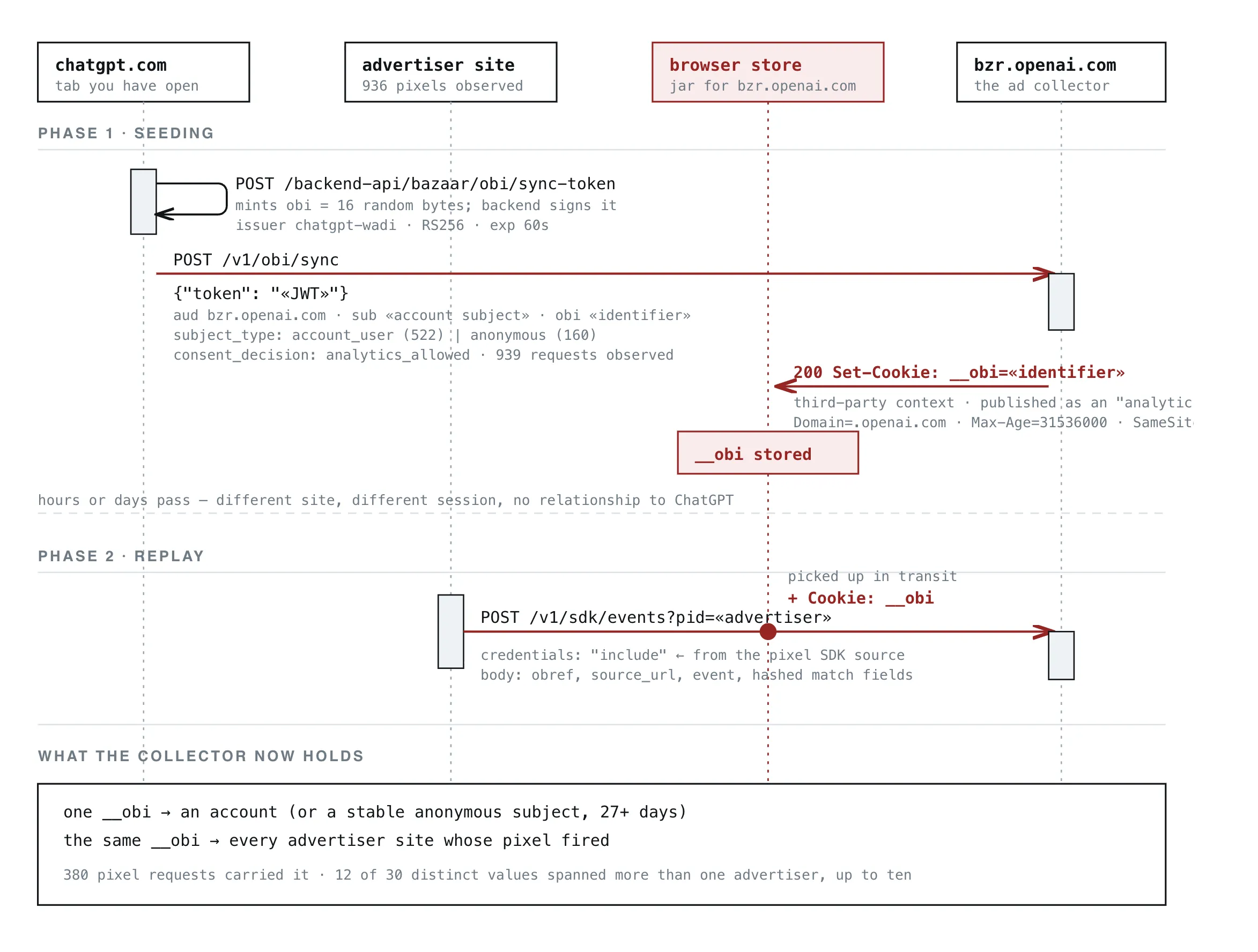
On the researcher’s test device, identical __obi values were transmitted from 12 distinct commercial websites operating under 13 separate pixel configurations, including portals such as Chewy, Wayfair, ThriftBooks, Eventbrite, HelloFresh, Coursera, and SeatGeek. In the wider traffic sample, 12 of 30 distinct __obi values appeared across multiple advertiser contexts, with one value observed across ten separate commercial domains.
Cross-Site Identity Resolution Timeline
| Event Phase | Protocol Action | Technical Scope & Isolation Boundary |
|---|---|---|
| Session Initialization | POST /sync-token |
RS256 JWT binds an account or anonymous subject identifier to a 60-second token |
| Cookie Persistence | Set-Cookie: __obi |
SameSite=None marks cookie eligible for cross-site transit |
| Merchant Attribution | GET /sdk/oaiq.min.js |
Browser network stack attaches cookie during initial script retrieval |
Official definitions within the OpenAI Cookie Policy classify __obi under Analytics cookies, assigning the entry an operational validity of 365 days. Because OpenAI’s consent architecture governs __obi through analytics consent rather than dedicated marketing controls, rejecting marketing consent alone did not inhibit cookie deployment in the observed tests.

Under-the-Hood Architectural Disconnection
The operational mechanics governing __obi rely on a three-stage exchange pipeline connecting client browser sessions, advertising collection endpoints, and third-party commercial storefronts. Network traces illustrate how a transient cryptographic assertion translates into an enduring client-side identifier.
The process originates on chatgpt.com. The client browser generates 16 bytes of entropy and dispatches an HTTP request to the internal platform backend:
POST /backend-api/bazaar/obi/sync-token
Unauthenticated sessions invoke /backend-anon/bazaar/obi/sync-token. The internal issuing service, identified by the JWT iss claim as chatgpt-wadi, returns an RS256-signed JSON Web Token containing identity claims that map the random entropy to internal account metadata.
{
  "iss": "chatgpt-wadi",
  "aud": "bzr.openai.com",
  "purpose": "obi_sync",
  "operation": "set",
  "consent_decision": "analytics_allowed",
  "consent_policy_version": "user_granular_consent_v1",
  "sub": "«redacted: 64-hex account subject»",
  "subject_type": "account_user",
  "obi": "«redacted: 22-char identifier»",
  "exp": "«iat + 60s»"
}
The signed payload enforces a 60-second expiration period (exp). The client browser immediately forwards this token to OpenAI’s programmatic advertising domain via an asynchronous POST request:
POST https://bzr.openai.com/v1/obi/sync
OpenAI’s edge servers process the token and respond with HTTP headers instructing the browser to store the persistent cookie.
HTTP/2 200 OK
Set-Cookie: __obi=«redacted»; Domain=.openai.com; HttpOnly; Max-Age=31536000; Path=/; SameSite=None; Secure
Assigning SameSite=None alongside the Secure flag marks the cookie as eligible for cross-site transmission where the host browser permits third-party cookies. Unlike standard application cookies scoped with SameSite=Lax or restricted to direct origin subdomains, __obi attaches to outbound cross-site requests addressed to *.openai.com.
+-------------------------------------------------------------------------+
|     [ CONCEPTUAL PROTOCOL FLOW: OBI TOKEN EXCHANGE AND AD PIXEL ]       |
+-------------------------------------------------------------------------+
|                                                                         |
|  [ User Browser Session (chatgpt.com) ]                                 |
|          |                                                              |
|          +---> Request Sync Token: POST /backend-api/.../sync-token     |
|          |     Response: 60s RS256 JWT (Account or Anonymous Subject)   |
|          |                                                              |
|          +---> Exchange Token: POST bzr.openai.com/v1/obi/sync          |
|                Response: Set-Cookie: __obi (SameSite=None; 1-Year)      |
|                                                                         |
+-------------------------------------------------------------------------+
|  [ Merchant Storefront (Retailer Site with OpenAI Pixel Embedded) ]     |
|          |                                                              |
|          +---> Browser fetches: <script src="bzrcdn.../oaiq.min.js">    |
|          |     * BROWSER NETWORK STACK ATTACHES __obi ON SCRIPT FETCH * |
|          |                                                              |
|          +---> Pixel Gathers DOM Text, Tag-Manager Buses, and Inputs    |
|          |                                                              |
|          v                                                              |
|  [ OpenAI Ingestion Endpoint (bzr.openai.com/v1/sdk/events) ]          |
|  Transmitted: Postal Code + Hashed Values + Sanitized URI Path          |
|                                                                         |
+-------------------------------------------------------------------------+
Partner storefronts complete the communication loop. Retailers advertising through ChatGPT embed OpenAI’s conversion measurement script (oaiq.min.js). When a user navigates to an integrated merchant, the browser parses the script tag:
GET https://bzrcdn.openai.com/sdk/oaiq.min.js
Because the request matches the .openai.com wildcard scope, the browser network stack appends __obi to the initial script retrieval. This transmission takes place before the pixel’s JavaScript executes, meaning client-side logic inside the pixel cannot bypass the credentialed request. However, network-level content blockers, DNS sinks, or browser extensions that block the request domain outright prevent the connection entirely.
Network captures reveal that the measurement SDK extracts page-level attributes across four labeled channels:
Pixel Ingestion Data Classifications
| Source Channel | Collection Mechanism | Technical Scope and Field Exposure |
|---|---|---|
in (Explicit Input) |
Merchant API Parameters | Transaction values, product identifiers, currency symbols |
fm (Form Harvesting) |
DOM Input Interception | Form input values, checkout elements, contact entries |
ht (DOM Traversal) |
Rendered HTML Parsing | Content headings, confirmation strings, text elements |
js (Tag-Manager Hooking) |
Data-Layer Interception | Hooks into window.dataLayer.push and Adobe tag arrays |
The observed traffic logged 685 automated collection events across DOM and tag sources (fm, ht, and js) compared to 255 merchant-supplied parameters (in). The SDK inspects standard tag architectures, parsing data passed into Google Tag Manager and Adobe Analytics pipelines. Personal identifiers such as email addresses, telephone numbers, and full names are processed with SHA-256 hashing prior to transit. In contrast, geographic indicators—including country, region, city, and postal codes—transit in plaintext. Postal code attributes appeared across 100 discrete captures across 28 hostnames.
URL structures also transit to ingestion endpoints. While query parameters are omitted, origin and path components remain intact. Observed records confirmed paths representing medical reference lookups, financial debt-management workflows, and litigation intake forms reaching collection endpoints.

Decoupled Systems & Browser Containment
The mechanics of cross-site cookie transit reflect fundamental architectural variations across modern web engines. Different browsers enforce distinct state-partitioning defaults, determining whether third-party identifiers can be transmitted across origin boundaries.
Browser Cookie Isolation Architectures
| Browser Environment | Storage Isolation Model | SameSite=None Cross-Site Handling |
Observed Path Handling |
|---|---|---|---|
| Chrome for Android | Shared Profile Cookie Jar | Cross-site delivery supported when third-party cookies are allowed | Verified transmission in testing; subject to user and enterprise third-party cookie configurations |
| Apple Safari (WebKit) | Intelligent Tracking Prevention | Blocks Third-Party Storage by Default | Blocked by default on this observed cross-site path |
| Chrome on iOS | Enforced WebKit Runtime | Subject to WebKit Storage Restrictions | Blocked by default on this observed cross-site path |
| Mozilla Firefox | Total Cookie Protection | Partitions Cookie Jars per Top-Level Site | Third-party state partitioned by default; specific __obi interaction not independently tested |
| Brave Browser | Shields Storage Partitioning | Partitions and Blocks Cross-Site State | Third-party state partitioned/blocked by default; specific __obi interaction not independently tested |
As detailed in documentation from the WebKit tracking prevention overview, WebKit environments restrict cross-site storage by default. Intelligent Tracking Prevention (ITP) suppresses third-party cookies on external network calls, preventing merchant storefronts on iOS Safari and iOS Chrome from transmitting __obi. Similarly, Mozilla’s architectural specifications on Total Cookie Protection and origin state partitioning detail how cookie jars are partitioned by top-level origin, isolating cookies created under openai.com from external merchant pages.
The investigation specifically reproduced the complete mechanism on Chrome for Android. As documented in Google Chrome’s cookie management policies, third-party cookies configured with SameSite=None; Secure are permitted on cross-site network fetches unless the user or device administrator enables third-party cookie blocking, facilitating communication between storefronts and OpenAI advertising endpoints.
Consent Classification and Observed Behavior Comparison
| Evaluation Attribute | Stated Cookie Policy Scope | Observed Runtime Deployment |
|---|---|---|
| Categorical Assignment | Classified as an Analytics cookie | Configured with SameSite=None; Secure for cross-site delivery |
| Evaluated Consent Claim | Distinct from oai_consent_marketing settings |
Governed exclusively by analytics_allowed in decoded tokens |
| Marketing Rejection Outcome | Intended to govern advertising and promotional use | Observed active on merchant requests when marketing consent was refused alone |
| Data Collection Profile | Described as evaluating service usage and performance | Carries checkout form data, plain-text postal codes, and URI paths |
The categorization applied to __obi within OpenAI’s legal policies introduces important governance questions. OpenAI provides discrete consent choices for analytics (oai_consent_analytics) and marketing (oai_consent_marketing). Every sync token decoded during the technical tests contained the attribute consent_decision: analytics_allowed.
Because the underlying token issuance service tied generation to the analytics preference, declining marketing cookies alone did not stop the issuance or transmission of __obi in the observed testing flow. This structure raises questions under international data governance standards regarding whether multi-site ad conversion measurement aligns with basic functional analytics or warrants classification as marketing telemetry.
Engineering evaluations must maintain strict distinctions between observed network transit and backend data handling. Traffic logs confirm that merchant portals transmit __obi alongside order indicators, form attributes, and URL paths to bzr.openai.com, receiving an HTTP 202 Accepted status. While incorporating account-level subject identifiers within the initial authorization token makes account resolution technically plausible by design, external network observations cannot independently confirm whether OpenAI’s backend systems link these inbound events to user conversational histories.
Engineering Checklist & Verification Schedules
Enterprise engineering teams managing web portals and endpoint fleets should evaluate third-party tag configurations to ensure external scripts conform to corporate privacy and data-handling standards.
Enterprise Webmaster Tag-Governance Checklist
Script Ingestion and Tag Auditing
- [ ] Audit application templates to locate dependencies loading resources from
bzrcdn.openai.com. - [ ] Evaluate whether Subresource Integrity (SRI) or version-pinned hosting aligns with vendor deployment models.
- [ ] Review tag management configurations to verify whether marketing tags access internal transaction buses.
Data-Layer Review and Field Handling
- [ ] Evaluate accessibility boundaries on
window.dataLayerandadobeDataLayerstructures. - [ ] Review whether postal codes and address fields require redaction prior to external tag dispatches.
- [ ] Review the “Automatic Matching” setting in OpenAI Ads Manager to assess whether DOM parsing is appropriate for checkout workflows.
Content Security Policy Verification
- [ ] Review
connect-srcdirectives to define authorized destinations for outgoing telemetry beacons. - [ ] Evaluate
script-srcpolicies to prevent the execution of unreviewed external scripts. - [ ] Validate checkout and customer intake funnels to ensure sensitive paths remain shielded from third-party beacons.
Endpoint Configuration and Storage Hygiene
Mobile Device Fleet Configuration
- [ ] Evaluate Chrome for Android configuration profiles across managed enterprise devices.
- [ ] Assess the operational impact of enabling third-party cookie restrictions across managed endpoints.
- [ ] Review the deployment of privacy-focused browser configurations where business requirements permit.
Identity and Session Hygiene Auditing
- [ ] Monitor enterprise network egress traffic for recurring calls toward
bzr.openai.com. - [ ] Establish regular profile maintenance routines across unmanaged browser sessions.
- [ ] Confirm that enterprise form designs avoid exposing plaintext user inputs to ambient script contexts.
Implementing structured Content Security Policies and reviewing tag ingestion boundaries can help engineering teams reduce unintended third-party data exposure during commercial transactions.
Frequently Asked Questions (FAQ)
Does rejecting marketing consent alone stop the __obi cookie?
Why does Safari on iOS block this tracking while Chrome on Android permits it?
Can third-party merchant websites read the __obi cookie directly?
Practical Implications & Future Outlook
The technical examination of the __obi cookie framework illustrates the evolving relationship between conversational AI platforms and online advertising architectures. For years, digital advertising systems have utilized browser state mechanisms to connect user engagement across independent websites. Applying these measurement patterns to conversational interfaces introduces new considerations. Users frequently input sensitive professional, technical, and personal details into conversational platforms under the assumption that these environments remain separate from broader advertising networks.
If merchant telemetry is ultimately resolved to account-level identities as the protocol design appears to permit, that combination would create unusually rich behavioral profiles. As AI agents increasingly manage practical tasks—such as scheduling, travel bookings, and product procurement—the operational boundaries between direct conversational utility and commercial profiling will require careful definition.
Navigating this transition requires engineering teams to apply disciplined governance across web properties. Organizations managing customer-facing sites must audit third-party script integrations, review tag-manager data exposures, and enforce precise Content Security Policies. In parallel, evolving browser storage standards continue to limit ambient cross-site data sharing across platforms. Long-term privacy in modern web environments will depend on robust client-side technical boundaries rather than policy declarations alone.
References
Share this article