What is mobile game monetization and what are the best strategies? Mobile game monetization is the framework of generating revenue from mobile players, with hybrid monetization representing an increasingly common strategy that balances in-app purchases with non-intrusive rewarded advertising while preserving player retention across distinct behavioral cohorts.
Mobile game monetization is the systemic deployment of commercial mechanisms designed to generate revenue across a mobile game’s player base. Modern game monetization frameworks rely on hybrid architectures that combine direct microtransactions (In-App Purchases) with programmatic ad placements (In-App Advertising), utilizing behavioral segmentation and attribution context to maximize player lifetime value without degrading long-term engagement.
| Term | Definition | Related Entity | Search Intent Role |
|---|---|---|---|
| Game Monetization | The commercial framework used to generate revenue from mobile games. | Hybrid Model | Informational / Commercial |
| In-App Purchase | Direct digital sales of virtual goods, currency, or content within an app. | Microtransactions | Technical / Informational |
| eCPM | The effective earnings generated per one thousand programmatic ad impressions. | Ad Monetization | Operational / Decision |
The Evolution of Mobile Game Monetization: From Single Models to Hybrid Strategies
The Limitations of Pure Premium and Pure IAP Models
Early mobile game economies relied on binary monetization architectures: upfront premium purchases or pure In-App Purchase (IAP) free-to-play ecosystems. While premium titles struggle with discovery on modern app stores, pure IAP models confront an inherent commercial reality: the non-payer distribution. Across casual, mid-core, and strategy genres, publisher case studies and telemetry consistently show that only a small minority of active daily players ever complete a real-money purchase. For example, published case studies from major ad platforms frequently document paying player ratios in the low single digits.
In a pure IAP architecture, game studios bear ongoing cloud hosting, server infrastructure, live-operations, and content production expenses for their entire player base while extracting commercial revenue exclusively from the small percentage of paying users. Relying solely on high-value spenders concentrates business risk. If user acquisition costs for paying cohorts escalate, or if high-spending players experience content fatigue, unit economics become strained. Pure IAP designs leave the engagement and attention of the non-paying majority unmonetized.
The Pitfalls of Aggressive Hyper-Casual Ad Flooding: Low LTV and Extreme Churn
To monetize non-paying audiences, early hyper-casual games adopted pure In-App Advertising (IAA) models. These titles relied on heavy ad frequency, exposing players to unskippable interstitials, banner ads, and forced video placements at every gameplay transition.
While pure ad models generate revenue across a wider proportion of the player base, aggressive ad density creates severe behavioral trade-offs. High ad frequency accelerates player fatigue, causing Day 1 and Day 7 retention rates to decline steeply. When player lifetime is compressed into a few days rather than months, total Lifetime Value (LTV) remains low. Consequently, hyper-casual studios were forced to rely on continuous user acquisition to replenish rapidly churning audiences. As programmatic user acquisition costs fluctuate and platform privacy frameworks restrict deterministic targeting, pure ad-flooding models experience significant margin compression.
The Rise of Hybrid Monetization: Unlocking Revenue Across the Player Distribution
Hybrid monetization has become increasingly prominent across mobile gaming categories as studios seek to balance revenue generation with long-term retention. A hybrid architecture integrates multiple revenue streams—microtransactions, battle passes, rewarded video placements, and carefully paced interstitials—into a single title.
By deploying complementary monetization channels, hybrid games address diverse player motivations:
- Paying Players: Provided with high-value progression bundles, cosmetic items, and battle passes that accelerate progression without disruptive forced ad interruptions.
- Engaged Non-Payers: Monetized through voluntary, opt-in rewarded video ads that grant gameplay utility, soft currency, or energy refills in exchange for attention.
- Casual or Short-Session Users: Monetized through non-intrusive placements that capture baseline yield without impairing initial onboarding.
How Does Hybrid Monetization Balance In-App Purchases and In-App Advertising
Core Components: Microtransactions, Battle Passes, Rewarded Video, and Interstitials
A balanced hybrid game economy deploys distinct monetization instruments tailored to specific interaction points:
- In-App Purchases (IAP): Direct microtransactions offering permanent progression items, premium currencies, gacha summons, or exclusive cosmetics. IAP represents the highest-margin revenue driver on a per-transaction basis.
- Battle Passes and Subscriptions: Seasonal progression systems that bridge casual engagement and direct spending. Players purchase progression tracks that reward sustained daily play with tiered milestone unlocks.
- Rewarded Video Placements: Opt-in video ads where players voluntarily choose to exchange attention for tangible in-game rewards (e.g., extra lives, double stage rewards, or resource boosts). Because engagement is initiated by the player, rewarded ads preserve player agency.
- Paced Interstitial Ads: Full-screen static or video ads shown at natural cognitive breaks in gameplay (e.g., completing a chapter or failing a level). These require disciplined frequency capping to prevent gameplay disruption.
The Complementary Economy: Evaluating Rewarded Ads as a Purchase Gateway
In game economy design, developers often express concern that offering free in-game utility via video ads will cannibalize IAP microtransactions. In practice, rewarded ads can complement IAP when rewards and placements are calibrated carefully.
Published industry case studies, such as implementations documented by Google AdMob and Unity, indicate that introducing rewarded ads can positively correlate with in-game engagement and subsequent microtransaction activity. When non-paying players engage with rewarded ads to obtain small quantities of premium items, they experience the utility and progression benefits of those mechanics before purchasing. This mechanical trial may help users appreciate the value of premium acceleration before making a direct purchase. However, complementarity is not guaranteed; developers must validate reward values through controlled experimentation, as excessively generous ad payouts can devalue premium currencies and cannibalize direct store purchases.
Protecting Core Gameplay Loops: Ensuring Ads Support Rather Than Interrupt Progression
The fundamental design principle of hybrid monetization is structural alignment. Ad placements must feel integrated into the game’s core progression rather than acting as external interruptions.
Placements should satisfy three criteria:
- Contextual Relevance: The reward offered should address an immediate gameplay need (e.g., reviving a character at a difficult encounter or replenishing stamina after an extended session).
- Voluntary Interaction: Core progression must never be completely gated behind mandatory ad views. Players should retain the option to progress through patience or gameplay skill.
- Predictable Value Hierarchies: Rewarded-ad value should be calibrated against IAP pricing and economy sinks so repeated ad consumption does not systematically undermine premium purchase value.
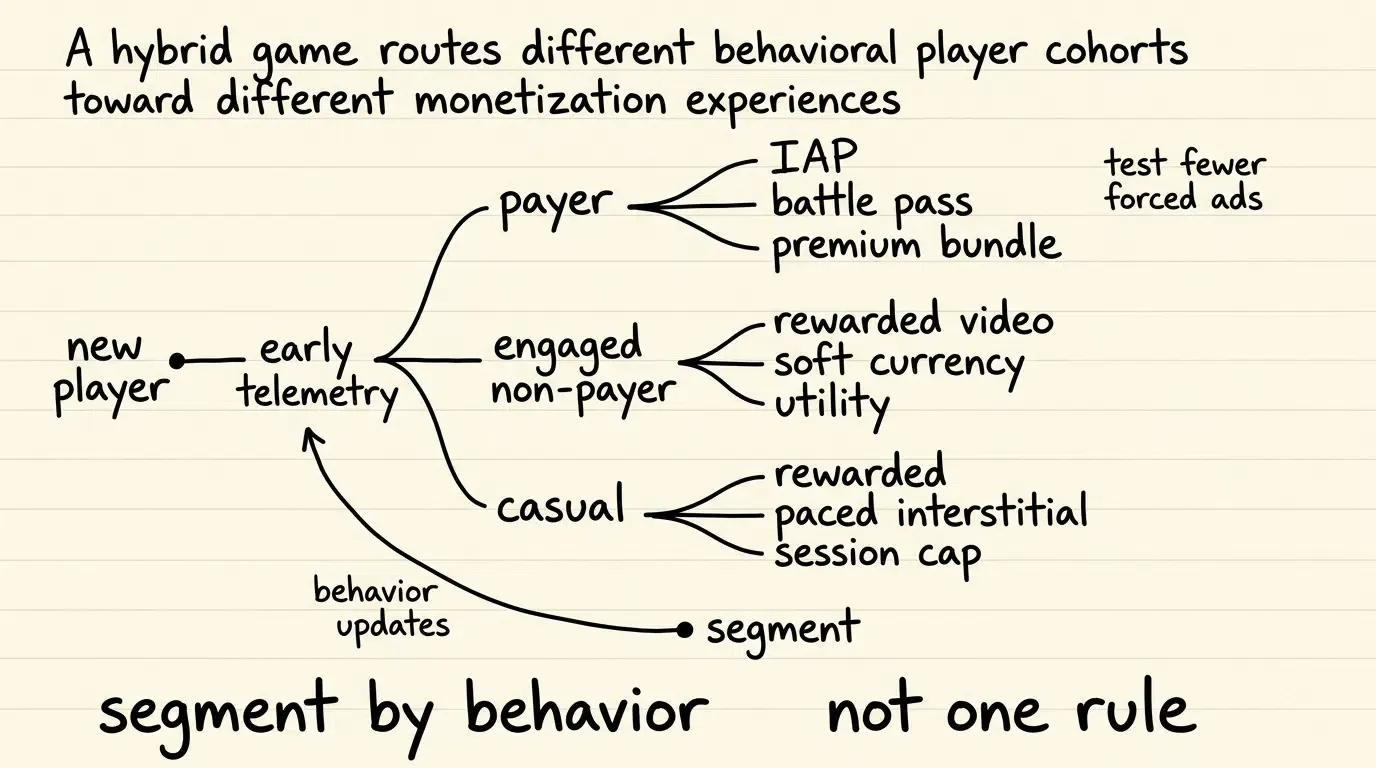
Establishing Segmented Player Personas: Payers, Engaged Non-Payers, and Casual Users
A monolithic monetization model that treats all players identically creates operational friction. High-value spenders should not encounter forced ads that diminish a premium gameplay experience, while highly engaged non-payers should receive ample opportunities to progress via rewarded engagement.
Hybrid architectures segment active cohorts into distinct behavioral personas:
- High-Value Payers: Players demonstrating willingness to make direct real-money purchases. Studios frequently test suppressing forced interstitial ads for paying cohorts to protect long-term retention, focusing in-game merchandising on high-tier bundles, live-ops events, and premium battle passes.
- Engaged Non-Payers: Players with substantial daily session depth who do not make direct purchases. These users are monetized primarily through opt-in rewarded video placements, event-based ad tasks, and engagement-driven battle pass tracks.
- Casual or Low-Engagement Users: Players with modest session depth and no purchase history. These users are monetized through a combination of rewarded video and conservative, session-capped interstitials shown between natural gameplay transitions.
Mathematical Modeling of Player Lifetime Value in Hybrid Games
The Blended Lifetime Value Formula: Total LTV Calculation
In a hybrid game economy, evaluating acquisition channels or cohort profitability using pure IAP metrics provides an incomplete picture. Analytics teams must model blended Lifetime Value (
All monetization metrics in this model must use a consistent accounting basis. Studios should avoid combining finalized net IAP proceeds with estimated gross ad revenue without explicit reconciliation adjustments; impression-level ad values may be estimated and can differ from finalized mediation revenue.
Where:
represents the cumulative net in-app purchase revenue generated per acquired player over their active lifecycle. represents the cumulative net programmatic advertising revenue generated per acquired player over their active lifecycle.
Calculating In-App Purchase Lifetime Value Across Retention Cohorts
In-App Purchase LTV evaluates daily cohort retention alongside active player spending rates over a specified time horizon
Alternatively, breaking down spending behavior across active payers:
Where:
represents the cohort retention rate on day (the probability that an acquired user is active on day ). represents the proportion of active retained users who complete a purchase on day . represents the average net purchase revenue generated by active paying players on day . is the average net IAP revenue generated per active daily user on day .
Calculating Ad Lifetime Value via Daily Impression Density and eCPM
Advertising LTV measures the cumulative programmatic revenue generated by ad impressions served across a player’s active lifespan:
Where:
represents the set of integrated ad formats (e.g., rewarded video, interstitial, native banner). represents the average number of impressions of format completed per active user on day . represents the effective net revenue per 1,000 impressions realized for format on day . is the cohort retention rate on day .
Measuring Blended Average Revenue Per Daily Active User
To monitor daily monetization velocity across live operations, studios track blended Average Revenue Per Daily Active User (ARPDAU):
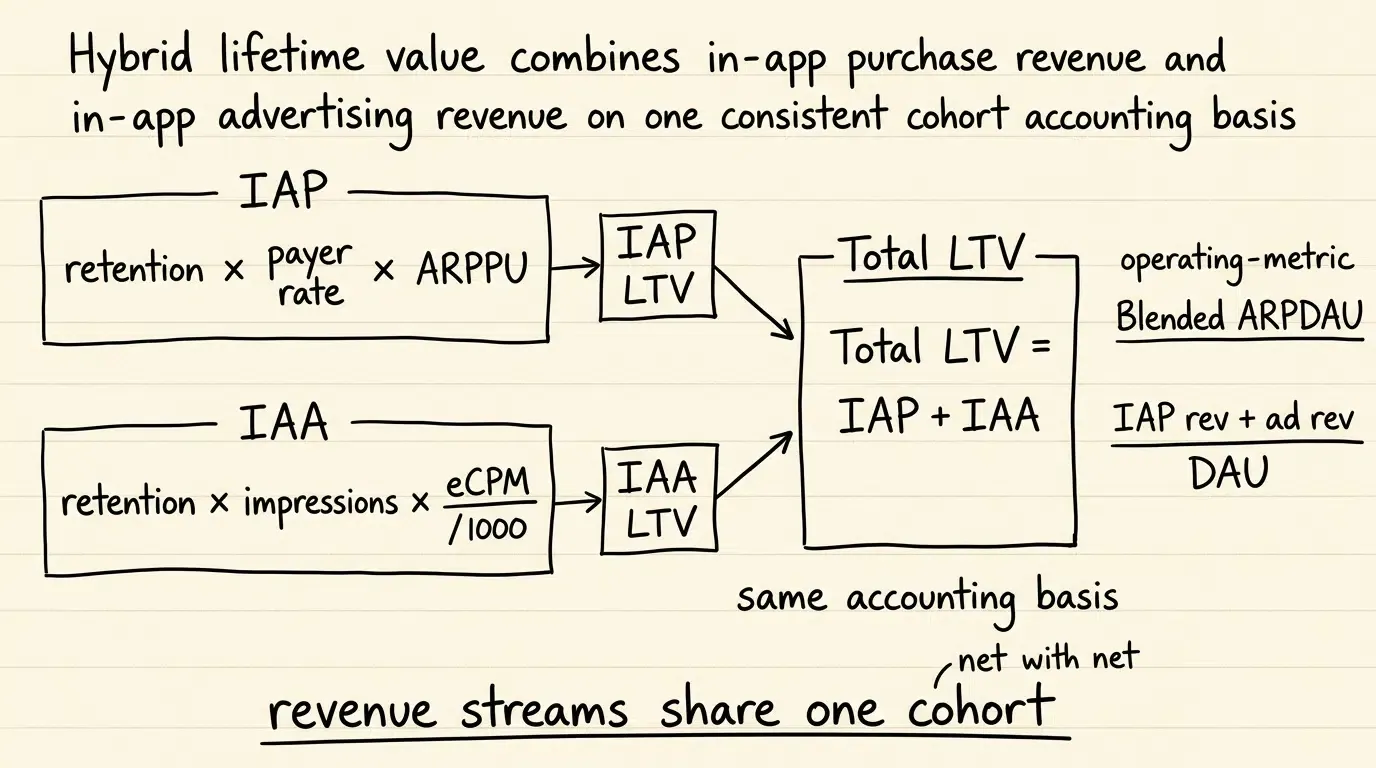
Tracking blended ARPDAU across acquisition channels enables growth teams to identify channels that deliver strong ad engagement even when direct initial IAP conversion rates appear modest.
How to Maximize Total Ad Revenue Without Accelerating Player Churn
Marginal Ad Yield Dynamics Across Session Depth
A common misconception in ad monetization is the assumption that doubling ad impressions per session automatically doubles ad revenue. In practice, serving additional ads within a single user session is subject to diminishing marginal returns.
Serving additional ads can produce diminishing marginal yield in some player cohorts, but this relationship is not universal. Modern bidding and mediation systems price each impression dynamically, so studios should measure impression-level revenue, fill, engagement, and retention by session ad depth rather than assume a fixed decay curve. In some game environments, ad engagement rates decline as session ad depth increases; players become less responsive to repeated interstitials or click close buttons more rapidly, which can lead to reduced engagement or lower average cleared bids over time.
Illustrative Hypothesis: Possible Session-Depth Yield Decay

Average
Impression
Yield
  |
  |  [Impression 1: Initial Session Demand]
  |\
  | \
  |  \
  |   \   [Impression 2: Secondary Fill]
  |    \
  |     \________________________
  |                              \  [Impression 4+: Diminishing Marginal Yield]
  +------------------------------------------------------------>
  1st Ad        2nd Ad        3rd Ad        4th Ad+   (Session Ad Depth)
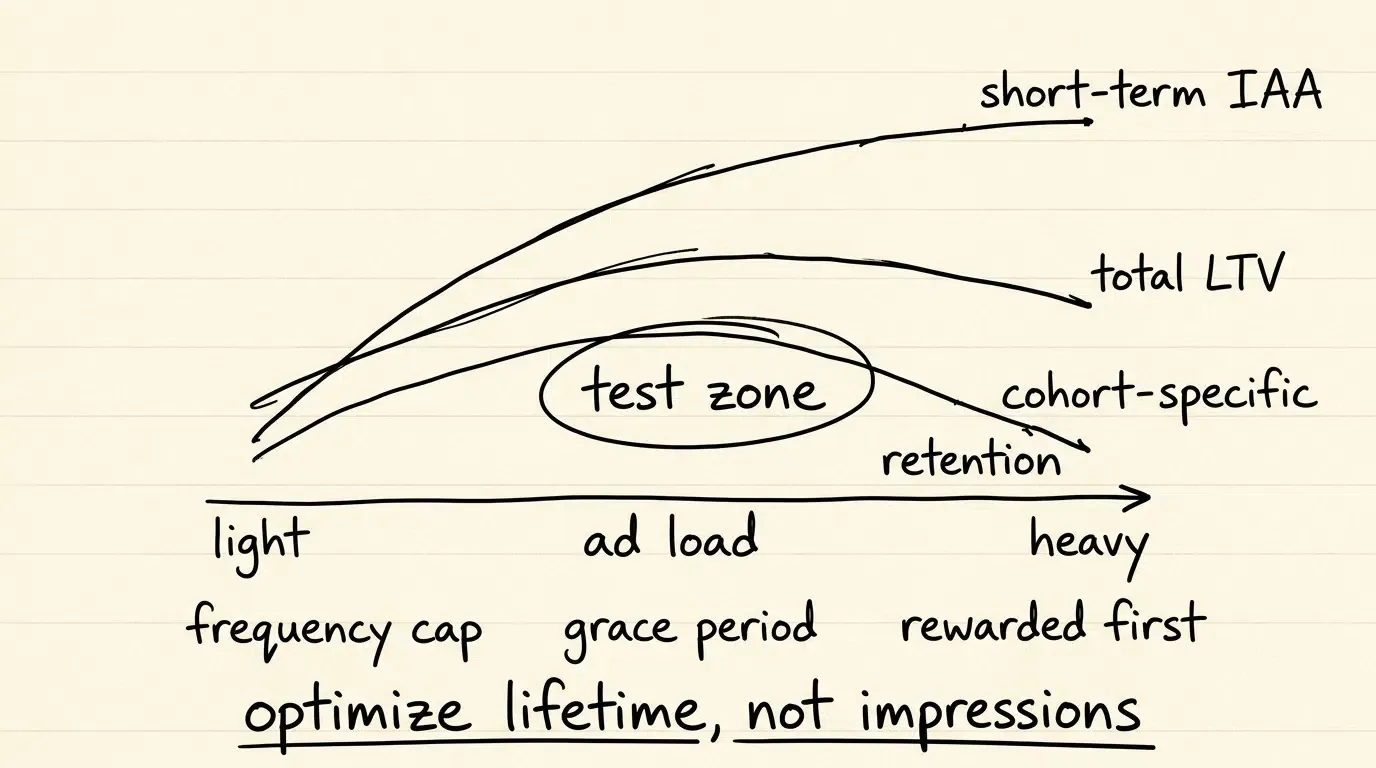
The Retention-Ad Load Trade-Off: Quantifying Churn Elasticity
Ad impressions carry an implicit cost measured in potential player attrition. Retention elasticity to ad load (
Illustrative scenario: If increasing average daily interstitial views from 2 to 4 increases immediate daily ad revenue by $0.03 per user, but accelerates Day 7 retention drop-off from 20% to 12%, overall cohort LTV declines. The marginal ad revenue gained in early sessions fails to compensate for the lost lifetime value—including future microtransactions, rewarded ad views, and organic referrals—of players who churned prematurely.
Enforcing Empirical Frequency Capping and Session Pacing
To optimize ad yield while safeguarding player retention, engineering teams configure mediation delivery rules based on tested constraints:
- Pacing Intervals: Test minimum intervals between unprompted interstitial ads (e.g., establishing a cooldown buffer of several minutes of active gameplay between interstitials) to avoid disrupting continuous play sessions.
- Onboarding Grace Periods: Consider suppressing unprompted ads during initial onboarding sessions or early tutorial levels, allowing new players to engage with the core loop before introducing advertising friction.
- Rewarded Video Limits: Calibrate daily rewarded video caps per placement to ensure players cannot circumvent core progression economies entirely through ad views.
Visualizing the Persona-Based Monetization Segmentation Flow
The workflow diagram below illustrates how incoming players can be routed into customized monetization experiences based on early session telemetry and acquisition context:
[New Player Attribution Ingestion]
               │
               ▼
  [Attribution Context & Early In-Game Telemetry]
               │
     ┌─────────┴───────────────────────────────┐
     ▼                                         ▼
[High IAP Propensity Cohort]          [Ad-Tolerant Non-Payer Cohort]
     │                                         │
     ├─► Test Suppressing Forced Ads           ├─► Enable Rewarded Video Placements
     ├─► Deliver Starter Pack Merchandising    ├─► Calibrate Non-Intrusive Banner Cadence
     └─► Maximize Retention & Session Length   └─► Maximize Blended ARPDAU via Rewarded Placements
Technical Framework for Segmented Monetization and Attribution Tracking
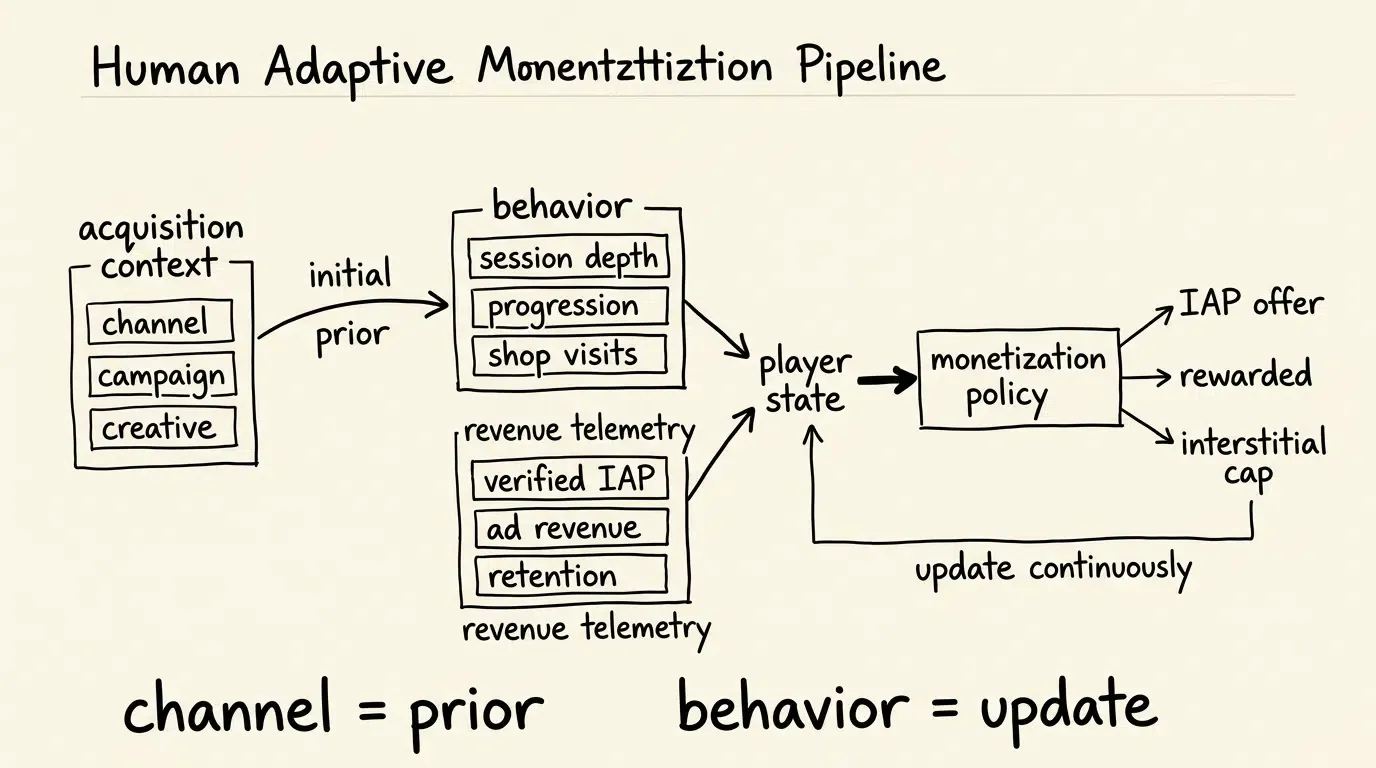
Using Acquisition Channel Attributes as Prior Signals for Day 0 Segmentation
A player’s early monetization propensity correlates with the acquisition channel and creative context that drove the installation. Users acquiring a game through a high-intent search query targeting specific gameplay mechanics may exhibit different aggregate behavioral patterns than users acquired via broad programmatic display banners.
Acquisition context—such as campaign type, creative placement, and channel category—can serve as an initial prior signal for early segmentation before extensive behavioral data is generated. However, this initial classification must remain dynamic; actual in-game telemetry (such as session length, level progression speed, and shop visits) must rapidly supersede channel-based assumptions to avoid misclassifying players.
Ingesting Impression-Level Ad Revenue and Purchase Events
To calculate blended LTV and evaluate campaign ROAS accurately, game architectures must capture both direct purchase receipts and Impression-Level Ad Revenue (ILRD).
Mobile ad mediation platforms (such as Google AdMob, AppLovin MAX, or Unity LevelPlay) provide impression-level revenue callbacks that transmit real-time telemetry upon serving an ad view. These callbacks expose placement identifiers, ad network sources, reported revenue values, and platform-specific revenue precision indicators (e.g., estimated versus publisher-reported). The client SDK or mediation webhook routes these events to an attribution gateway alongside verified IAP transactions.
Structuring the Player Monetization Event Record
To maintain unified telemetry across microtransactions and programmatic ad yield, attribution systems record monetization events using standardized schemas.
The schema placeholder below illustrates an event record capturing player attribution context, verified IAP transactions, impression-level ad revenue data, and cumulative realized revenue:
{
  "reference_architecture": true,
  "illustrative_thresholds": true,
  "player_monetization_record": {
    "telemetry_metadata": {
      "record_id": "mon_rec_2026_0910_8819",
      "timestamp_utc": "2026-09-10T08:45:00.000Z",
      "app_id": "com.example.game.rpg",
      "player_account_id": "usr_99812401",
      "session_id": "sess_4412_alpha_09"
    },
    "attribution_context": {
      "acquisition_channel": "partner_ad_network_video",
      "campaign_id": "cmp_rpg_hero_launch",
      "creative_theme": "cinematic_gameplay",
      "initial_prior_tier": "ad_tolerant_engaged_prospect"
    },
    "iap_transaction_telemetry": {
      "has_completed_purchase": true,
      "lifetime_purchase_count": 1,
      "lifetime_iap_net_revenue_usd": 4.99,
      "last_transaction": {
        "order_id": "ord_iap_881239",
        "product_id": "com.example.game.starter_bundle",
        "currency": "USD",
        "price_cents": 499,
        "receipt_validation_status": "verified_store_receipt"
      }
    },
    "ad_monetization_telemetry": {
      "unprompted_interstitials_suppressed": true,
      "lifetime_ad_impressions_served": 14,
      "lifetime_ad_net_revenue_usd": 0.42,
      "last_ad_event": {
        "ad_format": "rewarded_video",
        "ad_placement_id": "plm_dungeon_revive",
        "mediation_network": "network_gamma_bidding",
        "impression_revenue_usd": 0.0325,
        "revenue_precision": "estimated",
        "derived_ecpm_equivalent_usd": 32.50
      }
    },
    "blended_economic_metrics": {
      "accounting_basis": "net_revenue_reconciled",
      "cumulative_realized_revenue_usd": 5.41,
      "ltv_prediction": {
        "as_of_day": 7,
        "forecast_horizon_days": 180,
        "model_version": "hybrid_ltv_v3",
        "predicted_remaining_ltv_usd": 4.10,
        "predicted_total_ltv_usd": 9.51,
        "prediction_interval_usd": "<model_output>"
      },
      "behavioral_monetization_persona": "paying_hybrid_player",
      "ad_frequency_policy_state": "interstitials_suppressed_for_active_payer"
    }
  }
}
Reconciling Ad Network Postbacks with Merchant Billing Receipts to Reduce Discrepancies
Accurate economic auditing requires reconciling client-reported monetization telemetry against authoritative server-side billing systems:
- IAP Receipt Verification: Client purchase callbacks should be validated server-side against Apple App Store or Google Play Store billing APIs to detect local receipt spoofing and ensure only verified transactions credit LTV calculations.
- Mediation Log Reconciliation: Client-reported ad impressions should be cross-referenced against server-to-server mediation reporting to detect and reduce duplicate reporting caused by network retries.
- Blended Attribution Postbacks: Reconciled blended LTV metrics feed back into attribution reporting, enabling user acquisition teams to evaluate Cost-Per-Install bids against total revenue rather than relying solely on IAP metrics.
Comparative Analysis of Core Mobile Game Monetization Models
Evaluating Revenue Stability, Player Friction, and Scalability Across Industry Models
Selecting an appropriate monetization architecture requires evaluating genre compatibility, operational overhead, and audience tolerance.
The table below contrasts primary mobile game commercial models:
| Monetization Model | Primary Revenue Engine | Core Target Metric | Principal Operational Risk |
|---|---|---|---|
| Pure In-App Purchase | Virtual currency, cosmetics, progression packs | ARPPU, Payer Conversion Rate | Leaves non-paying player cohorts without a direct IAP revenue stream |
| Pure In-App Advertising | Interstitials, banners, rewarded ads | Impressions Per DAU, eCPM | Risk of retention degradation when ad frequency, placement, or interruption load is poorly calibrated |
| Hybrid (IAP + IAA) | Balanced microtransactions and rewarded ads | Blended ARPDAU, Total LTV | Risk of ad-driven IAP cannibalization if ad rewards are miscalibrated |
| Subscription / Battle Pass | Recurring seasonal progression tracks | Renewal Rate, Churn Rate | Continuous live-operations and content production demands |
Aligning Game Mechanics and Player Progression with Optimal Commercial Frameworks
Pure ad monetization is often suited to casual titles with short development cycles and simple loops. Pure IAP models are frequently deployed in social, cooperative, or highly competitive strategy titles where immersion and game balance are paramount.
For many mid-core, puzzle, action, and simulation titles, hybrid monetization provides strong revenue diversification. It captures baseline yield from non-paying users via rewarded video while preserving uncapped monetization potential from dedicated spenders.
When Should Game Studios Transition to a Hybrid Monetization Architecture
Suitable Conditions for Deploying a Hybrid Monetization Framework
Game development studios should evaluate a hybrid monetization framework under specific commercial conditions:
- Substantial Non-Paying Audience: Titles displaying healthy engagement metrics (e.g., strong average daily session length) but low IAP payer conversion rates.
- Segmentable In-Game Economy: Games with clear distinctions between convenience items (such as stamina refills or build accelerators) that can be offered via rewarded ads, and exclusive premium items (such as unique cosmetics or rare characters) reserved for direct purchase.
- Rising Acquisition Costs: Competitive marketing environments where relying exclusively on IAP or pure ad monetization fails to achieve payback on Cost-Per-Install bids.
- Live-Operations Infrastructure: Studios equipped to manage ad mediation waterfalls alongside in-game shop updates and event calendars.
Unsuitable Conditions for Aggressive Ad Integration
Integrating advertising introduces commercial liabilities in specific production contexts:
- High-Immersion Narrative Titles: Story-driven or atmospheric games where commercial ad placements break narrative immersion and player engagement.
- Strictly Competitive eSports: Competitive titles where granting gameplay advantages, character revives, or progression resources via rewarded ads impairs competitive integrity.
- Titles with Ultra-High Spender Density: Hardcore strategy titles where user LTV is heavily dominated by large purchases, where showing ads risks alienating core revenue contributors.
Common Pitfalls in Hybrid Monetization Design
- Pitfall 1: Uncalibrated Ad Exposure for Paying Players: Subjecting players who have completed real-money purchases to intrusive, unskippable ads creates friction. Studios should test suppressing unprompted ads for paying cohorts, though permanent removal policies depend on the specific commercial entitlements sold.
- Pitfall 2: Devaluing Premium Currencies via Ad Rewards: Granting excessive premium currency through rewarded ads directly undermines IAP store conversion. Ad rewards should focus on soft currencies, progression boosts, or temporary utility items.
- Pitfall 3: Over-Relying on Channel Priors Without Behavioral Updates: Assuming an acquisition channel guarantees a player’s spending profile without updating segmentation based on in-game actions leads to misallocated ad loads.
Frequently Asked Questions (FAQ)
What is hybrid monetization in mobile games?
How does ad frequency affect Day 7 player retention?
How can attribution tracking improve mobile game monetization?
Summary and Decision Framework
Optimizing mobile game monetization requires establishing a balanced hybrid framework that balances player experience with commercial revenue. Maximizing long-term profitability relies on formulating blended LTV calculations, setting empirical ad pacing limits, and deploying behavioral segmentation informed by acquisition attribution.
As acquisition costs evolve, studios must move away from static, universal ad rules toward dynamic monetization architectures that adapt to player engagement profiles. Integrating channel attribution context with in-app purchase and impression-level ad revenue tracking enables developers to optimize blended ARPDAU, protect core paying cohorts, and achieve durable commercial returns.
To explore how parameter passing and channel attribution can support player segmentation and revenue tracking in your title, consult the mobile attribution implementation reference.
Related Materials
-
Concepts: Hybrid Monetization, Blended LTV, In-App Purchase, Ad Monetization, ARPDAU, eCPM Optimization
-
Technologies: Attribution SDK, Mobile Ad Mediation, Server-to-Server Ingestion, Player Segmentation Engine
-
Standards: IETF RFC 8259 JSON Data Interchange Format, W3C Mobile Web Best Practices, OWASP Mobile Security Testing Guide
-
APIs: Google Play Billing Library, Apple StoreKit In-App Purchases API, Channel Statistics Interfaces
-
Official Documentation & Industry Research:
Share this article