How to secure custom QR codes against scanning hijacking? Secure custom QR code campaigns by using trusted HTTPS destinations, validating and authenticating routing parameters at the server, monitoring scan anomalies, and inspecting physical placements for unauthorized sticker replacements. HMAC-SHA256 can protect the integrity of signed campaign parameters, while risk-based telemetry and operational controls help identify suspicious activity. No single cryptographic or geolocation control can prevent every form of physical QR replacement or attribution fraud.
Custom QR code security protects the integrity of offline-to-online campaign routing through several complementary controls: verified destinations, authenticated redirect parameters, replay-resistant event processing, risk-based fraud detection, and physical asset monitoring. These controls reduce unauthorized parameter modification and attribution abuse, but they cannot guarantee the authenticity of a barcode that has been physically replaced with an unrelated QR code.
| Term | Definition | Related Entity | Search Intent Role |
|---|---|---|---|
| Custom QR Code | A configurable QR code encoding a selected destination URL; additional security controls, such as authenticated routing parameters, are optional architectural protections. | Mobile Measurement Partner | Informational / Commercial |
| Ad Fraud | Malicious manipulation of attribution signals to steal campaign credit or manipulate user acquisition metrics. | Click Hijacking | Informational |
| Tracking Parameters | Query parameters or other metadata used to identify campaigns, traffic sources, or conversion journeys. Security-sensitive parameters require server-side validation or integrity protection when they influence trusted attribution or reward decisions. | HMAC Signature | Technical / Informational |
Why Is a Custom QR Code Vulnerable to Offline Scanning Hijacking
The Physical Attack Vector: Malicious Sticker Overlays on Print Media
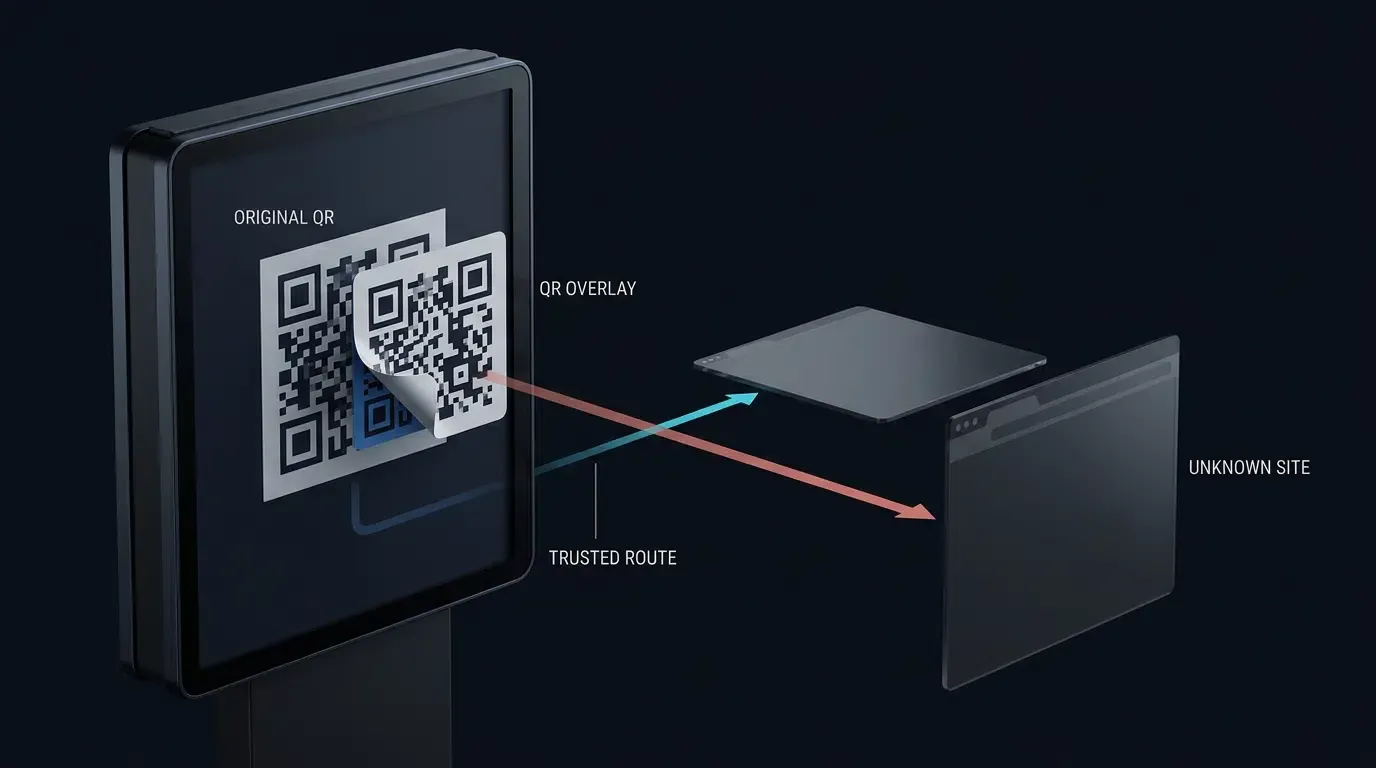
Unlike digital advertising channels protected by Transport Layer Security (TLS) and domain verification, physical matrix barcodes are deployed in public, unmonitored environments. A primary physical attack vector is the sticker overlay exploit, where malicious actors print adversarial barcodes on adhesive labels and physically place them over legitimate promotional collateral on transit posters, billboard displays, or retail packaging.
When a user scans the substituted QR code, the device may open an attacker-controlled HTTPS or HTTP destination. Depending on the attacker’s implementation and the user’s subsequent actions, this may expose the user to phishing, deceptive downloads, or unauthorized tracking. Attribution theft is possible if the attacker can also exploit a vulnerable tracking or conversion-credit mechanism; it is not an automatic consequence of every sticker replacement.
The Digital Threat Model: Man-in-the-Middle URL Interception and DNS Spoofing
Beyond physical tampering, unencrypted custom QR codes expose digital vulnerabilities during the redirection pipeline. When a barcode encodes a static, plain-text HTTP URL containing raw query strings (such as http://example.com/download?channel_id=1024), the initial connection lacks cryptographic integrity verification and domain authentication.
In unencrypted or compromised Wi-Fi networks (such as public airport or coffee shop hotspots), Man-in-the-Middle (MitM) proxies or rogue DNS resolvers intercept the unencrypted HTTP GET request. The proxy server modifies the query parameters on-the-fly—replacing the legitimate publisher ID with an attacker-controlled channel code—before returning a 302 redirect location header. Because the underlying app store link remains valid, standard client-side validation fails to detect that the tracking payload was altered during transit.
Attribution Theft: How Fraudsters Hijack Custom QR Code Tracking Parameters
Ad fraud syndicates systematically target high-value offline channels (such as out-of-home billboards or print inserts) because these campaigns frequently carry lucrative referral payouts. Fraudsters deploy automated scraping bots to scan public QR code images posted on digital signage, social media photos, or online PDFs.
Once the underlying URL pattern is extracted, automated scripts execute click-flooding routines against the destination server. By generating thousands of synthetic web sessions using injected device parameters (User-Agent strings, IP ranges, and dynamic sub-IDs) within minutes of a legitimate campaign launch, the fraudulent network attempts to claim credit for future organic mobile app installs. When a genuine consumer eventually scans the physical code and installs the application, the attribution model incorrectly credits the fraudulent click-flooding network rather than the offline physical campaign.
How Do Fraud Vectors Manipulate Offline Redirection Flow
Exploiting Static Unencrypted Web Redirects in Public Spaces
A printed QR code may contain a static HTTPS URL, a signed campaign identifier, or an opaque server-issued token. The primary risks arise when its destination relies on insecure HTTP transport, unmanaged routing infrastructure, or unvalidated campaign parameters. Short-lived scan-session context can still be generated at the server after the static QR URL is opened.
When an organization prints tens of thousands of marketing flyers containing unmanaged redirection links, the target landing page logic remains permanently fixed. If an intermediate redirection domain expires, suffers a DNS takeover, or lacks rigorous parameter validation, the entire physical distribution becomes a security vulnerability. Attackers monitor expired domains associated with legacy print campaigns, acquire the domain names, and route all incoming scan traffic to malware endpoints or competitor referral links.
Parameter Injection Attacks: Overwriting Dynamic Sub-Channel Identifiers
In advanced parameter injection attacks, adversaries exploit weak server-side URL parsing. When a custom QR code routes through an intermediate web gateway before reaching the app store, the gateway script processes dynamic query parameters passed via the URL string:
https://routing.example.com/redirect?app_id=com.app&sub_channel=poster_01
If the server-side endpoint fails to sanitize incoming input or validate parameter signatures, an attacker can append duplicate parameter keys or inject encoded payloads:
https://routing.example.com/redirect?app_id=com.app&sub_channel=poster_01&sub_channel=attacker_id
Depending on whether the HTTP parser evaluates the first or last instance of duplicate keys, the server may accept attacker_id while ignoring poster_01. Consequently, the attribution database attributes downstream conversion events to the injected entity without alerting campaign operators.
Automated Machine Scans vs. Authentic Human Mobile Engagements
Human browsers and automated clients may exhibit different request patterns, but no single User-Agent string, touch signal, IP classification, or timing interval reliably proves that a scan was performed by a person. Legitimate security scanners and preview services can resemble automated abuse, while sophisticated bots may reproduce normal browser behavior. Use these signals as inputs to calibrated risk analysis, supported by event-sequence validation and independently verified conversion evidence.
The Financial Impact of Undetected Scanning Hijacking on User Acquisition Budgets
Undetected offline redirection fraud inflicts severe financial damage on enterprise user acquisition operations:
- Direct Financial Loss: Marketing organizations pay cost-per-install (CPI) or cost-per-action (CPA) payouts to fraudulent affiliate accounts that hijacked attribution credit from legitimate physical collateral.
- Corrupted Channel Valuation: Physical out-of-home (OOH) media campaigns appear underperforming or unprofitable in marketing analytics dashboards because their conversions are misattributed to digital click-flooding networks.
- Degraded Customer Experience: Users scanning compromised physical codes are subjected to unexpected redirects, phishing prompts, or broken landing pages, eroding brand trust and increasing onboarding drop-off rates.
Cryptographic Signatures and HMAC Verification in Redirection Flows
Signing Campaign Parameters Without Exposing Secret Keys
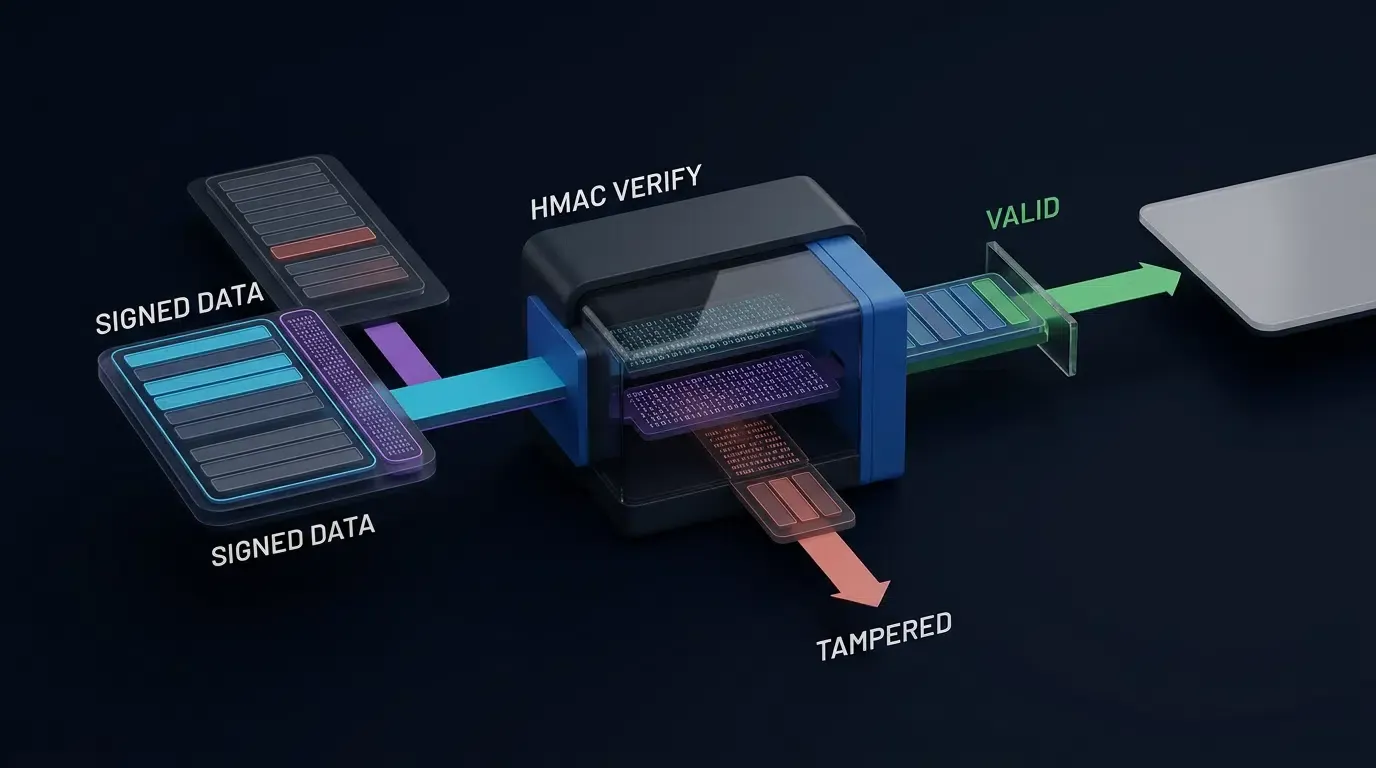
HMAC-SHA256 enables a trusted server to authenticate the integrity of campaign routing parameters. It does not encrypt the parameters or hide their values from anyone who scans the QR code.
A secure implementation must define an unambiguous, versioned signing format. For example, the signing input can consist of length-delimited UTF-8 fields in a fixed order: signature version, application identifier, campaign identifier, channel identifier, expiration time, and token identifier. The server computes the HMAC using a secret key held in server-side key management infrastructure. The secret must never be embedded in the QR code, browser JavaScript, or mobile application.
The resulting URL includes the signed fields, a key identifier, and the signature. Reject unexpected duplicate fields, noncanonical values, malformed signatures, and unknown key identifiers before resolving any destination.
Use HTTPS for all transport and redirection endpoints. HMAC and TLS address different risks: HMAC authenticates the selected payload fields, while TLS protects the connection and authenticates the HTTPS endpoint.
Verifying Routing Integrity at the Gateway
When a request reaches the routing gateway, perform these checks before assigning attribution credit:
- Validate HTTPS routing host and path against the deployed configuration.
- Reject malformed fields, duplicate security-sensitive query parameters, and unsupported signing versions.
- Verify that the application and campaign identifiers exist and belong to an authorized tenant.
- Validate the signature using the server-side key selected by the key identifier, with a constant-time comparison of correctly decoded signature bytes.
- Enforce the declared validity policy. Treat long-lived physical campaign codes differently from short-lived session credentials.
- Resolve the destination from a server-controlled allowlist rather than accepting an arbitrary destination URL from the QR request.
- Record the routing decision and relevant risk indicators without automatically treating every anomaly as confirmed fraud.
For long-running physical campaigns, use a stable signed campaign identifier or an opaque server-issued lookup token in the printed QR code. Generate short-lived scan-session identifiers at the server after a legitimate scan reaches the gateway.
Preventing Replay and Duplicate Attribution Without Breaking Printed QR Codes
A physical QR code is normally reusable: many legitimate consumers may scan the same poster over days or months. Consequently, a nonce embedded in the printed asset must not be treated as a globally single-use credential.
Distinguish between three separate objects:
- Printed campaign token: Identifies an approved campaign placement and can be reused during its authorized validity period.
- Scan-session identifier: A server-issued value created for an individual visit; it can support short-lived session controls and telemetry correlation.
- Conversion or webhook event identifier: A unique identifier used to prevent duplicate downstream processing and reward issuance.
For short-lived operations that genuinely require one-time consumption, implement atomic claim-or-reject semantics in the server-side store, with a defined expiration policy. Do not rely on separate read-then-write operations or per-edge in-memory caches for globally consistent one-time enforcement.
Signed URLs still require monitoring, revocation, rate limiting, and attribution-side deduplication. A valid signature alone does not prove that a scan was performed by a human or that a resulting conversion deserves payment.
Guidance regarding key management and authentication workflows can be found in the OpoInstall docs.
[Verified HTTPS QR Destination]
              │
              ▼
[Application-Owned / Verified Routing Gateway]
              │
              ▼
[Signed Parameter Verification]
       │                  │
    Invalid             Valid
       │                  │
       ▼                  ▼
[Reject / Log]    [Risk Signal Evaluation]
                           │
                           ▼
                   [Policy Decision]
                      │        │
                    Allow    Review/Hold
                      │        │
                      ▼        ▼
                [Approved   [Safe User
                 Redirect]   Experience]
How Physical Inspection and Risk-Based Telemetry Detect QR Campaign Abuse
Physical Sticker Replacement Requires an Independent Trust Check
A malicious sticker can replace a legitimate QR code with a different destination. When this happens, the user’s browser may never contact the original campaign gateway. Therefore, a signature on the original campaign token cannot, by itself, detect or block the replacement.
Mitigation requires controls outside the original URL-validation pipeline: routine visual inspections, tamper-evident labels where appropriate, placement inventories, trusted campaign-domain communication, customer reporting channels, and monitoring for unexpected declines in legitimate scan traffic. A trusted browser or application can also help users recognize unexpected domains, although this does not eliminate the physical attack.
Using Geolocation as a Risk Signal
IP geolocation can indicate the approximate network location of a request, but it is not a reliable measurement of the scanner’s physical position. Mobile carriers, corporate networks, VPNs, proxies, and shared gateways can create substantial differences between IP-derived geography and a user’s actual location.
Browser geolocation, when used, requires the user’s permission and appropriate privacy disclosures. If the user declines, the campaign should provide a functioning path that does not depend on precise location collection.
A scan appearing far from the expected poster location should increase risk for review rather than automatically establish fraud. Evaluate any distance threshold using historical campaign data, the known quality of the location signal, and the cost of false positives.
Interpreting Proxy, ASN, and Scanner Signals
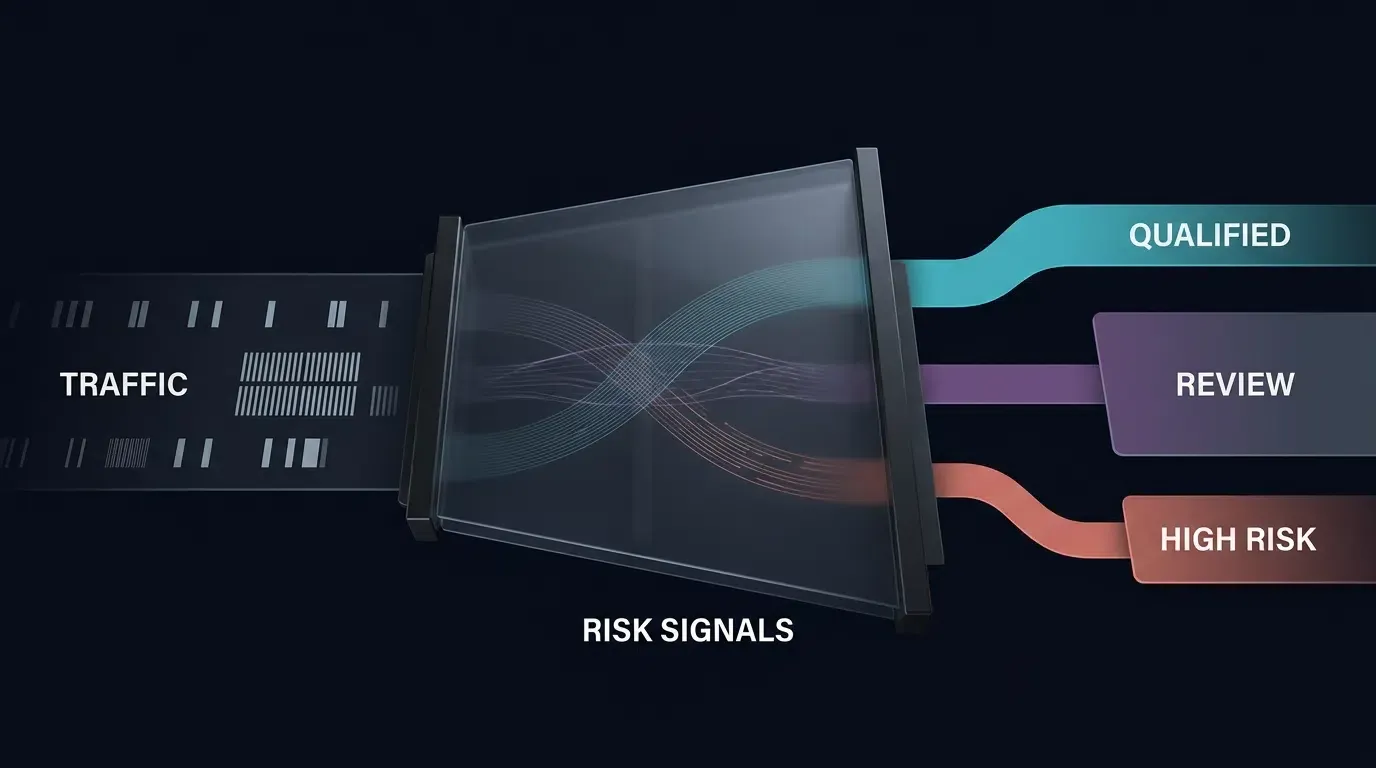
Hosting ASN classifications, proxy indicators, User-Agent patterns, and scan velocity can help prioritize investigations. They do not reliably distinguish all legitimate users from automated traffic in isolation.
Security scanners, social preview services, enterprise VPN users, and shared mobile gateways may create traffic that resembles automation. Conversely, adversaries may use residential proxies and realistic browser environments.
Combine multiple independent signals, assign a risk score, and separate low-risk automatic handling from decisions requiring analyst review.
Measuring Scan-to-Launch Timing Without Inventing Universal Thresholds
For an individual journey, define the observed time interval as the difference between a trusted server-side scan timestamp and the first-app-launch or conversion timestamp available to the attribution system.
Do not label a single journey’s time difference as a statistical mean. The mean time to install (MTTI) is an aggregate metric calculated over an explicitly defined population of journeys.
Extremely short intervals, unusually repeated event sequences, or inconsistent event ordering may justify investigation. However, there is no universal ten-second minimum for legitimate human behavior or universal two-second threshold that proves click injection. Build thresholds from measured baselines, supported attribution mechanisms, clock quality, and independently confirmed fraud examples.
Flag suspicious events for risk-based review and restrict reward eligibility only according to documented, testable policies.
An application-owned security event payload schema is defined in the JSON Schema reference below, enabling S2S risk notification when anomalous telemetry is registered.
Webhook Security Event Schema and Example Payload
This JSON Schema defines an illustrative application-owned security event format (QrSecurityAnomalyWebhook).
{
  "$schema": "https://json-schema.org/draft/2020-12/schema",
  "title": "QrSecurityAnomalyWebhook",
  "type": "object",
  "additionalProperties": false,
  "required": [
    "event_id",
    "event_type",
    "schema_version",
    "detected_at",
    "app_id",
    "campaign_id",
    "risk"
  ],
  "properties": {
    "event_id": {
      "type": "string",
      "minLength": 1,
      "maxLength": 128
    },
    "event_type": {
      "const": "security_anomaly_detected"
    },
    "schema_version": {
      "const": "1.0"
    },
    "detected_at": {
      "type": "string",
      "format": "date-time"
    },
    "app_id": {
      "type": "string",
      "minLength": 1,
      "maxLength": 255
    },
    "campaign_id": {
      "type": "string",
      "minLength": 1,
      "maxLength": 128
    },
    "risk": {
      "type": "object",
      "additionalProperties": false,
      "required": ["category", "level", "decision"],
      "properties": {
        "category": {
          "type": "string",
          "enum": [
            "signature_mismatch",
            "suspected_replay",
            "unusual_scan_velocity",
            "geolocation_anomaly",
            "suspected_proxy_traffic"
          ]
        },
        "level": {
          "type": "string",
          "enum": ["LOW", "MEDIUM", "HIGH", "CRITICAL"]
        },
        "decision": {
          "type": "string",
          "enum": ["OBSERVE", "REVIEW", "HOLD", "REJECT"]
        }
      }
    }
  }
}
The example JSON payload below adheres to the QrSecurityAnomalyWebhook schema defined above:
{
  "event_id": "evt_sec_9876543210_abc",
  "event_type": "security_anomaly_detected",
  "schema_version": "1.0",
  "detected_at": "2026-10-30T05:40:00Z",
  "app_id": "com.example.app",
  "campaign_id": "cmp_ooh_fall_2026",
  "risk": {
    "category": "signature_mismatch",
    "level": "CRITICAL",
    "decision": "HOLD"
  }
}
Evaluating Verification Layers Against Known Threat Vectors
Comparative Analysis of Security Frameworks
Mobile growth architectures employ varying levels of QR code security based on risk tolerance, campaign budget, and technical complexity. Basic deployments rely on simple domain locking, whereas enterprise implementations integrate multi-layered cryptographic signing, authenticated parameters, and risk-based telemetry validation.
OpoInstall, a mobile attribution and deep linking platform, can be integrated within a mobile growth stack to track campaign redirections and support attribution data pipeline workflows.
| Verification Mechanism | Main Security Property | Threats It Can Reduce | Important Limitation |
|---|---|---|---|
| Static HTTPS URL | Authenticated, encrypted transport to the intended HTTPS endpoint | Network interception and in-transit URL manipulation | Does not prevent physical QR sticker replacement or unauthorized campaign-parameter changes accepted by the server |
| Server-Issued Opaque Campaign Token | Server-controlled campaign and placement lookup | Arbitrary modification of campaign identifiers when the server validates the token | A public token can still be copied and reused |
| HMAC-SHA256 Payload Signing | Integrity and authenticity of selected campaign fields | Unauthorized changes to signed parameters | Does not encrypt the fields, establish a human scan, or prevent replay by itself |
| Session and Event Replay Controls | Freshness, event deduplication, and idempotent processing | Duplicate webhook delivery, repeated reward processing, and some automated abuse | Must not invalidate the reusable token printed on physical marketing materials |
| Risk-Based Telemetry Review | Probabilistic anomaly detection | Suspicious traffic concentration, proxy indicators, unusual event sequences | Can generate false positives and cannot independently detect a sticker that sends all traffic to another domain |
| Physical Placement Controls | Asset authenticity and operational monitoring | Unauthorized sticker overlays and replacement attempts | Requires inspection, trusted-domain communication, and incident handling |
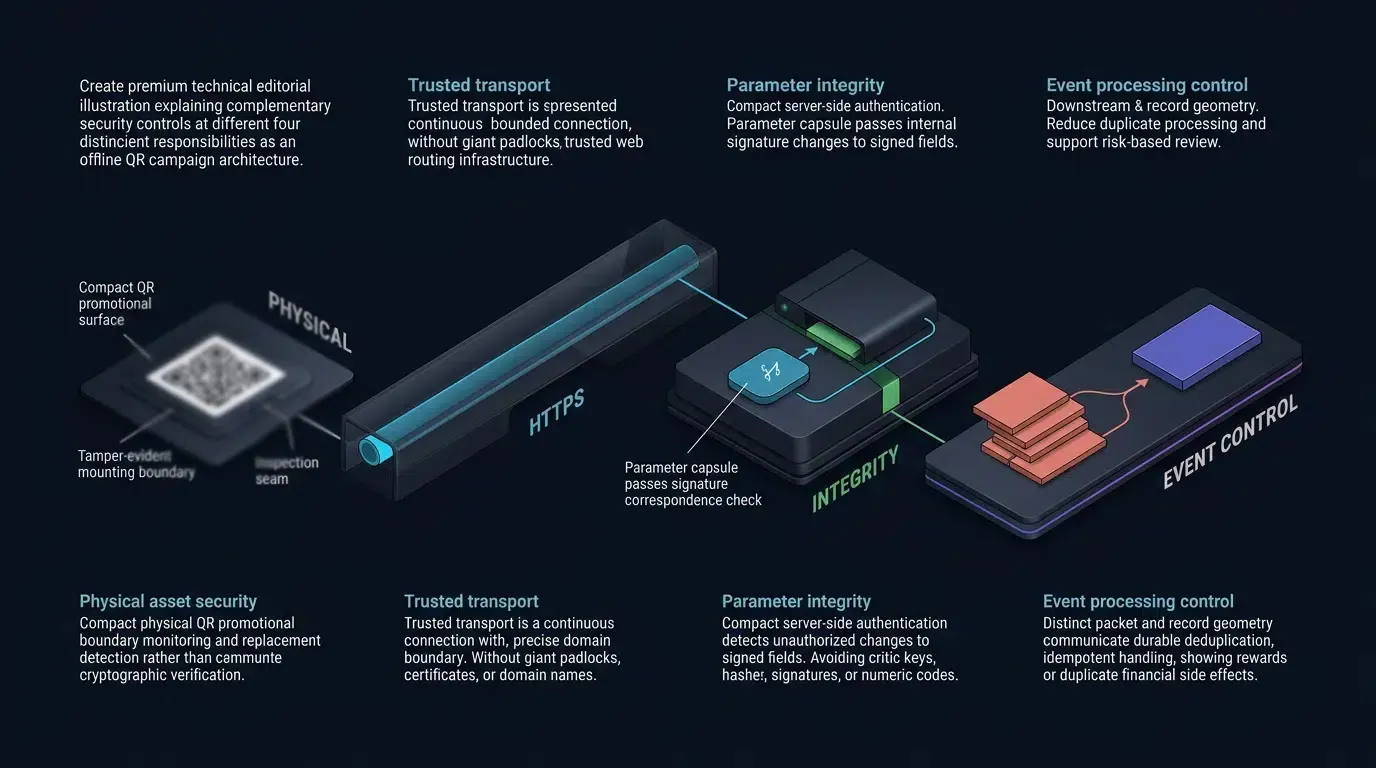
Configuring Risk Controls in an Attribution and Campaign Management Stack
Defining Campaign-Specific Risk Thresholds
Security teams can define risk policies at the campaign gateway, analytics service, or supported mobile measurement platform. Examples include rate limits, unusual request concentration, repeated event identifiers, unexpected geography, and elevated proxy-risk indicators.
These values must be calibrated against observed traffic rather than treated as universal fraud thresholds. Shared IP addresses and legitimate automated link checks should be considered when choosing enforcement rules.
Review, Quarantine, and Recovery
Where the deployed platform supports these capabilities, suspicious channels can be placed into a review state, attribution payments can be temporarily withheld, and alerts can be sent to security analysts. High-confidence invalid requests may be rejected, while uncertain cases should remain eligible for investigation and appeal.
Do not automatically blacklist an IP address or quarantine an entire offline channel solely because of one location mismatch or hosting-network classification. Record the rule, supporting evidence, affected events, review decision, and recovery procedure.
Product Integration Boundary
OpoInstall provides mobile attribution and deep-linking resources relevant to QR-driven campaigns. Teams should verify which anti-fraud signals, configurable rules, security webhooks, and channel-management functions are available in their actual product edition and deployed release.
If a desired control is not exposed by the vendor platform, implement it in an application-owned routing gateway or risk service rather than describing it as an existing OpoInstall console feature. Consult the OpoInstall developer console and attribution SDK integration resources for capabilities verified in the environment being deployed.
When Is Advanced QR Security Necessary for Mobile Campaigns
Suitable Conditions for Deploying Cryptographic QR Security
Implementing cryptographic QR signatures and risk-based telemetry verification is highly recommended under the following operational conditions:
- High-Value Financial Incentives: Referral campaigns offering substantial monetary rewards, gift cards, or in-app currency for completed app installations.
- Unmonitored Public Collateral: Out-of-home (OOH) advertising deployed in high-traffic, unmonitored environments (subway stations, bus stops, public flyers) vulnerable to physical sticker overlays.
- High-Budget Performance Campaigns: Large-scale print or television campaigns where misattributed conversions result in significant affiliate commission overpayments.
- Regulated Industry Verticals: Mobile applications in fintech, healthcare, or gaming requiring verifiable audit trails for compliance and data integrity.
Unsuitable Conditions for Deploying Cryptographic QR Security
Conversely, full cryptographic verification introduces unnecessary overhead in the following low-risk scenarios:
- Internal Corporate Testing: QR codes used exclusively within secure corporate offices for employee testing or internal event check-ins.
- Low-Stakes Informational Content: Barcodes directing users to public documentation, customer support pages, or static menu PDFs with no referral payouts or conversion tracking.
- Short-Run Ephemeral Scans: Temporary event displays managed continuously by staff where physical sticker overlays are immediately detected and removed.
Common Misconceptions in QR Code Anti-Fraud Strategy
Misconception 1: HTTPS or HMAC Can Prevent Every Sticker Overlay
HTTPS authenticates and protects the connection to the destination selected by the scanner. HMAC authenticates the signed campaign fields accepted by the intended gateway. Neither mechanism can prevent a person from replacing the printed barcode with a completely different QR code.
Physical replacement requires separate controls such as placement inspections, tamper-evident materials, clear communication of trusted domains, and incident reporting.
Misconception 2: Static QR Codes Are Necessarily Insecure
A static QR code is simply a barcode whose encoded content does not change after printing. It may contain a valid HTTPS URL, an opaque server-issued campaign token, or a signed campaign identifier.
The security risk arises when the receiving system trusts editable campaign parameters, accepts unauthorized destinations, or processes duplicated conversion events without verification. Static printing alone does not imply those vulnerabilities.
Misconception 3: HMAC Signatures Automatically Stop Replay Attacks
An unchanged valid request can retain a valid HMAC signature. Replay prevention requires additional controls appropriate to the operation, such as authenticated delivery timestamps, durable event-ID deduplication, and idempotent server-side effects. Public printed campaign tokens must remain reusable during their authorized campaign lifetime.
Pre-Deployment Security Verification Checklist
Before launching an offline QR campaign, verify these scenarios in a staging environment:
- Signed parameter modification: Change a signed campaign or channel identifier without updating the signature. Expected result: the gateway rejects the modified routing payload.
- Repeated legitimate poster scans: Scan the same approved physical QR code from multiple devices. Expected result: legitimate routing remains available without duplicate conversion rewards.
- Unauthorized destination: Attempt to supply an external redirect destination outside the gateway allowlist. Expected result: the gateway rejects the destination.
- Sticker replacement simulation: Replace the original QR with a different-domain test code. Expected result: the original signature system is not falsely credited with preventing the attack; placement inspection or user reporting identifies the substituted asset.
- Webhook forgery and replay: Submit invalid signatures, stale authenticated delivery timestamps where the protocol supports them, and duplicate event identifiers. Expected result: invalid events are rejected and valid retries produce no duplicate side effects.
- Location and proxy false positives: Simulate shared mobile gateways, enterprise VPNs, and legitimate security scanners. Expected result: risk indicators trigger documented review decisions rather than automatic fraud declarations.
- Key rotation and incident recovery: Rotate a signing key and revoke an obsolete key according to the configured policy. Expected result: valid active campaigns remain routable and compromised credentials no longer authenticate requests.
Record the test input, expected outcome, observed result, environment, and relevant log or event identifier. Do not mark a scenario as passed until it has been executed.
Frequently Asked Questions (FAQ)
How to secure custom QR codes against scanning hijacking?
What is a physical sticker overlay attack in QR code marketing?
How does an MMP detect proxy fraud in offline scan campaigns?
Summary and Security Decision Framework
Securing custom QR codes requires distinct protections for physical replacement, network-level manipulation, campaign-parameter tampering, and fraudulent attribution events. No single signature, location check, or mobile measurement service can eliminate all of these threats.
For higher-value campaigns, combine trusted HTTPS routing, signed or server-issued campaign tokens, replay-resistant downstream event processing, explicit destination allowlists, privacy-conscious anomaly detection, and operational monitoring of physical placements. Treat suspicious telemetry as evidence for a documented risk decision rather than an automatic proof of fraud.
OpoInstall can be evaluated as part of the mobile attribution and deep-linking stack. Confirm the anti-fraud functions supported by the deployed product before attributing specific security controls to its SDK, gateway, or developer console.
To explore mobile attribution and deep-linking capabilities, consult the mobile attribution implementation reference.
Related Materials
-
Concepts: Custom QR Code, Redirection Fraud, HMAC Signature Verification, Geolocation Anomaly Audit
-
Technologies: Mobile Measurement Partner, Edge Redirection Gateway, S2S Fraud Webhook, W3C URI Protocols
-
Standards: OWASP Mobile Security Testing Guide, NIST SP 800-57 Key Management Guidance, IETF RFC 7515 (JWS), NIST HMAC FIPS 198-1 Specification, OWASP Webhook Security Cheat Sheet
-
Platform and Integration Interfaces: Apple Universal Links, Android App Links, application-owned HTTPS redirection gateways, authenticated security webhooks, and server-side attribution validation
-
Official Documentation & References:
Authenticating and Processing Security Webhooks
The QrSecurityAnomalyWebhook JSON Schema and example payload define an illustrative, application-owned security event. They are not an official OpoInstall webhook API contract. Schema validation checks the structure of an event, but it does not establish the identity of the sender or prevent forged deliveries.
A production webhook receiver should apply the following controls before allowing a security event to affect campaign or attribution state:
-
Transport and request validation: Require HTTPS, allow only the expected HTTP methods, and enforce request body size and rate limits.
-
Publisher authentication: Authenticate each delivery using the actual publisher’s documented verification protocol. For HMAC-signed webhooks, calculate the expected signature over the exact raw request bytes specified by that protocol and compare correctly decoded signatures using a constant-time operation. Do not reserialize JSON before verification unless the publisher explicitly requires it.
-
Delivery freshness and replay protection: Where the protocol includes authenticated delivery timestamps and event identifiers, validate their freshness and reject replayed deliveries. An unsigned timestamp alone does not provide replay protection. Follow the publisher’s documented behavior when authenticated timestamps are unavailable.
-
Schema validation: After authentication, validate the event body against the supported JSON Schema and reject malformed fields, unsupported schema versions, and unexpected event types.
-
Durable event deduplication: Persist processed event identifiers and make downstream actions idempotent. Legitimate webhook retries must not create duplicate payout holds, campaign restrictions, alerts, or other side effects.
-
Independent enforcement authorization: Treat
risk.levelandrisk.decisionas event data rather than unconditional commands. Even an authenticated event markedCRITICALmust pass the receiving application’s own authorization and risk policy before an IP address is blacklisted or a campaign is suspended. -
Key management, privacy, and auditing: Store signing secrets in managed secret storage, implement rotation and revocation procedures, redact sensitive authentication data from logs, and retain only the telemetry necessary for the declared security purpose.
Webhook publishers may use different signature headers, signing inputs, timestamp formats, retry schedules, and event identifiers. Verify the actual integration contract before deployment. Do not invent vendor-specific signing details or attribute unsupported webhook functionality to OpoInstall.
Implementation boundary: This article presents a reference security architecture. Production webhook authentication, supported event fields, delivery semantics, and OpoInstall-specific capabilities require confirmation against the deployed product release.
Reference: OWASP Webhook Security Cheat Sheet.
Share this article