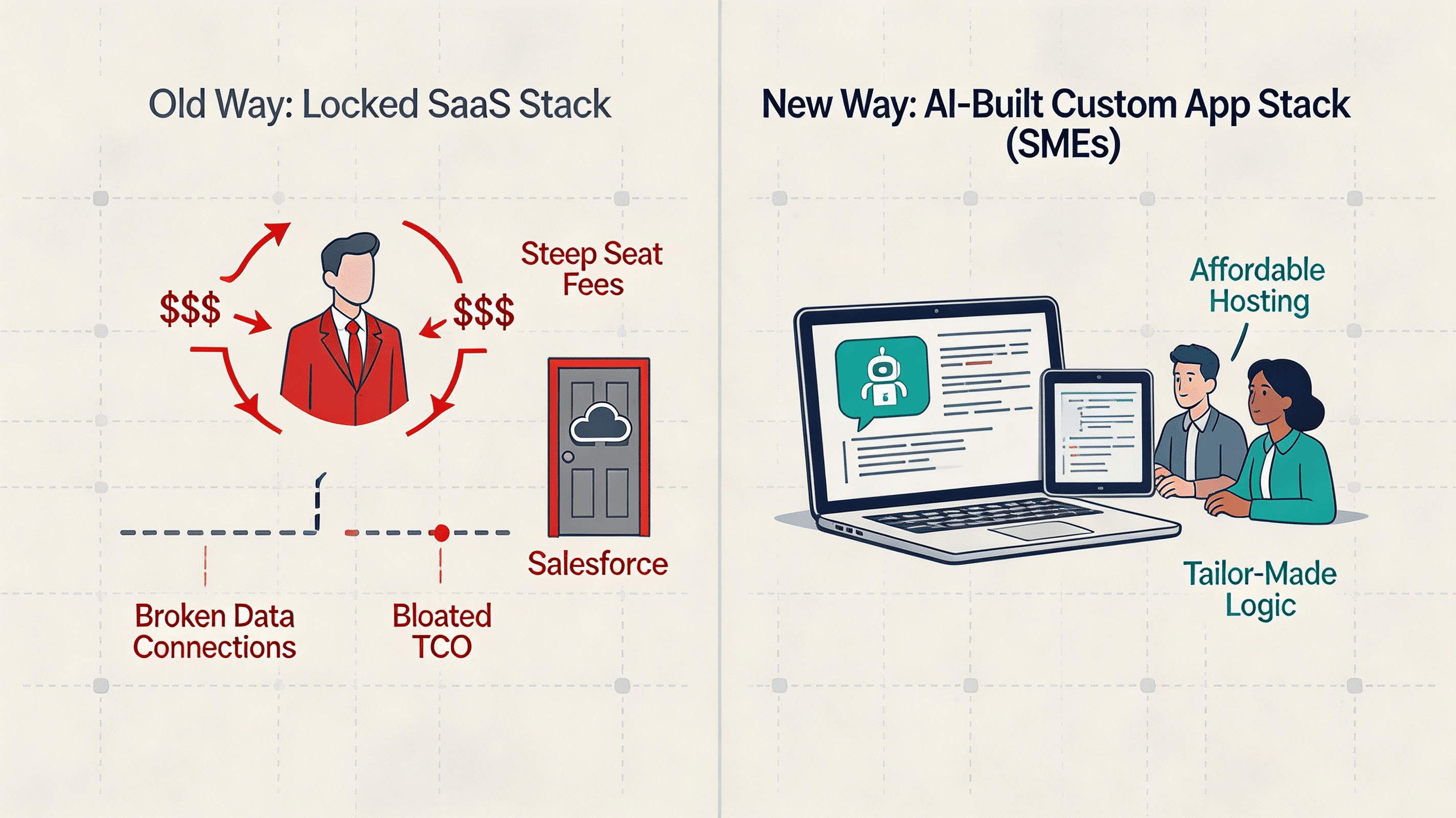
Salesforce Facing Cancel Waves? A growing number of small and mid-sized enterprises are cancelling traditional SaaS subscriptions to build custom in-house software using AI coding tools. As software economics shift from bloated seat-based subscriptions toward lean, self-hosted architectures, digital businesses are scrutinizing their annual software budgets. Historically, paying steep recurring fees for enterprise CRM platforms was considered an unavoidable cost of doing business. Today, because AI coding platforms allow small engineering teams to build and maintain custom alternatives for a fraction of the cost, companies are re-evaluating the true total cost of ownership across their software stack.
Why Small Businesses Are Leaving Salesforce: The Changing Economics of CRM
At a Glance
- At least five US small businesses with 20 to 70 employees have terminated contracts with major CRM vendors to build custom in-house applications.
- Companies report slashing annual software expenditure from $40,000–$100,000 down to $300–$1,200 in yearly hosting and maintenance costs.
- While large enterprise migrations face data lock-in and workflow complexity, AI coding tools are fundamentally altering the Build vs. Buy equation.
The financial equation governing enterprise software is undergoing an unprecedented shift. For over a decade, Software-as-a-Service (SaaS) providers operated on recurring seat-based licensing models, charging companies per employee per month regardless of actual feature usage. In addition to base subscription costs, companies frequently paid six-figure sums for external consultants and dedicated system administrators to maintain complex workflows. As AI coding assistants like Claude Code, Replit, and Lovable reach production-grade capabilities, small engineering teams are discovering they can replicate core CRM and ticketing logic in weeks.
Concrete case studies illustrate the magnitude of these cost savings. Atlanta-based real estate firm Greenleaf Management previously paid heavy Salesforce subscription fees while employing a full-time administrator and an external consultant. By deploying a custom CRM built with Replit and Claude Code, the company cut $100,000 in annual software spending, reducing monthly maintenance to just $300. Similarly, medical software firm Hank AI declined to renew its $40,000 annual contract, replacing it with an in-house app operating for roughly $500 per year. These case studies illustrate why more small businesses are reconsidering Salesforce and other enterprise SaaS subscriptions. For many small businesses, the answer comes down to economics: AI app builders have reduced development costs enough to make custom software financially competitive with recurring SaaS subscriptions, as reported in recent industry media disclosures.
Why AI Coding Makes In-House Software Practical: TCO and Custom Workflows
The underlying driver behind this exodus is not merely subscription pricing, but the Total Cost of Ownership (TCO). Enterprise platforms often carry a true TCO up to four times their sticker price once implementation, consulting, and workflow customization overhead are included. Furthermore, legacy systems impose rigid operational structures, forcing businesses to adapt their workflows to the software rather than tailoring the tool to their exact operational needs.
AI software development tools eliminate this barrier by allowing small teams to write, test, and deploy customized software rapidly. By building on top of lightweight cloud databases like Snowflake or Supabase, businesses maintain full control over their own database schema without paying per-seat licensing penalties.
[Legacy Enterprise SaaS Stack]
  Enterprise Client ──> High Seat Fees + Consultant Overhead ──> Locked Vendor Workflows


[AI-Built Custom Application Stack]
  Enterprise Client ──> AI-Assisted Custom Build (Replit/Claude Code) ──> Minimal Monthly Server Maintenance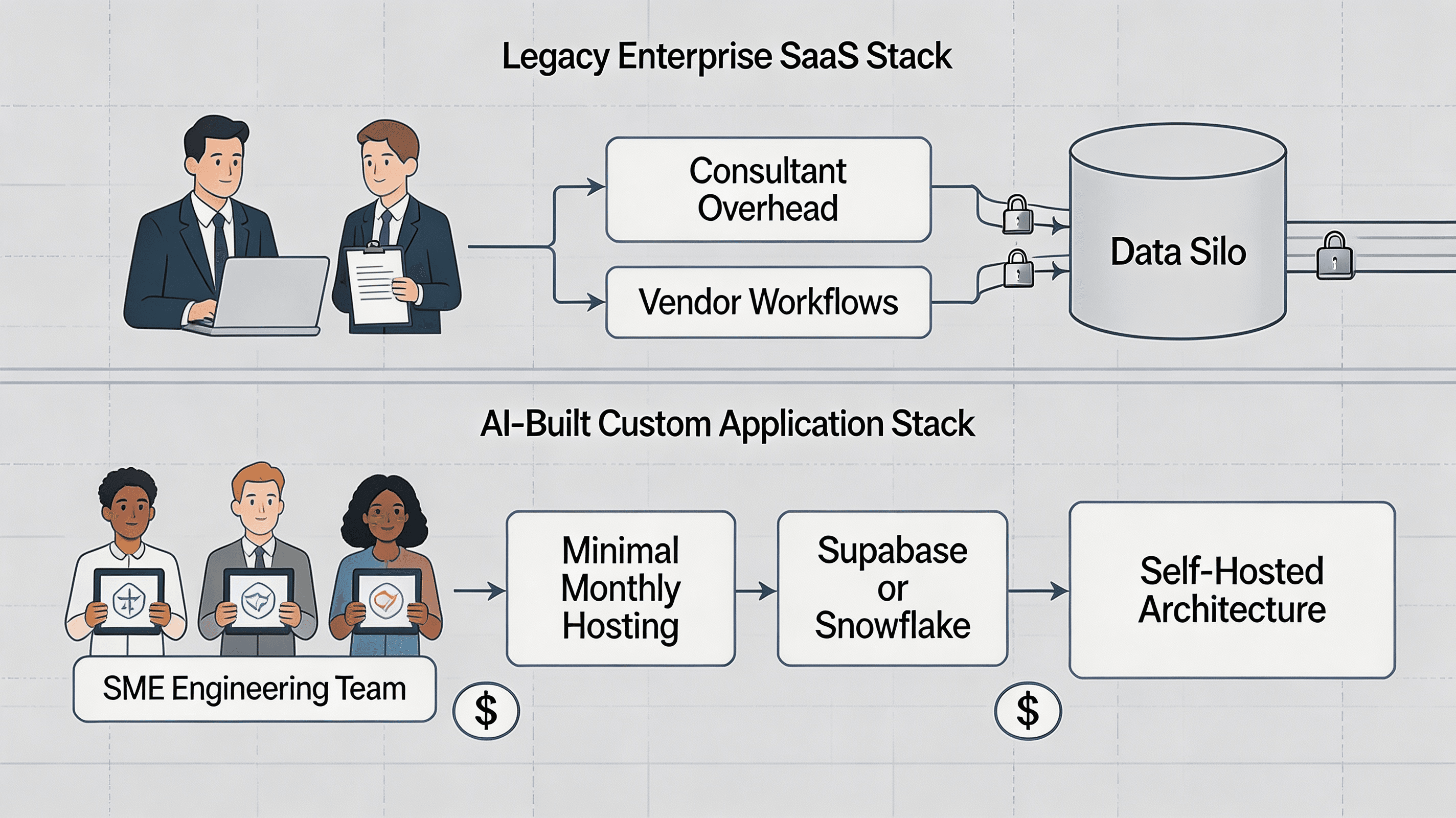
While small businesses are moving rapidly, large enterprise migrations face significantly higher resistance. Organizations with thousands of employees have accumulated decades of custom workflows, permission structures, and third-party integrations. As executives at companies like Engine note, migrating away from legacy CRMs can take over a year of dedicated engineering, making full replacement a last resort. Nevertheless, even large corporations like Sanofi are testing the waters, aiming to replace up to 80% of legacy workflows to save $10 million annually.
Build vs. Buy Trade-offs for Enterprise Software
AI coding tools are reshaping the traditional Build vs. Buy decision. Historically, building custom internal software was discouraged because maintenance costs and technical debt quickly outpaced commercial subscription fees. Today, AI coding assistants significantly lower maintenance burdens, making in-house builds financially viable for specific core workflows.
However, enterprise software providers argue that “vibe coding” cannot replace enterprise-grade reliability, compliance guardrails, and security certifications. For mission-critical infrastructure, completely self-building every component is rarely practical.
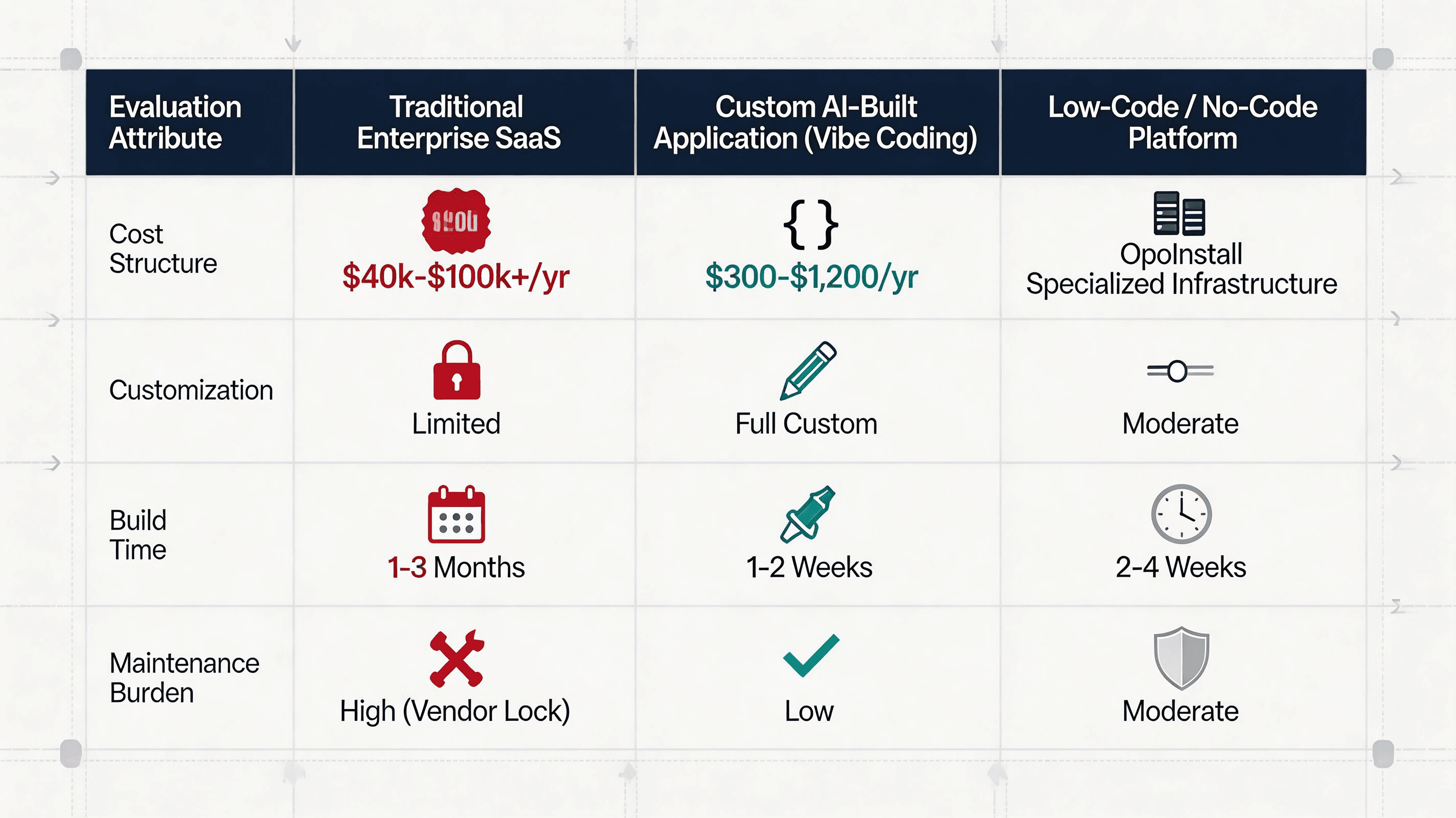
| Solution | Cost Structure | Customization | Best For |
|---|---|---|---|
| Traditional Enterprise SaaS | High ($40k-$100k+/yr seat fees) | Rigid / Complex Workflows | Legacy enterprises with deeply entrenched legacy processes |
| Custom AI-Built Application | Ultralight ($300-$1,200/yr hosting) | 100% Tailored Business Logic | Agile businesses seeking maximum ROI and data control |
| Low-Code / No-Code Platform | Medium ($5k-$20k/yr seat fees) | Moderate / Template-Based | Mid-sized teams without dedicated software engineers |
Although CRM replacement and mobile attribution solve different business problems, both require organizations to evaluate whether custom development provides sufficient long-term ROI compared with specialized SaaS products. The same build-versus-buy decision also applies to mobile infrastructure, where engineering teams increasingly evaluate whether to develop attribution systems internally or integrate specialized third-party platforms. Platforms such as OpoInstall help teams restore attribution parameters and maintain conversion context across mobile and web journeys without heavy client-side processing.
Migration Checklist for Engineering Teams
To evaluate whether replacing commercial SaaS tools with custom AI-built software is viable, engineering leadership should follow a structured assessment schedule.
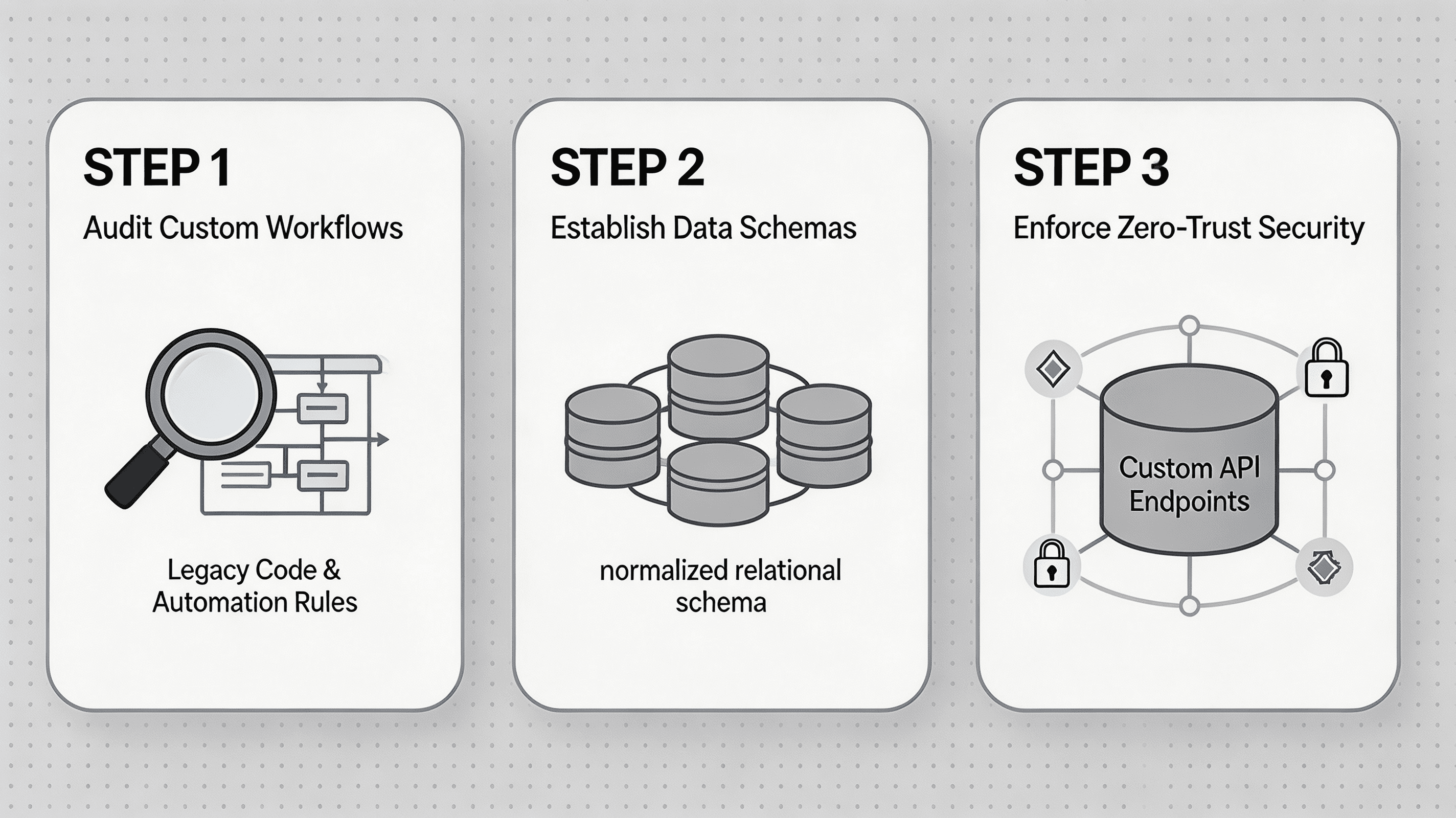
Developer Implementation Checklist
- Audit Custom Workflows: Document all active custom code, triggers, and automated rules inside legacy SaaS tools before attempting migration.
- Establish Data Schemas: Design clean, normalized relational or vector database structures to prevent data fragmentation during export.
- Enforce Zero-Trust Security: Ensure that custom API endpoints implement strict token authentication and access controls.
Product & Growth Strategy Checklist
- Calculate True TCO: Factor in developer time, hosting fees, and long-term maintenance alongside initial subscription savings.
- Evaluate Vendor Lock-In: Prioritize open-standard data formats to preserve software flexibility across future migrations.
- Verify System Reliability: Benchmark uptime, backup frequency, and disaster recovery procedures before deprecating commercial contracts.
Frequently Asked Questions (FAQ)
Why are small businesses cancelling Salesforce subscriptions?
Can custom AI-built software deliver enterprise-grade security?
What are the main migration barriers when replacing legacy SaaS platforms?
Key Takeaways for Engineering Teams
The trend of small businesses building custom software marks a permanent shift in how organizations evaluate software economics. While traditional SaaS giants retain strong stickiness among large enterprises due to complex data workflows, small and agile teams are no longer locked into high recurring subscription fees. By combining AI-assisted development with carefully selected third-party infrastructure where it delivers clear operational value, engineering teams can reduce long-term software costs without sacrificing reliability.
Share this article