How to publish and promote a hyper casual mobile game? Publishing and promoting a hyper-casual mobile game on a budget requires rapid marketability testing, disciplined CPI-to-LTV unit economics, and platform-compliant web-to-store routing designed to reduce avoidable drop-off across supported social distribution environments.
Hyper-casual game promotion is an agile performance marketing methodology focused on validating mass-market gameplay appeal, optimizing short-term advertising monetization, and scaling user acquisition under strict margin constraints. Because classic hyper-casual titles monetize predominantly through in-app ads with short player lifecycles, marketing efficiency depends on keeping Cost-Per-Install (CPI) below short-tail advertising Lifetime Value (LTV) while minimizing conversion friction across social ad channels.
| Term | Definition | Related Entity | Search Intent Role |
|---|---|---|---|
| Hyper Casual | A mobile game genre characterized by minimalist design, simple loops, and high ad density. | Casual Games | Technical / Informational |
| Mobile Game Marketing | The commercial promotion and user acquisition strategies deployed for mobile titles. | Performance UA | Informational / Commercial |
| App Launch | The strategic phases of releasing a game, spanning prototyping, soft launch, and scaling. | Marketability Testing | Operational / Analytical |
The Commercial Dynamics of Hyper Casual Publishing in Modern Mobile Markets
The Fast-Paced Lifecycle: Concept Prototyping, Rapid Marketability Testing, and Swift Iteration
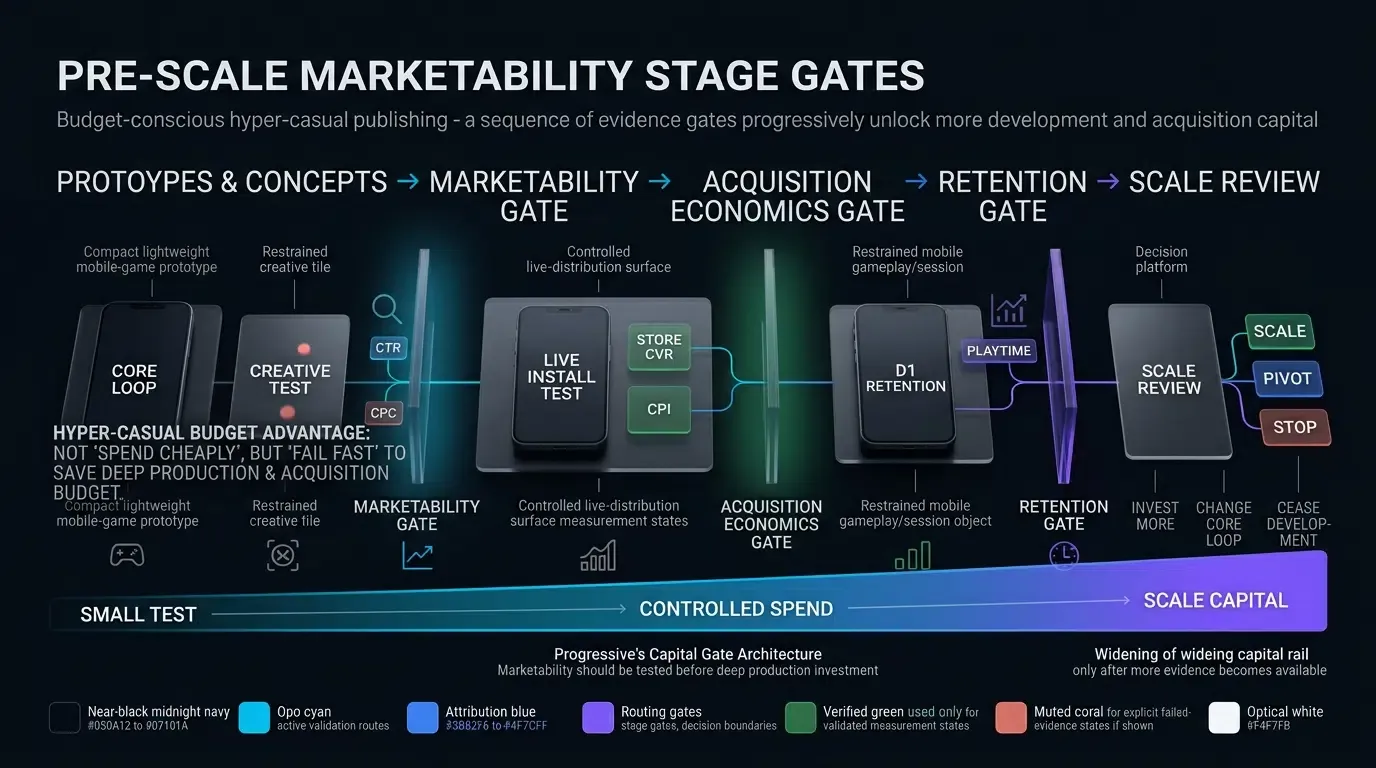
The hyper-casual publishing model operates on speed and empirical validation. Unlike traditional mobile titles that require extensive content creation before initial audience testing, hyper-casual games begin with lightweight mechanical prototypes. Studios construct a single core interaction loop—such as stacking, slicing, sorting, or running—and immediately expose gameplay video assets to live audience testing on social feeds.
An illustrative operating cadence often divides into three experimental stages:
- Ideation and Marketability Validation: Testing core creative assets to evaluate initial audience engagement before developing complete game architecture.
- Soft Launch and Retention Measurement: Deploying a minimal viable build to measure early session length, Day 1 retention, and initial ad interaction.
- Scale, Pivot, or Terminate: Allocating marketing capital to concepts demonstrating positive unit economics, while terminating or re-theming underperforming concepts before development costs accumulate.
Actual test duration should be determined by statistical sample size, traffic availability, confidence intervals, and iteration cost rather than rigid calendar rules. This rapid workflow ensures that studios invest marketing capital exclusively in concepts with verified market demand.
The Low-Margin Reality: Why Hyper-Casual Profitability Demands Low-Cost Scalability
Classic hyper-casual titles operate on narrow contribution margins per user. Because in-app advertising represents the primary revenue engine and player lifecycles are relatively short, cumulative advertising revenue per player must be evaluated against acquisition costs.
Realized advertising LTV varies substantially across geographic markets, operating systems, and player cohorts. Consequently, the allowable Cost-Per-Install is strictly constrained. If a studio pays an acquisition cost that exceeds realized short-tail advertising revenue, the campaign operates at a loss. Sustainable publishing requires keeping acquisition costs low while optimizing the conversion efficiency of the download funnel.
The Evolution Toward Hybrid-Casual: Increasing Progression Depth to Sustain User Acquisition
Rising acquisition costs on programmatic ad networks have prompted many hyper-casual publishers to evolve their gameplay loops toward hybrid-casual designs. While core gameplay remains accessible, hybrid-casual titles introduce light progression systems, meta-layers (such as meta-progression upgrades or collections), and optional microtransactions alongside advertising placements.
This progression structure is designed to extend engagement depth and should be validated against Day 7 and Day 30 retention and monetization experimentally. By expanding the revenue ceiling per user, studios can sustain higher competitive CPI bids across programmatic ad networks, enabling viable acquisition even in competitive advertising environments.
See Also: Hyper Casual ──> Mobile Attribution Model
How to Validate Marketability and CPI Feasibility During Soft Launch
Phase 1: Social Video Creative Testing ── Measuring Click-Through Rate and Cost-Per-Click
Before publishing a complete game build to app stores, publishers conduct creative testing on social feeds (such as TikTok or Meta) using prototype or representative gameplay creatives that accurately reflect the tested mechanic. Conceptual ads should not materially misrepresent the eventual user experience, adhering to platform policies against deceptive promotion.
Key diagnostic indicators during Phase 1 include:
- Video Click-Through Rate (CTR): Measures the percentage of viewers who interact with the ad call-to-action. High CTR indicates that the visual hook, mechanic clarity, and gameplay theme resonate with broad consumer audiences.
- Cost-Per-Click (CPC): Measures the cost required to drive a user to a destination link. Low CPC indicates high creative appeal, signaling that the concept has potential to achieve viable acquisition costs when scaled.
If an early prototype fails to meet creative CTR baselines, publishers iterate on visual perspective, thematic art styles, or gameplay pacing before expanding the game build.
Phase 2: Closed Store Testing ── Validating Baseline Cost-Per-Install and Store Conversion Rate
Once an ad creative demonstrates strong marketability, the studio uploads a functional build to app store platforms for closed-market testing. TestFlight is utilized for iOS build testing and early cohort feedback, while public store conversion rate (CVR) is evaluated separately on store product pages.
During Phase 2, performance marketing teams evaluate:
- Store Conversion Rate (CVR): The percentage of store page visitors who initiate a download. High CVR indicates alignment between the ad creative and the app store listing assets.
- Baseline Cost-Per-Install (CPI): The actual acquisition cost per installed user under live campaign bidding conditions. Lower-cost geographies can validate technical funnels and relative creative differences, but CPI and monetization must be revalidated in the target market before scaling decisions.
Phase 3: Day 1 Retention Gate ── Confirming Core Loop Traction Before Allocating Scale Budgets
The final validation hurdle is player retention. Even if a game achieves low early acquisition costs, it cannot generate adequate advertising revenue if players abandon the game immediately.
Publishers evaluate early retention metrics:
- Day 1 Retention: Measures whether the core mechanic provides sufficient immediate satisfaction to bring players back across their initial 24-hour elapsed window.
- Session Count and Playtime: Evaluates the number of gameplay loops completed per daily active player, dictating the available inventory for ad placements.
A game must clear these qualitative and quantitative gates before publishing teams allocate substantial marketing capital.
Establishing an Early Paid-Acquisition Gate
A campaign fails the Day-7 paid-acquisition gate when tested CPI exceeds the conservatively forecast Day-7 advertising contribution allowed by the studio’s target margin:
Where
The Hyper Casual Unit Economics Model: Balancing CPI Against Day 7 Ad LTV
The Core Unit Margin Formula: Acquisition Margin Calculation
The commercial viability of hyper-casual publishing is evaluated through the Day-7 paid acquisition contribution:
Where:
represents the cumulative net programmatic advertising revenue generated per acquired player through Day 7 post-install. represents the average cost paid to acquire that installed user.
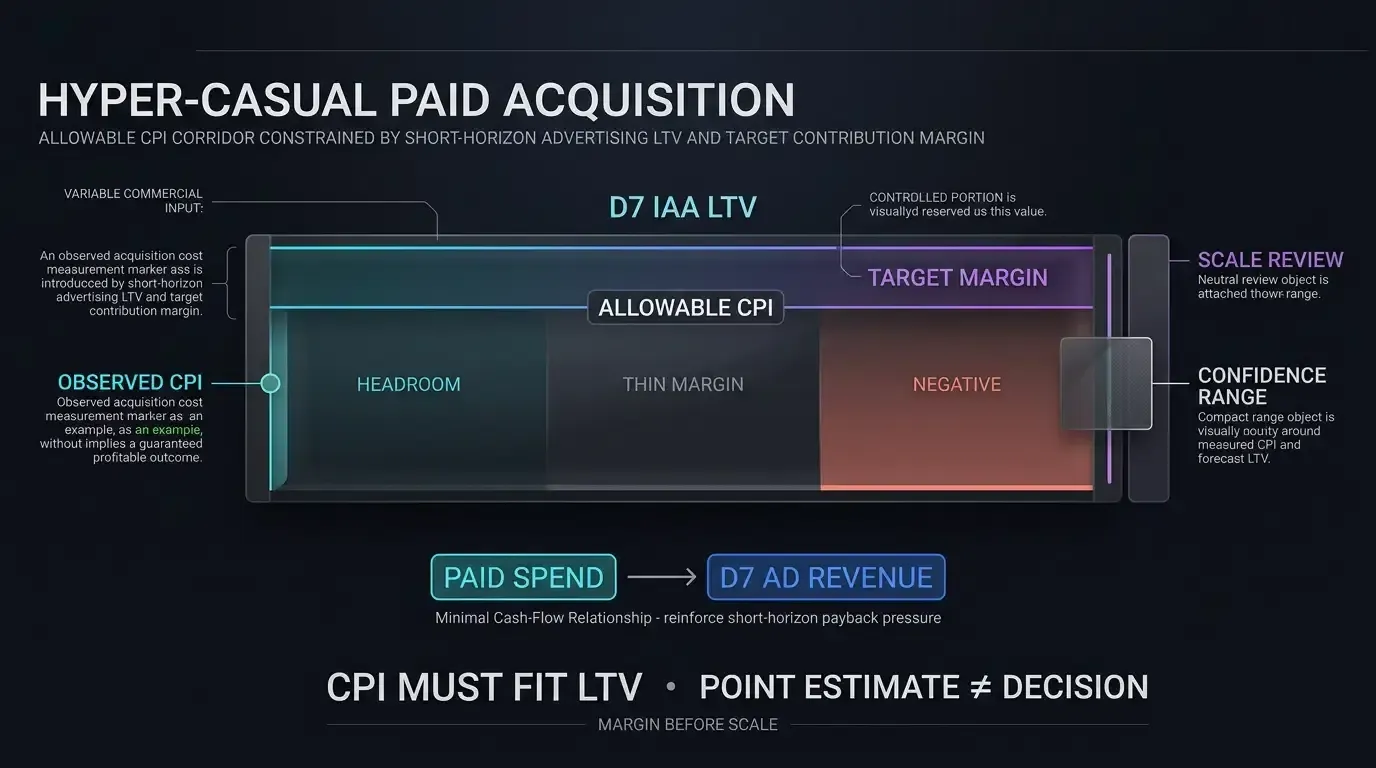
To scale on a limited budget, the acquisition contribution margin must remain positive across target geographic cohorts before factoring in studio overhead, operational expenses, and platform fees.
Deconstructing Short-Horizon Ad LTV: Daily Impressions, eCPM, and Rapid Retention Decay
In hyper-casual games, player lifecycle is compressed, making short-horizon LTV (specifically D0–D7 cumulative advertising LTV) the primary payback engine. A large share of early ad revenue can concentrate in the first several days for short-retention titles, requiring teams to measure the actual cumulative revenue curve for each cohort.
D0–D7 cumulative advertising LTV is formulated across eight elapsed-day buckets (
Where:
represents the cohort retention rate on elapsed day post-install. represents the deployed ad format inventory (rewarded video, interstitials, banners). is the average number of impressions of format completed per active user on day . is the effective net revenue per 1,000 impressions cleared on day .
The Importance of Early Payback Horizons in Preserving Publishing Cash Flow
For indie developers and budget-constrained publishers, cash flow velocity is as critical as total margin. Waiting months for user acquisition spend to break even ties up working capital and limits testing capacity.
Publishers prioritize accelerated payback horizons, aiming for campaigns to recover acquisition costs within short operational timeframes (such as early post-install days) to free up marketing capital for continuous reinvestment. Studios should set title-specific payback targets based on cash constraints, observed revenue curves, creative durability, and required contribution margins.
Evaluating the Impact of Organic Spillover on Incremental Acquisition Costs
When a hyper-casual title scales paid acquisition, it can generate organic spillover: as download volume increases, the game climbs app store free charts, boosting visibility and driving unassisted organic downloads.
However, not all concurrent organic downloads are caused by paid campaigns; baseline organic search, brand awareness, and word-of-mouth exist independently. To measure true acquisition efficiency, studios evaluate effective incremental CPI using experimentally validated organic lift:
Estimating incremental organic lift requires controlled measurement—such as geographic holdout testing or spend-pause evaluations—rather than assuming that all concurrent organic downloads are attributable to paid advertising.
How Does Frictionless Web to Store Routing Compress Acquisition Costs
The Social In-App Browser Problem: Webview Enclosures Blocking Direct Store Downloads
A major point of conversion friction in social performance marketing occurs inside enclosed in-app webviews. When a prospective player taps an ad on social messaging or media platforms (such as WeChat, Line, TikTok, or Instagram), the platform frequently opens the destination landing page within its own sandboxed in-app browser rather than the device’s default system browser.
These enclosed in-app webviews introduce technical constraints:
- Download Interception: Many in-app browsers block direct APK downloads on Android, flagging third-party packages as unauthorized.
- Scheme Protocol Restrictions: In-app webviews may suppress custom URI scheme redirects (
market://or custom deep links) designed to launch app store clients automatically. - Session Isolation: Sandboxed cookie storage isolates the user from their default system browser, complicating parameter transmission.
The Drop-Off Bottleneck: How Manual Browser Prompts Erode User Conversion
When an in-app browser blocks direct downloading or store redirection, users are typically confronted with a manual multi-step workaround (e.g., prompting the user to open an external menu and select “Open in Default Browser”).
Requiring manual browser navigation introduces friction, leading to user drop-off before players reach an app store page or package download state. In low-margin hyper-casual marketing, conversion drop-off directly inflates effective acquisition costs, as each dropped user represents paid advertising spend that failed to generate an install.
Mechanics of Quick Installation: Environment Detection and Handoff Flows
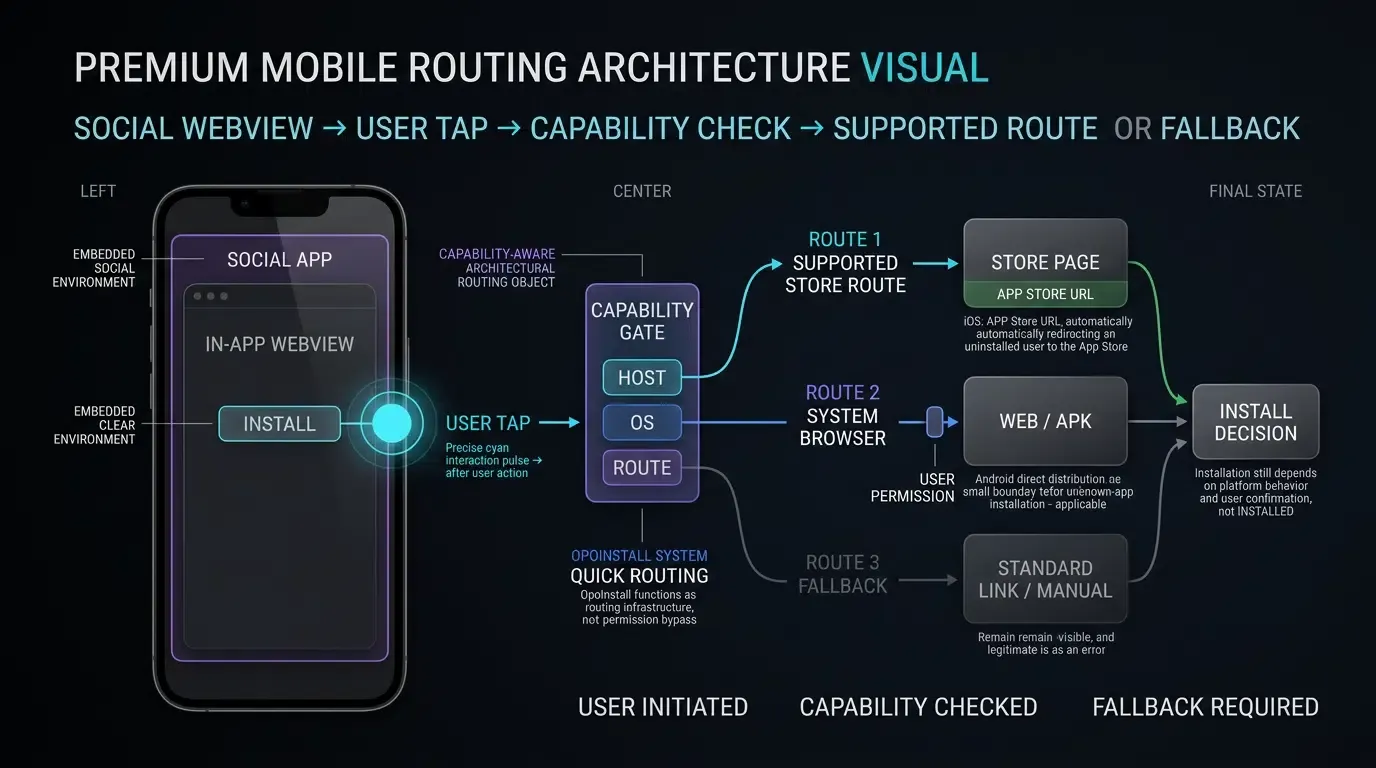
OpoInstall Quick Installation technology reduces manual routing steps in supported host-app and browser combinations after an explicit user interaction.
When a user taps an install action within a supported in-app environment:
- Environment Capability Detection: The Web SDK evaluates the host application user-agent and operating system context to determine available routing capabilities.
- User-Initiated Transition: Following an explicit user interaction, the routing script executes an environment-supported intent or redirect to transition the user to the device’s default browser or store client. Unsupported environments fall back to standard web landing pages or manual instructions.
- Android Direct Distribution Governance: In direct APK distribution environments, the default browser initiates the package download. Under Android platform security, installing non-store packages requires the user to explicitly grant “Install unknown apps” permission for that browser source. Furthermore, as of September 2026, Android developer verification is rolling out; Google states that enforcement begins September 30, 2026 for supported installation channels on certified Android devices in Brazil, Indonesia, Singapore, and Thailand, with broader rollout planned from 2027. Direct-distribution teams should verify current registration and installation requirements before relying on APK delivery.
- iOS App Store Routing: On iOS, Universal Links route installed users directly into the application, while uninstalled users are routed via explicit App Store product URLs, as Universal Links do not natively fall back to the App Store for uninstalled users.
Visualizing the Social In-App Browser to Quick Installation Redirection Pipeline
The diagram below illustrates the capability-checked routing flow from a social in-app browser to installation:
[User Taps Promotional Link in Social App]
                     │
                     ▼
    [Landing Page Checks Host Capability]
                     │
     ┌───────────────┴───────────────────────────────┐
     ▼                                               ▼
[Supported In-App Environment]              [Unsupported Environment]
     │                                               │
     ▼                                               ▼
[User Taps Install Button]                  [Display Fallback Store Link]
     │                                               │
     ▼                                               │
[System Browser / Store Intent Triggered]           │
     │                                               │
     └──────────────────────┬────────────────────────┘
                            │
                            ▼
     [Platform Store Page or Direct APK Download]
                            │
                            ▼
     [User Confirms Installation & System Permissions]
Technical Framework for Frictionless Social Routing and Quick Installation
Configuring Intent Filters and Universal Links for Frictionless App Wake-Up
To ensure that users who already have the game installed are routed immediately into gameplay rather than redundant store pages, mobile binaries configure native deep-linking handlers.
- Android Intent Filters: Configured within
AndroidManifest.xmlto intercept incoming URI schemes and verified App Links domains. - Apple Universal Links: Configured within Xcode entitlements (
com.apple.developer.associated-domains) to link the application bundle identifier to hosted apple-app-site-association (AASA) domain endpoints.
Developers seeking integration libraries and configuration templates can consult the SDK integration resources for implementation guidelines.
Implementing Dynamic Browser Escape Logic in Restricted In-App Environments
Handling social in-app browsers requires deploying dynamic redirection scripts on the promotional landing page. The script inspects incoming user-agent strings to detect restricted environments.
When a supported restricted environment is identified, the script executes an automated intent scheme or redirection header upon a confirmed user tap, prompting the operating system to open the target URL within the primary external browser. This can transition the user out of the embedded container in supported configurations and initiate immediate store navigation or package downloading.
Teams can review available cheating monitoring documentation for technical interfaces and telemetry configuration controls.
Structuring the Hyper-Casual Campaign Telemetry and Quick-Routing Record
To maintain full visibility across social ad funnels, ingestion gateways structure campaign routing and redirection telemetry into standardized schemas.
The schema placeholder below illustrates an empirical telemetry record capturing in-app browser environment flags, quick installation routing states, and downstream attribution links:
{
  "reference_architecture": true,
  "illustrative_values": true,
  "hyper_casual_campaign_routing_record": {
    "telemetry_metadata": {
      "routing_event_id": "route_ev_2026_0916_8812",
      "timestamp_utc": "2026-09-16T08:15:00.120Z",
      "app_id": "com.example.hyper.runner",
      "device_platform": "Android"
    },
    "routing_request": {
      "user_action": "install_button_tap",
      "host_environment": "social_in_app_webview",
      "detected_user_agent": "Mozilla/5.0 (Linux; Android 14) AppleWebKit/537.36 (KHTML, like Gecko) Version/4.0 Mobile Safari/537.36 InAppBrowser",
      "requested_destination": "google_play_store"
    },
    "routing_decision": {
      "capability_status": "supported_intent_redirect",
      "selected_route": "intent_scheme_browser_escape",
      "fallback_route": "standard_web_store_url"
    },
    "routing_result": {
      "execution_status": "store_intent_dispatched",
      "fallback_used": false,
      "user_gesture_verified": true,
      "failure_reason": null,
      "route_latency_ms": 115,
      "route_latency_measurement": "user_tap_to_intent_dispatch"
    },
    "campaign_economics_telemetry": {
      "market_iso": "USA",
      "sample_size_installs": 1250,
      "tested_creative_ctr_percent": 4.85,
      "observed_cpc_usd": 0.08,
      "observed_cpi_usd": 0.28,
      "modeled_day_7_ad_ltv_usd": 0.38,
      "ltv_model_version": "v2_short_tail_regression",
      "cpi_confidence_interval": {
        "lower_usd": 0.25,
        "upper_usd": 0.31
      },
      "day_7_ltv_confidence_interval": {
        "lower_usd": 0.33,
        "upper_usd": 0.43
      },
      "projected_acquisition_margin_usd": 0.10,
      "commercial_decision_status": "human_review_required"
    },
    "attribution_handoff": {
      "channel_code_preserved": "tk_runner_042",
      "campaign_id": "cmp_runner_marketability_us",
      "creative_id": "cr_fail_state_hook_03",
      "attribution_session_status": "ready_for_first_open_restoration"
    }
  }
}
Passing Campaign Identifiers to Measure Downstream In-App Ad ROAS by Creative Asset
Optimizing hyper-casual user acquisition requires linking downstream ad revenue back to the specific creative asset that drove the download.
When a user clicks a promotional ad, the routing link embeds dynamic campaign parameters (channelCode, campaign_id, creative_id). The routing engine preserves these parameters through the installation process. When the application launches and initializes the attribution SDK, these tags are retrieved via asynchronous callbacks, allowing analytics pipelines to join campaign metadata with subsequent in-game ad revenue metrics.
Comparative Analysis of Hyper Casual Distribution Channels Under Budget Constraints
Evaluating Cost Structures, Volume Potential, and Technical Overhead Across Acquisition Vectors
Budget-constrained hyper-casual publishers evaluate multiple acquisition channels to identify the most cost-effective path to volume.
The table below contrasts primary hyper-casual distribution vectors across operational requirements and scaling characteristics:
| Distribution Vector | Initial Budget Required | Scaling Velocity | Primary Technical Requirement | Core Operational Trade-Off |
|---|---|---|---|---|
| Programmatic Video Networks | Moderate to High | High | Ad Network Tracking & S2S Postbacks | Escalating bids on competitive Tier-1 inventory |
| Social Feed Video Ads | Low to Moderate | Rapid | Video Creative Pipeline & Conversion Tracking | Creative performance can decay rapidly over time |
| Direct Web / APK Routing | Low | Moderate | Quick Installation & Intent Routing | Limited to Android; requires unknown-app permissions |
| Internal Cross-Promotion | Negligible Media Cost | Cumulative | Portfolio In-App Placements & Ad Logic | Carries inventory opportunity cost across titles |
Analyzing Channel Synergies in Production Environments
Indie studios with limited capital typically begin with Social Feed Video Ads due to flexible testing budgets and granular audience targeting. Once a title achieves verified marketability metrics, publishers expand acquisition across Programmatic Video Networks to access high-volume gaming inventory. Simultaneously, studios with multiple active titles leverage Internal Cross-Promotion to circulate players across their portfolio, lowering overall blended acquisition costs.
When Should Hyper Casual Publishers Kill a Prototype versus Scale User Acquisition
Conditions Triggering a Kill, Pivot, or Redesign Review
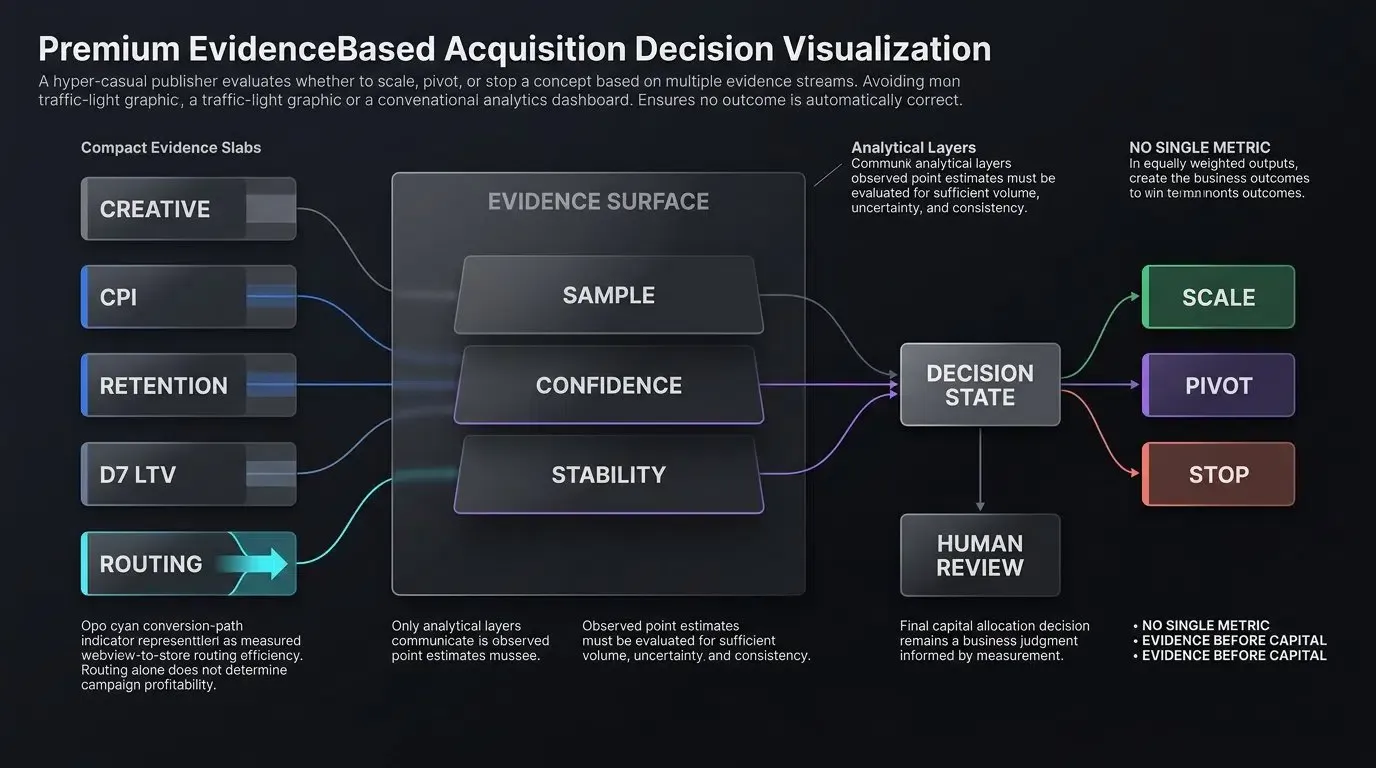
Terminating underperforming concepts early prevents capital depletion. No single CTR, retention, or CPI observation should automatically terminate a prototype without sufficient sample size and root-cause review. Projects should enter a formal review when:
- Creative CTR Fails to Meet Minimum Baselines: Video creative testing yields click-through rates significantly below genre benchmarks across multiple creative angles, signaling weak marketability under tested creative and audience combinations.
- Day 1 Retention Falls Below Viability Thresholds: Post-install testing displays sustained early drop-offs across adequately sized cohorts after excluding onboarding defects, indicating that the core interaction loop lacks lasting engagement.
- Acquisition Cost Exceeds Projected Revenue Horizons: Empirical CPI testing exceeds total projected advertising LTV, creating a negative acquisition contribution margin that cannot be resolved through minor balance tuning.
Conditions Permitting Scaled Acquisition Investment
Publishers greenlight scalable user acquisition budgets when:
- Verified Positive Acquisition Margin: Empirical CPI testing confirms an acquisition cost that is comfortably below observed Day-7 advertising LTV within target confidence bounds.
- Predictable Retention Decay: Cohort retention grids demonstrate stable Day 1 and Day 3 retention curves that align with profitable advertising payback horizons.
- Creative Resilience: Multiple ad creative variations achieve consistent click volume across broad demographic audiences without rapid performance degradation.
Common Pitfalls in Hyper-Casual Promotion
- Pitfall 1: Premature Full-Scale Game Development: Building dozens of levels, complex menus, and meta-features before validating creative CTR on social feeds leads to wasted engineering capital on unmarketable concepts.
- Pitfall 2: Tolerating Enclosed Social Webview Friction: Forcing prospective players through manual browser prompts on social platforms increases funnel drop-off, inflating effective CPIs.
- Pitfall 3: Scaling on Unverified Point Estimates: Authorizing large-scale acquisition budgets based on small sample sizes without evaluating confidence intervals or retention stability leads to capital misallocation.
Frequently Asked Questions (FAQ)
How do hyper-casual games make money with zero in-app purchases?
What is a viable CPI benchmark for scaling a hyper-casual game?
How does reducing download friction improve hyper-casual marketing ROI?
Summary and Decision Framework
Successfully publishing and scaling a hyper-casual mobile game on a limited budget requires aligning agile creative validation with disciplined unit economics. Maximizing commercial returns relies on testing marketability before building deep content, calculating acquisition contribution margins against short-tail ad LTV, and eliminating conversion friction across social media traffic sources.
By deploying platform-compliant routing technologies that transition players from restricted social webviews directly to download states, publishers can preserve marketing conversion efficiency. Combining rapid prototyping with automated attribution tracking enables studios to identify stronger candidates earlier and make better-informed scale decisions.
To explore how quick-installation routing and campaign attribution can optimize your game’s user acquisition funnel, consult the mobile attribution implementation reference.
Related Materials
-
Concepts: Hyper Casual Publishing, Marketability Testing, Ad Monetization, Quick Installation, eCPM, Blended CPI
-
Technologies: Mobile Attribution SDK, Deep Linking, Web-to-App Redirection, In-App Browser Routing
-
Standards: IETF RFC 3986 Uniform Resource Identifier Syntax, W3C Mobile Web Best Practices, OWASP Mobile Security
-
APIs: Google Play Install Referrer API, Android Intent Filter Specifications, Chrome Android Intent Handling
-
Official Documentation & References:
Share this article