How to set up ad monetization for casual games? Setting up ad monetization for casual games requires integrating an ad mediation SDK to manage a hybrid mediation stack combining bidding and waterfall demand sources across rewarded video, interstitial, and banner formats while deploying impression-level revenue tracking to optimize ad yield and eCPM while preserving cohort retention.
Ad monetization is the systematic deployment of in-app advertising mechanisms to generate revenue from free-to-play mobile players. In casual and hyper-casual gaming, especially in ad-heavy titles where direct in-app purchases represent a minor revenue component, ad monetization architectures deploy mediation platforms that combine real-time auctions across bidding sources with ordered waterfall demand sources, optimizing effective cost per mille (eCPM) while enforcing disciplined frequency capping to preserve player retention.
| Term | Definition | Related Entity | Search Intent Role |
|---|---|---|---|
| Ad Monetization | The commercial process of generating revenue by displaying ads to players. | In-App Advertising | Informational / Commercial |
| eCPM | The calculated revenue yield generated per one thousand ad impressions. | Impression Yield | Operational / Decision |
| Hyper Casual | A mobile game genre characterized by minimalist design, simple loops, and high ad density. | Casual Games | Technical / Informational |
The Core Architecture of Ad Monetization in Casual and Hyper Casual Games
The Free-to-Play Economics: Why Casual Games Rely Heavily on In-App Advertising
Mobile casual and hyper-casual games operate on commercial models distinct from complex core titles. In genres characterized by lightweight mechanics, immediate onboarding, and short play sessions, player willingness to complete direct In-App Purchases (IAP) is historically modest. While mid-core RPGs and 4X strategy titles generate the majority of their revenue from a small percentage of dedicated spenders, casual and hyper-casual titles monetize broad audience attention primarily through In-App Advertising (IAA).
For hyper-casual games in particular, advertising revenue has historically served as the primary commercial engine. At the acquisition-unit level, an ad-funded cohort must generate sufficient advertising LTV relative to CPI before broader studio operating costs are considered:
If an ad monetization stack fails to achieve adequate fill or triggers premature player churn through uncalibrated ad delivery, reduced LTV can push the cohort below its acquisition-cost payback threshold, destabilizing the studio’s user acquisition engine.
The Mediation Imperative: Why Single Ad Network SDKs Constrain Fill Rates and Yield
Integrating a single ad network directly into a mobile game binary introduces severe commercial and technical constraints. No single ad network maintains 100% fill rates or market-leading bids across every geographic region, device operating system, and ad format. Single-network fill and yield can vary substantially by geography, format, user mix, and demand availability, leaving inventory under-monetized during off-peak demand cycles.
Ad mediation platforms (such as Google AdMob, AppLovin MAX, and Unity LevelPlay) solve this fragmentation by serving as an automated orchestration layer. A mediation platform combines bidding sources and waterfall sources through one orchestration layer, increasing competition and coverage across integrated demand partners. When an ad opportunity occurs in the game, the mediation engine evaluates participating networks, conducting an auction and waterfall sequence to improve competition among integrated demand sources and increase the probability of selecting a higher-value available fill.
The Primary Revenue Equation: Balancing Impression Volume, eCPM, and Retention
Total advertising revenue is governed by a fundamental commercial equation:
Where effective Cost Per Mille (eCPM) represents the net earnings generated per one thousand programmatic impressions:
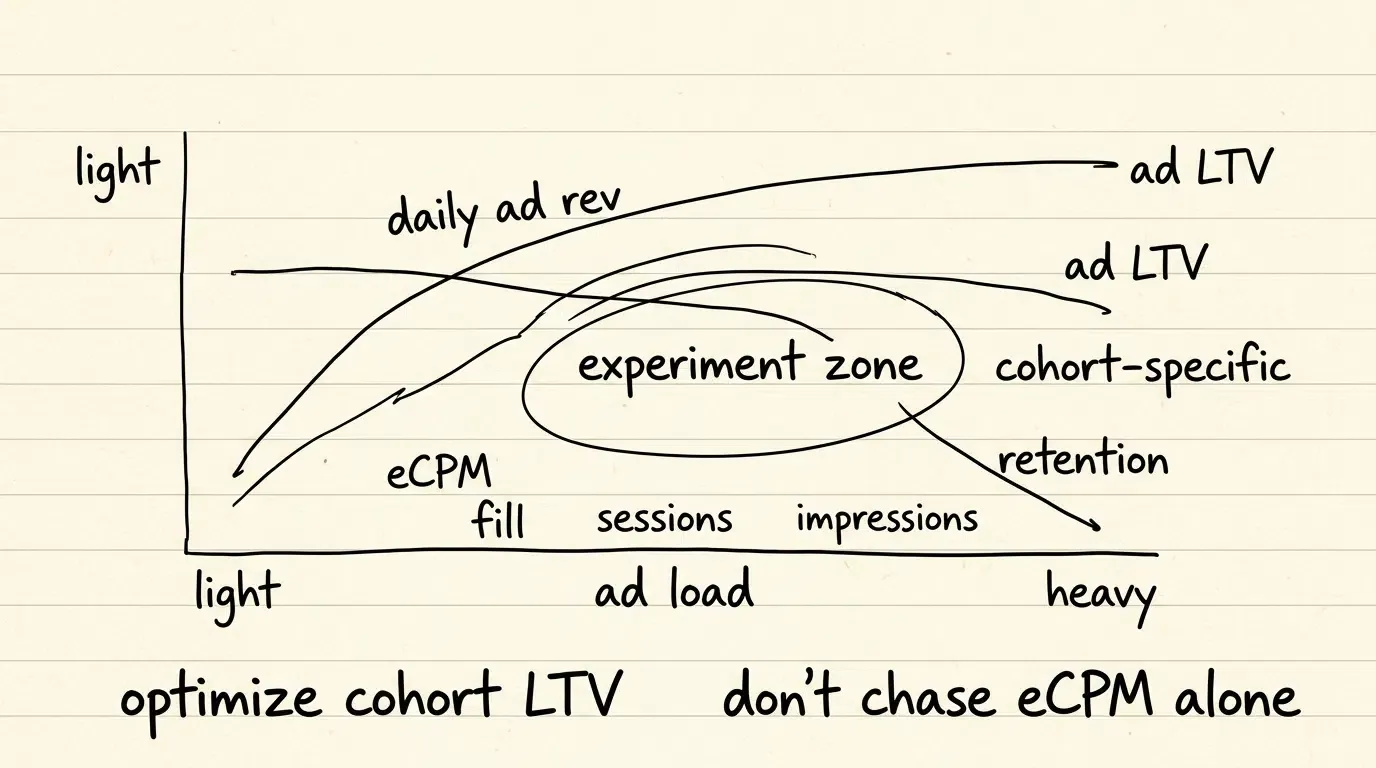
Expanding total ad revenue requires balancing impression volume and unit eCPM. However, these variables interact dynamically with player retention. Forcing excessive ad impressions within short intervals degrades player engagement, accelerating churn and reducing the total active sessions during which a player can be monetized. Optimizing an ad monetization stack requires maximizing average advertising revenue per active player across a cohort’s lifespan rather than pursuing isolated short-term eCPM spikes.
How to Select and Deploy the Optimal Ad Formats for Casual Gameplay
Rewarded Video: Preserving Player Agency by Exchanging Attention for Progression Boosts
Rewarded video is often a high-value ad format in mobile gaming because users explicitly choose to engage. A rewarded placement is strictly opt-in: players actively choose to watch a full-screen video ad in exchange for high-utility in-game rewards, such as extra lives, currency multipliers, score boosters, or continuous revives.
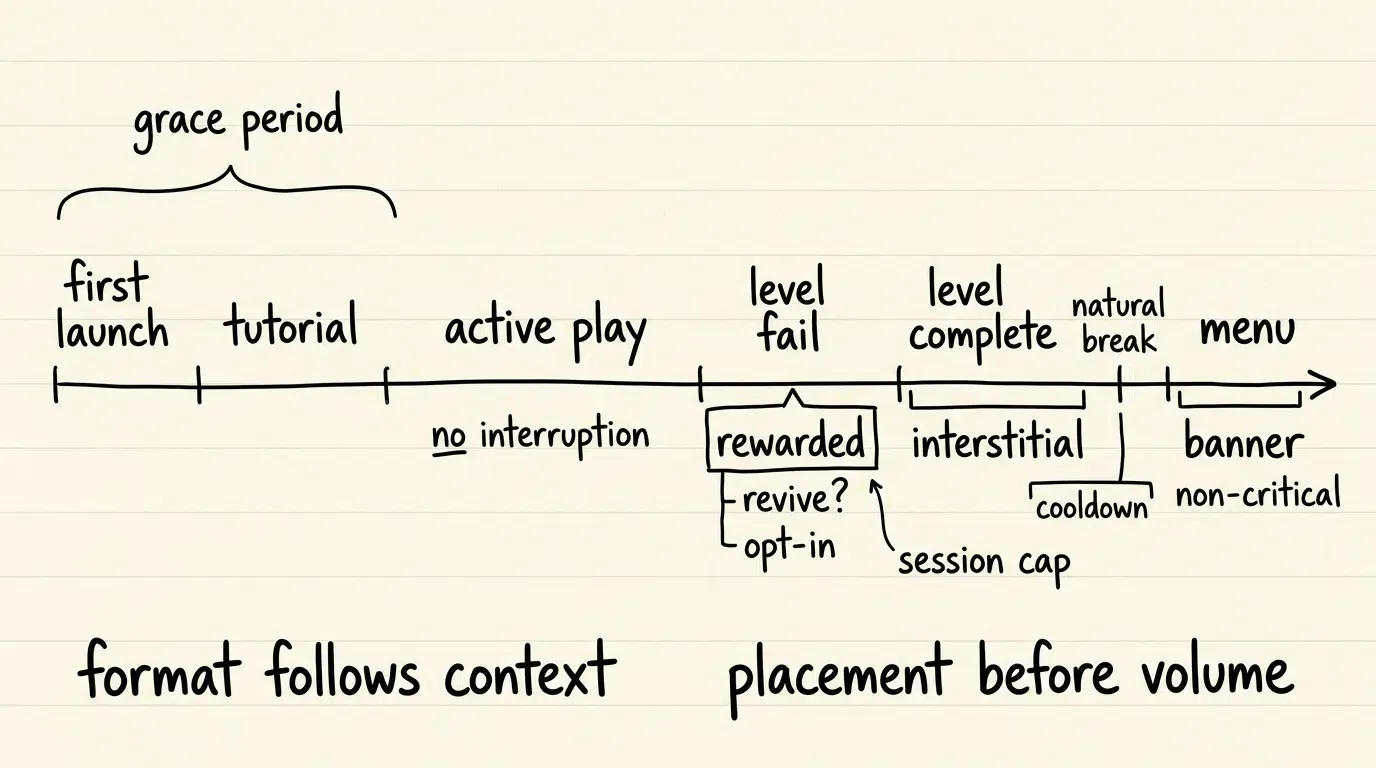
Because rewarded video is user-initiated, it preserves player agency and does not interrupt active gameplay. Advertisers frequently place high commercial value on rewarded video due to high user intent and completed-view opportunities, which can support strong eCPM performance in many implementations. In casual and hyper-casual design, rewarded placements should be positioned at moments of acute player motivation—such as immediately following a narrow level failure—to maximize opt-in engagement without creating gameplay friction.
Interstitial Ads: Monetizing Natural Cognitive Breaks Between Game Sessions
Interstitial ads are full-screen static, video, or playable ads that appear at natural transitions in the game flow, such as between completed levels, after stage failures, or upon returning to a main menu. Unlike rewarded video, interstitials are system-initiated and do not provide an in-game reward.
Because interstitials interrupt the player, their implementation requires strict technical governance:
- Cognitive Break Alignment: Interstitials must only display when a clear task or gameplay segment has concluded. Displaying unexpected interstitial ads during active gameplay or during level loading violates platform store policies (such as Google Play Better Ads guidelines) and causes acute player churn.
- Dismissal and Close Controls: Providing clear, standard close controls aligned with platform ad-experience policies ensures that players are not trapped in non-dismissible loops.
- Frequency Governance: Testing and enforcing placement cooldowns and session caps protects player retention from ad fatigue.
Banner and Native Ads: Capturing Baseline Yield During Non-Critical Game Screens
Banner ads are rectangular display units anchored to the top or bottom of the screen, or integrated as Medium Rectangle (MREC) units within menu views. Native ads match the visual style of the application, rendering within UI feeds or level selection menus.
While banner ads command lower eCPMs than full-screen video formats, they generate consistent background yield because impressions refresh automatically at platform-configured or optimized intervals while the player remains on a screen. In casual games, banners should be reserved for static menus, pause screens, or level-end evaluation views. Banners must never overlap active touch zones or obscure critical gameplay elements, as accidental clicks trigger high bounce rates and ad network policy penalties.
Format Sequencing: Establishing Complementary Ad Flows Across Early Player Sessions
Maximizing player lifetime value requires sequencing ad formats thoughtfully throughout the player journey:
- Onboarding Grace Periods: Consider suppressing unprompted interstitial ads during a player’s initial onboarding sessions, allowing players to experience the core game loop and develop mechanical attachment before introducing commercial friction.
- Early Rewarded Introduction: Introduce rewarded video as the initial monetization format. Players who experience the benefit of rewarded bonuses become acclimated to ad engagement without feeling interrupted.
- Paced Interstitial Cadence: Introduce paced interstitials between level completions only after the onboarding grace period concludes, enforcing cooldown buffers to prevent back-to-back ad exposure.
The Mechanics of In-App Bidding versus Mediation Waterfalls
Legacy Waterfall Mediation: Historical CPM Prioritization, Latency Overhead, and Revenue Leakage
Historically, mobile ad mediation operated via sequential client-side waterfalls. In a traditional waterfall, the publisher manually ranked participating ad networks based on historical average CPMs. When an ad request occurred, the mediation SDK queried the top-ranked network. If that network declined to fill the impression, the SDK called the second-ranked network, continuing down the daisy chain until an ad filled.
Legacy waterfalls introduced severe operational and commercial inefficiencies:
- Revenue Leakage: An ad network positioned lower in the waterfall might have had a real-time buyer willing to pay a high clearing price for a specific user. However, if a higher-tier network accepted the impression for a lower historical floor, the publisher lost the higher bid, sacrificing revenue.
- Sequential Latency: Sequential network calls introduced noticeable delays. In casual games, where ad load speed dictates whether an ad renders before the player navigates away, waterfall latency caused missed impressions and empty ad slots.
- Operational Overhead: Ad monetization managers spent hours weekly manually adjusting geographic price floors across dozens of ad network dashboards.
Real-Time Programmatic In-App Bidding: Simultaneous Auctions and Unified Yield Optimization
In-app bidding replaces sequential waterfalls with real-time, simultaneous programmatic auctions, mirroring header bidding architectures in web publishing.
When an ad placement triggers:
- Bid Solicitation: The mediation SDK sends a concurrent request to all participating demand partners and programmatic bidders simultaneously.
- Real-Time Valuation: Each demand partner evaluates user device context, placement type, and geographic parameters in real time, submitting its programmatic bid within the mediation platform’s configured auction timeout.
- Unified Clearing: The mediation engine compares all submitted bids simultaneously, identifying the winning bidder to render the impression.
In-app bidding reduces reliance on historical average eCPM ranking, exposes more impression-level real-time competition, and can reduce sequential-call latency relative to deep waterfalls.
The Modern Hybrid Mediation Stack: Combining Real-Time Bidders with Traditional Backfill Lines
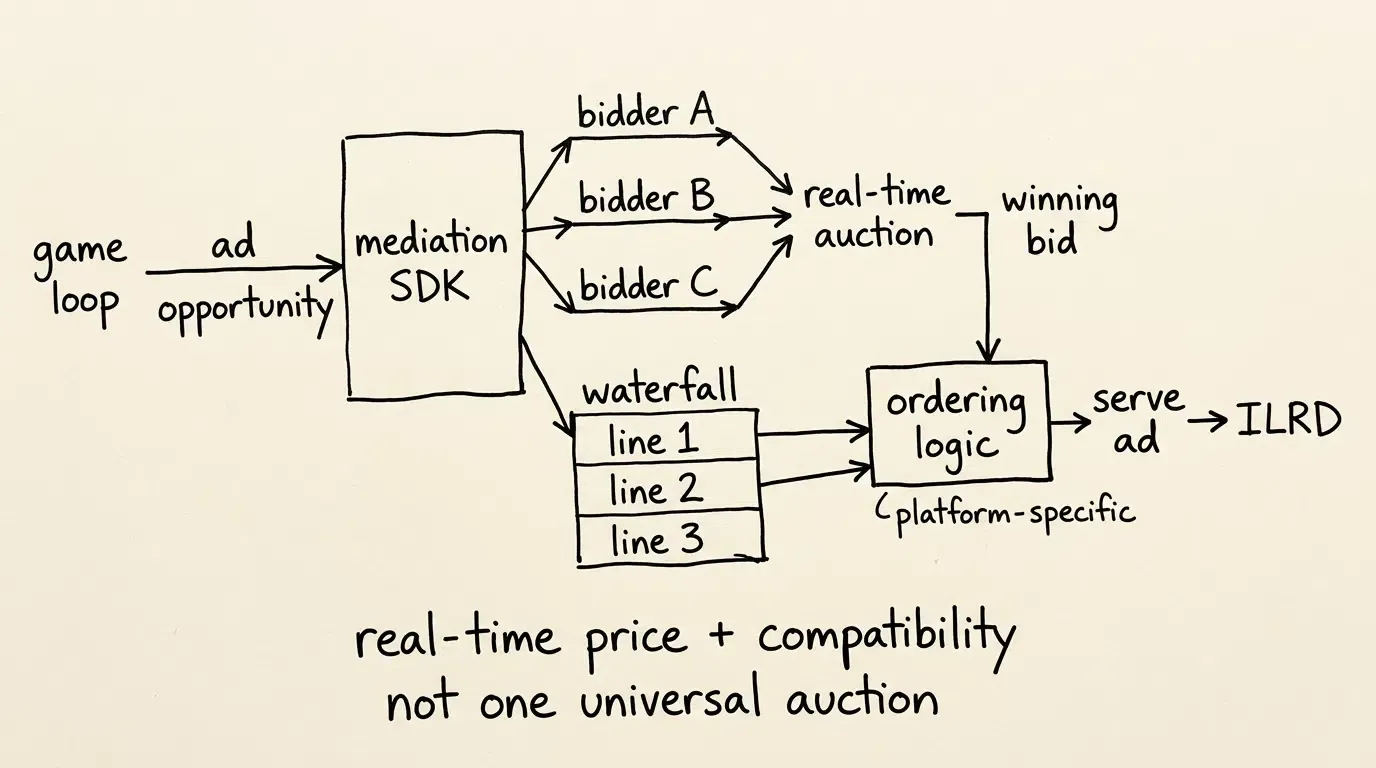
In production environments, hybrid mediation combines real-time bidding sources with waterfall sources, but the exact ordering depends on the mediation platform. In Google AdMob, for example, bidding sources first participate in a real-time auction. The winning bidding source is then inserted into the mediation waterfall according to its eCPM value, where higher-ranked waterfall sources may still receive an earlier opportunity to serve.
Therefore, hybrid mediation should be modeled as a platform-specific combination of real-time price discovery and waterfall compatibility rather than as a single global highest-bid-wins auction.
Hybrid Ad Mediation Request and Ordering Flow:

[Ad Opportunity Triggered in Game Loop]
                 │
                 ▼
  [Mediation SDK Solicits Real-Time Bids]
                 │
                 ▼
  [Bidding Auction Selects Winning Bid with eCPM Value]
                 │
                 ▼
  [Winning Bid Inserted into Mediation Waterfall Ranking]
                 │
     ┌───────────┴──────────────────────────┐
     ▼                                      ▼
[Higher-Ranked Waterfall Source]   [Winning Real-Time Bidder]
(Evaluated first if its eCPM        (Serves if higher-ranked
 value ranks above the bid)          waterfall sources do not fill)
     │                                      │
     └───────────┬──────────────────────────┘
                 ▼
     [Ad Rendered to Player] ──► [Provisional ILRD Telemetry Logged]
How to Balance Ad Frequency Against Player Retention Decay
Marginal Ad Yield Dynamics Across Session Depth
A common misconception in casual game publishing is that doubling ad impressions per session automatically doubles ad revenue. In practice, incremental ad impressions may exhibit diminishing marginal returns, depending on demand, placement, user response, and session context.
Modern bidding and mediation systems price each impression dynamically, so studios should measure impression-level revenue, fill, engagement, and retention by session ad depth rather than assume a fixed decay curve. In some player cohorts, ad engagement rates decline as session ad depth increases; players become less responsive to repeated interstitials or dismiss them rapidly, which can correlate with reduced engagement or lower average cleared bids over extended sessions.
The Retention-Ad Load Trade-Off: Quantifying Churn Elasticity Across Session Depth
The true cost of an ad impression is not zero; it carries an implicit cost measured in potential player attrition. Retention elasticity to ad load (
Illustrative scenario: If increasing average daily interstitial views from 2 to 5 generates an immediate ad revenue gain of $0.04 per active user, but accelerates Day 7 retention drop-off from 18% to 9%, overall cohort LTV declines. The short-term ad revenue gained in early sessions fails to compensate for the lost long-term impressions, rewarded ad views, and organic referrals of players who churned prematurely.
Enforcing Frequency Capping, Pacing Intervals, and First-Session Grace Periods
To stabilize retention while capturing strong ad yield, studios implement disciplined ad pacing controls:
- Dynamic Pacing Intervals: Test minimum active gameplay buffers between unprompted interstitial ads (e.g., evaluating cooldown periods between interstitials) to avoid disrupting continuous play sessions.
- Session Frequency Caps: Test capping the maximum number of forced interstitials displayed within a single session against engagement outcomes.
- Onboarding Grace Periods: Test suppressing unprompted interstitial ads until a new user completes initial onboarding or advances past a defined progression checkpoint, ensuring player engagement is established before commercial interruption.
Evaluating the Impact of Interruptive Ads on Day 1 and Day 7 Retention
Displaying unexpected or non-dismissible full-screen ads during active gameplay creates acute player friction and can violate platform ad-experience policies (such as Google Play Disruptive Ads standards). Unexpected early-session full-screen interruptions can increase user friction and should be tested against session termination, Day 1 retention, and downstream advertising LTV. Studios should prioritize skippable formats with clear platform-standard dismissal controls and use extended video formats conservatively, preferring explicit opt-in rewarded placements when extended viewing time is required.
Technical Framework for Mediation Integration and Impression Tracking
Integrating Lightweight Mediation SDKs: Minimizing Binary Overhead and Cold Start Latency
Casual and hyper-casual players exhibit high sensitivity to app download sizes and cold-start loading latency. If integrating an ad mediation stack inflates client binary size or introduces main-thread stalls during application launch, conversion rates from store page to first session can drop.
Engineering teams must prioritize lightweight SDK architectures:
- Modular Adapter Selection: Import mediation adapters only for ad networks that deliver verified fill and yield in target geographic markets, avoiding bloated client packages containing unused network binaries.
- Threading Governance: Follow each mediation SDK’s documented initialization threading requirements and ensure initialization does not introduce avoidable main-thread blocking during game engine boot.
- ProGuard and Obfuscation Rules: Configure code-shrinking rules carefully to protect mediation reflection adapters while stripping unused third-party dependencies.
Developers can reference current SDK integration resources for implementation guidelines on lightweight telemetry capture.
Ingesting Impression-Level Ad Revenue for Real-Time ROAS Reconciliation
Evaluating user acquisition profitability requires tracking ad revenue at the individual impression level. Historically, studios relied on aggregate daily network reports, dividing total ad earnings by total DAU to estimate a blended average revenue per user. This aggregate approach blinded UA teams to channel-specific profitability.
Impression-Level Ad Revenue (ILRD) provides a revenue value for individual impressions together with source-specific precision metadata. The value may be a provider-reported precise paid value (precise), an estimated value based on historical data, a publisher-provided value, or another provider-specific precision state depending on the winning demand source and mediation platform. Real-time impression values should therefore be treated as reported or provisional monetization telemetry until reconciled against finalized network reporting.
By capturing ILRD telemetry and passing attribution parameters via client SDKs, game backends link ad revenue directly to the marketing partner, campaign, and creative that acquired the user.
Teams can consult current cheating monitoring documentation for technical interfaces and telemetry configuration controls.
Structuring the Impression-Level Ad Revenue Telemetry Record
To maintain consistent economic telemetry across analytical pipelines, ingestion gateways structure impression events using standardized schemas.
The schema placeholder below illustrates a provisional ILRD telemetry record capturing mediation auction metadata, ad format details, reported revenue precision, and player attribution tags:
{
  "reference_architecture": true,
  "illustrative_values": true,
  "ad_monetization_impression_record": {
    "telemetry_metadata": {
      "impression_event_id": "imp_ev_2026_0915_7741",
      "timestamp_utc": "2026-09-15T09:20:00.120Z",
      "app_id": "com.example.casual.runner",
      "player_account_id": "usr_77182901",
      "session_id": "sess_8829_beta_01"
    },
    "attribution_context": {
      "acquisition_channel": "partner_ad_network_video",
      "campaign_id": "cmp_casual_runner_scale",
      "creative_id": "cr_gameplay_30s",
      "country_iso": "USA"
    },
    "ad_mediation_telemetry": {
      "mediation_platform": "hybrid_mediation_engine",
      "auction_type": "hybrid_bidding_and_waterfall",
      "winning_ad_network": "network_alpha_bidding",
      "ad_format": "interstitial_video",
      "ad_placement_id": "plm_level_complete_break",
      "session_ad_depth_count": 2
    },
    "revenue_telemetry": {
      "revenue_status": "provisional_impression_value",
      "revenue_value_status": "present",
      "revenue_precision_provider": "admob",
      "source_revenue_precision": "precise",
      "normalized_revenue_confidence": "high_confidence",
      "reported_impression_revenue_usd": 0.0245,
      "currency": "USD",
      "derived_ecpm_equivalent_usd": 24.50,
      "reconciliation_status": "pending_finalized_network_reporting"
    },
    "frequency_and_pacing_state": {
      "active_gameplay_cooldown_seconds": "<configured_cooldown_seconds>",
      "session_interstitial_cap_limit": "<configured_session_cap>",
      "session_interstitial_count_current": 2,
      "onboarding_grace_period_status": "completed"
    },
    "audit_disposition": {
      "duplicate_impression_check": "passed",
      "attribution_reconciliation_status": "linked_to_acquisition_cohort",
      "ad_roas_pipeline_forwarded": true
    }
  }
}
Reconciling Mediation Impression Callbacks with Attribution Channel Context
Achieving true economic visibility requires reconciling client-reported impression callbacks with server-side mediation logs and attribution pipelines:
- Deduplication Filtering: Ingestion gateways validate unique impression identifiers to filter out duplicate impression pings caused by network retries or client reconnects.
- Revenue Precision Tagging: Ad revenue callbacks should preserve the provider’s native precision state—for example, a provider-reported precise paid value, an estimate derived from historical data, a publisher-provided value, or another provider-specific precision category. These provisional values should be reconciled against finalized network reporting before they are treated as final publisher revenue.
- Channel-Level Ad-ROAS: Reconciled impression revenue feeds back into user acquisition dashboards, enabling performance marketers to evaluate Cost-Per-Install bids against verified advertising LTV rather than relying on unsegmented cohort averages.
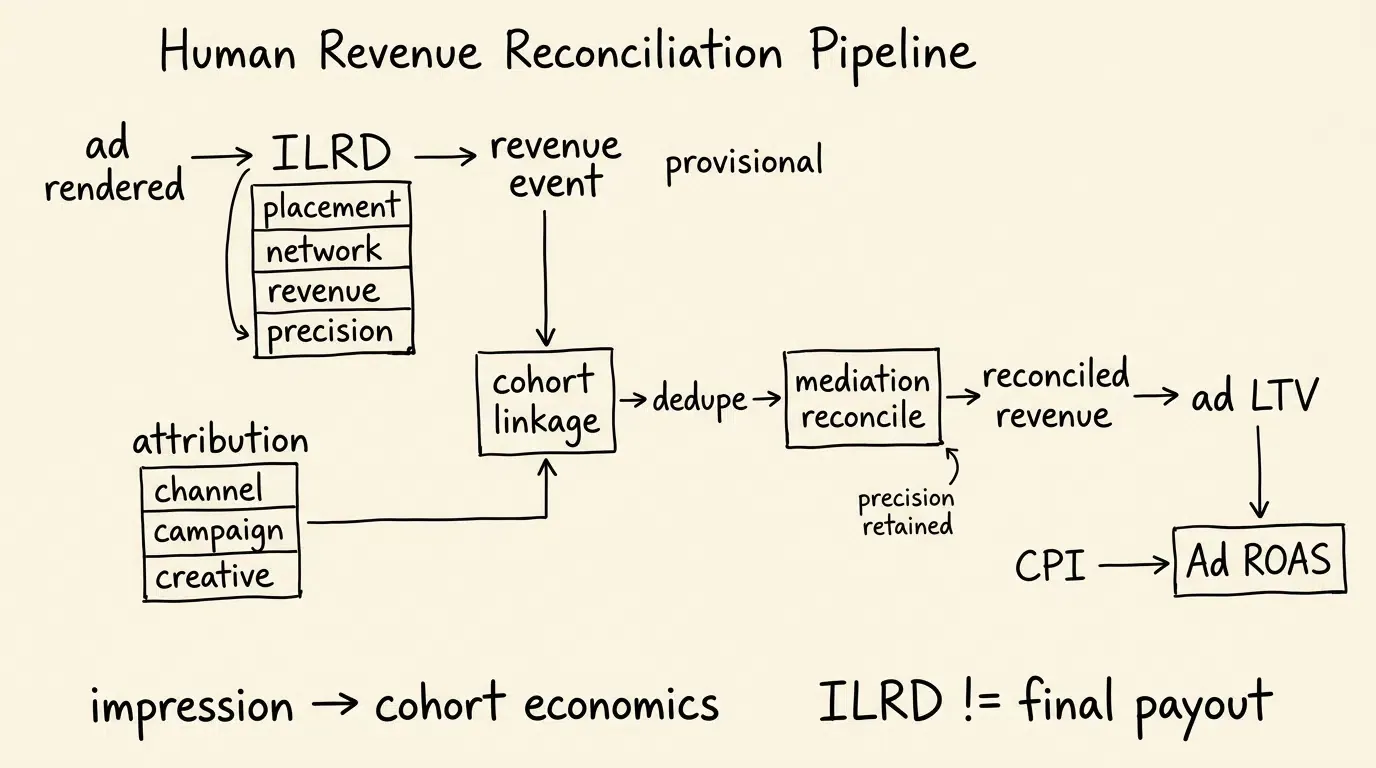
Comparative Analysis of Ad Monetization Mediation Models
Evaluating Setup Complexity, Technical Latency, and Revenue Efficiency Across Mediation Approaches
Selecting the appropriate mediation architecture requires balancing engineering implementation overhead against auction efficiency and revenue yield.
The table below contrasts primary mobile ad mediation models:
| Architecture | Pricing Input | Latency Characteristic | Main Operational Trade-Off |
|---|---|---|---|
| Traditional Waterfall | Historical/manual average eCPM | Sequential calls may add latency | Broad compatibility, but less real-time price competition |
| Pure In-App Bidding | Impression-level real-time bids | Parallel auction, platform-dependent latency | Better real-time competition, but requires full bidder adapter support |
| Hybrid Mediation | Real-time bidding plus waterfall ranking | Mixed latency profile | Combines bidding competition with waterfall compatibility, but adds setup complexity |
Analyzing the Strategic Shift to Unified Auctions
Pure manual waterfalls are less attractive where broad bidding support is available, but waterfall sources remain relevant for unsupported demand partners, regional coverage, custom events, and hybrid mediation configurations. The appropriate mix depends on bidder coverage, regional demand, format support, operational complexity, and measured revenue and fill performance.
When Should Casual Game Developers Introduce Non-Ad Revenue Streams
Suitable Conditions for Incorporating In-App Purchases
While many traditional hyper-casual titles have relied predominantly on ad monetization, casual and hybrid-casual games should evaluate introducing direct microtransactions under specific commercial conditions:
- Stable Day 7 and Day 30 Retention: Titles demonstrating durable engagement curves where a meaningful percentage of players continue playing past the first week.
- Deep Core Progression Systems: Games featuring progression mechanics, character upgrades, persistent base building, or cosmetic collections that provide natural sinks for direct spending.
- Escalating User Acquisition Costs: Publishing environments where rising CPI rates make it difficult to achieve payback strictly through ad impressions, requiring high-value IAP purchases to lift total LTV.
- Live-Ops Infrastructure: Studios equipped to manage seasonal events, limited-time shop bundles, and battle pass progression tracks.
Unsuitable Conditions for Direct Microtransactions
Introducing direct microtransactions introduces operational overhead that is unviable in specific production scenarios:
- Transient Hyper-Casual Prototypes: Minimalist games designed for short lifecycles and rapid market testing where development time spent building store economies exceeds potential returns.
- Games with Shallow Progression: Titles lacking content depth where purchasing items eliminates the game’s challenge, accelerating player boredom and churn.
Common Pitfalls in Casual Ad Monetization
- Pitfall 1: Unexpected Full-Screen Interruptions: Displaying unexpected or non-dismissible full-screen ads during active gameplay violates platform ad-experience policies and creates severe user friction.
- Pitfall 2: Omitting Impression-Level Ad Revenue Tracking: Relying solely on aggregate daily network reports blinds user acquisition teams to true channel-level ROAS, leading to misallocated marketing spend.
- Pitfall 3: Setting Excessive Waterfall Floor Prices: Overly aggressive eCPM floors can reduce fill when available demand does not clear the configured threshold, leaving inventory unmonetized.
Frequently Asked Questions (FAQ)
How do casual mobile games make money from ads?
What is the difference between ad mediation and an ad network?
How does impression-level ad revenue improve user acquisition ROAS?
Summary and Decision Framework
Setting up a scalable ad monetization stack in casual and hyper-casual games requires moving beyond single-network integrations toward unified hybrid mediation architectures. Maximizing commercial performance relies on implementing non-intrusive rewarded video, enforcing disciplined interstitial frequency caps, and tracking revenue at the impression level.
By balancing ad load against player retention decay and reconciling impression revenue with acquisition attribution, game developers can optimize eCPM yield, lower blended acquisition payback horizons, and achieve durable profitability.
To explore how mobile attribution and impression telemetry can power your casual game monetization strategy, consult the mobile attribution implementation reference.
Related Materials
-
Concepts: Ad Monetization, In-App Advertising, eCPM Optimization, Ad Mediation, Hybrid Waterfall, Rewarded Video
-
Technologies: Mobile Attribution SDK, Ad Mediation Engine, Impression-Level Ad Revenue (ILRD), In-App Bidding
-
Standards: IETF RFC 8259 JSON Data Interchange Format, W3C Mobile Web Best Practices, IAB Mobile In-App Advertising Standards
-
APIs: Google Mobile Ads SDK Mediation Interfaces, AdMob Impression-Level Ad Revenue API, Unity LevelPlay ILR API
-
Official Documentation & References:
Share this article