How to buy ads for mobile gaming campaigns? Buying ads for mobile gaming campaigns requires structuring bids around real-time downstream conversion postbacks delivered through supported measurement interfaces to prevent fraud and train auto-bidding algorithms.
Mobile gaming advertising is the buy-side performance marketing process of acquiring players through programmatic ad networks, Demand-Side Platforms (DSPs), and social media channels. Modern mobile ad buying relies on machine learning bidding models that adjust bids dynamically based on post-install conversion events, requiring reliable conversion feedback to optimize user acquisition spend toward high-LTV player cohorts.
| Term | Definition | Related Entity | Search Intent Role |
|---|---|---|---|
| Mobile Gaming Advertising | The buy-side performance UA strategies deployed to acquire mobile players. | Performance UA | Informational / Commercial |
| Performance Marketing | Data-driven ad buying where spend is optimized against measurable conversion goals. | Programmatic Bidding | Operational / Technical |
| Conversion Tracking | The measurement system connecting downstream revenue and events back to ad channels. | S2S Postback | Technical / Informational |
The Buy-Side Architecture of Programmatic Mobile Gaming Advertising
The Ecosystem Overview: Advertisers, Demand-Side Platforms, Ad Networks, and Supply Sources
The buy-side infrastructure of mobile gaming advertising operates as a multi-tiered performance marketing ecosystem. Game studios and performance marketing teams (Advertisers) deploy user acquisition budgets to acquire active players across global ad inventory.
To execute ad campaigns at scale, advertisers interface with three primary media channels:
- Self-Attributing Networks (SANs): Walled-garden ad platforms (such as Google Ads, Meta Ads, or TikTok for Business) that manage their own demand, inventory, and platform-specific conversion measurement.
- Demand-Side Platforms (DSPs): Independent programmatic buying platforms that allow advertisers to purchase ad impressions across multiple Supply-Side Platforms (SSPs) and ad exchanges via real-time bidding (RTB).
- In-App Ad Networks: Gaming-focused ad networks that aggregate SDK-based inventory directly from mobile publishers, specializing in video, playable, and rewarded ad formats.
The Shift from Manual Placement Buying to Programmatic Algorithmic Auctions
A large share of scalable mobile user acquisition is managed through automated auction and optimization systems, although buying mechanics vary substantially across SANs, ad networks, and open-web DSPs. Historically, mobile user acquisition relied on manual publisher negotiations, static placement buys, and fixed Cost-Per-Install (CPI) contracts.
Modern mobile gaming advertising relies heavily on automated programmatic auctions. Rather than bidding on static ad placements, ad networks deploy machine learning algorithms that evaluate individual impression opportunities in real time. These algorithms inspect user device context, geographic signals, publisher category, and historical engagement patterns to calculate the probability of a conversion. Bids are computed dynamically for every impression, shifting the practitioner’s role from manual placement management to algorithmic governance—configuring targets, managing learning phases, and feeding clean conversion signals back to auto-bidders.
The Role of an Independent Mobile Measurement Partner in Buy-Side Ad Operations
Buying ads for mobile gaming campaigns requires reliable conversion measurement and platform-compatible feedback signals. Depending on the platform, these signals may originate from first-party analytics, store integrations, a certified App Attribution Partner (AAP), an independent Mobile Measurement Partner (MMP), or supported server-to-server (S2S) event APIs.
An independent measurement platform provides an independent cross-channel measurement view, subject to attribution rules, consent state, platform-reported conversions, conversion windows, and modeled measurement, performing three key functions:
- De-Duplicated Attribution: Ingests touchpoint telemetry across participating ad networks, deduplicating eligible conversion claims according to the configured attribution methodology and applicable privacy constraints.
- Conversion Postback Routing: Ingests real-time client and server events (installs, registrations, purchases) and routes verified postback payloads back to originating ad networks.
- Cross-Channel Measurement: Aggregates media spend, install volume, and post-install revenue to calculate attribution-based campaign ROAS across participating channels.
See Also: Mobile Gaming Advertising ──> Performance UA Architecture
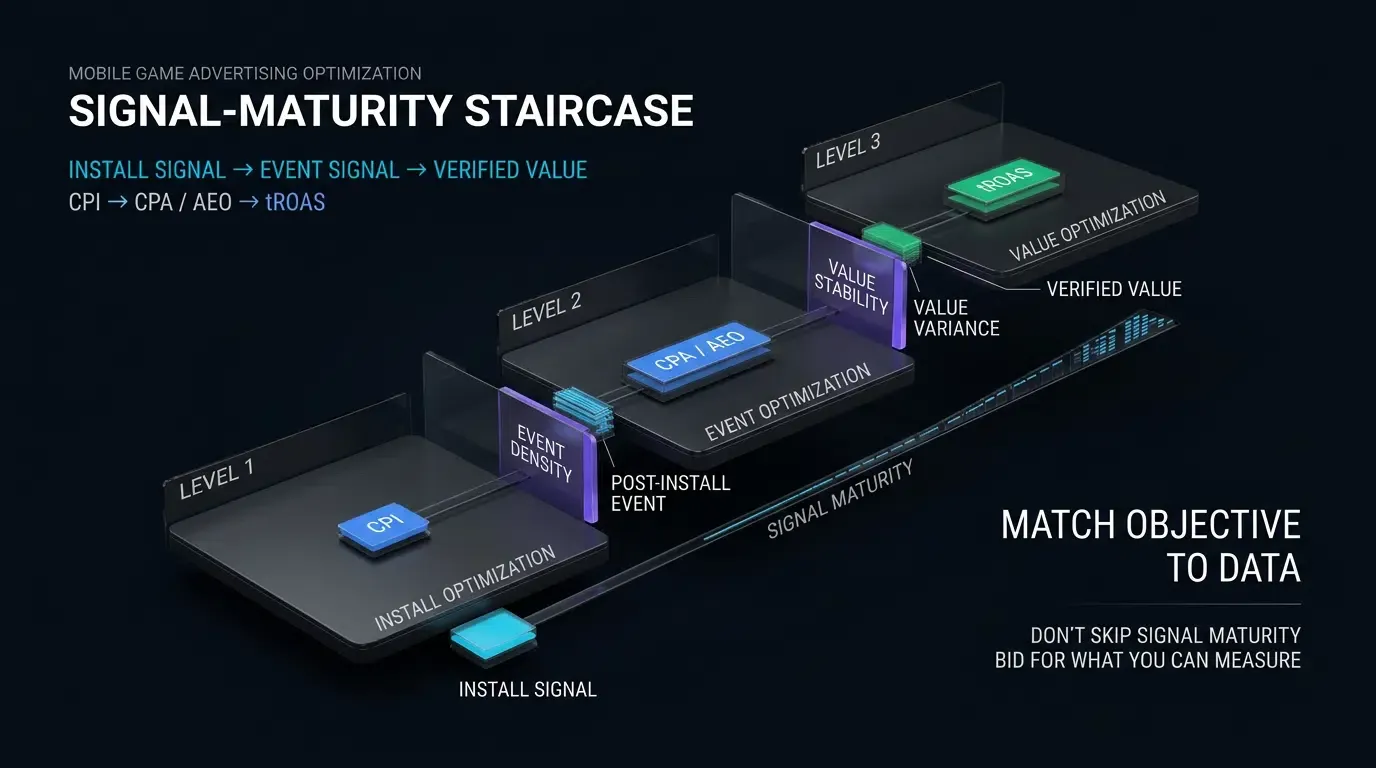
How Do Bidding Models Evolve Across Campaign Maturity Horizons
Stage 1: Fixed Cost-Per-Install ── Broad Audience Exploration and Cold-Start Baseline Ingestion
When launching a new campaign or introducing a new game concept, ad network machine learning models operate with limited campaign-specific conversion history for that specific application binary.
In an illustrative campaign maturity framework, UA teams often initiate acquisition using fixed Cost-Per-Install (CPI) or Cost-Per-Mille (CPM) bidding models:
- Operational Goal: Generate an initial volume of installs to establish baseline conversion data.
- Targeting Strategy: Broad demographic or interest-based targeting that allows the ad network algorithm to explore different publisher placements.
- Risk Profile: Higher risk of acquiring unmonetized volume; the algorithm cannot yet differentiate high-spending players from non-paying users.
Fixed CPI bidding serves as an exploratory phase. Once a campaign establishes sufficient conversion density, UA teams evaluate transitioning to event-optimized bidding models.
Stage 2: App Event Optimization ── Bidding for Mid-Funnel Engagement Milestones
Event-optimized acquisition (such as App Event Optimization or Target Cost-Per-Action bidding) shifts the optimization objective from the install event to a specific post-install milestone (e.g., tutorial_complete, reach_level_5, or account_registration). Event-optimized objectives and Target CPA bidding structures are platform-specific and should not be treated as universal synonyms across ad networks.
In an event-optimized campaign, the ad network algorithm evaluates impression opportunities based on the predicted probability
The ad network automatically bids higher for users who match the behavioral profile of players who historically complete that event, while lowering bids for users unlikely to progress past onboarding. Event optimization stabilizes acquisition quality, ensuring that paid spend acquires engaged players rather than passive downloads.
Stage 3: Target ROAS ── Scaling Spend Against High-Value Payer Cohorts
For games with deep virtual economies, mid-funnel event optimization is eventually augmented by Target ROAS (tROAS) or Value-Based Bidding. In a value-optimized campaign, the ad network algorithm optimizes bids directly against predicted monetary revenue over a designated time horizon rather than discrete event counts.
A useful internal valuation abstraction compares expected conversion value over the configured horizon with the target ROAS. Actual auction-time bid calculations remain platform-proprietary:
Where
Managing the Learning Phase: Avoiding Abrupt Bid and Budget Edits That Reset Algorithmic Models
Programmatic auto-bidders rely on statistical learning phases to calibrate their predictive models. Learning requirements and volume guidelines are platform- and strategy-specific. For example, Google Ads notes that App Campaign Target ROAS bidding operates most effectively when campaigns accumulate stable historical conversion value volume (such as meeting platform-recommended conversion thresholds over 30-day windows).
Large or frequent changes to budgets, targets, conversion definitions, or campaign structure can disrupt learning or create stabilization periods. Follow the active platform and campaign type’s current change-management guidance before making material edits. UA teams should apply incremental budget edits and allow sufficient stabilization time before evaluating performance.
Mathematical Formulations for Bidding and Budget Pacing
The Target CPA Bidding Formula: Max Bid Calculation Based on Conversion Probability
To evaluate whether a programmatic bid aligns with target unit economics, media buyers model bid valuation as a function of conversion probability and downstream event targets. The equations below represent economic reference valuations for internal planning; they do not reproduce the proprietary machine learning bidding algorithms used internally by Google, Meta, TikTok, or other platforms.
For an event-optimized campaign, the maximum allowable CPM bid (
Where:
is the maximum dollar value the advertiser is willing to pay for a completed in-game milestone. is the predicted Install Rate (CVR). is the predicted post-install event completion rate.
The Target ROAS Bidding Formula: Max Bid Calculation Based on Predicted Lifetime Value
For value-bidding campaigns, the impression valuation incorporates predicted conversion value over a specified time horizon (
Where:
is expressed as a target ratio (e.g., 1.25 for a 125% target). is the expected conversion or business value generated by the user through day .
Calculating Dynamic Bid Multipliers Based on Observed Channel Performance
When managing campaigns across sub-publishers or geographic tiers in systems where manual multiplier control is available, UA teams evaluate an illustrative internal bid multiplier (
Where:
is an illustrative damping factor (e.g., ) that prevents extreme bid oscillations caused by small sample sizes.
Automated Smart Bidding strategies on platforms like Google Ads manage bids dynamically at auction time and do not utilize manual multiplier formulas.
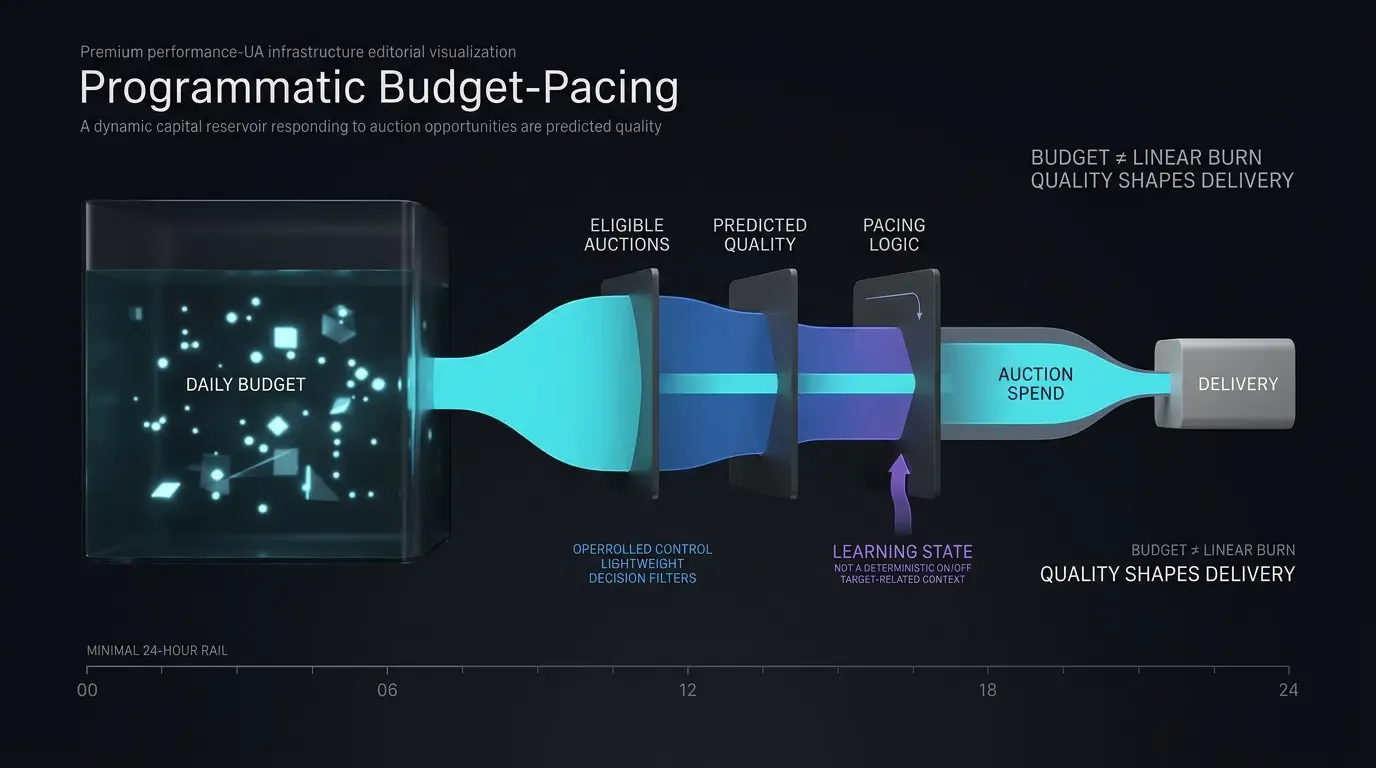
Budget Pacing Mechanics: Platform-Controlled Pacing and Delivery
Programmatic ad platforms distribute daily budgets dynamically according to real-time auction opportunities, overdelivery rules, and partner-specific pacing settings. Rather than assuming a rigid linear hourly burn rate, platforms adjust delivery velocity throughout the day based on impression opportunity volume and predicted user conversion quality.
Programmatic Budget Delivery Pipeline:
 Daily Budget
Expenditure ($)
|
| [Budget Delivery Varies with Eligible Auction Opportunities & Platform Logic]
| /─────────────────────────────────── (Budget Distributed Based on Auction Quality)
| /
|/ [Continuous Baseline Delivery]
|=========---------------------------------------------►
+------------------------------------------------------------>
00:00 06:00 12:00 18:00 24:00 (UTC Time)
How Do Real-Time S2S Feedback Loops Train Programmatic Auto-Bidders
The Machine Learning Engine: How Ad Networks Train Lookalike Models on Postback Signals
Programmatic auto-bidders rely on continuous telemetry feedback loops to optimize campaign performance.
When a player completes an in-game milestone or purchase, the attribution platform or game backend transmits a conversion signal to the ad network’s supported integration endpoint. The ad network’s machine learning engine ingests this conversion signal, processes the user’s contextual profile according to privacy and consent rules, and updates its predictive targeting models over time.
The Risk of Unverified Signal Ingestion: How Spoofed Payloads Pollute Bidding Algorithms
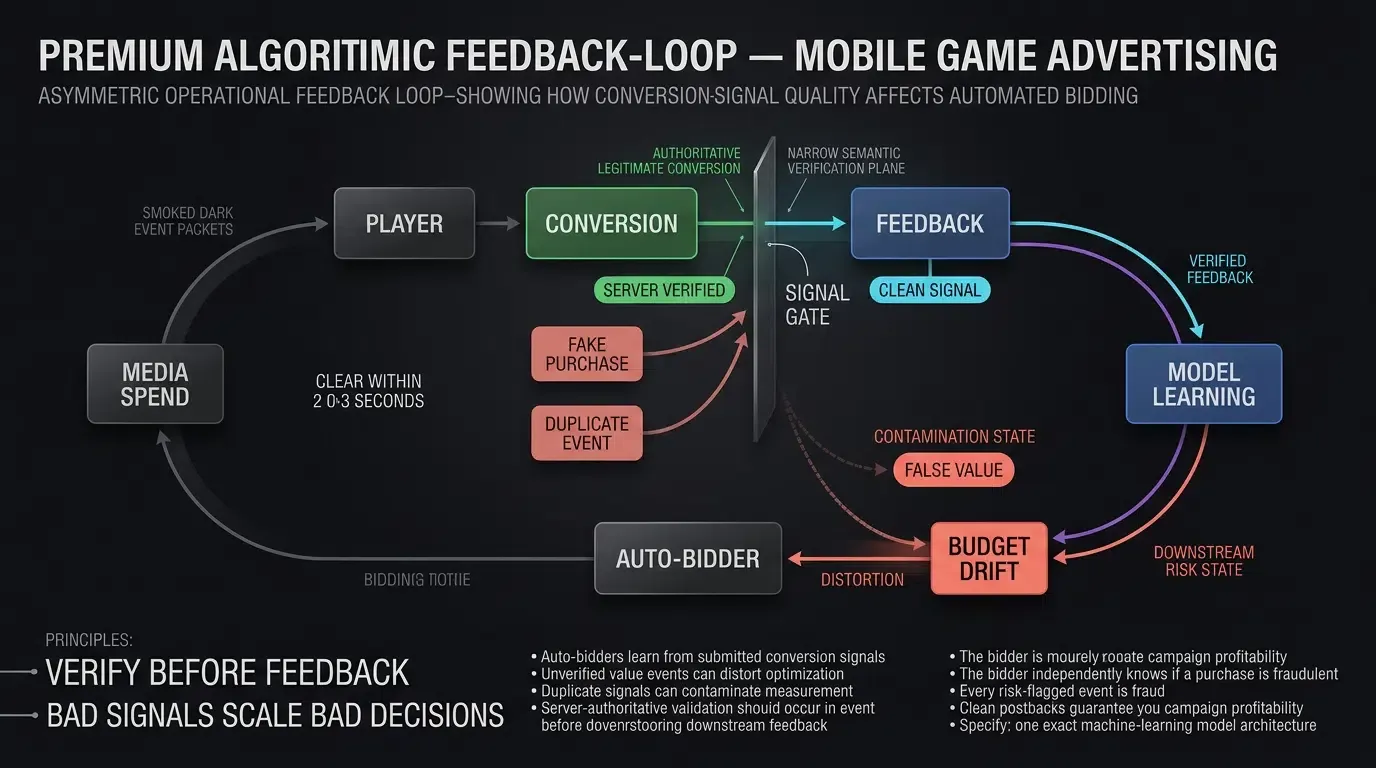
The operational efficiency of machine learning auto-bidders depends entirely on data quality—a principle summarized as “garbage in, garbage out.”
If an advertiser forwards unverified client-side conversion pings directly to ad networks without server-authoritative validation, malicious actors can exploit the feedback loop. For example, billing emulators or bot farms can generate fake purchase events. If these fake conversions are reported as real revenue to an ad network’s value bidder, the machine learning algorithm interprets the fraudulent placement as a high-value channel. The auto-bidder responds by allocating more advertising budget to the fraudulent publisher, creating a destructive feedback loop that drains marketing capital.
Suppressing Fraudulent and Unverified Conversions to Protect Bidding Signal Purity
To protect machine learning bidding algorithms from data pollution, attribution architectures enforce strict pre-postback validation gates:
[Ad Network / DSP Serves Impression]
                 │
                 ▼
[User Installs & Completes In-Game Conversion Event]
                 │
                 ▼
[Game Server Validates Transaction / Milestone]
                 │
                 ▼
[OpoInstall Ingests & Evaluates Conversion Telemetry]
                 │
     ┌───────────┴───────────────────────────┐
     ▼                                       ▼
[Valid Event Confirmed]             [Unverified / Risk-Flagged Event]
     │                                       │
     ▼                                       ▼
[Dispatch Postback to Partner API]   [Suppress Outbound Postback]
     │                               (Prevents Algorithm Pollution)
     ▼
[Partner Ingestion & Optimization Pipeline]
These controls reduce the risk that unverified, duplicate, or high-risk events contaminate downstream optimization signals; final measurement and optimization eligibility remains partner-specific.
Technical Framework for S2S Conversion Feedback and Bidder Telemetry
Ingesting Real-Time Postback Signals for Downstream Ad Network Integration
S2S conversion feedback requires structured integration between the game server, the attribution platform, and ad network conversion APIs.
When an in-app milestone occurs, the game backend dispatches a server event to the attribution engine. Partner feedback paths are platform-specific:
- Google Ads: App Campaign Target ROAS has specific supported conversion-source requirements. Eligible Firebase or Google Play codeless app conversions should be treated separately from generic Google Ads API conversion uploads, which should not automatically be assumed to qualify as biddable App Campaign conversion sources. Treat reporting uploads and biddable app-conversion sources as distinct capabilities.
- Meta, TikTok, and Other Partners: Expose their own app-event, conversion, or MMP integration paths (such as Meta Conversions API or TikTok Events API for App), accepting native transaction amounts, ISO currency codes, and event identifiers corresponding to purchases.
Developers seeking technical specifications for event logging structures and data warehouse integration can consult current raw data export documentation for payload formats and ingestion guidelines.
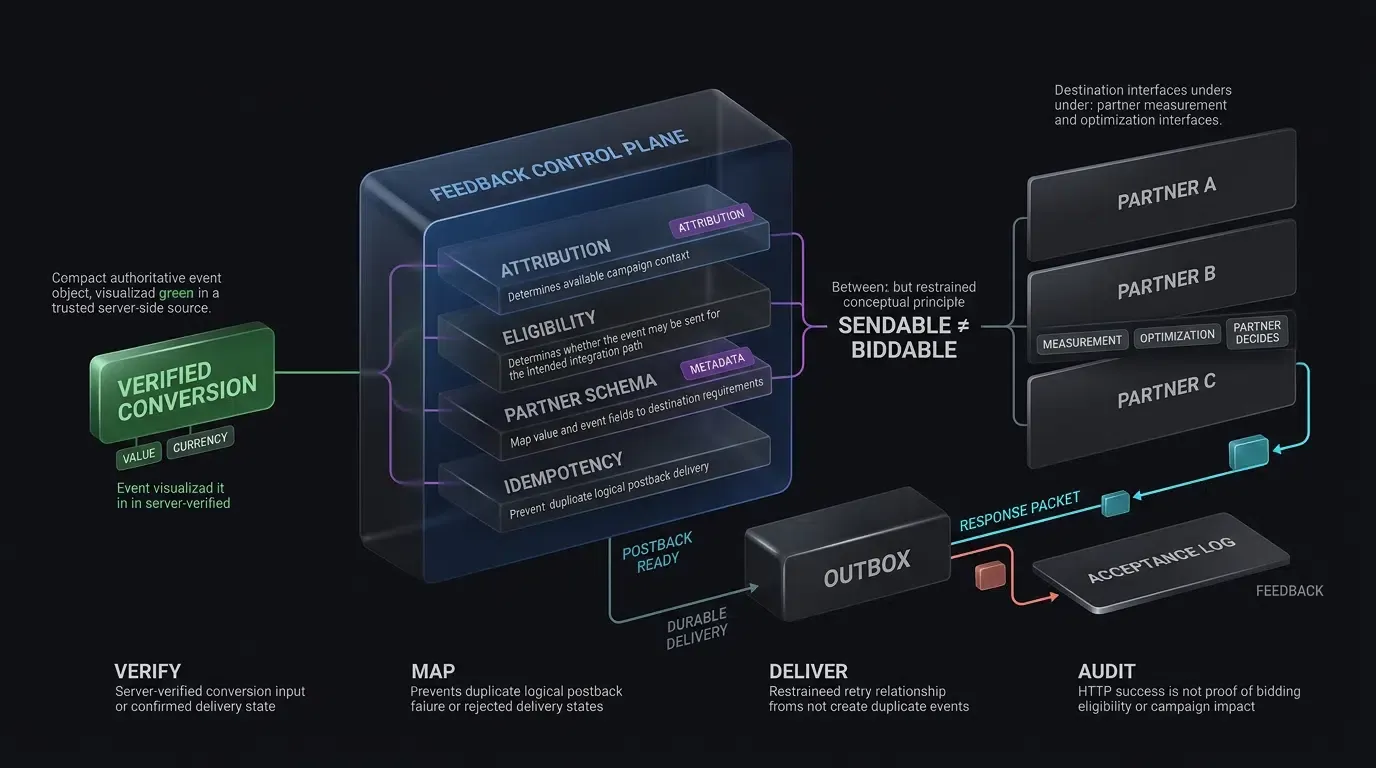
Configuring Value Mapping and Currency Normalization for Value Bidders
When transmitting postbacks to value-bidding models, monetary values must be formatted according to the destination platform’s schema requirements, typically transmitting native currency values alongside ISO 4217 currency codes.
Ad networks parse these currency payloads to calculate campaign conversion value. If a game operates in multi-currency environments, transmitting un-normalized amounts without currency codes (e.g., reporting 500 Japanese Yen as $500.00 USD) causes severe bid inflation.
For engineering teams evaluating SDK integration controls and telemetry collection modules, consult the SDK integration resources for implementation guidelines.
Structuring the Programmatic Bidding Postback and Feedback Record
To maintain auditability across outbound bidder integrations, attribution gateways log postback dispatches using standardized schemas. Client-reported monetary values are diagnostic only; outbound conversion value must be derived from server-authoritative transaction state or another trusted value source.
The schema placeholder below illustrates an S2S postback verification payload capturing campaign identifiers, normalized transaction values, ad network dispatch states, and idempotency keys:
{
  "reference_architecture": true,
  "illustrative_values": true,
  "programmatic_bidding_postback_record": {
    "telemetry_metadata": {
      "postback_event_id": "pb_ev_2026_0917_3301",
      "timestamp_utc": "2026-09-17T06:10:00.120Z",
      "app_id": "com.example.game.strategy",
      "player_account_id": "usr_88291042"
    },
    "client_telemetry_request": {
      "account_id": "usr_88291042",
      "session_id": "sess_9981_beta",
      "client_event_name": "iap_purchase",
      "client_reported_value_minor": 1999,
      "currency": "USD"
    },
    "server_authoritative_verification": {
      "purchase_verification_status": "server_verified_transaction",
      "authoritative_amount_minor": 1999,
      "authoritative_currency": "USD",
      "value_basis": "gross_customer_purchase_value",
      "backend_transaction_reference": "iap_evt_2026_0917_0042",
      "server_validation_source": "Google_Play_Developer_API_Productsv2"
    },
    "attribution_resolution_context": {
      "acquisition_channel": "google_ads",
      "campaign_id": "cmp_troas_us_scale_v2",
      "ad_group_id": "ag_strategy_rpg_us",
      "creative_id": "cr_cinematic_battle_01",
      "attribution_resolution_status": "resolved_deterministic"
    },
    "partner_delivery": {
      "integration_type": "direct_events_api",
      "partner_supported_interface": "events_api_v2",
      "partner_native_currency": "USD",
      "partner_native_amount": 19.99,
      "transport_status": "http_success",
      "partner_measurement_acceptance": "accepted_for_measurement",
      "local_feedback_eligibility": "eligible_to_send",
      "partner_optimization_eligibility": "partner_determined"
    },
    "outbound_postback_dispatch": {
      "idempotency_key": "pb:iap_evt_2026_0917_0042:partner_conversion_api:purchase",
      "dispatch_attempt_count": 1,
      "http_transport_status": 200,
      "durable_outbox_state": "committed"
    },
    "signal_integrity_governance": {
      "fraud_suppression_check": "passed",
      "duplicate_suppression_check": "passed",
      "bidding_algorithm_pollution_risk": "low_verified_signal"
    }
  }
}
Managing Postback Retry Policies and Idempotency Control
To ensure reliable delivery without duplicate signal injection, attribution postback dispatchers enforce robust transport governance:
- Canonical Idempotency Keys: Generate deterministic idempotency keys derived from the unique transaction ID, destination partner ID, and event type.
- Durable Outbox Queuing: Persist outbound postback requests in transactional outbox queues before execution.
- Exponential Backoff with Jitter: If an ad network API endpoint returns a transient 5xx error or times out, the outbox worker retries delivery using exponential backoff to avoid API rate limits.
- Partner Response Tracking: Log HTTP transport status codes, attempt counters, and partner transaction references to maintain an immutable audit trail of all outbound postback transmissions.
Comparative Analysis of Core Programmatic Bidding Strategies
Evaluating Capital Requirements, Learning Deadlines, and Data Density Across Bidding Models
Selecting the optimal bidding strategy depends on campaign maturity, daily conversion volume, and available marketing capital.
The table below contrasts primary programmatic bidding strategies across performance UA operations:
| Bidding Strategy | Primary Optimization Objective | Data Density Requirement | Best Suited Lifecycle Stage | Primary Operational Risk |
|---|---|---|---|---|
| CPM / Impression Buying | Impression delivery and reach | Low (Basic impression signal) | Brand awareness & broad reach | Disconnect between impression cost and actual conversion |
| Target CPI / Install Optimization | Acquiring install conversions around target | Low to Moderate (Basic install signal) | Soft launch & early-stage scaling | Risk of acquiring unmonetized volume |
| Target CPA (AEO) | Maximizing specific event completions | Platform-specific event density | Mid-stage scaling | Over-indexing on low-value event grinders |
| Target ROAS (tROAS) | Maximizing total conversion value return | Platform-specific conversion volume | Mature live-ops scaling | Cold-start bidding failure on low-volume campaigns |
Matching Game Genres and Economy Depth to Optimal Bidding Taxonomy
Target CPI bidding can be appropriate for casual titles with uniform, short-tail monetization where install volume correlates directly with ad revenue. Target CPA bidding excels in mid-core games where specific progression milestones (e.g., reaching Level 10 or joining a guild) serve as strong proxies for long-term retention. Target ROAS bidding can be appropriate for titles with sufficiently dense, reliable value signals and meaningful user-value variance.
When Should UA Teams Transition from Fixed CPI to Value-Based Bidding
Suitable Conditions for Activating Target ROAS Bidding
Performance UA teams should evaluate transitioning from fixed CPI to Target ROAS bidding under specific campaign parameters:
- Sufficient Conversion Density: Campaigns generating enough verified purchase events to satisfy the learning and volume guidelines established by the target advertising platform.
- Wide Spender Value Variance: Titles where player spending ranges from low-cost starter packs to high-tier currency bundles, making flat-CPI bidding inefficient.
- Reliable Platform-Supported Value Signal: The campaign has a platform-supported conversion source (such as Google Analytics for Firebase, Google Play codeless conversions, or certified AAP integrations) that supplies timely, correctly valued, deduplicated events suitable for the selected bidding strategy.
Unsuitable Conditions for Value-Optimized Campaigns
Deploying value bidding is ineffective under specific operational constraints:
- Cold-Start Prototypes: Early soft-launch campaigns lacking historical conversion data or validated LTV curves.
- Low-Variance Catalogs: Titles where conversion values show very little variance, where event-count bidding (AEO) may achieve comparable rather than superior optimization relative to event-count bidding.
- Low-Volume Campaigns: High-friction niche games unable to meet partner-specific conversion volume guidelines, causing value-bidding algorithms to struggle during cold-start learning phases.
Common Pitfalls in Mobile Game Ad Buying
- Pitfall 1: Abrupt Budget and Target Edits: Modifying daily campaign budgets or ROAS targets by large amounts within short windows, disrupting machine learning models.
- Pitfall 2: Forwarding Unverified Client Purchase Events: Transmitting unauthenticated client-side callbacks to ad networks, training auto-bidders on fake emulator traffic.
- Pitfall 3: Mixing Optimization Value with Financial ROAS: Campaign optimization may use gross purchase value, modeled value, ad revenue, or another documented business-value basis. For financial payback analysis, reconcile that optimization value against the studio’s chosen realized-revenue or contribution basis rather than treating the two as interchangeable.
Frequently Asked Questions (FAQ)
How do user acquisition teams buy ads for mobile gaming campaigns?
What is the difference between CPI bidding and Target ROAS bidding?
Why is filtering unverified conversions critical for programmatic ad bidding?
Summary and Decision Framework
Structuring bids and budgets in mobile gaming advertising requires shifting from static install buying toward dynamic, value-driven acquisition. Achieving sustainable marketing payback relies on aligning bidding models with campaign maturity, enforcing disciplined budget pacing, and feeding clean, server-verified conversion signals back to programmatic ad networks.
By deploying secure S2S postback feedback loops and reconciling gross purchase spend with net revenue, performance UA teams protect their automated bidding algorithms, reduce avoidable budget waste, and improve the consistency of commercial decision-making.
To explore how S2S attribution postbacks and channel analytics can power your ad buying campaigns, consult the mobile attribution implementation reference.
Related Materials
-
Concepts: Mobile Gaming Advertising, Performance UA, Programmatic Bidding, Target ROAS, Target CPA, S2S Postbacks
-
Technologies: Mobile Measurement Partner, Demand-Side Platform (DSP), Conversion API, Auto-Bidding Algorithms
-
Standards: IETF RFC 8259 JSON Data Interchange Format, W3C Performance Timing, OWASP Mobile Security
-
APIs: Google Ads API Conversion Uploads, Meta Conversions API for App Events, TikTok Events API, Channel Statistics Interfaces
-
Official Documentation & References:
Share this article