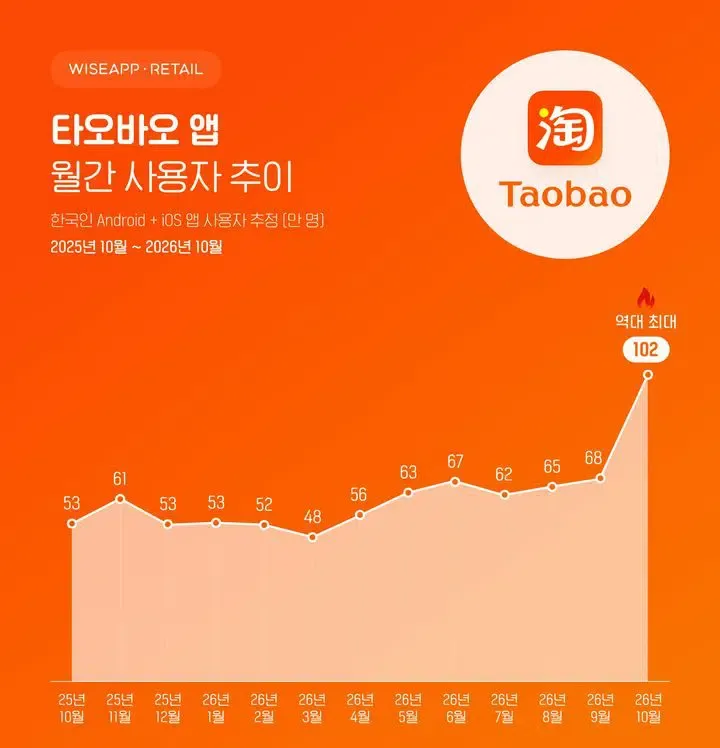
Taobao Hits 1.02M MAU in South Korea? According to Sina Tech reporting citing data released on November 24, 2026 by South Korean app and payment analytics firm WiseApp·Retail, Taobao reached 1.02 million monthly active users (MAU) in South Korea in October 2026, crossing the one-million mark for the first time and posting 93.9% year-over-year growth. While Alibaba’s main domestic marketplace still trails larger cross-border rivals in total user volume, South Korean media reports point to Korea-targeted promotions and demand for Chiikawa merchandise, alongside social-media shopping guides that may have helped more shoppers discover the app.
Why Taobao Hits 1.02M MAU in South Korea: Market Context and Demographics
At a Glance
-
Sina Tech and South Korean media citing WiseApp·Retail data reported that Taobao’s South Korea MAU reached an all-time high of 1.02 million in October 2026, up 93.9% year over year.
-
Users in their twenties and thirties accounted for 63.9% of Taobao’s October user base in South Korea, split between ages 20–29 at 39.8% and ages 30–39 at 24.1%.
-
Within the same October 2026 WiseApp·Retail comparison of major Chinese cross-border shopping apps in South Korea, AliExpress led at 9.31 million MAU (+2.3% YoY), followed by Temu at 8.42 million (+1.7% YoY) and Shein at 1.58 million.
South Korea’s cross-border e-commerce market includes established platforms such as AliExpress and Temu, making Taobao’s rapid year-over-year growth notable against their much larger user bases. According to October 2026 app usage figures from WiseApp·Retail, as reported by South Korean media, AliExpress ranked first among the Chinese cross-border shopping apps compared, with 9.31 million MAU and 2.3% year-over-year growth. Temu ranked second at 8.42 million MAU with 1.7% growth, followed by Shein at 1.58 million MAU.
Against those slower-growing baselines, Taobao’s 93.9% annual expansion stood out as the fastest growth rate among the tracked Chinese cross-border apps. Even after passing 1.02 million active users, Taobao remains fourth in overall active user scale within that cohort and sits well behind South Korean domestic leaders such as Coupang and Naver. Because monthly active user counts reflect app activity rather than completed checkouts, the October dataset measures active app reach rather than gross merchandise volume, order frequency, or net revenue.
Demographic breakdowns point to a distinct audience profile behind the October expansion. Users aged 20 to 29 represented 39.8% of Taobao’s Korean MAU, while users aged 30 to 39 accounted for 24.1%. Combined, adults in their twenties and thirties formed 63.9% of Taobao’s South Korean user base, highlighting the importance of younger shoppers in the platform’s local growth.
| Cross-Border App (South Korea, Oct 2026) | Monthly Active Users (MAU) | Year-over-Year Growth | Reporting Attribution |
|---|---|---|---|
| AliExpress | 9.31 million | +2.3% | WiseApp·Retail (Nov 24, 2026) |
| Temu | 8.42 million | +1.7% | WiseApp·Retail (Nov 24, 2026) |
| Shein | 1.58 million | Not disclosed in cited summary | WiseApp·Retail (Nov 24, 2026) |
| Taobao | 1.02 million | +93.9% | WiseApp·Retail (Nov 24, 2026) |
What Drove Taobao’s 93.9% App Growth in South Korea?
South Korean economic reporting and WiseApp·Retail analysts highlighted two converging factors behind the October jump. First, Taobao introduced promotional discounts tailored specifically to South Korean shoppers in October 2026, lowering initial friction for first-time buyers.
Second, niche intellectual property demand catalyzed organic peer discovery across social channels. Local supply shortages for authentic Chiikawa collectibles pushed young South Korean fans toward an official Chiikawa flagship store on Taobao. According to South Korean newspaper Herald Economy via Sina Tech, local buyers gave the official storefront a local nickname translating to “China Chiikawa Market.”

Korean shoppers subsequently shared shopping guides and store instructions across social networks and fan communities to help peers locate official listings. Alongside character collectibles, South Korean media observed rising interest in Chinese cosmetics and apparel on the app, coinciding with increased tourist travel between South Korea and China.
Social Discovery Friction in Cross-Border Web-to-App Journeys
When consumer discovery shifts from broad paid app-install campaigns toward community tutorials and shared links, mobile handoff engineering presents specific constraints. Depending on the social browser, app installation state, and link configuration, a shared product URL may open in an embedded WebView or mobile browser instead of reaching the intended native app screen. These routing constraints reflect general mobile engineering behavior rather than direct telemetry measurements of Taobao’s Korean user flows.
If a shopper does not yet have the target retail app installed and proceeds to the App Store or Google Play, standard web query strings—such as a flagship store slug or product identifier—do not automatically persist across the installation boundary. Without deferred parameter handling or an app-level fallback path, newly onboarded users may land on a generic home screen instead of the specific store featured in a community guide.
Comparing Cross-Border Web-to-App Handoff Paths
Engineering and growth teams supporting cross-border retail expansion face distinct trade-offs at the Web-to-App handoff layer. Because operating system link verification and app-store installs rely on separate mechanisms, mobile teams typically evaluate four distinct technical paths within the same user-handoff layer.
(Illustrative Comparison — Not an Official Taobao Platform Topology)
| Handoff Mechanism | Installed App Behavior | New Install Parameter Scope | Primary Technical Dependency | Key Operational Limit |
|---|---|---|---|---|
| Mobile Web Browser Fallback | Remains in web browser or WebView; performs no native app launch | No built-in post-install recovery; manual search or another app-defined fallback may be required. | Standard HTTP URLs | Lacks automated post-install context restoration without manual navigation or an app-defined fallback |
| iOS Universal Links / Android App Links | Launches native app directly when domain verification succeeds | None across app-store downloads | Hosted apple-app-site-association or assetlinks.json |
Embedded social WebViews may still keep clicks inside the browser |
| Google Play Install Referrer API | Not applicable to already-installed direct launches | Retrieves Play Store install referrer string on Android only | Google Play Store and Play Install Referrer Library | Android/Google Play exclusive; does not support iOS or general App Store routing |
| Deferred Parameter Pass-Through SDK | Can invoke installed app launch when paired with native link routing | Attempts first-launch recovery of supported SKU or campaign parameters | Client SDK plus server-side parameter cache | Recovery depends on OS constraints and parameter availability at first launch |
At the operating-system level, Apple’s Supporting Universal Links documentation describes how verified HTTPS links open installed iOS apps through NSUserActivityTypeBrowsingWeb. On Android, Google’s Verify App Links documentation details how setting android:autoVerify="true" alongside a hosted assetlinks.json manifest lets verified URLs launch the native app directly. For Android store downloads, the Google Play Install Referrer Library provides an interface to retrieve store-level referrer details on Google Play.
Architectural Perspective: Parameter Pass-Through for Social Retail Links
No public evidence indicates that Taobao uses any specific third-party deep-linking vendor in its South Korean app. However, cross-border shopping apps acquiring users via community tutorials—for example, a shopper tapping a “View flagship item in app” link inside a mobile blog—often evaluate how to preserve store or product identifiers across an app download.
In this adjacent Web-to-App scenario, an installation parameter pass-through framework such as OpoInstall operates within a four-part separation of responsibilities:
-
Installation Parameter Pass-Through (
OpoInstall SDK): Launches an already-installed mobile app with custom parameters, or attempts to retrieve cached campaign or item parameters upon first app launch under supported environments. When parameters are missing, invalid, or unavailable at first launch, the merchant application should handle the unavailable context and route users to a safe fallback screen. -
Merchant Application Logic (
Merchant App): Parses and validates any received flagship store ID or SKU identifier locally, then navigates the shopper to the matching storefront page or defaults safely to the home screen. -
Order and Payment Confirmation (
Merchant Backend): Records completed checkouts, payment settlement, currency conversion, and refund eligibility inside the merchant’s own server-side transaction database. -
Campaign Attribution (
Attribution System): Evaluates qualifying post-install events against promotional partnership rules independently of the client-side link launcher.
Keeping these four boundaries separate ensures that link parameter passing neither substitutes for order verification nor assumes that every mobile WebView preserves referrer payloads reliably.
Engineering and Growth Checklists for Cross-Border App Expansion
Product and engineering teams preparing a retail application for international user growth can audit their mobile handoff paths using the following general engineering practices rather than vendor-specific guarantees.
Engineering Readiness Checklist
-
Verify Domain Association Files: Confirm that
apple-app-site-associationand.well-known/assetlinks.jsonare served over HTTPS without HTTP redirects so operating systems can retrieve and validate domain associations for installed users, while noting that embedded social WebViews may still override automatic app launches. -
Sanitize Incoming Deep Link Parameters: Validate every product ID, flagship store slug, or campaign tag received via Universal Links, App Links, or first-launch parameter callbacks before executing in-app navigation.
-
Implement Safe Fallback Routing: Design first-launch handlers inside the merchant app to open a localized home screen or category landing page gracefully whenever parameters are missing, invalid, or unavailable at first launch.
-
Support Native Play Store Referrers: Integrate the Google Play Install Referrer API to capture supported Google Play campaign strings on Android installations independently of web cookies.
Growth and Localization Checklist
-
Track Organic Community Discovery: Monitor whether spikes in MAU stem from niche IP demand, user-generated guides, or localized promotional landing pages rather than paid ad networks alone.
-
Provide Search-Friendly Identifiers: Ensure flagship stores and popular SKUs remain easy to find via clean in-app search keywords and copyable item codes when social WebViews block direct app launches.
-
Separate Reach From Monetization: Evaluate monthly active user surges alongside activation, checkout completion, and repeat retention cohorts rather than treating MAU growth as equivalent to profitable GMV.
Frequently Asked Questions (FAQ)
How fast did Taobao grow in South Korea in October 2026?
Who is driving Taobao's user growth in South Korea?
How does Taobao compare with AliExpress and Temu in South Korea?
Key Takeaways for Engineering Teams
As Taobao hits 1.02M MAU in South Korea, the milestone illustrates how localized promotions and niche IP demand can accelerate international app adoption even in mature markets led by established competitors. Social guides and shared storefront links can involve different browser environments, so engineering teams should verify whether these entry points reliably route shoppers into the intended native app screens.
For campaigns that originate in social guides or shared product links, engineering teams can test whether native linking and supported first-launch parameter recovery reduce navigation friction. Separating link routing from merchant SKU validation, server-side transaction accounting, and attribution rules allows mobile teams to evaluate cross-border user journeys cleanly across diverse mobile browsers.
References
Share this article