How to set up in-app purchase attribution for mobile games? Setting up in-app purchase attribution requires linking verified store transactions to initial install touchpoints, normalizing multi-currency values to standard ISO minor units, and delivering verified conversion values through each advertising partner’s supported server-side, MMP, or platform-native measurement interface for ROAS optimization.
In-App Purchase (IAP) attribution is the end-to-end measurement architecture that links verified store microtransactions and subscription revenue back to the available acquisition context at the most granular level permitted by the applicable attribution framework. By standardizing multi-currency transactions into normalized minor units and transmitting verified conversion payloads to ad networks, IAP attribution enables studios to calculate attribution-based campaign ROAS using verified revenue and the acquisition context that can be resolved.
| Term | Definition | Related Entity | Search Intent Role |
|---|---|---|---|
| In-App Purchase | Direct digital sales of virtual goods, currency, or content within an app. | Microtransactions | Technical / Informational |
| Conversion Tracking | The systematic attribution of downstream revenue events to acquisition sources. | ROAS Optimization | Commercial / Technical |
| ROAS | Return on Ad Spend; the ratio of attributed revenue to advertising acquisition cost. | Value Bidding | Operational / Analytical |
The Architectural Role of In-App Purchase Attribution in Game UA
The Strategic Shift: Moving Beyond Cost-Per-Install Toward Value-Driven Acquisition
Mobile game user acquisition (UA) has evolved from volume-focused strategies toward value-optimized marketing frameworks. In early mobile eras, marketing teams optimized acquisition campaigns primarily against Cost-Per-Install (CPI) or early Day 1 return rates. However, because free-to-play mobile games generate the vast majority of their revenue from a small percentage of paying users, optimizing strictly for low-cost volume frequently acquires low-intent audiences who never complete microtransactions.
In-App Purchase (IAP) attribution shifts marketing optimization from volume to value. By measuring the monetary value generated by players post-install and mapping those transactions back to available acquisition touchpoints, studios evaluate the actual commercial efficiency of their advertising spend. This enables performance marketing teams to calculate Return on Ad Spend (ROAS) across participating media sources and deploy automated bidding strategies that prioritize high-value spenders over unmonetized volume.
The Data Pipeline Overview: From In-Game Checkout to Ad Network Feedback Loops
A resilient IAP attribution architecture spans multiple interconnected systems:
- Store Billing Execution: The player completes a transaction through Apple StoreKit or Google Play Billing.
- Server-Authoritative Validation: The game backend independently validates the store receipt or purchase token against platform store APIs to ensure legitimacy.
- Attribution Context Resolution: The verified revenue event is evaluated against available acquisition records. Where deterministic attribution is available, it can be linked to the stored acquisition context; otherwise, the event remains unattributed at user level or is incorporated into an aggregate privacy-preserving measurement layer.
- Multi-Currency Normalization: Foreign currency amounts are converted into standardized minor units and base reporting currencies.
- Partner Feedback Dispatch: Route verified conversion values through each advertising platform’s supported measurement interface—such as eligible app-conversion integrations, MMP postbacks, or server-side event APIs—according to partner-specific bidding eligibility and consent requirements.
- Data Warehouse Ingestion: Reconciled transaction records are written to internal business intelligence pipelines for longitudinal cohort LTV analysis.
Why Incomplete Purchase Attribution Corrupts Performance Marketing Decisions
Operating a mobile game without verified IAP attribution creates structural measurement blind spots. If purchase telemetry is untracked, delayed, or unverified:
- Misallocated Ad Budgets: Marketing teams may scale campaigns that deliver cheap installs but zero paying players, while defunding expensive ad placements that yield profitable payer cohorts.
- Corrupted Algorithmic Bidders: Programmatic ad networks rely on conversion postbacks to train machine learning models. If revenue signals are missing or inaccurate, ad network bidding algorithms optimize toward non-paying users.
- Unreconciled Financial Reporting: Discrepancies emerge between gross merchant billing receipts and reported marketing revenue, preventing finance and user acquisition teams from establishing reliable payback horizons.
See Also: In-App Purchase ──> Mobile Attribution Model
How Does Attribution Tracking Link In-Game Purchases to Acquisition Touchpoints
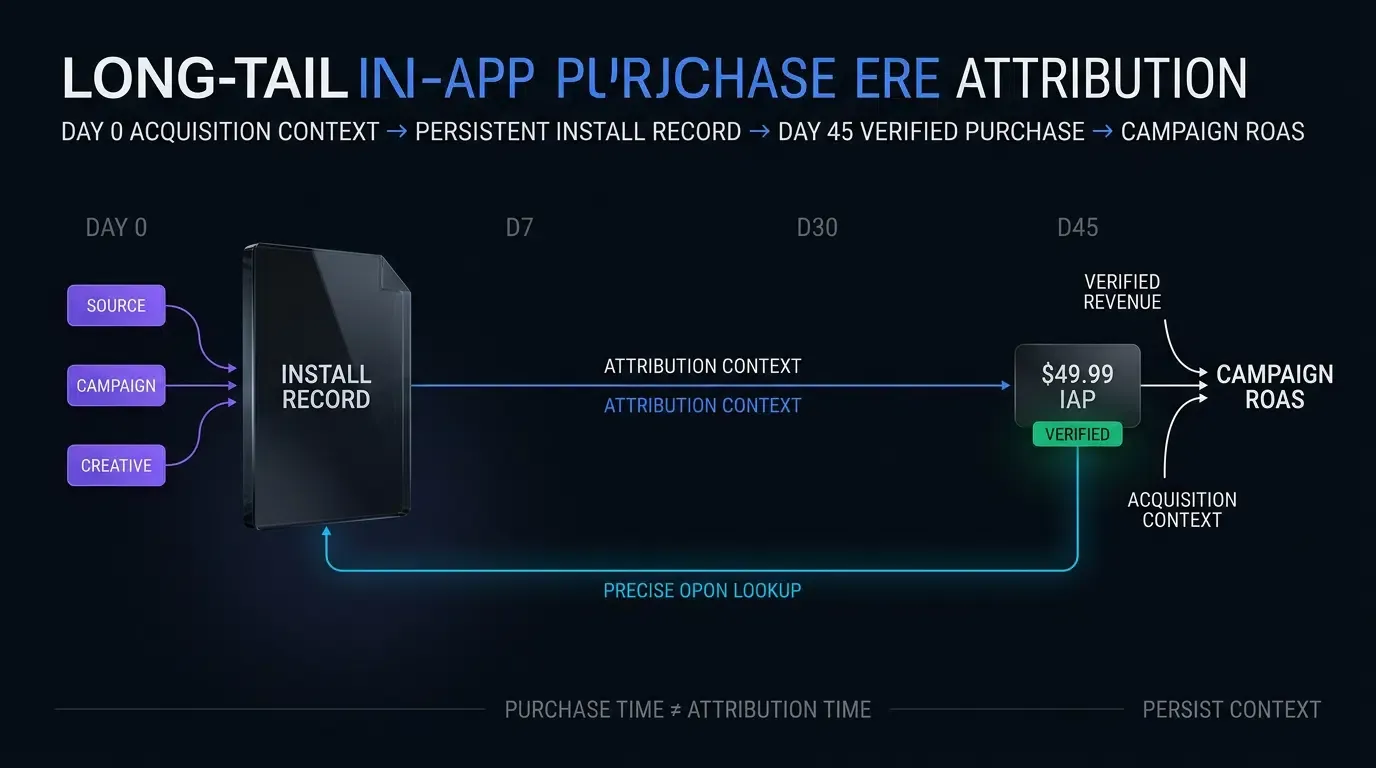
The Attribution Key Concept: Stamping User Profiles with Install Context on Day 0
Linking an in-game transaction occurring on Day 45 to an ad clicked on Day 0 requires persistent attribution key binding.
When a user downloads and launches a mobile game for the first time, the attribution SDK initializes and communicates with the attribution server. The server evaluates candidate touchpoints (ad clicks, impressions, deep-link parameters) and establishes the winning acquisition context where attribution can be resolved. The attribution engine generates a unique attribution record linking the installation to specific metadata:
partner_id: The advertising network or media source (e.g., Google Ads, Meta, TikTok, Unity Ads, Organic).campaign_id: The unique campaign identifier.creative_id: The specific visual asset that drove the click.ad_group_id: The placement or audience targeting segment.
The game backend stores this attribution identifier alongside the internal player account record in its primary database. Whenever the player executes an in-game purchase, the transaction event inherits this foundational attribution context.
Bridging the Latency Gap: Associating Long-Tail Purchases with Historical Clicks
Unlike e-commerce transactions that often occur immediately post-click, mobile game monetization exhibits substantial time latency. While impulse starter packs may be purchased on Day 0, high-tier currency bundles and progression gacha pulls frequently occur weeks or months post-install.
Attribution tracking architectures maintain persistent cohort linkage throughout the player lifecycle. When an in-game purchase event is ingested, the system queries the player’s historical install record rather than looking for a proximate ad click. This long-tail binding enables game studios to measure cumulative
Handling Cross-Device and Re-Engagement Scenarios in Payer Journeys
Payer journeys frequently span multiple devices or re-engagement touchpoints. A player acquired via a mobile ad may later link their account to a secondary mobile device or PC client, or return to the game after a re-engagement retargeting ad.
Attribution platforms resolve these scenarios through unified account mapping:
- Account-Level Persistence: Purchases executed on secondary devices inherit the original user acquisition attribution context if the player authenticates using a unified game account ID.
- Retargeting Re-Attribution: If an existing, dormant player clicks a dedicated re-engagement ad and completes a purchase within a defined re-engagement window, the attribution engine can assign fractional credit or re-attribution flags to the retargeting campaign while preserving the original acquisition source in raw data logs.
Resolving Identity Disconnects Across Privacy-Preserving Frameworks
Platform-level privacy frameworks—such as Apple’s App Tracking Transparency (ATT) and AdAttributionKit/SKAdNetwork on iOS, and Google Privacy Sandbox on Android—restrict deterministic device tracking across unconsented users.
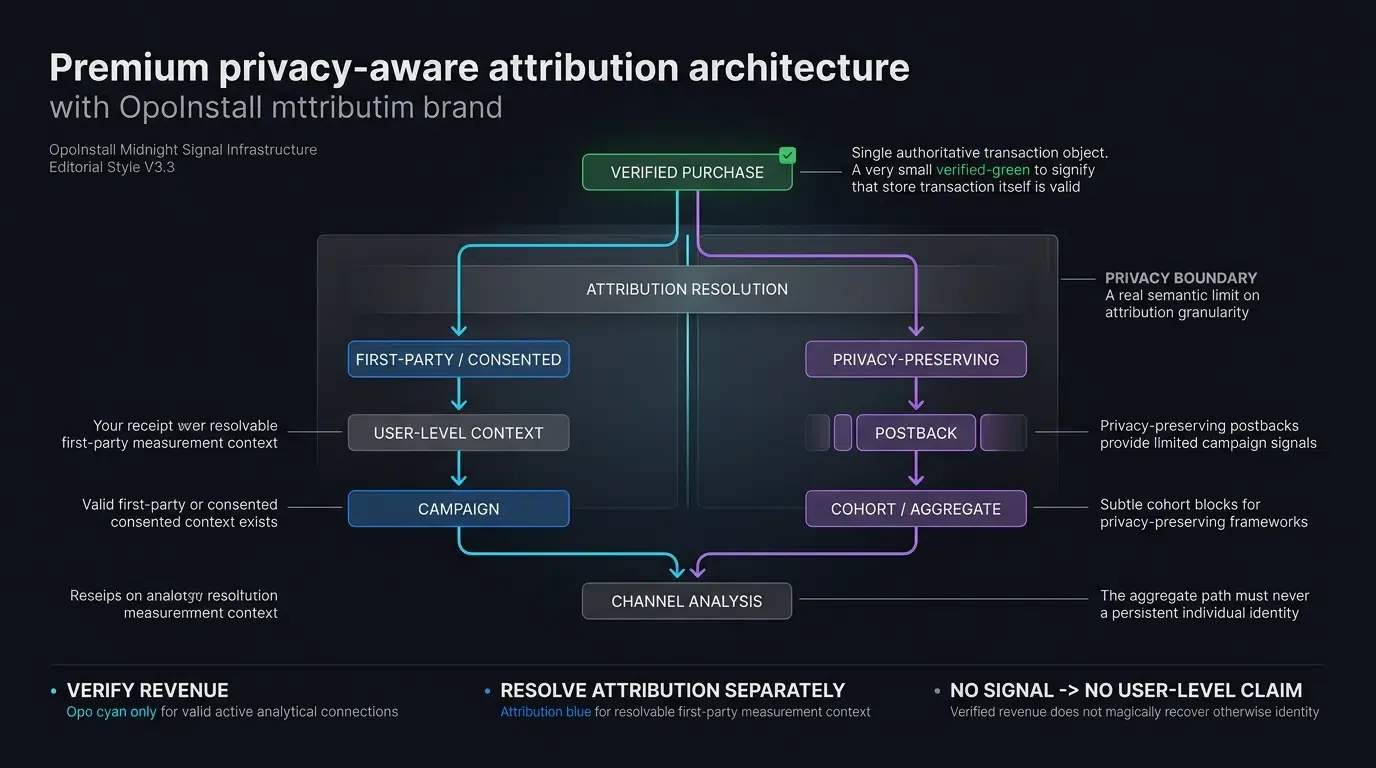
To maintain robust IAP attribution under aggregated or privacy-centric environments, game architectures deploy complementary measurement layers:
- Deterministic First-Party Telemetry: For consenting users or first-party account environments, transactions are linked deterministically via internal account IDs and secure S2S callbacks.
- AdAttributionKit and SKAdNetwork Conversion Values: Apple privacy-preserving attribution frameworks support fine (6-bit) and coarse (
low,medium,high) conversion-value signaling within platform-defined postback windows. The exact update windows and available granularity depend on the active framework configuration and postback data tier, allowing ad networks to optimize early value bidding without receiving persistent user identifiers. - Aggregated Cohort Modeling: Verified store transactions provide authoritative revenue inputs, while privacy-preserving attribution postbacks and other aggregate campaign signals provide acquisition context. Data science models can combine these sources to estimate channel-level LTV where user-level attribution is unavailable; verified receipts alone do not recover otherwise unavailable campaign attribution.
Technical Framework for Multi-Currency Normalization in Global Games
The Multi-Currency Challenge: Ingesting Global Player Payments Across Divergent Currency Exponents
Global mobile games distribute across hundreds of regional storefronts, accepting payments in dozens of local fiat currencies. When processing transactions globally, an attribution pipeline encounters significant formatting differences.
Attempting to aggregate raw numerical transaction values without currency normalization introduces severe data corruption. Ingesting ¥500 Japanese Yen, $4.99 US Dollars, and 1.500 Bahraini Dinars as raw floating-point numbers in the same database column distorts ROAS calculations. An accurate revenue pipeline must systematically normalize every transaction using standardized currency specifications.
ISO 4217 Structural Mechanics: Managing Zero-Decimal, Two-Decimal, and Three-Decimal Currencies
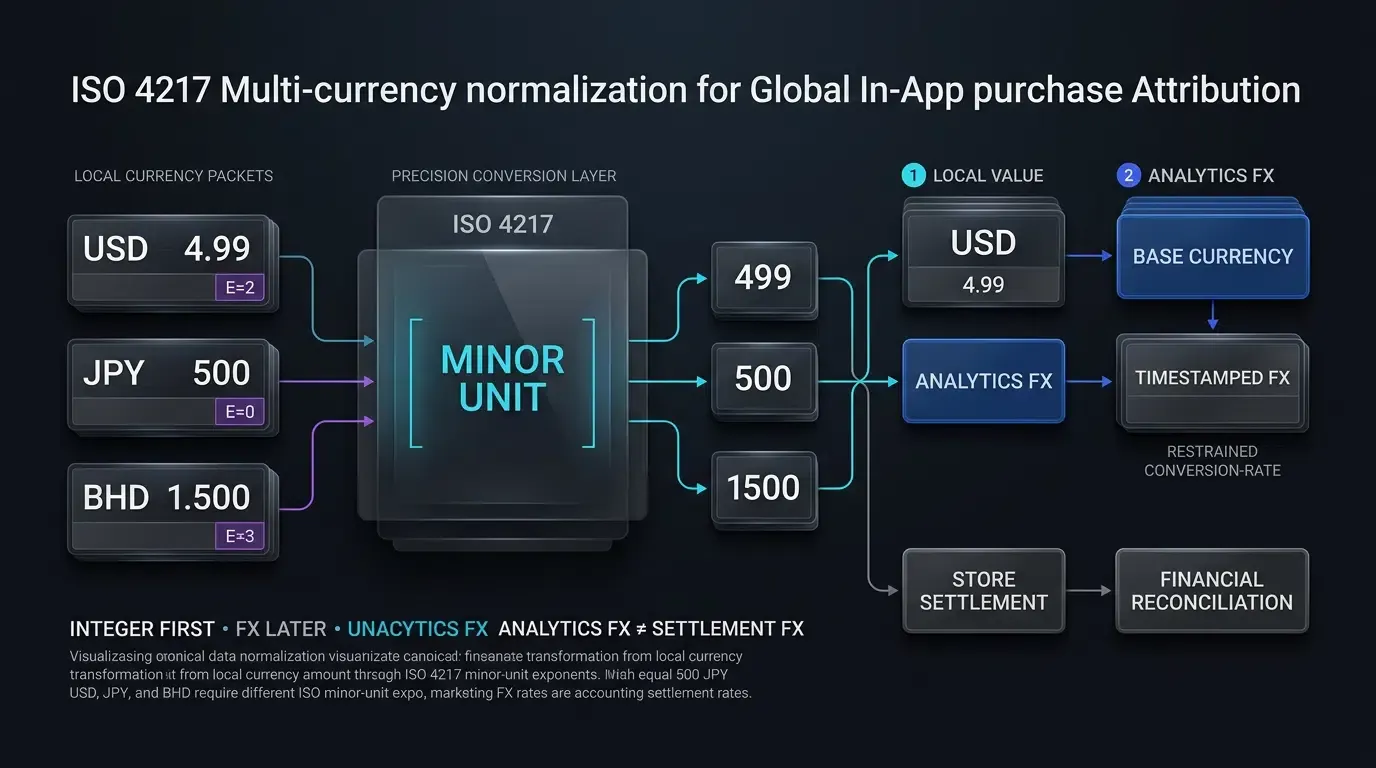
The international standard for currency representation is ISO 4217. ISO 4217 defines a three-letter alphabetic currency code alongside a minor unit exponent (
- Two-Decimal Currencies (
): Currencies such as USD, EUR, GBP, and CAD divide into 100 minor units (cents, pence). A $4.99 transaction represents 499 minor units. - Zero-Decimal Currencies (
): Currencies such as JPY, KRW, and VND have no minor currency sub-units. A ¥500 transaction represents exactly 500 minor units. - Three-Decimal Currencies (
): Currencies such as BHD (Bahraini Dinar), KWD (Kuwaiti Dinar), and JOD (Jordanian Dinar) divide into 1,000 minor units (fils). A 1.500 BHD transaction represents 1,500 minor units.
To avoid binary floating-point representation errors, MajorUnits must be parsed from exact decimal string representations rather than converted directly from floating-point numbers:
The table below illustrates standard ISO 4217 currency exponent mappings:
| Currency Code (ISO 4217) | Currency Name | Minor Unit Exponent | Format Example | Minor Unit Integer Representation |
|---|---|---|---|---|
| USD | US Dollar | 2 | $4.99 | 499 |
| EUR | Euro | 2 | €4.99 | 499 |
| GBP | British Pound | 2 | £4.99 | 499 |
| JPY | Japanese Yen | 0 | ¥500 | 500 |
| KRW | South Korean Won | 0 | ₩5,000 | 5000 |
| BHD | Bahraini Dinar | 3 | BD 1.500 | 1500 |
Fixed versus Dynamic Exchange Rate Conversions: Establishing a Base Currency for Data Warehousing
To evaluate marketing performance across international campaigns, foreign transactions should be routed through two distinct currency normalization streams:
- Marketing Analytics FX Stream: Ingestion gateways convert incoming local minor units into a standardized base reporting currency (typically USD or EUR) using a documented, timestamped exchange rate feed (such as daily reference rates from central banks or commercial FX APIs). Reference-rate sources should be governed as analytics policy inputs rather than treated as executable transaction FX quotes. This base currency value is stored in data warehouses alongside the original local transaction amount.
- Financial Settlement FX Stream: Studios reconcile monthly accounting data against the actual settled proceeds and exchange rates published in Apple and Google financial reports, separating operational marketing evaluation from finalized banking remittance.
Mitigating Rounding Errors and Floating-Point Inaccuracies in Financial Reporting
In computer systems, standard IEEE 754 floating-point arithmetic (e.g., float or double data types) introduces binary rounding errors during multiplication and division. In financial accounting pipelines processing millions of transactions, cumulative floating-point errors generate material discrepancies.
Engineering best practices mandate:
- Integer Ingestion: Transmit and store all monetary values across client SDKs, server ingestion gateways, and webhook payloads strictly as 64-bit integer minor units accompanied by their ISO 4217 string code.
- Decimal Precision Libraries: Execute downstream currency conversions, platform tax deductions, and store commission splits using arbitrary-precision decimal libraries (such as
BigDecimalin Java/Kotlin orDecimalin Python) with documented rounding policies (e.g.,HALF_EVENorHALF_UP).
How to Structure Real-Time S2S Postbacks for Programmatic Value Bidders
The Mechanics of Value Bidding: App Event Optimization and Target ROAS
Programmatic advertising platforms provide value-optimization bidding models (such as Target ROAS or Value Optimization) that adjust bids dynamically based on predicted player revenue.
To operate effectively, value-bidding algorithms require reliable ingestion of verified transaction values within the freshness windows required by each advertising partner. If an attribution platform fails to dispatch purchase postbacks or transmits corrupted revenue figures, the ad network’s optimization model operates on inaccurate data, impairing bidding precision.
Constructing the S2S Postback Payload: Event Names, Value Mapping, and Partner Schemas
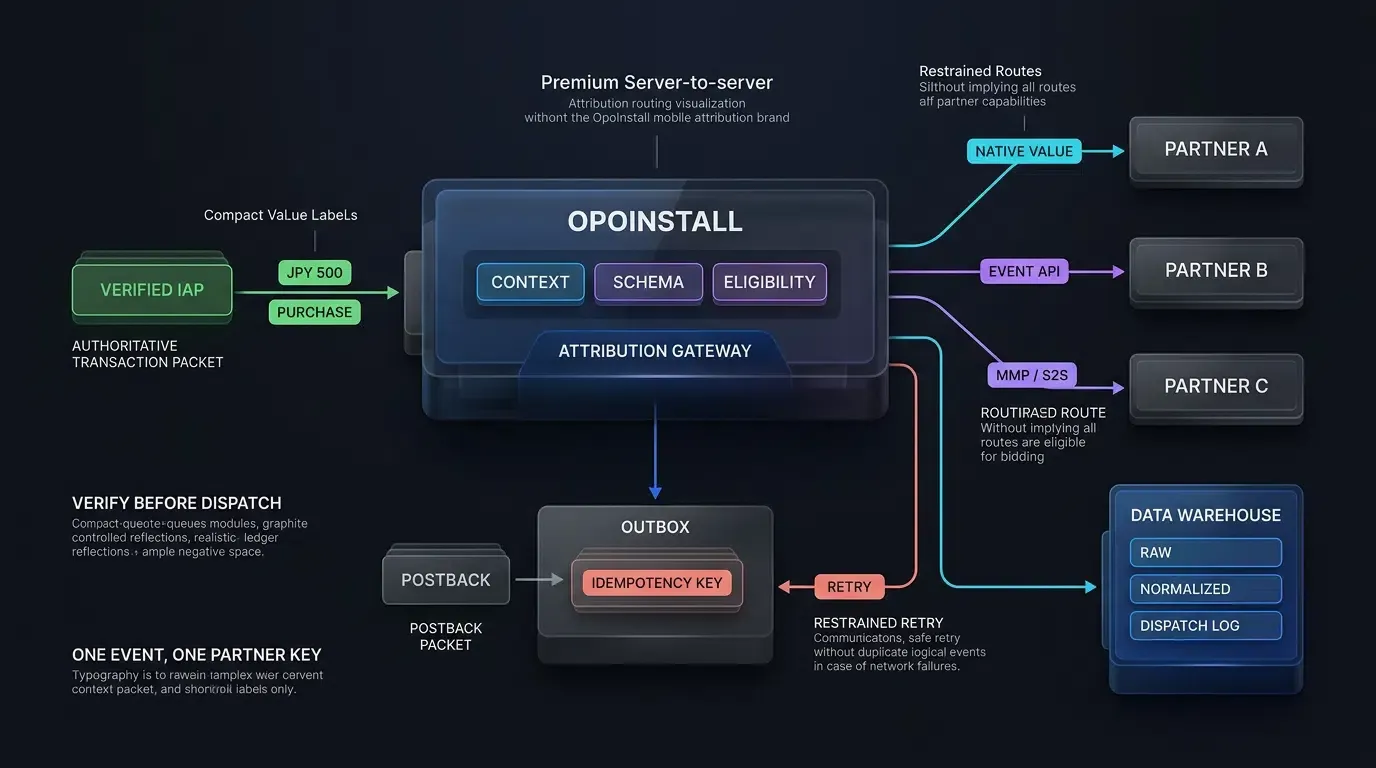
When an IAP transaction clears server-side validation, the attribution gateway formats a partner-specific S2S postback payload. Partner feedback paths and schema requirements are platform-specific:
- Google Ads: App Campaign Target ROAS has specific supported conversion-source requirements. Eligible Firebase or Google Play codeless app conversions should be treated separately from generic Google Ads API conversion uploads, which should not automatically be assumed to qualify as biddable App Campaign conversion sources. Treat reporting uploads and biddable app-conversion sources as distinct capabilities.
- Meta, TikTok, and Other Partners: Expose their own app-event, conversion, or MMP integration paths (such as Meta Conversions API or TikTok Events API for App), accepting native transaction amounts, ISO currency codes, and event identifiers corresponding to purchases.
Importantly, ad network postbacks should transmit the transaction’s native local currency and value where supported, allowing the ad platform’s internal conversion engine to handle billing normalization rather than forcing every partner postback into a pre-converted base currency.
Visualizing the Verified In-App Purchase to Attribution Postback Pipeline
The sequence diagram below illustrates the telemetry pipeline from store receipt verification to partner routing and data warehousing:
[Player Completes In-App Purchase]
                │
                ▼
  [Game Server Validates Store Receipt]
                │
                ▼
  [Server-Verified Transaction Record Created]
                │
     ┌──────────┴──────────────────────────┐
     ▼                                     ▼
[Log to Attribution Engine]       [Internal Data Warehouse]
(OpoInstall S2S Event Stream)     (Gross/Provisional ──► Later Reconciliation)
     │
     ▼
[Attribution Engine Resolves Available Acquisition Context]
     │
     ▼
[Partner Routing Layer]
     │
     ▼
[Deliver to Partner-Supported Measurement Interface]
     │
     ▼
[Reporting & Bidding Eligibility Determined Per Partner]
Developers seeking technical specifications for event logging structures and data warehouse integration can consult current raw data export documentation for payload formats and ingestion guidelines.
For engineering teams evaluating SDK integration controls and telemetry collection modules, consult the SDK integration resources for implementation guidelines.
Structuring the S2S In-App Purchase Attribution Postback Record
To maintain full auditability across downstream integrations, attribution gateways log outbound postback dispatches according to structured reference schemas.
The schema placeholder below illustrates an S2S postback verification record capturing canonical transaction references, normalized currency telemetry, attribution metadata, and partner dispatch states:
{
  "reference_architecture": true,
  "illustrative_values": true,
  "s2s_iap_attribution_postback_record": {
    "telemetry_metadata": {
      "postback_event_id": "pb_ev_2026_0915_4481",
      "timestamp_utc": "2026-09-15T09:40:00.120Z",
      "app_id": "com.example.game.rpg",
      "player_account_id": "usr_99812401"
    },
    "store_transaction_context": {
      "store_platform": "Google_Play",
      "store_environment": "Production",
      "backend_transaction_reference": "iap_evt_2026_0915_4481",
      "product_id": "com.example.game.gem_pack_03",
      "purchase_verification_status": "store_verified",
      "server_validation_source": "Google_Play_Developer_API_Productsv2"
    },
    "currency_normalization_telemetry": {
      "raw_local_currency": "JPY",
      "iso_4217_exponent": 0,
      "local_minor_units": 500,
      "base_reporting_currency": "USD",
      "fx_conversion": {
        "rate_source": "ecb_reference_rates",
        "source_rate_date": "2026-09-14",
        "source_base_currency": "EUR",
        "derived_cross_rate": "JPY_USD",
        "rate_derivation_method": "EUR_JPY_and_EUR_USD_cross",
        "rate": "0.00670000",
        "rounding_mode": "HALF_EVEN",
        "policy_version": "marketing_fx_v3"
      },
      "normalized_base_amount_cents": 335,
      "accounting_basis": "gross_customer_price_normalized"
    },
    "attribution_context": {
      "acquisition_channel": "google_ads",
      "campaign_id": "cmp_troas_hero_scale",
      "ad_group_id": "ag_strategy_rpg_us",
      "creative_id": "cr_cinematic_battle_01",
      "install_date_utc": "2026-08-15",
      "payer_tenure_days": 31
    },
    "downstream_postback_dispatch": {
      "destination_ad_network": "partner_conversion_api",
      "partner_native_currency": "JPY",
      "partner_native_amount": 500,
      "dispatch_attempt_count": 1,
      "http_status": 200,
      "partner_response_id": "resp_partner_99812_ack",
      "postback_status": "dispatched_successfully",
      "bidding_optimization_eligible": true,
      "idempotency_key": "pb:iap_evt_2026_0915_4481:partner_conversion_api:purchase"
    },
    "financial_reconciliation": {
      "financial_reconciliation_status": "pending_monthly_settlement",
      "attribution_reconciliation_status": "linked_to_acquisition_cohort"
    }
  }
}
Retry-Safe Idempotent Delivery and Deduplication Control
A critical requirement in S2S postback delivery is managing network unreliability without injecting duplicate signals into ad network bidding models. If an ad network endpoint times out or returns a temporary 5xx error, naive retry mechanisms can double-count revenue if the partner processed the request before dropping the connection.
Resilient postback delivery architectures enforce:
- Canonical Idempotency Keys: Generate deterministic idempotency identifiers derived from the backend transaction reference, destination partner ID, and event type.
- Durable Outbox Queues: Persist outbound postbacks in transactional outbox queues, executing exponential backoff retries with jitter upon network failures.
- Partner Response Tracking: Log HTTP response codes, attempt counters, and partner transaction references to maintain an immutable audit trail of all outbound postback transmissions.
How to Reconcile Marketing ROAS Across Cross-Platform Payment Channels
The Accounting Gap: Client-Reported Gross Values versus Store Net Proceeds
Evaluating marketing efficiency requires reconciling two distinct financial metrics:
- Gross Checkout Spend: The total monetary amount charged to the consumer’s payment method at point-of-sale.
- Net Realized Proceeds: The actual cash distributions received by the game studio from app stores after platform deductions.
Client-side attribution events record gross consumer spend (store_purchase_price). If performance marketing teams calculate ROAS by dividing gross spend directly by media costs, reported ROAS reflects top-line checkout volume rather than net realized cash proceeds.
Accounting for Store Platform Fees, Local Taxes, and Refund Clawbacks
Accurate financial reconciliation requires modeling platform deductions in downstream data warehouses:
Key deduction factors include:
- Platform Service Fees: Store fees vary depending on developer tier, subscription tenure, storefront region, and program participation.
- Local Digital Services Taxes and VAT: Withholding taxes deducted by platform stores in specific international jurisdictions before developer remittance.
- Refunds and Chargebacks: Apple and Google provide server-to-server refund notifications when a consumer disputes a charge. Analytics pipelines must match refund tokens back to original acquisition cohorts to adjust cumulative LTV.
Evaluating Longitudinal Cohort ROAS Curves: Cumulative Payback Calculations
Return on Ad Spend (ROAS) must be evaluated across longitudinal time horizons (
Tracking cumulative cohort ROAS curves across acquisition channels allows growth teams to identify channels that achieve fast payback versus channels that require extended monetization horizons to break even.
Integrating Alternative Web Checkouts and Third-Party Web Store Purchases into Attribution
As alternative billing frameworks and direct-to-consumer (D2C) web stores expand across mobile gaming, players increasingly purchase virtual goods outside native mobile client binaries.
To maintain unified IAP attribution across third-party web stores:
- Unified Account Linking: The web checkout identifies the player using their unique internal game account ID.
- Server-Side Ingestion: The web store payment gateway dispatches an S2S purchase webhook to the game server.
- Attribution Pipeline Stitching: The game backend forwards the verified web transaction to the attribution engine, stamping the event with the player’s original mobile acquisition source.
- Fee Reconciliation: The data warehouse applies the payment processor’s specific fee structure, ensuring accurate net revenue calculation across all payment channels.
Comparative Analysis of In-App Purchase Attribution Integration Methods
Evaluating Technical Overhead, Security Guarantees, and Reporting Accuracy Across Integration Paths
Game engineering teams evaluate three primary architectural methods for integrating IAP attribution.
The table below contrasts standard integration methodologies:
| Integration Methodology | Implementation Location | Data Freshness | Security and Tamper Resistance | Primary Operational Trade-Off |
|---|---|---|---|---|
| Client-SDK Direct | Native Mobile Client (iOS / Android) | Immediate real-time | Low to Moderate (Vulnerable to client-side spoofing) | Simple setup, but risks reporting unverified receipts |
| Server-to-Server (S2S) | Authoritative Game Backend | Controlled / Streamed | High (Can provide high integrity when events originate from authoritative backend verification) | Requires backend webhook integration and routing logic |
| Hybrid Pipeline | Client Event Trigger + Server Validation | Real-time with server sync | High (Client telemetry reconciled with backend state) | Useful when low-latency client telemetry and authoritative backend verification must coexist |
Selecting the Appropriate Architectural Approach
Direct client-only reporting is suitable primarily for preliminary, non-financial analytics. For any title deploying value-optimized ad campaigns (tROAS) or managing substantial acquisition budgets, the Hybrid Pipeline or Server-to-Server (S2S) integration is strongly preferred to ensure that only verified transactions trigger downstream value signals.
When Should Game Studios Deploy Advanced In-App Purchase Value Optimization
Suitable Operational Conditions for Deploying Target ROAS and Value Bidding
Game growth teams should activate advanced IAP value bidding under specific commercial conditions:
- Sufficient Conversion Density: Campaigns generating enough verified purchase events to satisfy the specific learning thresholds established by the target advertising platform.
- High Payer Value Variance: Games with wide monetization distributions where high-spending players generate substantially higher revenue than casual buyers, making flat-CPI bidding inefficient.
- Validated Live Operations and Economy Sinks: Titles possessing mature live-ops calendars and deep item progression capable of monetizing acquired spenders over multi-month horizons.
Unsuitable Conditions for Value-Optimized Campaigns
Deploying value bidding introduces operational friction in specific scenarios:
- Early Soft-Launch Prototypes: Games testing early onboarding and core retention where monetization mechanics and item pricing are unvalidated.
- Low-Variance Catalogs: Titles where conversion values show very little variance, where event-count bidding (AEO) may achieve comparable results with lower operational complexity.
- Low-Volume Campaigns: High-friction niche games unable to meet partner-specific conversion volume thresholds, causing value-bidding algorithms to struggle during cold-start learning phases.
Common Pitfalls in In-App Purchase Attribution
- Pitfall 1: Dispatching Unverified Client Callbacks: Forwarding unvalidated client-side purchase events to ad networks allows local emulator spoofing to inject fake revenue signals, corrupting auto-bidding models.
- Pitfall 2: Neglecting ISO 4217 Minor Unit Normalization: Failing to account for currency exponents results in reporting 500 Japanese Yen as $500.00 USD, triggering catastrophic bidding inflation on international campaigns.
- Pitfall 3: Omitting Refund Postback Signals: Failing to ingest store refund and chargeback notifications leaves disputed revenue credited in marketing dashboards, leading to false-positive ROAS calculations.
Frequently Asked Questions (FAQ)
What is in-app purchase attribution in mobile gaming?
How are different global currencies handled in purchase attribution?
Why is server-verified purchase telemetry necessary before sending ad network postbacks?
Summary and Decision Framework
Setting up an authoritative In-App Purchase attribution architecture is the foundation for scaling profitable mobile game user acquisition. Transforming marketing performance from volume-based acquisition to value-driven growth requires linking verified store transactions to initial install touchpoints, enforcing strict multi-currency normalization, and feeding clean revenue telemetry back to ad networks.
By deploying server-verified S2S postback pipelines and reconciling gross checkout values with net accounting proceeds, game studios protect their automated bidding algorithms, eliminate reporting discrepancies, and ensure that user acquisition budgets invest in acquiring high-LTV player cohorts.
To explore how raw data exports and conversion tracking interfaces can be integrated into your title’s revenue attribution pipeline, consult the mobile attribution implementation reference.
Related Materials
-
Concepts: In-App Purchase Attribution, Currency Normalization, ISO 4217, Value Bidding, Target ROAS, S2S Postbacks
-
Technologies: Server-to-Server Webhook Engine, Mobile Attribution SDK, Raw Data Pipelines, Conversion API
-
Standards: ISO 4217 Currency Codes, IETF RFC 8259 JSON Data Interchange Format, W3C Performance Timing
-
APIs: Google Ads API Conversion Uploads, Apple StoreKit 2 Transaction API, TikTok Events API
-
Official Documentation & References:
Share this article