What is IAP and how does it affect game revenue? In-App Purchase (IAP) is the digital commerce system enabling players to buy virtual goods, directly driving high-margin mobile game revenue when integrated with server-side receipt validation and attribution tracking.
In-App Purchase (IAP) is a platform-integrated billing framework that enables mobile game players to purchase digital content, virtual currencies, permanent unlocks, and recurring subscriptions directly within an application. By implementing server-authoritative receipt validation and linking verified transactions to available acquisition attribution context, game studios secure virtual economies against billing fraud while enabling channel-level payer and revenue analysis where attribution can be resolved.
| Term | Definition | Related Entity | Search Intent Role |
|---|---|---|---|
| IAP | Direct digital sales of virtual goods, currency, or content within an app. | Microtransactions | Technical / Informational |
| Receipt Validation | Server-side verification of store-signed purchase tokens to prevent billing fraud. | StoreKit 2 / Google Play API | Security / Operational |
| Conversion Tracking | The programmatic attribution of revenue events to specific marketing sources. | ROAS Optimization | Commercial / Technical |
The Core Architecture of In-App Purchases in Mobile Game Monetization
The Commercial Mechanics of IAP: Driving High-Margin Lifetime Value in Free-to-Play Titles
In mobile free-to-play gaming, In-App Purchases (IAP) represent the primary engine of high-margin commercial revenue. Unlike advertising monetization, which generates incremental, fractional-cent earnings per impression, IAP captures direct consumer willingness-to-pay. Microtransactions enable players to purchase virtual currencies, cosmetic items, gacha summons, energy refills, and content expansions directly through native platform billing flows.
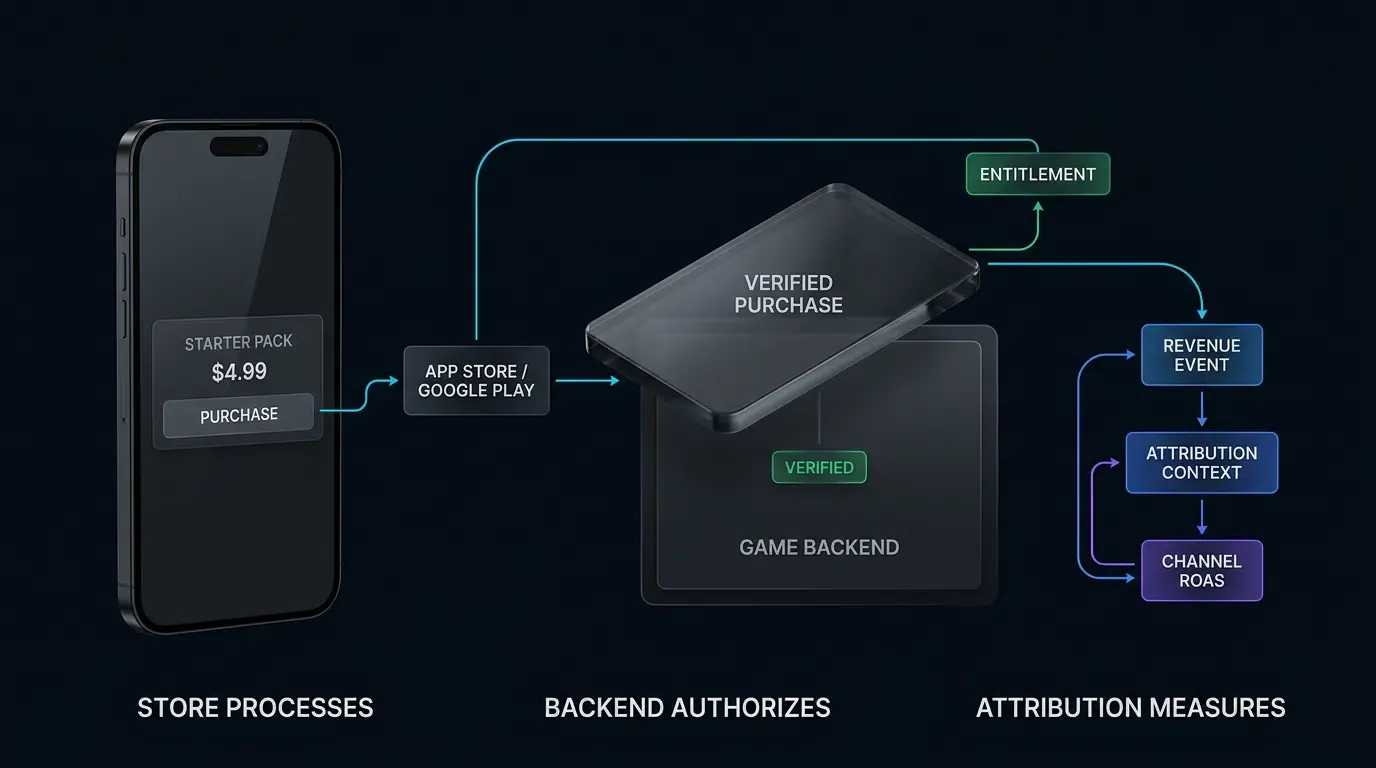
Because IAP transactions deliver high revenue density per transaction, paying players dictate the commercial success and payback velocity of user acquisition campaigns. Maximizing IAP revenue requires studios to establish a robust transaction pipeline: facilitating frictionless checkout on the client, securing digital goods delivery via server-authoritative validation, and attributing purchase revenue back to marketing acquisition sources to calculate Return on Ad Spend (ROAS).
Direct Store Integration: Navigating Apple App Store Connect and Google Play Console Billing Pipelines
Implementing IAP requires deep technical integration with platform store backends:
- Apple App Store Connect: Manages digital product definitions, pricing tiers, localized descriptions, and subscription groups. Transactions are processed via Apple’s StoreKit framework on iOS.
- Google Play Console: Manages in-app product catalogs, base plans, subscription offers, and localized pricing. Purchases are handled through the Google Play Billing Library on Android.
When transactions are processed through platform billing systems, Apple or Google handles substantial portions of the consumer payment processing, taxation, pricing localization, and store-side commerce lifecycles. However, operating across both platforms requires abstracting differences in product configurations, lifecycle states, and receipt formats into a unified game backend economy.
The Payer Distribution Reality: Why Securing and Tracking the Paying Minority Dictates Studio Payback
Across free-to-play mobile games, player monetization follows a Pareto-like distribution: only a small minority of active daily players complete real-money transactions. A small segment of high-value spenders often contributes a substantial proportion of overall in-app revenue.
Because revenue is concentrated within this paying cohort, tracking and securing every transaction is critical. Failing to validate purchases allows malicious actors to generate unauthorized virtual currency using local billing emulators, destabilizing the in-game economy. Conversely, failing to link purchase events to attribution data blinds performance marketing teams, preventing them from identifying which advertising channels, campaigns, and creatives acquire high-value spenders.
How Do StoreKit 2 and Google Play Billing Handle Transaction Lifecycles
The Transaction State Machine: From User Initiation to Final Entitlement Delivery
A complete mobile in-app purchase follows a multi-phase state machine that spans the client application, the platform store, and the authoritative game backend:
- Product Query: The client queries the platform billing SDK (
StoreKit 2on iOS,BillingClienton Android) to fetch localized pricing and product metadata. - Purchase Initiation: The player triggers a purchase flow, prompting the native operating system payment sheet.
- Payment Processing: Apple or Google verifies payment details, charges the consumer account, and generates a cryptographically signed transaction token or receipt.
- Client Delivery: The platform store returns the purchase token or signed transaction data to the game client’s purchase listener.
- Server Verification: The client forwards the token, order identifier (where available), and account context to the game backend.
- Store Validation: The game backend validates the token directly with Apple or Google server APIs.
- Entitlement Grant: Upon successful validation, the game backend credits the player’s account in the database.
- Platform-Specific Finalization:
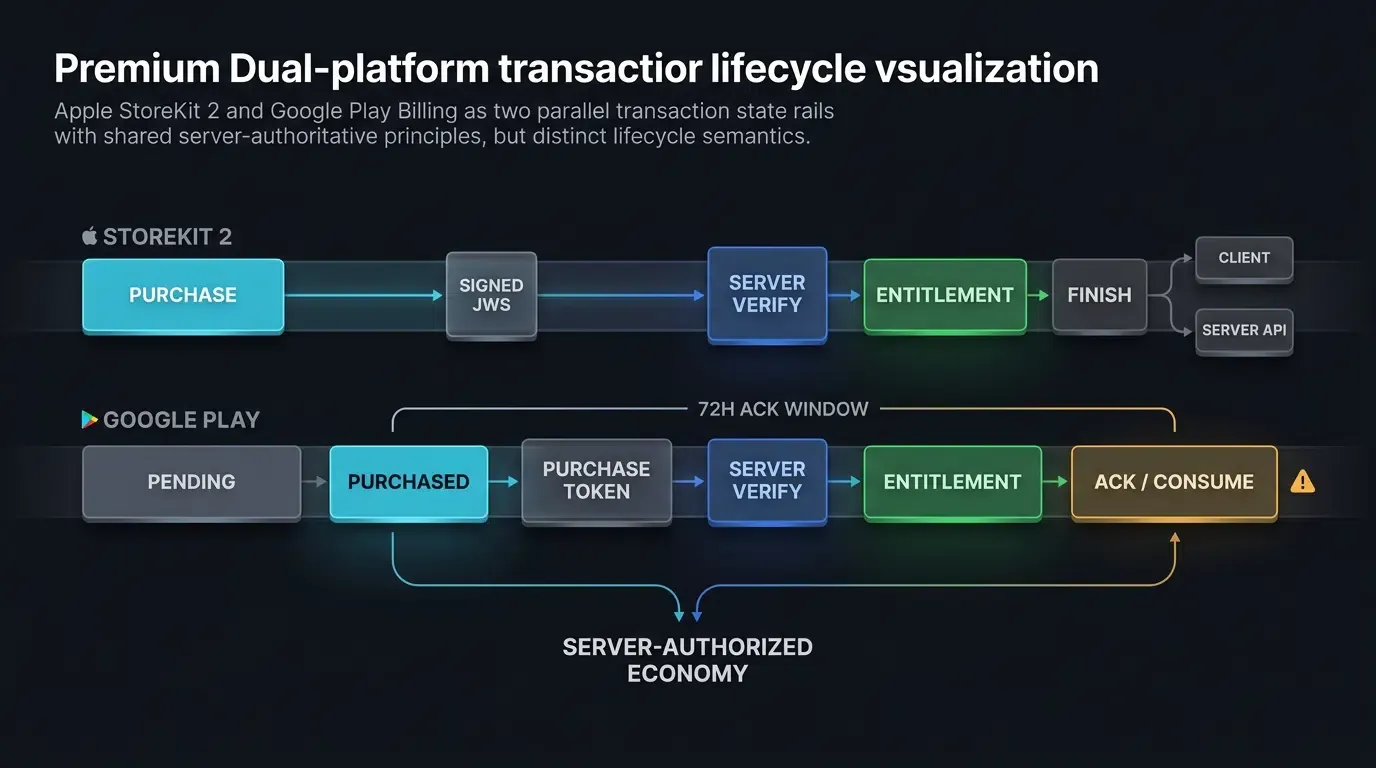
- Apple StoreKit 2: After backend-authorized entitlement delivery, Apple transactions may be finalized either by calling
Transaction.finish()in the app or, for server-managed entitlement architectures, by calling the App Store Server APIFinish Transactionendpoint (POST /inApps/v1/transactions/{transactionId}/finish). Only one successful finalization path is required. - Google Play Billing: The backend or client acknowledges the purchase (for non-consumables/subscriptions) or consumes it (for consumables) using Google Play APIs.
- Apple StoreKit 2: After backend-authorized entitlement delivery, Apple transactions may be finalized either by calling
Apple StoreKit 2 Architecture: Cryptographically Signed JSON Web Signatures and App Store Server API
StoreKit 2 introduces Apple-signed transaction data in JSON Web Signature (JWS) format, standardized under IETF RFC 7515, as the modern transaction-verification path. While legacy App Store receipt files remain for backward compatibility, the legacy verifyReceipt endpoint is deprecated for new server validation architectures.
In StoreKit 2, every transaction is represented as a signed JWS string containing header, payload, and signature components:
The decoded payload includes verified metadata: transactionId, originalTransactionId, productId, purchaseDate, bundleId, environment, and revocationDate. The game backend validates the JWS signature using Apple’s public root certificate chain or verifies transaction status server-to-server by querying the App Store Server API (https://api.storekit.apple.com/inApps/v1/transactions/{transactionId}).
Google Play Billing Architecture: Purchase Tokens, Order IDs, and the Mandatory 3-Day Acknowledgement Rule
Google Play Billing on Android utilizes a token-based verification framework. Upon completing a transaction, Google Play returns a Purchase object providing a purchaseToken and product information, and may include an orderId when one is generated for that commerce flow.
A critical operational requirement in Google Play Billing is the 3-Day Mandatory Acknowledgement Rule:
- State-Gated Acknowledgement Clock: For purchases requiring acknowledgement, the 3-day (72-hour) acknowledgement window begins strictly when Google Play transitions the transaction into the
PURCHASEDstate. Time spent inPENDINGdoes not consume this acknowledgement window. - One-Time Products: Non-consumable items must be acknowledged using
BillingClient.acknowledgePurchase()on the client orpurchases.products.acknowledgevia the Google Play Developer API. Consumable items must be consumed usingBillingClient.consumeAsync()or server-side consumption endpoints. - Subscription Acknowledgement: Acknowledge subscription purchases that introduce a new purchase token, such as an initial purchase, a plan upgrade/downgrade, or a re-signup. Ordinary subsequent automatic renewals do not require repeated acknowledgement. Short-duration prepaid subscriptions can use shorter acknowledgement deadlines; for example, Google requires prepaid plans shorter than one week to be acknowledged within half of the plan duration.
- Automatic Refund Penalty: If a purchase is not acknowledged or consumed within the required window after entering the
PURCHASEDstate, Google Play automatically revokes the transaction, refunds the user’s payment, and cancels the order.
Handling Transaction Interruptions: Pending Purchases, Network Drops, and Deferred Payments
Real-world mobile transactions frequently experience network interruptions, app crashes, or external payment delays (such as parental approval requests or cash-based payment methods).
Robust billing architectures must handle asynchronous states:
- Pending Transactions: When a payment requires external confirmation, the platform returns a
PENDINGstatus. The game must not grant items immediately. Instead, game servers utilize store server notifications (Apple Server Notifications v2 or Google Real-Time Developer Notifications) as triggers to re-query authoritative purchase state from store APIs once the payment clears. - Interrupted Purchases and Session Recovery: If the client crashes between payment completion and server validation, StoreKit 2 and Google Play Billing maintain transaction state. Upon the next application startup, the client must listen to
Transaction.updateson iOS or queryqueryPurchasesAsync()on Android to recover unfinished transactions.
Technical Framework for Server-Side Receipt Validation and Fraud Prevention
The Vulnerability of Client-Side Validation: Local Proxy Exploits, Binary Hooking, and Spoofed Receipts
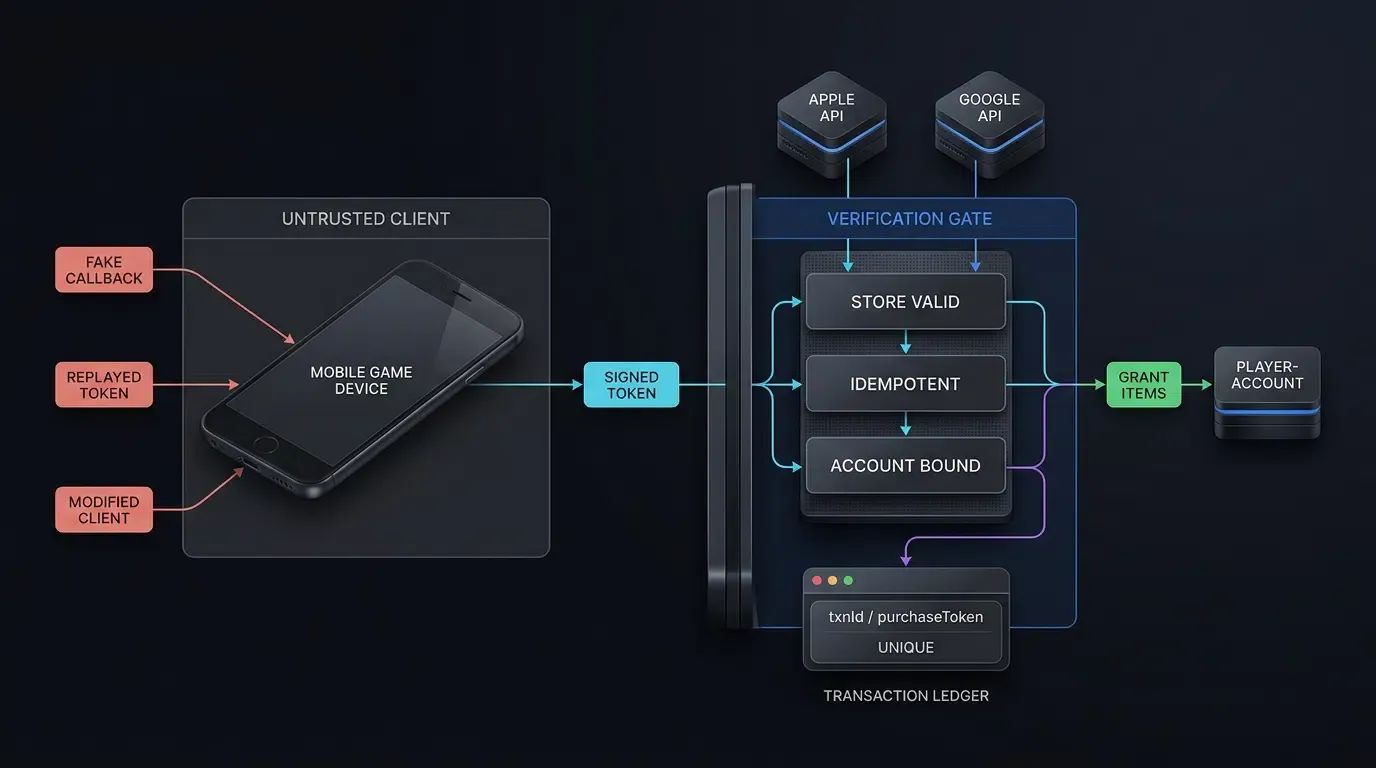
Relying exclusively on on-device client logic to validate purchases introduces severe economic vulnerabilities. In mobile threat models, client-side runtime environments must be treated as untrusted.
Common client-side IAP exploit vectors include:
- Billing Emulation Frameworks: Tools on rooted Android devices or jailbroken iOS devices intercept billing API calls, returning fake purchase success callbacks directly to the client application.
- Local Man-in-the-Middle (MitM) Proxies: Interception proxies replace server responses with mock success payloads, tricking client-only verification routines.
- Binary Modification: Attackers modify compiled client binaries to bypass local verification checks entirely.
While StoreKit 2 on-device VerificationResult provides cryptographic verification on the device, client code can still be manipulated on compromised runtimes. Authoritative virtual economy items must be granted exclusively by a backend server that independently validates transactions with Apple or Google store APIs.
Building the Server-Authoritative Verification Pipeline: Gateway Routing to Store APIs
A resilient server-side validation pipeline isolates client requests, communicates with platform store APIs via secure service credentials, and enforces strict business rules before mutating database records.
Secure Client-Server-Store IAP Verification Pipeline:

[Mobile Game Client]           [Game Backend Server]          [Apple / Google Store API]
         │                              │                                     │

    1. Initiate Purchase                  │                                     │
    2. Store Returns Signed Token ────────┼─────────────────────────────────────► (Processes Billing)
         │                              │                                     │
    3. Transmit Token & Payload ─────────►│                                     │
         │                              4. Validate Signature & App Context ──►
         │                              │                                     │
         │                              │◄── 5. Return Verified Transaction ──┘
         │                              │    (Status: Verified, Product, Token)
         │                              │
         │                              6. Idempotency Check (purchaseToken/txnId)
         │                              7. Grant In-Game Virtual Items
         │                              │
         │                              8. Authoritative Finalization:
         │                              │  ├─► Apple (Option A): Client calls ──► (StoreKit finish())
         │                              │  ├─► Apple (Option B): Server S2S ────► (App Store Finish Txn API)
         │                              │  └─► Google: Server S2S API ──────────► (Play consume/acknowledge)
         │                              │
    4. Log Client Telemetry ─────────────►│
       (Reconciled with Backend Record)   │
To validate Apple StoreKit 2 JWS transactions, a valid cryptographic signature is necessary but not sufficient for entitlement authorization. The backend must:
- Verify the JWS signature against Apple’s root certificate authority chain.
- Initialize the verifier with the expected application context: validate that the transaction’s
bundleIdmatches the app,environmentmatches Production or Sandbox, and ensure production verifier context includes the app’s Apple ID where required by the App Store Server Library. - Verify product identifier, transaction status, and revocation status before granting digital entitlements. Prefer Apple’s official App Store Server Library verification functions rather than writing custom cryptographic parsers.
For Google Play Billing, the backend receives the purchaseToken from the client. For one-time products, the backend queries purchases.productsv2.getproductpurchasev2 to retrieve the authoritative purchase state; for subscriptions, it queries purchases.subscriptionsv2.get. After entitlement delivery, the backend acknowledges or consumes the purchase using the appropriate endpoint.
App Store Server API .p8 private keys and Google Cloud Service Account credentials must remain strictly server-side, stored in a managed secret vault (KMS); never ship either credential inside the client application binary or commit it to source control.
Teams can review available cheating monitoring documentation for technical interfaces and fraud detection parameters.
Preventing Replay Attacks: Enforcing Transaction-Token Idempotency and Account Binding
To neutralize receipt replay attacks, the game server must enforce strict database-level idempotency:
- Primary Idempotency Keys: For Google Play, use the
purchaseTokenas the primary database deduplication key, as purchase tokens are globally unique across transactions. For Apple, usetransactionId. - Supporting Metadata: Store Google
orderId(where generated) and AppleoriginalTransactionIdas supporting commercial metadata for refund and customer support reconciliation. - Atomic Processing: When a receipt verification request arrives, check whether the
purchaseTokenortransactionIdhas already been processed. If present, return the existing entitlement status without granting duplicate virtual items. - Account Binding: Verify that the transaction is bound to the requesting player account to prevent cross-account receipt injection.
The JSON schema below illustrates a server-side receipt verification payload:
{
  "reference_architecture": true,
  "illustrative_values": true,
  "iap_server_verification_record": {
    "telemetry_metadata": {
      "verification_id": "ver_iap_2026_0915_9981",
      "timestamp_utc": "2026-09-15T09:30:00.120Z",
      "app_id": "com.example.game.rpg",
      "player_account_id": "usr_99812401"
    },
    "store_transaction_context": {
      "platform": "iOS",
      "store_environment": "Production",
      "store_transaction_id": "2000000123456789",
      "original_transaction_id": "2000000123456789",
      "product_id": "com.example.game.starter_pack",
      "product_type": "Consumable",
      "purchase_date_utc": "2026-09-15T09:29:45.000Z"
    },
    "apple_verifier_context": {
      "validation_protocol": "Apple_App_Store_Server_API_v2",
      "expected_bundle_id": "com.example.game.rpg",
      "expected_environment": "Production",
      "production_app_apple_id_configured": true,
      "transaction_bundle_id_match": true,
      "transaction_environment_match": true,
      "jws_signature_verified": true,
      "root_certificate_chain_valid": true,
      "revocation_status": "none",
      "ownership_type": "PURCHASED"
    },
    "commercial_revenue_telemetry": {
      "currency": "USD",
      "gross_customer_amount_minor": 499,
      "gross_amount_source": "store_transaction_price",
      "net_developer_proceeds_minor": null,
      "net_proceeds_status": "pending_financial_reconciliation",
      "store_fee_minor": null,
      "accounting_basis": "gross_purchase_price_until_reconciled"
    },
    "security_and_idempotency_state": {
      "idempotency_key": "txn_2000000123456789",
      "database_duplicate_check": "unique_new_transaction",
      "account_binding_verified": true,
      "entitlement_grant_status": "items_credited_successfully"
    },
    "attribution_reconciliation": {
      "attribution_channel": "partner_ad_network_video",
      "campaign_id": "cmp_rpg_launch_us",
      "revenue_event_logged_to_attribution": true,
      "ad_network_postback_eligible": true
    }
  }
}
Dual Platform Client SDK Tracking Implementation for Purchase Events
The Requirement for Accurate Revenue Telemetry in Attribution and Analytics
Accurate measurement of user acquisition campaigns requires transmitting purchase telemetry from client applications or game servers to the attribution platform. Tracking in-app purchases allows marketing teams to evaluate Return on Ad Spend (ROAS), calculate payer cohort retention, and train programmatic ad network bidding algorithms.
Client-side SDK events serve as immediate telemetry indicators; authoritative financial reporting and bidding signals should be reconciled against backend-verified transaction records.
When logging purchase telemetry, events must carry essential commercial parameters:
- Event Identifier: Standardized event key (e.g.,
iap_purchase). - Monetary Amount: Transaction value represented in integer minor units according to the ISO 4217 currency exponent (e.g., 499 for $4.99 USD, or 500 for ¥500 JPY which has zero decimal places).
- Currency Code: ISO 4217 three-letter currency code (e.g.,
USD,EUR,JPY). - Transaction Identifier: Unique backend transaction reference or public order ID to enable automated deduplication without exposing raw platform tokens to marketing SDKs.
Android Kotlin Implementation: Reporting Verified Purchase Events via saveEvent
On Android, games integrated with the native OpoInstall SDK report purchase events using the saveEvent API. The implementation passes the event key, the monetary amount in integer minor units, and custom key-value metadata.
iOS Swift Implementation: Reporting Verified Purchase Events via reportEffectPoint
On iOS, games integrated with the native OpoInstall SDK report purchase events using the reportEffectPoint API. The implementation passes the effect point identifier, the integer monetary amount in minor units, and an effect dictionary containing transaction metadata.
Developers seeking client SDK packages and integration documentation can consult the SDK integration resources for implementation guidelines. Note that API names and signatures are version-specific examples; verify against currently deployed SDK documentation.
The code examples below illustrate client-side IAP tracking across Android Kotlin and iOS Swift:
// Android Implementation (Kotlin)
// File: IapPurchaseHandler.kt
package com.example.game.billing

import android.content.Context
import com.opoinstall.api.OpoInstall
import java.util.HashMap

class IapPurchaseHandler(private val context: Context) {

    /**
     * Reports a purchase event to OpoInstall attribution SDK for marketing telemetry.
     * Note: Authoritative financial accounting is reconciled downstream via server-verified receipts.
     *
     * @param backendPurchaseEventId Unique transaction reference or verified order ID
     * @param productId SKU identifier (e.g. com.example.game.starter_pack)
     * @param amountMinor Monetary transaction value in integer minor units (e.g. 499 for $4.99 USD)
     * @param currency ISO 4217 Currency Code (e.g. USD, JPY)
     */
    fun trackPurchaseTelemetry(
        backendPurchaseEventId: String,
        productId: String,
        amountMinor: Long,
        currency: String
    ) {
        require(amountMinor in 0..Int.MAX_VALUE.toLong()) { "amountMinor exceeds SDK integer event range" }

        val extraData = HashMap<String, String>()
        extraData["transaction_reference"] = backendPurchaseEventId
        extraData["product_id"] = productId
        extraData["currency"] = currency
        extraData["revenue_basis"] = "store_purchase_price"

        // Report purchase telemetry to OpoInstall SDK
        OpoInstall.getInstance().saveEvent("iap_purchase", amountMinor.toInt(), extraData)
    }
}
// iOS Implementation (Swift)
// File: IapPurchaseTracker.swift
import Foundation
import libOpoInstallSDK

class IapPurchaseTracker: NSObject {

    /**
     * Reports a purchase event to OpoInstall attribution SDK for marketing telemetry.
     * Note: Authoritative financial accounting is reconciled downstream via server-verified receipts.
     *
     * @param backendPurchaseEventId Unique transaction reference or Apple Transaction ID
     * @param productId In-App Product Identifier (e.g. "com.example.game.starter_pack")
     * @param amountMinor Monetary transaction value in integer minor units (e.g. 499 for $4.99 USD)
     * @param currency ISO 4217 Currency Code (e.g. "USD", "JPY")
     */
    @objc public static func trackPurchaseTelemetry(
        backendPurchaseEventId: String,
        productId: String,
        amountMinor: Int,
        currency: String
    ) {
        let effectDictionary: [String: String] = [
            "transaction_reference": backendPurchaseEventId,
            "product_id": productId,
            "currency": currency,
            "revenue_basis": "store_purchase_price"
        ]

        // Report purchase telemetry to OpoInstall SDK
        OpoInstallSDK.defaultManager()?.reportEffectPoint(
            "iap_purchase",
            effectValue: amountMinor,
            effectDictionary: effectDictionary
        )
    }
}
How to Reconcile In-App Purchase Telemetry with Acquisition Attribution
Linking In-Game Revenue to Initial Marketing Channels
Attribution tracking links in-game purchase events back to the specific marketing source, campaign, and creative that acquired the player. When a player installs the game, the attribution SDK records the acquisition touchpoint (e.g., Google Search, TikTok Ad, Meta Campaign, or Organic Discovery).
When an IAP transaction occurs days or weeks later, the attribution engine associates the revenue with the original install touchpoint. This enables studios to disaggregate blended financial metrics, linking verified transactions to available acquisition attribution context and enabling channel-level revenue analysis where attribution can be resolved.
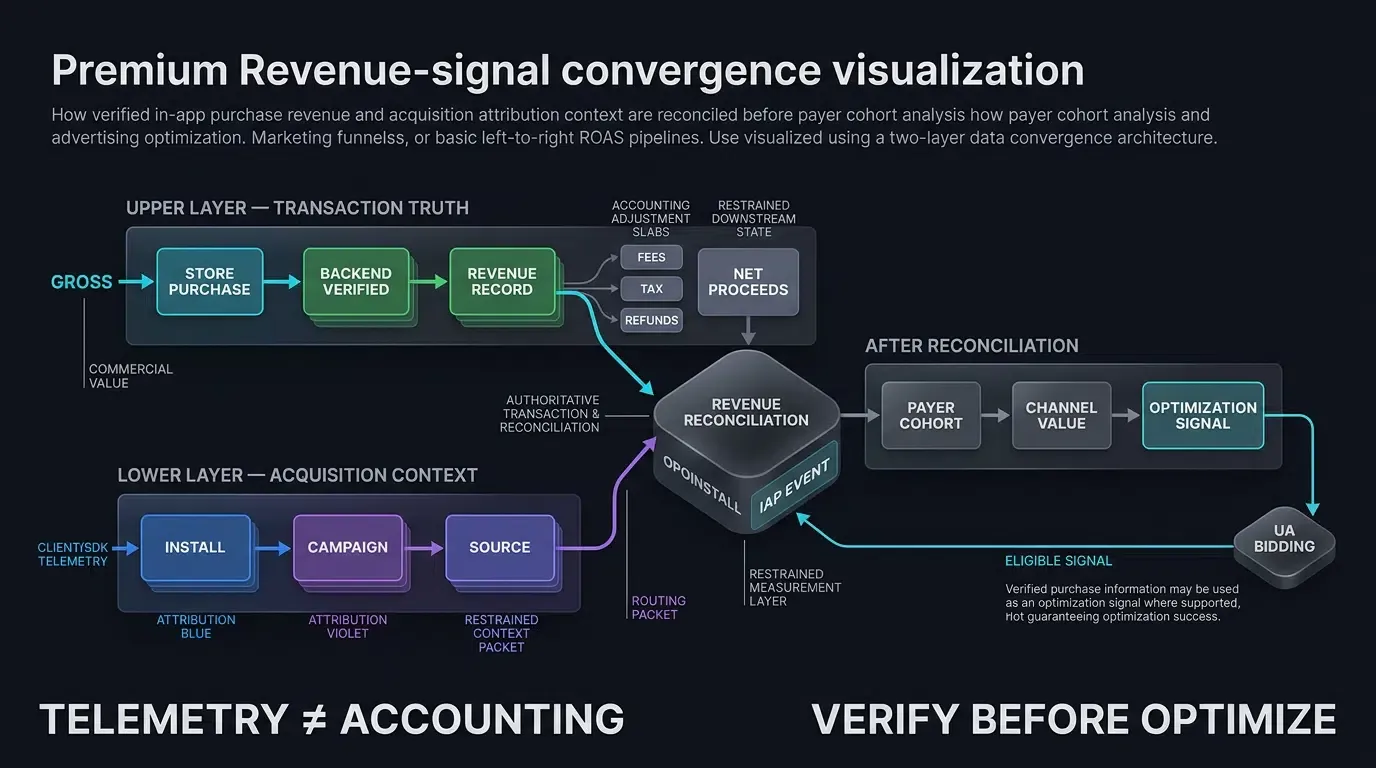
Reconciling Gross Store Proceeds against Net Accounting Revenue
To maintain financial accuracy, data engineering pipelines must reconcile gross customer spending reported at checkout against net realized proceeds.
Reconciliation requires accounting for standard store deductions:
- Platform Commission Fees: Store service fees vary by platform, program, developer tier, and product type (e.g., standard rates, small developer programs, or subscription tenure reductions).
- Local Taxes and Value-Added Tax (VAT): Withholding taxes deducted by platform stores prior to developer payout.
- Refunds and Chargebacks: Apple and Google provide refund reporting and real-time developer notifications when a customer disputes a transaction or initiates a chargeback.
Client-side events record gross purchase prices (store_purchase_price); data warehouses must apply store fee reconciliation downstream to derive net realized proceeds for financial LTV modeling.
Tracking Downstream Payer Cohorts: Cumulative IAP LTV Horizons
Payer behavior unfolds over longitudinal timeframes. Studios evaluate cumulative In-App Purchase Lifetime Value (
Where:
is the classical cohort retention rate on day . is the fraction of active users from the same acquisition cohort who complete an IAP on elapsed day . is the average net IAP revenue among those same-day active payers.
Different acquisition sources may exhibit different payer timing and long-tail spend patterns; these differences should be measured empirically by channel rather than inferred from channel labels.
Optimizing User Acquisition Bidding: Feeding Verified IAP Signals to Ad Network Auto-Bidders
Modern programmatic advertising networks utilize machine learning optimization models (such as Target ROAS or Value Optimization) to identify players with high spending propensity.
Where supported, verified purchase signals can be forwarded as optimization events or value postbacks to participating advertising platforms. This enables ad networks to shift bidding budgets automatically toward audience segments with verified purchasing behavior, improving campaign efficiency.
Comparative Analysis of In-App Purchase Product Types and Store Policies
Evaluating Operational Mechanics, Accounting Rules, and Lifecycle Demands Across Product Types
Mobile app stores categorize in-app purchases into distinct technical and commercial classifications.
The table below contrasts standard IAP product classifications across Apple StoreKit and Google Play Billing ecosystems:
| Product Classification | Apple StoreKit Product Type | Google Play Product Type | Platform Restoration Rule | Typical In-Game Use Case |
|---|---|---|---|---|
| Consumable | Consumable | One-Time Product (Consumable) | Maintained by game server; not automatically restored by store | Gold, gems, energy refills, gacha pulls |
| Non-Consumable | Non-Consumable | One-Time Product (Non-Consumable) | Restorable across user devices via native store transactions | Ad removal, character unlocks, story expansions |
| Auto-Renewing Subscription | Auto-Renewable Subscription | Subscription (Auto-Renewing Base Plan) | Managed and renewed automatically by store platforms | VIP membership, season battle passes |
| Non-Renewing / Prepaid Subscription | Non-Renewing Subscription | Subscription (Prepaid Base Plan) | Requires manual server-side duration management on iOS; Google manages prepaid terms | 30-day daily gem passes, limited event access |
Aligning Game Economies with Platform Store Guidelines
Platform billing remains the default mechanism for in-app digital goods transactions. However, permitted external payment options and alternative billing programs vary by storefront, region, program eligibility, and platform policy (such as European Union Digital Markets Act provisions, United States storefront external purchase links, or regional alternative billing programs in South Korea and Japan). Developers must evaluate the specific rules applicable to each distribution market rather than assuming a single global payment rule.
Furthermore, platform guidelines (such as Apple App Store Review Guidelines) require that games featuring randomized virtual items (such as gacha mechanics or loot boxes) explicitly disclose the statistical drop probabilities for each item type prior to purchase.
When Should Game Studios Enforce Strict Server-Side IAP Validation
Suitable Conditions for Mandatory Server-Authoritative Validation
Game development teams should enforce strict server-side receipt validation under specific operational conditions:
- Multiplayer and Competitive Games: Titles with shared virtual economies, leaderboards, or player trading where unearned currency exploits destroy competitive balance.
- Material Commercial Impact: Any microtransaction whose fraudulent fulfillment can materially affect revenue, tradable inventory, automated payouts, or downstream optimization signals.
- Campaigns Feeding Postbacks to Ad Networks: User acquisition pipelines where purchase events trigger real-time ad network postbacks or affiliate payouts, where spoofed events would corrupt auto-bidding algorithms.
Unsuitable Conditions for Complex Server Pipelines
Deploying complex server-to-server validation infrastructure introduces unnecessary overhead in limited scenarios:
- Standalone Offline Single-Player Titles: Offline casual games without backend servers or accounts, where native client-side StoreKit and Google Play Billing verification provides baseline protection, provided the studio accepts the inherent client-side security trade-off.
- Early Gameplay Prototypes: Soft-launch prototypes evaluating core mechanic retention before building scalable backend billing infrastructure.
Common Pitfalls and Security Vulnerabilities in IAP Implementation
- Pitfall 1: Client-Side Virtual Item Delivery: Crediting virtual currencies or items directly inside client purchase listeners without server receipt validation leaves the game vulnerable to basic billing emulators.
- Pitfall 2: Neglecting Google Play Acknowledgement: Failing to acknowledge or consume Google Play purchases within the required window after entering the
PURCHASEDstate results in automatic order refunds and lost revenue. - Pitfall 3: Omitting Unique Transaction Deduplication: Failing to enforce unique
purchaseToken(Google) ortransactionId(Apple) constraints in database schemas leads to duplicate item grants during network retries or replay attacks.
Frequently Asked Questions (FAQ)
What is an in-app purchase and how does it generate mobile game revenue?
Why is client-side IAP receipt validation vulnerable to billing fraud?
How does tracking in-app purchases improve game user acquisition ROAS?
Summary and Decision Framework
Implementing a resilient In-App Purchase infrastructure requires combining platform-standard billing lifecycles, server-authoritative receipt validation, and granular attribution tracking. Maximizing IAP revenue relies on protecting virtual economies against local billing exploits, enforcing idempotency checks, and linking verified purchase events to acquisition channels.
By integrating secure StoreKit 2 and Google Play Billing pipelines with mobile measurement SDKs, game studios can safeguard their monetization streams, optimize marketing spend toward high-LTV player cohorts, and build sustainable live-operations growth.
To explore how client SDK tracking and channel attribution can be configured for your game’s monetization pipeline, consult the mobile attribution implementation reference.
Related Materials
-
Concepts: In-App Purchase, Receipt Validation, StoreKit 2, Google Play Billing, Payer Cohort Tracking, IAP-ROAS
-
Technologies: App Store Server API, Google Play Developer API, Attribution SDK, JSON Web Signature (JWS)
-
Standards: IETF RFC 7515 JSON Web Signature (JWS), W3C Mobile Web Best Practices, OWASP Mobile Application Security
-
APIs: Google Play Billing Library, Google Play Developer API (Productsv2), Apple StoreKit 2 Transaction API, Apple App Store Server API (Finish Transaction), OpoInstall Event Tracking Interfaces (saveEvent, reportEffectPoint)
-
Official Documentation & References:
Share this article