How to adjust attribution windows to reduce click spamming fraud? Adjusting attribution windows to reduce click spamming fraud requires analyzing empirical Click-to-Install Time (CTIT) distributions, shortening multi-day lookback windows on channels exhibiting anomalous flat tails, and validating legitimate conversion retention against time-lag reports.
An attribution lookback window is a configured timeframe between an ad interaction (impression or click) and an application install during which a media source is eligible to claim conversion credit. Adjusting this window represents a critical operational trade-off: tightening the window shrinks the temporal attack surface exploited by click flooding and timing arbitrage, while expanding it accommodates high-consideration users whose natural evaluation cycle spans several days.
| Term | Definition | Related Entity | Search Intent Role |
|---|---|---|---|
| Attribution Tracking | The systematic measurement and credit assignment of marketing touchpoints. | Conversion Pipeline | Technical / Informational |
| Attribution Window | The designated temporal boundary governing conversion eligibility after an ad touch. | Lookback Duration | Operational / Decision |
| Ad Fraud | The deliberate exploitation of attribution rules to siphon advertising commissions. | Click Spamming | Informational / Security |
The Strategic Function of Attribution Lookback Windows in Mobile Measurement
The Mechanics of Credit Assignment: How Attribution Engines Evaluate Touchpoint Recency
In mobile performance advertising, attribution engines determine which promotional channel receives credit for an application installation. When a user launches an application for the first time, the client SDK initializes and transmits an installation event to the measurement gateway. The attribution engine queries historical engagement logs—comprising impressions, clicks, and deep-link redirects—to identify candidate touchpoints associated with that device.
Under standard last-touch attribution models, the interaction carrying the most recent timestamp prior to the install launch claims 100% of the conversion credit, provided the interaction occurred within an authorized timeframe. This temporal boundary is the attribution lookback window. If an ad engagement occurs outside this window, the attribution engine discards it from consideration, classifying the downstream conversion as organic or attributing it to an earlier qualifying touchpoint. Consequently, lookback windows define the operational boundary of commercial attribution eligibility.
Click-Through Windows versus View-Through Windows
Attribution architectures enforce distinct windows depending on the interaction modality:
- Click-Through Lookback Windows (CTW): Govern conversions following an explicit user action, such as clicking an ad banner, tapping a sponsored search placement, or engaging with an interactive promo. Because a click demonstrates active intent, platforms configure click-through windows across multi-day intervals. However, default durations vary materially across ad platforms, conversion actions, and measurement configurations.
- View-Through Lookback Windows (VTW): Govern conversions following an ad impression where no physical click occurred. Because impressions represent passive exposure, view-through windows are generally configured shorter than click-through windows to limit speculative claims. For example, Google Ads applies a 24-hour view-through window in certain Android App Campaign contexts, while other display channels allow customizable intervals. Attributing installs to passive impressions across extended multi-day horizons introduces substantial risk of misattribution, as causal links decay rapidly after impression exposure.
The Multi-Day Window Challenge: Why Extended Durations Expand Exposure
Many growth marketing teams operate under the assumption that default attribution settings configured by ad networks or Mobile Measurement Partners (MMPs) reflect optimal configurations for every channel. In practice, standard multi-day windows are often configured to maximize matched conversions across broad inventory sources.
In programmatic and affiliate environments, broad multi-day lookback windows create an expansive temporal surface area vulnerable to exploitation. When attribution engines permit clicks from 7, 14, or 30 days prior to claim credit for a modern app launch, they expand the window during which speculative touchpoints can overlap with natural organic installs. Malicious networks capitalize on these wide windows by sending millions of low-intent or automated clicks across broad device pools, waiting for real-world organic activity to trigger attribution matching.
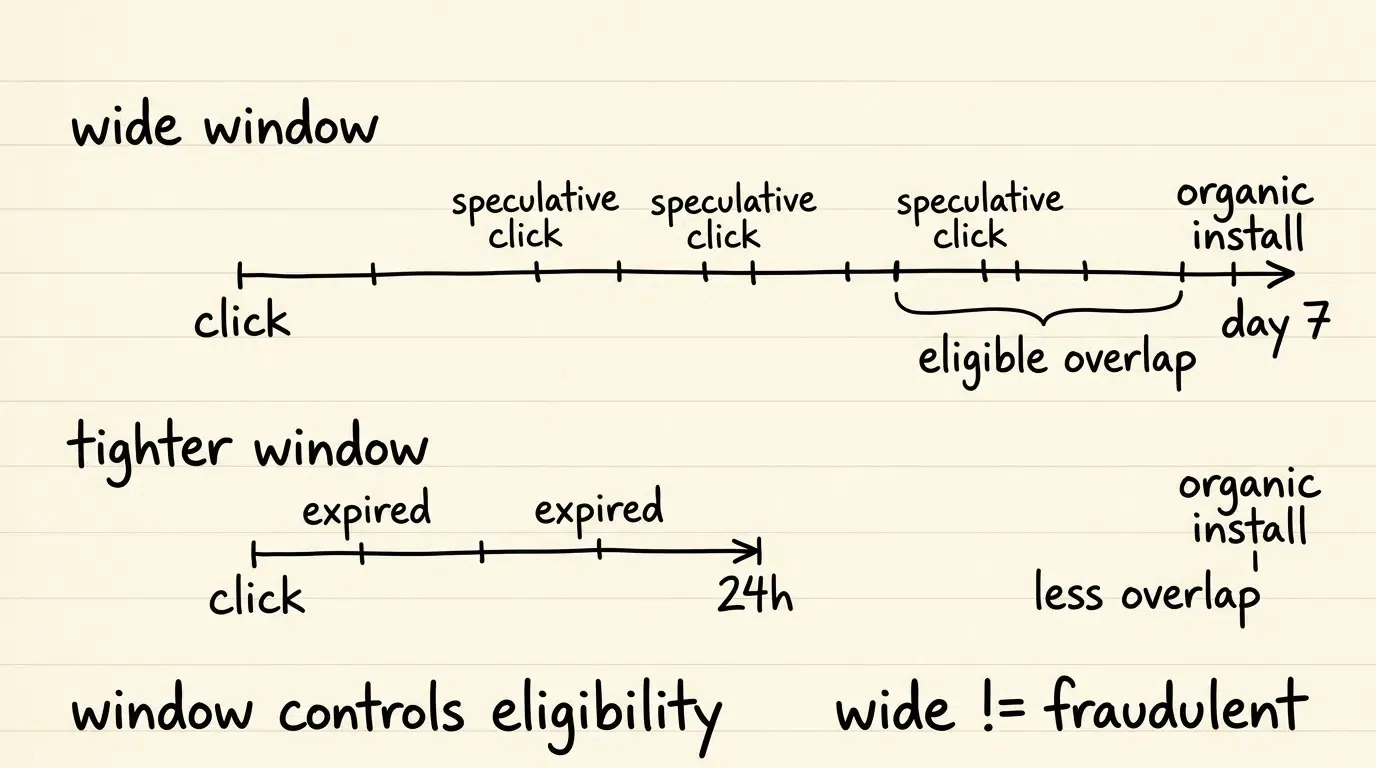
How Extended Attribution Windows Expose Campaigns to Click Spamming and Why Click Injection Is Different
Click Spamming as a Statistical Temporal Surface Problem
Click spamming (also referred to as click flooding) is fundamentally an attack on temporal probability. Fraudulent publishers or ad networks do not target users who have demonstrated explicit interest in an advertised product. Instead, they generate continuous streams of synthetic or unprompted clicks across high volumes of active mobile devices.
These speculative clicks remain active in the attribution platform’s lookback cache. If any recipient of those background pings downloads an advertised application days later, the arbitrage network is awarded a Cost-Per-Install (CPI) or Cost-Per-Action (CPA) commission. The advertiser compensates the network for a user who was already converting through organic discovery or alternative marketing channels, inflating acquisition costs while potentially claiming conversions that provide little or no incremental lift attributable to the fraudulent touchpoint.
Mathematical Modeling of Speculative Click Interception
To understand why wide windows invite click spamming, the interaction can be modeled using an illustrative Poisson process. Assuming fraudulent speculative clicks arrive independently at an average rate
Where:
represents the frequency of speculative clicks delivered to a given device per unit of time. represents the duration of the active attribution lookback window.
This model illustrates temporal overlap opportunity rather than confirmed fraud attribution. Because
Why Window Contraction Mitigates Click Spamming but Not Click Injection
While click spamming operates over extended timeframes, click injection is an install-time exploit. Historically on Android, click-injection malware exploited system-level broadcast intents and install-state transitions to detect an ongoing installation and dispatch a synthetic click seconds before the application was first launched.
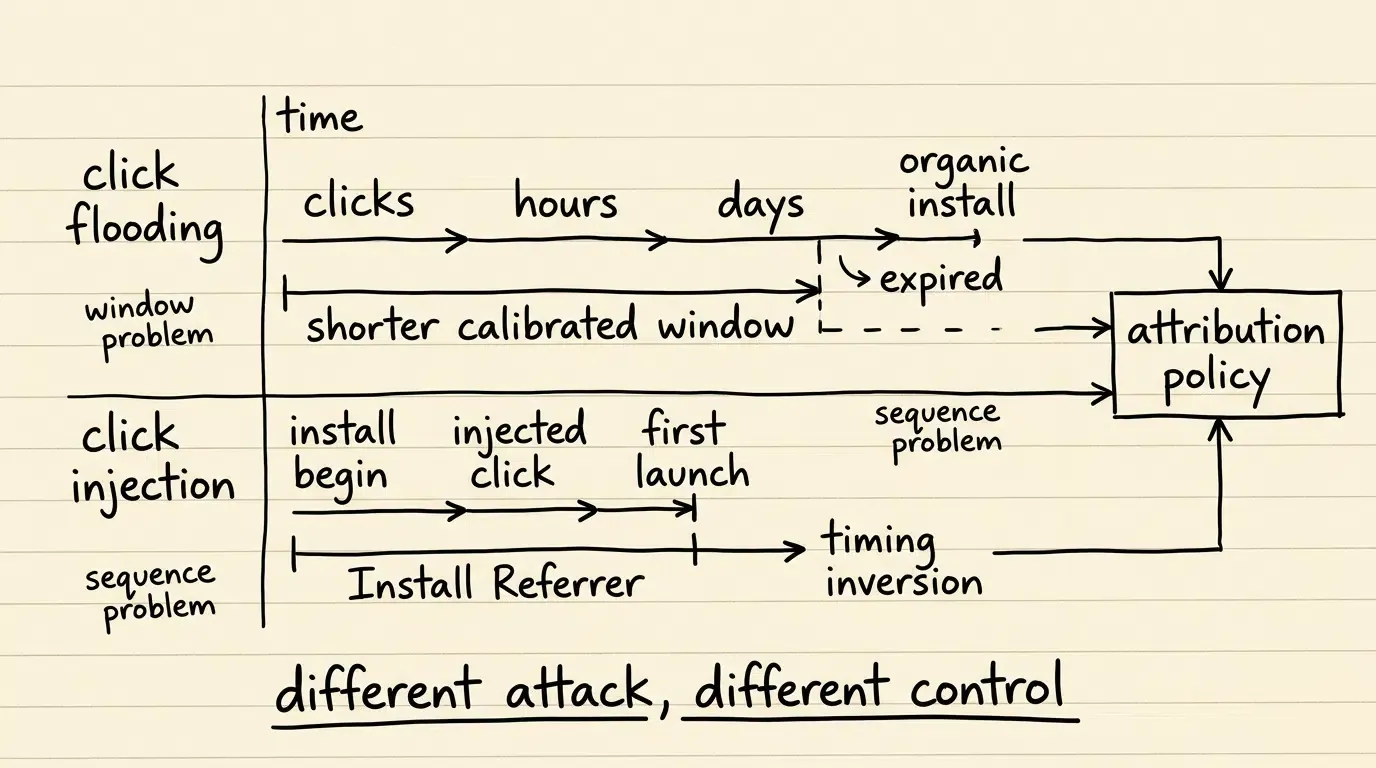
Because click injection takes place within seconds of app installation, contracting an attribution window from 7 days to 24 hours does not prevent click injection; the injected click occurs moments before launch, easily falling within even a 1-hour lookback window. Therefore, marketing teams must understand that attribution window contraction is specifically designed to neutralize click spamming and timing arbitrage. Countering click injection requires independent timestamp reconciliation using Google Play Install Referrer data.
Differentiating Between Click Flooding and Click Injection Mechanics
Marketing and data analytics teams must maintain clear technical differentiation between these two attribution threats:
| Threat Dimension | Click Flooding (Spamming) | Click Injection |
|---|---|---|
| Execution Vector | High-volume background clicks, unprompted touchpoint cycling | Install-state monitoring triggering last-second clicks |
| Temporal Placement | Dispatched hours or days prior to user installation | Dispatched seconds after download begins, before app launch |
| Attribution Vulnerability | Wide lookback windows (multi-day durations) | Lack of install-begin timestamp verification |
| Primary Countermeasure | Empirically calibrated contraction of click-through attribution windows based on channel-specific CTIT distributions | Google Play Install Referrer timestamp reconciliation |
| Impact on CTIT | Produces flatter, long-tailed distribution curves | Produces anomalously short CTIT clusters within seconds |
The Analytical Trade-Off: Balancing Fraud Exposure Against Delayed Conversion Loss
The Core Decision Dilemma: Fraud False Acceptance versus Legitimate False Rejection
Calibrating attribution lookback windows presents an operational trade-off between two distinct risks:
- Fraud False-Acceptance Risk: Permitting an overly wide lookback window allows speculative, non-incremental clicks to remain eligible for attribution, leading to unearned commission payouts.
- Legitimate False-Rejection Risk: Enforcing an overly narrow lookback window drops genuine, high-intent human clicks where the user legitimately required multiple days to evaluate, download, or launch the application.
Attribution Window Optimization Frontier:

Risk Level
  |
  |\                                 /  Fraud False-Acceptance Risk
  | \   (Legitimate False-Rejection /   (Speculative Overlap from Click Flooding)
  |  \   Risk from Dropped Users)  /
  |   \                           /
  |    \                         /
  |     \       Optimal         /
  |      \     Threshold       /
  |       \        |          /
  |________\_______V_________/________________
  0h      12h     24h       48h     7d      30d  (Lookback Window Duration)
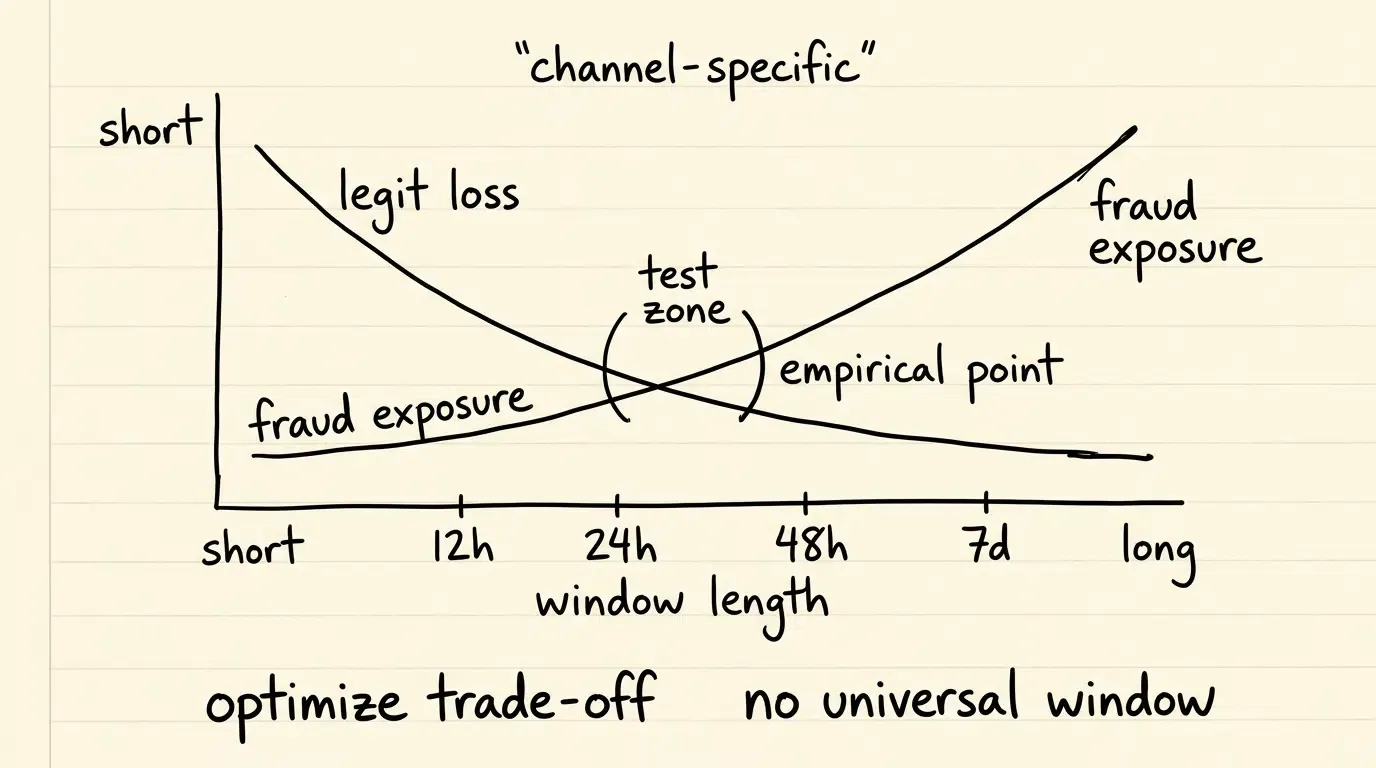
The objective of window calibration is identifying the empirical operational point where the marginal reduction in fraudulent claims exceeds the marginal loss of legitimate conversion visibility.
Analyzing Cumulative Conversion Distribution Curves
To determine appropriate window lengths without arbitrary guesswork, growth teams evaluate empirical cumulative distribution functions of Click-to-Install Time (CTIT) derived from trusted acquisition channels.
The cumulative probability
Industry research across attribution providers (such as AppsFlyer’s observation that roughly 75% of legitimate installs complete within the first hour, and Adjust’s distribution-modeling research showing high early concentration) demonstrates that legitimate intent-driven installs cluster heavily in early time intervals. However, exact quantiles vary materially based on application package size, network conditions, ad formats (such as rewarded video versus display banners), and regional download speeds. Window calibration must therefore rely on an application’s own empirical CTIT quantiles rather than assumed universal percentages.
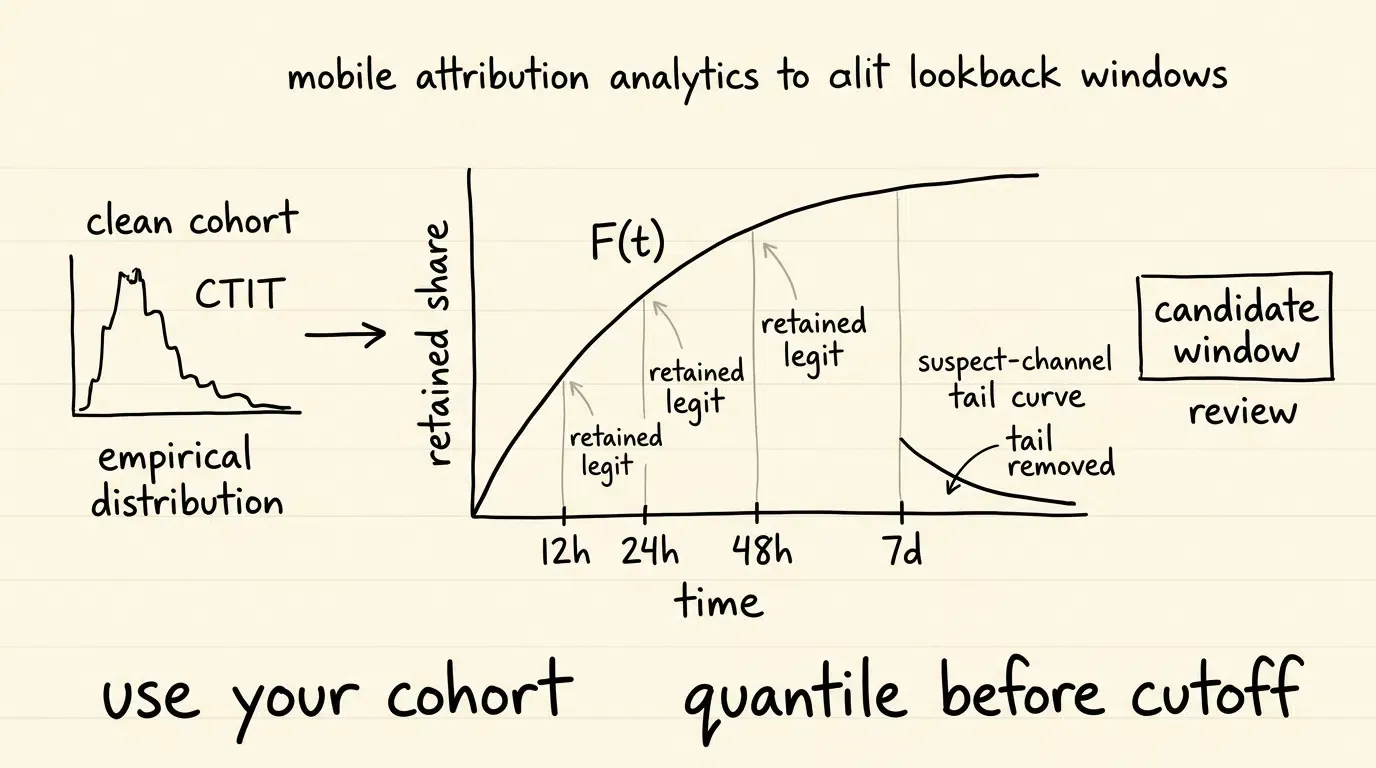
Attribution Elasticity: Measuring Conversion Drop per Unit of Window Contraction
Attribution elasticity (
Evaluating elasticity serves as an illustrative scenario tool:
- Low Window Sensitivity: On intent-driven channels (such as branded search), contracting a lookback window from 7 days to 24 hours often results in minimal conversion loss, indicating that the vast majority of converting users act quickly upon clicking.
- High Window Sensitivity: On speculative affiliate channels, contracting the window may cause reported conversion volumes to drop substantially. While some of this drop represents legitimate delayed users, an abrupt volume collapse warrants investigation to determine whether the channel was reliant on multi-day background overlap.
Evaluating Conversion Latency Across Mobile Verticals
Conversion latency curves vary substantially across business models and user onboarding friction:
- Casual Gaming and Utility Apps: Characterized by low friction and immediate engagement. Package sizes are compact, onboarding requires minimal setup, and users launch immediately post-download. These verticals naturally display rapid CTIT decay, making shorter test windows (e.g., 12 to 24 hours) viable.
- FinTech, Neobanking, and Regulated Apps: Involve identity verification, document scanning, and compliance reviews. Users frequently download the application but delay initial launch or account funding until identity documents are ready, displaying longer legitimate latency.
- B2B SaaS and Enterprise Productivity: Multi-device workflows where a user clicks an ad on desktop or mobile web but completes installation and team configuration over several days.
How to Audit Click to Install Time Distributions to Calibrate Window Thresholds
Establishing Empirical Click-to-Install Time Baselines for Clean Channels
Calibration begins by auditing CTIT distributions across comparatively trusted or independently validated cohorts—such as owned media, organic social links, and authenticated search campaigns.
Data engineers extract raw click and install timestamps to compute individual latencies:
Aggregating these observations into discrete time intervals establishes the empirical baseline. A healthy baseline displays a steep peak within early hours, followed by rapid decay toward baseline levels over subsequent intervals.
Identifying the Fraud Anomaly Region on the CTIT Curve
When auditing third-party ad networks, analytics teams inspect the CTIT distribution for deviations from established baselines. Click flooding produces a flatter, long-tailed distribution curve with a substantially weaker early-install peak:
Click-to-Install Time (CTIT) Diagnostic Profiling:

Install
Volume
  |      /\
  |     /  \    Legitimate Cohort (Rapid Decay toward Baseline)
  |    /    \
  |   /      \___________________
  |  /                           \
  | /      ======================= Fraudulent Click Flooding Region
  |/                               (Flatter Long Tail across Multi-Day Horizon)
  +------------------------------------------------------------>
  0h    2h    12h    24h    48h    72h    5d    7d  (Time Elapsed)
                     |
                     ▲
            Example Test Window Cutoff
The fraud anomaly region is characterized by an absence of early-hour concentration paired with uniform conversion volumes extending across days 2 through 7. Shortening the attribution window cuts off this extended tail, preventing speculative clicks from remaining eligible for attribution.
Using Install Referrer Timing Signals to Address Click Injection Independently
Because click injection occurs immediately prior to app launch, shortening attribution lookback windows is ineffective against it. Protecting campaigns against click injection requires evaluating Google Play Install Referrer timing signals.
Google Play Install Referrer exposes client-side referrer_click_timestamp_seconds and install_begin_timestamp_seconds, along with server-side timestamp counterparts (referrer_click_timestamp_server_seconds and install_begin_timestamp_server_seconds) in the lower-level service response. Fraud analysis should compare timestamps from the same time domain and treat a referrer click recorded after install initiation as a strong click-injection signal under the configured fraud-enforcement policy:
This temporal inconsistency serves as a strong diagnostic indicator of click injection, enabling attribution engines to invalidate the click under the configured policy regardless of whether the general attribution window is configured to 1 hour or 7 days.
Visualizing Attack Surface Reduction Across Window Configurations
The diagram below illustrates how window adjustments address click flooding while Install Referrer validation addresses click injection:
Standard Multi-Day Window (Expanded Exposure Surface):
[Ad Click] ─────────────────────────────────────────────────────────────► [Day 7]
|◄───────────── Broad Temporal Surface for Speculative Click Flooding ────────►|

Constrained Test Window (Reduced Exposure Surface):
[Ad Click] ──────────────► [Day 1]
|◄── Focused Intent ────►| (Multi-Day Speculative Overlap Excluded Beyond Cutoff)

Click Injection Interception (Evaluated via Referrer Timing Signals):
[Download Begins] ──► [Malicious Click Injected] ──► [Install Completes & Opens]
        │                        │                               │
        └──────── Referrer Timing Disqualifies Click ────────────┘
                  (install_begin_timestamp_seconds < referrer_click_timestamp_seconds)
Technical Framework for Custom Attribution Window Configuration
Configuring Channel-Specific and Format-Conditioned Lookback Durations
Attribution architectures should avoid rigid, account-wide window settings in favor of granular, channel-specific policies. High-trust search campaigns operate under different conversion dynamics than programmatic display inventory.
Key operational considerations include:
- Format Differentiation: Applying tighter windows to display inventory while maintaining longer test intervals for high-consideration content.
- Tiered Partner Governance: Testing newly onboarded, unverified media sources with constrained windows until clean CTIT distributions are verified.
- View-Through Disablement: Disabling view-through attribution on inventory sources lacking robust viewability measurement.
Decoupling View-Through Windows from Click-Through Windows
View-Through Attribution (VTA) represents an elevated misattribution risk when paired with multi-day windows. Because users encounter numerous ad impressions daily, extended VTA windows can easily overlap with organic installs by coincidence.
Engineering teams should configure view-through windows independently from click-through windows:
- Impression Window Constraints: Restricting VTW to short intervals (such as 1 to 24 hours depending on media type) to ensure only proximate impressions claim credit.
- Click Priority Precedence: Where the attribution model uses click-over-view precedence, ensure valid clicks supersede eligible impression claims consistently.
Structuring the Attribution Window Policy Configuration Schema
To manage granular window policies across diverse partner ecosystems, attribution gateways enforce structured policy schemas.
The schema placeholder below illustrates an attribution configuration record defining channel-specific lookback durations, install referrer validation rules, and policy evaluation states:
{
  "reference_architecture": true,
  "illustrative_thresholds": true,
  "attribution_window_policy_record": {
    "policy_metadata": {
      "policy_id": "pol_win_opt_2026_0910_01",
      "timestamp_utc": "2026-09-10T08:00:00.000Z",
      "app_id": "com.example.enterprise.app",
      "evaluation_engine": "OpoInstall Attribution Rules Reference Architecture"
    },
    "channel_governance_profile": {
      "partner_id": "partner_network_display_beta",
      "channel_type": "programmatic_display",
      "risk_tier": "tier_2_unverified_affiliate"
    },
    "window_configuration": {
      "click_through_window_hours": 24,
      "view_through_window_hours": 0,
      "view_through_attribution_enabled": false,
      "default_network_lookback_override": true,
      "historical_network_default_days": 7
    },
    "install_referrer_enforcement": {
      "require_install_referrer_validation": true,
      "reject_if_click_postdates_install_begin": true,
      "timing_fields_evaluated": [
        "referrer_click_timestamp_seconds",
        "install_begin_timestamp_seconds"
      ]
    },
    "dynamic_threshold_triggers": {
      "flat_tail_anomaly_trigger": true,
      "early_window_ratio_baseline": "<empirical_channel_baseline>",
      "observed_early_hour_ratio": 0.08,
      "window_adjustment_mode": "review_required",
      "automated_action_authorized": false
    },
    "audit_disposition": {
      "current_policy_status": "active",
      "proposed_adjustment_status": "pending_review",
      "conversion_eligibility_state": "window_constrained_and_referrer_verified",
      "reason_codes": [
        "LOOKBACK_WINDOW_SHORTENED_TO_24H",
        "VTA_DISABLED_FOR_DISPLAY",
        "INSTALL_REFERRER_TIMING_ACTIVE"
      ]
    }
  }
}
Governance Framework for Dynamic Lookback Adjustments
When analytics engines detect anomalous flat-tail CTIT distributions on an active channel, governance policies should require human review or structured approval before changing commercial terms:
- Audit Notification: An alert flags the channel for review when the proportion of early-hour conversions falls significantly below established historical baselines.
- Approval-Gated Policy Adjustments: Lookback window reductions are executed following analytical review, ensuring media partners receive transparent documentation of timing anomalies before commercial reconciliation.
Comparative Analysis of Attribution Window Policies Across Ad Formats
Evaluating Optimal Lookback Configurations by Ad Placement and Media Type
Different advertising formats carry distinct user interaction dynamics. Applying an identical window across search, video, and programmatic banners distorts measurement integrity.
The matrix below outlines illustrative starting hypotheses for testing lookback configurations across advertising formats:
| Ad Placement / Format | Typical User Intent Profile | Example Test Click Window | Example Test View Window | Primary Attribution Risk Mitigated |
|---|---|---|---|---|
| Paid Search (High Intent) | Immediate, active intent | 12 to 24 Hours | Disabled | Click flooding, organic cannibalization |
| In-App Rewarded Video | High engagement, immediate action | 12 to 24 Hours | 1 to 6 Hours | Impression-based attribution overlap |
| Programmatic Display Banner | Low intent, passive exposure | 24 Hours | Disabled | Click spamming, impression fraud |
| Social / Influencer Content | High consideration, delayed download | 48 to 72 Hours | 12 to 24 Hours | False rejection of delayed conversions |
| Affiliate Networks | Variable intent, multi-touch hops | 24 Hours | Disabled | Speculative attribution claiming |
Balancing Marketing Intent Profiles Against Fraud Vulnerability
As outlined in the comparison matrix, formats characterized by passive exposure warrant tight click windows and disabled view-through attribution. In contrast, formats involving substantial user consideration justify extended test windows, as genuine users frequently research application features before downloading.
When Should Attribution Windows Be Dynamically Shortened
Conditions Warranting Window Contraction Evaluation
Growth marketing and fraud teams should evaluate attribution lookback window contraction under specific operational conditions:
- Flat Multi-Day CTIT Distributions: When an ad network’s latency profile displays uniform installation volumes across days 2 through 7 without an early conversion peak.
- Inverse Organic Volume Correlations: When scaling paid spend on a specific media partner correlates with an immediate, unexplained contraction in organic baseline downloads.
- High Clicks-Per-Install Ratios: When a publisher experiences an exponential increase in click volume paired with declining conversion rates, suggesting automated background touchpoints.
- Low Downstream Cohort Retention: When an attributed cohort exhibits near-zero Day-1 or Day-7 retention, which may indicate low-quality or non-consensual traffic when combined with timing anomalies.
Conditions Warranting Extended Lookback Durations
Maintaining broader lookback windows (48 to 72 hours) is appropriate under specific commercial parameters:
- High-Friction Onboarding Flows: Products requiring identity verification, document uploads, or external account linking before full activation.
- Large Application Binaries: Applications with substantial asset downloads where users routinely defer installation until connecting to Wi-Fi networks.
- High-Consideration B2B and SaaS Platforms: Cross-device discovery workflows where users evaluate software across desktop before installing mobile companions.
Common Misconceptions in Attribution Window Management
- Misconception 1: Shortening the Attribution Window Stops Click Injection: Click injection occurs within seconds during package download. Because the injected click lands seconds before launch, shortening a lookback window from 7 days to 24 hours does not prevent click injection. Click injection must be resolved by verifying Google Play Install Referrer timing signals.
- Misconception 2: Standardizing an Identical Window Across All Networks Ensures Fairness: Enforcing an identical multi-day window across diverse channels creates an uneven playing field that rewards speculative click spammers while failing to reflect the natural latency of intent-driven channels.
- Misconception 3: Shorter Windows Always Reduce Scalable Growth: While contracting windows drops reported conversion counts on low-intent channels, it removes unearned organic claims, lowering effective Customer Acquisition Costs and freeing capital for incremental acquisition.
Frequently Asked Questions (FAQ)
What is an attribution lookback window in mobile advertising?
How does shortening a click-through window mitigate click spamming without harming legitimate campaigns?
Why are install referrer timestamps more effective than window adjustments against click injection?
Summary and Decision Framework
Optimizing attribution lookback windows is a foundational operational defense against mobile attribution fraud. Effectively managing windows requires moving away from static, universal defaults and adopting format-specific, empirical configurations that balance fraud risk against legitimate delayed conversions.
By combining calibrated lookback windows for click spamming with install referrer timestamp validation for click injection, marketing organizations can protect their ad spend, restore organic baseline transparency, and ensure that advertising budgets reward genuine incremental growth.
To explore how custom attribution windows and cheating monitoring rules can be deployed across your acquisition campaigns, consult the mobile attribution implementation reference.
Related Materials
-
Concepts: Attribution Lookback Window, Click Flooding, Click Injection, View-Through Attribution, Click-Through Attribution
-
Technologies: Mobile Measurement Partner, Install Referrer API, Real-Time Fraud Engine, Dynamic Window Policy
-
Standards: IETF RFC 3339 Timestamp Formatting, W3C Performance Timeline, OWASP Mobile Application Security
-
APIs: Google Play Install Referrer API, Apple StoreKit Ad Network API, Channel Statistics Interfaces
-
Official Documentation & Industry Research:
Share this article