Doubao restricts GUI actions? On September 16, 2026, the Nubia NaviX Ultra smartphone officially went on sale featuring the consumer release of the Doubao Phone Assistant, yet real-world device testing revealed that automated graphical user interface (GUI) actions were halted across major third-party platforms including WeChat, Taobao, Meituan, and JD.com. Two days earlier, on September 14, Doubao published the Screen Automation Execution Protocol, establishing the Doubao SAEP Protocol as a formal negotiation framework to govern how external AI agents interact with Android application surfaces. For operating system architects, mobile security teams, and platform developers, this deployment bottleneck exposes a fundamental structural conflict between system-level multimodal agents seeking friction-free screen traversal and independent application runtimes defending security perimeters and transaction integrity while creating commercial tension around traffic and transaction control.
The Commercial Reality of Mobile Agents: Inside the NaviX Ultra Launch and GUI Gridlock
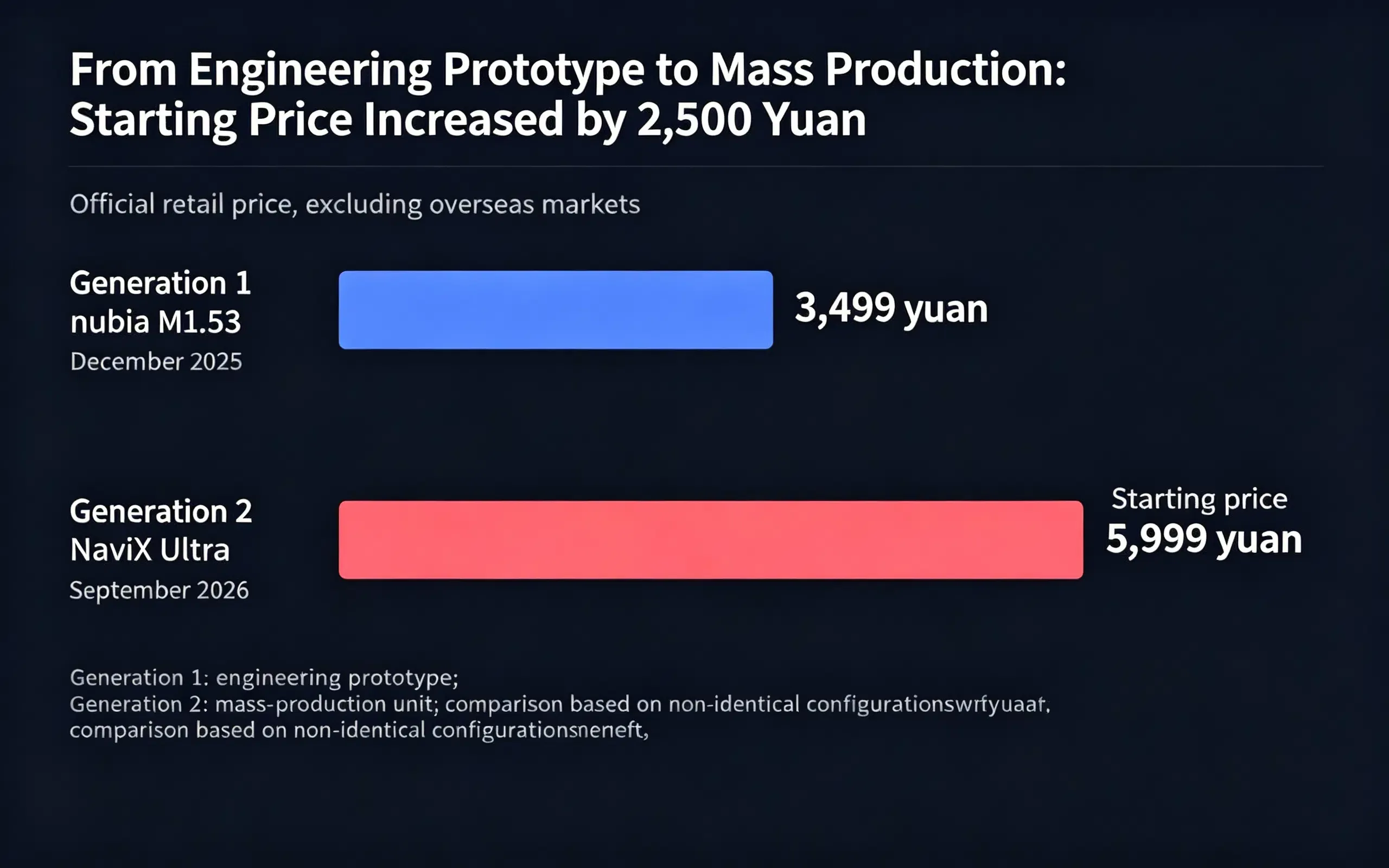
The arrival of the Nubia NaviX Ultra—branded colloquially across Chinese technology media as the “Doubao Phone Gen 2”—carried substantial consumer and commercial expectations. Priced from 5,999 yuan (reaching 5,499 yuan after national consumer electronics subsidies), the device represents a 2,500-yuan premium over the initial 3,499-yuan M153 engineering prototype distributed to developers in December 2025. Following the commercial launch, Nubia announced that launch-day sales value exceeded 100 million yuan within one second of orders opening.
Despite aggressive hardware marketing emphasizing an end-to-end intelligent agent workflow, initial real-device evaluations by media outlets and independent engineers revealed an operational impasse. While the integrated Doubao Phone Assistant could launch designated application packages upon voice command, automated in-app traversal, simulated taps, and multi-step checkouts were unavailable under the current SAEP policy and third-party platform restrictions. User commands to post updates to WeChat Moments, compare product specifications on Taobao, complete retail checkouts on JD.com, or finalize food delivery orders on Meituan were not executed. In practice, automated GUI actions were supported across system applications, ZTE core utilities, ByteDance’s internal portfolio (such as Douyin, Feishu, and Qishui Music), and a limited set of explicitly integrated partners like Caocao Mobility, while common third-party consumer workflows remained in a suspended, manual state.
At a Glance
- Immediate Functional Bottleneck: While the device launches third-party application binaries upon voice command, automated in-app traversal, simulated taps, and background checkouts remain restricted across major digital ecosystems.
- Introduction of the SAEP Protocol: On September 14, 2026, Doubao unveiled the Screen Automation Execution Protocol (SAEP), initiating a 30-day public review period (running through October 15, 2026) during which third-party apps remain shielded from automated GUI interaction by default.
- System Permissions vs. Business Moats: Despite Doubao commanding over 382 million monthly active mobile app users as of June 2026, raw audience scale cannot override application-level security sandboxes or commercial traffic governance rules.
- Architectural Paradigm Evolution: The mobile engineering landscape is rapidly moving away from unpermissioned visual screen-scraping toward declared agent-to-agent (A2A) interfaces, fine-grained permission manifests, and mutual platform agreements.
This real-world limitation mirrors the technical history of the platform’s first-generation preview. When the Nubia M153 engineering prototype launched on December 1, 2025, it demonstrated automated GUI operations through privileged system-level input injection capabilities, including the INJECT_EVENTS permission. Within 48 hours, users reported account security anomalies and abnormal session terminations inside WeChat. By December 3, Doubao withdrew automated WeChat execution capabilities entirely. On December 5, the team formally contracted the assistant’s operational scope, prohibiting automation across gaming environments, reward-point farming interfaces, and financial institutions. The transition from the M153 prototype to the mass-produced NaviX Ultra demonstrates that raw vision-language model (VLM) screen comprehension cannot substitute for structural, bilateral platform authorization.
Under-the-Hood Architectural Governance: Deconstructing the SAEP Rules and Notice Period
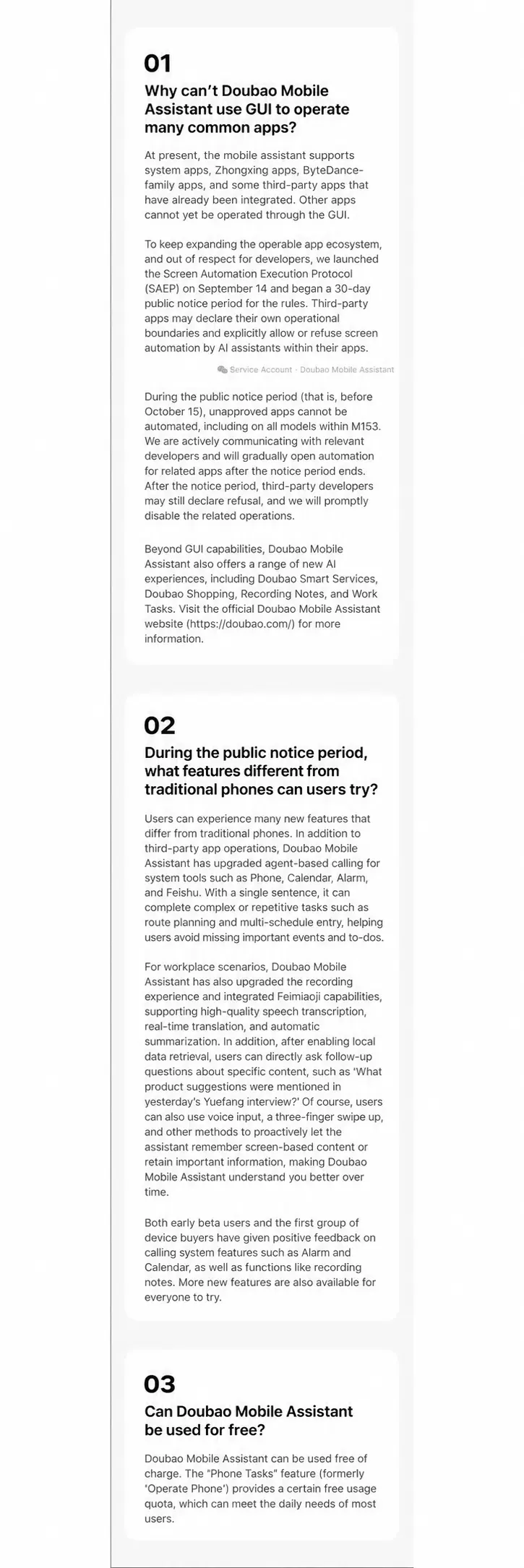
The launch of the Doubao SAEP Protocol on September 14, 2026, marks an industry attempt to standardize how operating system agents declare, request, and execute screen automation. Rather than treating third-party application view hierarchies as passive visual targets, SAEP introduces an explicit consent lifecycle governing automated interactions. On September 17, 2026, Doubao Phone Assistant released an official question-and-answer statement directly addressing why common third-party apps cannot currently be operated via GUI, formally detailing the 30-day notice period and application self-determination framework.
The governance rollout operates across two distinct phases. During the initial 30-day public notice window—extending from September 14 through October 15, 2026—the execution layer enforces a fail-closed default state across all supported hardware (including both the NaviX Ultra and earlier M153 platforms). Unless a third-party application developer explicitly submits an affirmative opt-in declaration, the Doubao Phone Assistant will not perform synthetic input events or execute automated tasks inside that application’s UI hierarchy. Following the expiration of this notice window, the protocol transitions to a risk-tiered framework: applications that formally register refusal via protocol channels or official developer communication email will remain excluded while that refusal remains in effect, while applications that have not registered an explicit stance will be evaluated and granted incremental automation capabilities based on functional risk tiers. Third-party developers retain the ongoing right to declare refusal at any point, which prompts the assistant to terminate automated actions.
Under the reported scope of the SAEP framework, application developers can declare specific operational boundaries across distinct functional controls:
- General Screen Automation Permission: Declaring whether the application permits an external agent to initiate automated workflows within its window surfaces.
- Screen Capture and Inspection: Controlling whether the assistant is authorized to capture screenshots or inspect permitted view content during task execution.
- Simulated User Input: Regulating whether the agent may inject synthetic touch coordinates, gestures, or automated text strings into native views.
- Content Modification: Defining whether the assistant is allowed to alter, edit, or clear existing text, form fields, or user-generated drafts within the application state.
This formal protocol addresses the stark operational realities exposed by empirical agent testing. In May 2026, the AndroidDaily research benchmark evaluated leading visual language models across 350 standard mobile tasks distributed throughout 94 production Android applications. Under strict multi-step testing conditions, the most capable multimodal agent achieved an end-to-end task completion rate of only 62.0 percent, while the benchmark’s automated evaluation framework (GRADE) demonstrated an 87.37 percent agreement rate with human annotators.
+--------------------------------------------------------------------------+
|            ANDROIDDAILY BENCHMARK: MULTI-STEP AGENT ATTRITION            |
+--------------------------------------------------------------------------+
|                                                                          |
|  Evaluated Tasks: 350 Realistic Multi-Step Workflows                     |
|  Evaluated Environment: 94 Production Android Applications               |
|                                                                          |
|  Top-Performing Multimodal Agent Completion Rate: 62.0%                  |
|  [====================================>                          ]       |
|                                                                          |
|  Dominant Failure Modes Identified in Benchmark:                         |
|  1. Latency-induced UI misalignment                                      |
|  2. Memory-induced repetitive action loops                               |
|  3. Protocol-induced capability degradation                              |
|                                                                          |
|  Examples of Real-World Execution Friction:                              |
|  - Asynchronous UI updates & pop-ups occurring during inference latency  |
|  - Redundant back-and-forth coordinate cycles on ambiguous visual states |
|  - Dynamic form validation rules & regional service boundaries           |
|                                                                          |
+--------------------------------------------------------------------------+
The gap between recognizing a UI component and successfully completing an end-to-end workflow stems from non-deterministic application environments. Production applications frequently alter layout hierarchies via dynamic server-driven UI frameworks, introduce transient promotional pop-ups, enforce anti-scraping token challenges, and require conditional decision-making when selected SKUs or seating allocations are unavailable. When an assistant attempts to parse these states purely through visual coordinate inference without direct application feedback loops, execution pipelines collapse, creating orphaned sessions, incorrect purchases, or security exceptions.
Decoupled Systems and Threat Modeling: Security Sandboxes, Traffic Moats, and Decision Sovereignty
The reluctance of third-party platforms to permit unrestricted GUI automation is driven by fundamental security engineering principles and commercial platform defense. Viewing the conflict purely as anti-competitive resistance ignores the serious operational and legal vulnerabilities introduced when external processes simulate user interactions within authenticated application boundaries.
From an application security standpoint, headless GUI automation operates across application view boundaries. In Android architectures, applications reside within isolated Linux UID process sandboxes, communicating via verified Binder IPC and explicit Intents. When an AI assistant leverages system-level AccessibilityService hooks or custom display injection layers to manipulate an interface, it interacts with the application’s exposed view hierarchy from the outside without breaching the underlying process sandbox. However, this privileged interaction layer introduces substantial operational friction.
+--------------------------------------------------------------------------+
|               POTENTIAL RISK SURFACES: AGENT VS. RUNTIME                 |
+--------------------------------------------------------------------------+
|                                                                          |
|  OPERATING SYSTEM PRIVILEGED LAYER                                       |
|  +--------------------------------------------------------------------+  |
|  | Multi-Agent Assistant (Doubao Phone Assistant / System VLM Engine) |  |
|  +--------------------------------------------------------------------+  |
|         |                                                      |         |
|   (Privileged Input Injection /                     (Display Frame Buffer /  |
|    Synthetic Event Dispatch)                         Visual Layout Parsing)  |
|         v                                                      v         |
|  +--------------------------------------------------------------------+  |
|  | HOST APPLICATION WINDOW & VIEW HIERARCHY                          |  |
|  |                                                                    |  |
|  |  [ Potential Threat & Stability Vectors ]                           |  |
|  |  * Sensitive View Exposure: Ingestion of unredacted balance/SMS    |  |
|  |  * Anti-Fraud Signal Distortion: Automation alters behaviors       |  |
|  |  * Non-Deterministic Input: Inadvertent button/order triggering    |  |
|  |  * Ambiguous Authorization: Unclear liability for automated steps  |  |
|  +--------------------------------------------------------------------+  |
|                                                                          |
+--------------------------------------------------------------------------+
This interaction model creates multiple potential risk surfaces:
- Anti-Fraud Telemetry Invalidation: Some fraud and bot-detection systems evaluate interaction timing, gesture patterns, device signals, and other behavioral indicators to authenticate human presence and detect automated scripts. Synthetic click injection alters these behavioral signatures, prompting platform risk engines to flag accounts, terminate sessions, or enforce re-authentication checkpoints to prevent suspected fraud.
- Exposure of Sensitive View States: An agent capable of ingesting screen buffers can inadvertently capture sensitive text fields, personal transaction ledgers, identity documents, and private conversational context, incorporating them into local context buffers or transmitting them across remote inference connections.
- Ambiguity in Transaction Authorization: When an assistant triggers operational state changes—such as submitting an order or modifying user preferences—based on probabilistic natural language interpretation, resolving liability for unintended consequences becomes difficult if the user did not directly execute the confirmation step.
Beyond technical security considerations, commercial platform defense plays a decisive role. The economic engine of major digital ecosystems relies heavily on the discovery phase that precedes transactions. On August 12, 2026, Reuters reported that Tencent achieved an 11 percent increase in total revenue for the second quarter, highlighted by a 22 percent year-over-year surge in marketing services revenue driven by AI-enhanced advertising efficiency within the Weixin ecosystem. Platforms invest heavily in proprietary search rankings, recommendation algorithms, and curated promotional feeds designed to influence consumer choice.
| Governance Dimension | Unregulated GUI Automation | Doubao SAEP Framework | Negotiated Structured Integration |
|---|---|---|---|
| Interaction Channel | Screen buffer scraping and synthetic coordinate click injection | Declared policy manifest governing screenshot, input, and edit rights | Pre-agreed capability interface / API schema rather than visual scraping |
| Permission Baseline | Relies on system-level accessibility or OS input privileges | 30-day fail-closed review period with explicit developer opt-out | Explicit bilateral authorization and agreed operational scope |
| Behavioral Risk Footprint | Frequently triggers platform anti-automation heuristics | Constrained to workflows authorized by application developers | Application-controlled execution paths operating under agreed authorization rules |
| Data Ingestion Scope | Ingests full visual layouts; risks capturing adjacent sensitive context | Restricts screen capture and permitted visual access based on declared boundaries | Can exchange task parameters without relying on continuous visual screen buffer parsing |
| Execution Resilience | Vulnerable to UI shifts, overlays, and layout mutations (62.0% success) | Bound to visual stability but backed by formal developer assent | Less dependent on visual layout stability; governed by programmatic state checks |
| Commercial Control | Bypasses intermediate in-app navigation and promotional surfaces | Allows platforms to withhold automation on high-value workflows | Preserves platform transaction routing and agreed service boundaries |
When an external assistant bypasses an application’s visual discovery path—locating products, evaluating vendors, and applying discounts autonomously—it can reduce the underlying platform’s exposure opportunities across advertising, sponsored discovery, and cross-selling surfaces. From the perspective of competing digital platforms, granting unrestricted access to an assistant operated by ByteDance—which maintains competing e-commerce and local lifestyle business units—creates a substantial commercial disincentive. Third-party platforms naturally seek to retain sovereign control over consumer engagement and transaction routing.
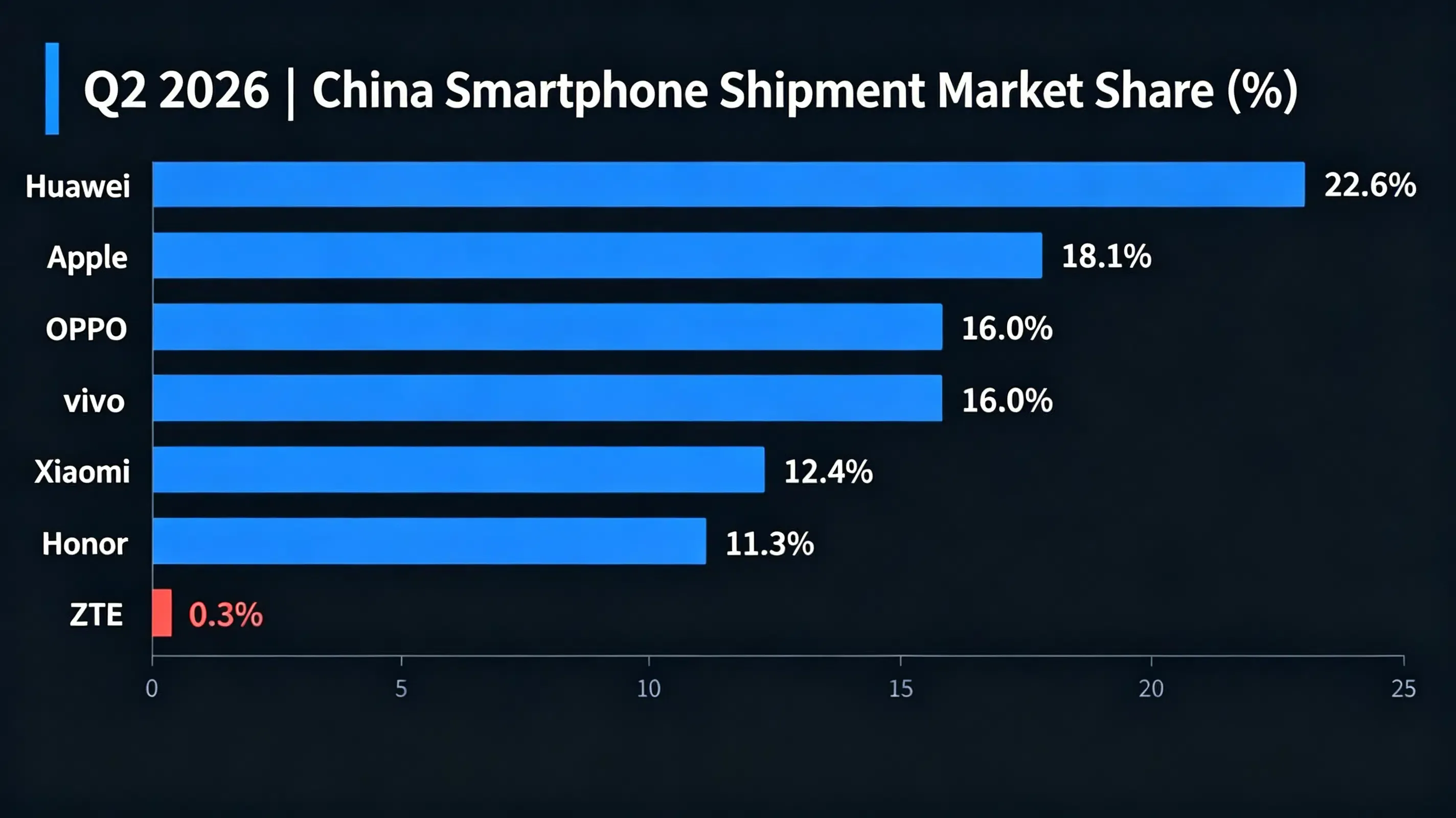
This dynamic illustrates why consumer app scale alone does not guarantee operating system leverage. According to QuestMobile research, Doubao achieved 382 million monthly active users on mobile apps in June 2026, leading competitors such as Alibaba’s Qwen (167 million MAU). However, application-level popularity operates downstream from hardware control. In the Chinese smartphone market, IDC data for the second quarter of 2026 shows that the top six OEMs (Huawei, Apple, OPPO, vivo, Xiaomi, and Honor) commanded approximately 96.4 percent of device shipments. ZTE stood at 0.3 percent, while Nubia was not separately listed in the top-ten table. Because primary device manufacturers actively develop proprietary assistant ecosystems to differentiate hardware, cross-platform agents face severe platform boundaries when attempting to assert system-level operational dominance.
From Headless Scraping to Governed Interfaces: The Shift Toward Structured Integration
The deployment friction surrounding the NaviX Ultra and the subsequent introduction of SAEP highlight that unstructured visual scraping represents a transitional phase in mobile AI assistance. Operating arbitrary software through visual simulation presents persistent maintenance overhead, high operational failure rates, and irreconcilable platform resistance.
The mobile industry is increasingly turning toward negotiated, structured execution frameworks characterized by Agent-to-Agent (A2A) interfaces and formal capability-sharing agreements. Under this paradigm, applications do not leave their visual interfaces exposed to unguided coordinate navigation; instead, they expose verified, parameterized functional endpoints directly to the operating system runtime.
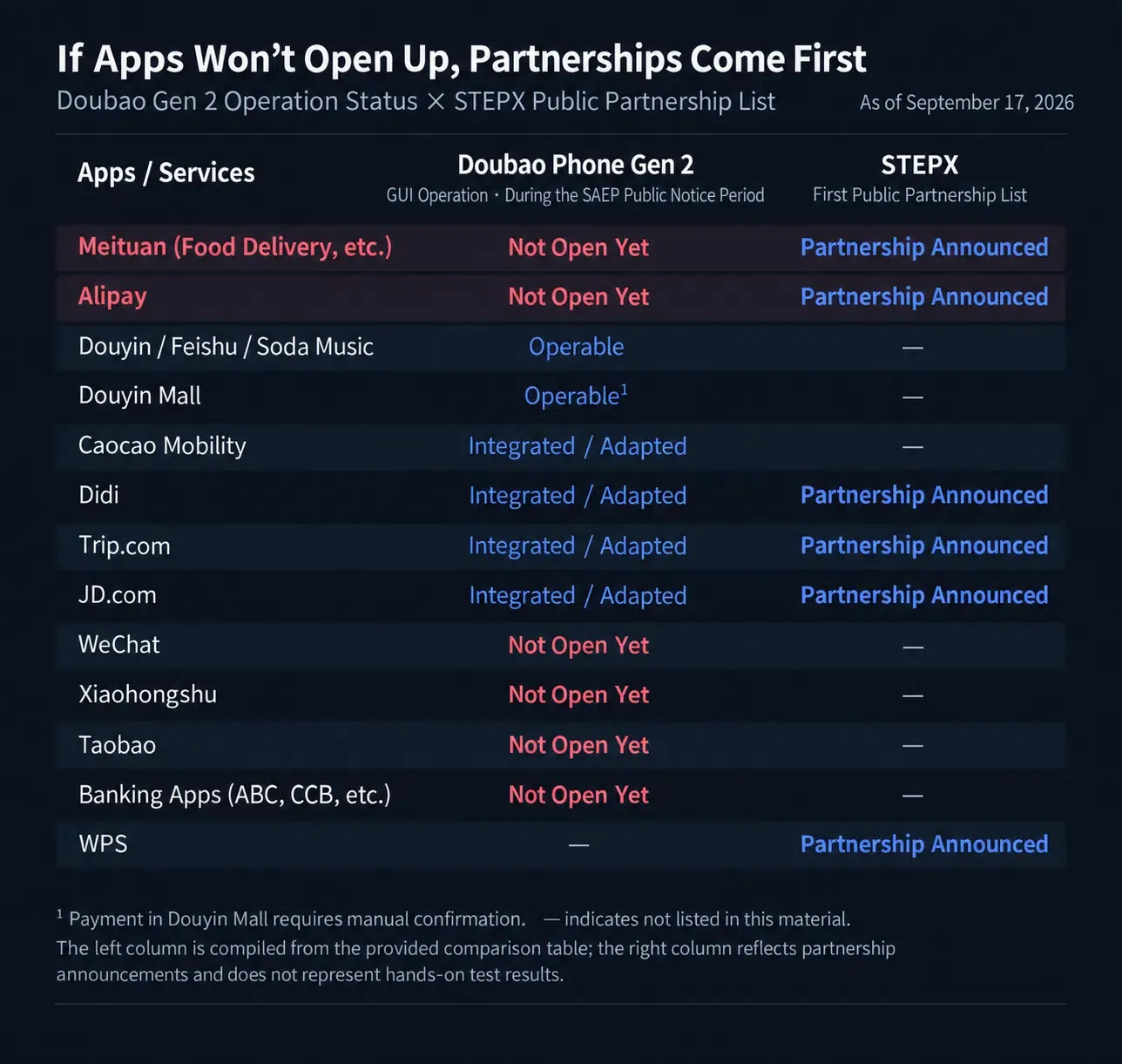
Recent industry implementations highlight this trajectory:
- Structured Terminal Ecosystems: On July 13, 2026, StepFun (阶跃星辰) launched its STEPX terminal brand and the STEPX Neo device solution alongside the Step AOS platform. As reported by Caixin, StepFun announced initial ecosystem partnerships with providers including Alipay, Baidu, Meituan, JD.com, Didi, Ctrip, and Amap, relying on pre-negotiated protocol interfaces rather than unconstrained GUI manipulation to execute external services.
- Bilateral A2A Cooperation: In mid-2026, Tencent established authorized A2A capability partnerships with major domestic hardware manufacturers including Huawei, Honor, Xiaomi, OPPO, and vivo. This mechanism enables system-level assistants—such as Honor’s YOYO or OPPO’s Xiaobu—to initiate WeChat voice and video calls or dispatch messages to designated contacts via verified bilateral authorization flows without requiring unrestricted access to private chat screens.
+--------------------------------------------------------------------------+
|            MOBILE AGENT INTERACTION: ARCHITECTURAL TRANSITION            |
+--------------------------------------------------------------------------+
|                                                                          |
|  [ User Voice Command: "Order iced latte from nearby cafe" ]             |
|                                |                                         |
|                                v                                         |
|  [ System Agent Orchestrator: Semantic Intent & Parameter Extraction ]   |
|                                |                                         |
|         +----------------------+----------------------+                  |
|         |                                             |                  |
|         v                                             v                  |
|  [ Unregulated Visual Path ]                 [ Governed Capability Path ]|
|  - Parse screen via visual VLM               - Query declared SAEP policy|
|  - Inject synthetic touch events             - Dispatch structured A2A   |
|  - High failure rate on dynamic UI           - Programmatic state check  |
|  - Blocked by risk & security rules          - App-controlled authority  |
|         |                                             |                  |
|         v                                             v                  |
|  [ Suspended Execution / Failure ]           [ Verified Fulfillment ]    |
|                                                                          |
+--------------------------------------------------------------------------+
For software engineering teams, this shift transforms mobile architecture. Rather than treating application security merely as defensive obfuscation against bots, developers must evaluate how their platforms expose addressable capabilities, establish machine-readable permission boundaries, and safeguard sensitive transaction states as operating systems grow increasingly agentic.
Frequently Asked Questions (FAQ)
What happens when the 30-day SAEP notice period expires on October 15, 2026?
Why do banking and payment applications restrict automated GUI agent actions?
How does SAEP differ from standard Android AccessibilityService permissions?
Strategic Guidance for Mobile Engineering Teams
To navigate the emergence of system-level AI assistants and evolving screen automation protocols, mobile development and security teams should consider the following engineering practices:
- Formulate Application-Specific Agent Access Policies: Evaluate how automated GUI interaction impacts user security, platform terms, and business workflows. Development teams should determine whether to participate in governance frameworks like SAEP, register explicit opt-out declarations, or pursue negotiated bilateral integration paths.
- Implement Step-Up Verification at Transaction Boundaries: Ensure that sensitive mutations—such as order placement, fund disbursement, profile alteration, or credential updates—require affirmative human confirmation. Enforcing biometric prompts, two-factor challenges, or cryptographic attestation can prevent or substantially reduce the risk of automated completion where verification requires independent user presence or hardware-backed confirmation.
- Monitor Synthetic Input and Automated Interaction Signals: Incorporate behavioral telemetry and input validation within security monitoring stacks to detect abnormal interaction timing, repeated coordinate patterns, automation-specific event sequences, and other anomalous risk signals across critical application workflows.
- Prepare Modular, Headless Capability Endpoints: Decouple core digital services from rigid, deeply nested visual navigation paths. Designing addressable, schema-validated API interfaces positions applications to integrate securely with structured agent frameworks (such as A2A protocols) without exposing visual view hierarchies to unverified scraping.
References
- 36Kr. (2026). Doubao smartphone? In your dreams. 36Kr Technology Reporting.
- IT Home. (2026). Why are many common apps unable to be operated via GUI? Doubao Phone Assistant responds. IT Home Mobile Ecosystem Desk.
- The Economic Observer. (2026). Doubao Phone Assistant launches GUI cooperation protocol SAEP, allowing third-party apps to choose independently. EEO Technology Desk.
- Yicai. (2026). Hands-on test of Nubia Doubao AI phone: Payment handoff to users. Yicai Financial & Tech News.
- QuestMobile. (2026). China Mobile Internet 2026 Half-Year Comprehensive Report. QuestMobile Industry Insights.
- Zhang, C., et al. (2026). AndroidDaily: A Verifiable Benchmark for Mobile GUI Agents on Real-World Closed-Source Applications. arXiv Computer Science Repository.
- International Data Corporation. (2026). Why Huawei and Apple Grew While China’s Smartphone Market Fell Again in Q2 2026. IDC Research.
- Reuters. (2026). China’s Tencent posts 11% second-quarter revenue rise, profit misses estimates. Reuters Technology News.
- Caixin. (2026). StepFun launches Step AOS and unveils first AI phone STEPX Neo. Caixin Technology Desk.
- IT Home. (2026). OPPO ColorOS Xiaobu Assistant integrates WeChat, enabling voice calls and messaging via A2A. IT Home Mobile Intelligence Reporting.
Share this article