How to secure tracking parameters against postback tampering? Securing tracking parameters in S2S postbacks requires constructing canonical request payloads, computing HMAC-SHA256 message authentication codes with secure server keys, and enforcing strict timestamp windows alongside atomic nonce deduplication.
Tracking parameter tampering in Server-to-Server (S2S) postbacks occurs when malicious actors alter plaintext query values or re-send intercepted event payloads across transport pipelines to claim unearned commissions or inflate conversion values. By establishing canonical payload serialization, binding request nonces, and computing keyed-hash message authentication codes (HMAC-SHA256), engineering teams ensure that conversion tracking parameters remain tamper-evident and verifiable between servers.
| Term | Definition | Related Entity | Search Intent Role |
|---|---|---|---|
| Tracking Parameters | Telemetry key-value pairs defining channel, campaign, and conversion context. | S2S Postback | Technical / Informational |
| HMAC | A cryptographic construction calculating a message authentication code via a shared key. | Message Integrity | Security / Informational |
| Ad Fraud | The deliberate exploitation of attribution pipelines to siphon marketing spend. | Parameter Tampering | Informational / Commercial |
The Vulnerability of Unsigned Tracking Parameters in S2S Postbacks
The Architecture of Server-to-Server Attribution: How Webhook Pipelines Transmit Conversion Signals
Modern mobile performance advertising relies heavily on Server-to-Server (S2S) webhooks to communicate attributed conversion milestones. In a standard postback architecture, a mobile attribution platform or Mobile Measurement Partner (MMP) ingests install and in-app event signals from client applications. Once attribution logic establishes the winning media source, the attribution server dispatches an automated HTTP POST or GET request to the advertiser’s backend, an ad network endpoint, or an affiliate tracking gateway.
These S2S postbacks carry contextual tracking parameters structured as JSON bodies or URL query parameters. Typical payloads convey transaction identifiers, campaign identifiers, publisher partner codes, device attributes, and monetary event values. Because these server-side notifications trigger financial transactions—such as Cost-Per-Action (CPA) payouts, affiliate billing, and revenue reconciliations—the underlying telemetry represents high-value commercial targets for manipulation.
The Risk of Plaintext Key-Value Pairs: Interception, Modification, and Proxy Arbitrage
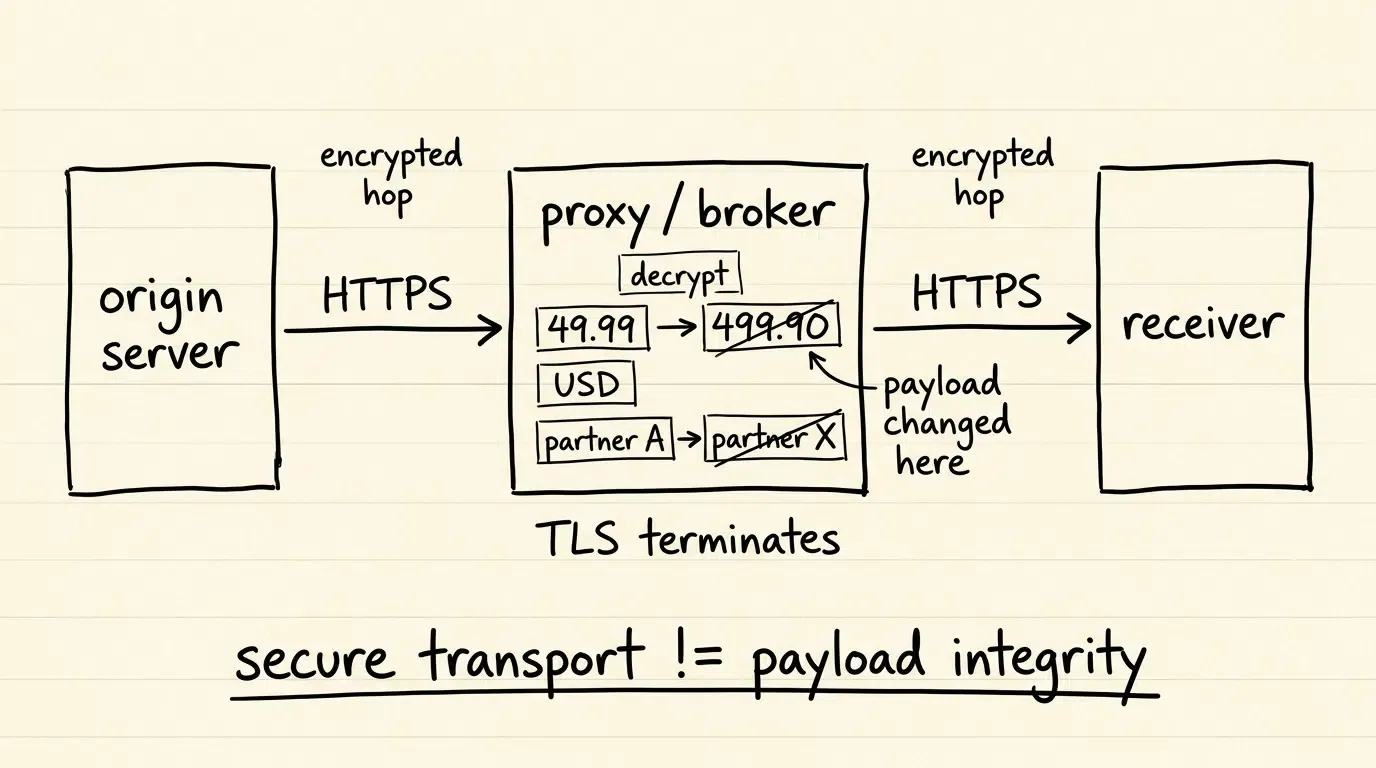
Transmitting tracking parameters without application-layer cryptographic authentication exposes data pipelines to manipulation. While Transport Layer Security (TLS/HTTPS) protects data in transit between immediate authenticated transport connection endpoints, it operates strictly on a hop-by-hop basis across independent network connections. Under normal operation, an on-path eavesdropper cannot modify properly authenticated end-to-end TLS traffic. However, in multi-tier advertising architectures, tracking webhooks frequently traverse intermediary nodes—such as reverse proxies, content delivery networks (CDNs), load balancers, and third-party routing brokers—that legitimately terminate TLS connections before establishing new outbound connections to the final recipient.
If any intermediary system terminating TLS is compromised, misconfigured, or operated by an untrusted entity, the plaintext payload can be modified in memory before it is forwarded to the next destination. For example, an intermediary can alter a payout currency parameter, inflate conversion amounts, or rewrite affiliate identification tags, effectively diverting revenue while preserving valid transport encryption on the subsequent network hop.
Why Simple Static API Tokens Fail to Protect Parameter Integrity in Transit
A widespread vulnerability in basic webhook integrations is relying on static pre-shared API keys transmitted within HTTP headers (such as Authorization: Bearer <TOKEN>) or embedded directly in query strings. While a static token verifies that the sender possesses the pre-shared credential, it provides zero cryptographic binding to the payload contents.
If an intermediary captures a webhook carrying a static API token, that token can be reused to authenticate entirely different, manipulated parameters. The receiving server inspects the static token, verifies its presence in a database, and accepts the altered parameters as authentic. To protect tracking parameters effectively, the verification mechanism must bind the authentication credential directly to the exact byte sequence of the transmitted data.
How Parameter Tampering Distorts Conversion Value and Partner Attribution
Targeted Parameter Exploit Vectors: Modifying Event Values, Currencies, and Partner Identifiers
Attackers target specific tracking parameters within conversion payloads to maximize financial yield while minimizing detection:
- Monetary Event Values: In percentage-based CPA or revenue-share campaigns, malicious intermediaries alter reported transaction amounts. A genuine purchase of $49.99 can be rewritten as $499.90, triggering unearned commissions that are an order of magnitude higher than the actual commercial transaction.
- Currency Identifiers: By altering a currency parameter from a lower-value denomination to a higher-value currency (such as converting Japanese Yen to US Dollars) without modifying the numerical amount, attackers multiply commission payouts while evading basic format validation filters.
- Publisher and Partner Routing Tags: Fraudulent actors operating within affiliate networks swap partner identification parameters to reroute conversion attribution away from legitimate media sources toward affiliate accounts under their control.
- Click Identifiers: Modifying downstream attribution tokens allows attackers to associate conversions with speculative, pre-generated click events, executing attribution theft on server-side conversion records.
Attribution Stealing via Transaction Identifier Swapping
Transaction identifiers serve as deduplication anchors in conversion tracking. When a conversion webhook lacks cryptographic payload integrity, malicious actors can perform transaction ID swapping.
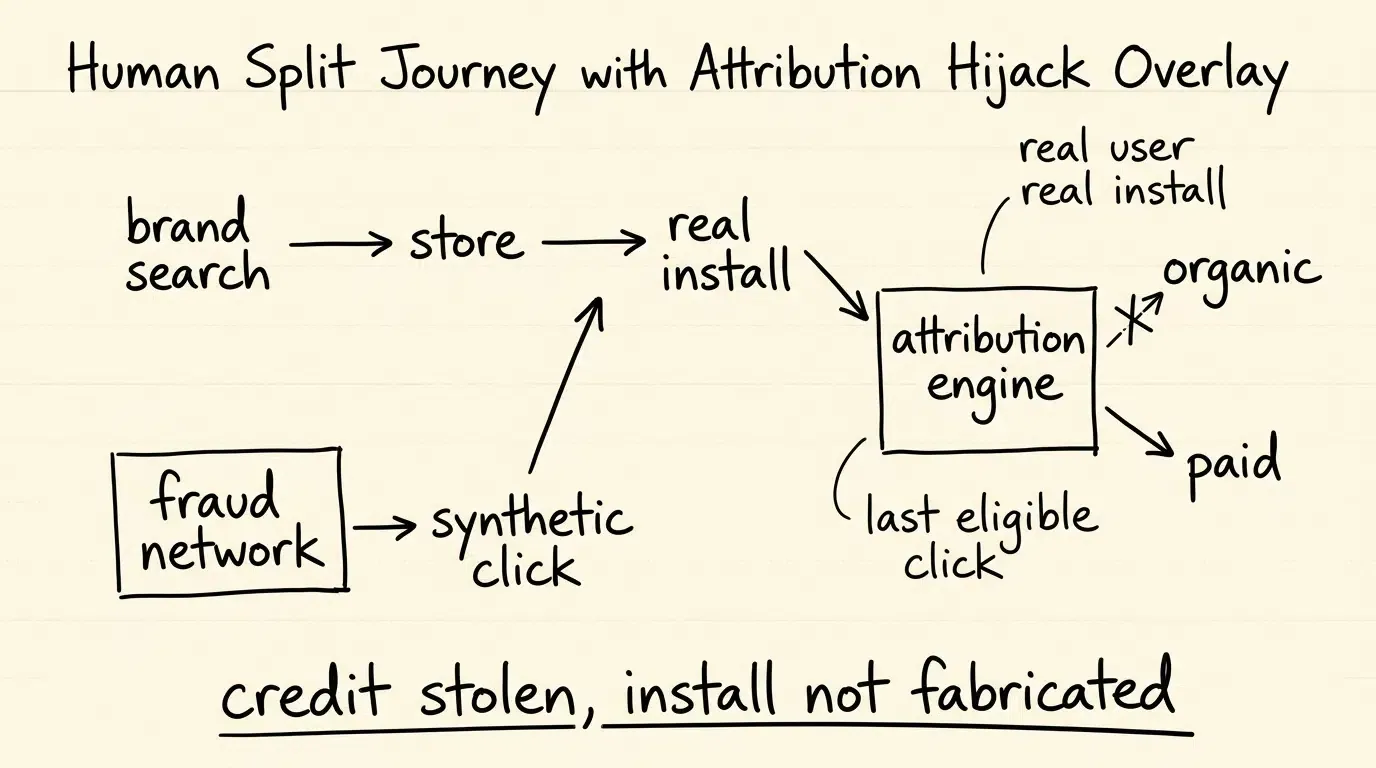
By replacing the original transaction identifier with an identifier matching a pending or incomplete session from another channel, an attacker forces the receiving attribution gateway to credit a different campaign. When combined with timing arbitrage, this manipulation rewires the historical touchpoint sequence, allowing low-performing channels to steal attribution credit from organic discovery or paid search campaigns.
The Commercial Impact: Inflated Commission Payouts and Corrupted Financial Reporting
The downstream consequences of parameter tampering corrupt core business metrics and drain marketing budgets:
- Direct Capital Depletion: Advertisers pay inflated or entirely fabricated affiliate commissions and agency fees based on falsified conversion values.
- Corrupted ROAS and CAC Calculation: When conversion values are artificially inflated or attributed to wrong channels, Return on Ad Spend (ROAS) and Customer Acquisition Cost (CAC) metrics become untrustworthy, leading growth teams to allocate budgets toward compromised channels.
- Accounting Discrepancies: Reconciliation failures emerge between financial payment gateways and marketing reporting dashboards, creating administrative overhead and contractual disputes between media buyers and publishers.
Differentiating Between Accidental Encoding Errors and Deliberate Fraudulent Alterations
Engineering teams must distinguish deliberate parameter manipulation from benign transmission errors. Intermediary web servers and proxies frequently alter payloads unintentionally through misconfigured URL decoding, character set transformations (such as converting UTF-8 to ISO-8859-1), or re-ordering JSON dictionary keys.
Accidental encoding errors typically present as malformed strings, escaped character corruption (e.g., %20 converted to +), or truncated parameters, resulting in overall payload parsing failures. In contrast, deliberate parameter tampering preserves valid syntax and schema conformance while modifying specific business-logic values. Cryptographic authentication solves both problems by rejecting any request whose byte stream deviates from the sender’s original output.
Technical Framework for Canonical Payload Construction and HMAC Signing
The Requirement for Deterministic Canonicalization Across Diverse Backend Stacks
To verify message integrity cryptographically, both the sending server (such as an attribution platform) and the receiving server (such as an advertiser backend) must generate identical cryptographic hashes from the same input data. However, identical datasets can be serialized into diverse string representations across different programming languages and web servers.
For example, JSON key ordering is inherently non-deterministic; Python, Go, Java, and Node.js JSON serializers order object keys differently. Similarly, HTTP query parameters can be positioned in arbitrary sequence. To avoid signature verification failures on legitimate requests, engineering teams must establish a deterministic canonicalization specification that converts arbitrary request data into an identical byte stream before hashing.
Step-by-Step Serialization: Parameter Alphabetical Sorting, URI Encoding, and Delimiter Control
To ensure full cryptographic coverage across both HTTP query parameters and request bodies, engineering teams must establish a deterministic signature base.
Inspired by the content-digest principle in RFC 9530 Digest Fields and the message component binding principles standardized in RFC 9421 HTTP Message Signatures, this reference profile hashes the raw HTTP body bytes directly rather than relying on brittle JSON re-serialization:
If the HTTP request has no body (such as a standard GET postback), BodyDigest is computed over an empty byte string (SHA-256("")).
For requests containing URL query parameters, parameters must be normalized into a canonical query string (CanonicalQuery):
- Semantic Parameter Extraction: Canonicalization operates on parsed semantic key-value pairs after one well-defined percent-decoding pass. Do not recursively decode values. A literal
+is treated as a literal plus character, not as a space; form-urlencoded decoding (+to space) must not be applied in this profile. - Define Character Encoding: Treat all parameter keys and values strictly as UTF-8 byte sequences.
- Strict Percent-Encoding (RFC 3986): Apply RFC 3986 percent-encoding to all keys and values. When re-encoding, leave only RFC 3986 unreserved characters (
ALPHA / DIGIT / "-" / "." / "_" / "~") unescaped. Ensure spaces are encoded as%20(never as+), and hexadecimal escape characters use uppercase letters (e.g.,%2A). - Lexicographical Bytewise Sorting: Sort all encoded parameter pairs in ascending alphabetical order by their raw encoded key bytes. If keys are identical, sort by their encoded value bytes.
- Deterministic Joining: Join each key and value with an equals sign (
=), and join adjacent pairs with an ampersand (&). If no query parameters exist,CanonicalQueryevaluates to an empty string ("").
Computing the HMAC-SHA256 Authentication Tag: Secret Key Governance and Secure Transport Headers
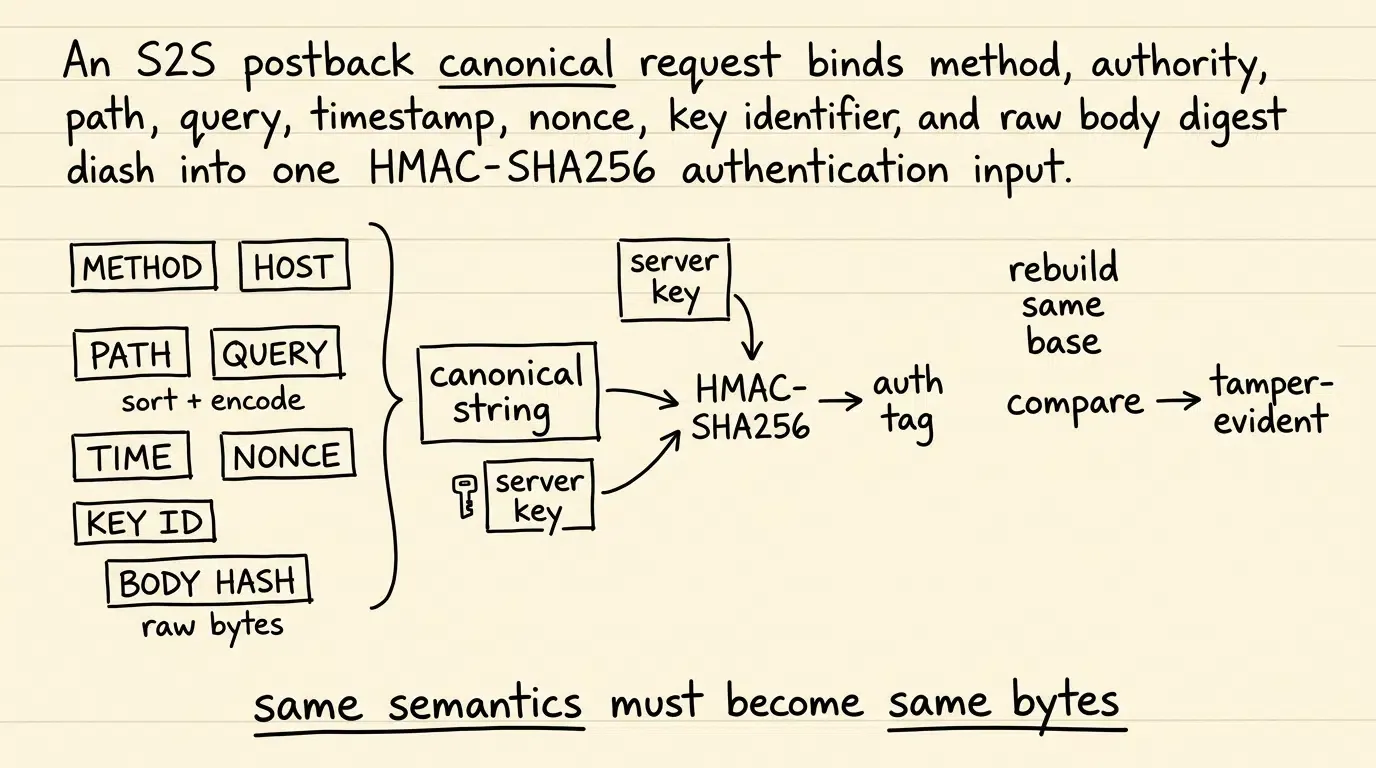
Once the individual components are normalized, the sender constructs the full canonical signature base. To prevent parameter omission, authority confusion, and cross-service replay, the signature base explicitly binds the HTTP method, the target authority (host), the normalized path, the canonical query string, the request timestamp, the request nonce, the key identifier, and the body digest into a unified string separated by newline delimiters (\n):
To ensure cross-platform interoperability:
- Authority Normalization: Lowercase the registered host name and apply one documented port policy (for example, omit the default HTTPS port 443 but retain non-default ports). Signer and verifier must apply an identical rule.
- Path Normalization: Define the request path as the exact normalized target path exposed by the agreed gateway layer, applying RFC 3986 dot-segment normalization and prohibiting post-signature path rewriting. Percent-encoded unreserved octets in PATH should follow the same versioned normalization policy on both signer and verifier.
The sending server computes a Keyed-Hash Message Authentication Code (HMAC) using SHA-256 and the shared secret key (
In this reference profile, the 32-byte authentication tag is encoded as a 64-character lowercase hexadecimal string and transmitted in custom headers:
POST /api/v1/attribution/postback HTTP/1.1
Host: attribution.advertiser.com
X-Signature-Timestamp: 1788942598000
X-Signature-Nonce: c3d9a10b-58cc-4372-a567-0e02b2c3d479
X-Signature-Key-Id: key_partner_live_v2
X-Signature-Tag: 9b2d3c4e5f6a7b8c9d0e1f2a3b4c5d6e7f8a9b0c1d2e3f4a5b6c7d8e9f0a1b2c
Content-Type: application/json

{"currency":"USD","event_name":"purchase","event_value":49.99,"order_id":"ord_99812","partner_id":"net_alpha"}
To prevent content-interpretation confusion and representation metadata tampering (as warned in RFC 9530 Digest Fields), the receiving endpoint strictly pins Content-Type to application/json. Requests specifying any other media type are rejected at the edge prior to canonical evaluation. Furthermore, application-layer HMAC authentication supplements rather than replaces transport encryption; S2S postbacks must still be transmitted over authenticated HTTPS to ensure payload confidentiality.
To prevent algorithm downgrade and substitution vulnerabilities (as warned in RFC 9421), the receiving gateway pins the expected cryptographic algorithm (HMAC-SHA256) on the server side rather than dynamically parsing unauthenticated algorithm headers. Secret keys should be cryptographically generated with at least 128 bits of entropy (using 256-bit keys for standard reference profiles) and stored in secure backend key management services (KMS). Unknown key identifiers must fail through a bounded local cache lookup and return a generic authentication failure path rather than triggering unbounded remote lookups.
Visualizing the S2S Parameter Ingestion, Signature Verification, and State Commitment Pipeline
The sequence diagram below outlines the end-to-end verification flow between the originating attribution platform and the receiving advertiser gateway:
[Originating Server (MMP / Partner)]                 [Ingestion Server (OpoInstall / Advertiser)]
               │                                                             │
  1. Assemble Tracking Parameters & Body                                     │
  2. Construct Canonical Base (Method, Host, Path, Query, Time, Nonce, Key, BodyDigest)
  3. Compute HMAC-SHA256 Tag using Secret Key                                │
  4. Transmit HTTP POST + Signature Headers ───────────────────────────────► │
                                                                             │
                                                           5. Enforce Parser & Size Limits
                                                                             │
                                                           6. Validate Timestamp Window (|t_server - t_req| <= 300s)
                                                                             │
                                                           7. Reconstruct Canonical String & Compute Expected MAC
                                                                             │
                                                           8. Constant-Time Tag Comparison (HMAC Equal?)
                                                              ├─► FAILED: Terminate & Log Tamper Attempt (401)
                                                              └─► PASSED: Proceed to Replay Defense
                                                                             │
                                                           9. Atomic Nonce Verification (Check & Store in Cache)
                                                              ├─► DUPLICATE: Reject Replay Attack (409)
                                                              └─► UNIQUE: Commit Event to Database & Postback (200)
How to Prevent Replay Attacks Without Exposing Ingestion Gateways to State Poisoning
The Threat of Replay Attacks: Duplicating Legitimate Payloads to Drain Marketing Budgets
A critical vulnerability in webhook architectures is the replay attack. In a replay scenario, an attacker does not alter tracking parameters or break the cryptographic hash; instead, they intercept a valid, signed postback request and transmit the identical byte sequence repeatedly to the ingestion endpoint.
Because the payload and authentication tag match, a verification system that evaluates only HMAC validity would accept every replayed request as genuine. This allows attackers to replicate a single valid $50 CPA conversion thousands of times, draining marketing budgets through duplicate commission payouts.
The Critical Verification Sequence: Enforcing Authentication Before Nonce Invalidation
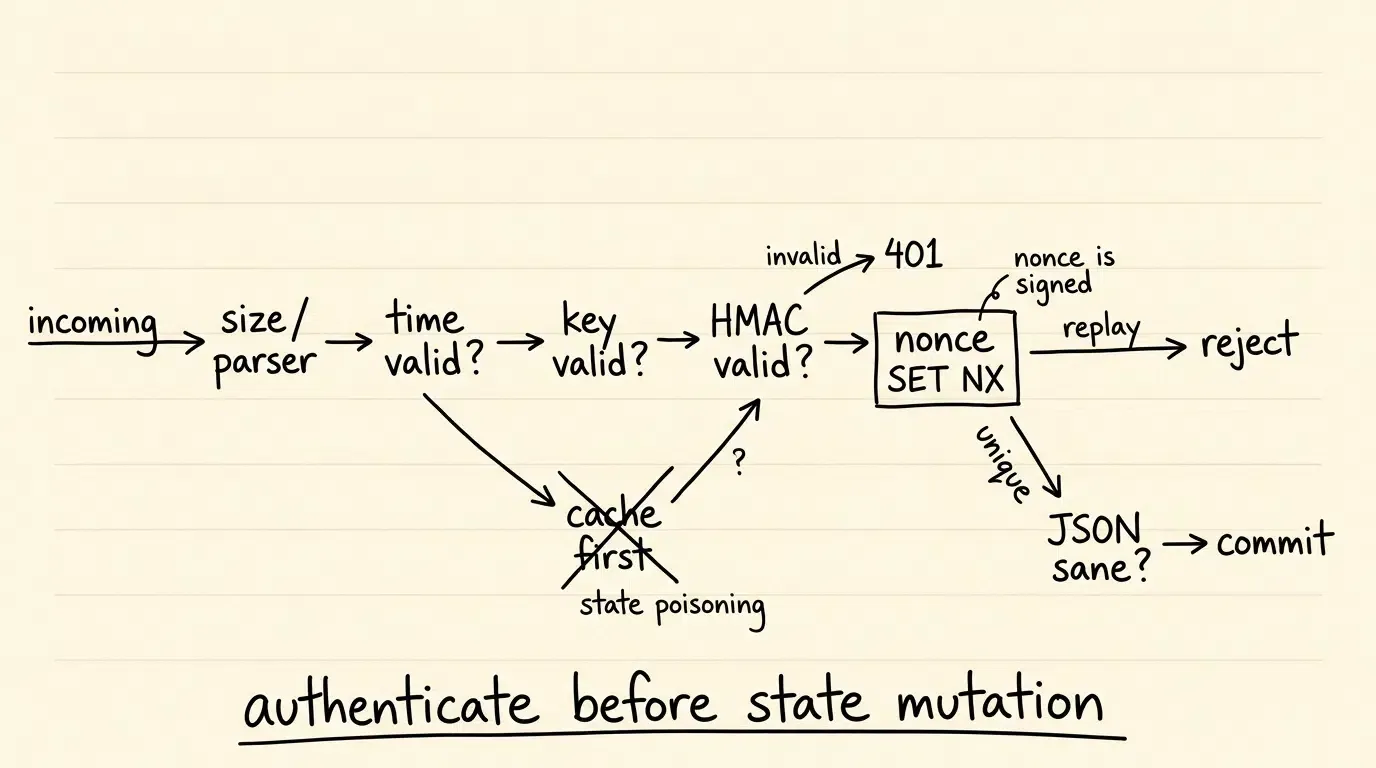
Replay prevention requires combining short timestamp validity windows with unique transaction nonces. However, binding the transaction nonce directly into the authenticated signature base is an absolute prerequisite. If the nonce is omitted from the canonical HMAC input, an attacker can simply generate new random nonces while replaying the original payload and authentication tag, bypassing nonce deduplication entirely.
Furthermore, the architectural sequence in which verification checks are executed is vital for operational stability. A severe security defect occurs when an ingestion gateway records a nonce in its stateful cache before verifying the cryptographic authentication tag. In this flawed sequence, an unauthenticated attacker could flood the ingestion endpoint with unauthenticated requests containing random nonces, exhausting cache memory capacity, triggering eviction pressure, and degrading ingestion performance.
To prevent state poisoning, ingestion servers must enforce a strict verification order:
- Syntactic and Timestamp Validation: Verify that the incoming request timestamp (
) falls within an acceptable historical window relative to authoritative server time ( ):
Requests outside this illustrative window are dropped immediately. This bounds the required storage duration of historical nonces in memory.
2. Cryptographic Tag Verification: Retrieve the shared secret matching X-Signature-Key-Id, reconstruct the canonical request string (including CanonicalQuery, AUTHORITY, Nonce, and KeyId), compute the expected HMAC-SHA256 tag, and perform a constant-time comparison against the incoming header tag. If the tag is invalid, terminate the request immediately with an HTTP 401 Unauthorized status.
3. Atomic Nonce Invalidation: Only after the request passes HMAC authentication, check and persist the unique nonce in an atomic in-memory cache (e.g., Redis SET key value NX EX 720). The cache Time-To-Live (TTL) should exceed the total potential replay window (e.g., 600 seconds window duration plus safety margin, totaling 720 seconds) to ensure that edge clock variations cannot cause premature nonce expiration. If the nonce already exists in the cache, reject the request as an HTTP 409 Conflict.
4. Semantic JSON Hardening: After cryptographic authentication, reject JSON payloads containing duplicate object member names or schema ambiguities prior to business processing.
Mitigating Timing Attacks and Cache Poisoning
Enforcing HMAC authentication prior to nonce cache mutation guarantees that only requests signed with an authorized shared secret can consume memory resources in the deduplication cache. Unauthenticated spoofing attempts and random nonce floods are rejected at the edge before any backend state mutation occurs.
Furthermore, constant-time comparison algorithms must be used for HMAC verification. Standard string comparison operators (== or ===) are not guaranteed to provide timing-resistant comparison and may leak data-dependent timing behavior in specific runtime environments. Verification logic must decode the hex or Base64 tag into raw bytes, validate expected length, and execute a timing-resistant comparison primitive (such as crypto.timingSafeEqual in Node.js or MessageDigest.isEqual in Java).
Structuring the Secure S2S Postback Verification Schema
To maintain architectural separation between tracking parameters, transport headers, and verification outcomes, engineering teams should log postback audits according to a structured reference schema.
The schema placeholder below illustrates an S2S postback verification payload where incoming parameters, security metadata, and gateway decisions are cleanly decoupled:
```json
{
  "reference_architecture": true,
  "s2s_postback_verification_record": {
    "audit_metadata": {
      "audit_id": "aud_s2s_sig_2026_0909_8812",
      "timestamp_utc": "2026-09-09T08:30:00.125Z",
      "ingestion_gateway": "edge_gateway_us_east",
      "evaluation_engine": "OpoInstall Postback Security Reference Engine"
    },
    "transport_security_headers": {
      "signature_algorithm_pinned": "HMAC-SHA256",
      "request_timestamp_ms": 1788942598000,
      "request_nonce": "c3d9a10b-58cc-4372-a567-0e02b2c3d479",
      "key_identifier": "key_partner_live_v2"
    },
    "canonical_request_context": {
      "http_method": "POST",
      "authority": "attribution.advertiser.com",
      "uri_path": "/api/v1/attribution/postback",
      "canonical_query_string": "",
      "canonical_string_components": [
        "POST",
        "attribution.advertiser.com",
        "/api/v1/attribution/postback",
        "",
        "1788942598000",
        "c3d9a10b-58cc-4372-a567-0e02b2c3d479",
        "key_partner_live_v2",
        "8f9b2d3c4e5f6a7b8c9d0e1f2a3b4c5d6e7f8a9b0c1d2e3f4a5b6c7d8e9f0a1b"
      ],
      "body_digest_algorithm": "SHA-256",
      "raw_body_bytes_digest": "8f9b2d3c4e5f6a7b8c9d0e1f2a3b4c5d6e7f8a9b0c1d2e3f4a5b6c7d8e9f0a1b",
      "canonical_hash_input_length_bytes": "<computed>"
    },
    "cryptographic_verification": {
      "timestamp_delta_seconds": 2.125,
      "timestamp_window_valid": true,
      "auth_tag_verification": "match_verified",
      "constant_time_comparison_result": "match_verified",
      "tamper_detected": false
    },
    "replay_defense_state": {
      "verification_precedence_enforced": true,
      "nonce_cache_lookup": "unique_entry",
      "atomic_cache_mutation": "persisted_ttl_720s",
      "replay_attack_detected": false
    },
    "postback_disposition": {
      "http_response_code": 200,
      "disposition_state": "payload_verified_and_committed",
      "verified_payload_content": {
        "currency": "USD",
        "event_name": "purchase",
        "event_value": 49.99,
        "order_id": "ord_99812",
        "partner_id": "net_alpha"
      },
      "reason_codes": [
        "HMAC_AUTH_TAG_VERIFIED",
        "TIMESTAMP_WITHIN_WINDOW",
        "NONCE_ATOMICALLY_CONSUMED"
      ]
    }
  }
}
Comparative Analysis of Postback Security Mechanisms
Evaluating Postback Protection Protocols Across Computational Overhead and Assurance Levels
Engineering teams evaluate diverse security mechanisms to protect tracking parameters. The optimal selection balances implementation complexity, cryptographic performance, and security guarantees.
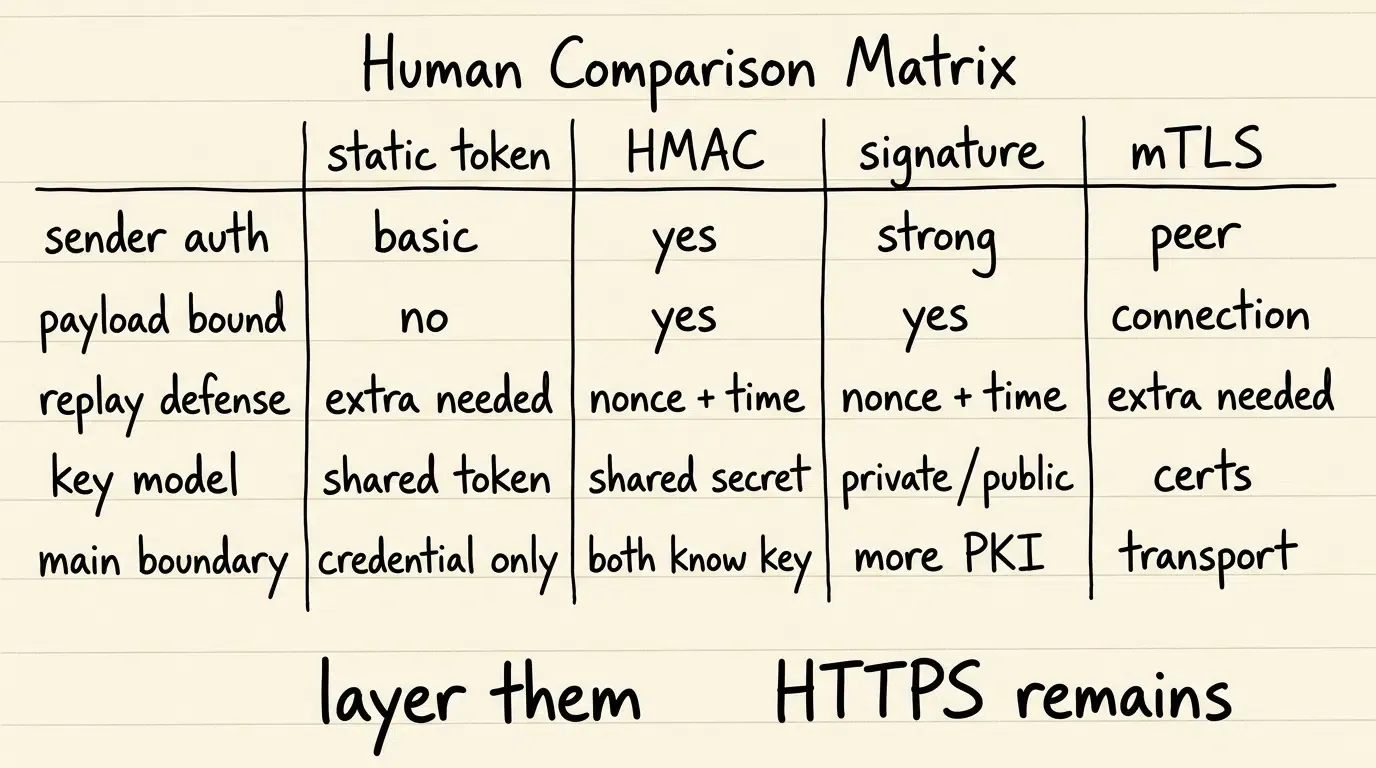
The table below contrasts standard postback security protocols:
| Security Mechanism | Cryptographic Primitive | Primary Strength | Operational Trade-off |
|---|---|---|---|
| Static Shared Token | Pre-shared API Key in HTTP Header | Low computational overhead; simple setup | Does not independently authenticate payload contents |
| Symmetric HMAC-SHA256 | Keyed-Hash Message Authentication Code (RFC 2104) | Detects unauthorized modification; high throughput | Requires secure server-side secret storage and shared key lifecycle |
| Asymmetric Digital Signatures | Public/Private Key Pair (e.g., Ed25519 / RSA) | Stronger signer attribution; private key never shared | Higher cryptographic overhead; requires public key infrastructure |
| Mutual TLS (mTLS) | Transport Layer X.509 Certificate Handshake | Cryptographic peer verification at connection layer | Complex certificate management; protects transport, not payload state |
Architectural Trade-offs in Production Environments
While Mutual TLS (mTLS) establishes peer authentication at the transport layer, it does not provide application-layer tamper-evidence once the request terminates at an intermediate reverse proxy. Conversely, asymmetric signatures (such as Ed25519 or ECDSA) provide stronger signer attribution—preventing the recipient from generating valid signatures—but operational non-repudiation still depends on private key custody and strict identity binding controls.
HMAC-SHA256 is computationally inexpensive for typical webhook payloads and is generally well suited to high-throughput server-to-server authentication, providing robust tamper-detection and straightforward key management between trusted enterprise backends.
When Should S2S Postback Signing Be Required for Mobile Applications
High-Risk Conditions Where Authenticated Postback Signing Should Be Required
Cryptographic signing of tracking parameters is strongly recommended under specific risk conditions:
- High-Value Cost-Per-Action (CPA) Payouts: Marketing programs where individual conversion events trigger real-world monetary compensation, affiliate commissions, or financial credit.
- Third-Party and Multi-Tier Affiliate Networks: Campaigns where postbacks traverse intermediary ad aggregators, sub-affiliate networks, or external routing brokers.
- Revenue-Share and Dynamic Value Billing: Business models where advertising fees are calculated as a percentage of the dynamic
event_valueparameter transmitted in the postback. - Regulatory and Financial Audit Compliance: Enterprise organizations subject to data integrity audits requiring tamper-evident or integrity-controlled accounting records for marketing expenditures.
Unsuitable Conditions for Complex Postback Signing
Implementing per-request cryptographic signing may introduce unnecessary operational overhead in specific architectures:
- Isolated Private Cloud Microservices: Internal service-to-service communications operating entirely within a secured private Virtual Private Cloud (VPC) protected by internal service mesh authentication.
- High-Volume Low-Risk Telemetry: High-frequency pings where event transaction values are zero and alternative transport-level security or authenticated batching sufficiently mitigates risk.
Common Misconceptions in S2S Postback Security
- Misconception 1: HTTPS Renders Parameter Signing Redundant: HTTPS encrypts traffic only between immediate transport endpoints. It does not prevent an authorized intermediary from altering parameters before forwarding, nor does it prevent replay attacks against the destination gateway.
- Misconception 2: HMAC Is Equivalent to a Public Digital Signature: An HMAC relies on a shared symmetric key known to both the sender and receiver. While it guarantees that an entity in possession of the key created the tag, it does not provide mathematical non-repudiation against the other key holder, unlike asymmetric public-key cryptography.
Frequently Asked Questions (FAQ)
What is tracking parameter tampering in mobile advertising postbacks?
Why is an HMAC considered a message authentication code rather than a digital signature?
Why must cryptographic verification occur before consuming transaction nonces?
Summary and Decision Framework
Securing tracking parameters against postback tampering is essential for safeguarding performance marketing investments and preserving attribution integrity. Eliminating vulnerability to parameter alteration requires moving beyond static tokens toward cryptographic authentication models that combine deterministic canonical request construction, HMAC-SHA256 message authentication tags, and atomic replay defense.
Engineering teams must implement rigorous server-to-server validation gates that verify request integrity prior to mutating internal state or recording conversion value. By binding transaction nonces, query strings, and host context directly into the signature base, maintaining symmetric key lifecycle standards, and enforcing constant-time signature comparison, mobile applications can ensure that accepted postbacks are authenticated, replay-resistant, and tamper-evident after signing.
To review available data interfaces and security integration specifications, consult the mobile attribution implementation reference.
Related Materials
-
Concepts: Tracking Parameters, Postback Tampering, Canonical Serialization, Message Authentication Code, Replay Attack Defense
-
Technologies: Server-to-Server Postback, HMAC-SHA256, Ingestion Gateways, Idempotency Caches
-
Standards: RFC 2104 HMAC Keyed-Hashing for Message Authentication, RFC 9110 HTTP Semantics, RFC 9421 HTTP Message Signatures, RFC 9530 Digest Fields, RFC 3986 URI Generic Syntax, OWASP API Security Top 10
-
APIs: Event Ingestion Interfaces (Reference Architecture), S2S Postback Webhook Engine
-
Official Documentation & References:
Share this article