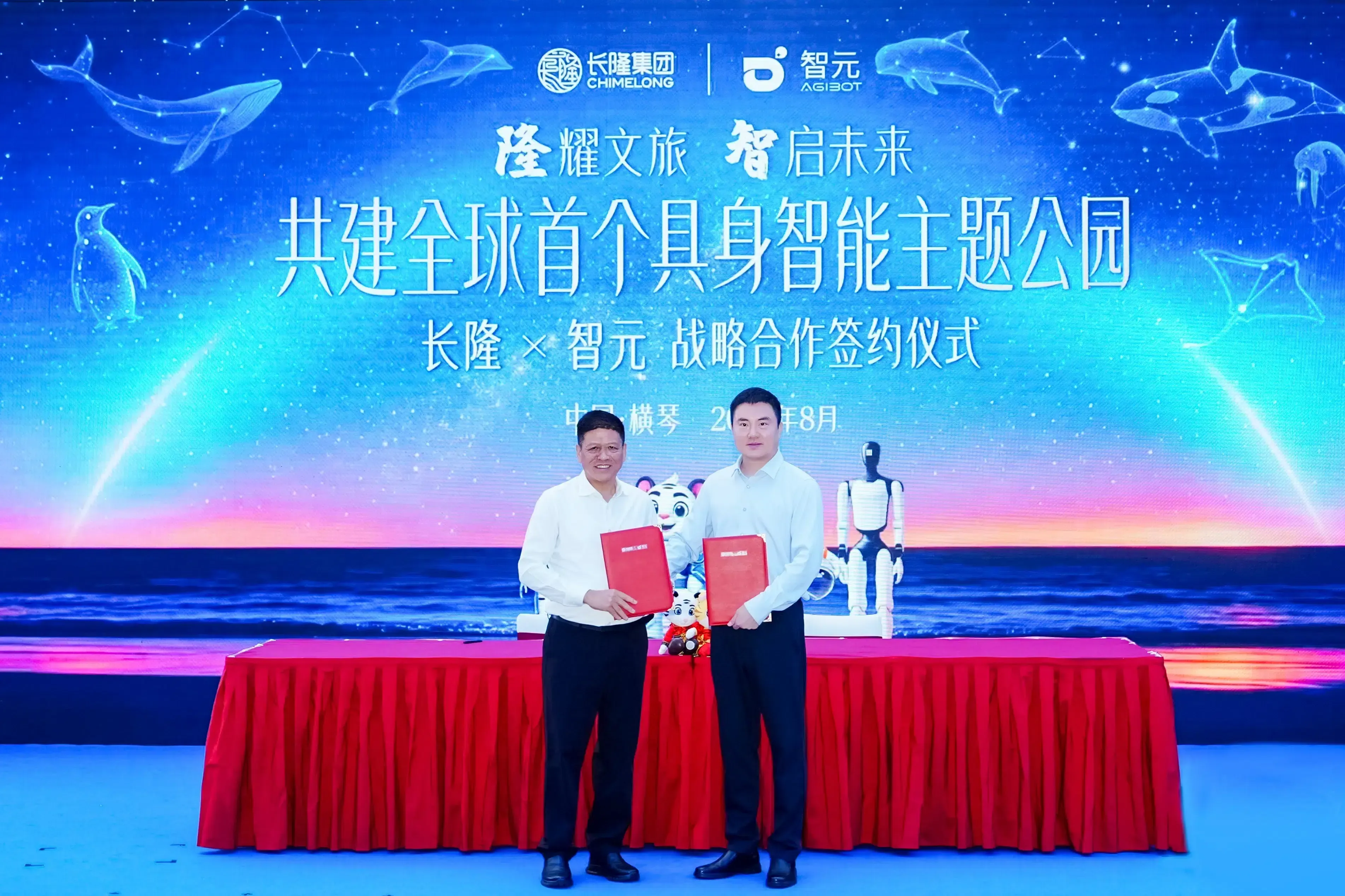
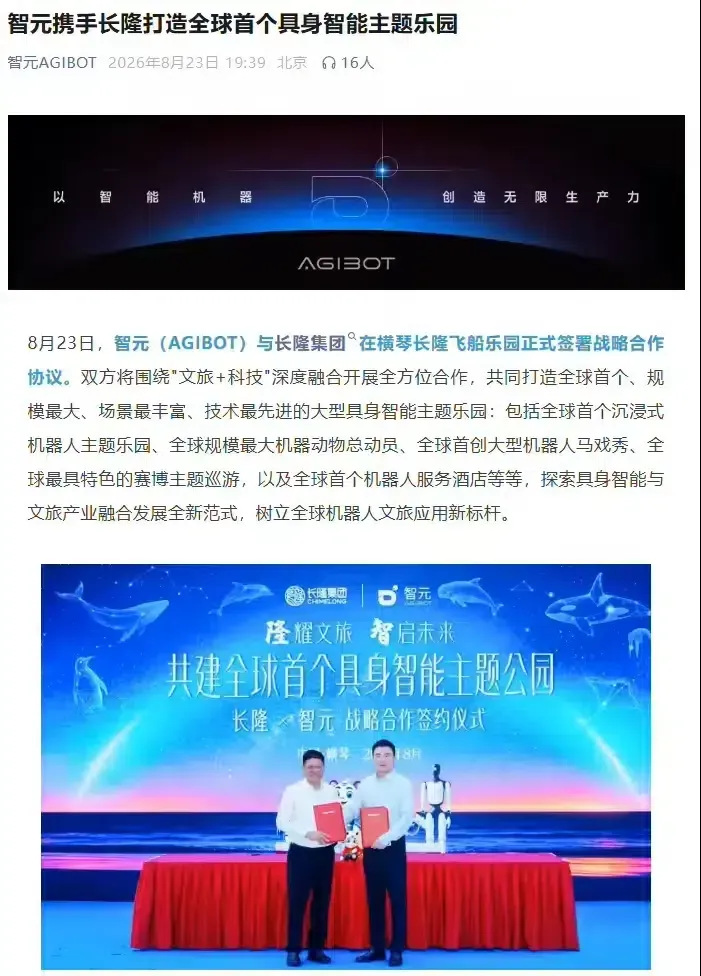
Are AgiBot and Chimelong planning the world’s first embodied AI theme park? The August 23 strategic agreement sets out plans to build what the companies describe as the world’s first immersive embodied intelligence theme park, exploring how general-purpose humanoid robots transition from factory pilots to high-traffic commercial tourism environments. Signed at Chimelong Spaceship Park in Hengqin, the partnership unites physical hospitality with general-purpose robotics. Historically, physical tourism venues relied on static signage and manual service personnel to engage visitors. As autonomous bipedal and quadruped platforms achieve commercial repeatability, large-scale entertainment resorts are exploring physical robotics across guest interpretation, hotel hospitality, and stage performances, creating dynamic physical touchpoints that connect real-world attendance with digital ecosystem services.
Why Embodied AI Creates New Offline-to-Digital Touchpoints
At a Glance
- Strategic agreement signed on August 23, 2026, at Chimelong Spaceship Park in Hengqin to plan an immersive embodied intelligence theme park.
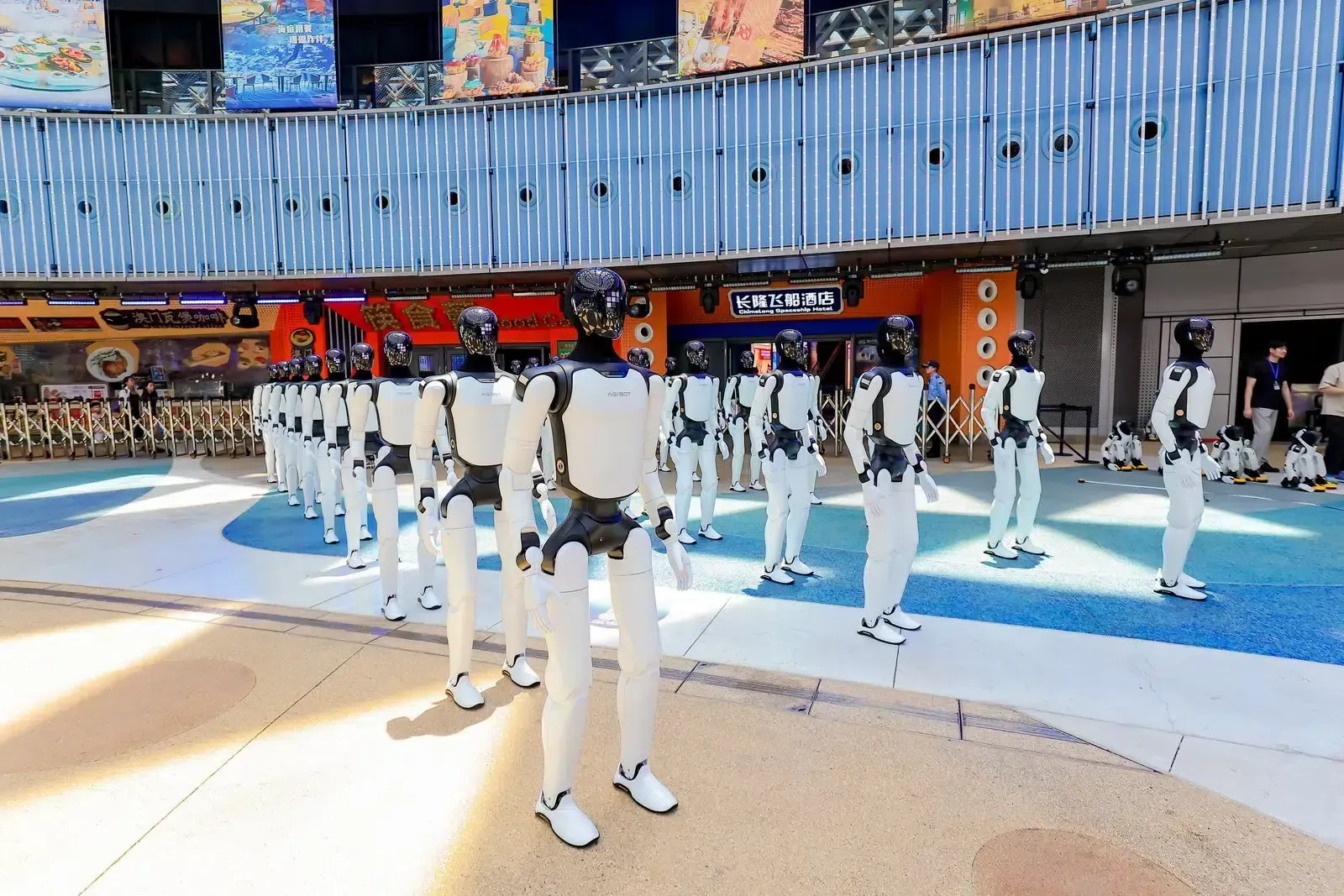
- The collaboration outlines robotic deployments across park parades, live circus performances, guest science interpretation, and dedicated robot-serviced hotels.
- Chimelong provides multiple park environments for real-world technical validation, while AgiBot contributes its large-scale deployment capabilities.
The commercialization of embodied artificial intelligence is expanding from structured industrial manufacturing toward public consumer destinations. For decades, theme parks and mega-resorts utilized pre-programmed animatronics and fixed interactive kiosks to entertain guests. While effective for scripted shows, traditional installations lack autonomous navigation, real-world multi-modal perception, and flexible task execution. Managing guest flows, localized inquiries, and hospitality assistance across vast resort properties still demands substantial manual operational coordination.
Deploying intelligent humanoid and quadruped robots directly into public environments creates a new operational paradigm. Beyond hardware durability, tourism operators are exploring how physical robotics can enhance the overall visitor journey. When guests interact with an autonomous physical agent, that physical interaction creates an opportunity that could connect to digital resort services, such as mobile ticketing, queue management, or loyalty programs. The underlying robotics deployment plans are detailed in the official Chimelong Group announcement regarding the partnership.
The commercial roadmap outlined by the AgiBot-Chimelong partnership reflects a broader integration of cultural tourism and robotics engineering. The agreement outlines plans to develop robot hotel hospitality, robot parade performances, and cybernetic circus acts across Chimelong’s destinations. Supported by AgiBot’s manufacturing milestone of producing over 15,000 units by mid-2026, the two organizations are also establishing an embodied AI joint laboratory to conduct scenario validation and long-term research. For commercial growth teams, large-scale deployments of this kind could also turn physical interactions into valuable digital entry points if operators connect them to mobile services.
From Physical Robot Interactions to Mobile App Journeys
If tourism operators choose to connect physical robot interactions to digital mobile applications—such as through QR codes, links, or near-field prompts displayed during a service interaction—a distinct offline-to-app attribution challenge emerges. In standard digital marketing, customer journeys rely on browser-based tracking containers, persistent HTTP cookies, and structured referrer headers. Physical touchpoints introduce a different attribution boundary because the customer journey begins outside a conventional browser session.
When a visitor scans a code displayed on a moving robot terminal or interaction kiosk, the mobile device typically opens a web landing page or redirects directly to an application marketplace. If the target mobile application is not already installed on the visitor’s device, the user must navigate through the app store, download the application, and complete a cold launch. During this transition, the initial pre-install referral context does not automatically survive into the application’s first launch.
Technical Breakdown: Preserving Pre-Install Context Across App Store Boundaries
Shared or generic QR codes provide limited touchpoint granularity, while pre-install URL context still requires a restoration mechanism if the journey crosses an app-store installation. If all robots or park zones display an identical static URL, the operator cannot distinguish which specific physical terminal or performance attraction initiated the interaction.
The diagram below illustrates the architectural difference between unmanaged offline redirection and a deferred parameter restoration workflow:
[Unmanaged Offline Redirection]
  Visitor Scans Touchpoint ──> App Store Download ──> First App Launch (Pre-Install Context Dropped)

[Deferred Parameter Restoration Flow]
  Visitor Scans Dynamic Trigger ──> Parameter Matching Node ──> First App Launch (Pre-Install Context Restored)
Without a parameter restoration mechanism, the application opens to a generic onboarding screen, forcing the user to manually search for the specific ride reservation, show guide, or promotional benefit introduced during the physical interaction. In broader application distribution, similar challenges exist when bridging offline physical interactions to mobile conversion funnels without friction. Operators require systematic parameter pass-through capabilities that preserve campaign context through the installation boundary, eliminating manual code entry and reducing onboarding drop-off.
Build vs. Buy: Managing Offline Referral Tracking and Attribution
As physical venues explore intelligent hardware touchpoints to support digital engagement, engineering teams must determine how to manage offline attribution data. Managing referral context in large-scale embodied AI deployments requires technical infrastructure capable of reconciling dynamic parameters with mobile application activations. Organizations typically evaluate whether to build custom in-house context-matching engines or integrate dedicated deferred deep linking platforms.
Architectural Evaluation: Custom Implementations vs. Standardized Platforms
Constructing an internal database to map offline scans to mobile device activations requires ongoing engineering maintenance. Depending on platform constraints, an in-house system may need to combine unique referral tokens, store-specific referrer mechanisms, account handoff, or privacy-compatible matching techniques. Developers must also maintain high-concurrency lookup tables to prevent latency spikes during high-attendance periods. Conversely, adopting an established deferred deep linking platform provides standardized parameter resolution workflows while allowing teams to design attribution around first-party and contextual parameters rather than relying solely on advertising identifiers.
The table below outlines the core architectural trade-offs across different offline-to-app tracking approaches:
| Solution | Touchpoint Granularity | Post-Install Restoration | Engineering Ownership | Best For |
|---|---|---|---|---|
| Shared Static QR | Low (Single Generic URL) | None by itself | Low | Basic informational displays without conversion tracking |
| Unique/Dynamic QR + Custom Backend | Configurable (Per Terminal/Zone) | Custom implementation required | High (Continuous Maintenance) | Specialized enterprise architectures with dedicated backend teams |
| Deferred Deep Linking Platform | Configurable (Dynamic Parameterization) | Built-in supported workflow | Vendor + SDK integration | Large-scale tourism, smart retail, and physical-to-digital funnels |
Depending on implementation requirements, organizations may construct an internal event-matching database or adopt commercial platforms such as OpoInstall. For instance, custom parameters passed through OpoInstall links could encode identifiers such as a venue, campaign, staff referral source, or physical touchpoint for later restoration after installation. When a visitor installs the mobile application, the SDK restores the eligible in-park context upon the first launch without requiring manual invitation codes, supporting offline-to-app attribution and contextual onboarding across physical venues.
Integration Checklists: Preparing Digital Funnels for Embodied AI Deployments
To maximize the effectiveness of physical touchpoints, technical and product teams can establish structured implementation workflows connecting hardware interactions to mobile conversion funnels.
Developer Implementation Checklist
- Configure Unique Touchpoint Parameters: Use unique campaign or touchpoint parameters for each relevant QR code or digital link, encoding specific venue IDs or zone IDs rather than broad generic URLs.
- Integrate Deferred Deep Linking SDKs: Embed lightweight client SDKs within the mobile application to query and retrieve cached parameters during the initial cold launch.
- Apply Cryptographic Signatures Where Needed: Sign sensitive reward-bearing parameters with an HMAC or another server-generated cryptographic signature so the backend can detect and reject tampered payloads.
Product & Growth Strategy Checklist
- Design Contextual Onboarding Experiences: Automatically direct newly onboarded users to the specific attraction guide or promotional voucher introduced at the physical touchpoint.
- Analyze Physical Foot-Traffic Attribution: Track installation velocity across distinct park zones and resort properties to measure the effectiveness of various physical touchpoints.
- Streamline User Registration: Remove friction by eliminating mandatory manual referral code inputs, relying on background parameter restoration to maintain attribution.
Adopting these engineering practices helps operators turn physical venue interactions into measurable, privacy-conscious digital user acquisition channels.
Frequently Asked Questions (FAQ)
Why is physical AI in theme parks different from factory robot automation?
How do dynamic QR codes prevent attribution loss during offline app downloads?
Can deferred deep linking pass customized visitor data without requiring login credentials?
Key Takeaways for Engineering Teams
The strategic plans outlined in the AgiBot and Chimelong Plan partnership highlight an emerging industry direction: physical environments are increasingly connecting to mobile software ecosystems. As autonomous robotic platforms enter hospitality, retail, and entertainment spaces, physical touchpoints will serve as important gateways for digital engagement.
To capture the value of these physical interactions, engineering teams must design resilient data architectures that bridge offline events with mobile applications. Implementing server-side parameter pass-through frameworks, deferred deep linking, and automated scenario restoration helps preserve journey context from the initial physical interaction into subsequent mobile engagement.
Share this article