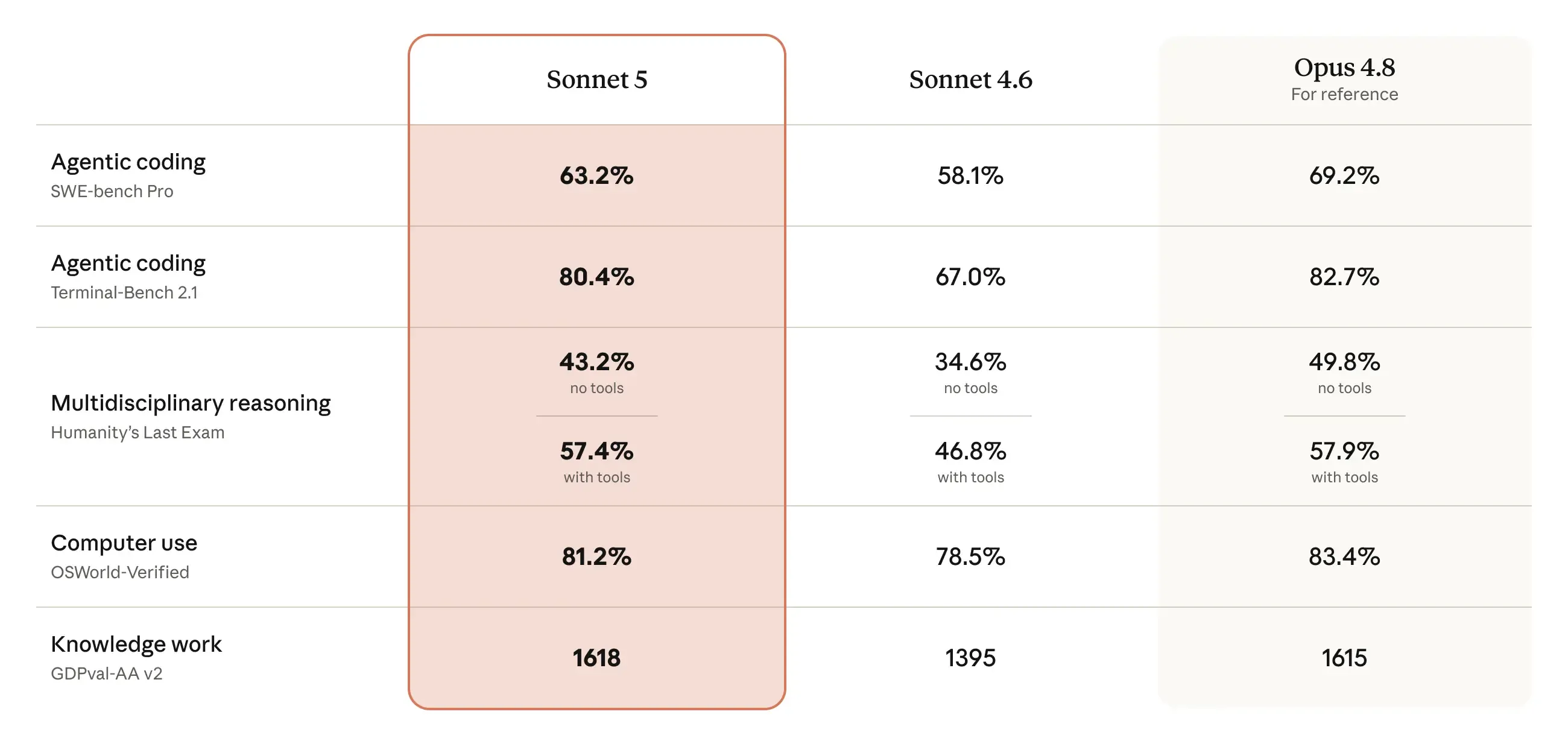
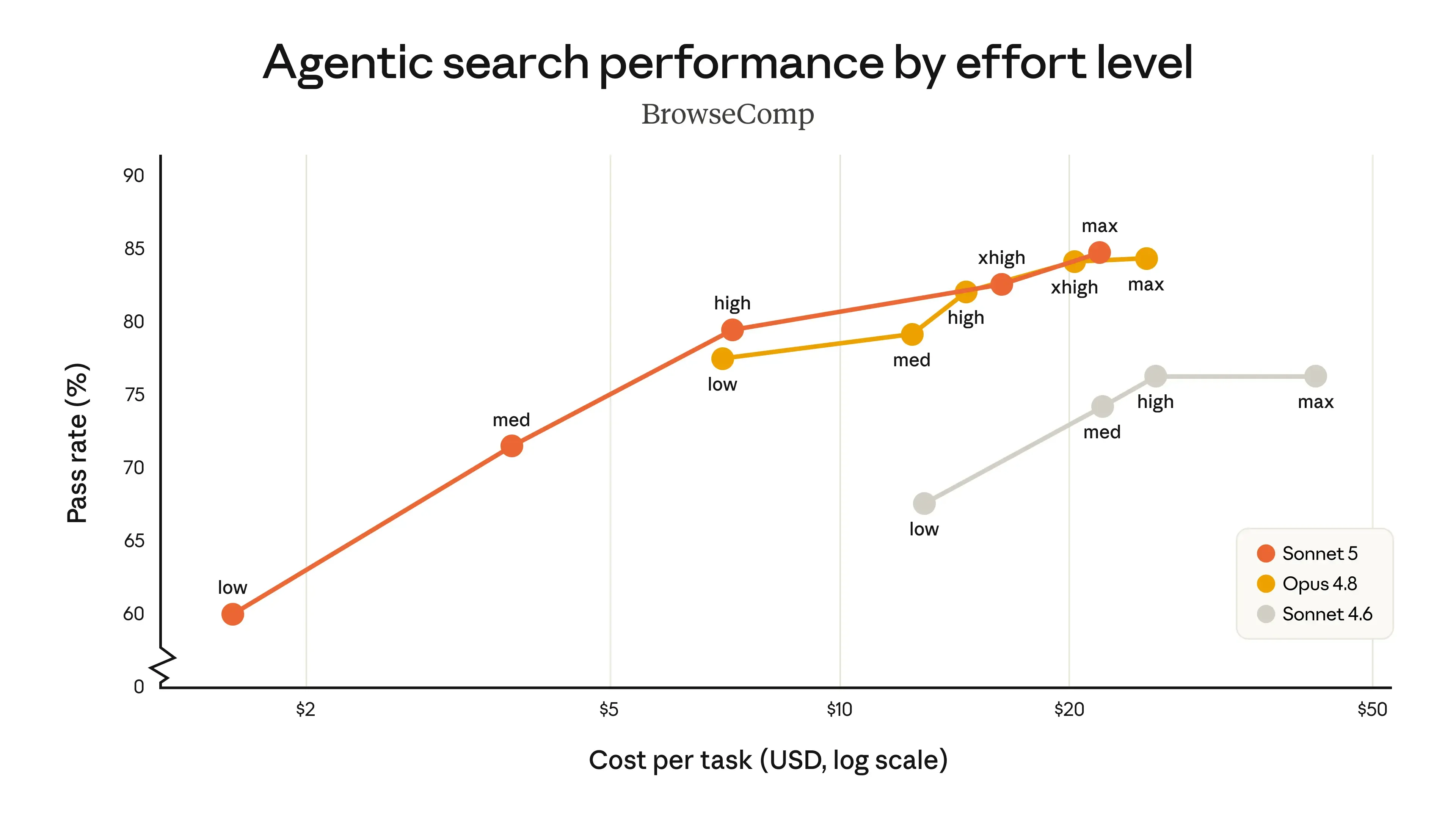
Anthropic Launches ‘Sonnet 5’? Anthropic released Claude Sonnet 5 on June 30, replacing Claude Sonnet 4.6 across all plans, as detailed in the official Anthropic release announcement. Although the model’s published list prices are lower, its effective deployment costs depend heavily on workload characteristics, cache hit rates, and input formats. Because of the updated tokenizer’s token inflation, real-world API billing in highly structured codebases can rise significantly, making the new model not cheaper than Claude Opus 4.8 in several common production scenarios. This release highlights a broader shift in enterprise AI development: evaluating a model now involves not only benchmark performance, but also tokenization behavior, caching efficiency, and total cost of ownership.
At a Glance
- Near-Opus Performance: Claude Sonnet 5 delivers performance close to Claude Opus 4.8, but real-world API savings may be smaller than the listed prices suggest.
- Potential Token Inflation: Depending on the content type, the updated tokenizer may generate approximately 1.0x to 1.35x more billable tokens for the same input.
- SaaS Billing Shifts: Facing immense compute loads from unattended agent actions, providers are shifting away from flat-rate limits toward strict, token-based metering.

The Pricing Dilemma: Why Listed API Rates Clash with Token Inflation
The pricing announcement on June 30, 2026, introduced an introductory price of $2 per million input tokens and $10 per million output tokens on the Claude Platform. The promotional tariff remains active through August 31, 2026, after which standard rates of $3 per million input tokens and $15 per million output tokens will take effect. While these list prices appear lower than the Claude Opus 4.8 rates of $5 input and $25 output, actual project costs vary. The updated tokenizer implemented in Claude Sonnet 5 maps identical text characters to 1.0 to 1.35 times more tokens than preceding models. Because of this structural adjustment, the standard pricing scheme operates as a cost-neutral transition rather than a direct discount.
To understand how this token inflation affects enterprise budgets, consider an illustrative cost scenario processing one million raw input tokens. For illustration, assume the same input codebase was measured as 1,000,000 tokens under the Claude Sonnet 4.6 tokenizer. Under Claude Sonnet 5, assuming the upper-end 1.35× tokenizer multiplier described by Anthropic, that same codebase could map to approximately 1,350,000 tokens. At the introductory rate of $2.00 per million, the cost is $2.70—a marginal 10% saving. However, once the standard pricing of $3.00 per million takes effect, the same codebase will cost $4.05. This represents a 35% cost increase over the legacy model, and only a 19% savings compared to the flagship Claude Opus 4.8, rather than the expected 40% discount.
Illustrative Cost Scenario (1M Token Workload)
| Execution Scenario | Token Multiplier (Illustrative) | Rate per Million Input | Total Cost per 1M Input Tokens |
|---|---|---|---|
| Claude Sonnet 4.6 | 1.00x (reference example) | $3.00 (Standard) | $3.00 |
| Claude Sonnet 5 (Promo) | up to 1.35x | $2.00 (Introductory) | $2.70 |
| Claude Sonnet 5 (Standard) | up to 1.35x | $3.00 (Standard) | $4.05 |
| Claude Sonnet 5 (+ 90% Caching) | 0.135x (90% Cache Hit) | $3.00 (Standard) | $0.77 |
| Claude Opus 4.8 | 1.00x (reference example) | $5.00 (Standard) | $5.00 |
 Underlying Tokenizer Mechanics: How KV Cache and Context Length Alter Billing
According to the Claude Sonnet 5 System Card, Claude Sonnet 5 adopts an updated tokenizer. Anthropic notes that the same input may map to approximately 1.0 to 1.35 times more tokens depending on the content type, making the introductory pricing of $2 per million input tokens and $10 per million output tokens roughly cost-neutral. In practice, structured inputs such as source code, markdown, or JSON documents may experience larger token-count differences than plain natural language text.
One possible explanation is that code, markdown, and JSON naturally contain denser syntactic structures than ordinary prose. Modern LLM tokenizers often tokenize these structures differently from natural language, which can increase the total number of billable tokens. Anthropic has not disclosed the implementation details of Claude Sonnet 5’s tokenizer, so the exact mechanism remains undisclosed.
Illustrative Example:

Same Input
      │
      ├── Claude Sonnet 4.6 → 1,000,000 tokens
      │
      └── Claude Sonnet 5   → up to 1,350,000 tokens (Depending on Content Type)
For long-context applications, prompt caching remains a key mechanism to reduce API expenses. The system allows developers to cache system instructions, standard reference libraries, and large static documents, cutting input costs by up to 90% depending on cache hit rates. However, cache misses on dynamically compiled, multi-file code runs can quickly accumulate massive billing overhead. As the active context window approaches the 1M token limit, cumulative input and output token consumption can spike rapidly without yielding usable code outputs.
In-House Token Optimization vs. Pre-Built Budget Architectures
In practice, engineering teams usually choose between building an internal cost-verification framework, deploying self-hosted API gateways, or adopting pre-built SDK solutions. Developing a proprietary system requires substantial engineering overhead. Teams must build custom server-side databases, maintain execution state libraries, and continuously update logic to comply with evolving OS security standards. For many organizations, the maintenance cost of an in-house tracker is high.
Alternatively, developers generally evaluate several approaches to monitor runtime execution without relying entirely on cloud-side metrics:
- Local Model Deployments: Running small, highly specialized open-source models inside secure offline environments.
- Strict Firewall Sandboxing: Restricting active development containers from establishing external outbound network connections.
- Enterprise MMPs: Utilizing robust third-party mobile measurement platforms for deep-linking workflows.
- Specialized Parameter SDKs: Deploying dedicated integration utilities for precise, cost-sensitive custom parameter pass-through.
Developer Environment Setup Comparison
| Optimization Strategy | Cost Reduction Potential | Execution Latency | Recommended Workload |
|---|---|---|---|
| Direct API Calls | ❌ None | ⚡ Low (<1s) | Real-time user queries |
| Prompt Caching | ✅ High (Up to 90%) | ⚡ Low (<1s) | High-volume repetitive contexts |
| Context Compression | 🔄 Moderate | ⚠️ Medium | Long-form document analysis |
| Local Models | ✅ High (No API Cost) | ⚠️ Medium | Lightweight offline testing |
| Batch Requests | ✅ High (50% Discount) | ❌ High (Delayed) | Non-urgent background operations |
Capability and Cost Comparison
| Model | Input Price (Promo/Std) | Output Price (Promo/Std) | Reasoning Level | Tokenizer Overhead |
|---|---|---|---|---|
| Claude Sonnet 5 | $2.00 / $3.00 per M | $10.00 / $15.00 per M | High (Near-Opus) | ⚠️ 1.0x–1.35x |
| Claude Opus 4.8 | $5.00 per M | $25.00 per M | Maximum (Frontier) | ✅ 1.0x (Baseline) |
Raw Prompt Context -> Analyze System Instructions -> Prompt Caching (90% Savings) -> Cache Hit (Execute)
                               |
Cache Miss -> Context Compression -> Segment Payload -> Execute at Introductory Rates
While AI cost optimization focuses on reducing unnecessary token consumption, many mobile teams face a similar efficiency challenge after users leave the browser and install an app. Preserving referral parameters across that transition often requires server-side state persistence. Platforms such as Opoinstall address that separate layer of the workflow. Similar platforms include Branch, AppsFlyer, Adjust, and other deferred attribution systems. Among these, Opoinstall provides an SDK that maps transaction variables and session metadata to a centralized state database, ensuring that session contexts are preserved even when initial tasks are executed headlessly across off-peak queues. Engineering teams may evaluate these approaches according to deployment requirements and cost-control goals, and as Anthropic Launches ‘Sonnet 5’, developers face the choice of utilizing these integrated libraries.
Operational Cost Control and Integration Checklists
Backend engineering teams face the immediate task of auditing all active database integrations before launching automatically compiled builds. Product leads should redesign invitation and registration loops to accommodate non-visual user journeys. Instead of assuming the user will read an email and click a button, product leads should design workflows that expect programmatic triggers. Growth teams must update their performance metrics. When autonomous software handles triage, open rates and click-through rates become less reliable. Marketing operations should focus on downstream in-app telemetry and transaction-verified conversion milestones, optimizing campaigns based on the actual actions performed within the application.
Programmatic Cost Verification Checklist
To ensure budget security and prevent unexpected token billing increases, engineering steps should focus on the following parameters:
- Prompt Cache Audit: Configure aggressive context caching for system instructions and long static references to reduce baseline input costs.
- Context Compaction Triggers: Set up automated local limits to compress or truncate history logs before exceeding the 200k token threshold.
- Tokenizer Overhead Testing: Bench-test your codebases against the new token mapping engine to estimate the exact multiplier (up to 1.35x) on billing.
- Cost Dashboard Integration: Set up real-time telemetry to track and visualize token utilization across different project tiers.
- Model Selection Routing: Establish a routing policy that uses Claude Sonnet 5 for high-volume execution, reserving Claude Opus 4.8 only for complex reasoning tasks.
Frequently Asked Questions (FAQ)
Why might Claude Sonnet 5 not be as inexpensive as its list prices suggest?
Does Claude Sonnet 5 replace Claude Sonnet 4.6?
How does the tokenizer affect billing in development environments?
Should developers use Claude Sonnet 5 for coding instead of Claude Opus 4.8?
As token pricing becomes more dynamic, engineering teams will spend less time choosing the most powerful model and more time choosing the most cost-effective one. Benchmark scores alone are no longer enough. Understanding tokenization, caching, and workload planning will become part of everyday AI engineering.
Share this article