How can businesses use QR codes to track offline ad performance? Businesses track offline ad performance by deploying dynamic, parameter-embedded QR codes across individual print placements, allowing centralized attribution platforms to segment scan ingress, store dispatches, and verified mobile installations by media channel.
A QR code for business is an enterprise-grade, trackable two-dimensional barcode deployed across physical marketing assets to bridge offline audience exposure with digital conversion analytics. By embedding unique promotional channel tokens into dynamic routing URLs, business QR codes allow marketing teams to quantify print advertising performance, calculate cost-per-install, and reconcile multi-channel return on ad spend without relying on manual promo codes.
| Term | Definition | Related Entity | Search Intent Role |
|---|---|---|---|
| QR Code for Business | A commercial-grade trackable barcode used to attribute offline campaign performance. | Channel Statistics & Tracking | Informational / Commercial |
| qr code tracking | The process of logging, segmenting, and attributing routing interactions from physical print media. | Return on Ad Spend | Technical / Commercial |
| create qr code for app | The deployment workflow of generating barcodes that direct users to app download funnels. | App Parameter Installation | Commercial |
| app qr code | A 2D barcode engineered to route mobile users directly into store onboarding. | Deferred Deep Linking | Technical |
The Economics of Offline Print Advertising and How QR Code for Business Closes the Attribution Gap

The Historical Dilemma of Print Advertising: High Spend and Limited Placement-Level Conversion Telemetry
Enterprise marketing organizations routinely commit substantial capital budgets to physical print media, including roadside billboards, metropolitan transit posters, quarterly trade publications, direct-mail catalogues, and retail packaging. Despite the reach of physical collateral, offline advertising has historically suffered from an asymmetry in measurement: media buying requires deterministic, dollar-denominated expenditure, while performance verification often relies on coarse, post-campaign estimation.
Traditional print measurement models depend on third-party circulation estimates, traffic audits, panel surveys, and post-campaign brand awareness indices. While these metrics estimate broad brand visibility, they lack granular placement-level conversion telemetry to demonstrate conversion velocity, calculate acquisition unit economics, or isolate which specific geographic or editorial placements generate downstream application installs. Consequently, offline media budgets remain vulnerable during performance marketing reviews because growth leaders lack a verifiable audit trail linking physical capital expenditure to mobile user acquisition.
The Mechanics of Offline Marketing Waste: Why Brand Awareness Studies Fail Performance Scrutiny
In performance-driven organizations, brand recall studies fail to provide actionable telemetry for several operational reasons:
- Temporal Disconnect: Awareness surveys are conducted weeks or months after print circulation, decoupling campaign observation from active consumer conversion decisions.
- Aggregated Blended Noise: Surveys cannot isolate whether an increase in product installs stemmed from a specific highway billboard, concurrent digital paid search, programmatic social video, or word-of-mouth referral.
- Absence of Cohort Telemetry: Traditional print monitoring cannot track conversion velocity, first-week retention, or in-app lifetime value (LTV) across distinct physical media assets.
When marketing performance is evaluated on Return on Ad Spend (ROAS) or Customer Acquisition Cost (CAC), physical campaigns lacking granular telemetry risk being defunded in favor of digital paid channels, even when physical media effectively reaches high-intent audiences.
Transforming Static Collateral into Interactive Conversion Ingress Points
Deploying a custom QR code for business transforms passive physical media into measurable conversion entry points. Rather than treating a transit billboard or direct mailer as an unmeasured display, the asset functions as a structured gateway into an application acquisition funnel.
When physical print collateral incorporates a dynamic, trackable barcode, interactions generate an observable digital telemetry trail. Passing pedestrians or readers convert physical interest into digital routing requests by scanning the marker with their smartphone camera. By structuring the underlying link architecture with unique, placement-specific channel identifiers, enterprise analytics teams establish a structured attribution pathway connecting a physical media buy to an attributed mobile app installation.
Bridging Physical Engagement to Digital Runtimes: Why Enterprises Require Business-Grade QR Codes
Consumer-grade barcode tools simply encode static URLs pointing to a corporate homepage or an unparameterized app store listing. For commercial enterprises, this approach is insufficient. Once printed on tens of thousands of physical mailers or long-term outdoor billboards, a static barcode cannot be updated if destination URLs expire, marketing campaigns rotate, or deep-linking routing logic shifts.
A business-grade QR architecture supports four core operational capabilities:
- Dynamic Remote Re-Routing: The ability to modify downstream destination URLs, app store targets, or campaign landing pages within a centralized management console without altering or reprinting the physical matrix.
- Channel Parameter Segmentation: Encapsulating multi-tier channel identifiers (
channelCode,sub_channel,placement_id) within compact, high-contrast barcode matrices. - Conditional Context Preservation: Supporting the transmission of promotional parameters (such as regional vouchers or sales representative tokens) across the app store installation boundary into the native mobile client upon initial launch, subject to supported installation paths, SDK integration, and operating system privacy permissions.
- Enterprise Telemetry Integration: Exporting attribution outcomes and in-app conversion records into enterprise data warehouses via structured Server-to-Server (S2S) event feeds.
Architectural Mechanics: Segmenting Print Media via Unique Channel Identifiers
The Multi-Channel Hierarchy: Grouping Billboards, Magazines, Direct Mail, and Retail Collateral
Accurate print attribution requires establishing an organized channel taxonomy before generating production artwork. Enterprise marketing operations deploy collateral across diverse physical environments, each exhibiting distinct exposure dynamics and operational lifecycles.
To structure reporting within an attribution console, campaigns can follow a multi-tier organizational hierarchy:
- Macro Channel Group: Defines the high-level physical medium category (e.g.,
ooh_billboard,print_magazine,direct_mail,in_store_pos). - Parent Channel (
channelCode): Identifies the primary media placement or vendor partner (e.g.,times_sq_digital_screen,trade_journal_q2,retail_partner_apac). - Sub-Channel (
sub_channel): Isolates granular operational variables, such as physical panel orientation, regional store branches, or individual promotional mailer batches.
By organizing physical print collateral into this structured taxonomy, data teams can evaluate macro-channel unit economics while retaining the ability to audit individual physical placements.
Structuring URL Parameter Taxonomy for Offline Campaigns
When constructing destination URLs for business QR campaigns, query strings must convey placement context without introducing excessive character length. URL parameters should be formatted in strict compliance with the URI generic syntax defined in IETF RFC 3986.
An illustrative parameter taxonomy for enterprise physical collateral includes:
https://promo.example.com/d?channelCode=subway_ldn_central&placement_id=oxford_cir_p04&batch=2026_q2&promo=TRAVEL25
In this illustrative schema:
- The channelCode parameter functions as the primary reporting key within the attribution platform, grouping the physical asset within macro reporting views.
- The placement_id parameter captures physical inventory coordinates for media auditing.
- The batch parameter records the print production run to monitor material deployment cycles.
- The promo parameter represents candidate application metadata passed through the attribution pipeline to pre-populate onboarding offers upon initial app launch after backend validation.
Note that specific parameter keys and batch creation workflows depend on the deployed attribution platform configuration. Developers configuring custom channel parameters can consult the OpoInstall channel statistics documentation for supported interface rules.
Dynamic Shortlinks vs. Raw URLs: Preserving Optical Scannability while Embedding Rich Metadata
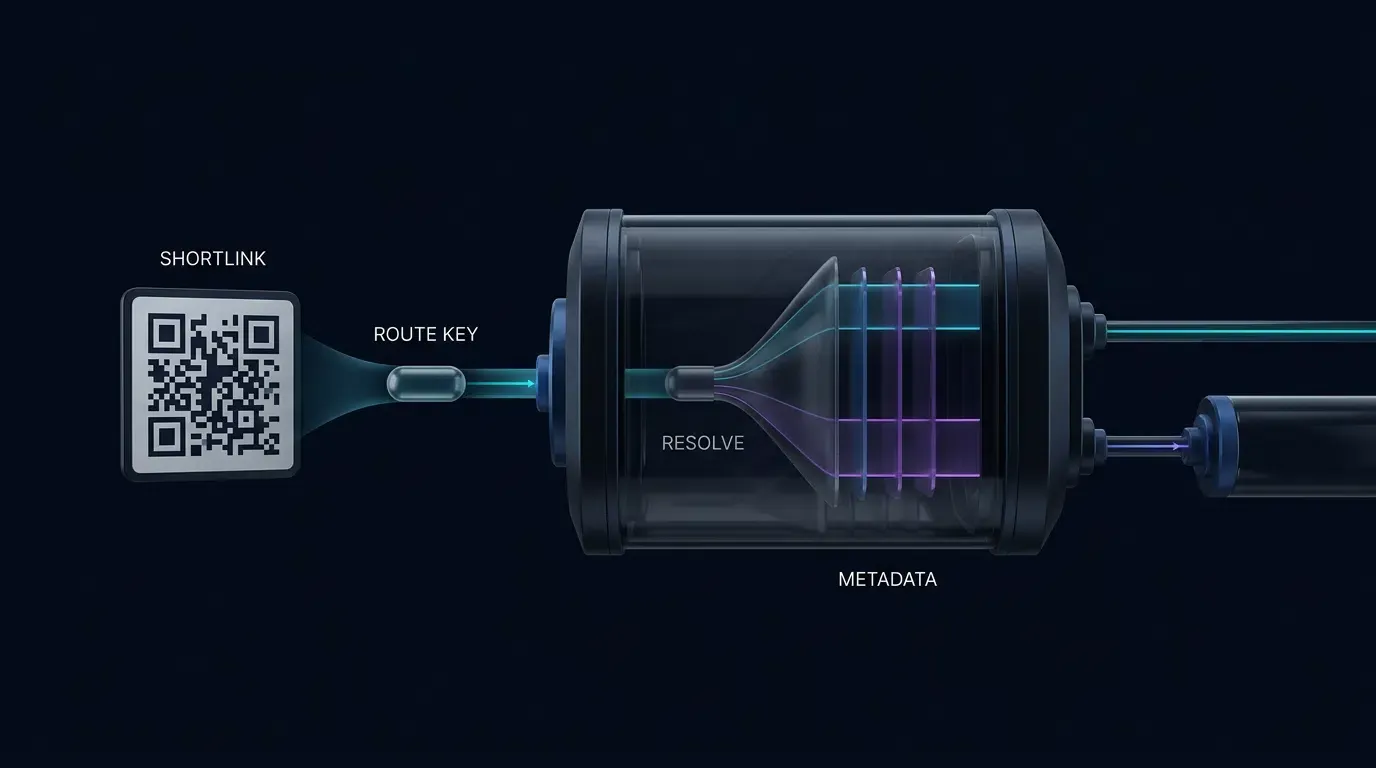
A direct tension exists between marketing data granularity and optical barcode scannability. In compliance with the ISO/IEC 18004 Standard for QR Code Barcodes, the physical module density of a QR code matrix increases as the encoded data payload grows. Longer encoded URLs can require higher QR symbol versions, depending on byte length, character encoding mode, and error correction level.
High-density barcodes introduce scanning challenges on physical print collateral:
- Reduced Module Pitch: For a fixed physical print footprint (e.g., a
direct mailer), higher symbol versions produce smaller individual modules that are more susceptible to ink spread on porous paper. - Optical Distance Constraints: Mobile cameras require closer proximity or higher lens resolution to resolve dense module grids under dim ambient lighting.
- Increased Decode Latency: Optical decoders require clearer focus and higher contrast to segment dense matrices when scanned at an angle.
Enterprise QR code architectures address this trade-off by encoding short routing URLs (e.g., https://promo.example.com/d/p04). An intermediary routing service ingests the short path, resolves the associated campaign taxonomy server-side, and executes downstream redirection. Short routing URLs help reduce matrix density when fixed physical print dimensions are retained, preserving rich metadata downstream without crowding the physical symbol.
Automated Device Disambiguation: Routing iOS and Android Users to Respective Stores via a Single Code
A single physical print placement must serve diverse smartphone operating systems without requiring fragmented creative layouts. Printing separate barcodes side-by-side for different mobile platforms clutters print layouts and divides visual attention.
An enterprise business QR code routes traffic through an intermediary web landing page. When accessed, the routing layer evaluates client request signals (such as User-Agent headers and User-Agent Client Hints):
- iOS Devices: The routing layer directs the user to the Apple App Store listing or triggers configured Apple Universal Links when the application is already installed.
- Android Devices: The routing layer directs the user to Google Play, passing supported referral parameters to the Google Play Install Referrer API where applicable.
- Ambiguous or Non-Mobile Clients: Because User-Agent strings can be masked by privacy settings, enterprise proxies, or desktop-mode mobile browsers, the landing page must render explicit, clickable fallback buttons for both app stores to ensure uninterrupted user navigation.
Decoupling Macro Channel Reporting from Granular Sub-Placement Tags
In complex retail or franchise networks, an enterprise may deploy barcodes across hundreds of physical locations while managing budgets through a central marketing team. Generating separate top-level applications for every point of sale fragments executive reporting.
By pairing parent channel codes with granular placement parameters, enterprises decouple high-level budget reporting from local execution auditing. The attribution platform aggregates campaign volume under the parent channel code while preserving placement-level identifiers in raw event exports for downstream business intelligence analysis.
Calculating Offline Ad ROI: Formulating ROAS and Effective CPI Across Physical Media
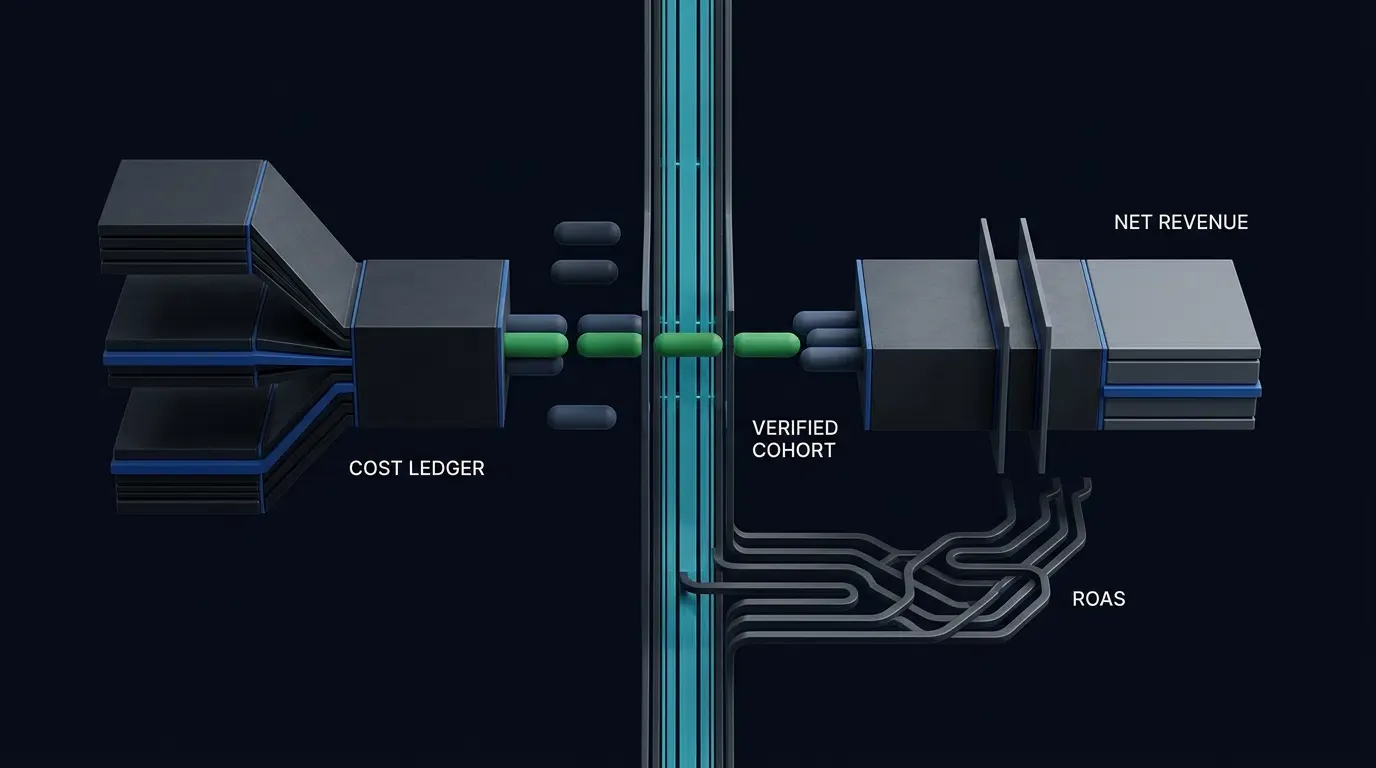
Establishing Mathematical Frameworks for Offline-to-Online Attribution
Evaluating physical print advertising requires strict measurement definitions that separate observable network events from inferred physical behavior, and distinguish attribution-based metrics from causal incrementality:
| Analytical Layer | What Can Be Observed or Computed | Methodological Boundary |
|---|---|---|
| Routing Telemetry | HTTP requests arriving at the QR routing endpoint with a channelCode |
Proves a link was requested; does not prove the request occurred in front of the physical sign |
| Attributed Install | An initial app launch matched to a prior routing request under configured rules | Establishes rule-based channel assignment; does not prove counterfactual causality |
| Attributed ROAS | Gross or net revenue generated by attributed cohorts divided by media spend | Measures assigned revenue efficiency; does not equal incremental lift or net corporate ROI |
Within this framework, three core operational counts are tracked:
- Gross Ingress Requests (
): Total HTTP requests received by the intermediary routing URL. - Eligible Landing Visits (
): Deduplicated client sessions arriving at the landing page within cohort window after filtering automated bot requests. - Verified Attributed Installs (
): Initial application launches attributed to the physical campaign under a documented matching and verification policy within an active lookback window. For placement-level ROI reporting, verified_attributed_installsrepresents the verified primary-placement partition only; verified secondary-amplification installs are reported separately and may be included in broader campaign-level totals under a different aggregation policy. Physical-origin classification is inferred from available signals and must not be treated as deterministic evidence of in-person scanning.
Formulating Effective Cost Per Install Across Heterogeneous Print Buys
To normalize customer acquisition costs across disparate print mediums (e.g., comparing an upfront highway billboard lease against unit-cost direct mail postcards), finance and growth teams calculate the Effective Cost Per Install (eCPI):
Where:
represents creative design, pre-press preparation, and physical printing costs. represents placement leasing, ad space purchasing, or publication slotting expenses. represents postage, freight, retail installation labor, or inventory handling fees. counts only installations in the verified primary-placement partition ( status = attributedandverification_status = verified). If, eCPI is undefined and reported as nullrather than zero.
Formulating Physical Return on Ad Spend Using Downstream In-App Revenue
While eCPI measures acquisition cost efficiency, enterprise budget reviews require evaluating downstream monetization. It is essential to distinguish between Return on Ad Spend (ROAS) and Return on Investment (ROI):
- Attributed ROAS measures the ratio of attributed net revenue to total campaign advertising expenditure over evaluation window
(e.g., 30, 60, or 90 days post-install):
- Attributable Contribution and Net Profit ROI account for cost of goods sold (COGS), order fulfillment expenses, and allocated operational overhead before evaluating return against the defined investment base:
In these formulations:
represents tax-exclusive settled gross in-app billings ( attributed_gross_revenue, recorded net of applicable sales or value-added taxes) minus customer refunds, chargebacks, and platform app store commission fees. Note that if refunds and chargebacks exceed gross billings during an evaluation period,and the resulting can be negative. represents the fully loaded campaign expenditure. is defined by corporate accounting policy (either when evaluating marketing-spend ROI, or total capital deployed when evaluating holistic project ROI). The numerator and investment base must follow the same documented project scope and accounting policy; additional capital expenditure, depreciation, or allocated investment costs must be reflected consistently when using a holistic project ROI definition.
Attribution-based ROAS measures revenue assigned to a campaign under configured matching rules; it does not establish incremental advertising lift without an appropriate control or experimental design (such as geographic holdout testing or matched-market experiments).
Cohort Alignment Rules: Accounting for Print Media Shelf Life and Delayed Conversion Windows
A common analytical error in offline media evaluation involves dividing current-month installs by current-month print expenditure. Unlike digital search ads that resolve within minutes, physical print collateral exhibits three distinct temporal windows:
- Contract Display or Distribution Period: The dates during which a billboard is leased or a direct mailer batch is delivered.
- Physical Persistence Period: How long a magazine issue remains in a waiting room or a product box remains on a shelf.
- Active Scan Response Window: The period during which consumers actively scan the barcode and convert.
To prevent temporal misalignment, data pipelines enforce cohort-based attribution:
All attributed installs and subsequent revenue events (
Case Analysis: Comparing Unit Economics Across Transit Billboards, Industry Magazines, and Packaging
The table below presents a hypothetical financial reconciliation across three distinct physical media deployments:
| Deployment Medium | Fully Loaded Campaign Cost ( |
Estimated Placement Footprint | Eligible Web Visits ( |
Verified Attributed Installs ( |
Effective CPI ( |
90-Day Attributed Net Revenue ( |
90-Day Attributed ROAS ( |
|---|---|---|---|---|---|---|---|
| Metropolitan Subway Posters | $18,500 | 6,420 | 1,840 | $10.05 | $27,600 | 149.19% | |
| B2B Trade Magazine Insert | $8,200 | 1,120 | 410 | $20.00 | $19,680 | 240.00% | |
| In-Box Retail Product Inserts | $4,500 | 2,850 | 1,210 | $3.72 | $14,520 | 322.67% |
Simulated Scenario / Illustrative Financial Model: These figures represent a synthetic financial model demonstrating how eCPI and attributed ROAS calculations operate across different cost structures. In practice, conversion rates and revenue outcomes depend on audience targeting, offer relevance, creative execution, and pricing models, and must be established through empirical campaign measurement.
Telemetry and Multi-Channel Data Reconciliation for Enterprise Campaigns
The Offline Ingestion Pipeline: Ingress Requests, Validated Web Visits, Store Dispatches, and Installs
To maintain auditability across corporate business intelligence systems, offline attribution signals are processed through a staged pipeline:
[Physical Media Deployments] ──> Subway Poster / Magazine / Direct Mail
             │
             ▼
[Discrete Parameterized QRs] ──> channelCode=subway_ny / mag_q2 / mail_vip
             │
             ▼
[Intermediary Routing Layer] ──> Logs Routing Ingress & Dispatches Store
             │
             ▼
[Native App First Launch] ───> Mobile SDK Queries Attribution Resolution
             │
             ▼
[Enterprise Data Warehouse] ─> Joins Placement Ledger with Verified Events
When a device requests the routing URL encoded in a business QR code, the routing layer logs the ingress event, evaluates request risk signals, and directs the user to the appropriate store. Upon initial application launch, the native SDK queries the attribution service to resolve the installation status, emitting structured event records for warehouse reconciliation.
Structuring Enterprise Print Campaign Attribution Event Schemas
To ingest offline attribution outcomes into enterprise data warehouses without double-counting media budgets, event records reference a versioned placement cost ledger via a foreign key (cost_ledger_reference_id) rather than embedding raw total campaign costs into every individual install row.
The JSON Schema below defines an internal warehouse event structure recording an offline print attribution resolution outcome across attributed, pending, unmatched, and disqualified states:
{
  "$schema": "https://json-schema.org/draft/2020-12/schema",
  "title": "EnterprisePrintCampaignAttributionEvent",
  "description": "Illustrative internal warehouse event schema recording an offline print campaign attribution resolution outcome across attributed, pending, unmatched, and disqualified states. Note: event_id requires database-level primary key enforcement, and cost_ledger_reference_id joins with the financial reconciliation contract.",
  "type": "object",
  "required": [
    "schema_version",
    "event_id",
    "event_type",
    "occurred_at_utc",
    "received_at_utc",
    "app_id",
    "placement_metadata",
    "traffic_hygiene",
    "attribution"
  ],
  "properties": {
    "schema_version": { "type": "string", "example": "1.2.0" },
    "event_id": {
      "type": "string",
      "description": "Unique transaction idempotency key. Requires database primary key enforcement to prevent duplicate accounting.",
      "example": "evt_print_ooh_98471204a"
    },
    "event_type": { "type": "string", "example": "offline_print_attribution_resolution" },
    "occurred_at_utc": { "type": "string", "format": "date-time", "example": "2026-04-14T09:12:44Z" },
    "received_at_utc": { "type": "string", "format": "date-time", "example": "2026-04-14T09:12:45Z" },
    "app_id": { "type": "string", "example": "com.enterprise.bankingapp" },
    "placement_metadata": {
      "type": "object",
      "required": [
        "macro_channel",
        "channel_code",
        "placement_id",
        "production_batch",
        "cost_ledger_reference_id"
      ],
      "properties": {
        "macro_channel": {
          "type": "string",
          "enum": ["billboard_ooh", "transit_shelter", "trade_magazine", "direct_mail", "packaging_insert"],
          "example": "transit_shelter"
        },
        "channel_code": { "type": "string", "example": "subway_ldn_central" },
        "sub_channel": { "type": ["string", "null"], "example": "oxford_circus_southbound" },
        "placement_id": { "type": "string", "example": "panel_ox_04b" },
        "production_batch": { "type": "string", "example": "2026_q2_print_run_01" },
        "cost_ledger_reference_id": {
          "type": "string",
          "description": "Foreign key linking to cost_ledger.cost_ledger_reference_id in the financial reconciliation contract. Prevents double-counting fixed media spend across individual install events.",
          "example": "ledger_print_2026_q2_ox04b"
        }
      }
    },
    "traffic_hygiene": {
      "type": "object",
      "required": ["ingress_classification", "amplification_flag"],
      "properties": {
        "ingress_classification": {
          "type": "string",
          "enum": ["qualified_interactive", "uncertain_no_js", "flagged_automated"],
          "example": "qualified_interactive"
        },
        "amplification_flag": {
          "type": "string",
          "description": "Inferred traffic origin based on velocity and geolocation signals relative to the physical deployment zone. Must not be treated as deterministic proof of in-person scanning.",
          "enum": ["consistent_with_primary_footprint", "secondary_digital_amplification", "unclassified"],
          "example": "consistent_with_primary_footprint"
        }
      }
    },
    "attribution": {
      "type": "object",
      "required": ["status", "method", "verification_status"],
      "properties": {
        "status": {
          "type": "string",
          "enum": ["attributed", "pending", "unmatched", "disqualified"]
        },
        "method": {
          "type": "string",
          "enum": ["deferred_deep_link_context", "play_install_referrer", "authorized_first_party_binding", "none"]
        },
        "evidence_reference": {
          "type": ["string", "null"]
        },
        "verification_status": {
          "type": "string",
          "enum": ["verified", "pending_validation", "rejected", "unverified"]
        },
        "time_to_install_seconds": {
          "type": ["integer", "null"],
          "minimum": 0,
          "example": 312
        }
      }
    },
    "custom_parameters": {
      "type": "object",
      "description": "Untrusted application-level promotional context. Backend services must authenticate voucher eligibility before financial provisioning.",
      "properties": {
        "promo_code": { "type": "string", "example": "TRAVEL25" },
        "sales_rep_id": { "type": ["string", "null"], "example": "rep_london_402" },
        "onboarding_route": { "type": "string", "example": "promotions/summer_travel" }
      }
    }
  },
  "allOf": [
    {
      "if": {
        "properties": { "attribution": { "required": ["status"], "properties": { "status": { "const": "attributed" } } } }
      },
      "then": {
        "properties": {
          "attribution": {
            "required": ["evidence_reference"],
            "properties": {
              "verification_status": { "const": "verified" },
              "method": { "enum": ["deferred_deep_link_context", "play_install_referrer", "authorized_first_party_binding"] },
              "evidence_reference": { "type": "string", "minLength": 1 }
            }
          }
        }
      }
    },
    {
      "if": {
        "properties": { "attribution": { "required": ["status"], "properties": { "status": { "const": "pending" } } } }
      },
      "then": {
        "properties": {
          "attribution": {
            "required": ["evidence_reference"],
            "properties": {
              "verification_status": { "const": "pending_validation" },
              "method": { "enum": ["deferred_deep_link_context", "play_install_referrer", "authorized_first_party_binding"] },
              "evidence_reference": { "type": "string", "minLength": 1 }
            }
          }
        }
      }
    },
    {
      "if": {
        "properties": { "attribution": { "required": ["status"], "properties": { "status": { "const": "unmatched" } } } }
      },
      "then": {
        "properties": {
          "attribution": {
            "properties": {
              "verification_status": { "const": "unverified" },
              "method": { "const": "none" },
              "evidence_reference": { "type": "null" }
            }
          }
        }
      }
    },
    {
      "if": {
        "properties": { "attribution": { "required": ["status"], "properties": { "status": { "const": "disqualified" } } } }
      },
      "then": {
        "properties": {
          "attribution": {
            "properties": {
              "verification_status": { "const": "rejected" },
              "method": { "const": "none" },
              "evidence_reference": { "type": "null" }
            }
          }
        }
      }
    }
  ]
}
Formalizing Offline Media Cost and ROAS Reconciliation Contracts
Event-level logs alone cannot compute ROAS unless joined with a formal media cost and revenue reconciliation contract. Install attribution events reference the same versioned cost ledger record (cost_ledger_reference_id) used by the reconciliation contract; the data warehouse joins event records to the financial ledger on this key rather than repeatedly summing fixed campaign costs from individual event rows.
Because JSON Schema validates structural types and field presence rather than executing cross-field arithmetic equations, data engineering pipelines must pair structural schema validation with explicit financial reconciliation rules:
| Financial Verification Rule | Enforcement Logic in Data Warehouse |
|---|---|
| Total Cost Identity | Verify total_loaded_cost == production_cost + media_placement_cost + distribution_cost |
| Net Revenue Identity | Verify attributed_net_revenue == attributed_gross_revenue - refunds_and_chargebacks - platform_store_fees (where gross revenue is recorded net of applicable sales/VAT taxes) |
| Disjoint Install Partitioning | Verify verified_attributed_installs, secondary_amplification_installs, pending_installs, and unmatched_installs are mutually exclusive sets |
| eCPI Zero-Denominator Guard | Compute total_loaded_cost / verified_attributed_installs; if installs equal 0, set ecpi = null |
| ROAS Zero-Cost Guard | Compute (attributed_net_revenue / total_loaded_cost) * 100; if total_loaded_cost == 0, set attributed_roas_percentage = null |
| Maturity Lock Gate | Permit finalized_locked only after the last eligible install’s revenue window has matured, pending attribution and financial adjustments have been resolved under the reporting policy, and ledger currency and cost reconciliation checks have passed |
The JSON Schema and illustrative contract instance below specify the structure for reconciling physical print media costs against attributed cohort installations and net revenue, intended for structural schema validation paired with the financial reconciliation rules above:
{
  "$schema": "https://json-schema.org/draft/2020-12/schema",
  "title": "EnterpriseOfflineMediaRoasContractSchema",
  "description": "Formal JSON Schema governing cost ledger linkage, disjoint cohort install partitioning, tax-exclusive net revenue accounting, and ROAS/eCPI reconciliation for physical print campaigns. Cross-field arithmetic identities are enforced by the warehouse reconciliation engine.",
  "type": "object",
  "required": [
    "contract_version",
    "reconciliation_id",
    "campaign_placement",
    "cost_ledger",
    "cohort_window",
    "attribution_summary",
    "revenue_ledger",
    "computed_metrics",
    "audit_metadata"
  ],
  "properties": {
    "contract_version": { "type": "string" },
    "reconciliation_id": { "type": "string" },
    "campaign_placement": {
      "type": "object",
      "required": ["campaign_id", "channel_code", "placement_id", "production_batch"],
      "properties": {
        "campaign_id": { "type": "string" },
        "channel_code": { "type": "string" },
        "placement_id": { "type": "string" },
        "production_batch": { "type": "string" }
      }
    },
    "cost_ledger": {
      "type": "object",
      "required": [
        "cost_ledger_reference_id",
        "currency",
        "production_cost",
        "media_placement_cost",
        "distribution_cost",
        "total_loaded_cost",
        "allocation_method"
      ],
      "properties": {
        "cost_ledger_reference_id": {
          "type": "string",
          "description": "Primary ledger key referenced by individual attribution events (placement_metadata.cost_ledger_reference_id)."
        },
        "currency": { "type": "string", "pattern": "^[A-Z]{3}$" },
        "production_cost": { "type": "number", "minimum": 0 },
        "media_placement_cost": { "type": "number", "minimum": 0 },
        "distribution_cost": { "type": "number", "minimum": 0 },
        "total_loaded_cost": { "type": "number", "minimum": 0 },
        "allocation_method": { "type": "string", "enum": ["direct_placement_invoice", "pro_rata_circulation", "equal_panel_split"] }
      }
    },
    "cohort_window": {
      "type": "object",
      "required": [
        "cohort_start_utc",
        "cohort_end_utc",
        "attribution_window_hours",
        "last_eligible_install_utc",
        "revenue_maturity_days",
        "maturity_basis"
      ],
      "properties": {
        "cohort_start_utc": { "type": "string", "format": "date-time" },
        "cohort_end_utc": { "type": "string", "format": "date-time" },
        "attribution_window_hours": { "type": "integer", "minimum": 1, "maximum": 4320 },
        "last_eligible_install_utc": { "type": "string", "format": "date-time" },
        "revenue_maturity_days": { "type": "integer", "enum": [7, 14, 30, 60, 90, 180] },
        "maturity_basis": { "type": "string", "const": "per_install_timestamp_plus_maturity_days" }
      }
    },
    "attribution_summary": {
      "type": "object",
      "required": [
        "eligible_web_visits",
        "verified_attributed_installs",
        "secondary_amplification_installs",
        "pending_installs",
        "unmatched_installs",
        "partition_exclusivity_rule",
        "deduplication_basis"
      ],
      "properties": {
        "eligible_web_visits": { "type": "integer", "minimum": 0 },
        "verified_attributed_installs": { "type": "integer", "minimum": 0 },
        "secondary_amplification_installs": { "type": "integer", "minimum": 0 },
        "pending_installs": { "type": "integer", "minimum": 0 },
        "unmatched_installs": { "type": "integer", "minimum": 0 },
        "partition_exclusivity_rule": { "type": "string" },
        "deduplication_basis": { "type": "string" }
      }
    },
    "revenue_ledger": {
      "type": "object",
      "required": ["attributed_gross_revenue", "refunds_and_chargebacks", "platform_store_fees", "attributed_net_revenue", "recognition_policy"],
      "properties": {
        "attributed_gross_revenue": {
          "type": "number",
          "minimum": 0,
          "description": "Tax-exclusive settled gross in-app billings (recorded net of applicable sales or value-added taxes)."
        },
        "refunds_and_chargebacks": { "type": "number", "minimum": 0 },
        "platform_store_fees": { "type": "number", "minimum": 0 },
        "attributed_net_revenue": { "type": "number" },
        "recognition_policy": { "type": "string" }
      }
    },
    "computed_metrics": {
      "type": "object",
      "required": ["ecpi", "attributed_roas_percentage", "zero_denominator_handling", "incrementality_disclaimer"],
      "properties": {
        "ecpi": { "type": ["number", "null"], "minimum": 0 },
        "attributed_roas_percentage": {
          "type": ["number", "null"],
          "description": "Ratio of attributed_net_revenue to total_loaded_cost expressed as a percentage. Unbounded minimum permits negative ROAS when refunds exceed gross billings."
        },
        "zero_denominator_handling": { "type": "string" },
        "incrementality_disclaimer": { "type": "string" }
      }
    },
    "audit_metadata": {
      "type": "object",
      "required": ["reconciliation_status", "reconciled_at_utc", "data_source_system"],
      "properties": {
        "reconciliation_status": { "type": "string", "enum": ["finalized_locked", "provisional_maturity_pending", "under_audit"] },
        "reconciled_at_utc": { "type": "string", "format": "date-time" },
        "data_source_system": { "type": "string" }
      }
    }
  }
}
{
  "contract_version": "2026.2",
  "reconciliation_id": "rec_ooh_ldn_2026_q2_004",
  "campaign_placement": {
    "campaign_id": "spring_retail_drive_2026",
    "channel_code": "subway_ldn_central",
    "placement_id": "panel_ox_04b",
    "production_batch": "2026_q2_print_run_01"
  },
  "cost_ledger": {
    "cost_ledger_reference_id": "ledger_print_2026_q2_ox04b",
    "currency": "USD",
    "production_cost": 1500.00,
    "media_placement_cost": 16000.00,
    "distribution_cost": 1000.00,
    "total_loaded_cost": 18500.00,
    "allocation_method": "direct_placement_invoice"
  },
  "cohort_window": {
    "cohort_start_utc": "2026-04-01T00:00:00Z",
    "cohort_end_utc": "2026-04-30T23:59:59Z",
    "attribution_window_hours": 72,
    "last_eligible_install_utc": "2026-05-03T18:40:12Z",
    "revenue_maturity_days": 90,
    "maturity_basis": "per_install_timestamp_plus_maturity_days"
  },
  "attribution_summary": {
    "eligible_web_visits": 6420,
    "verified_attributed_installs": 1840,
    "secondary_amplification_installs": 95,
    "pending_installs": 0,
    "unmatched_installs": 310,
    "partition_exclusivity_rule": "Mutually exclusive partitions: verified_attributed_installs represents the verified primary-placement partition only and strictly excludes secondary_amplification_installs, pending_installs, and unmatched_installs. Physical-origin classification is inferred from available signals and must not be treated as deterministic evidence of in-person scanning.",
    "deduplication_basis": "1 verified install per install_event_id requiring status=attributed AND verification_status=verified"
  },
  "revenue_ledger": {
    "attributed_gross_revenue": 34500.00,
    "refunds_and_chargebacks": 1725.00,
    "platform_store_fees": 5175.00,
    "attributed_net_revenue": 27600.00,
    "recognition_policy": "Tax-exclusive net settled in-app billings within 90 days of each user's individual install timestamp, strictly restricted to the 1840 verified_attributed_installs primary-placement partition."
  },
  "computed_metrics": {
    "ecpi": 10.05,
    "attributed_roas_percentage": 149.19,
    "zero_denominator_handling": "If verified_attributed_installs == 0, ecpi resolves to null. If total_loaded_cost == 0, attributed_roas_percentage resolves to null.",
    "incrementality_disclaimer": "Measures rule-based attributed ROAS; does not establish counterfactual incremental lift without holdout control testing."
  },
  "audit_metadata": {
    "reconciliation_status": "finalized_locked",
    "reconciled_at_utc": "2026-08-05T04:00:00Z",
    "data_source_system": "enterprise_bi_warehouse_reconciler_v2"
  }
}
Mitigating Measurement Drift and Fraud in Physical Print Distribution
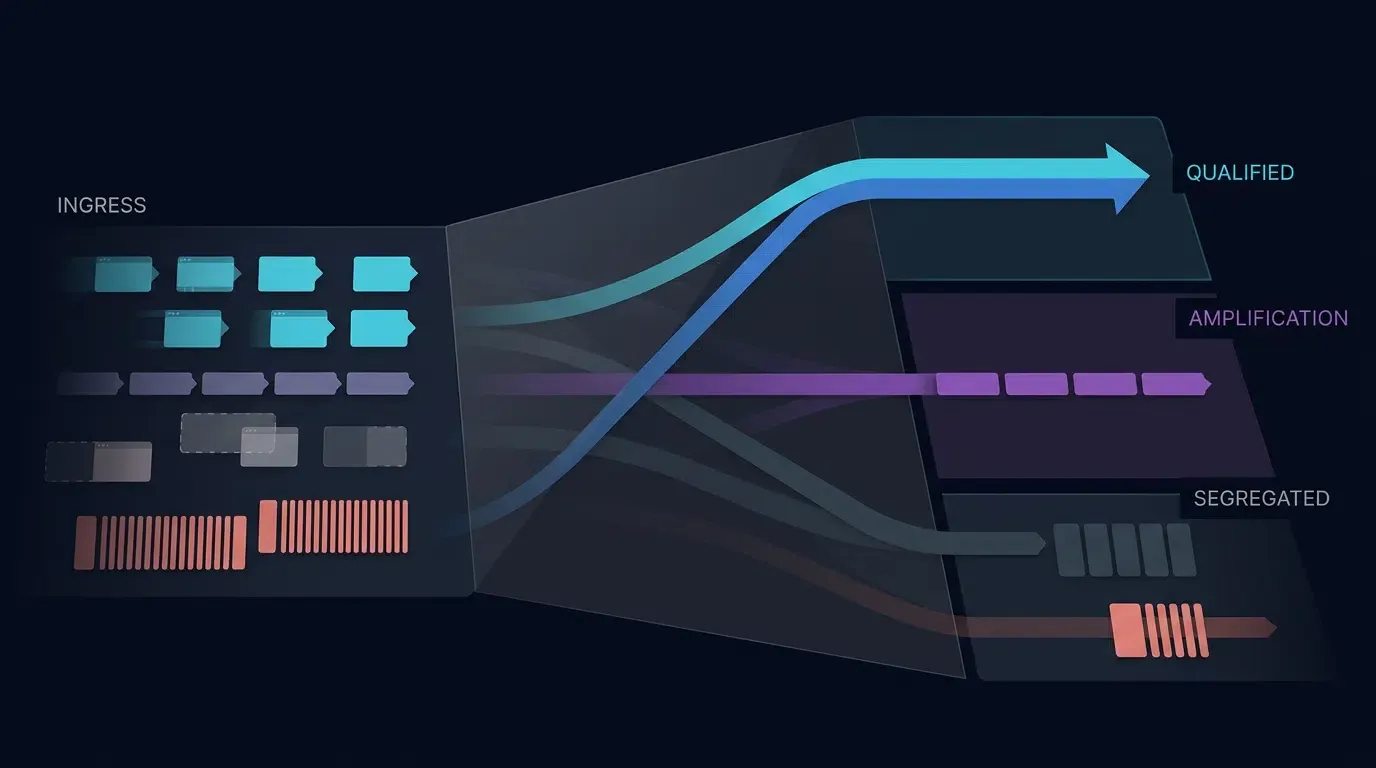
Distinguishing Genuine Optical Scans from Web Link Scraping and Bot Ingress
Publicly accessible URLs encoded in physical QR codes are frequently accessed by automated systems, including link preview generators inside messaging apps, corporate email security scanners, and web crawlers. Simultaneously, legitimate human users may browse via corporate VPNs, cellular carrier-grade NAT, or privacy relays (such as Apple iCloud Private Relay) that route traffic through datacenter IP ranges.
Consequently, attribution pipelines must avoid rigid rules that automatically discard all datacenter IPs or non-standard browsers. Instead, enterprise data hygiene relies on a staged risk-classification pipeline:
[Observed Routing Ingress]
             │
             ▼
[Multi-Signal Risk Evaluation] ──> (UA Signature + JS Telemetry + Request Velocity)
             │
     ┌───────┴───────┐
     ▼               ▼
[Qualified]     [Uncertain / Automated]
     │               │
     ▼               ▼
[Main Funnel]   [Flagged / Segregated Reporting Pool]
- Known Automated Crawlers: Requests matching verified search spider signatures or automated head-requests without asset rendering are segregated into a non-human monitoring log.
- Client-Side Telemetry: Web JS SDK execution provides positive confirmation of an interactive browser session, while requests lacking script execution are marked as
uncertain_no_jsrather than silently deleted, preserving visibility for users on restricted browsers. - Corroborated Exclusion: Traffic is excluded from primary conversion denominators only when multiple corroborating signals confirm automated scraping or replay activity.
Managing Secondary Amplification: What Happens When Physical Mailers Are Shared Digitally
A recurring phenomenon in offline marketing involves secondary digital amplification. A consumer receives a physical postcard or sees a transit poster featuring a promotional QR code, photographs the code, and posts the image to an online forum or social media group.
When thousands of remote users scan the photographed image from their screens:
- Channel Attribution vs. Physical Exposure: From a pure link-routing perspective, these installs originated from the QR code’s
channelCode. However, crediting all viral digital installs directly to the local physical print placement can distort location-specific media renewal decisions. - Cohort Segmentation Strategy: Rather than discarding these conversions or claiming an unblemished physical-only baseline, analytics teams monitor temporal velocity spikes and IP geolocation divergence relative to the physical deployment zone. When corroborated anomalies occur, the surplus volume is segmented into a separately reported, mutually exclusive Secondary Digital Amplification partition (
secondary_amplification_installs), allowing marketers to credit the print campaign for sparking viral interest while keeping local foot-traffic eCPI benchmarks realistic.
Physical QR Sticker Tampering and Visual Security Best Practices
Physical signage deployed in public transit and retail spaces is exposed to physical tampering, where malicious actors place adhesive stickers containing rogue QR codes over legitimate corporate barcodes.
While application-layer defenses such as URL validation and input sanitization align with general mobile security principles outlined in OWASP Mobile Security Guidance, protecting physical collateral requires operational field measures:
- Protective Physical Mounting: Print barcodes beneath tamper-resistant laminates, reverse-printed acrylic panels, or locked transit display cases.
- Integrated Visual Borders: Design custom frames where brand artwork and color accents interlock with the outer quiet zone boundary, making physical sticker overlays visually conspicuous to passersby and venue staff.
- Domain Transparency: Display the expected destination domain name in clear text adjacent to the barcode so users can verify the URL preview shown by their native camera scanner before tapping through.
Handling Print Media Decay: Establishing Inactive Destination Fallbacks for Expired Campaigns
Physical print media frequently remains in circulation long after a promotional campaign concludes. A trade magazine issue or product box printed in 2025 may be scanned by a prospective customer in 2027.
Properly configured dynamic routing can direct late scans to an active fallback page, provided the shortlink service and destination remain available:
- Lifecycle State Routing: When a campaign’s active promotional window expires in the management console, the shortlink route transitions from the time-bound promotional landing page to an evergreen product download page.
- Late-Arriving Telemetry Tagging: Scans occurring after campaign expiration are logged into an archived post-campaign bucket, ensuring users experience a functional onboarding path while keeping closed financial accounting periods locked.
Organizations configuring multi-channel routing lifecycles can register and manage campaign endpoints via the OpoInstall developer console.
Comparative Analysis of Offline Media Placements and Attribution Performance
Evaluating Conversion Efficiency, Cost Density, and Attribution Fidelity Across Print Mediums
Selecting physical media channels requires evaluating how environmental context, viewing duration, and cost structures affect attribution tracking. The table below outlines illustrative planning ranges across common commercial print mediums:
| Print Placement Medium | Placement Granularity | Illustrative Active Scan Window | Typical Cost Structure | Primary Operational & Measurement Constraint |
|---|---|---|---|---|
| Outdoor Billboards (OOH) | Location / Panel ID | 14 to 30 days (Lease bound) | High fixed lease & production | Long scan distance, brief pedestrian dwell time |
| Industry Trade Magazines | Issue / Page Placement | 30 to 180 days (Long tail) | Moderate fixed slotting cost | Extended lag between print distribution and scan |
| Direct Mail Postcards | Batch / Audience Segment | 7 to 21 days (Post-delivery) | Variable unit print & postage | Risk of secondary digital sharing of promo codes |
| Retail Product Packaging | SKU / Production Batch | Extended (Product lifecycle) | Low marginal printing cost | Scans occur post-purchase; measures retention/upsell |
Illustrative planning ranges, not universal scan-response or placement-duration benchmarks. Actual scan velocity and persistence depend on creative execution, audience targeting, and distribution environment.
Strategic Trade-offs in Media Selection for Mobile App Acquisition
Outdoor billboards and transit shelters provide broad geographic reach, but their physical distance and brief viewing windows generally result in lower scan-to-impression ratios compared to handheld collateral.
Conversely, direct mail postcards and in-box product inserts allow consumers to scan the barcode at close range under stable indoor lighting. Depending on production costs, audience qualification, and promotional incentives, handheld collateral may achieve lower observed eCPI for direct app acquisition, whereas trade publications and outdoor signage often support broader brand discovery alongside measurable direct response.
Frequently Asked Questions (FAQ)
How does a business QR code attribute app installs to a specific billboard or magazine ad?
Can dynamic QR codes change destinations after physical collateral has already been printed?
How do enterprises calculate ROAS on physical print campaigns using QR codes?
Summary and Decision Framework
To track offline print ad performance effectively, enterprise marketing organizations must replace unmeasured static links with structured, parameter-embedded QR code for business deployments. Quantifying physical advertising returns relies on configuring hierarchical channel taxonomies, enforcing cohort-aligned conversion windows, separating attributed ROAS from incremental profit ROI, and reconciling media expenditure ledgers against verified native app installations.
As omni-channel acquisition strategies mature, marketing architectures must connect physical collateral with enterprise business intelligence systems while maintaining strict data hygiene around automated traffic and secondary sharing. By combining dynamic shortlink routing with mobile attribution SDKs, platforms such as OpoInstall can support offline channel tracking and attribution reconciliation workflows, subject to configured routing links, SDK integration, and supported store installation paths.
For detailed developer specifications on configuring channel parameters and exporting attribution logs, consult the OpoInstall channel statistics documentation.
Related Materials
- Concepts: Multi-Channel Channel Segmentation, Return on Ad Spend, Effective Cost Per Install, Print Telemetry Reconciliation
- Technologies: Dynamic Shortlink Routing, Mobile Attribution SDK, Web JS SDK, Server-to-Server Event Streams
- Standards: ISO/IEC 18004 Information Technology — Automatic Identification and Data Capture Techniques — QR Code Bar Code Symbology Specification, IETF RFC 3986 Uniform Resource Identifier (URI) Generic Syntax
- Product Capabilities: OpoInstall Channel Statistics Interface, OpoInstall Conversion Event Recording Services
- Official Documentation & References:
Share this article