Anthropic Sonnet 5.5 Speeds Up 30%? Anthropic has officially released Claude Sonnet 5.5, with the lab reporting over 30% faster output generation and up to 30% lower cost per completed task. As generative artificial intelligence platforms transition from experimental prototypes to high-volume production systems, software engineering teams face mounting pressure to control token consumption and runtime latency. Historically, enterprise architects assumed that achieving state-of-the-art coding performance required deploying the largest, most expensive flagship models. Today, because optimized mid-tier architectures can solve complex software engineering challenges in fewer operational steps and tool calls, the fundamental economics of automated developer tooling are shifting toward execution efficiency.
Production Economics: Why Task Completion Cost Matters More Than Token Price
At a Glance
- Anthropic released Claude Sonnet 5.5 on September 28, 2026, delivering over 30% faster output generation and up to 30% lower cost per completed task.
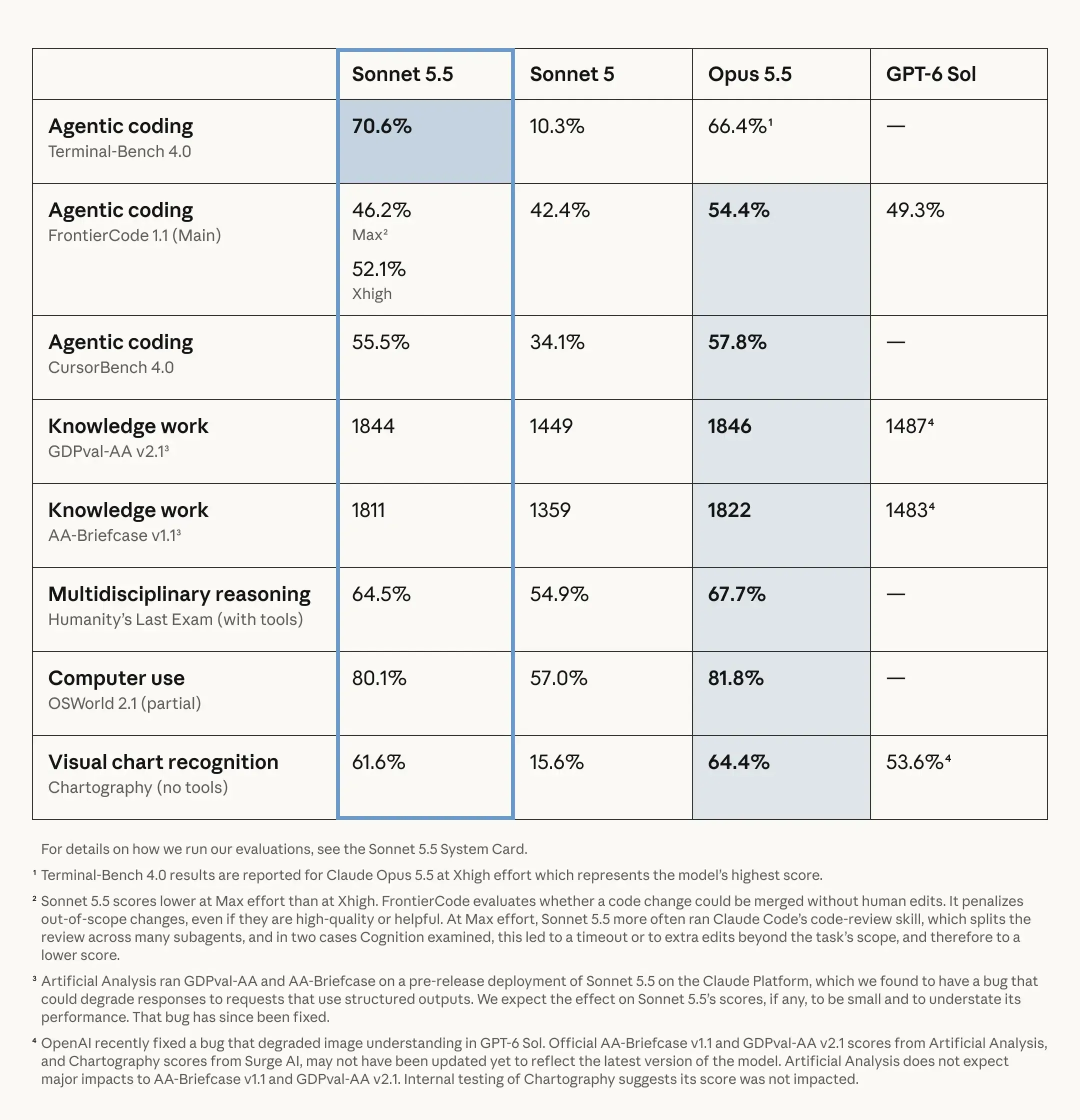
- On the Terminal-Bench 4.0 agentic coding evaluation, Sonnet 5.5 scored 70.6%, outperforming flagship Claude Opus 5.5 at 66.4% and Sonnet 5 at 10.3%.
- API token pricing remains anchored at $2 per million input tokens and $10 per million output tokens, achieving cost reductions through fewer execution steps and batched tool calls.
The commercial viability of deploying autonomous software engineering agents has historically encountered severe economic constraints. Running multi-step developer tools that inspect codebases, execute shell commands, and iteratively fix unit tests consumes massive token volumes. While top-tier frontier models demonstrate remarkable reasoning depth, their high token costs and elevated generation latencies make continuous, unattended execution expensive for scaling software enterprises.
When evaluating developer infrastructure, headline API pricing often obscures the true cost of completing a job. A model with low per-token pricing that loops through dozens of repetitive tool calls and retries ultimately costs significantly more than a model that solves problems in fewer execution steps. This dynamic is explored in industry reporting on Sonnet 5.5, which highlights how task completion costs are decoupling from raw token list prices.

Anthropic has structured Claude Sonnet 5.5 to address these operational bottlenecks directly. While maintaining base API rates of $2 per million input tokens and $10 per million output tokens, the model achieves up to a 30% reduction in net task costs by requiring substantially fewer reasoning steps. Anthropic’s published customer testing reports highlight notable efficiency gains across production workloads:
- Box reported that Sonnet 5.5 operated 2.4 times faster while using 12% fewer total tokens to recheck source documents and identify code regressions.
- Zendesk observed that support tickets were processed 20% faster alongside fewer automated decision errors than existing production models.
- Slack demonstrated that the model outperformed Sonnet 5 on offline bot evaluations without prompt modifications, consuming roughly 14% fewer output tokens.
- Lovable found that Sonnet 5.5 required approximately one-third fewer tool calls and half as many shell executions during automated application builds.
- Base44 verified that the model completed full application builds in an average of 3.6 iterations, compared to 7.7 iterations for Opus 5.
These results illustrate how execution efficiency fundamentally alters developer productivity. By reducing failed tool calls and eliminating redundant iterations, mid-tier models provide a sustainable foundation for continuous enterprise automation.
Technical Dissection: Evaluating Coding Benchmarks and Subagent Scaling
The emergence of mid-tier models outperforming flagships on specific technical benchmarks reflects a shift in foundation model post-training. Early scaling laws suggested that raw parameter count was the primary determinant of model intelligence. However, complex agentic tasks—such as navigating terminal environments and editing sprawling repositories—depend heavily on context management, precise tool-use discipline, and scope control.
Flagship models such as Opus 5.5 possess immense reasoning capacity, excelling at ambiguous, open-ended architectural decisions. Yet extensive reasoning depth can occasionally introduce operational overhead on tightly defined tasks. In the FrontierCode benchmark evaluations, for example, Anthropic noted that Sonnet 5.5 at Max effort scored lower than at Xhigh because it more frequently invoked Claude Code’s code-review skill. This skill split reviews across multiple subagents, which in examined cases led to timeouts or out-of-scope edits penalized by the benchmark harness. In contrast, Sonnet 5.5 running at standard effort is particularly well suited to constrained, well-scoped execution: it quickly parses repository structures, evaluates proposed changes, and operates within defined file boundaries.
Benchmark Parity: Terminal-Bench, CursorBench, and GDPval-AA
Anthropic’s published evaluations show Sonnet 5.5 matching or surpassing top-tier benchmarks across everyday technical domains. On Terminal-Bench 4.0, which evaluates multi-step command-line problem-solving, Sonnet 5.5 scored 70.6%, outperforming Opus 5.5 at 66.4% and Sonnet 5 at 10.3%. On CursorBench 4.0, derived from real-world Cursor developer sessions, Sonnet 5.5 reached 55.5%, trailing Opus 5.5 (57.8%) by just over two percentage points. Furthermore, on GDPval-AA v2.1, measuring real-world professional tasks across 44 occupations, Sonnet 5.5 achieved an Elo rating of 1844, closely tracking Opus 5.5 at 1846.
To examine how streamlined models optimize autonomous execution, consider the workflow differences:
[Monolithic Flagship Agent Loop]
  User Prompt ──> Heavy Reasoning Chain ──> Sprawling Tool Calls (High Token Burn) ──> Risk of Over-editing & Timeouts

[Streamlined Mid-Tier Agent Loop]
  User Prompt ──> Scoped Intent Mapping ──> Batched Tool Calls ──> Fewer Execution Steps ──> Concise Patch Delivered
This streamlined execution loop can reduce opportunities for context drift and unnecessary round trips. Anthropic reports 30%+ faster output generation alongside reduced step counts versus Sonnet 5. The model batches tool calls together, minimizing round-trip network latency between the agent runtime and host environments.
Sonnet 5.5 also introduces tier-one safety infrastructure into the mid-tier category. It is the first Sonnet variant to deploy with cybersecurity safeguards similar to Opus 5.5. High-risk vulnerability discovery tasks automatically fall back to earlier architectures, while approved defenders receive tiered permissions through the Cyber Verification Program. Additionally, the system incorporates safety classifiers designed to reduce industrial-scale reasoning extraction and keep preserved thinking bound to the originating account.
Architectural Strategy: Allocating Workloads Across Frontier and Mid-Tier Models
As AI foundation models bifurcate into ultra-deep reasoning engines and agile execution models, engineering leaders must re-evaluate how they allocate model tiers across the software development lifecycle. Deploying a single flagship model across an entire engineering pipeline introduces unnecessary latency and cost. Instead, modern developer infrastructure increasingly relies on dynamic model routing, assigning tasks based on structural complexity.

When architecting production workflows, teams must weigh the trade-offs between deep conceptual reasoning and high-throughput task resolution. While flagship models remain indispensable for broad architectural planning, intermediate models handle the vast majority of day-to-day code execution with superior responsiveness.
The following decision matrix outlines the technical alignment across model tiers:
| Workload Category | Primary Model Choice | Cost Profile | Latency Profile | Best For |
|---|---|---|---|---|
| Routine Bug Fixes & PR Reviews | Claude Sonnet 5.5 | Low ($2 / $10 per 1M tokens) | Fast (30%+ faster output generation) | Well-scoped daily software tasks and high-volume CI/CD checks |
| Full Codebase Architecture & Migrations | Claude Opus 5.5 | High ($4 / $20 per 1M tokens) | Adaptive, deep thinking cycles | Complex, ambiguous refactoring across sprawling repositories |
| Interactive Prototyping & UI Design | Claude Sonnet 5.5 | Low ($2 / $10 per 1M tokens) | Fast, responsive iteration | Designing user flows, generating diagrams, and frontend scaffolding |
| Advanced Cybersecurity Research | Verified-access Claude models | Depends on model and access tier | Thorough multi-step verification | Authorized high-risk security research under Anthropic verification programs |
Anthropic structures cybersecurity capabilities through tiered safeguards. While routine vulnerability remediation proceeds normally on Sonnet 5.5, higher-risk security tasks automatically fall back to earlier architectures. For authorized defenders conducting advanced security research, access to expanded capabilities across Sonnet 5.5, Opus 5.5, and Mythos models is managed through the multi-tiered Cyber Verification Program.
By establishing dynamic routing rules, engineering organizations can direct routine pull request reviews, unit test generation, and bug localization to Sonnet 5.5. This preserves top-tier Opus capacity for high-complexity architectural refactoring, keeping engineering budgets predictable without compromising software reliability.
Integration Checklists: Operationalizing Sonnet 5.5 in Enterprise CI/CD
As software organizations incorporate high-speed, cost-effective models like Sonnet 5.5 into their production pipelines, engineering teams must establish robust governance schedules. Maximizing cost savings requires aligning API parameter settings with task complexity while preventing unmonitored agent drift.
Developer Implementation Checklist
- Configure Dynamic Effort Levels: Utilize the model’s native effort settings—defaulting to Medium in Claude apps and Claude Code, and High on the Claude Platform—to balance reasoning depth against token expenditure.
- Leverage Prompt Caching: Implement prompt caching on static system prompts and repository maps to secure a 90% discount on cache-read tokens ($0.20 per million tokens).
- Deploy Asynchronous Batch Processing: Route non-real-time evaluations, automated code audits, and batch migrations through batch APIs to achieve a 50% discount on standard token costs.
- Integrate Fail-Safe Fallbacks: Establish programmatic circuit breakers that gracefully terminate or reroute requests if automated tool loops exceed predefined iteration budgets.
Governance & Infrastructure Checklist
- Re-evaluate Subscription Unit Economics: Calculate marginal compute costs per active developer to determine whether high-speed mid-tier models allow offering higher usage quotas or lower tier pricing.
- Monitor Iteration Ratios: Measure the average number of tool executions required to resolve user tasks; reductions in iteration counts directly improve developer satisfaction.
- Configure US-Only Processing Where Required: For regulated enterprise clients with domestic data residency requirements, configure US-only inference endpoints (available at 1.1x pricing under qualifying enterprise terms).
- Verify Zero Data Retention Eligibility: Confirm zero data retention status with the API provider, ensuring enterprise compliance while noting that specialized features like persistent prompt caches may operate under distinct data retention terms.
By adopting these structured operational practices, software organizations can convert algorithmic speed and token efficiency into predictable development gains.
Frequently Asked Questions (FAQ)
Why does Sonnet 5.5 cost less per task if per-token pricing matches Sonnet 5?
Can Claude Sonnet 5.5 replace Opus 5.5 for software engineering?
How does prompt caching impact operating costs in coding agents?
Key Takeaways for Engineering Teams
The release of Claude Sonnet 5.5 reflects an industry evolution from unconstrained parameter scaling toward operational task efficiency. High-throughput software engineering platforms do not necessarily require the compute overhead of flagship models for every operational phase. When an intermediate model reliably resolves scoped codebase tasks in fewer iterations, automated software development becomes significantly more cost-effective to deploy at scale.
Capitalizing on these efficiency gains requires establishing disciplined architecture: routing tasks dynamically based on complexity, enforcing tool-use boundaries, and systematically applying prompt caching. As foundation model providers continue to optimize token efficiency alongside raw reasoning, engineering teams that design modular, cost-monitored pipelines will maintain the most sustainable and scalable production workflows.
References
-
Anthropic. Introducing Claude Sonnet 5.5.
-
Anthropic. Claude Sonnet 5.5 System Card.
-
Anthropic. Claude API Pricing and Data Residency.
-
Anthropic. Commercial Terms of Service and Data Retention Policy.
-
VentureBeat. Anthropic Launches Claude Sonnet 5.5 with 30% Cost Reduction Per-Task.
-
TechCrunch. Anthropic Releases Sonnet 5.5 as a Significantly Cheaper, Faster Work Partner.
-
9to5Mac. Anthropic Upgrades Claude with New Sonnet 5.5 Model.
Share this article