What are the best Unity Ads alternatives for game monetization? Common Unity Ads alternatives to evaluate include Google AdMob, AppLovin, and Mintegral, deployed through unified mediation platforms to improve global fill rates and auction competition without relying on a single demand source.
Ad network diversification is a mobile game monetization strategy where developers deploy multiple programmatic demand sources and bidding networks through a unified mediation platform rather than relying on a standalone ad SDK. By expanding demand beyond Unity Ads, game studios protect themselves against regional fill rate drops, increase real-time auction competition to optimize eCPM yield, and reduce single-demand-source concentration risk across global player cohorts.
| Term | Definition | Related Entity | Search Intent Role |
|---|---|---|---|
| Unity Ads | A programmatic mobile ad network historically integrated into game engines. | Ad Network | Informational / Commercial |
| Ad Monetization | The commercial process of generating revenue by displaying ads to players. | In-App Advertising | Technical / Operational |
| Ad Mediation | An orchestration layer that routes ad requests across multiple demand sources using real-time bidding, waterfall logic, or hybrid configurations. | In-App Bidding | Operational / Decision |
The Commercial Risks of Single Network Reliance in Mobile Game Monetization
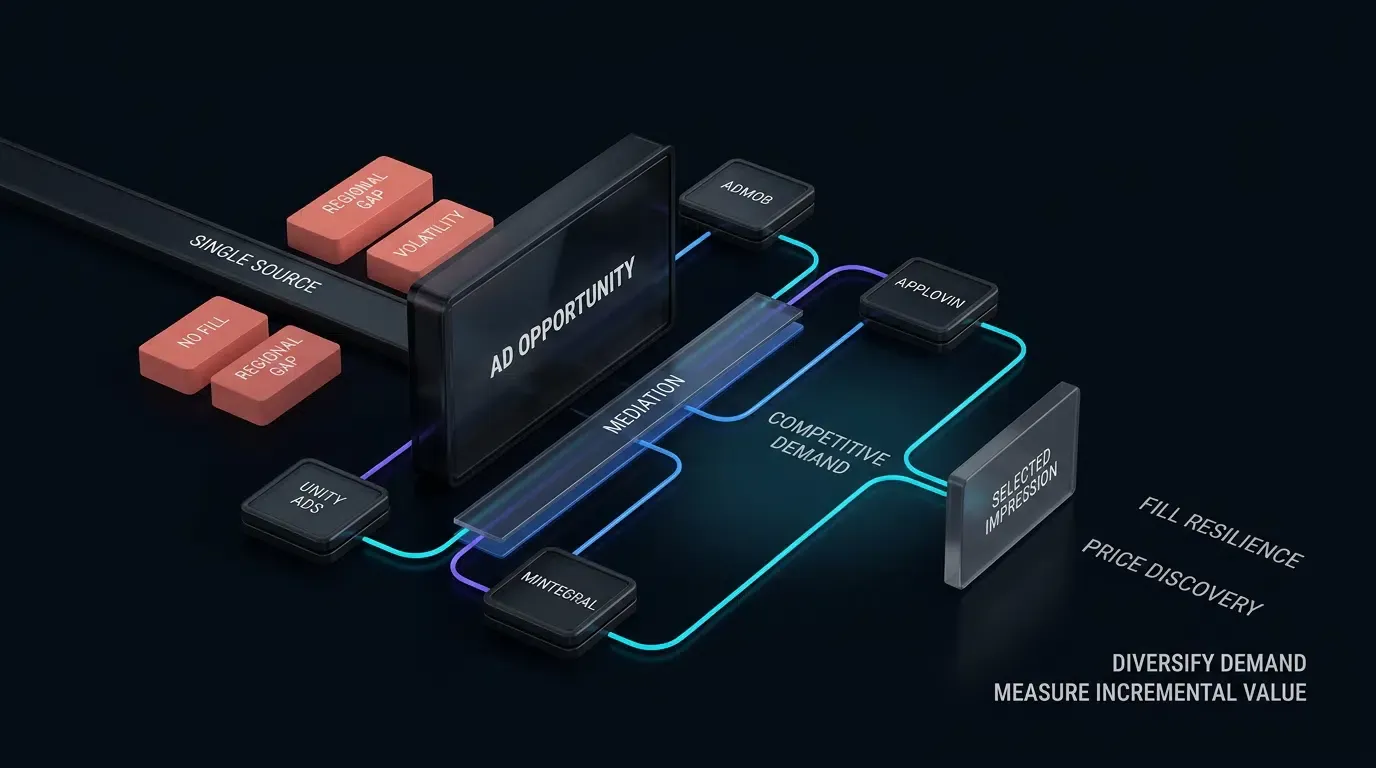
The Vulnerability of Single-Source Monetization: Regional Fill Volatility and Demand Fluctuations
Relying exclusively on a single ad network—such as a standalone Unity Ads integration—introduces structural revenue vulnerabilities for mobile game studios. No individual advertising network maintains consistent fill rates, premium demand density, or top-tier bids across every global territory. While a single network may deliver strong effective Cost Per Mille (eCPM) performance in Tier-1 markets (such as the United States, Canada, and Western Europe), its fill rate and pricing power often fluctuate in Tier-2 and Tier-3 regions (such as Latin America, Southeast Asia, or Eastern Europe).
When a game scales internationally, single-network reliance can result in unmonetized ad opportunities. If a network fails to return an ad creative during a rewarded video prompt or level-complete break, the placement goes unfilled. The player experiences an empty ad state, and the studio captures zero revenue. Diversifying ad demand through mediation can improve effective fill and reduce no-fill exposure where additional demand sources provide incremental eligible inventory.
The In-App Bidding Deficit: Why Standalone SDKs Miss Competitive Price Discovery
A standalone ad network SDK operates without real-time cross-network competition. While a standalone network can still run its own internal advertiser auction, the publisher cannot directly compare that opportunity against bids or expected values from independent demand sources at the same decision point.
Without multi-network competition, the publisher misses real-time price discovery. An external buyer on a competing ad network might have been willing to pay a higher clearing price for that specific player’s impression. By deploying a unified mediation layer where alternative ad networks compete in real-time in-app bidding auctions, studios force demand sources to compete dynamically, improving auction density and lifting overall advertising revenue per daily active user (ARPDAU).
Mitigating Platform Concentration Risk across Global Android and iOS Player Bases
Operating with a single monetization provider concentrates operational and regulatory risk. Ad networks periodically update SDK versions, adjust revenue-share terms, alter compliance requirements, or experience server-side delivery disruptions. If a studio’s sole monetization partner undergoes a service outage or algorithmic bidding shift, game revenue drops immediately.
Multi-network diversification distributes commercial exposure across independent global infrastructure. Studios maintain operational continuity by adjusting traffic allocation dynamically through mediation dashboards, shielding their monetization pipelines from single-vendor policy changes, technical deprecations, or regional bidding downturns.
See Also: Unity Ads ──> Ad Mediation Architecture
What Are the Leading Unity Ads Alternatives for Mobile Games
The following network characteristics are screening hypotheses rather than universal performance rankings. Validate every candidate using title-specific country, OS, format, latency, fill, revenue-per-impression, and incremental-lift data before retaining it in production.
Google AdMob: Global Demand and Broad Format Coverage to Validate
Google AdMob represents one of the largest programmatic demand sources in mobile gaming, backed by Google’s broad global advertiser base and programmatic access to Google demand.
Key evaluation characteristics include:
- Broad Global Fill: Extensive demand coverage across emerging and established markets, making it a candidate demand source for international distribution.
- Bidding and Mediation Ecosystem: Offers in-app bidding capabilities alongside mediation groups, enabling unified auction participation across formats.
- Format Versatility: Comprehensive format support across rewarded video, interstitial ads, native units, banners, and app-open placements.
AppLovin: Gaming-Focused Demand and MAX Ecosystem to Validate
AppLovin is a prominent monetization and performance marketing ecosystem in mobile gaming, particularly across casual, puzzle, and hybrid-casual genres. Through its MAX mediation platform and the AppLovin Exchange (ALX), it connects publishers to mobile gaming advertisers.
Key evaluation characteristics include:
- Gaming Demand Density: Concentration of mobile gaming advertisers bidding for rewarded video, playable ads, and full-screen interstitials.
- In-App Bidding Focus: Advanced programmatic bidding adapters that compete in real-time auctions across leading mediation platforms.
- Interactive Ad Support: High-performance rendering for interactive playable ads, which frequently drive strong user engagement in casual gaming loops.
Mintegral: Global Mobile Demand with Regional Presence to Validate
Mintegral is a global programmatic advertising platform with established demand across Asia-Pacific (APAC) markets, as well as demand density across North America and Europe.
Key evaluation characteristics include:
- Regional Demand Strength: Strong advertiser demand across China, Japan, South Korea, and Southeast Asian markets.
- Programmatic Bidding Adapters: Bidding adapters that compete in real-time auctions across major mediation platforms. On Google Mobile Ads mediation, Mintegral bidding is currently documented as open beta; verify current adapter status and format coverage before production rollout.
- Interactive Creative Formats: Support for 3D interactive ads and rewarded video placements designed for casual gaming.
InMobi and DT Exchange: Programmatic Exchange Demand to Validate
InMobi and DT Exchange (Digital Turbine) represent broad programmatic ad exchanges that connect publishers to global brand advertisers and performance DSPs.
Key evaluation characteristics include:
- Brand and Performance Demand: Representation from brand-focused advertisers seeking video placements alongside performance gaming demand.
- Exchange-Level Bidding: Integration with major Demand-Side Platforms (DSPs), increasing the number of programmatic buyers competing for game inventory.
- Display and Native Unit Yield: Solid monetization for non-intrusive banner and native ad placements in secondary game menus.
Decision Criteria for Evaluating Alternative Ad Networks
Geographic Coverage and Fill Reliability: Comparing Tier-1 Strength against Emerging Market Fill
When evaluating alternative ad networks, game studios must analyze geographic alignment between their player base and the network’s demand density:
- Tier-1 Markets (US, CA, UK, DE, AU): Compare each eligible demand source using measured bid rate, fill, revenue per impression, latency, and incremental lift.
- APAC and Emerging Markets (JP, KR, SEA, LATAM, IN): Repeat the same evaluation using local cohort data; do not assume that a network’s historical regional reputation will reproduce in the current title.
Studios distributing titles globally should select a balanced portfolio of networks that combine Tier-1 bidding strength with reliable emerging-market fill.
Ad Format Specialization: Rewarded Video vs Interstitial vs Native and Banner Yield
Different ad networks demonstrate distinct format strengths depending on integration capabilities:
- Rewarded Video: Requires demand partners with high-budget video advertisers and interactive playable assets (AppLovin, Unity Ads, Mintegral).
- Interstitial Placements: Requires networks capable of clearing static and video units rapidly between gameplay transitions (Google AdMob, DT Exchange).
- Banners and Native Units: Requires programmatic exchanges capable of maintaining fill on auto-refreshing display units (Google AdMob, InMobi). Note that format support is mediator-specific; for example, AppLovin bidding via Google AdMob mediation does not support banner formats.
In-App Bidding Support: True Simultaneous Auctions versus Legacy Tag-Based Waterfalls
Engineering teams must evaluate whether prospective ad networks support native in-app bidding adapters within their chosen mediation platform.
Networks that support in-app bidding can reduce manual waterfall tuning and enable simultaneous price competition, although timeout management, adapter maintenance, fallback configuration, and performance monitoring still remain. Integration capabilities are mediator-specific and time-sensitive; for example, Google ended Unity Ads waterfall mediation support on January 31, 2026, transitioning Unity Ads integration to in-app bidding on AdMob.
SDK Stability and Binary Footprint: Balancing Demand Breadth Against App Package Bloat
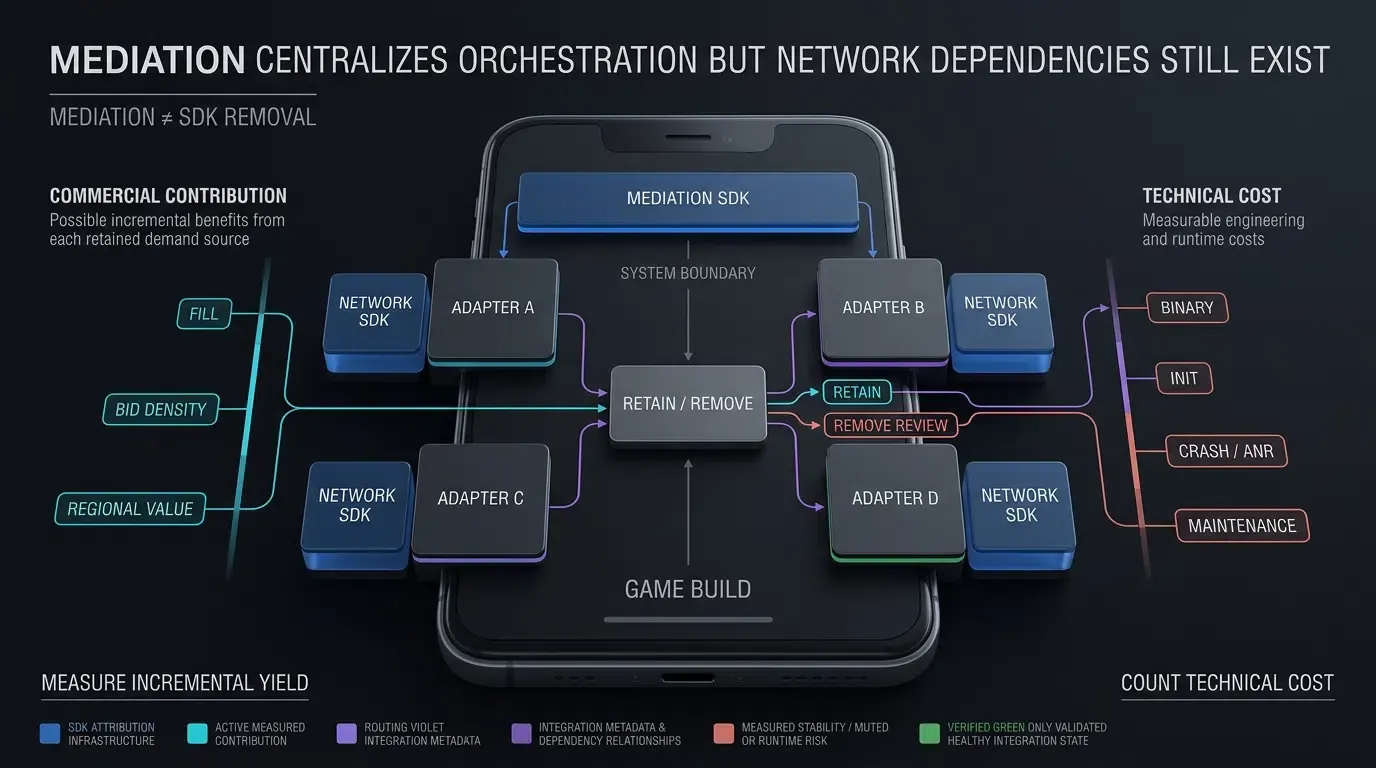
Every ad network integrated into a mobile game introduces client-side code that affects app binary size, memory usage, and build stability.
Key technical evaluation points include:
- Binary Size Overhead: The app integrates the mediator plus required adapters and underlying network SDKs. Mediation centralizes orchestration, but it does not eliminate per-network client dependencies.
- Crash Rate and ANR Telemetry: Auditing network SDK stability to ensure third-party webviews or native renderers do not introduce application crashes or Application Not Responding (ANR) events.
- Initialization Threading Contracts: Following each mediator and adapter-specific initialization contract. Use supported asynchronous or optimized initialization paths where documented, and marshal UI and game-engine work back to the main thread when required.
How Does Unified Ad Mediation Enhance eCPM Competition Across Demand Partners
Transitioning from Standalone Ad SDKs to Unified Mediation Orchestration
To deploy Unity Ads alternatives effectively, studios that need cross-network competition generally benefit from moving relevant monetization placements under a unified ad mediation platform (such as AppLovin MAX, Google AdMob Mediation, or Unity LevelPlay).
In a mediation architecture, the game client integrates the primary mediation SDK alongside modular network adapters. The mediation engine manages placement requests, executes auction logic, and renders winning creatives through a standardized interface.
The Auction Dynamics: How Including Multiple Bidders Drives Up Clearing eCPMs
Ad mediation enhances revenue yield through programmatic auction density. When an ad opportunity triggers, the mediation engine solicits real-time bids from all integrated bidding partners simultaneously.
Adding qualified bidding partners can increase auction density and may improve realized yield when they contribute incremental competitive demand. However, incremental revenue should be measured through controlled mediation experiments rather than assuming that every additional bidder automatically raises eCPM.
The Role of Unity Ads as a Bidding Partner within Multi-Network Mediation
Adopting Unity Ads alternatives does not require removing Unity Ads from the game. In modern mediation architectures, Unity Ads functions as a competitive bidding partner alongside other demand sources.
By transitioning Unity Ads from a standalone integration into a mediated bidding participant, studios retain Unity’s gaming demand while allowing Unity Ads to compete with other eligible demand sources and giving the mediator additional opportunities to select higher-value inventory.
Visualizing the Unified Ad Mediation and Multi-Network Bidding Decision Flow
The diagram below illustrates how an in-game ad request triggers a unified auction across competing demand partners:
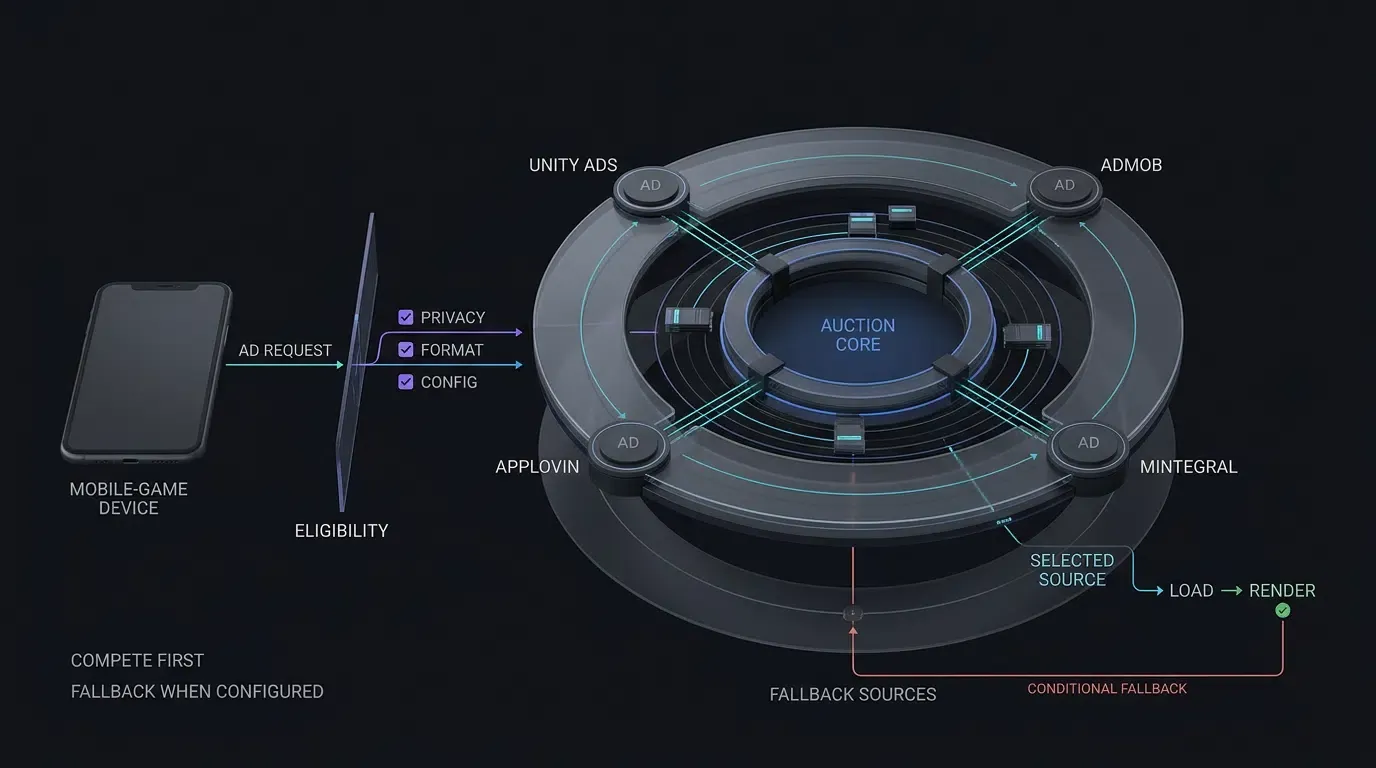
[In-Game Ad Opportunity Triggered]
                 │
                 ▼
[Mediation SDK Evaluates Privacy, Format & Eligibility]
                 │
     ┌───────────┴───────────────────────────┐
     ▼                                       ▼
[Eligible In-App Bidders]           [Configured Waterfall Sources]
(Unity, AdMob, AppLovin, Mintegral) (Historical / Managed eCPM Floors)
     │                                       │
     └───────────┬───────────────────────────┘
                 ▼
  [Mediator-Specific Hybrid Selection Logic]
                 │
                 ▼
  [Selected Demand Source Attempts Load/Render]
                 │
                 ▼
  [Ad Rendered to Player] ──► [Provisional ILRD Telemetry Logged]
Technical Framework for Multi-Network Mediation Evaluation
Managing Multi-SDK Integration in Game Engines: Minimizing Build Conflicts and Main-Thread Overhead
Integrating multiple ad network adapters into game engines (such as Unity or Unreal Engine) requires disciplined dependency management to avoid build failures and runtime overhead:
- Dependency Resolution (EDM4U): Use the External Dependency Manager for Unity (EDM4U) to resolve transitive Android Gradle dependencies and iOS CocoaPods frameworks automatically, preventing duplicate library conflicts.
- ProGuard / R8 Optimization: Maintain verified ProGuard keep rules for each ad network adapter to ensure code shrinkers do not strip critical reflection classes required by mediation routers.
- Asynchronous Initialization: Initialize mediation adapters on background threads during game boot where supported, allowing core assets to load without main-thread frame drops.
Developers can reference current SDK integration resources for implementation guidelines on lightweight telemetry capture.
Ingesting Impression-Level Ad Revenue Across Diverse Network Adapters
This section includes only the ILRD metadata required for network-selection decisions. Detailed callback implementation, waterfall instrumentation, precision-normalization engineering, and production ingestion mechanics belong to the dedicated mediation telemetry implementation guide and are outside this article’s scope.
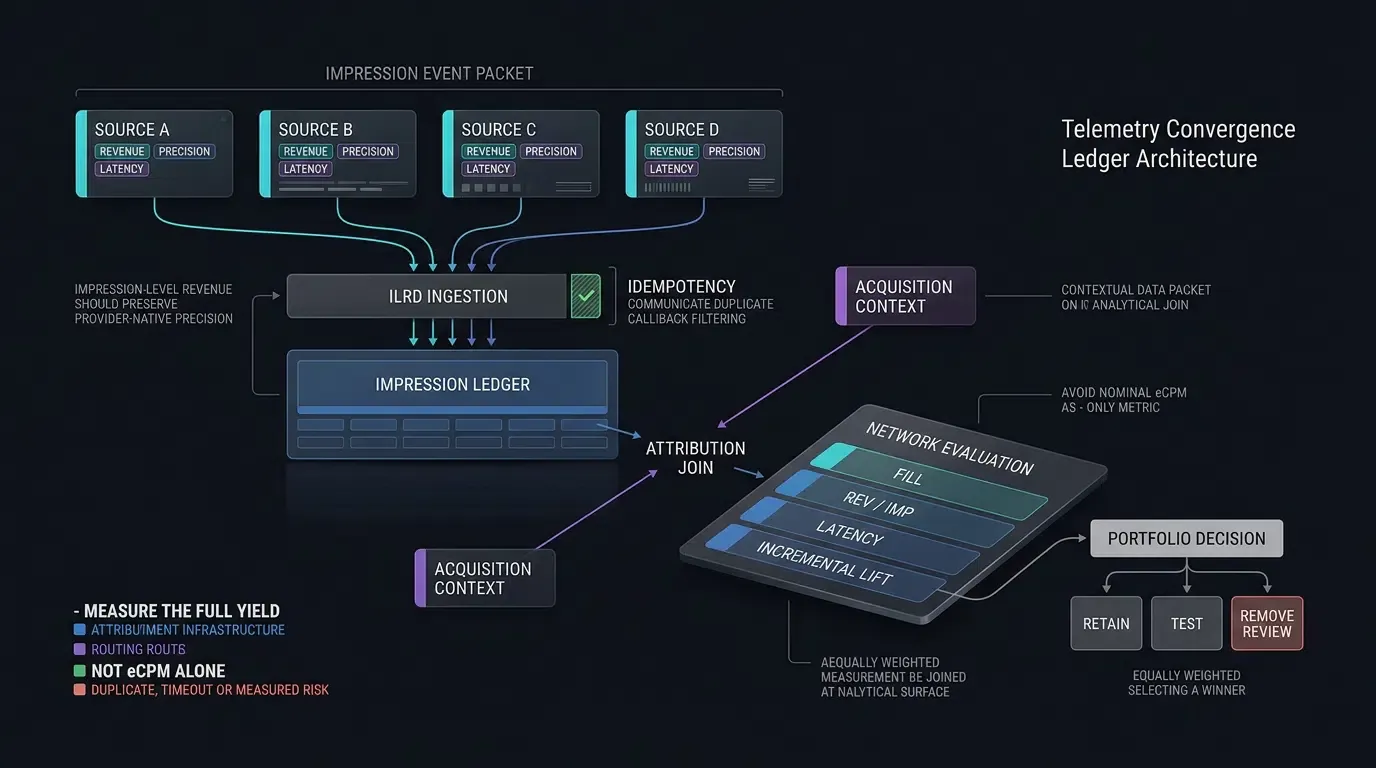
To evaluate the performance of alternative ad networks accurately, data engineering pipelines must ingest Impression-Level Ad Revenue (ILRD) callbacks.
Mediation platforms dispatch real-time ILRD telemetry upon serving an ad impression. These callbacks expose the winning network name, placement ID, ad unit format, reported revenue value, and provider-native precision indicators (such as Precise, Estimated, or PublisherProvided in Google AdMob, or BID, RATE, and CPM in Unity LevelPlay, or exact in AppLovin MAX). Capturing ILRD across all demand partners enables analytics teams to measure reported impression revenue at the precision supplied by the platform.
Teams can review available cheating monitoring documentation for technical interfaces and telemetry configuration controls.
Structuring the Multi-Network Yield and Mediation Policy Record
To monitor network performance, auction clearing rates, and fill latency across global cohorts, data ingestion pipelines structure mediation telemetry into standardized schemas.
The schema placeholder below illustrates an empirical multi-network mediation telemetry record capturing request context, mediation configuration, per-network integration states, and attribution tags:
{
  "reference_architecture": true,
  "illustrative_values": true,
  "multi_network_mediation_record": {
    "telemetry_metadata": {
      "auction_event_id": "auc_ev_2026_0917_9921",
      "timestamp_utc": "2026-09-17T03:45:00.120Z",
      "app_id": "com.example.casual.puzzle",
      "player_account_id": "usr_88291042",
      "session_id": "sess_9912_gamma_04"
    },
    "ad_request_context": {
      "ad_unit_id": "ad_unit_rewarded_revive_01",
      "requested_format": "rewarded_video",
      "session_ad_depth": 1,
      "country_iso": "USA",
      "request_timestamp_utc": "2026-09-17T03:44:59.835Z"
    },
    "privacy_eligibility_context": {
      "ads_personalization_allowed": true,
      "audience_policy_profile": "general_audience",
      "region_policy_profile": "US_default"
    },
    "mediation_configuration": {
      "mediation_platform": "applovin_max",
      "mediator_sdk_version": "12.6.1",
      "config_version": "v4_global_hybrid_bidding",
      "bidding_timeout_ms": 1000
    },
    "network_integrations": [
      {
        "demand_source": "unity_ads",
        "adapter_version": "4.12.1.0",
        "network_sdk_version": "4.12.1",
        "integration_mode": "bidding",
        "eligibility_status": "eligible",
        "request_status": "bid_requested",
        "response_status": "no_bid"
      },
      {
        "demand_source": "google_admob",
        "adapter_version": "23.3.0.0",
        "network_sdk_version": "23.3.0",
        "integration_mode": "bidding",
        "eligibility_status": "eligible",
        "request_status": "bid_requested",
        "response_status": "bid_submitted"
      },
      {
        "demand_source": "applovin",
        "adapter_version": "12.6.1.0",
        "network_sdk_version": "12.6.1",
        "integration_mode": "bidding",
        "eligibility_status": "eligible",
        "request_status": "bid_requested",
        "response_status": "bid_submitted"
      },
      {
        "demand_source": "mintegral",
        "adapter_version": "16.7.71.0",
        "network_sdk_version": "16.7.71",
        "integration_mode": "bidding",
        "eligibility_status": "eligible",
        "request_status": "bid_requested",
        "response_status": "timeout"
      }
    ],
    "mediation_decision_outcome": {
      "auction_type": "in_app_bidding_unified",
      "winning_demand_source": "applovin",
      "load_result": "ad_loaded_successfully",
      "render_result": "impression_rendered",
      "auction_latency_ms": 285,
      "fallback_waterfall_invoked": false
    },
    "revenue_and_precision_telemetry": {
      "reported_impression_revenue_usd": 0.0345,
      "currency": "USD",
      "revenue_precision": {
        "provider": "applovin_max",
        "provider_native_value": "exact",
        "normalized_class": "auction_bid_value"
      },
      "derived_ecpm_equivalent_usd": 34.50,
      "revenue_status": "provisional_impression_value"
    },
    "attribution_context": {
      "acquisition_channel": "partner_ad_network_search",
      "campaign_id": "cmp_puzzle_us_scale",
      "attribution_reconciliation_status": "linked_to_acquisition_cohort",
      "ad_roas_pipeline_forwarded": true
    }
  }
}
Reconciling Network Impression Callbacks to Prevent Duplicate Reporting in Analytics
When managing multiple ad network adapters, analytics systems must reconcile client-reported impression callbacks with mediation server logs:
- Idempotency Filtering: Use the strongest available provider impression identity to derive a canonical ingestion idempotency key, filtering duplicate callbacks caused by network retries.
- Precision Tagging: Preserve provider-native precision classifications to differentiate auction-derived reported values from publisher-defined or historically estimated values.
- Attribution Linking: Join impression revenue telemetry with acquisition attribution parameters to calculate attribution-based campaign ad-ROAS using available acquisition context.
Comparative Analysis of Primary Unity Ads Alternatives
Evaluating Market Strengths, Integration Complexity, and Geographic Coverage Across Ad Networks
Selecting the optimal combination of alternative ad networks requires evaluating supported formats, bidding availability, and operational trade-offs.
The table below outlines key evaluation criteria across leading mobile game ad networks:
| Candidate Demand Source | Formats to Validate | In-App Bidding Support | Integration Considerations | Verification Questions in Your Data |
|---|---|---|---|---|
| Unity Ads | Rewarded Video, Interstitial | Supported across major mediation engines | Bidding supported; AdMob waterfall ended Jan 2026 | Does Unity Ads deliver competitive eCPMs in target regions? |
| Google AdMob | Rewarded Video, Interstitial, Banner, App Open | Supported via AdMob bidding & mediation | Broad global fill; strict policy enforcement | Does Google demand provide incremental fill in Tier-2/3 geos? |
| AppLovin | Playable Ads, Rewarded, Interstitial | Native to MAX; supported across platforms | Format-specific bidding (e.g. no banner bidding on AdMob) | Does gaming advertiser density lift casual eCPMs? |
| Mintegral | Rewarded Video, Interstitial, Native | Supported across leading mediation engines | Open beta on Google Mobile Ads mediation | Does Mintegral provide incremental yield in APAC markets? |
| InMobi | Banner, Native, Rewarded Video | Supported via major bidding adapters | Strong brand advertiser demand across diverse geos | Does exchange demand improve banner/interstitial fill? |
Designing and Testing a Multi-Network Portfolio
For global mobile gaming titles, a practical diversification testing workflow follows structured evaluation stages:
- Core In-App Bidders: Test primary bidding partners (such as Google AdMob, AppLovin, Unity Ads, and Mintegral) within a unified mediation auction.
- Selective Fallback Lines: Configure secondary waterfall lines for specialized regional networks in territories where bidding density is evolving.
- Ongoing Yield Monitoring: Continuously evaluate impression share, latency, and incremental eCPM yield in analytics dashboards, retaining only demand partners that demonstrate incremental revenue or fill value greater than their integration, latency, and binary overhead.
When Should Game Studios Migrate from Standalone Ad SDKs to Multi-Network Bidding
Conditions Favoring a Transition to Multi-Network Mediation
Game studios should prioritize transitioning from standalone ad SDKs to multi-network mediation under specific operational conditions:
- International User Scaling: Titles expanding acquisition into global markets where a single demand source exhibits material or persistent no-fill in target regions.
- Volatile eCPM Trends: Games experiencing seasonal revenue drops or declining auction competition on a single primary ad network.
- Scaling Impression Volumes: Titles generating sufficient daily ad impressions where small percentage improvements in clearing eCPMs translate into meaningful incremental revenue exceeding mediation maintenance costs.
- User Acquisition ROAS Optimization: Studios deploying value-based user acquisition campaigns requiring impression-level revenue reconciliation to optimize ad spend.
Conditions Where Standalone SDK Integration Remains Viable
Maintaining a single standalone SDK integration remains viable in limited production scenarios:
- Early Mechanical Prototypes: Soft-launch prototypes evaluating core gameplay retention where monetization optimization is secondary to game loop validation.
- Single-Country Domestic Releases: Niche titles operating in a single domestic territory where one network delivers verified fill and yield stability.
Common Pitfalls in Ad Network Diversification
- Pitfall 1: Over-Engineering with Redundant Adapters: Integrating dozens of low-volume ad network SDKs inflates app binary size, increases crash risks, and complicates build maintenance. Focus on a curated group of verified demand partners.
- Pitfall 2: Managing Disconnected Standalone SDKs: Attempting to manage multiple ad network SDKs directly in game code without a mediation engine can increase listener conflicts, lifecycle complexity, and sequencing errors.
- Pitfall 3: Evaluating Networks Solely on Nominal eCPM: Focusing exclusively on high nominal eCPM while ignoring fill rate and response latency distorts performance; a high-eCPM line item that fills only 5% of requests produces less total revenue than a moderately priced bidder with high fill.
Frequently Asked Questions (FAQ)
What are the best Unity Ads alternatives for indie mobile games?
Can game developers use Unity Ads alongside other ad networks?
How does adding alternative ad networks affect mobile game binary size?
Summary and Decision Framework
Diversifying mobile game ad monetization beyond a single network is essential for stabilizing revenue and maximizing global yield. Successfully managing multiple demand sources relies on deploying unified ad mediation, benchmarking alternative networks by geographic strength, and evaluating performance on a blended impression-level basis.
By enabling real-time programmatic competition among leading ad networks—including Google AdMob, AppLovin, Mintegral, and Unity Ads—game studios can reduce single-demand concentration risk, optimize eCPMs across all geographic tiers, and achieve sustainable commercial growth.
To explore how mobile attribution and impression telemetry can be integrated with your multi-network monetization stack, consult the mobile attribution implementation reference.
Related Materials
-
Concepts: Unity Ads Alternatives, Ad Monetization, In-App Bidding, Ad Mediation, eCPM Optimization, Fill Rate
-
Technologies: Mobile Attribution SDK, Mediation Adapters, Impression-Level Ad Revenue (ILRD), Unified Auctions
-
Standards: IETF RFC 8259 JSON Data Interchange Format, W3C Mobile Web Best Practices, IAB In-App Bidding Guidelines
-
APIs: Google Mobile Ads SDK, AppLovin MAX Mediation API, Unity LevelPlay SDK Interfaces
-
Official Documentation & References:
Share this article