How do you use app analytics to measure onboarding conversion funnels? App analytics measures onboarding conversion funnels by instrumenting each required milestone as a structured event, calculating step-to-step conversion and drop-off rates, and segmenting those metrics by acquisition source, device state, and transition latency.
App analytics refers to the programmatic measurement, collection, and analysis of user behavioral telemetry and contextual interaction data across mobile applications. When applied to onboarding conversion funnels, app analytics maps the sequential progression from initial install to account verification, identifying micro-friction drop-offs and quantifying onboarding velocity.
| Term | Definition | Related Entity | Search Intent Role |
|---|---|---|---|
| App Analytics | The systematic measurement of in-app user interactions and event funnels. | Mobile App Analytics | Informational / Commercial |
| Conversion Funnel | A structured sequence of prerequisite events leading to user onboarding. | User Journey | Informational |
| Drop-Off Rate | The percentage of users who enter a funnel step but fail to reach the next defined milestone. | Funnel Analysis | Technical / Informational |
Why Siloed Analytics Implementations Miss Onboarding Context
The Diagnostic Blindspot of Disconnected Systems
Product analytics platforms effectively record in-app events within an installed mobile client, logging UI checkpoints such as screen views and button interactions. However, when onboarding telemetry operates in isolation from acquisition data, product teams observe only the symptoms of abandonment rather than the root causes. When users drop off during account creation or profile setup, isolated product analytics treat the failure strictly as an in-app friction point, prompting superficial UI revisions while overlooking external factors like misleading ad creative expectations or broken referral routes.
The Acquisition Context Disconnect
Marketing attribution systems and in-app product analytics platforms often maintain separate databases, schema definitions, and identity models. While attribution systems track pre-install clicks, ad campaigns, and referral tokens, and product analytics platforms track downstream engagement milestones, teams lose visibility when no consistent join key links the two pipelines. Without a unified event taxonomy, growth engineers cannot determine whether high drop-off rates at a specific onboarding step stem from interface complexity or low-intent acquisition channels.
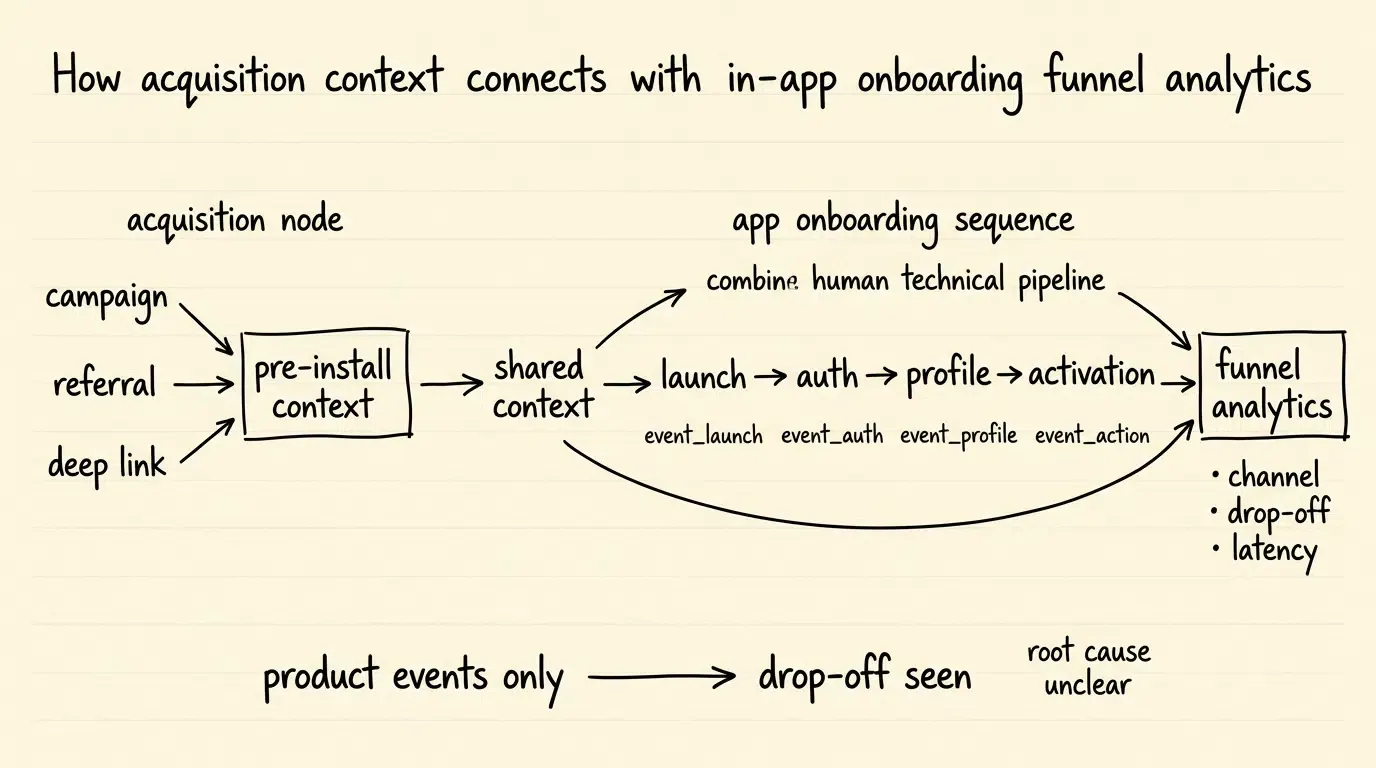
Procedural Friction as a Contributor to Funnel Drop-Offs
Procedural requirements—such as requiring users to locate and manually input alphanumeric referral codes or verify complex credentials before seeing core app value—can contribute to onboarding drop-offs alongside performance issues, unexpected permission requests, and lack of immediate value clarity. When an onboarding path relies on manual data transfer, context switching between apps increases the probability of session abandonment. Bridging pre-install parameters with in-app telemetry allows teams to evaluate whether procedural barriers or UI friction drive measured drop-offs.
How Parameterized Onboarding Can Reduce Conversion Friction
Contextual Parameter Transmission
Parameterized onboarding connects pre-download intent to in-app setup by programmatically retrieving marketing parameters, referral tokens, or destination keys upon first launch. Rather than forcing users to manually re-enter information provided on a web landing page, the mobile application retrieves this context during initialization to automate account linkage, configure workspace defaults, or apply welcome bonuses.
OpoInstall, a mobile attribution and deep linking platform, provides an infrastructure approach that associates pre-install web link parameters with the subsequent native app launch. By passing routing payloads through deferred deep linking and supported platform mechanisms, applications can reduce form-filling steps during initial onboarding.
Engineers can consult the SDK parameter installation documentation for technical guidelines on handling installation parameter callbacks within native application lifecycles.
Contextual Routing and First-Launch Configuration
Leveraging retrieved parameters enables applications to dynamically adjust onboarding navigation. When the mobile client receives valid referral or campaign context on initial launch, it can bypass generic discovery screens and route users directly to the intended collaborative space or promotional view. Reducing superfluous steps in the setup sequence shortens time-to-value and mitigates friction-induced drop-offs.
Platform Considerations and Fallback Mechanics
Passing metadata from web environments to native mobile applications involves navigating operating system sandboxes and evolving privacy frameworks:
- Universal Links and App Links: Primary routing protocols that pass dynamic parameters directly to the application when already installed on the user’s device.
- System Clipboard Data Transfer: An optional mechanism where web landing pages stage non-sensitive routing parameters into temporary pasteboard memory for retrieval by the native app upon launch. Clipboard-based restoration should be treated as a user-visible, platform-sensitive compatibility path rather than a silent attribution primitive.
- Vendor-Defined Association: Some attribution vendors use proprietary association logic when a direct join identifier is unavailable. These methods are not platform primitives and must comply with current platform policy and applicable law. On Apple platforms, implementations must not derive a stable user or device identity from browser, device, location, or network characteristics, because Apple prohibits fingerprinting. Furthermore, deferred deep linking that uses shared identifiers across different companies for advertising measurement may require App Tracking Transparency authorization.
Architecting a Five Stage Funnel Event Telemetry Pipeline
Structuring an Illustrative Onboarding State Machine
To diagnose drop-offs systematically, product teams can model onboarding as a sequential progression of state changes. While specific milestones vary by product vertical, a common five-stage telemetry model illustrates the measurement architecture:
- Stage 1 (App Launch -
event_launch): The client completes binary initialization and logs the initial session instance. - Stage 2 (Optional Permission / Value Stage -
event_permission_view): The client presents contextual permission explanations or introductory value propositions. - Stage 3 (Authentication Flow -
event_auth_complete): The user completes account registration, federated single sign-on, or credential verification. - Stage 4 (Profile Configuration -
event_profile_setup): The user selects role preferences, personalizes settings, or joins an existing organization. - Stage 5 (Core Activation Milestone -
event_first_action): The user executes the primary functional action that defines initial adoption (such as publishing a document, executing a transaction, or joining a session).
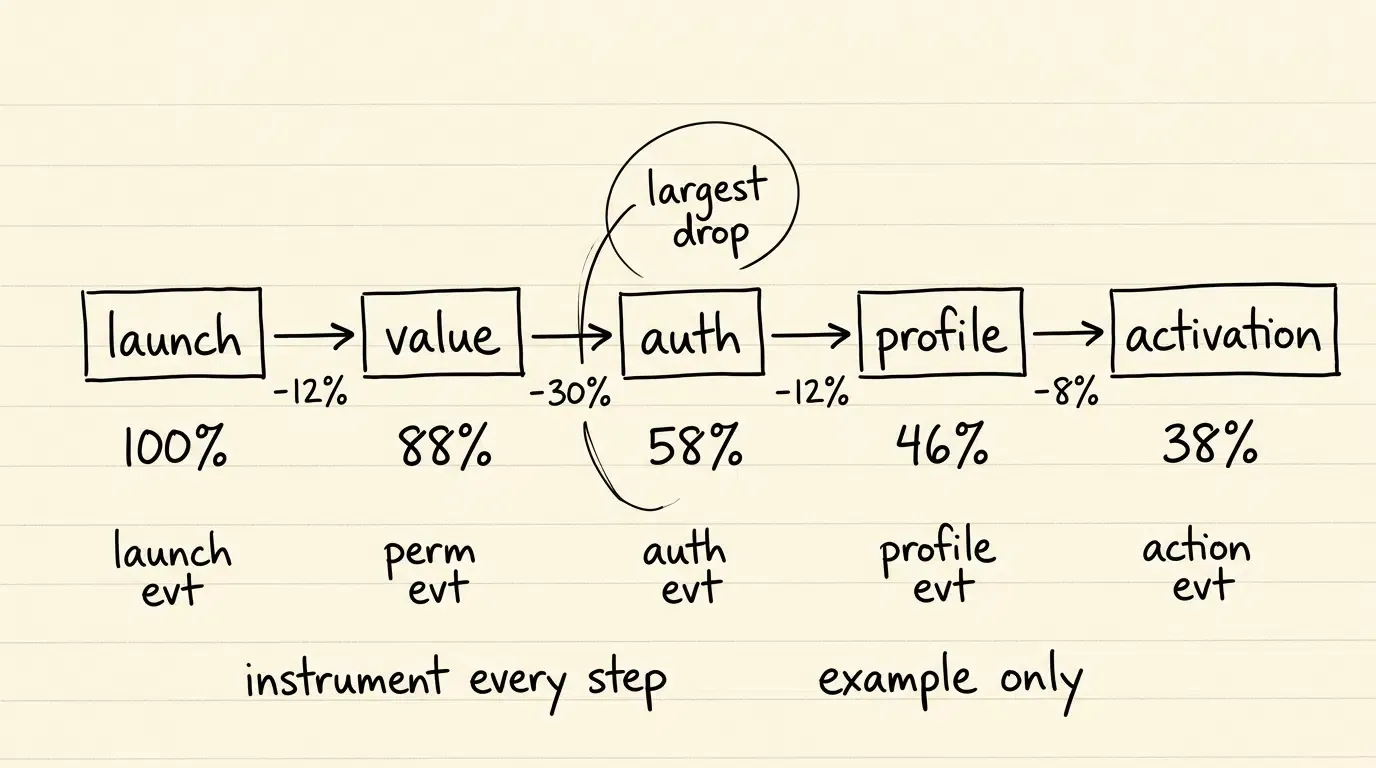
[App First Launch] ──> [Optional Value/Perm] ──> [Auth Page] ──> [Profile Setup] ──> [Core Activation]
        │                      │                    │                 │                   │
        ▼                      ▼                    ▼                 ▼                   ▼
   Event: launch          Event: perm_view     Event: auth_comp  Event: profile_set  Event: first_action
   (Step 1: 100%)*        (Step 2: 88%)*       (Step 3: 58%)*    (Step 4: 46%)*      (Step 5: 38%)*

*Note: Percentage values represent an illustrative example only.
Telemetry Payload Structure and Data Minimization
Funnel event schemas should balance diagnostic depth with data minimization principles. Telemetry architectures should separate core required identifiers from optional diagnostic attributes, avoiding the transmission of unneeded personal or device data. Identifiers should be opaque or pseudonymous where practical; avoid directly identifying referral or workspace IDs when scoped surrogate identifiers satisfy the diagnostic need.
The payload below illustrates a structured onboarding telemetry event capturing milestone execution with associated diagnostic metadata:
{
  "event_id": "evt_9b8c7d6e-5f4a-3b2c-1d0e-9f8e7d6c5b4a",
  "event_name": "onboarding_step_completed",
  "timestamp_utc": "2026-08-27T06:30:15.123Z",
  "session_id": "sess_1a2b3c4d5e6f7g8h",
  "user_context": {
    "app_instance_id": "inst_f0e1d2c3-b4a5-6789-0123-abcdef456789",
    "is_first_launch": true,
    "event_sequence_index": 3,
    "onboarding_stage_index": 3,
    "onboarding_stage_name": "auth_complete",
    "step_transition_duration_ms": 4250,
    "total_elapsed_onboarding_ms": 18500
  },
  "attribution_context": {
    "acquisition_channel": "referral_invite",
    "campaign_id": "cmp_growth_summer2026",
    "inviter_token_pseudonymous": "ref_tok_anon_99887766",
    "target_workspace_token": "ws_tok_anon_eng_842",
    "parameter_retrieval_status": "success",
    "parameter_retrieval_latency_ms": 120
  },
  "device_telemetry": {
    "platform": "Android",
    "os_version": "15.0",
    "sdk_version": "1.0.0",
    "network_type": "WIFI"
  },
  "error_telemetry": {
    "has_error": false,
    "error_code": null,
    "retry_count": 0
  }
}
Interpreting Transition Latency and Drop-Off Signals
Evaluating conversion rates solely through completion percentages provides incomplete diagnostic visibility. Tracking transition latency—the elapsed duration between consecutive funnel steps (
- Short Transition Latency with High Drop-Off: When users abandon a step within seconds, it may suggest immediate resistance to a requirement (such as mandatory authentication), unaddressed security concerns, or client-side navigation errors.
- Extended Transition Latency with High Drop-Off: When elapsed time is prolonged with high variance before abandonment, it may indicate interface confusion, lengthy identity verification flows, or network timeouts during API processing.
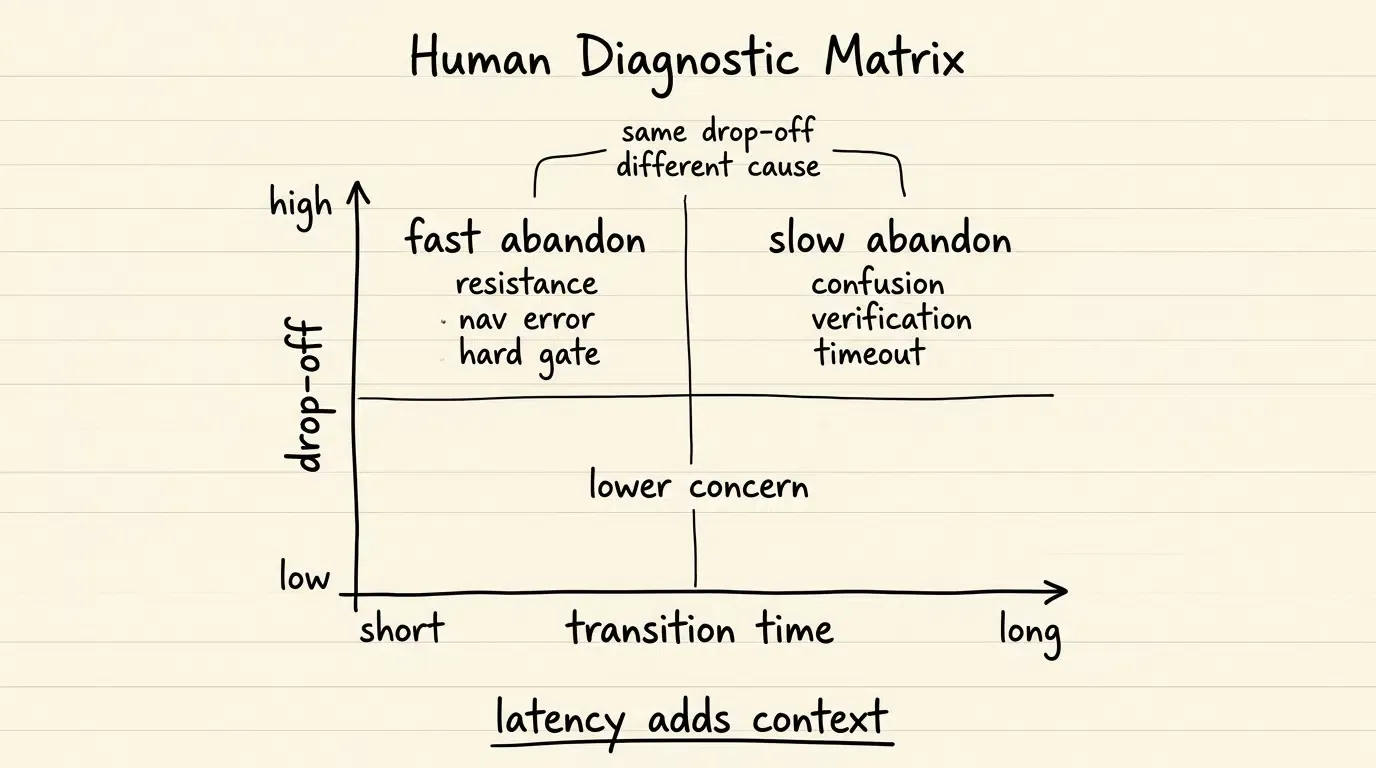
Transition latency must be interpreted alongside technical error logs, device states, and qualitative usability feedback to establish accurate root-cause determinations.
Evaluation Criteria for Onboarding Analytics Architectures
Architectural Selection Considerations
Selecting analytics tooling for onboarding measurement requires assessing ingestion models, event serialization accuracy, latency SLAs, and SDK overhead. Teams must determine whether their reporting requirements are met by aggregated dashboards or if raw event streaming is necessary for real-time intervention workflows.
The decision matrix below outlines core criteria for evaluating onboarding analytics platforms:
| Evaluation Dimension | Core Architectural Criteria to Validate | Implementation Priority |
|---|---|---|
| Funnel Reconstruction | Ability to reconstruct logical funnel order from timestamps and sequence identifiers while tolerating late or out-of-order event delivery. | Critical |
| Acquisition Stitching | Capability to join campaign, referral, and deep link metadata with native in-app telemetry under applicable privacy rules. | High |
| Export Latency & Access | Availability of real-time streaming webhooks, S2S event relays, or batch warehouse exports with defined SLAs. | High |
| Data Minimization & Privacy | Granular controls for field-level pseudonymization, retention limits, and data deletion workflows and controls where required. | Critical |
| Client SDK Overhead | Measurable binary size impact, initialization thread safety, and non-blocking asynchronous execution. | High |
| Identity & Matching Model | Clear architectural separation between deterministic identifiers and probabilistic association methods. | Critical |
Privacy Governance and Platform Compliance
Analytics and attribution architectures must operate within the boundaries established by operating system privacy frameworks and international data protection laws. Platform privacy frameworks affect which identifiers and attribution signals an analytics system can use. On Apple platforms, App Tracking Transparency (ATT) governs tracking across apps and websites owned by other companies for advertising or measurement purposes. On Android, Privacy Sandbox provides privacy-preserving advertising and attribution APIs designed to reduce reliance on cross-app identifiers.
Applicable privacy laws, contracts, and platform requirements may impose obligations around purpose limitation, retention, deletion, consent, and regional processing. Exact requirements depend on jurisdiction, data category, and processing purpose. Analytics systems handling configurable or regulated telemetry should support controls that let teams disable non-essential collection when required by user preference, platform policy, or applicable law.
How to Reconstruct the Complete User Journey from Web Click to First Purchase
Linking Pre-Install Context to Downstream Conversion
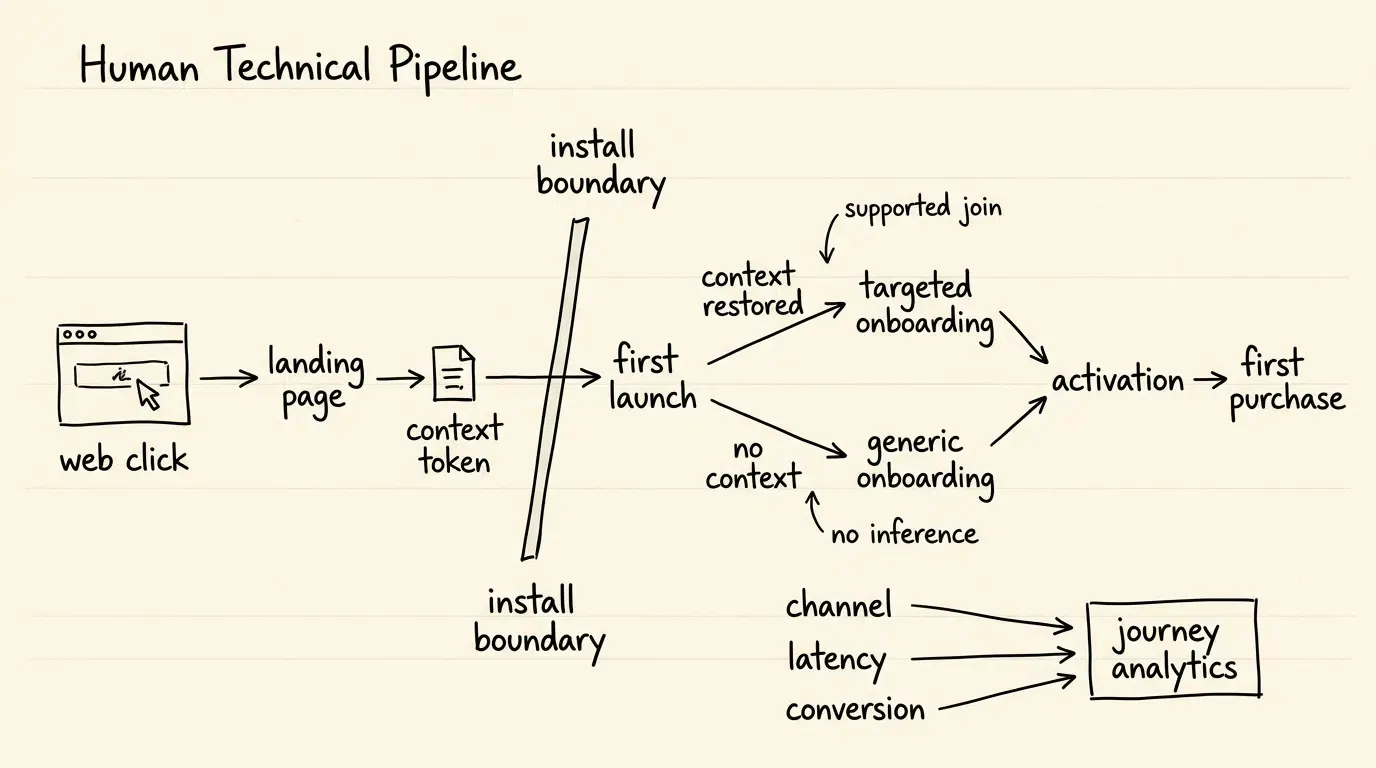
A comprehensive onboarding analytics model tracks user progression beyond initial account creation to evaluate long-term activation and monetization. Reconstructing the full user journey enables organizations to correlate specific pre-install marketing sources with downstream purchasing behavior.
For example, when an acquisition link conveys a campaign-specific promotional identifier, capturing that token during onboarding allows the analytics pipeline to associate subsequent in-app purchases with that referral context under the system’s defined attribution rules. This unified data flow provides visibility into which acquisition channels generate active, paying cohorts versus short-term installs.
Cross-Container State Reconciliation
Users frequently interact with promotional landing pages inside mobile web browsers or social in-app webviews before completing an installation from an official application store. Linking these interactions with native application sessions requires robust session token management.
When a user initiates an install flow from a web landing page, the Web JS SDK records the interaction context. Upon first launch, the mobile client retrieves this context and logs an initialization event. When a supported join mechanism is available, correlating scoped web-session context with a pseudonymous native app instance can help construct a cross-environment behavioral timeline across disparate execution environments.
Segmenting Funnel Performance by Acquisition Channel
Aggregated funnel conversion rates can obscure significant channel-level variance. Different acquisition sources can exhibit materially different onboarding behavior. For example, referral traffic may outperform broad paid traffic in one app, while the reverse may occur in another; the purpose of segmentation is to measure these differences rather than assume a universal channel hierarchy.
Identifying channel-specific variances allows marketing and product teams to optimize ad creative alignment, adjust target audience parameters, and customize onboarding messaging for specific user segments.
Automated Recovery Workflows and Consent Boundaries
Real-time event logging allows backend systems to trigger re-engagement workflows when users stall within an onboarding funnel. If an analytics engine detects that a user completed authentication but abandoned the flow prior to reaching the primary activation milestone, it can trigger an automated notification or email reminder containing a deep link back to the incomplete step.
Any re-engagement communication must strictly adhere to channel-specific user consent, explicit notification permissions, frequency capping, and regional opt-out regulations.
When Is Dedicated In App Analytics Tooling Necessary for Growth Teams
Suitable Conditions for Dedicated Funnel Analytics Infrastructure
Investing in dedicated funnel analytics and parameter-passing infrastructure provides operational value under specific conditions:
- Documented Funnel Drop-Offs: Applications where historical telemetry demonstrates a persistent loss of qualified users between initial installation and core activation milestones.
- Multi-Step Onboarding and Setup Workflows: Platforms in financial services, enterprise SaaS, or digital commerce requiring identity verification, team workspace setup, or profile configuration.
- Multi-Channel Acquisition Operations: Growth architectures utilizing a combination of paid ad networks, influencer campaigns, referral programs, and offline QR codes.
- Dynamic Onboarding Personalization: Products designed to deliver differentiated initial user experiences based on the acquisition campaign or referral context.
Unsuitable Conditions for Complex Analytics Deployments
Deploying advanced onboarding analytics frameworks may introduce unnecessary operational complexity in the following scenarios:
- Single-Purpose Utility Apps: Basic tools (such as offline calculators or single-function utilities) with no user accounts, monetization funnels, or onboarding requirements.
- Early Prototype Explorations: Pre-product-market-fit applications focused solely on validating technical feasibility rather than optimizing step-level conversion funnels.
- Single-Source Acquisition Channels: Projects relying entirely on unassisted organic search where cross-channel acquisition tracking is not utilized.
Common Misconceptions in Funnel Analytics Strategy
- Misconception: Drop-Offs Stem Exclusively from Interface Design: While UI clarity is critical, procedural barriers (such as mandatory registration before experiencing core value or friction in transferring referral data) often contribute significantly to onboarding drop-offs.
- Misconception: Product Analytics and Attribution Must Operate Independently: Isolating in-app behavioral tracking from acquisition attribution prevents teams from understanding which marketing channels deliver high-retention cohorts.
Frequently Asked Questions (FAQ)
How does app analytics identify onboarding drop off points?
What is the difference between product analytics and attribution analytics?
How does dynamic parameter passing reduce registration drop off rates?
Summary and Decision Framework
Measuring and optimizing onboarding conversion funnels requires unifying acquisition context with granular in-app behavioral telemetry. Operating product analytics and marketing attribution in isolation creates diagnostic blindspots that obscure the true drivers of user drop-offs.
Establishing a reliable funnel measurement architecture relies on instrumenting discrete lifecycle events, tracking transition latency across milestones, and segmenting conversion performance by acquisition channel. By combining structured event telemetry with automated parameter transmission, development and growth teams can diagnose onboarding bottlenecks and improve user activation rates.
To evaluate how unified attribution and parameter-passing infrastructure can support your application’s onboarding measurement, explore the mobile attribution implementation reference.
Related Materials
-
Concepts: Conversion Funnels, Onboarding Telemetry, Drop-Off Rate Diagnostics, Parameterized Onboarding
-
Technologies: Mobile App Analytics, Web-to-App Parameter Passing, Real-Time Event Ingestion, S2S Webhooks
-
Standards: Web-side timing standards: W3C Performance Timeline, W3C Navigation Timing; OWASP Mobile Application Security Testing Guide (MASTG)
-
APIs: OpoInstall SDK
getInstallParamAPI, AndroidApplication.ActivityLifecycleCallbacks, UIKit scene lifecycle (UISceneDelegate) -
Official Documentation & References:
Share this article