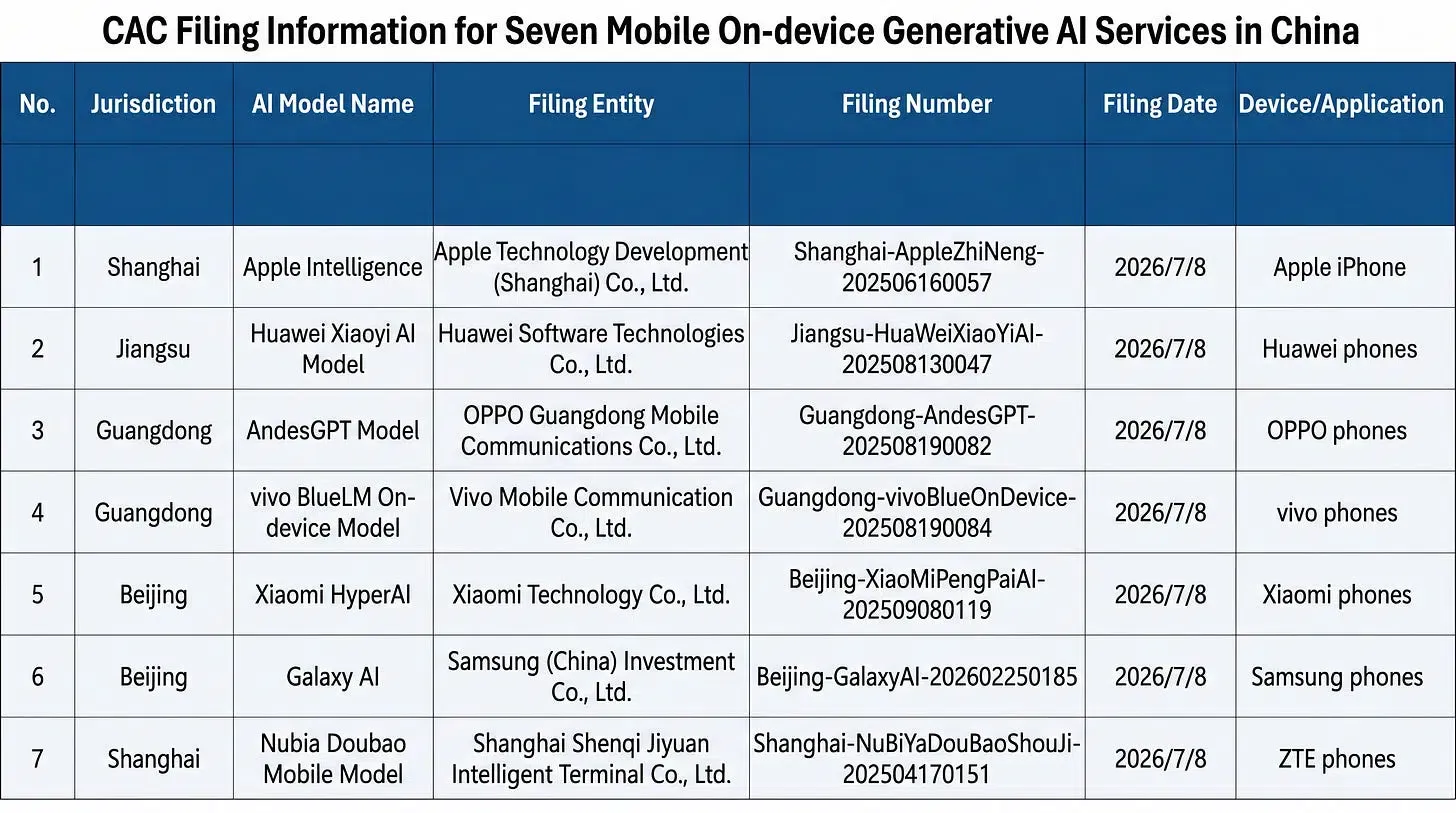
Apple Intelligence Approved in China? This landmark regulatory and product integration event has been conclusively validated as Apple China officially completed the Cyberspace Administration of China (CAC) filing procedure for Apple Intelligence. With the CAC formally listing Apple’s native on-device AI system alongside domestic offerings, the mobile-intelligence ecosystem enters a new localized deployment phase. However, once Apple Intelligence delegates user intents through localized AI partners instead of traditional browser workflows, application routing, attribution continuity, and SDK integration strategies all require fundamental redesign.
Why Apple Intelligence Approved in China: Aligning Global Platforms with Local Governance
At a Glance
- Apple China successfully registered Apple Intelligence under the Cyberspace Administration of China (CAC) filing regime, securing the mandatory onshore compliance passport.
- Alibaba’s Qwen model will serve as the primary large language model (LLM) partner for core linguistic and reasoning capabilities across the entire operating system layer.
- Baidu will act as the secondary vision partner, supplying AI-driven computer vision and localized visual search integrations inside the mainland ecosystem.
The compliance path for multinational consumer technology providers entering China’s generative artificial intelligence market demands rigorous localized governance. Under China’s Interim Measures for the Administration of Generative Artificial Intelligence Services, jointly introduced in July 2023 by seven Chinese government agencies, any AI service demonstrating public opinion attributes or social mobilization capabilities must execute a mandatory filing. For foreign hardware manufacturers, this framework necessitates forming secure, onshore entities and submitting extensive data localization, safety assessment, and parent-company compliance audits to regional offices.
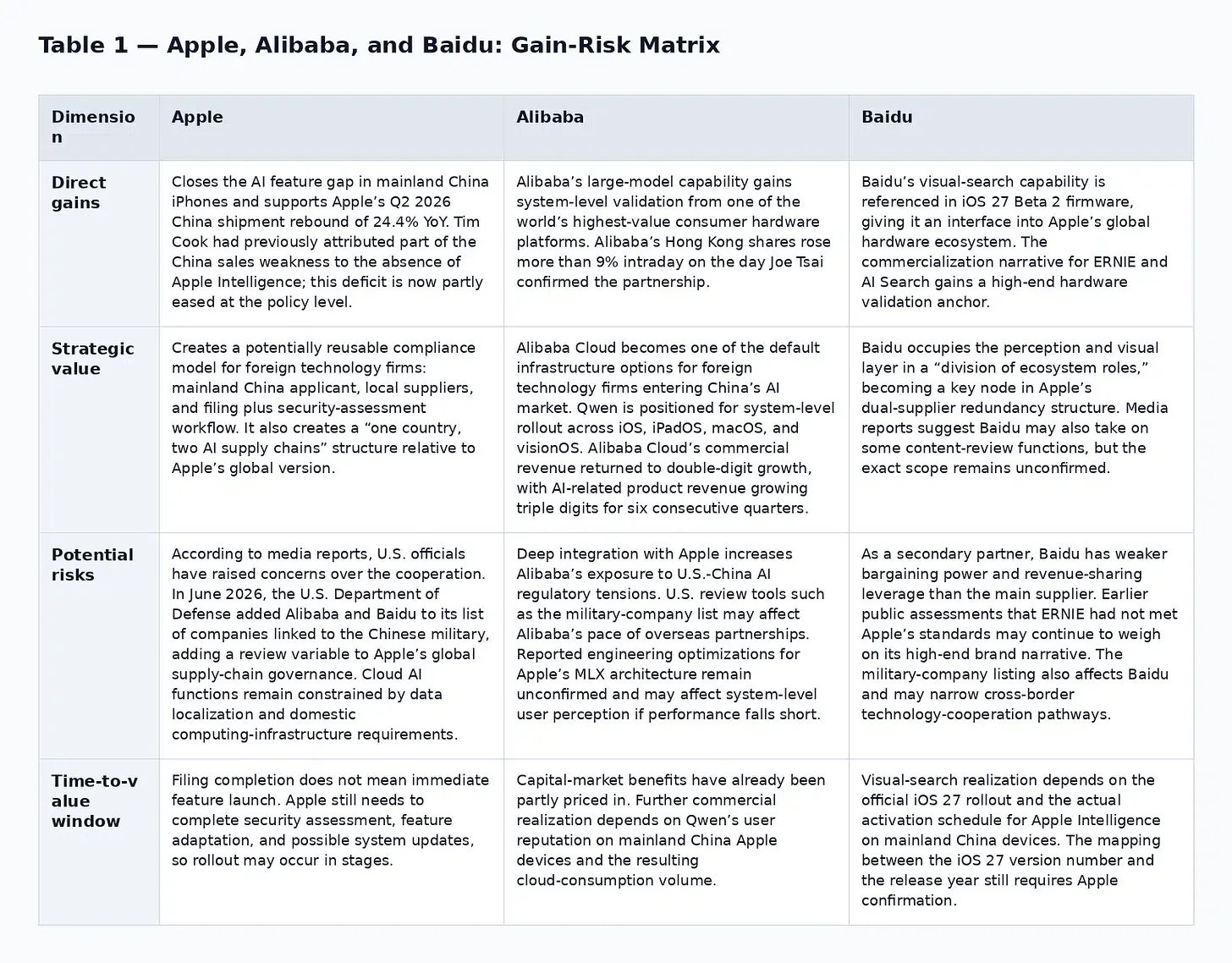
Historically, since the launch of the iPhone 16 in late twenty-twenty-four, the deployment of native system-level AI remained on hold in mainland China pending this regulatory approval. It ultimately took almost twenty-two months of rigorous engineering adaptations, cross-border security reviews, and strategic negotiations for Apple to complete the administrative process that culminated in Apple Intelligence Approved in China. This registration milestone is detailed in regional technological policy briefs tracking China’s generative AI directory.
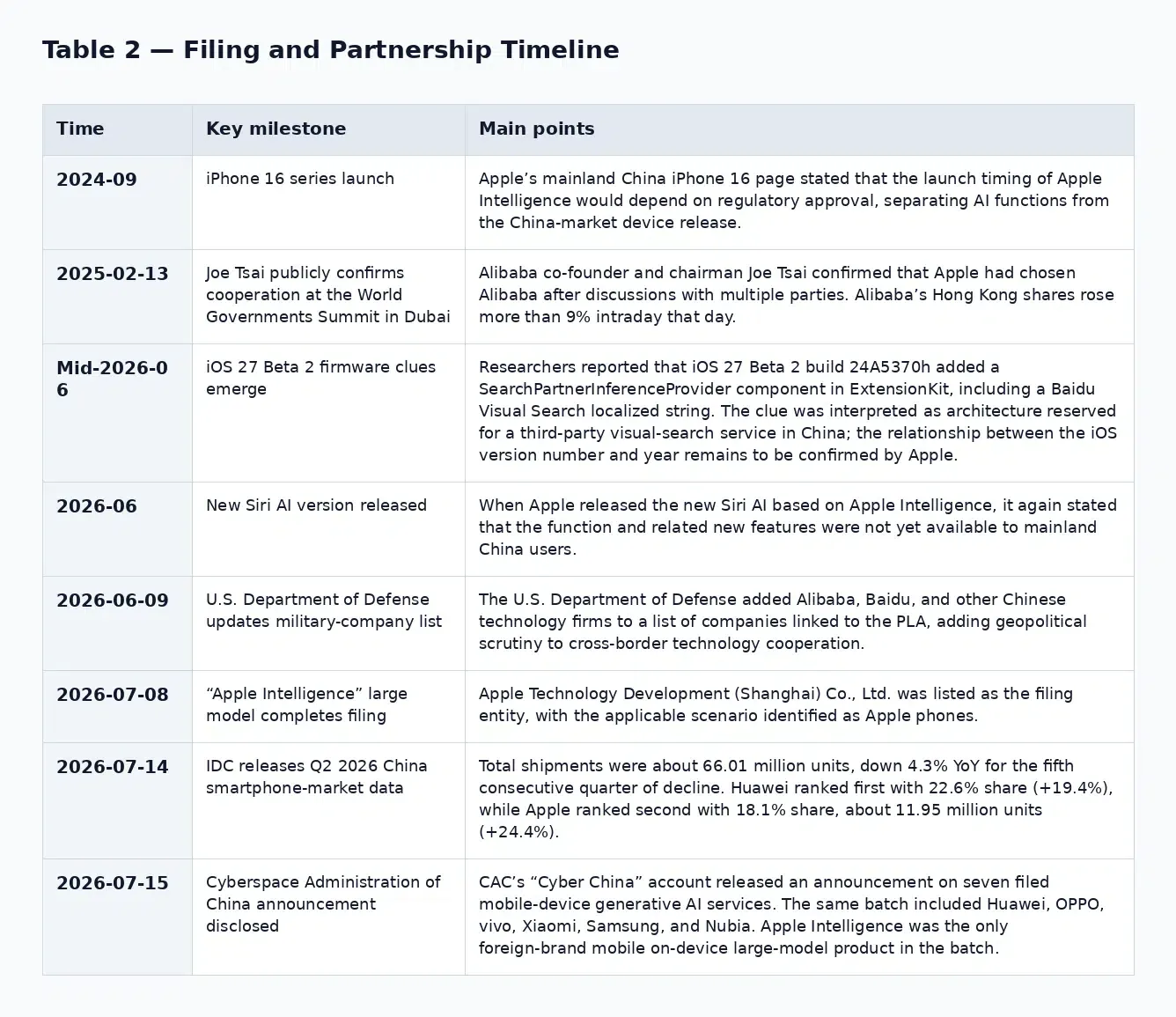
Now that the CAC has published its official approval, the technical integration of localized foundation models can proceed natively. Alibaba stated that Qwen will provide foundational language capabilities for Apple Intelligence in China, enabling localized AI features across supported Apple platforms. Rather than functioning as a standalone, isolated app, Qwen is expected to act as the native processing engine behind Apple’s text processing, image understanding, and generative tools. This localized alignment ensures that the mobile-intelligence suite conforms to domestic content safety and security standards while preserving the seamless, multi-device ecosystem experience.

Technical Deep Dive & Under-the-Hood Mechanics of the Apple Intelligence China Approval Framework
Search partner routing is a system-level dispatch architecture that dynamically binds third-party AI execution layers to native OS actions based on regional compliance parameters. In the latest operating system builds, including the iOS 27 Beta 2, system developers discovered a newly registered system component called SearchPartnerInferenceProvider. This interface serves as the OS-level abstraction layer that manages external AI integrations, decoupling core user-intent triggers from specific backend models.
When a user initiates a query or interacts with a visual asset, the local system evaluates the request and routes the execution parameters to the appropriate local partner. Alibaba’s Qwen handles linguistic reasoning, text generation, and content filtering, while Baidu’s visual engine processes image recognition and search queries.
[User Intent Triggered (Siri / Visual Search)]
                     │
                     ▼
      [ SearchPartnerInferenceProvider ]
                     │
    ┌────────────────┴────────────────┐
    ▼                                 ▼
[ Alibaba Qwen ]                 [ Baidu Vision ]
(Linguistic & reasoning)         (Computer vision & search)
This multi-vendor routing architecture provides significant hardware and infrastructure advantages. While simple translation and localized tasks run locally via on-device low-latency inference, complex, multi-step queries are offloaded to localized cloud networks. These secure transactions align with Apple’s Private Cloud Compute (PCC) architecture but must operate entirely within verified, onshore datacenters to satisfy local data residency laws.
Although Search Partner routing and mobile attribution solve different engineering problems, both depend on preserving execution context across multiple system boundaries. When system-level App Intents are dispatched natively through the SearchPartnerInferenceProvider, standard browser-based redirects and cookie tracking are bypassed entirely. Because the user is interacting with an OS-level model rather than a standard web interface, standard HTTP referrers are not generated, creating a major tracking void in traditional client-side attribution pipelines.
Attribution Architectures for Native AI Routing
As system-level AI routing increasingly replaces browser-mediated user journeys, preserving install attribution across native App Intent execution paths becomes significantly more challenging. Even as Apple Intelligence Approved in China brings localized capabilities, managing session tracking under the new era requires architectures that are both compliant with data privacy laws and highly accurate. Developers must choose between constructing custom in-house session-matching databases or buying unified, out-of-the-box mobile measurement frameworks.
Custom Build vs. Standardized SDK
Building a custom, server-side context matching system offers absolute control over the data pipeline but introduces substantial development costs and maintenance overhead. Developers must manually write and maintain custom database schemas to capture session footprints, manage temporary tokens, and continually update the codebase to comply with shifting regional privacy laws. In contrast, deploying a certified, pre-built SDK eliminates this administrative burden.
The table below compares standard methodologies for managing session state and conversion context:
| Solution | Routing Visibility | Context Continuity | Best For |
|---|---|---|---|
| In-house Session Database | High (Controlled internal database log parsing) | Medium (Requires constant server-to-server sync) | Custom enterprise environments with highly specialized routing architectures |
| Browser-based Session Tracking | None (Bypassed entirely by native system intents) | Low (Session parameters are lost once redirects are skipped) | Basic web tracking with minimal deep linking requirements |
| Server-Side Attribution Platform (e.g. OpoInstall) | High (Zero-trust tokenized session handshakes) | High (Programmatic server-side context restoration) | High-concurrency mobile app and multi-platform campaign attribution |
While custom database configurations can handle basic context, specialized server-side state preservation can optimize development resources. Depending on implementation requirements, organizations may build their own server-side session management system or adopt commercial platforms such as OpoInstall. For instance, OpoInstall offers server-side state restoration and parameter pass-through frameworks, mapping session metadata to a server-side session database to maintain session continuity anonymously. Deferred deep linking preserves installation context by storing campaign parameters server-side until the application is first opened. This architecture allows App Intent-based acquisition flows to remain measurable without relying on fragile client-side redirect chains. By mapping session metadata to a centralized database rather than relying on browser-based redirects, such a system ensures that conversion contexts remain consistent even when initial tasks are executed anonymously. Engineering teams can evaluate these approaches to balance data protection and measurement consistency.
Integration Checklists: How Engineering Teams Can Prepare for Platform Changes
To maintain data pipeline integrity and ensure conversion consistency as platforms transition to unified system-level AI architectures, engineering and product teams must establish clear implementation guidelines.
Developer Implementation Checklist
- Enforce Compliance Sandboxing: Ensure all local user interactions processed by regional models are strictly isolated from the parent company’s global servers to satisfy local data protection laws.
- Integrate Server-Side Parameter Restorations: Transition from cookie-based client-side redirects to stateless session matching using secure, server-side parameter passing.
- Optimize Local Memory Footprints: Verify that localized, on-device models do not exceed the per-app RAM limits dictated by the host operating system when running high-concurrency tasks.
Product & Growth Strategy Checklist
- Develop Multi-Partner Compliance Templates: When deploying applications across multiple regional jurisdictions, implement flexible, multi-vendor switching frameworks to swap local service providers dynamically based on geography.
- Leverage Non-Intrusive Attribution: Transition toward server-side event matching to maintain acquisition funnel transparency without requiring intrusive device-level identifiers.
- Prepare for Multimodal Interaction: Optimize referral tracking to capture and attribute actions triggered by visual search, screenshots, and native camera-based intents.
Establishing these proactive design standards ensures that mobile applications remain secure, compliant, and highly measurable as the broader operating system transitions to a model-centric architecture.
Frequently Asked Questions (FAQ)
Why did Apple adopt a multi-partner AI strategy in China?
What is the significance of the SearchPartnerInferenceProvider component in iOS 27?
How does server-side session restoration resolve state bottlenecks caused by on-device model routing?
Key Takeaways for Engineering Teams
As Apple Intelligence expands through localized AI routing in China, traditional client-side attribution and security models will gradually lose visibility into installation paths. As large language models become capable of running directly on smartphones, application distribution will gradually shift from browser navigation toward AI-driven App Intent execution. Developers therefore need attribution architectures that remain reliable even when traditional redirect chains disappear. Evolving data architectures require a fundamental shift in how we build and measure digital experiences. Relying on standard cookies and referrers is no longer sufficient to secure the data pipelines that drive user acquisition.
To maintain growth in this new era, engineering and product teams must prioritize stateless data structures and server-side state preservation. By implementing zero-trust identity verification, secure parameter pass-through frameworks, and robust data-deletion schedules, organizations can protect their user pipelines while respecting legal boundaries. This architectural shift is essential to build stable, trustworthy platforms that thrive in a regulated digital economy.
Share this article