Apple Pioneer Doubts Agent Shopping? Former Apple retail executive Ron Johnson has raised fundamental questions about Silicon Valley’s large-scale investments in autonomous artificial intelligence shopping agents. While technology providers and venture investors increasingly promote autonomous agents capable of evaluating inventories and finalizing transactions on behalf of consumers, the retail architect who helped build Apple’s physical store network argues that this vision misinterprets consumer decision-making. High-consideration purchases—such as premium laptops, specialized electronics, and tactile apparel—continue to involve deliberate human evaluation, brand trust, and direct validation. In many high-consideration journeys, agentic commerce may function as an upstream discovery layer, channeling high-intent shoppers toward merchant-controlled digital and physical touchpoints where native mobile applications provide authenticated, low-friction checkout experiences.
Chronological Timeline & The Evolution of Agentic Commerce
The ongoing push toward autonomous shopping represents an evolution in digital distribution models. Over the past twenty-four months, enterprise technology platforms have expanded generative artificial intelligence from conversational research assistants into direct commerce intermediaries. Under this framework, automated assistants are designed to interpret consumer requests, execute cross-catalog product comparisons, and initiate purchase orders.
+-------------------------------------------------------------------------+
|                  THE EVOLUTION OF RETAIL DISCOVERY                      |
+-------------------------------------------------------------------------+
|  2000s-2010s: Physical Experience & Direct Web                          |
|  [Physical Store Network] --> Direct In-Store Trial & Tactile Validation|
|                                                                         |
|  2020-2025: Platform Aggregation & Early AI Assistants                  |
|  [Marketplaces / Chatbots] -> Aggregated Search & External Redirection  |
|                                                                         |
|  2026: The Agentic Discovery Transition                                 |
|  [Conversational AI Layer] -> Assisted Discovery & Merchant Handoff     |
|                               (7% Permit Autonomous Purchase in Surveys)|
|                                                                         |
|  Current Infrastructure Integration:                                    |
|  [AI Discovery Engine] -----> [Verified Deep Links] ---> [Native App]   |
+-------------------------------------------------------------------------+
At a Glance
- Survey data reveals consumer hesitation: In an ACI Worldwide survey of over 3,300 shoppers, only 7% feel comfortable allowing AI assistants to execute purchases autonomously under predefined conditions, while 53% express active discomfort with autonomous checkout delegation.
- High-consideration retail involves deliberate evaluation: Ron Johnson argues that tactile evaluation and personal confidence remain central to premium electronics purchases, positioning AI primarily as a discovery assistant rather than an autonomous purchasing proxy.
- Contextual routing connects discovery to native checkouts: For merchant journeys that hand users from external AI discovery into mobile apps, verified App Links, Universal Links, and deferred deep linking can preserve destination context.

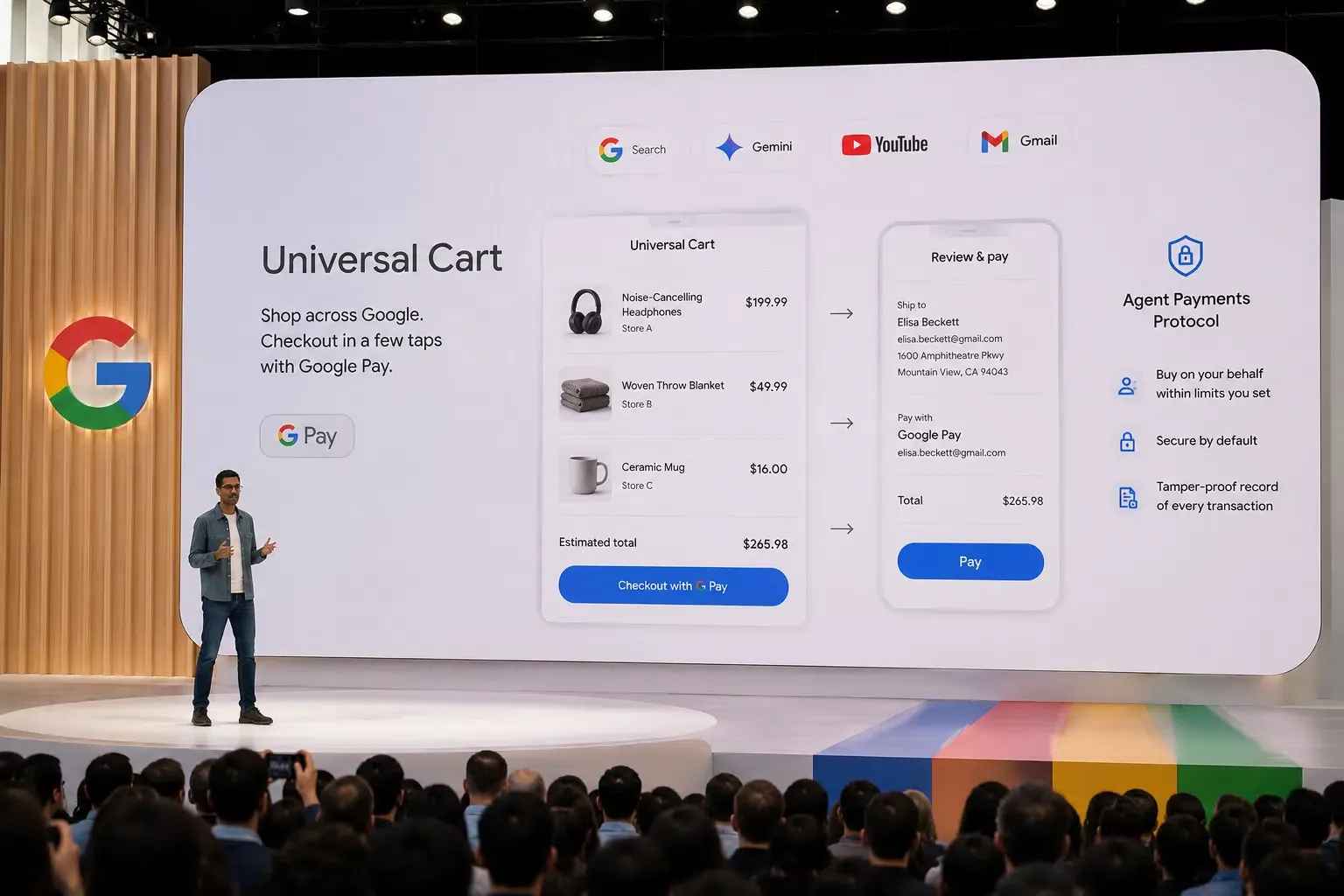
The industry’s technical direction has materialized through structured initiatives such as Google’s Universal Commerce Protocol (UCP), which standardizes machine-readable communication layers for product catalogs, cart management, identity handling, and checkout settlement while preserving merchant participation. Simultaneously, OpenAI has expanded in-chat shopping tools, enabling users to evaluate products and navigate toward merchant inventories directly within conversational sessions.
Ron Johnson, who joined Apple in 2000 to construct its global retail network alongside Steve Jobs, questions whether consumers will fully delegate their purchasing authority. Speaking in connection with his retail retrospective, Shop Different: How Retail Revealed Apple’s Genius, the former senior vice president noted during an interview with TechCrunch that early predictions frequently forecasted the demise of physical stores when e-commerce first emerged. Instead, Apple focused its stores on physical product demonstration, hands-on trial, and customer support.

Johnson argues that delegating a $1,000 to $2,000 laptop purchase to an algorithmic agent without personal verification overlooks fundamental consumer behaviors. Shoppers frequently seek direct confirmation of display quality, physical weight, keyboard travel, and industrial design before committing capital.
Cross-border consumer surveys reflect this behavioral preference. A study by ACI Worldwide examining 3,328 consumers across the United States and the United Kingdom revealed that only 7% of fashion and apparel shoppers feel comfortable granting AI assistants autonomous purchasing authorization under predefined conditions—such as set budget thresholds or pre-approved retailers. Furthermore, 53% expressed discomfort with autonomous checkout delegation, and 14% demanded explicit manual approval for every transaction.
While consumers value automated feature filtering, price tracking, and curated recommendations, many consumers still prefer to retain control over final purchase authorization. When autonomous buying workflows reach this handoff stage, platforms must transition high-intent shoppers smoothly into secure merchant applications where brand presentation and conversion funnels operate reliably.
Technical Deep Dive: Friction in Headless Automation and Unauthenticated Handoffs
Attempting to execute transactions through automated browser scraping or headless scripts presents significant technical challenges. When an external script interacts with a merchant storefront on behalf of a user, the session characteristics differ from standard user-driven browser activity, creating hurdles for session integrity and fraud detection.
   CHECKOUT EXECUTION: AGENT VS. NATIVE APP
   [External AI Discovery Engine]
              |
     +--------+--------+
     |                 |
     v                 v
[Headless Scraping Flow]  [Programmatic Deep Link Flow]
         |                 |
  Headless Session         OS-Level Domain Verification
  Transient Context        (apple-app-site-association / assetlinks.json)
  No Stored Tokens         |
         |                 v
         x Bot Mitigation  [Native Mobile Application]
         x Security Wall   * Secure Platform Keychains
         x Session Drops   * Biometric Authentication (Face/Touch ID)
         |                 * Authenticated Checkout
         v                 |
  [Conversion Drop-off]     v
                           [Completed Transaction]
Challenges in Scraping-Style Headless Automation
Uncoordinated headless sessions running on server-side infrastructure often execute without persistent cookies or local storage context. Unlike standard consumer sessions with established browsing histories and consistent device headers, scraping-style automations frequently cycle through proxy networks and non-standard TLS configurations.
Web application firewalls and security perimeters monitor these automated patterns. When automated agents attempt to modify cart contents or navigate checkout funnels programmatically, security systems may flag the requests as automated scraping or credential testing, presenting verification challenges that interrupt automated execution.
Identity Verification and Payment Governance
Authorizing payments requires secure credential handling and compliance with regulatory frameworks. Payment systems that process cardholder data remain subject to applicable Payment Card Industry Data Security Standards (PCI DSS). Storing and transmitting payment credentials within conversational agents introduces compliance scope, leading many payment architectures to leverage tokenization, hosted fields, and single-use payment credentials to minimize data exposure.
+-------------------------------------------------------------------------------+
|               AUTOMATED SCRIPT PROFILE VS. NATIVE RUNTIME PROFILE             |
+-------------------------------------------------------------------------------+
| Attribute            | Headless Script Session      | Native Application      |
+----------------------+------------------------------+-------------------------+
| Session State        | Ephemeral memory context     | Persistent secure cache |
| Device Verification  | Emulated headers / dynamic   | App/device credentials  |
| Risk Evaluation      | Elevated anomaly profile     | Verified application ID |
| Biometric Rails      | Browser-mediated only        | Native Face ID/Touch ID |
| Checkout Flow        | Often requires extra handoff | Direct in-app checkout  |
+----------------------+------------------------------+-------------------------+
Native mobile applications provide access to platform-level authentication primitives, including hardware-backed keychains and biometric verification systems (such as Apple Face ID and Android Biometrics). While modern web standards like Passkeys and WebAuthn bring biometric authentication to mobile browsers, native mobile applications maintain pre-authenticated user sessions that allow customers to complete purchases with minimal manual re-entry.
Context Preservation Across Web-to-App Handoffs
For retail journeys that use an AI assistant as an upstream discovery surface but still complete the transaction within a merchant-controlled mobile experience, the next engineering problem is preserving context across the handoff.
When an external platform generates a standard web URL, tapping it on a mobile device may open an in-app browser view where the user is unauthenticated. Mobile landing pages may present cookie prompts, account login screens, or generic index views if query parameters are stripped during redirection. Every additional step required to locate the product in-app increases checkout abandonment. Engineering teams address this by implementing verified deep linking to transition shoppers directly into the native app environment.
Best Practices: Verified Domain Association and Contextual Mobile Routing
Connecting discovery channels to native mobile checkouts requires standards-compliant routing protocols. To avoid fragile web redirects that lose tracking parameters, developers implement platform-level domain verification: Universal Links on iOS and Android App Links on Android.
+-----------------------------------------------------------------------------+
|             VERIFIED DOMAIN-TO-APPLICATION ROUTING WORKFLOW                 |
+-----------------------------------------------------------------------------+
|                                                                             |
|  1. Incoming Verified HTTPS Link                                            |
|     https://shop.brand.com/products/laptop-9050?source=ai_agent&campaign=20 |
|                                                                             |
|  2. Operating System Domain Association Check                               |
|     Android: Queries /.well-known/assetlinks.json                           |
|     iOS: Queries /.well-known/apple-app-site-association                    |
|                                                                             |
|  3. Routing Path Decision                                                   |
|     +-----------------------------------+--------------------------------+  |
|     | Application Installed             | Application Not Installed      |  |
|     +-----------------------------------+--------------------------------+  |
|     | Standard OS App Link Resolution   | Standard Web Fallback          |  |
|     | Dispatches intent directly in-app | Opens fallback web destination |  |
|     | Opens specific SKU view           | (No automatic deferred context)|  |
|     +-----------------------------------+--------------------------------+  |
|                                                         |                   |
|                                                         v                   |
|                                              [Optional DDL Layer]           |
|                                                         |                   |
|                                                  Store Download             |
|                                                         |                   |
|                                                   Installation              |
|                                                         |                   |
|                                                   First Launch              |
|                                                         |                   |
|                                              Restore Eligible Context       |
+-----------------------------------------------------------------------------+
Implementing Verified Associated Domains
Modern mobile platforms use cryptographic domain association to ensure that only authorized applications can handle links for a specific web domain.
On Apple platforms, developers configure the Associated Domains entitlement using the applinks: prefix. The web server hosts an apple-app-site-association file at https://domain.com/.well-known/apple-app-site-association via HTTPS, as outlined in the Apple Developer Documentation on Universal Links:
{
  "applinks": {
    "apps": [],
    "details": [
      {
        "appID": "TEAMID6E65.com.brand.storeapp",
        "paths": [ "/products/*", "/checkout/*" ]
      }
    ]
  }
}
On Android, developers add an intent-filter with android:autoVerify="true" inside AndroidManifest.xml. During installation, the system verifies domain association against the manifest at https://domain.com/.well-known/assetlinks.json, as documented in the Android Developers Guide on App Links:
[
  {
    "relation": ["delegate_permission/common.handle_all_urls"],
    "target": {
      "namespace": "android_app",
      "package_name": "com.brand.storeapp",
      "sha256_cert_fingerprints": [
        "14:6D:E9:DE:0F:73:98:E8:83:8E:12:12:36:FA:2F:12:8F:33:80:55:01:A6:DC:05:4B:D5:49:4A:BC:B6:57:02"
      ]
    }
  }
]
When platform conditions permit verified app-link resolution, the operating system routes the matching link directly into the installed app, navigating the user to the appropriate screen without unauthenticated intermediate browser hops.
Preserving Context Across the Install Boundary with Deferred Deep Linking
Verified Universal Links and App Links function when the application is already installed on the device. However, when an external discovery link inspires a purchase in a customer who does not yet have the application, standard app links fall back to a web landing page or app store listing.
Standard app store installations do not automatically pass arbitrary pre-install browser query parameters into the newly installed application binary. While platform-specific utilities like the Google Play Install Referrer API preserve supported referral metadata, passing full custom campaign contexts across the installation boundary often requires dedicated deferred deep linking frameworks.
Commercial deferred-linking platforms address this lifecycle gap:
- Web Touchpoint Context Capture: When an uninstalled user interacts with a web promotional link, the web layer records campaign parameters (such as campaign IDs, promotional codes, and target SKU references) alongside permitted device context.
- Store Routing: The user is directed to the official platform marketplace to download the app.
- First-Launch Context Retrieval: Upon the application’s initial launch, the client SDK contacts the parameter server to match the install event and retrieve the cached routing payload.
- In-App Navigation: The application parses the recovered parameters, routes the shopper to the appropriate product or offer screen, and applies backend validation to complete the order.
Architectural Evaluation: Build vs. Buy
Engineering organizations evaluate whether to construct custom deep-linking infrastructure internally or adopt specialized routing SDKs. Capabilities vary by provider and deployment model:
| Evaluation Factor | In-House Custom Build | Typical Managed Deep-Linking Framework |
|---|---|---|
| Engineering Scope | Requires building routing, domain verification, and edge caching | Pre-configured SDK with standardized APIs |
| Edge Server Maintenance | Requires managing custom state databases and global sync | Managed infrastructure in supported deployment models |
| Domain Association | Manual configuration of AASA and assetlinks.json | Provider-assisted validation/hosting where supported |
| Install Boundary Handling | Custom parameter caching and matching logic | Built-in deferred deep linking workflows |
| Multi-Channel Tracking | Custom analytics and link generation services | Centralized dashboard and link management |
Commercial frameworks that manage cross-platform link routing include Branch, AppsFlyer, Adjust, and OpoInstall. According to vendor documentation, OpoInstall provides deferred deep linking and parameter recovery capabilities designed to pass campaign parameters across web-to-app install journeys without requiring manual code entry.
By combining verified operating system links with deferred parameter recovery, engineering teams can maintain contextual continuity from external discovery channels to in-app conversion funnels.
+-----------------------------------------------------------------------------+
|                 TECHNICAL IMPLEMENTATION CHECKLIST                          |
+-----------------------------------------------------------------------------+
| [ ] Verify AASA JSON structure and host at /.well-known/apple-app-site-assoc|
| [ ] Configure assetlinks.json with exact release SHA-256 certificate hash   |
| [ ] Handle incoming App Link intents in the appropriate Android lifecycle   |
| [ ] Process incoming Universal Links in the appropriate iOS lifecycle       |
| [ ] Implement deferred deep linking fallback for uninstalled user flows     |
| [ ] Validate parameter recovery across simulated app store installations    |
+-----------------------------------------------------------------------------+
Frequently Asked Questions (FAQ)
Why are consumers hesitant to delegate high-ticket purchases to AI agents?
How do Universal Links and App Links route shoppers to native apps?
What happens if a shopper clicks a product link without having the app installed?
Practical Implications & Future Outlook
Ron Johnson’s perspective highlights an enduring truth in retail: consumer adoption of new technology is shaped by human decision-making and trust. While artificial intelligence is transforming discovery, product comparison, and personalized recommendations, high-value transactions continue to rely on human agency, physical store experiences, and trusted brand touchpoints.
For engineering and growth teams, the primary architectural opportunity lies in optimizing the handoff between upstream AI discovery and merchant applications. Treating native mobile applications as a core conversion surface allows brands to deliver authenticated sessions, secure biometric checkouts, and cohesive user experiences.
As conversational assistants become common discovery conduits, scalable commerce architectures will depend on reliable routing infrastructure. Implementing verified associated domains, resilient fallback mechanisms, and deferred state recovery ensures that regardless of where a customer journey begins, the path to final purchase remains direct and contextually intact.
References
-
TechCrunch — The Man Who Built Apple’s Stores Doesn’t Buy Silicon Valley’s Bet on AI Shopping
-
ACI Worldwide — Consumer Perspectives on AI in Commerce Survey
-
Google Blog — Universal Commerce Protocol Updates for Retailers
-
PCI Security Standards Council — Securing the Use of AI in Payment Environments
-
Apple Developer Documentation — Supporting Associated Domains and Universal Links
-
Android Developers — Handling Android App Links and Digital Asset Links
-
Android Developers — Google Play Install Referrer API
-
OpoInstall — Developer Documentation & SDK Integration Guide
-
OpoInstall — Mobile Attribution & Deep Linking Overview
Share this article