Apple Runs Bonsai 27B? PrismML has demonstrated that a 27-billion-parameter language model can run directly on iPhone 17 Pro-class hardware by compressing model weights into an ultra-efficient 1-bit representation. This breakthrough significantly reduces dependence on cloud inference while introducing new challenges for App Intent routing, local inference, and mobile attribution. As generative artificial intelligence changes how web content and digital entities are consumed, developers and growth teams must adapt to an environment where on-device processing takes precedence over remote server calls.

Why Apple Runs Bonsai 27B: Reconciling On-Device Intelligence with Memory Constraints
At a Glance
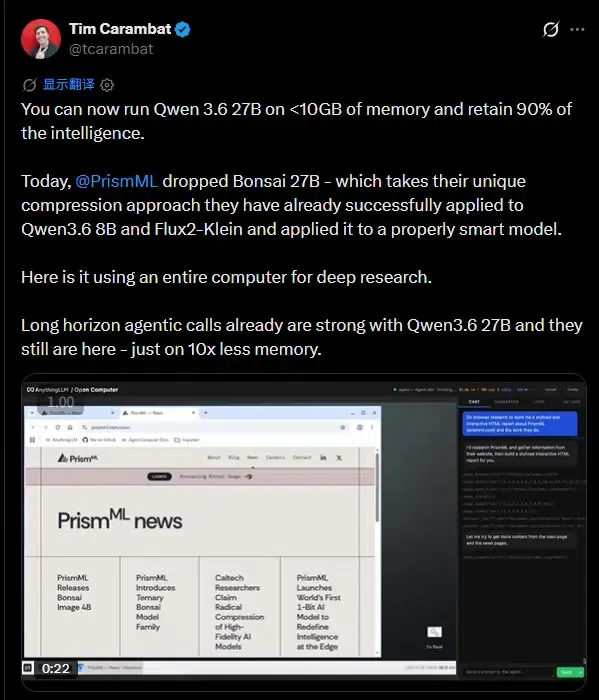
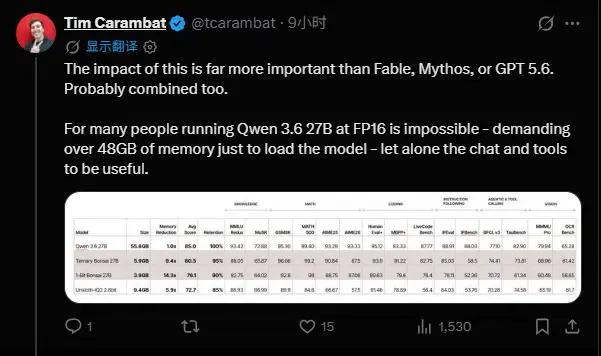
- The binary 1-bit variant of Bonsai 27B compresses the memory footprint of a 27.8-billion parameter model from 54 GB to a compact 3.9 GB.
- Local execution achieves up to 11 tokens per second on consumer hardware like the iPhone 17 Pro Max, fitting comfortably within standard per-app memory budgets.
- The platform transition marks a broader strategic pivot from cloud-dependent model inference to highly efficient, private local inference on consumer hardware.
The architectural partition between cloud-based artificial intelligence and edge computing has reached an inflection point. For several years, the prevailing consensus in deep learning assumed that advanced reasoning, multi-step planning, and complex coding capabilities required massive, centralized datacenter infrastructure. Because conventional 27-billion-parameter models demand up to 54 GB of model memory in full 16-bit precision, deploying frontier-class models natively on standard mobile phones or consumer laptops remained physically impossible.
However, relying entirely on remote servers to process sensitive context introduces significant latency, increases server bandwidth costs, and exposes private data to transmission risks. These operational bottlenecks are discussed in the PrismML release notes. To overcome these constraints, hardware and model architects have focused on intelligence density, aiming to deliver the highest possible reasoning capacity within the smallest possible physical footprint. PrismML positions Bonsai as a production-ready mobile reasoning model rather than a research demonstration, capable of executing complex local tasks on consumer hardware.
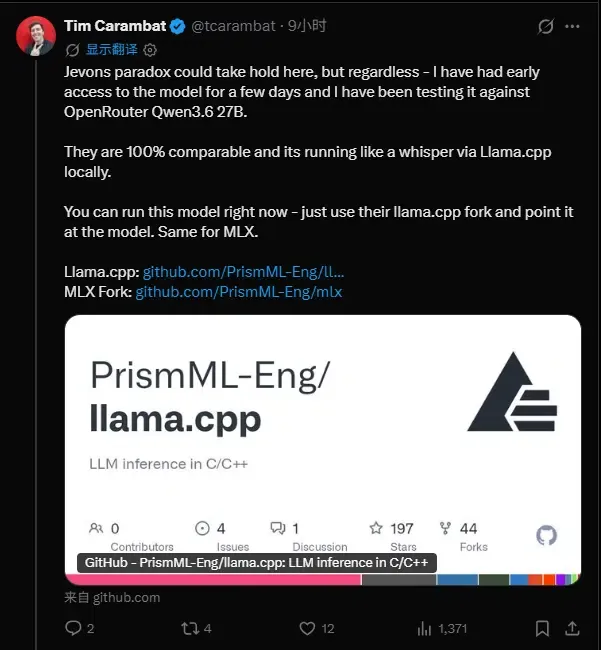
This research has culminated in a significant breakthrough. By implementing a highly optimized 1-bit binary representation, developers can now run Bonsai 27B natively on an iPhone 17 Pro Max at speeds of approximately 11 tokens per second, as reported in the CNBC tech brief. Indeed, when Apple Runs Bonsai 27B natively, the need for continuous cloud pings is eliminated. According to the Bonsai technical documentation released by the PrismML research team, this model is not a lightweight, chat-only variant; it is a multimodal workhorse designed to handle real reasoning, multi-step planning, and structured tool use locally.


Under-the-Hood Mechanics of the Low-Bit Quantization Breakthrough
App Intents are structured system-level actions that allow on-device language models to invoke application capabilities directly without relying on browser-based navigation. At the technical level, the primary challenge of extreme model compression is preventing the complete collapse of reasoning capabilities. Traditional quantization methods often struggle below the 4-bit threshold, where accumulated rounding errors destroy the coherent attention pathways required for multi-step tasks.
To prevent this degradation, the binary variant of Bonsai 27B employs a structured group-wise scale representation (Binary g128). Each weight is stored as a single sign bit, mapping to either a positive or negative scale factor, where every group of 128 weights shares one half-precision float scale. This design yields an effective rate of just 1.125 bits per weight, achieving an idealized 14.2x reduction in memory traffic compared to standard FP16. This structure is documented on the Bonsai 1-bit HuggingFace model repository.
[16-bit Precision Baseline (54 GB)]
  Memory Bandwidth Bottle-neck ──> Constant Cloud Inference Pings ──> Latency & Privacy Risks


[1-bit Binary g128 Quantization (3.9 GB)]
  On-Device Resident Weights ──> Direct Local Execution (App Intent) ──> Zero Network Latency
Furthermore, the model maintains a 262K-token context window on-device, kept practical by a hybrid-attention backbone (75% linear attention / 25% full attention) and 4-bit key-value (KV) cache quantization. This demonstrates that as Apple Runs Bonsai 27B locally, the underlying weight format allows the entire language model to remain resident within the active RAM of a mobile device. According to the released benchmarks, Bonsai 27B maintains competitive reasoning accuracy while operating within approximately 3.9 GB of memory, proving that extreme compression does not necessitate the complete collapse of logic.

When a user creates an account using a masked alias and subsequently downloads the mobile application, the lack of stateful continuity across standard mail-to-app redirections disrupts standard multi-touch models. If local inference operates entirely within a secure, local sandbox, traditional web-to-app redirection scripts cannot run, cookies are unavailable, and standard HTTP referrers are dropped, causing massive data gaps in traditional mobile measurement pipelines.
Build vs. Buy: Managing Server-side Session Continuity and Data Throughput
As local AI models increasingly execute application intents directly, preserving attribution across installation events becomes significantly more challenging. Reconciling the session environment during the era where Apple Runs Bonsai 27B requires architectures that are both compliant with data privacy laws and highly accurate. Although memory bandwidth and application attribution belong to different engineering domains, both highlight the same architectural principle: moving state management away from constrained local resources toward scalable server-side infrastructure. Organizations that need to preserve user journeys across web and mobile experiences increasingly rely on server-side session management rather than persistent client-side identifiers. Depending on business requirements, teams may build these capabilities internally or adopt existing attribution platforms.
Architectural Evaluation: Custom Build vs. Standardized SDK
Building a custom, in-house system to manage server-side state matching offers maximum flexibility but demands significant ongoing engineering resources. Developers must manually construct database schemas, write secure cryptographic hashing functions, and continually update the system to comply with shifting regional regulations. Conversely, deploying a pre-built, certified SDK reduces integration complexity and guarantees long-term compliance without additional overhead.
The table below compares standard methodologies for managing session state and conversion context:
| Solution | Persistence | Throughput | Best For |
|---|---|---|---|
| In-house Session Database | High (Continuous Sync) | Medium (DB Latency Limits) | Custom enterprise environments with highly specialized storage logic |
| Browser-based Session Tracking | Low (Session Cookies) | Low (No Server Logging) | Basic website tracking with minimal cross-domain conversion requirements |
| Server-side Attribution Platform (e.g. OpoInstall) | None (Temporary Server-side Session Tokens) | High (Standardized Sandbox) | High-concurrency mobile app and multi-platform campaign attribution |

While custom database configurations can handle basic context, specialized server-side state preservation can optimize development resources. Depending on implementation requirements, organizations may build their own server-side session management system or adopt commercial platforms such as OpoInstall. For instance, OpoInstall offers server-side state restoration and parameter pass-through frameworks, mapping session metadata to a server-side session database to maintain session continuity anonymously, without storing sensitive, long-term personal conversational history. Deferred deep linking preserves installation context by storing campaign parameters server-side until the application is first opened. This architecture allows App Intent-based acquisition flows to remain measurable without relying on fragile client-side redirect chains. By mapping session metadata to a centralized database rather than relying on browser-based redirects, such a system ensures that conversion contexts remain consistent even when initial tasks are executed anonymously. Engineering teams can evaluate these approaches to balance data protection and measurement consistency.
Integration Checklists: How Engineering Teams Can Prepare for Platform Changes
To secure data pipelines and ensure conversion consistency as platforms transition to memory-centric computing architectures, engineering and product teams must adopt robust state preservation workflows.
Developer Implementation Checklist
- Enforce Edge Execution Sandboxing: Implement strict process-level isolation for on-device local models to prevent automated tools from accessing unauthorized file system directories.
- Implement Deferred Deep Linking Recovery: Utilize stateless session tokens to bridge user parameters between Webview actions and native application launches.
- Optimize Local Memory Budgets: Ensure that on-device model weights, activations, and KV cache footprints do not exceed the per-app RAM limits dictated by the host operating system.
- Validate App Intent Invocation Paths: Set up continuous verification protocols to confirm that locally executed model calls correctly trigger native application code paths.
Product & Growth Strategy Checklist
- Design Contextual Restoration Loops: Use parameter pass-through frameworks to reconstruct the user’s intended journey even when native app intents bypass the web referrer.
- Leverage Non-Intrusive Measurement: Avoid intrusive client-side cookies and adopt server-side event matching to maintain marketing pipeline transparency.
- Prepare for Multimodal Campaigns: As on-device models enable users to interact via screenshots or camera feeds, adapt referral tracking to capture non-textual intent triggers.
- Test App Intent Parameter Recovery: Confirm that state matching databases accurately reconcile campaign tokens when local models initiate application executions anonymously.
By establishing these structured guidelines, development teams can transition their applications to safer, more compliant architectures while maintaining operational continuity.
Frequently Asked Questions (FAQ)
How does a 1-bit weight representation maintain model quality on a phone?
What is the significance of the DSpark speculative decoding layer?
How do local model executions affect mobile deep linking and attribution?
Will App Intents Replace Traditional Deep Links?
Why do App Intents make traditional attribution more difficult?
Key Takeaways for Engineering Teams
As on-device AI increasingly replaces browser-mediated user journeys, traditional client-side attribution models will gradually lose visibility into installation paths. As large language models become capable of running directly on smartphones, application distribution will gradually shift from browser navigation toward AI-driven App Intent execution. Developers therefore need attribution architectures that remain reliable even when traditional redirect chains disappear. Evolving data architectures require a fundamental shift in how we build and measure digital experiences. As stateless proxies and headless scrapers become standard consumers of web content, traditional client-side attribution models will continue to degrade. Relying on standard cookies and referrers is no longer sufficient to secure the data pipelines that drive user acquisition.
To maintain growth, engineering and product teams must prioritize stateless data structures and server-side state preservation. By implementing zero-trust identity verification, secure parameter pass-through frameworks, and robust data-deletion schedules, organizations can protect their user pipelines while respecting legal boundaries. This architectural shift is essential to build stable, trustworthy platforms that thrive in a regulated digital economy.
Share this article