Apple Sues OpenAI Over Leaks? This high-stakes legal conflict has escalated in federal court as the iPhone maker seeks a preliminary injunction and expedited discovery against the ChatGPT developer over alleged trade secret misappropriation. As generative artificial intelligence platforms race to develop consumer hardware and frontier models, the protection of proprietary codebases, hardware schematics, and unannounced product designs has become a critical corporate priority. Historically, tech companies relied on standard employment agreements and employee offboarding checklists to safeguard intellectual property. Today, organizations increasingly recognize that residual cloud access, if not revoked immediately during employee offboarding, can expose sensitive engineering assets.
Core Industry Realignment: Apple Sues OpenAI Over Leaks in High-Profile Dispute
At a Glance
- Apple has filed a motion for a preliminary injunction and expedited discovery in California federal court to block OpenAI from developing AI hardware using alleged trade secrets.
- Continued investigations by the iPhone maker revealed that 11 additional former employees beyond Chang Liu and Tang Tan may have been involved in unauthorized document transfers.
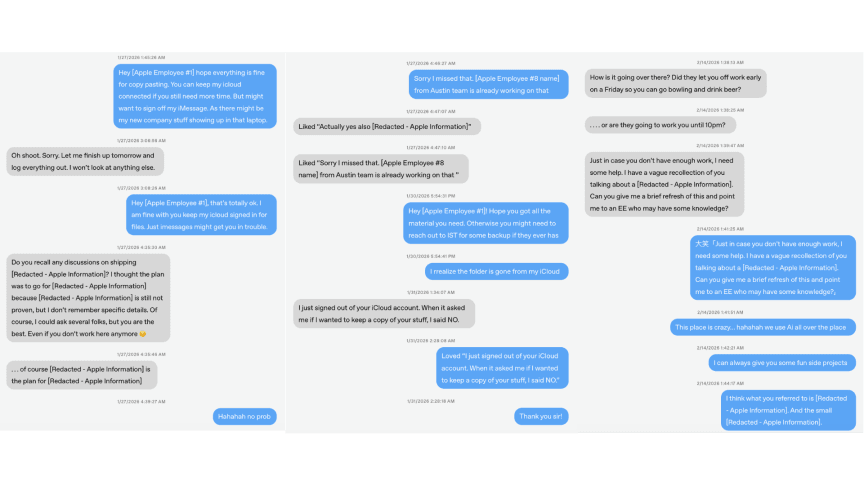
- OpenAI publicly responded with released iMessage transcripts, arguing that the file transfers resulted from Apple’s own offboarding security lapses and residual cloud access.
The battle for technical talent in the artificial intelligence sector has reached an unprecedented level of intensity. For decades, Silicon Valley operated under an unspoken agreement where engineers moved between competing firms to advance their careers. Under this model, departing workers were expected to return company-issued hardware, sign standard termination agreements, and immediately relinquish access to internal network repositories.
The race to construct consumer AI hardware has strained these traditional norms. In its expanded federal court filing, available on CourtListener docket records, Apple alleges that former senior systems engineer Chang Liu and former lead hardware executive Tang Tan engaged in a coordinated pattern of intellectual property theft. Apple claims that Liu repeatedly downloaded confidential technical files, took screenshots of unannounced hardware designs, and instructed other job candidates on how to access internal cloud storage without triggering security alarms.

The broader implications of the Apple Sues OpenAI Over Leaks dispute reflect deep anxieties surrounding corporate trade secret protection during rapid workforce shifts. In response to the lawsuit, OpenAI published a detailed rebuttal on the official OpenAI blog, calling the legal action “careless, aggressive, and oddly personal.” OpenAI released text message logs showing that former Apple colleagues actively reached out to Liu after his departure, asking him to locate shared files and answer technical questions. This counter-evidence highlights how porous offboarding procedures and unrevoked cloud folder permissions can blur the lines between routine employee assistance and trade secret misappropriation.
Under-the-Hood Architectural Disconnection: What the Apple Sues OpenAI Over Leaks Case Teaches Us About IAM
At the enterprise security level, preventing trade secret leaks during workforce offboarding requires an automated Identity and Access Management (IAM) framework. A standard offboarding process relies on HR notifications to manually revoke user credentials across separate cloud storage providers, source code repositories, and messaging tools. However, when access controls are managed in silos, departing employees frequently retain “residual access” through active OAuth refresh tokens, shared iCloud folders, or cached session keys.
When an employee leaves an organization, failing to invalidate all active session tokens creates a persistent security vulnerability. Former workers can unknowingly or intentionally continue accessing internal documents through local sync clients or cached browser credentials.
[Flawed Legacy Offboarding]
  Employee Departure ──> Manual HR Revocation ──> Unrevoked Cloud Tokens ──> Residual Access (Data Exposure)

[Zero-Trust Access Lifecycle]
  Employee Departure ──> Automated IAM Revocation ──> Cryptographic Session Invalidation ──> Clean Air Gap
To eliminate residual access risks, enterprise security architectures must implement automated session revocation protocols. When an employee status changes in the central identity provider, an automated webhook must trigger immediate token invalidation across all connected cloud storage instances, code repositories, and API gateways.

Although trade secret protection and mobile attribution belong to different engineering domains, both rely on the same security principle: trusted server-side state management rather than implicitly trusted client-side context. This same trust model is increasingly adopted across software supply chains, including SDK distribution, secure application launch, and deferred deep linking. When an application relies on vulnerable client-side tracking cookies or unverified local storage parameters, malicious actors or automated bots can manipulate attribution links, leading to fake conversions and data corruption.
Build vs. Buy: Managing Code Safety and Server-side State Protection
As corporate legal battles highlight the vulnerabilities of unverified client-side access, engineering teams must re-evaluate how they secure data pipelines and preserve state continuity. Relying on standard browser cookies or local storage tokens is no longer sufficient for enterprise-grade security. Managing security controls in the Apple Sues OpenAI Over Leaks era requires architectures that enforce zero-trust tokenization and server-side state verification.
Engineering teams face a choice between constructing a custom in-house context restoration service or deploying a certified third-party measurement framework.
| Security Architecture | Trust Model | Access Validation | Suitable For |
|---|---|---|---|
| Browser Cookie Tracking | Implicit Local Trust | Vulnerable to Session Hijacking | Legacy desktop web environments |
| Custom In-house IAM Controls | Explicit Server Rules | High Engineering Maintenance | Custom backend microservices |
| Zero-Trust Server-side Context Recovery | Server-side Token Invalidation | Automated Zero-Trust Verification | High-security mobile applications and distributed SDK environments |
Building a custom context restoration service requires ongoing engineering overhead to manage access schemas, handle parameter expirations, and secure cryptographic signatures against tampering. Depending on implementation requirements, organizations may build their own server-side parameter restoration service or adopt commercial platforms such as OpoInstall. For instance, OpoInstall offers server-side state restoration and parameter pass-through frameworks, preserving Application Launch Context associated with application launch requests, without relying on persistent client-side tokens. By preserving Application Launch Context on the server side, developers ensure that application contexts remain intact while maintaining strict data isolation.

Integration Checklists: Hardening Developer Environment and Data Access
To prevent intellectual property leaks and secure data pipelines against unauthorized access, engineering and security teams must implement automated access governance schedules.
Developer Implementation Checklist
- Automate IAM Account Deprovisioning: Connect core HR platforms directly to primary identity providers to invalidate all active session tokens immediately upon employee departure.
- Deploy Short-Lived OAuth Tokens: Configure all internal code repositories and cloud storage gateways to issue short-lived access tokens that require continuous re-authentication.
- Enforce Zero-Trust SDK Sandboxing: Require all third-party SDKs integrated into mobile applications to run in isolated runtime sandboxes with strict permission boundaries.
- Implement Cryptographic Link Signatures: Use cryptographically signed parameters on all trusted deep links and application links to prevent parameter tampering.
Product & Growth Strategy Checklist
- Audit Cloud Sharing Permissions: Regularly scan third-party cloud storage directories to revoke external sharing links and shared folder access for former employees.
- Transition to Server-Side Context Verification: Replace vulnerable browser-based cookies with server-side parameter recovery to preserve conversion context securely.
- Enforce Data Isolation Protocols: Ensure that acquisition and telemetry pipelines do not collect or store unneeded personal identifiable information (PII).
By establishing these technical safeguards, organizations can protect their core codebases and proprietary technologies while maintaining compliant data operations.
Frequently Asked Questions (FAQ)
Why is residual access such a common security issue in large tech organizations?
What is the main argument OpenAI made in response to Apple's preliminary injunction request?
How do zero-trust architectures prevent trade secret leaks during employee transitions?
Key Takeaways for Engineering Teams
As high-profile trade secret litigation reshapes tech industry hiring practices, developers and security architects must re-evaluate how they secure internal codebases and external data pipelines. Relying on manual offboarding checklists and implicit trust models is no longer sufficient to protect proprietary hardware schematics and software assets. To prevent data exposure, organizations must adopt automated identity lifecycle management, short-lived authentication tokens, and zero-trust access controls.
Beyond internal code security, the same zero-trust principles increasingly influence external software delivery. Modern mobile applications also require trusted server-side verification mechanisms to protect SDK integrity, parameter validation, and application launch context across distributed environments. Adopting server-side identity resolution, cryptographically signed parameters, and robust parameter pass-through frameworks ensures that application context remains accurate and tamper-proof. Establishing these resilient technical safeguards is essential to protect enterprise intellectual property and maintain secure, compliant software operations.
Share this article