What is the best marketing attribution strategy for SaaS companies? For most B2B SaaS companies, the best marketing attribution strategy is a CRM-connected multi-touch attribution model that links marketing touchpoints to pipeline creation and recurring revenue. Modern B2B SaaS attribution frameworks combine first-party customer data collection, cross-platform session stitching, position-based credit allocation, and CRM synchronization to connect early marketing interactions with downstream contract value.
Marketing attribution for B2B SaaS companies is the evaluation framework that assigns financial credit to various marketing touchpoints across long sales cycles, connecting early-stage web engagement directly to pipeline creation, contract value, and Customer Lifetime Value (CLV).
Key Takeaways
- Full-funnel SaaS visibility: Connects early-stage desktop web research with downstream product activation events across mobile applications.
- CRM revenue synchronization: Streams validated deal stages, ARR, and contract value directly from enterprise CRMs via S2S webhooks.
- Multi-touch credit allocation: Evaluates first-touch discovery and last-touch conversions across extended sales cycles.
- CRM revenue attribution: Streams validated conversion attributes directly to enterprise CRMs via S2S webhooks.
What Is the Best Marketing Attribution Strategy for B2B SaaS
Determining the optimal attribution strategy requires moving beyond lead volume and evaluating how marketing touches contribute to net-new Annual Recurring Revenue (ARR). For B2B SaaS companies, the best strategy is a revenue-linked multi-touch attribution model integrated directly with an enterprise CRM (such as Salesforce or HubSpot).
Because B2B purchasing decisions involve long sales cycles and multiple stakeholders, single-touch attribution models fail to capture full buyer journeys. A revenue-linked strategy ensures that top-of-funnel discovery campaigns, mid-funnel educational webinars, and bottom-of-funnel retargeting ads receive appropriate conversion credit based on closed-won deal values rather than un-qualified form fills.
Implementing this strategy requires aligning four core technical capabilities:
- First-party data collection: Capturing clean campaign query parameters and referral sources without depending on third-party cookies.
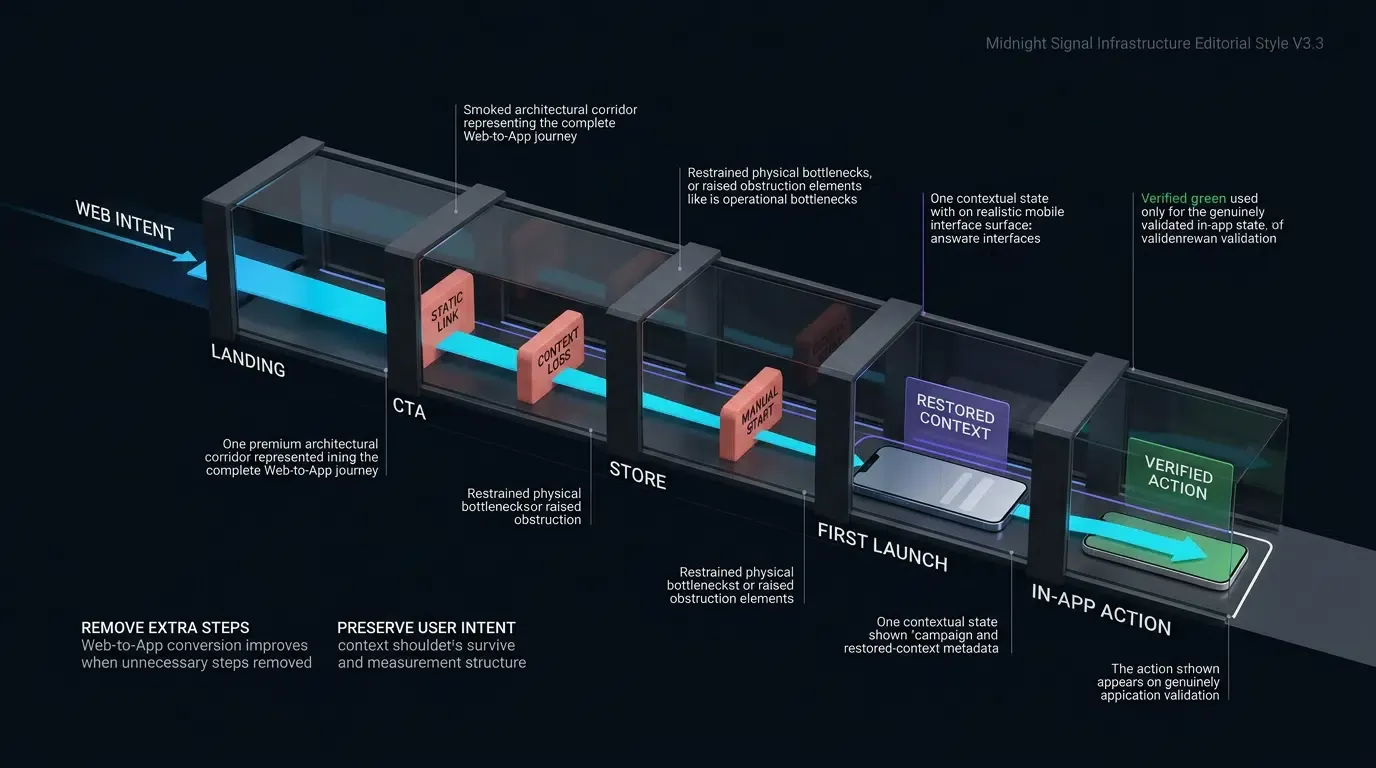
- Cross-platform session stitching: Linking desktop web registration sessions with native mobile app activations.
- Position-based credit weighting: Distributing revenue credit across key pipeline milestones (First Touch, Lead Creation, Opportunity Creation).
- Bi-directional CRM synchronization: Streaming attributed lead attributes into CRM records and pulling closed-won deal stages back into attribution dashboards.
Why Single-Touch Attribution Fails for B2B SaaS
Relying on single-touch attribution models introduces significant reporting biases in long-cycle B2B marketing. Single-touch models assign 100% of conversion credit to a single interaction, obscuring the contributions of intermediate nurturing channels.
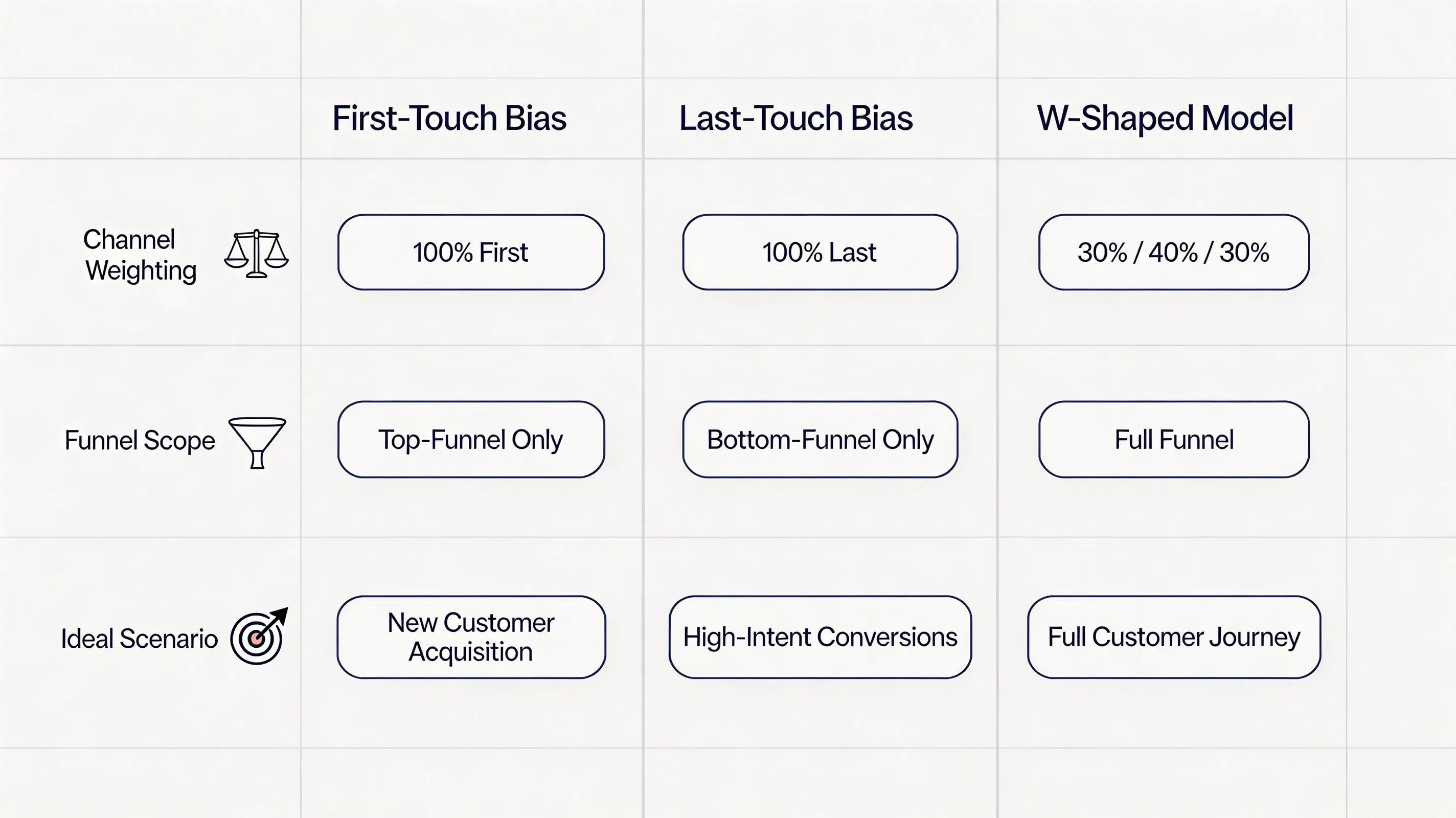
First-touch attribution assigns full credit to the initial interaction, such as an organic blog visit. While useful for evaluating brand awareness channels, first-touch models ignore downstream channels that drive final contract execution. Conversely, last-touch attribution credits the final interaction immediately preceding account creation or app installation. Last-touch models favor bottom-of-funnel retargeting ads while undervaluing top-of-funnel content that originally acquired the lead.
Relying exclusively on last-touch metrics often incentivizes marketing teams to over-index on cheap retargeting clicks while defunding top-of-funnel educational content. Multi-touch models resolve this bias by measuring how early discovery, mid-funnel nurturing, and final conversion triggers work together to generate pipeline value.
Best Attribution Models Compared
Selecting the correct attribution model determines how conversion credit is distributed across marketing touchpoints. B2B SaaS organizations typically evaluate five core attribution models:
| Attribution Model | Primary Credit Rule | Best For | Key Limitation |
|---|---|---|---|
| First-Touch Attribution | 100% to initial touchpoint | Top-of-Funnel Content & Discovery | Ignores downstream nurturing channels |
| Last-Touch Attribution | 100% to final touchpoint | Short Impulse Conversions | Over-values bottom-of-funnel retargeting |
| Linear Attribution | Equal distribution across touches | Simple Multi-Channel Journeys | Assigns equal weight to low-value clicks |
| Time-Decay Attribution | Increasing weight closer to conversion | Extended Sales Cycles | Undervalues initial brand discovery |
| W-Shaped Multi-Touch | 30% First, 30% Lead, 30% Opportunity, 10% Middle | Enterprise B2B SaaS Funnels | Requires complex CRM data integration |
Which Attribution Model Should Your SaaS Company Use
Choosing an attribution model requires aligning your measurement framework with your go-to-market (GTM) motion, sales cycle duration, and account contract size:
- Deploy W-Shaped Multi-Touch if: Your sales cycle exceeds 30 days, involves multiple buying stakeholders, and requires opportunity tracking inside an enterprise CRM.
- Deploy First-Touch Attribution if: Your GTM motion is purely content-led, brand awareness is the primary metric, and sales cycles resolve within a few days.
- Deploy Multi-Touch + Product Analytics if: You operate a Product-Led Growth (PLG) SaaS model where self-serve web trial sign-ups transition into native in-app feature activations and automated upgrades.
- Deploy Revenue Attribution if: Contract values vary significantly across accounts, and marketing performance is evaluated on ARR and CLV rather than cost-per-lead (CPL).
Revenue Attribution vs Lead Attribution
A fundamental mistake in SaaS marketing is evaluating success strictly through lead attribution rather than revenue attribution. Lead attribution measures volume-based top-of-funnel metrics like form fills, whitepaper downloads, and free trial sign-ups. Revenue attribution connects those leads to actual closed-won contract value and recurring subscription metrics.
| Attribution Dimension | Lead Attribution | Revenue Attribution |
|---|---|---|
| Primary Metric | MQLs, Form Submissions, Demo Requests | ARR, MRR, Closed-Won Contract Value |
| Data Focus | Volume and Cost Per Lead (CPL) | Pipeline Value, ROAS, and LTV:CAC Ratio |
| Funnel Scope | Top-of-Funnel (Awareness to Lead) | Full Lifecycle (Lead to Renewal) |
| Strategic Outcome | Evaluates Traffic Quantity | Evaluates Channel Profitability |
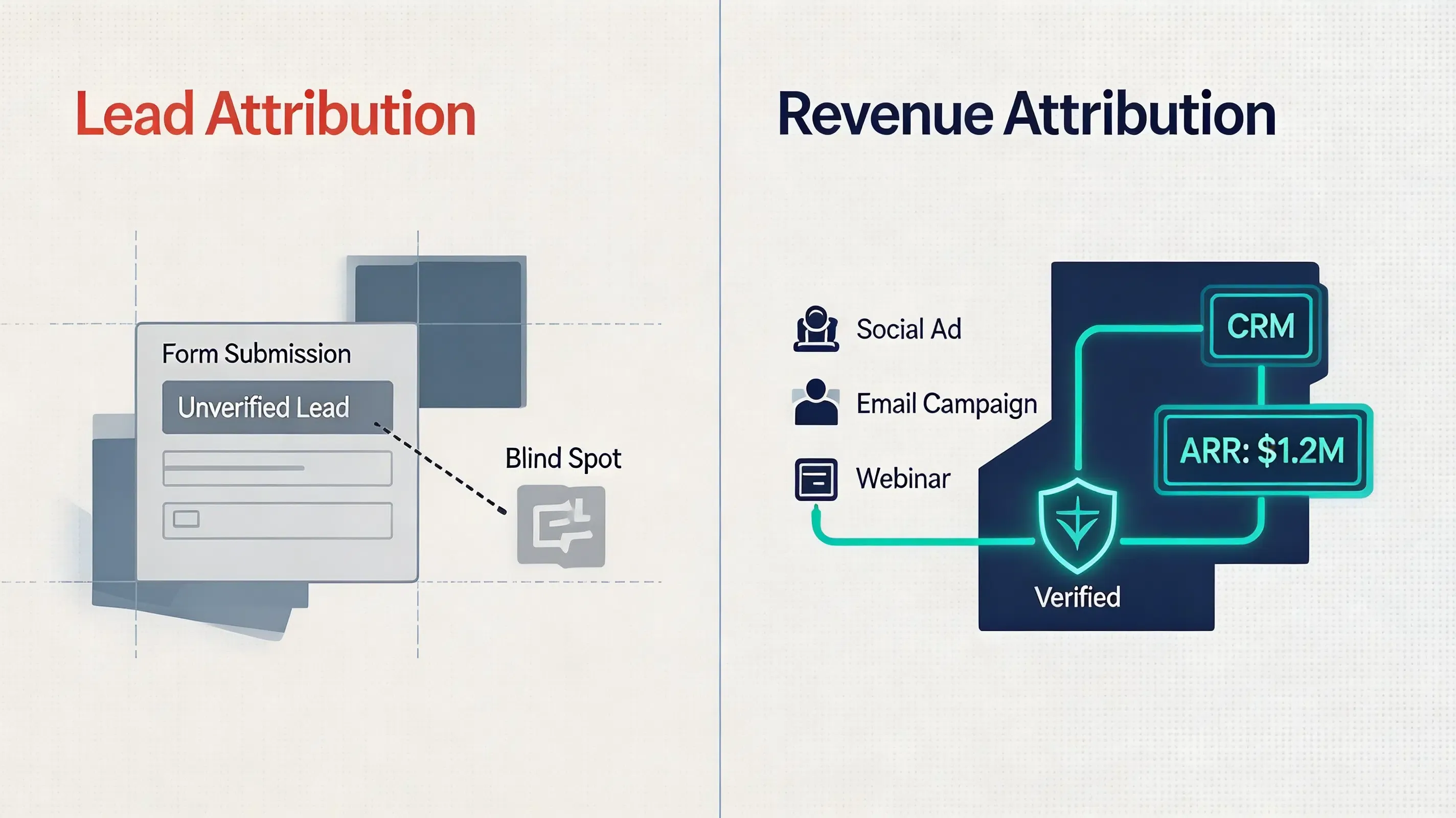
Focusing exclusively on lead attribution often incentivizes marketing teams to double down on cheap, low-intent traffic sources that generate high volumes of free trials but zero paying customers. Revenue attribution aligns marketing incentives directly with business profitability by auditing which channels yield high-retention, high-value accounts.
How Revenue Attribution Works With Enterprise CRMs
In B2B SaaS, the conversion from prospect to paying customer rarely happens inside a web browser session. Most conversion milestones occur deep within backend sales pipelines and CRM systems as sales reps log deal stages, contract terms, and Annual Recurring Revenue (ARR).
If your attribution platform only monitors website visits and web forms, it remains blind to the most critical business metrics:
- Pipeline creation: Knowing which marketing channels generate qualified sales opportunities rather than unqualified leads.
- Deal velocity: Tracking which content assets accelerate the time it takes for a lead to move from demo request to signed contract.
- Annual Recurring Revenue: Attributing actual dollar values to marketing campaigns rather than estimated average deal sizes.
- Customer Lifetime Value: Identifying which channels attract accounts with low churn rates and high net revenue retention.
Integrating attribution data directly with your CRM allows marketing teams to sync campaign parameters with account records, enabling closed-loop reporting that ties every dollar of ad spend directly to closed-won ARR.
How Web-to-Mobile SaaS Attribution Works
Many B2B SaaS platforms operate across both desktop web applications and native mobile apps. This environment introduces tracking fragmentation when users conduct research or register on desktop browsers, but subsequently download and activate team workspaces within mobile applications.
Standard browser identifiers cannot cross the operating system boundary to enter sandboxed mobile app stores. When a user launches the native mobile application for the first time, traditional web analytics treat the event as an isolated, unattributed mobile download, severing the connection to the earlier desktop web ad click.
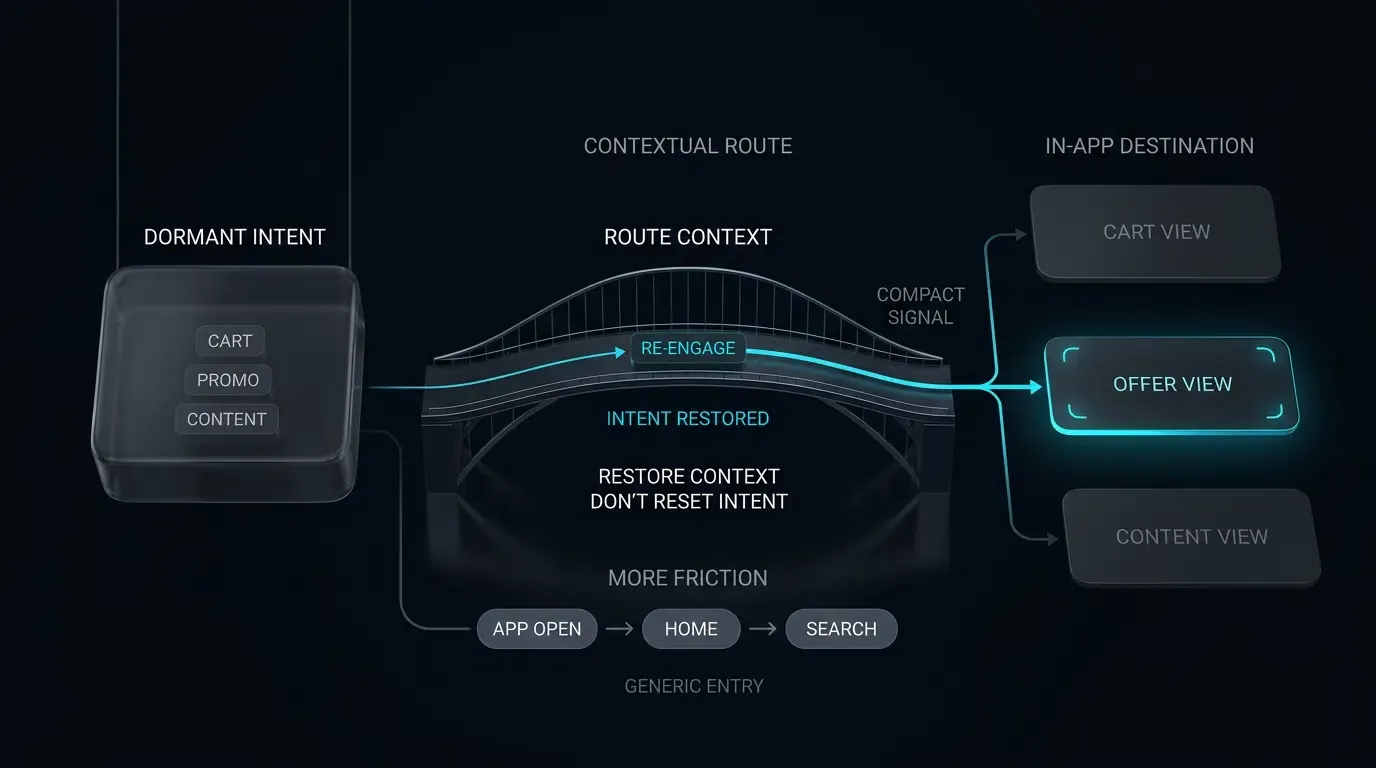
Overcoming this cross-platform disconnect requires deploying session stitching architectures and deferred deep linking systems. When a user registers on the web, a secure session token is generated. When the user downloads and opens the mobile app, integrated attribution systems resolve this token upon first launch, reconnecting the mobile activation back to the original desktop web campaign.
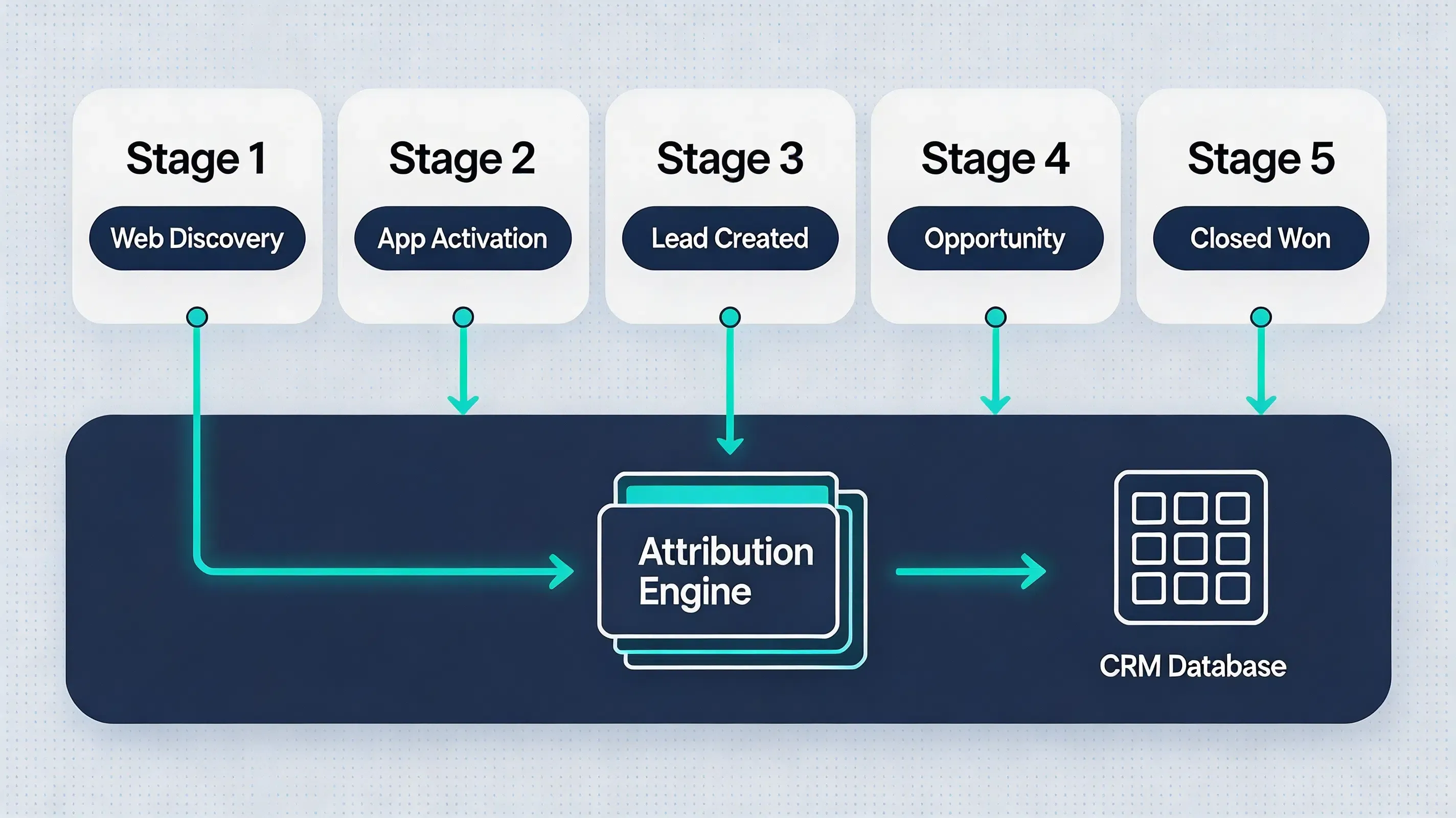
How to Build a SaaS Attribution Framework
Building an enterprise-grade SaaS attribution framework requires a structured approach that aligns marketing data with backend sales infrastructure:
- Step 1: Define Conversion Events and Taxonomy: Standardize event naming conventions (such as
trial_signup,team_invite,subscription_upgrade) and enforce clean UTM parameter rules across all acquisition channels. - Step 2: Connect Marketing Touchpoints: Deploy client-side web scripts and tracking links across paid ads, organic content, social channels, and email campaigns to capture incoming traffic data.
- Step 3: Select Your Attribution Model: Choose a model (such as Position-Based or Time-Decay) that reflects your sales cycle length and GTM motion.
- Step 4: Synchronize CRM and Revenue Data: Establish Server-to-Server (S2S) postbacks or API integrations between your attribution engine and internal CRM to map deal stages and ARR back to campaign sources.
- Step 5: Measure Revenue Impact and Optimize: Audit channel performance based on pipeline creation, LTV:CAC ratios, and ROAS, reallocating budget toward high-margin acquisition channels.
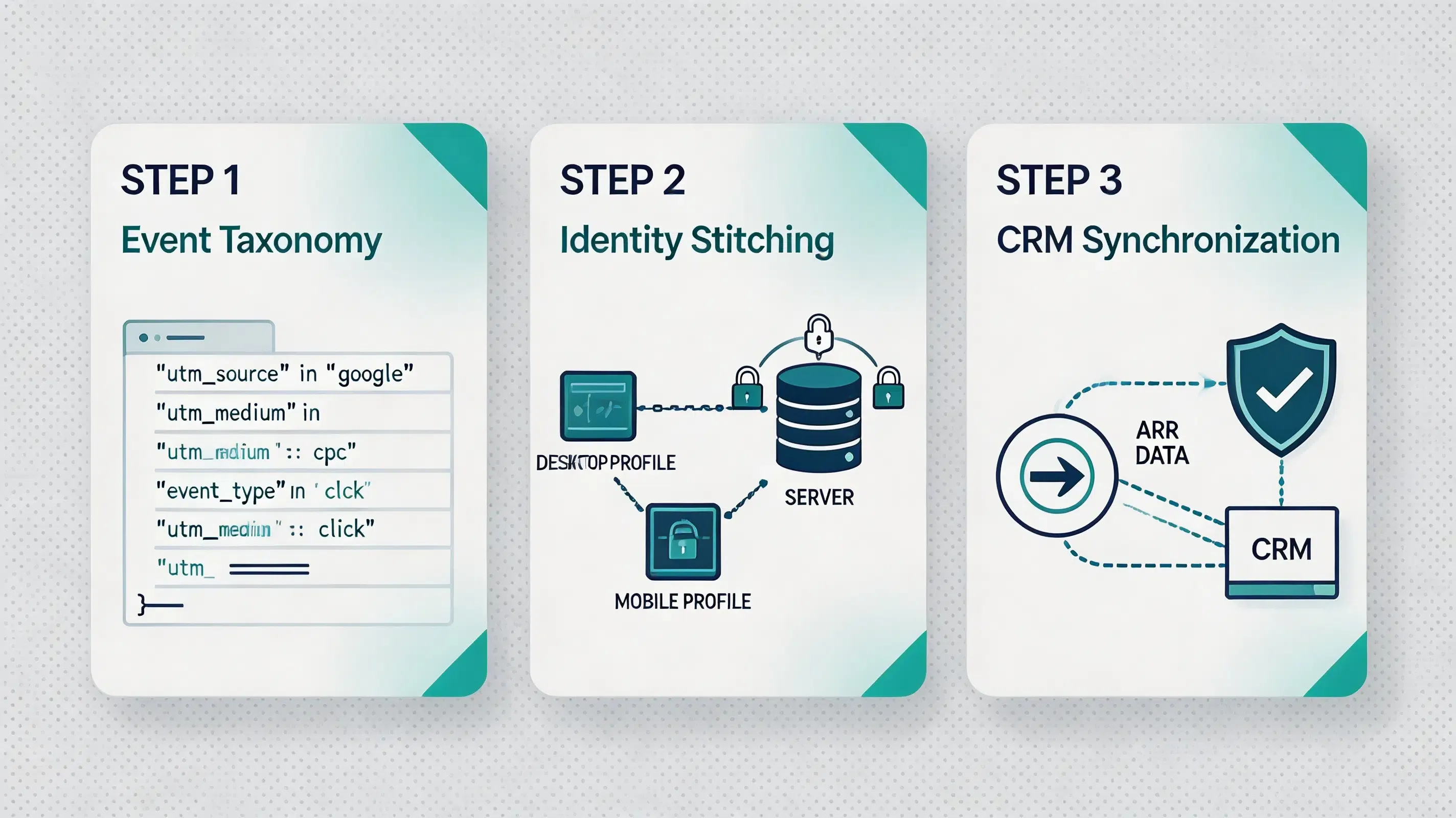
SaaS companies that require web-to-mobile attribution continuity typically deploy attribution infrastructure with session stitching, deferred deep linking, and server-side event synchronization. OpoInstall provides these capabilities for teams that need to connect acquisition campaigns with downstream mobile activation events.
Example: How SaaS Companies Connect Marketing Touchpoints With Revenue
Simulated Scenario: B2B Enterprise SaaS Application Integration
In a typical un-attributed workflow, a B2B SaaS company receives 10,000 organic web visits, resulting in 500 trial sign-ups and 50 mobile team activations. Without multi-touch attribution, paid search campaigns appear overly expensive based strictly on cost-per-lead, prompting marketing to cut paid search budgets.
When applying a CRM-connected multi-touch attribution strategy, the data reveals a different pattern:
- Top-of-funnel discovery: Organic search content drives the initial 10,000 visits, generating 60% of top-of-funnel awareness.
- Mid-funnel conversion: Paid retargeting ads and webinar invites trigger the 500 trial sign-ups, securing high lead creation credit.
- Downstream contract value: Cross-platform session stitching reveals that the 50 paid mobile activations originated from enterprise accounts initially acquired via paid search.
In this simulated architecture, an attribution infrastructure layer demonstrates how web registration signals can be synchronized with mobile activation events, while campaign identifiers are configured through a developer console. By connecting web touches to CRM pipeline milestones, the growth team realizes paid search drives the highest closed-won ARR, preserving high-ROI acquisition channels from accidental budget cuts.
Frequently Asked Questions
What is the best marketing attribution strategy for SaaS?
What is the most accurate attribution model for SaaS?
What attribution model is best for B2B SaaS?
How does cross-platform marketing attribution stitch desktop web clicks to app installs?
What is the difference between single-touch and multi-touch marketing attribution?
Can marketing attribution track B2B trial-to-paid conversions in real time?
How do server postbacks sync attributed lead parameters with enterprise CRMs?
Why do web cookies fail to attribute mobile application installs?
Does iOS ATT restrict B2B marketing attribution tracking?
Summary and Decision Framework
Choose an automated cross-platform marketing attribution architecture when your growth objectives match the following functional criteria:
- ✓ Long B2B Sales Cycles Require Full-Funnel Visibility: Conversion decisions involve multiple web touchpoints prior to native mobile application activation.
- ✓ Prospects Register on Web but Convert in Mobile App: Acquisition models rely on web trial sign-ups that transition into mobile team usage.
- ✓ Enterprise Data Warehouses Require Raw Data Logs: Business intelligence teams need un-aggregated postback streams synced to internal CRMs.
- ✓ Multi-Agency Campaigns Require Deduplication: Marketing budgets demand independent reconciliation across paid web channels and ad networks.
In these scenarios, deploying a cross-platform attribution strategy provides a practical architecture. A referral tracking SDK helps mobile teams connect user sharing events with verified installations while maintaining platform privacy requirements. A secure referral platform combines deferred deep linking, install attribution, server-side verification, and encrypted parameter passing into a single growth infrastructure. Platforms such as OpoInstall implement similar cross-platform measurement architectures depending on product requirements.
Related SaaS Attribution Topics
Related Concepts
- Install Attribution: The foundational measurement pipeline identifying application download sources.
- Multi-Touch Attribution: The attribution framework assigning conversion credit across multiple touchpoints in a user journey.
- Customer Lifetime Value: The projected cumulative revenue generated by a B2B account over time.
Related Technologies
- Google Play Install Referrer: Google’s native API passing install-time campaign metadata on Android.
- Universal Links: Apple’s native deep linking standard bridging web actions to native screens.
- App Links: Google’s verified deep linking protocol handling custom web URLs on Android.
Standards Referenced
- IETF RFC 3986: Uniform Resource Identifier (URI) Generic Syntax specification.
- OWASP Mobile Security: Official OWASP guidelines for secure S2S payload integration.
Official Documentation / References
Share this article