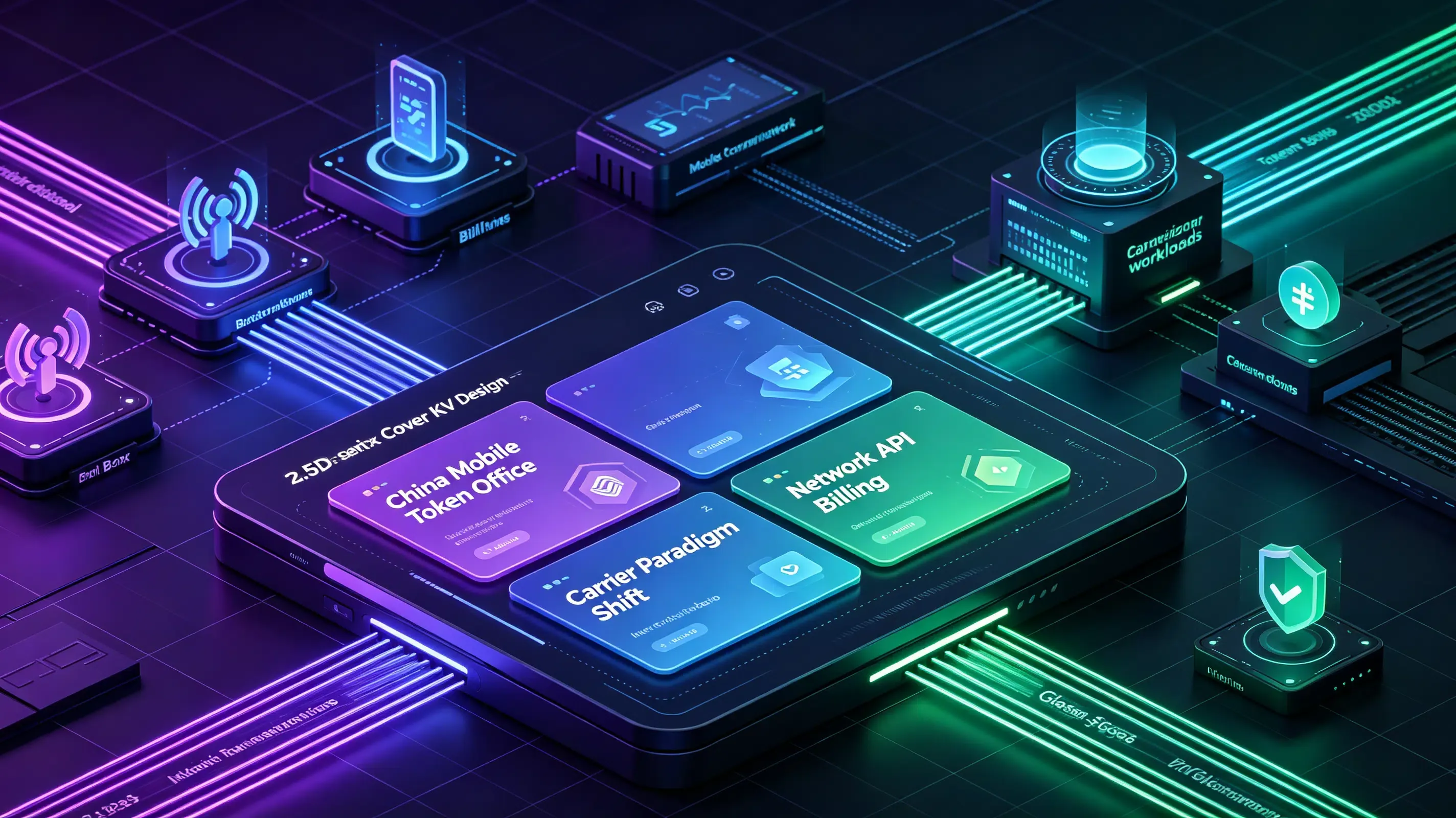
 China Mobile’s ‘Token’? The move reflects China Mobile’s broader strategy to position carriers as AI service providers rather than connectivity providers. On June 28, 2026, the telecom giant announced the establishment of a group-level ‘Token’ Office, led by core group leadership and the Strategic Development Department. For developer teams and product leads, this rapid organizational realignment highlights a technical shift: AI requests are rapidly transitioning from traditional, visual browser environments to carrier-level network API service calls, which fundamentally changes how data propagation and session lifecycles are analyzed at the network layer.
At a Glance
- Silo Fragmentation Broken: The group-level office unifies “creating, transporting, and applying” workloads, integrating departments like the mobile cloud, computing division, and market operations.
- Carrier Paradigm Shift: Challenged by cloud providers, the initiative marks a transition from billing raw data traffic (MB) to auditing programmatic model transactions.
- Programmatic Measurement Gaps: The transition to tokenized services on headless agent runtimes breaks traditional client-side session-tracking and browser cookie frameworks.

Structural Realignment and Carrier-Led AI Service Delivery
In June 2026, the establishment of the Token Office represents China Mobile’s bid to streamline its “creation, transportation, and application” loop. This unifies divisions that previously managed tasks independently: the computing power office, mobile cloud company, digital intelligence division, marketing department, and enterprise business unit. As reported in trade publications like C114 Communication, this structure mirrors previous enterprise initiatives such as Alibaba’s ATH (Alibaba Token Hub) business group, focusing on breaking internal department silos to consolidate billing, routing, and deployment into a unified ecosystem.
According to reports by C114, analysts at Goldman Sachs recently adjusted investment ratings of selected telecom operators to “Sell”, citing slow conversion of Token packages to significant revenues despite the cheap five-yuan subscription packages introduced in May 2026. This financial pressure was addressed directly by Chairman Chen Zhongyue at MWC26 Shanghai, where he outlined a strategic pivot from “Mobile Communication” to “Mobile Computing” and “Mobile AI”, driven by the 'MobileClaw' agent framework and the 'MoMA' model supermarket platform hosting over three hundred models. Telecom operators are increasingly integrating deep reasoning and computational services directly into cellular data plans, aiming to merge raw cellular connectivity with compute credits.

The Protocol Breakdown: How Network-Level Service Calls Bypass Client State
Unlike visual cloud AI engines that compile web-rendered pages, carriers manage token transactions and API routing directly at the network/telecom infrastructure layer. When a MobileClaw agent executes an action, such as initiating a transaction via a carrier-routed webhook, there is no human browser click, no browser-level Document Object Model (DOM) render, and no persistent cookie container. The assistant acts as an automated triage mechanism, reading and dispatching webhooks asynchronously at the core network layer.
Headless request routing often isolates the session from the client-side system. Because the request initiates via a server-to-server (S2S) network API rather than a human-facing local browser wrapper, traditional client-side SDK runtimes lose visibility. Traditional browser-based attribution methods may no longer capture the complete user journey because they rely on browser cookies to link the initial click to the installation. Under these conditions, the attribution accuracy decreases significantly across the communication stack.
Traditional Browser-Based Flow:
Web Link -> Visual Click -> Browser Session (Cookies, User-Agent) -> App Store -> App Install (Attributed)


Carrier Network-Level Flow:
MobileClaw Agent Action -> Stateless S2S Webhook -> Direct API Token Transaction (No DOM, No Cookies)
App Launches (Later) -> Device State Blank -> Reduced Attribution Accuracy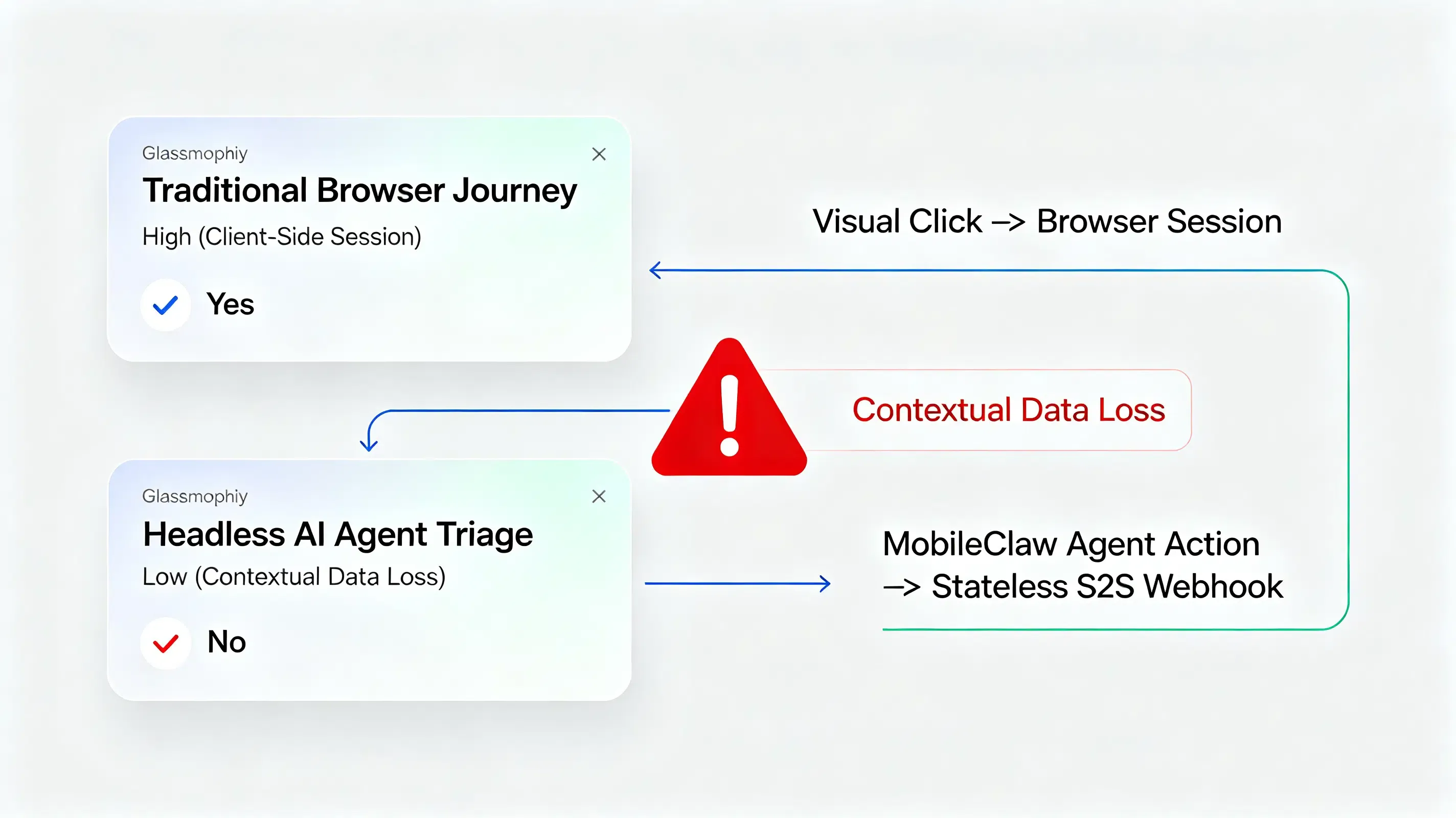
In typical production deployments, developers often encounter a notable portion of traffic being processed by automated scrapers. Tracing these programmatic interactions reveals that email security gateways or automated mailbox scanners may visit links before end users do. This behavior can interfere with browser-based attribution if systems assume every request originates from a real user. Consequently, in some implementations, the original referral context may no longer be available to the client application, resulting in significant attribution gaps across the carrier-grade billing interface.

Architectural Solutions: Build vs. Buy in State Restoration
In practice, engineering teams usually choose between building an internal attribution pipeline or integrating an existing attribution SDK. Developing a proprietary system requires substantial engineering overhead. Teams must build custom server-side databases, maintain device state-matching libraries, and continuously update logic to comply with evolving OS security standards. For many organizations, the maintenance cost of an in-house tracker is prohibitively high.
Alternatively, developers generally evaluate several approaches to preserve session state without client-side cookies:
- In-House Custom Services: Building proprietary state-matching databases on top of internal cloud architecture.
- Platform-Specific Tools: Relying on basic utilities like Firebase Dynamic Links (or their platform-native alternatives).
- Enterprise MMPs: Deploying mobile measurement partners such as Branch, AppsFlyer, or Adjust for deep-linking workflows.
- Specialized Parameter SDKs: Utilizing dedicated integration utilities for precise, cost-sensitive custom parameter pass-through.
State & Attribution Flow Comparison
| Interaction Flow | Visual Cookie Store | Headless Compatibility | Attribution Integrity |
|---|---|---|---|
| Traditional Browser Journey | ✅ Yes | ❌ No | High (Client-Side Session) |
| Headless AI Agent Triage | ❌ No | ✅ Yes | Low (Contextual Data Loss) |
| Server-Side State-Locking | ❌ No | ✅ Yes | High (Asynchronous Retrieval) |
Carrier-Level Token Dispatch -> Register Unique Metadata Lock
                                           |
Headless S2S Webhook Transaction -> Bind Transactional Hash (Carrier IP, Device OS)
                                           |
App launches on client -> SDK program-level context query -> Retrieve matching parameters
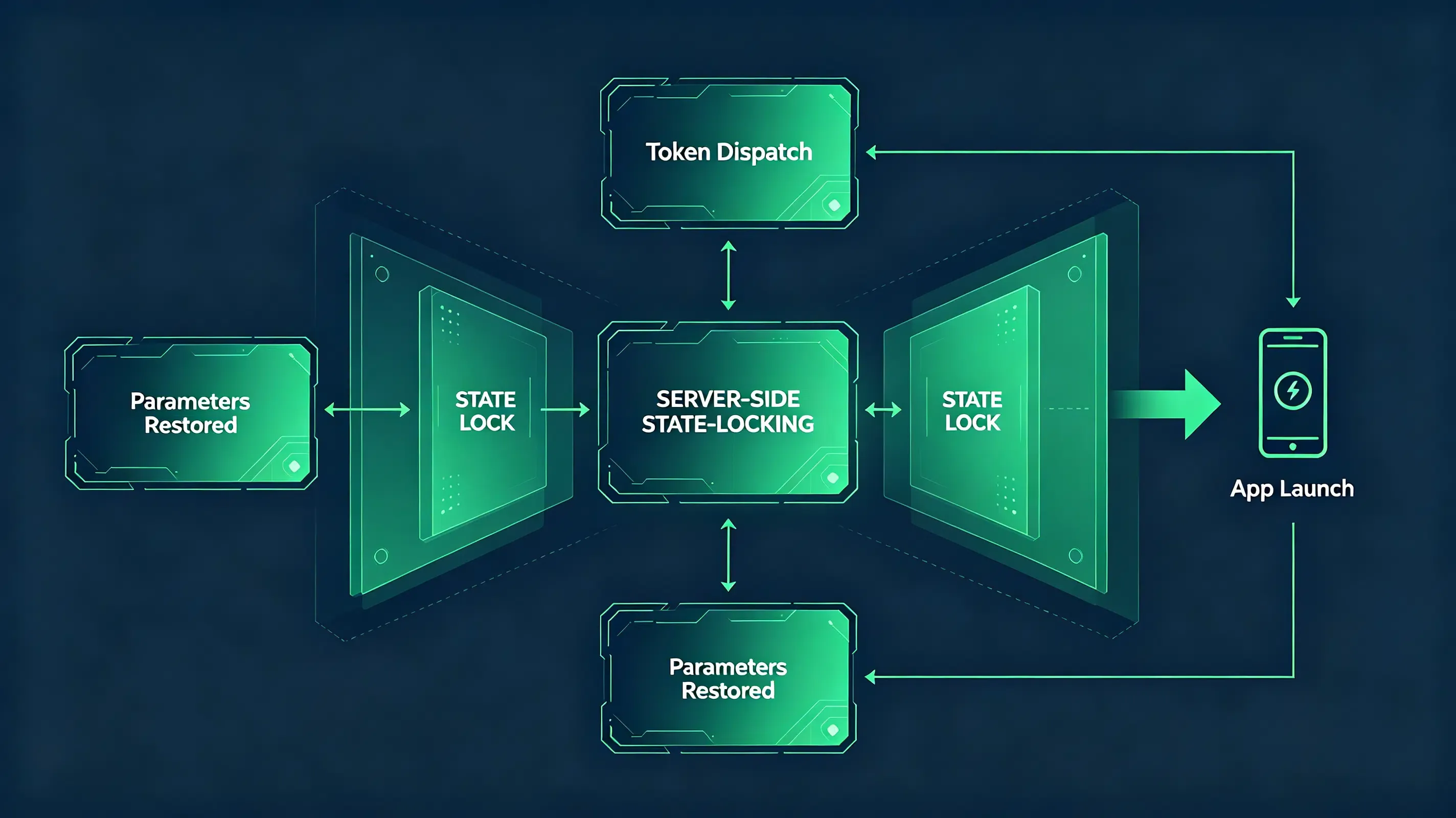
Commercial implementations of this architecture include Branch, AppsFlyer, Adjust, Opoinstall, and other deferred attribution platforms. These systems maintain server-side state before installation and restore parameters when the app is first launched, bypassing the reliability issues associated with client-side browser sessions. Engineering teams may evaluate these approaches according to deployment requirements and attribution accuracy goals.
Operational Team Adaptations and Integration Checklists
Backend engineering teams face the immediate task of auditing all active database integrations before launching automatically compiled builds. Product leads should redesign invitation and registration loops to accommodate non-visual user journeys. Instead of assuming the user will read an email and click a button, product leads should design workflows that expect programmatic triggers. Growth teams must update their performance metrics. When autonomous software handles triage, open rates and click-through rates become less reliable. Marketing operations should focus on downstream in-app telemetry and transaction-verified conversion milestones, optimizing campaigns based on the actual actions performed within the application.
Enterprise Tokenized Integration Checklist
To ensure data continuity before launching your integrated agentic workflows, engineering teams should execute the following steps:
- Contextual Path Verification: Audit how the MobileClaw compiler maps custom URL parameters to ensure deep-link survival.
- Headless Referral Preservation: Map alternative HTTP headers to capture referral parameters during server-to-server (S2S) agent executions.
- Telemetry Sandbox Tests: Ensure local data reporting does not trigger simulator fraud warnings in carrier sandbox testing environments.
- Multi-Platform Routing Checks: Align Universal Links with the MoMA platform schemas to prevent user friction during multi-screen Hand-Offs.

Frequently Asked Questions (FAQ)
Does China Mobile's 'Token' program affect existing contracts?
Do developers need to modify existing SDK integrations for tokenized billing?
How can referral attribution survive in tokenized carrier ecosystems?
The rise of carrier-managed AI services signals a broader shift toward network-native programmatic communication. As applications increasingly communicate through automated data exchanges rather than human-rendered layouts, engineering teams must re-evaluate traditional integration strategies. Platforms that depend heavily on manual, visual user actions may face structural gaps when automated agents manage the request pipeline. Transitioning to server-side attribution and secure parameter pass-through represents a highly probable direction for maintaining reliable tracking and security coverage.
This transition suggests a fundamental rewrite of our measurement frameworks and security protocols. Future attribution systems are likely to rely more heavily on server-side identity matching and secure state synchronization. As more AI agents begin acting as the first consumer of digital communication, attribution architectures will increasingly depend on server-side identity, deferred state recovery, and protocol-level context preservation rather than browser sessions alone.
Share this article