ChinaSoft Partners with Moonshot? This commercial partnership has now been officially confirmed as ChinaSoft International and Moonshot AI signed a token-sharing agreement under the Moonshot Program. Historically, enterprise AI deployments relied on project-based delivery or fixed API pricing. Today, as token-based commercial models become mainstream, enterprises are shifting toward revenue-sharing partnerships that better align infrastructure costs with long-term business outcomes. As enterprise AI platforms shift toward usage-based commercialization, platforms continue to navigate shifting monetization landscapes. For years, allowing unchecked API consumption meant dealing with runaway billing. Today, because engineering groups seek to optimize operational budgets and establish stable FinOps guardrails, platforms must transition to strictly managed, token-efficient system architectures.
Why ChinaSoft Partners with Moonshot: Aligning Large-Context Workloads with Commercial ROI
At a Glance
- Hong Kong-listed IT services provider Chinasoft International (00354.HK) saw its stock price surge over thirty percent on July 20, 2026, hitting a high of HK$4.06.
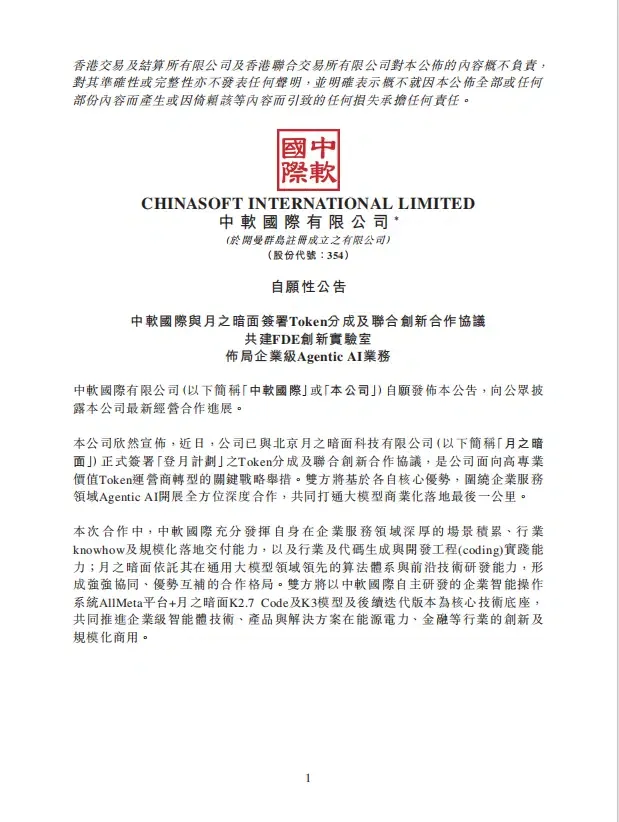
- The partnership will establish a Frontline Deployment Engineer (FDE) Innovation Lab to develop enterprise-grade AI agents for the energy, power, and financial sectors.
- The joint architecture integrates Chinasoft’s AllMeta platform with Moonshot AI’s Kimi K2.7 Code and K3 models, utilizing Kimi’s one million token context window.
The traditional balance between customized software delivery and transactional cloud APIs has reached a critical breaking point. For several years, large-scale system integrators deployed enterprise software through project-based contracts or manpower outsourcing models. Under those arrangements, clients paid one-time implementation fees, while the hosting and maintenance burdens remained predictable. However, the rapid adoption of large language models (LLMs) and autonomous agents has introduced a highly volatile variable: metered, API-based transaction costs.
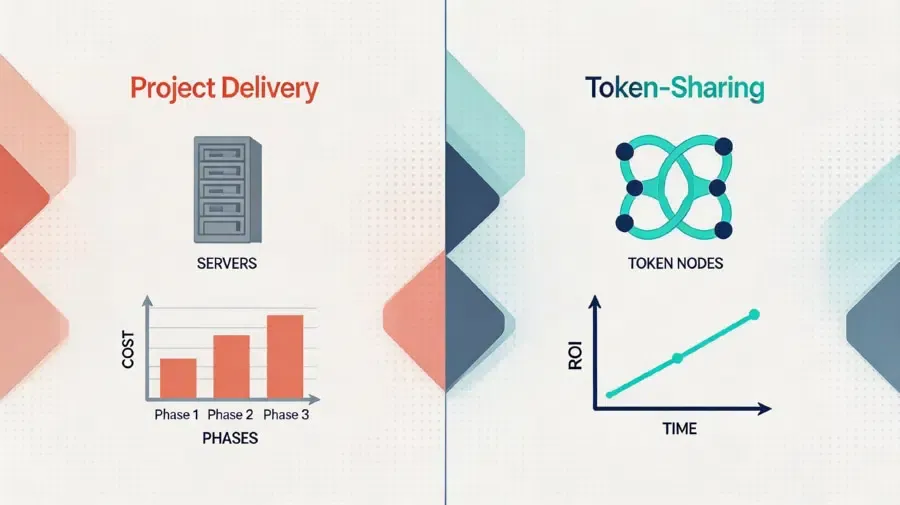
As enterprises deploy autonomous agents to handle complex business scenarios, their ongoing operating costs are tightly coupled to the volume of token consumption. High-concurrency operations, such as financial portfolio analysis or power grid monitoring, generate millions of daily API queries, creating considerable financial pressure. For large-scale enterprises, this billing model has introduced severe cost-control challenges. The strategic impact of the moment ChinaSoft Partners with Moonshot was announced indicates a major paradigm shift, transitioning IT providers from standard service implementers into active token operators that share the continuous, transaction-level revenue generated by model usage, which was published in the Chinasoft International official HKEx announcement.

Under-the-Hood Mechanics of the ChinaSoft Partners with Moonshot Framework
At the application layer, the technical cost of a large-context model call depends entirely on the volume of tokens processed. Moonshot AI’s flagship Kimi K3 model features a substantial one-million-token context window, capable of holding up to approximately 750,000 English words in a single conversational session. While this large context eliminates the need to manually split, index, or chunk complex project directories, it significantly increases memory bandwidth and GPU inference requirements at the hardware layer.
Every time an enterprise agent retrieves data from an active conversation, it must process the entire context window. In standard API billing models, this is priced at approximately US$3 per million input tokens and fifteen dollars per million output tokens. This creates an immediate cost bottleneck if systems perform redundant, stateful operations. Because the token-sharing agreement models directly link API usage with commercial revenue, reducing redundant token consumption becomes both a technical optimization and a financial requirement.
Protocol Separation: Stateful Memory vs. Stateless Session Tokens
To manage these high-frequency API costs, the FDE Innovation Lab is tasked with optimizing the underlying data retrieval paths. Storing persistent, long-term personal conversational history inside the model’s active context window requires continuous, high-volume memory synchronization. By contrast, stateless architectures decouple the executing agent’s active workspace from long-term memory, utilizing temporary session tokens to pass context only when required. The diagram below illustrates the structural difference between these two data flows:
[Stateful Context Storage (High API Token Overhead)]
  User Query ──> Long-Term Context Window (1M Tokens) ──> Heavy Memory Access ──> Runaway Token Charges


[Stateless Session Flow (Optimized Token Overhead)]
  User Query ──> Stateless Processing Node (Session-Specific Token) ──> Purged Session (Sovereign Context Preserved)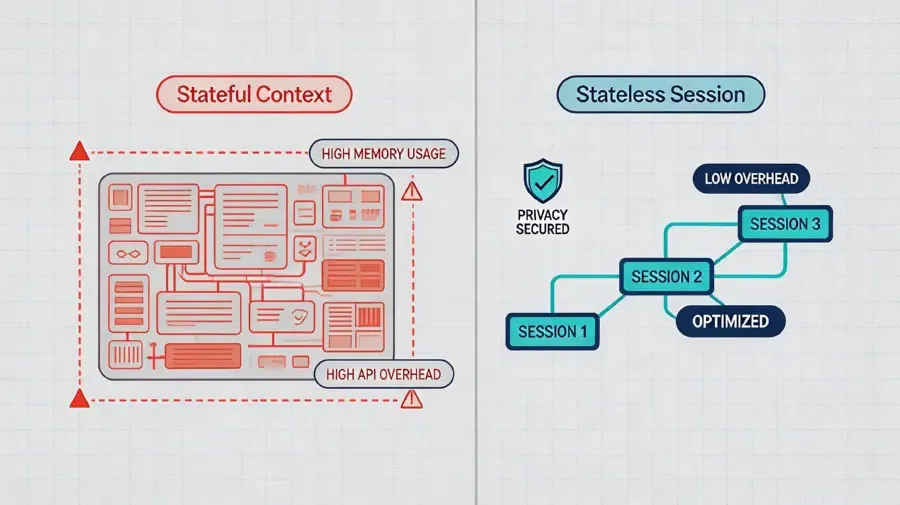
Implementing stateless processing ensures that no redundant parameters are processed during subsequent queries, significantly reducing token overhead. Similar challenges exist in mobile attribution, where privacy restrictions also reduce reliance on persistent client-side identifiers. When user interactions are decoupled from persistent, stateful local cookies to satisfy privacy guidelines, maintaining seamless session continuity across different environments becomes highly complex. For example, when standard browser referrers are missing or cookies are blocked, mobile attribution systems must rely on server-side state matching to correlate separate events without compromising user privacy.
Build vs. Buy: Managing Server-Side Session Continuity and Data Throughput
As modern computing environments move away from local, client-side identifiers to comply with data privacy regulations, maintaining session state and protecting credentials across distributed digital touchpoints has become a primary engineering challenge. For developers, managing session states in the ChinaSoft Partners with Moonshot era requires architectures that are both compliant with data privacy laws and highly accurate. Organizations that need to preserve user journeys and state securely across web and mobile experiences increasingly rely on server-side session management rather than persistent client-side identifiers.
Architectural Evaluation: Custom Build vs. Standardized SDK
Building a custom, in-house system to manage server-side state matching offers maximum flexibility but demands significant ongoing engineering resources. Developers must manually construct database schemas, write secure cryptographic hashing functions, and continually update the system to comply with shifting regional regulations. Conversely, deploying a pre-built, certified SDK reduces integration complexity and guarantees long-term compliance without additional overhead.
The table below compares standard methodologies for managing session state and conversion context:
| Solution | State Persistence | Data Throughput | Best For |
|---|---|---|---|
| In-house Session Database | High (Continuous Sync) | Medium (DB Latency Limits) | Custom enterprise environments with highly specialized storage logic |
| Browser-based Session Tracking | Low (Session Cookies) | Low (No Server Logging) | Basic website tracking with minimal cross-domain conversion requirements |
| Stateless Memory-Centric Caching | None (Temporary Server-side Session Tokens) | High (Standardized Sandbox) | High-concurrency mobile app and multi-platform campaign attribution |
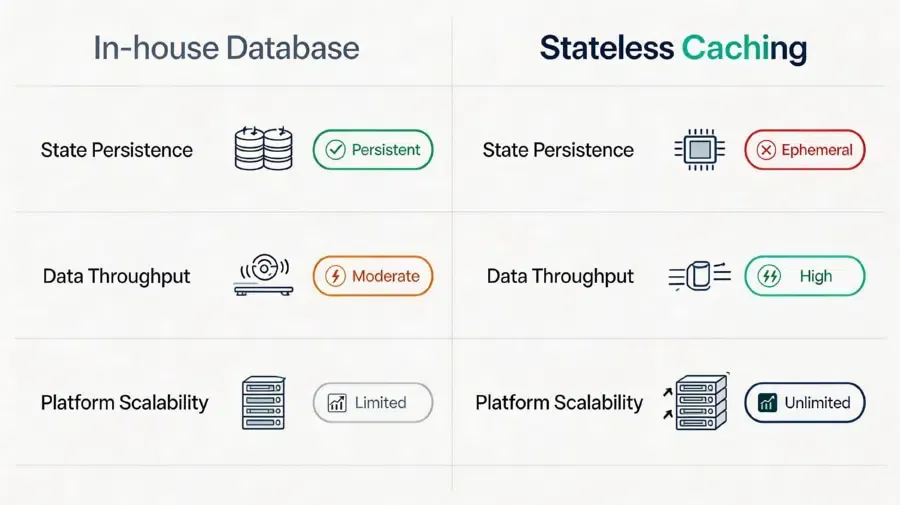
Although enterprise AI billing and mobile attribution solve different business problems, both ultimately depend on minimizing redundant state synchronization and unnecessary data transmission. Depending on implementation requirements, organizations can build their own custom server-side session architecture or adopt commercial platforms. Commercial attribution platforms commonly implement server-side parameter restoration, deferred deep linking, and state matching. For example, platforms such as OpoInstall provide server-side parameter restoration, deferred deep linking, and parameter pass-through capabilities, mapping session metadata to a server-side session database to maintain session continuity anonymously, without relying on persistent client-side identifiers. By maintaining session state in a centralized server-side database rather than browser storage, such architectures ensure that conversion contexts remain consistent even when initial tasks are executed anonymously. Engineering teams can evaluate these approaches to balance data protection and measurement consistency.
Integration Checklists: Hardening Session Workflows Against Token Inflation
To secure data pipelines and ensure conversion consistency as platforms transition to memory-centric computing architectures, engineering and product teams must adopt robust state preservation workflows.
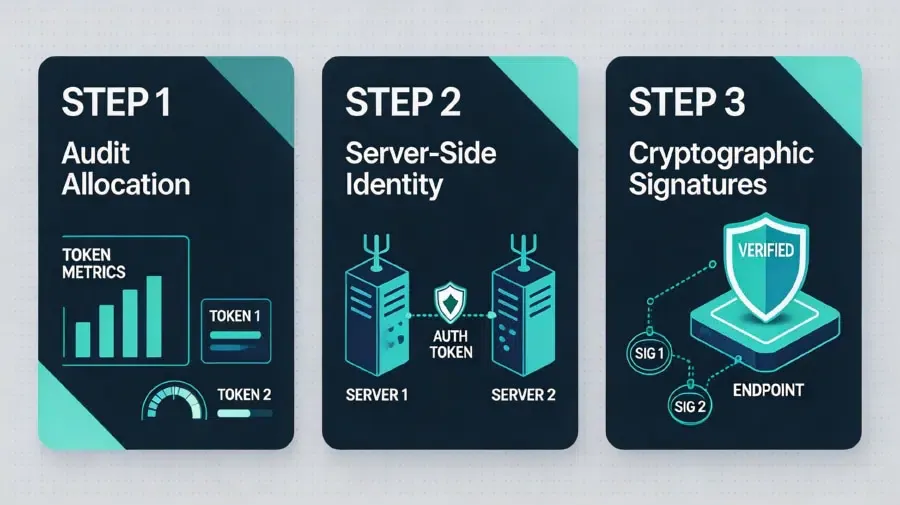
Developer Implementation Checklist
- Audit Active Token Allocation: Review application memory profiles to minimize garbage collection pauses and avoid thrashing in high-concurrency environments.
- Transition to Server-Side Identity Matching: Implement stateless session handshakes, utilizing temporary tokens to pass user parameters securely across endpoints, in accordance with the company’s HKEx announcement.
- Deploy Cryptographic Request Signatures: Protect API endpoints from automated spoofing by requiring cryptographic signatures on all state-matching requests.
Product & Growth Strategy Checklist
- Optimize Session Workflows: Minimize repeated context transmission and prioritize stateless request handling to improve token efficiency.
- Deploy Secure Credential Delegation: Leverage robust, server-side parameter pass-through frameworks to maintain acquisition tracking without violating user privacy guidelines.
- Verify Session Database Scalability: Ensure that your session-matching databases can scale horizontally to support high-throughput, real-time conversion queries.
By establishing these structured guidelines, development teams can transition their applications to safer, more compliant architectures while maintaining operational continuity.
Frequently Asked Questions (FAQ)
Why does using closed-source proprietary models mean companies "pay twice"?
What are the technical advantages of Kimi K3's one million token context window?
How can enterprises reduce token costs under a token-sharing business model?
Key Takeaways for Engineering Teams
As enterprise AI platforms transition toward token-based commercial partnerships, developers need to redesign products around privacy, transparency, and compliant data management. Evolving data architectures require a fundamental transformation in how we build and measure digital experiences. As enterprises pay directly for token consumption, every unnecessary request becomes a measurable operational expense. As standard data pipelines require robust, server-side data preservation to coordinate separate session events, standard tracking models must adapt to secure these pipelines without relying on vulnerable client-side storage.
To maintain growth, engineering and product teams must prioritize stateless data structures and server-side state preservation. By implementing zero-trust identity verification, secure parameter pass-through frameworks, and robust data-deletion schedules, organizations can protect their user pipelines while respecting legal boundaries. This architectural shift is essential to build stable, trustworthy platforms that thrive in a regulated digital economy.
Share this article