Recent industrial-scale deployments conclusively validate this strategic pivot. Specifically, at the official product rollout on June 23, 2026, Google introduced major upgrades to mobile browser automation. Consequently, these changes trigger a massive wave of frictionless web transactions. For developer teams, the immediate challenge is managing cross-platform transitions while maintaining robust security and data consistency. Crucially, the introduction of the Chrome 150 Autofills update marks a significant milestone in mobile user experiences.
Chrome 150 Autofills Mobile Fields: Deconstructing Google’s Dual-Platform Wallet Consolidation
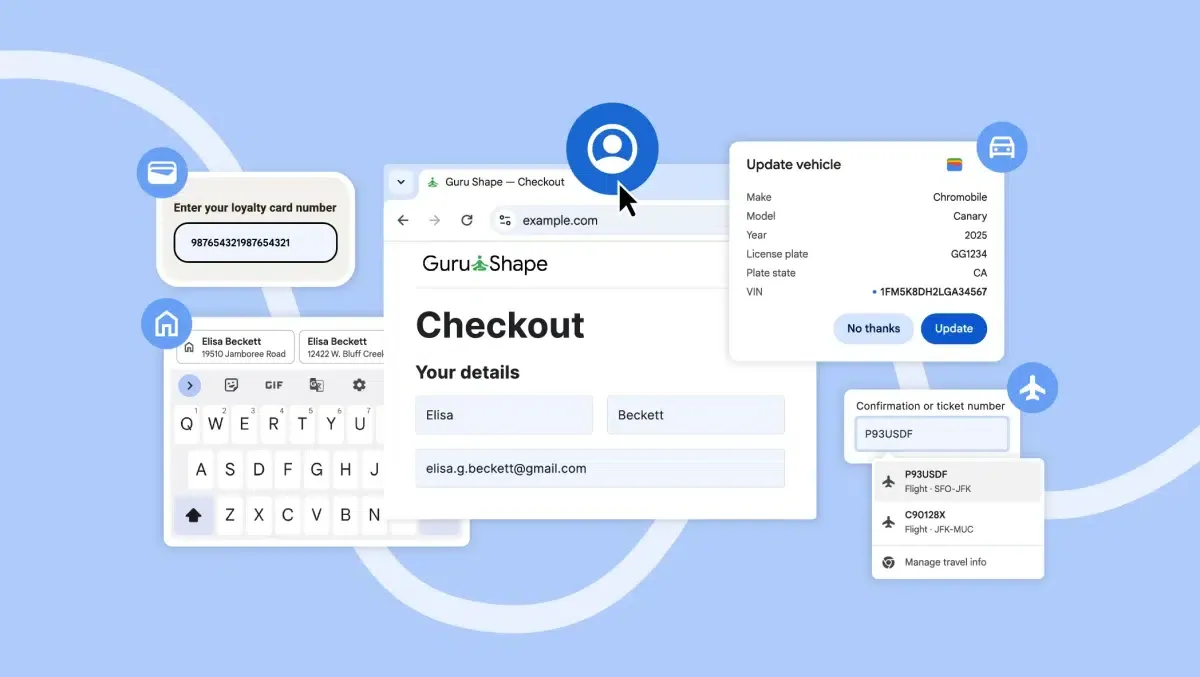
During the mobile rollout of Chrome 150 on June 23, 2026, Google introduced major upgrades to form automation. Specifically, the deeper integration between Google Wallet and Chrome Autofills simplifies documentation storage on mobile devices. Furthermore, the browser now supports complex data structures like driver’s licenses, passports, and Known Traveler Numbers. Consequently, mobile users no longer need to copy and paste alphanumeric strings manually. Meanwhile, the system enables two-way synchronization between browser fields and digital wallet databases. For instance, when a user types a vehicle license plate into a form, Chrome offers to encrypt and save it directly to Google Wallet. Detailed specs are outlined on The Keyword.
Wallet Integration and Chrome 150 Mobile Mechanics
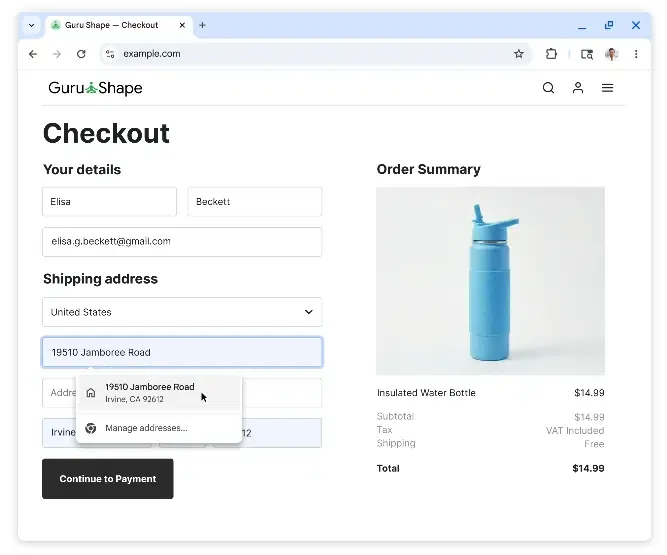
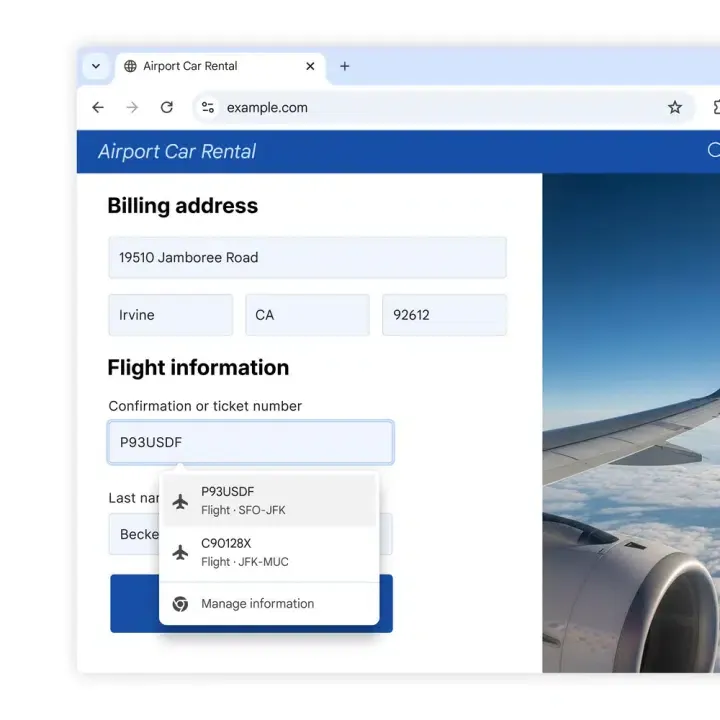
Specifically, when Chrome 150 Autofills complex form fields, it pulls saved passport numbers, Known Traveler Numbers, and flight details directly from the user’s digital wallet. For example, a traveler renting a car at an airport can instantly populate flight confirmation numbers and rental dates. Furthermore, this experience is rolling out globally on desktop, Android, and iOS. Consequently, mobile browsing becomes significantly less cumbersome, especially for frequent travelers. Meanwhile, Android users receive a two-line autofill suggestion layout instead of the traditional one-line interface. This visual upgrade allows users to quickly scan and select the accurate credential profile on cramped digital layouts.
The Five-Category Settings Metamorphosis
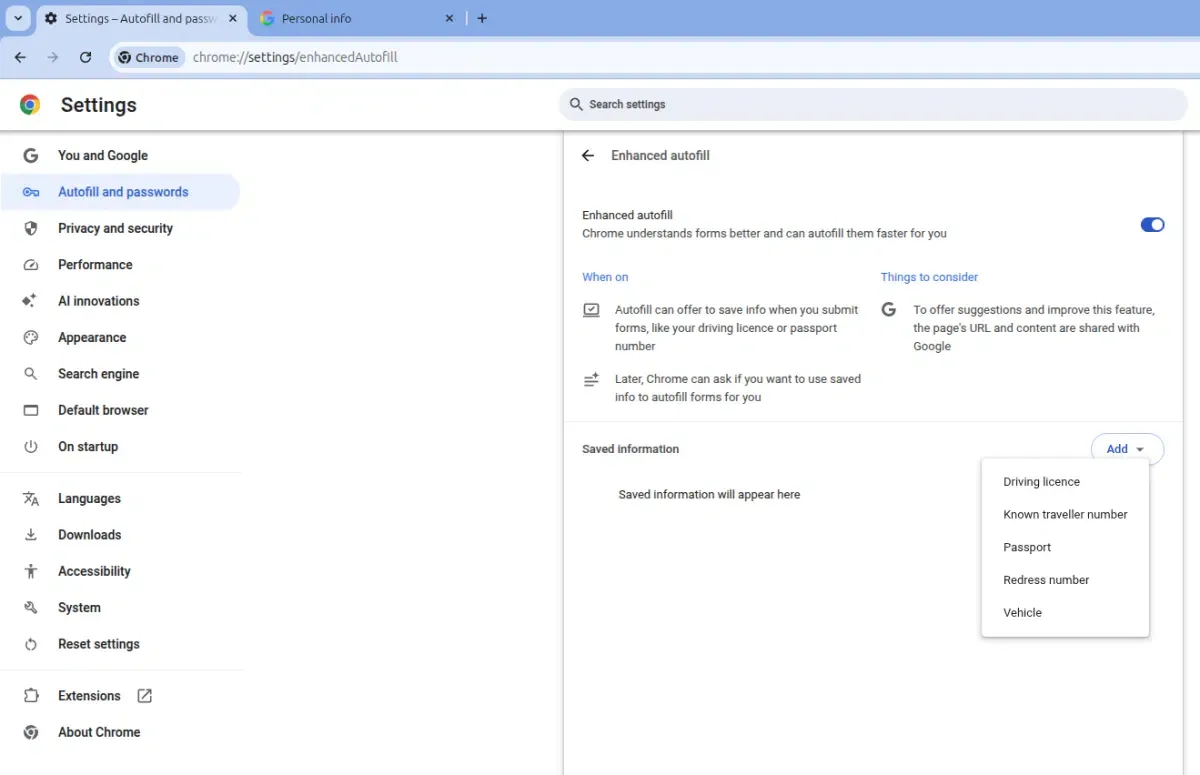
To accommodate these expanded capabilities, Google gave Chrome’s preference page a major structural overhaul. Specifically, the old “Passwords and Autofill” section is replaced by a clean, five-category layout in Chrome 150 for Android. Furthermore, this new interface organizes sensitive information into highly distinct groups. Consequently, users can manage their data with much greater granular control:
- Google Password Manager: Secures and manages raw passwords and cryptographic passkeys.
- Payments: Controls credit and debit cards, IBANs, and retail loyalty cards.
- Contact info: Aggregates verified home and work physical addresses.
- Identity docs: Manages driver’s licenses, state identity cards, and international passports.
- Travel: Restructures saved flight itineraries, known traveler numbers, and vehicle details like license plates or VINs.
Bidirectional Encryption and Consent Safeguards
Because handling government IDs introduces obvious security questions, Google has built strict user-level guardrails into the core layout. Specifically, when Chrome 150 Autofills driver’s licenses or passports, all syncing between the browser and Google Wallet happens through secure end-to-end encryption. Furthermore, the browser will never save or fill your sensitive information without explicit user consent. For instance, users can manage their sharing preferences using the “Use private pass across Google” toggle located near the bottom of individual wallet passes. Crucially, turning this off will immediately block the browser from accessing that specific document. Meanwhile, Google’s support pages disclose that visiting a website with an active form may share the site’s URL and content with Google to improve suggestion accuracy.
Bypassing Interactivity: How Automated Form Solutions Trigger a Web-to-App Ecosystem Shift
As browsers automate user fill-outs, web forms bypass traditional interactive friction, accelerating web-to-app conversions. Specifically, as Chrome 150 Autofills travel and payment data, web forms bypass traditional interactive friction, accelerating web-to-app conversions. Resolving user intents seamlessly during cross-platform hops requires robust universal link routing.
Reversing the Completing Paradigm: When Agent Execution Outperforms Pressed Keys
Furthermore, when thousands of autonomous agents execute tasks, they bypass traditional web browsers and direct user interfaces. Consequently, because Chrome 150 Autofills data in background threads, standard web flows are disrupted. Specifically, traditional attribution models rely on cookies, HTTP referrers, and UTM parameters to identify traffic sources. Meanwhile, agent-driven traffic is executed directly via APIs, which strips away standard tracking parameters. As a result, businesses experience massive data discrepancy, making it impossible to evaluate user acquisition ROI. Crucially, this data blackout prevents growth teams from optimizing their marketing campaigns.
Bot Swarms and the Ad Fraud Threat Vector
Furthermore, the availability of low-cost, high-performance tokens introduces a major security threat vector. For instance, malicious actors can deploy automated bot swarms to simulate organic interactions. Consequently, these bots can falsify app installs, execute fraudulent click spam, and trigger invalid conversion tracking events. Specifically, because the agent’s behavior mimics human decisions, traditional security thresholds cannot easily detect the fraud. As a result, developers face severe ad fraud risks, draining marketing budgets on non-existent traffic. Meanwhile, traditional software development kits (SDKs) designed for manual clicks struggle to cope with automated tasks. Crucially, this vulnerability exposes the urgent need for a more robust integration layer.
Reference Architectures & Engineering References: Establishing Robust Web-to-App Routing Protocols
To bridge the web-to-app gap and secure the checkout pipeline, software architects must implement standardized engineering safeguards. Specifically, we must adopt an “80/20” approach, where 80% of the architecture focuses on universal technical principles and 20% leverages proven tool standards. Furthermore, one of the most critical defensive measures is the deployment of secure, cross-platform intent filters. Consequently, when a transaction is completed in the browser, the server must initiate an instant, secure handshake to wake up the native application.
Constructing Unified Web-to-App Routing Protocols
Specifically, after Chrome 150 Autofills the initial form fields, the system must hand over the user context. Furthermore, this transition requires the deployment of a standardized universal linking architecture to route the user’s transaction state from the web directly into the native environment. Consequently, the application launches immediately, preserving the user’s checkout context. Meanwhile, the server validates the session token to ensure the transfer was not intercepted by malicious scripts. As a result, the integration of a reliable mobile sdk ensures data consistency across the entire acquisition lifecycle.
Hardening Cryptographic Signatures in SDK Implementations
Furthermore, securing transmission links requires the enforcement of Cryptographic Signatures. Specifically, every transit URL and API callback must be signed using private key encryption. Consequently, this ensures that the tracking url cannot be manipulated by intermediate proxy scripts. Meanwhile, when the application executes a handshake, the server verifies the signature to ensure authenticity. As a result, developers can confidently block spoofing attempts and maintain conversion tracking integrity. To avoid building these complex infrastructures manually, teams can deploy a pre-configured deferred parameter pass-through framework as a ready-to-use reference implementation.
Aligning Technical Teams: Chrome 150 Autofills Implementation Across Nodes
Specifically, implementing workflows when Chrome 150 Autofills technical documentation requires close coordination between technical and marketing departments. Specifically, the engineering team must focus on standardizing unique identifiers and ensuring SDK compatibility. Furthermore, developers must design a robust bundle id policy to handle multiple multi-tenant deployments. Consequently, this prevents identifier clashes when the app launches across different regional stores. Meanwhile, technical architects must implement secure signature verification to prevent spoofing of the ios sdk and android sdk. For instance, the ios sdk must leverage secure universal links, while the android sdk should rely on verified app links. Crucially, these deep linking protocols ensure that the transition from a web-to-app flow is both secure and instantaneous. As a result, teams can prevent malicious scripts from hijacking the deep link generator.
Technical Considerations for Developers and Architects
Specifically, developers must implement unified multi-platform identifiers across the android sdk and ios sdk. Furthermore, maintaining bundle id consistency is essential for cross-store routing. Consequently, when the app launches via custom url scheme or universal links, the context is restored immediately. Meanwhile, signature verification must run at the gateway level to prevent malicious script injection. As a result, the engineering team can guarantee high-quality raw data for downstream systems using a standardized universal linking architecture.
Growth Strategies and Customer Acquisition Under Deflation
Specifically, growth leads must adjust their acquisition metrics to focus on real-time cohort analysis. Furthermore, utilizing deferred deep linking allows the design of customized onboarding flows. Consequently, when a referred user launches the app, referral tracking automatically attributes the conversion. As a result, brands can calculate exact customer acquisition cost (cac) and return on ad spend (roas). Crucially, this precise attribution filters out invalid automated traffic. Furthermore, this collaborative alignment ensures that this model drives both technical stability and measurable growth.
Frequently Asked Questions (FAQ)
Does Chrome 150 Autofills Share Form Data with Google Servers?
Why Does the Fact That Chrome 150 Autofills IDs Impact Mobile Campaign Attribution?
How Can Developers Secure Handshakes After Chrome 150 Autofills Native Forms?
Macro Technology Forecasts: Privacy Sandboxes and the Future of Decoupled Web-to-App Journeys
The launch signifies a broader shift in the global technology landscape. Specifically, the traditional boundaries of operating systems and application distribution are beginning to dissolve. Furthermore, as intelligent agents and browser engines take over execution tasks, the primary interface for users will transition to highly automated, voice-enabled, or conversational layouts. Consequently, traditional app stores will lose their monopoly over discoverability. Meanwhile, the industry will witness a rapid rise in dynamically generated, single-purpose micro-applications designed for immediate tasks. As a result, the demand for instant, zero-friction distribution will escalate dramatically. Crucially, developers who fail to adapt their attribution and security layers to this new agentic paradigm will find themselves blind to their true traffic sources.
Furthermore, the consolidation of model intelligence within a few global giants will raise severe compliance walls. Specifically, data privacy frameworks like SKAdNetwork and Google Privacy Sandbox will continue to tighten data access. Consequently, developers must prioritize first-party, deterministic data collection over probabilistic tracking. Meanwhile, the integration of secure, multi-touch attribution standards will become the baseline for any technical architecture. As a result, the era where Chrome 150 Autofills highly sensitive credentials represents a new paradigm, signaling the beginning of a completely new technical era. Crucially, organizations must rebuild their data pipelines today to remain competitive in this decentralized future.
Share this article