Cloudflare Blocks Training Bots? Cloudflare has announced a new default policy that blocks AI training crawlers on eligible publisher sites while introducing new monetization options for content owners. As generative artificial intelligence changes how web content is consumed, AI platforms continue to consume massive quantities of web resources without establishing reciprocal value structures. Historically, allowing search-engine indexing meant receiving referral traffic that could be monetized through advertisements or subscriptions. Today, because mixed-use crawlers systematically scrape proprietary data for model training while generating direct summaries that bypass the need for clicks, publishers suffer severe revenue erosion.
The Operational Problem & Financial Bottlenecks: Cloudflare Blocks Training Bots on Ad-Supported Pages
At a Glance
- Automated shields initiate a default restriction on model scraping and programmatic agents within monetized content directories in the third quarter of twenty-twenty-six.
- Crawlers that combine search indexing with data harvesting will be restricted unless they split their operational purposes into isolated pipelines.
- New utility compensation frameworks are emerging to provide direct transaction-level rewards to content administrators instead of standard request counts.
The traditional equilibrium between online publishers and automatic web scrapers has fractured entirely. A tacit mutual agreement historically anchored the global internet for close to thirty years. Under this baseline bargain, web administrators welcomed parsing spiders to scan pages, receiving qualified user clicks from directory queries in return. Such a reciprocal exchange sustained self-funded media, ensuring that ad impressions, digital sponsorships, and recurring memberships could finance independent software manuals and journalism.
The current transition toward large-scale generative networks has reshaped crawler activity, shifting the objective from mere path discovery to data extraction. Autonomous collection systems now ingest complete digital directories, parse the semantic data, and serve synthesized insights within enclosed chat widgets. This immediate resolution bypasses the necessity of standard site visits. Evaluations show that when search interfaces present an integrated generative output, the likelihood of a reader clicking an outbound directory link is significantly lower, falling to single-digit percentages in many reported cases. These traffic patterns create immediate funding deficits for platforms dependent on standard ad-serving structures to offset operational overhead.
Why Cloudflare Blocks Training Bots Evolved Into a Publisher Mandate
Publishers have long faced a difficult trade-off between protecting their content and maintaining search visibility. If an independent site owner blocks Googlebot, Applebot, or Bingbot to prevent model training, they work under the risk of disappearing from traditional search indexes. This structural monopoly forces content creators into a difficult choice: yield valuable proprietary data for free or sacrifice discoverability entirely. This dynamic also encourages emerging AI entities to employ evasive crawling tactics, worsening the server load on publishers who already foot the bill for redundant requests.
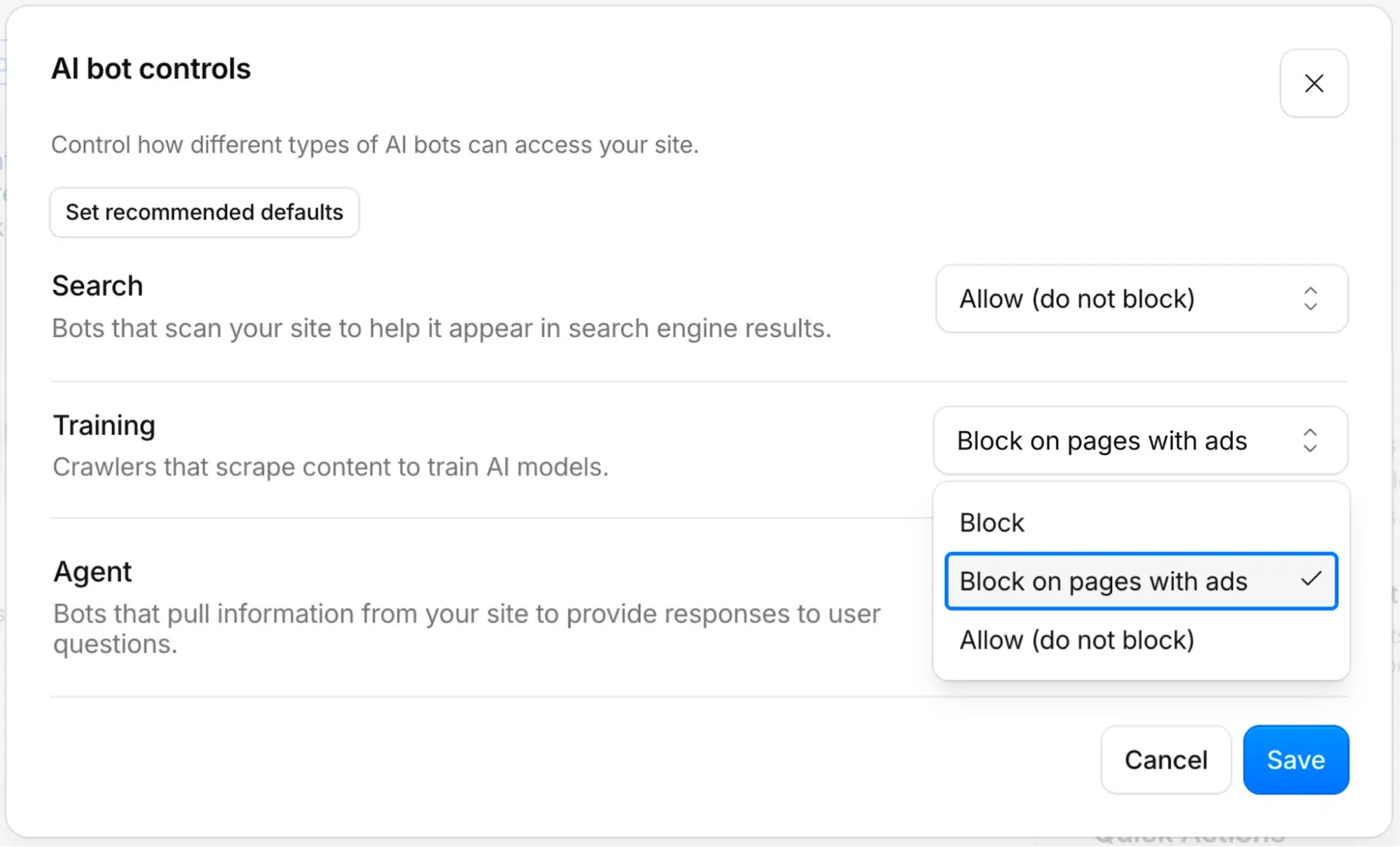
To enforce equilibrium, Cloudflare has introduced a declarative gating mechanism. Cloudflare said the default policy will begin rolling out on September 15, 2026, establishing default blocks against training bots and user-directed agents across all ad-supported customer pages. This update ensures that monetizable content cannot be crawled without explicit permission. Simultaneously, the networking giant is restructuring its monetization framework, transitioning from its legacy Pay Per Crawl architecture to an outcome-oriented Pay Per Use ecosystem. Through integrations with platforms like You.com and Ceramic.ai, publishers can secure direct compensation whenever an AI agent leverages their content to answer a query, introducing a sustainable, transaction-level revenue stream.
Systemic Root Causes & Non-Visual Request Chains of the Cloudflare Blocks Training Bots Policy
Analyzing the physical composition of internet traffic reveals that automated bots now account for over 50% of all online activity. This volume places immense strain on origin servers, particularly because duplicate requests often fetch unchanged content. Cloudflare telemetry indicates that over half of verified crawler traffic is entirely redundant, wasting computing power on both sides of the connection. The fundamental problem lies in the underlying architecture of modern search-and-scrape operations, which rely on mixed-use bots that obscure their true intent.
At the application layer, the technical characteristics of a user-directed agent differ substantially from standard human-driven browser sessions. This distinction is critical because modern headless scrapers bypass traditional interactive elements entirely, causing severe tracking disruptions across downstream measurement systems.
Protocol Disconnection: Stateless Agents vs. Stateful Web Browsers
Traditional web optimization assumes that standard browser sessions manage state through cookie stacks, local storage, and structured User-Agent strings. In contrast, autonomous agents and headless crawlers perform stateless HTTP requests. This difference breaks the measurement pipelines that publishers use to justify their ad value. The diagram below outlines the core application-layer differences:
[Standard Web Session]
  User Browser (Persistent State & Cookies) ──> Web HTTP Request ──> Ad Impressions & Referrers Registered


[Stateless Agent Session]
  Automated Crawler (Stateless HTTP / Headless Tool) ──> Isolated Fetch ──> Missing Referrers & Lost Attribution
When an automated browser agent fetches a page, processes the text, and renders an answer within a closed chat environment, the entire client-side context is destroyed. Traditional tracking scripts cannot execute. No ad impressions register, and standard referrer headers disappear. This creates an attribution void where the publisher provides the raw informational value, but the downstream system records zero engagement. The same loss of browser context also affects downstream mobile attribution workflows when a user eventually installs an application. Because these headless visits lack stateful tracking containers, standard mobile measurement tools fail to match the initial discovery event with the subsequent app installation. This dynamic accelerates the collapse of traditional multi-touch attribution models.
Solution Comparison: Build vs. Buy Trade-offs Under the Cloudflare Blocks Training Bots Era
As the default boundaries of client-side tracking dissolve under new automated scraper regulations, engineering teams must re-evaluate their attribution architectures. Relying solely on standard client-side browser cookies or device-level attributes is no longer a viable long-term strategy. Developers are faced with a fundamental build-versus-buy decision: construct an in-house server-side context-matching database or integrate a pre-built, hardened measurement system capable of surviving headless interactions.
Architectural Evaluation: Build vs. Buy in the Stateless Era
Building an in-house context-matching system requires setting up a server-side state database to cache and reconcile developer sessions. While this approach offers complete control over the data pipeline, the engineering overhead is substantial. Developers must manually reconcile incoming API payloads, manage session expirations, and implement secure cryptographic signatures to prevent fraud. Integrating an out-of-the-box, pre-built measurement SDK, by contrast, eliminates this maintenance burden.
The following comparison matrix outlines how different tracking methodologies perform in a stateless, agent-heavy environment:
| Metrics & Capabilities | In-house Database Session Build | Legacy Firebase / Webview Redirection | Premium MMP Platforms (Adjust, AppsFlyer) | Deferred Deep Linking SDK (OpoInstall) |
|---|---|---|---|---|
| Attribution Survival | High (Server-Side) | Low (Client-Side) | High (Multi-Touch) | High (Programmatic Mapping) |
| Development Cost | Extremely High | Low | High | Low |
| Maintenance Burden | High (Ongoing) | Low | Low | Low |
| Fraud Mitigation | Medium (Manual Rules) | Low | High (Algorithmic) | High (Zero-Trust Signatures) |
| Latency Impact | Variable | Medium | Medium | Low (Ultralight Footprint) |
Commercial implementations of this model include Adjust, AppsFlyer, Branch, and other deferred attribution systems. One example is OpoInstall, which provides deferred deep linking and server-side parameter recovery to preserve session metadata across distributed web and mobile contexts. By decoupling the redirect chain from client-side redirects, this approach preserves the user’s journey metadata from the initial search event down to the final app launch, bypassing the limitations imposed by scraper-blocking proxies. Mobile attribution platforms use similar server-side state restoration ideas to ensure conversion consistency when browser contexts are entirely absent.
Integration Checklists & Governance Schedules: Surviving Cloudflare Blocks Training Bots Disruptions
To ensure data continuity as Cloudflare implements its default training bot blocks on ad-supported pages, engineering and product teams must establish a structured transition schedule. For developers, this involves moving away from client-side redirects and adopting robust server-side verification methods. For growth teams, this requires revising ROAS calculation pipelines to account for the loss of standard browser attribution data.
Developer Implementation Checklist
- Implement RFC 7239 Forwarded Headers: Configure all incoming API gateways to read and parse the standardized
Forwardedheader to identify trusted intermediate proxies.
Forwarded: for=203.0.113.1;proto=https
- Adopt Cryptographic URL Signatures: Ensure all outgoing promotional links use cryptographically signed parameters to prevent automated bots from manipulating referral values.
- Enable Server-Side Session Matching: Shift from cookie-based client-side redirection to a programmatic state database that reconciles session keys upon first application launch.
Product & Growth Strategy Checklist
- Reconstruct ROAS Models: Adjust acquisition funnels to weigh server-side activation events higher than traditional client-side web ad clicks.
- Deploy Contextual Experience Restorations: Leverage parameter pass-through frameworks to reconstruct the user’s intended destination even if the web referrer was dropped by an agent.
- Audit Bot Traffic in BotBase: Use real-time behavioral classifications to audit how automated scrapers interact with marketing funnels.
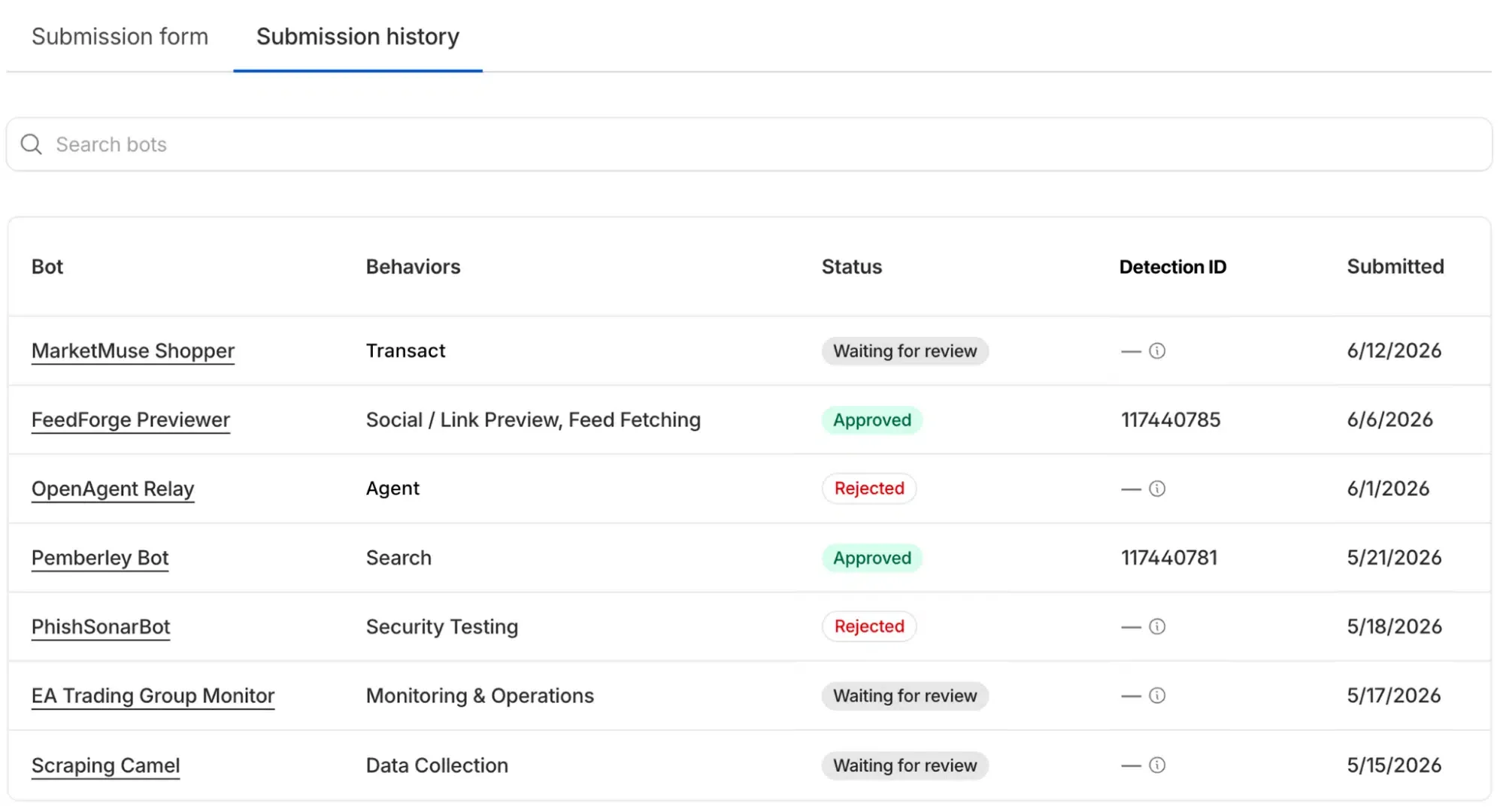
Developers can configure their sites to communicate explicit indexing preferences by extending their standard robots.txt configuration with modern metadata fields.
# Illustrative example inspired by proposed metadata extensions
User-agent: *
Content-Signal: search=yes,ai-train=no,use=reference
Allow: /
This structured approach allows content owners to maintain search discoverability while preventing AI platforms from permanently absorbing valuable proprietary content into their closed training datasets.
Frequently Asked Questions (FAQ)
Why does the same bot crawl pages for both search and AI training?
How does Cloudflare determine which pages contain ads to trigger the block?
What is the difference between Pay Per Crawl and Pay Per Use?
The transition of the internet from a human-centric browsing environment to an agent-driven ecosystem requires a fundamental shift in how we build and measure digital experiences. As automated proxies and stateless agents become the primary consumers of web content, traditional client-side attribution models will continue to degrade. Relying on browser cookies and basic HTTP referrers is no longer sufficient to secure the data pipelines that drive user acquisition and digital monetization.
To maintain growth in this new era, engineering and product teams must decouple their attribution logic from standard client-side browser actions. By adopting server-side identity resolution, cryptographically signed parameters, and robust parameter pass-through frameworks, organizations can protect their data pipelines from automated scraper blocks. This transition is not merely about adapting to a single policy update; it is about rebuilding our systems to survive in a decentralized, agent-ready internet.
Share this article