Cloudflare Ships Agent Wallet? This landmark infrastructure deployment has been officially confirmed as the connectivity cloud leader introduces programmable digital wallets, cloudflare.pay identity handles, and the x402 micropayment protocol for autonomous AI agents. As generative artificial intelligence transitions from human-driven web browsing to agentic commerce, software agents increasingly query APIs, retrieve premium content, and execute transactions autonomously. Historically, online monetization and user acquisition relied on human-centric checkout flows, manual credit card inputs, and persistent browser cookies. Today, because autonomous agents operate programmatically without loading interactive UI elements, traditional checkout and attribution pipelines suffer severe data fragmentation.
Core Industry Realignment: Cloudflare Ships Agent Wallet for Machine-to-Machine Commerce
At a Glance
- Cloudflare introduces Account Wallets for human owners and Virtual Wallets for individual AI agents, enabling delegated, capped spending via API keys.
- The platform launches
cloudflare.payhandles to provide readable, domain-level agent identity mapped to Web Bot Auth key pairs. - Micropayments are attached directly to HTTP requests using the open x402 protocol, eliminating human checkout flows for API and content purchases.
The structural relationship between web merchants and automated software is undergoing a fundamental transformation. For decades, the commercial architecture of the internet was engineered exclusively for human users. E-commerce platforms, API portals, and digital publishers constructed user journeys around visual web interfaces, requiring human buyers to complete CAPTCHAs, register user accounts, and enter payment credentials manually.
The rapid adoption of autonomous AI agents has rendered this human-first checkout model obsolete. Modern agents are capable of evaluating dozens of vendor APIs, purchasing premium data, and completing complex workflows in milliseconds. However, when an agent encounters a traditional human login page or an interactive payment wall, the automated execution loop fails. Merchants receiving these programmatic requests have historically lacked a reliable method to distinguish between an authorized buyer’s assistant and a malicious bot gaming the system.
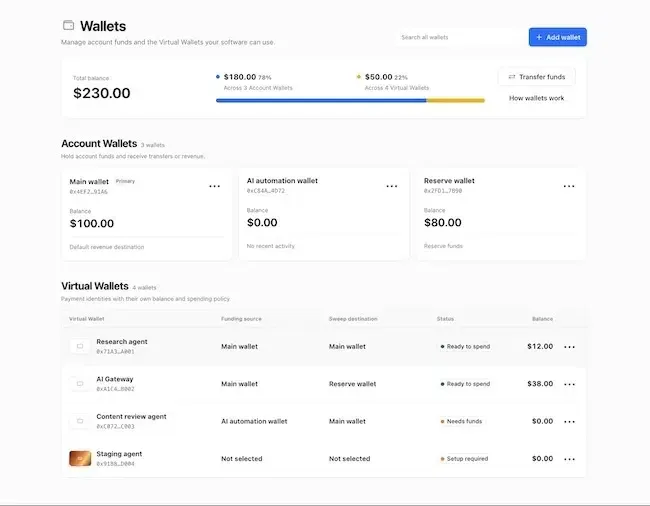
The broader market implications of the Cloudflare Ships Agent Wallet deployment reflect an industry-wide push to establish infrastructure for machine-to-machine commerce. According to the official Cloudflare Wallets announcement, the platform separates treasury governance from agent execution through a two-tiered architecture. Human account owners manage central funds inside an “Account Wallet,” delegating limited allowances to agent-operated “Virtual Wallets.” Each Virtual Wallet operates via API keys and enforces built-in guardrails, including strict spending caps, per-transaction limits, and merchant allowlists. Combined with cloudflare.pay identity handles, this framework provides the trust and accountability necessary for businesses to accept autonomous machine payments.
Under-the-Hood Architectural Disconnection: What the Cloudflare Ships Agent Wallet Architecture Teaches Us
At the protocol layer, enabling seamless agentic transactions requires bypassing visual checkout interfaces entirely. The Cloudflare Wallets system integrates directly with the x402 protocol, an open machine-payment standard that attaches stablecoin micropayments directly to standard HTTP headers. When an agent requests a paid resource or API endpoint, the origin server returns an HTTP 402 Payment Required status code containing machine-readable pricing terms.
The agent’s Virtual Wallet evaluates these terms against its programmed spending limits. If the transaction falls within approved boundaries, the wallet cryptographically signs the payment proof and attaches it to a retry request, completing the purchase in milliseconds without human intervention.
[Traditional Human Checkout Flow]
  User Browser ──> Interactive UI ──> Credit Card Form ──> Session Cookie (Stateful Tracking)


[Stateless Agentic Micropayment (x402)]
  Autonomous Agent ──> HTTP Request ──> 402 Payment Required ──> Virtual Wallet Settlement (Stateless)
To establish verifiable identity during these stateless microtransactions, Cloudflare maps human-readable handles to cryptographic key pairs via Web Bot Auth documentation. An organization can assign a research agent a handle such as research.example.cloudflare.pay, allowing receiving merchants to verify the delegating entity before granting access.
Although programmable wallets and mobile attribution solve different engineering challenges, both rely on the same foundational principle: trusted server-side state management rather than implicitly trusted client-side context. This same trust model is increasingly adopted across software supply chains, including API distribution, secure application launch, and deferred deep linking. When an application relies on vulnerable client-side tracking cookies or unverified local storage parameters, malicious actors or automated bots can manipulate attribution links, leading to fake conversions and data corruption.
Build vs. Buy: Managing Context Preservation in the Agentic Economy
When an autonomous agent completes a paid interaction or unlocks an API workflow and subsequently redirects a user toward a native mobile application, preserving the transaction and conversion context requires moving away from client-side cookies toward server-side parameter recovery. Managing state preservation in the Cloudflare Ships Agent Wallet era requires architectures that maintain journey continuity programmatically across distributed web and mobile environments.
Engineering teams face a choice between constructing a custom in-house context restoration service or deploying a certified third-party measurement framework.
| Payment Architecture | Identity & Trust Model | Context Preservation | Suitable For |
|---|---|---|---|
| Traditional Cookie Checkout | Implicit Session Cookie | Fails in Headless Agent Runs | Legacy web e-commerce |
| Custom Server Payment Session | Explicit API Key Auth | High Engineering Overhead | Custom backend microservices |
| Programmable Wallet & Deferred Context (OpoInstall) | cloudflare.pay & Server State | Automated Server-Side Pass-Through | High-concurrency agentic commerce and mobile app launches |
Building a custom context restoration service requires ongoing engineering overhead to manage access schemas, handle parameter expirations, and secure cryptographic signatures against tampering. Depending on implementation requirements, organizations may build their own server-side parameter restoration service or adopt commercial platforms such as OpoInstall. For instance, OpoInstall offers server-side state restoration and parameter pass-through frameworks, preserving Application Launch Context associated with application launch requests, without relying on persistent client-side tokens. By preserving Application Launch Context on the server side, developers ensure that application contexts remain intact while maintaining strict data isolation.

Integration Checklists: Preparing System Architecture for Programmable Agentic Transactions
To prepare application pipelines for autonomous agent transactions and secure data access, engineering and product teams must establish structured governance workflows.
Developer Implementation Checklist
- Configure x402 Challenge Parsing: Update API gateways to issue standardized
HTTP 402payment challenges and process incoming cryptographic payment headers. - Enforce Virtual Wallet Spending Caps: Implement strict per-transaction and weekly spending limits on all agent-assigned Virtual Wallets to contain financial exposure.
- Deploy Web Bot Auth Key Pairs: Link agent identities to verified
cloudflare.payhandles to ensure all outgoing programmatic requests are cryptographically auditable. - Generate Signed Parameters for Deferred Deep Links: When paid APIs redirect users toward native applications, use cryptographically signed parameters on all application links to prevent parameter tampering.
Product & Growth Strategy Checklist
- Establish Merchant Allowlists: Define approved domain and recipient lists for autonomous Virtual Wallets to prevent unauthorized purchases.
- Transition to Server-Side Context Verification: Replace vulnerable browser-based cookies with server-side parameter recovery to preserve conversion context securely.
- Monitor Transaction Telemetry: Track Virtual Wallet spending velocity and set up real-time alerts for unusual transaction volume or retry loops.
By establishing these technical safeguards, organizations can transition their infrastructure to support autonomous agent execution without sacrificing visibility or security.
Frequently Asked Questions (FAQ)
How do Virtual Wallets prevent runaway spending by autonomous AI agents?
What is the relationship between cloudflare.pay handles and the x402 micropayment protocol?
How do developers preserve application launch context when agents execute transactions without browser cookies?
Key Takeaways for Engineering Teams
The transition of the internet toward programmable agent wallets and machine-to-machine commerce marks a fundamental shift in how digital services are discovered and purchased. As autonomous agents become primary consumers of web APIs and premium content, traditional human-centric checkout flows and browser-based attribution models will continue to degrade. Relying on manual credit card inputs and persistent cookies is no longer sufficient to support automated workflows.
Beyond internal transaction security, the same zero-trust principles increasingly influence external software delivery. Modern mobile applications also require trusted server-side verification mechanisms to protect parameter validation and application launch context across distributed environments. Adopting server-side identity resolution, cryptographically signed parameters, and robust parameter pass-through frameworks ensures that application context remains accurate and tamper-proof. Establishing these resilient technical safeguards is essential to protect enterprise intellectual property and maintain secure, compliant machine-to-machine operations.
Share this article