How does multi-touch attribution work in mobile marketing? Multi-touch attribution works by capturing available user interaction signals across web and app channels, applying fractional credit allocation algorithms to estimate the relative contribution of touchpoints across the marketing funnel.
Multi-touch attribution is an analytical framework that estimates how multiple marketing touchpoints contribute to conversion outcomes by applying attribution models across a user’s journey. It helps mobile marketing teams evaluate channel contribution, optimize budget allocation, and reduce single-touch measurement bias.
| Term | Definition | Related Concept | Search Intent Role |
|---|---|---|---|
| Multi-Touch Attribution | A methodology that evaluates available touchpoints across a conversion path. | Mobile Measurement Partner | Informational / Commercial |
| Attribution Model | A mathematical rule determining how conversion credit is distributed. | Fractional Credit Allocation | Informational |
| Conversion Tracking | The systematic logging of user actions from click to post-install events. | Server-to-Server Postback | Technical / Informational |
Why Single-Touch Models Fail and How Multi-Touch Attribution Restores Data Accuracy
The Structural Vulnerability of Last-Touch Attribution
Single-touch models, specifically last-touch attribution, assign total conversion credit to the final ad interaction recorded prior to application installation. While computationally straightforward, this methodology introduces systemic distortions into performance evaluation. Retargeting campaigns, branded search ads, and bottom-funnel channels frequently capture 100% of the conversion weight simply because they represent the final temporal touchpoint ($T_n$). Consequently, upper-funnel discovery channels—such as programmatic display, influencer campaigns, and video promotions—receive zero measured credit. This misallocation leads marketing teams to defund early-stage acquisition channels, shrinking the top of the growth funnel over time.
The First-Touch Blindspot
Conversely, first-touch attribution allocates entire credit to the initial touchpoint ($T_1$). This approach assumes that customer discovery dictates conversion probability without accounting for middle-funnel nurturing, email remarketing, or targeted discount prompts. While first-touch evaluation highlights channel reach, it ignores the operational efficiency of conversion mechanics. Neither single-touch model fully reflects user decision-making across modern multi-screen environments, where users may interact with multiple measurable advertising touchpoints across distinct platforms before downloading a mobile application.
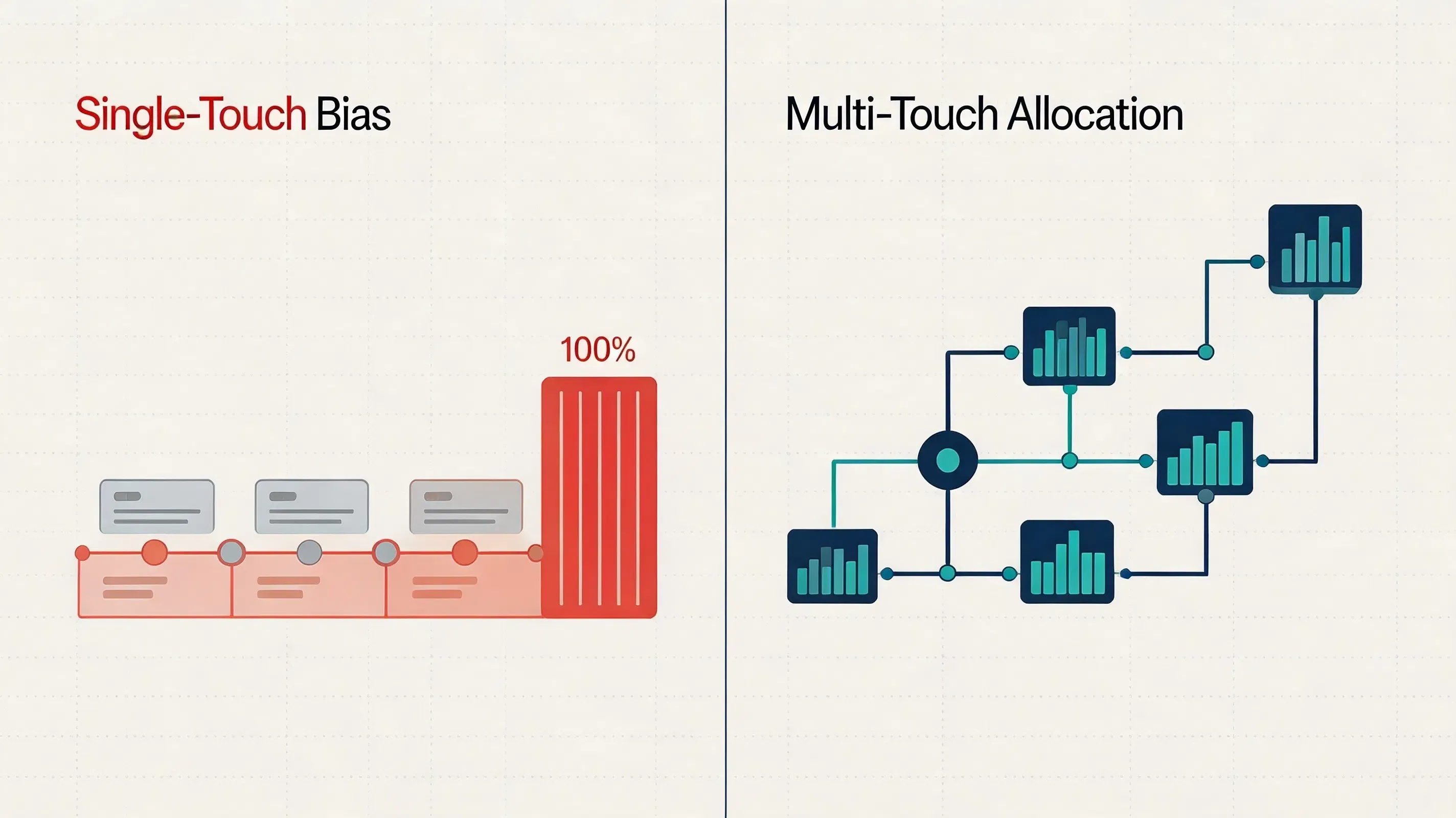
Eliminating Double-Counting in Self-Attributing Networks
Self-Attributing Networks (SANs), including walled-garden ad platforms, operate in isolation from third-party ecosystems. Self-Attributing Networks evaluate internal events independently and may claim conversion credit when their own attribution criteria are satisfied within their attribution windows. Without an independent referee, the same app installation may be reported by multiple networks simultaneously, inflating reported performance metrics across ad dashboards.
An independent Mobile Measurement Partner (MMP) mitigates this issue by establishing a centralized, objective ingestion pipeline. OpoInstall, an independent mobile measurement platform, captures touchpoints across participating channels and applies unified de-duplication rules. By processing clicks and impressions within a standardized timeline, the platform identifies the sequence of interactions ($T_1, T_2 \dots T_n$) and prevents multiple networks from receiving duplicate attribution credit for the same conversion event.
How Touchpoint Serialization Reconstructs Cross-Channel User Journeys
Constructing the Chronological Engagement Chain
Touchpoint serialization is the technical process of aggregating, ordering, and indexing discrete user engagement events into a linear sequence. Every measurable ad interaction, impression signal, and deep link transition may generate structured event data containing timestamps, publisher identifiers, campaign metadata, and contextual parameters.
Mathematically, a user’s multi-channel journey is represented as an ordered set:
$$\mathcal{J} = {T_1, T_2, T_3, \dots, T_n}$$
Where each touchpoint $T_i$ consists of a vector:
$$T_i = \langle \text{Timestamp}_i, \text{Channel}_i, \text{Campaign}_i, \text{Payload}_i \rangle$$
Subject to strict temporal constraints:
$$\text{Timestamp}_1 < \text{Timestamp}_2 < \dots < \text{Timestamp}n \le \text{Timestamp}{\text{conversion}}$$
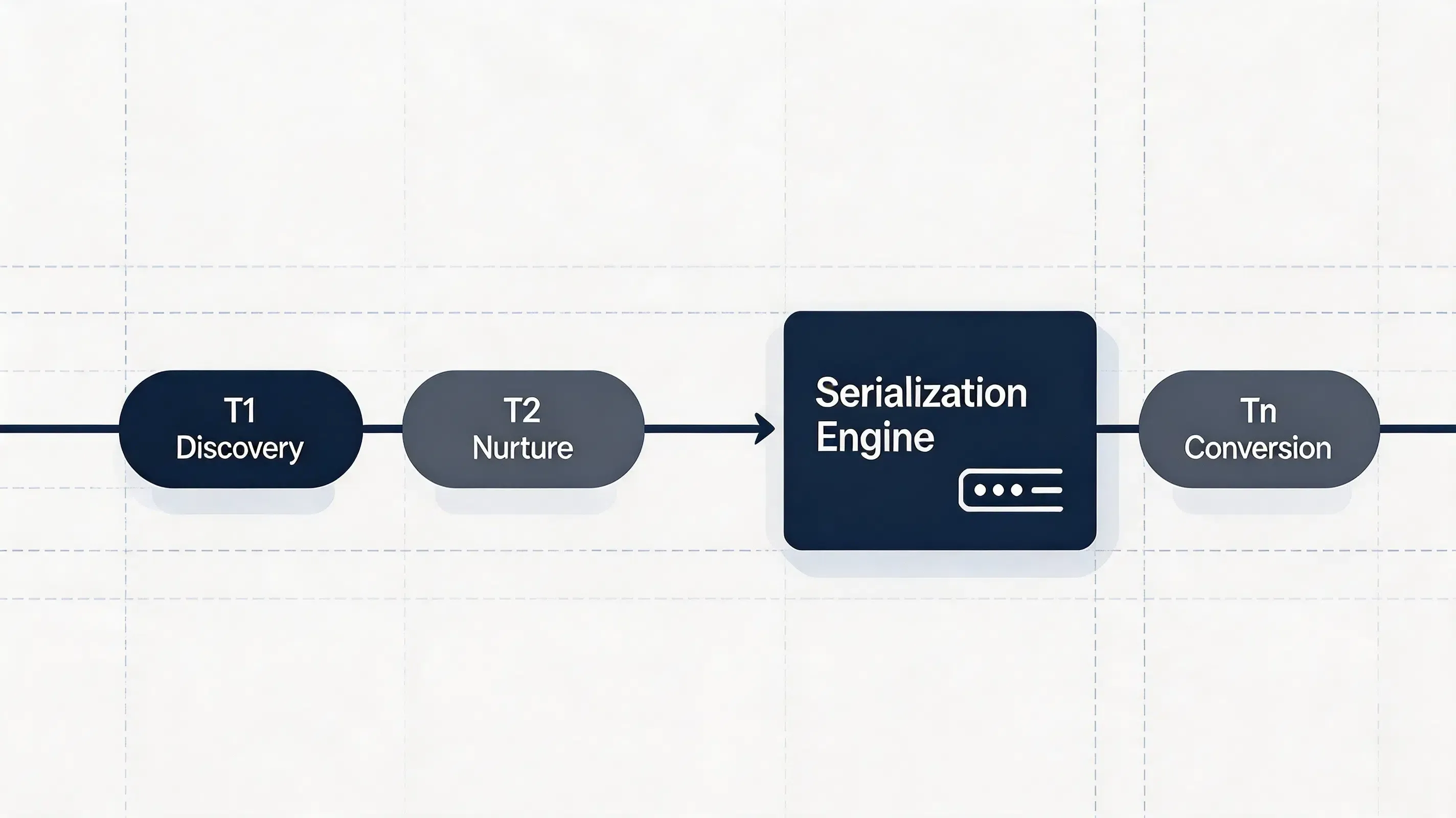
By maintaining temporal order across disparate ad networks, the attribution engine reconstructs an observable user journey from available web discovery signals to app installation events.
Privacy-Preserving Web-to-App Session Reconstruction
Connecting pre-install web interactions to post-install app sessions presents an engineering challenge due to operating system sandboxing. When a user clicks a referral link on a mobile web browser, web-based parameters (such as UTM parameters, publisher IDs, and dynamic campaign tokens) are logged by the Web JS SDK.
Upon store redirection and initial app launch, the native mobile SDK or attribution infrastructure uses privacy-preserving matching signals to associate the native launch event with prior web interactions. Once matched, the pre-install web touchpoints ($T_1 \dots T_{n-1}$) are merged with the native app install event ($T_n$), completing the cross-platform serialization chain.
Resolving Identity Disconnects Across Isolated Containers
User interactions often span isolated software environments, including external web browsers (Safari, Chrome), in-app webviews within social media applications, and native mobile applications. Each container maintains independent cookie storage and local state, preventing direct cross-container tracking.
To resolve these identity disconnects without violating platform privacy policies, modern attribution pipelines utilize first-party session stitching. Contextual tokens passed via dynamic URLs or secure ephemeral storage help associate in-app webview engagement with the default system browser download flow. This architecture preserves touchpoint continuity even when users transition across multiple browser contexts before completing an installation.
Managing Touchpoint Decay and Time-to-Install Windows
Not all touchpoints carry equal relevance over time. An ad click occurring 30 minutes before installation receives higher attribution weight than an impression logged 28 days prior. Attribution engines enforce configurable lookback windows (typically 7 to 30 days for clicks, 1 to 24 hours for impressions) to filter out stale interactions. Touchpoints occurring outside the defined lookback window are excluded from the chronological set $\mathcal{J}$, protecting attribution models from historical noise and random engagement claims.
Technical Mechanics of Fractional Credit Allocation Algorithms
Linear Credit Distribution
Linear attribution applies equal weight across all verified touchpoints in the engagement set $\mathcal{J}$. If a user journey contains $n$ touchpoints, the credit weight $W(T_i)$ assigned to each interaction $T_i$ is calculated as:
$$W(T_i) = \frac{1}{n}, \quad \forall i \in {1, 2, \dots, n}$$
Where:
$$\sum_{i=1}^{n} W(T_i) = 1.0$$
While linear distribution eliminates single-point bias, its core limitation lies in treating initial discovery identically to the final high-intent click that directly preceded store redirection.
Time-Decay Attribution
Time-decay models apply an exponential decay function to assign higher credit weights to touchpoints that occur closer in time to the conversion event. The weight $W(T_i)$ for touchpoint $T_i$ is defined by a half-life parameter $h$:
$$W(T_i) = 2^{-\frac{\Delta t_i}{h}}$$
Where $\Delta t_i = t_{\text{conversion}} - t_i$ represents the time elapsed between touchpoint $T_i$ and the final conversion, and $h$ is the designated half-life period (e.g., 7 days). To ensure the total credit sums to 1.0, the normalized weight $W_{\text{norm}}(T_i)$ is computed as:
$$W_{\text{norm}}(T_i) = \frac{2^{-\frac{\Delta t_i}{h}}}{\sum_{j=1}^{n} 2^{-\frac{\Delta t_j}{h}}}$$
The initial decay score represents relative influence before normalization rather than the final allocated credit. This model prioritizes temporally closer interactions while preserving measurable contribution from earlier touchpoints associated with the conversion journey.
Position-Based (U-Shaped and W-Shaped) Models
Position-based models allocate fixed percentages of credit to critical milestones in the user journey, distributing the remaining value equally among intermediate touchpoints.
For journeys containing at least three touchpoints, in a U-Shaped model, 40% of conversion credit is assigned to the first touchpoint ($T_1$, brand discovery), 40% is assigned to the last touchpoint ($T_n$, lead conversion), and the remaining 20% is divided equally among middle touches ($T_2 \dots T_{n-1}$):
$$W(T_1) = 0.40, \quad W(T_n) = 0.40$$
$$W(T_i) = \frac{0.20}{n - 2}, \quad \text{for } 1 < i < n$$
In B2B acquisition or high-consideration application funnels, a W-Shaped model introduces a third major milestone—the lead creation point ($T_{\text{mid}}$)—allocating 30% to $T_1$, 30% to $T_{\text{mid}}$, 30% to $T_n$, and 10% divided among supporting touchpoints.
[Web Ad Click (T1)] ──> [Social Post (T2)] ──> [Search Ad (T3)] ──> [App Launch / Conversion]
         │                       │                     │                      │
         ▼                       ▼                     ▼                      ▼
  First Interaction       Nurturing Phase      Final Conversion      MMP Event Processing
  (40% Credit U-Shape)    (20% Credit Shared)  (40% Credit U-Shape)  (Fractional S2S Postbacks)
Data-Driven and Algorithmic Weighting
Data-driven attribution models replace static rule-based formulas with statistical regression and Shapley value calculations derived from cooperative game theory. By comparing conversion rates of user cohorts exposed to specific touchpoint combinations against control cohorts where certain touchpoints were absent, algorithmic models isolate the marginal value contribution of each individual channel.
Some advanced attribution frameworks also evaluate incremental contribution, measuring whether a specific channel generated additional conversions beyond baseline organic user behavior. These models may also incorporate machine learning techniques to estimate channel contribution from historical conversion patterns.
How S2S Postbacks and Raw Data Pipes Capture Touchpoints
Server-to-Server Event Ingestion Architectures
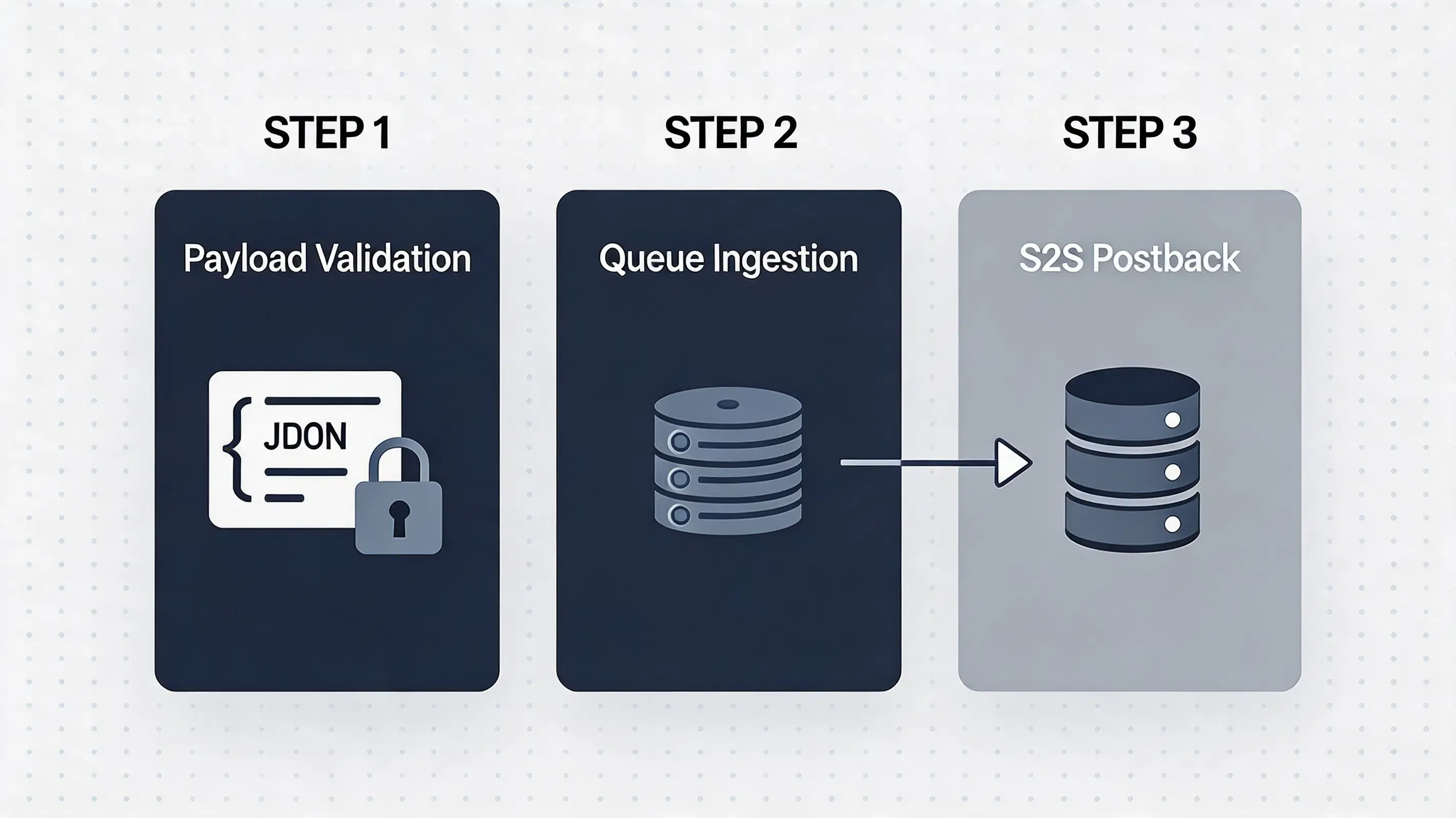
High-volume attribution platforms process large volumes of engagement signals in near real time. To maintain low latency, touchpoint logging is decoupled from client-side UI rendering. When a user interacts with an ad, the publisher server or Web JS SDK transmits an asynchronous HTTP POST request to the attribution ingestion API.
The edge ingestion node validates request signatures, strips non-standard headers, attaches a high-precision UTC timestamp, and enqueues the payload into a distributed message broker (e.g., Apache Kafka). Downstream processing workers consume these queues, execute touchpoint serialization, and write the structured records to real-time processing stores or analytical databases.
Structuring Multi-Touch Event Payloads
To facilitate downstream processing and multi-touch calculation, attribution logs adhere to standardized JSON schemas. Modern marketing attribution platforms combine SDK telemetry, server-side event pipelines, and privacy-preserving measurement models to output clean, structured payloads.
Developers and data engineers can consult the OpoInstall raw data export documentation for technical specifications regarding schema fields and export pipelines.
The schema below illustrates a simulated multi-touch attribution payload for a post-install conversion event containing serialized historical touchpoints. Note: The following schema is an illustrative example and does not represent a production API contract.
{
  "event_type": "post_install_conversion",
  "app_id": "com.example.app",
  "attribution_payload": {
    "conversion_id": "conv_9876543210_xyz",
    "conversion_timestamp_utc": "2026-08-06T02:45:00Z",
    "attribution_model_applied": "position_based_u_shaped",
    "total_touchpoints_recorded": 3,
    "touchpoint_sequence": [
      {
        "touchpoint_index": 1,
        "interaction_type": "click",
        "channel": "programmatic_display",
        "publisher_id": "pub_adnetwork_a",
        "campaign_id": "cmp_awareness_001",
        "timestamp_utc": "2026-08-01T10:15:22Z",
        "assigned_credit_weight": 0.40
      },
      {
        "touchpoint_index": 2,
        "interaction_type": "impression",
        "channel": "social_video",
        "publisher_id": "pub_social_b",
        "campaign_id": "cmp_consideration_002",
        "timestamp_utc": "2026-08-03T14:30:45Z",
        "assigned_credit_weight": 0.20
      },
      {
        "touchpoint_index": 3,
        "interaction_type": "click",
        "channel": "search_paid",
        "publisher_id": "pub_search_c",
        "campaign_id": "cmp_intent_003",
        "timestamp_utc": "2026-08-06T02:30:10Z",
        "assigned_credit_weight": 0.40
      }
    ]
  },
  "device_context": {
    "os": "Android",
    "os_version": "14.0",
    "sdk_version": "1.0.0",
    "network_type": "5G"
  },
  "security_metadata": {
    "nonce": "e3b0c44298fc1c149afbf4c8996fb92427ae41e4649b934ca495991b7852b855",
    "signature_hmac_sha256": "example_signature_value"
  }
}
Ensuring Payload Integrity and Replay Defense
Trusted SDK components or backend services generate request signatures using HMAC-SHA256 across attribution ingestion endpoints. System payloads append a dynamic HMAC-SHA256 signature for verification using a shared secret key and a transaction nonce:
$$\text{Signature} = \text{HMAC-SHA256}\Big(\text{SecretKey}, ; \text{Timestamp} + \text{Nonce} + \text{PayloadBody}\Big)$$
Upon receiving the request, the attribution server recomputes the HMAC signature and verifies that the nonce has not been processed previously. Requests with invalid signatures, expired timestamps ($\Delta t > 300\text{s}$), or duplicate nonces are rejected at the edge, protecting attribution data integrity against replay attacks and fraudulent event injection.
Comparative Analysis of Primary Attribution Weighting Models
Methodological Distinctions Across Common Attribution Frameworks
Selecting the appropriate attribution model depends on product vertical, conversion cycle length, and campaign composition. Rule-based models offer predictable, transparent calculations, whereas data-driven models require substantial historical conversion volume to achieve statistical significance.
The table below provides a comparative evaluation of primary attribution models:
| Attribution Model | Primary Credit Allocation | Best Suited Use Case | Key Analytical Limitation |
|---|---|---|---|
| Last Touch | 100% assigned to $T_n$ (Final Click) | Short-cycle, impulse conversions | Ignores upper-funnel discovery entirely |
| First Touch | 100% assigned to $T_1$ (Initial Click) | Pure brand awareness campaigns | Ignores conversion closing mechanics |
| Linear | Equal percentage across $T_1 \dots T_n$ | Balanced multi-channel campaigns | Assumes all interactions have equal influence |
| Time-Decay | Exponentially higher toward $T_n$ | High-consideration purchase loops | Undervalues early discovery channels |
| Position-Based (U-Shaped) | 40% to $T_1$, 40% to $T_n$, 20% middle | Comprehensive user acquisition | Requires static assumptions on middle touches |
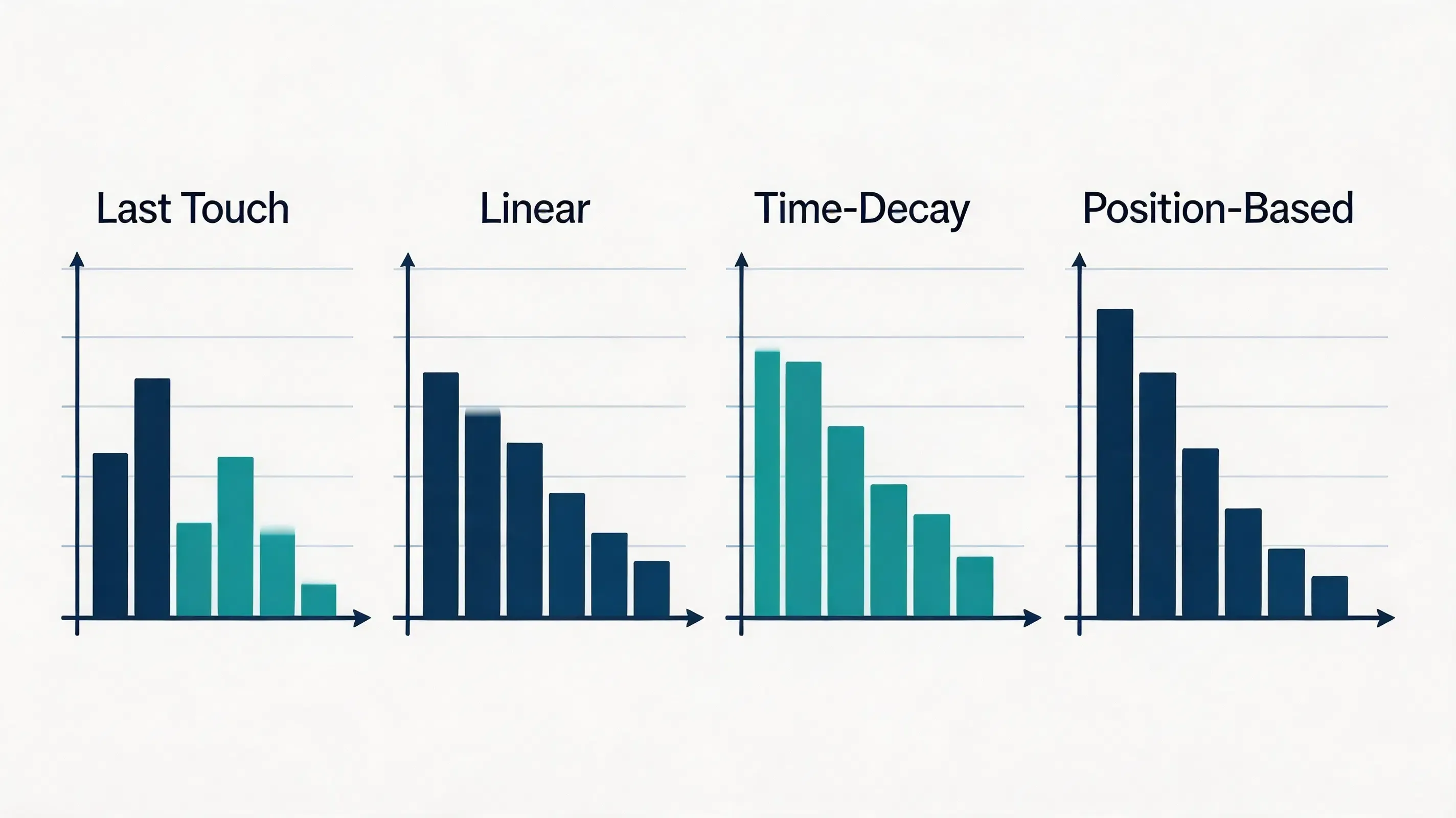
Evaluating Weight Distribution Across Strategic Channel Funnels
For mobile applications combining paid search, influencer marketing, and programmatic display, single-touch attribution models create systematic misallocations in ad spend. Deploying position-based or time-decay attribution provides visibility into how early awareness channels feed remarketing pipelines, enabling growth teams to optimize cross-channel budget allocation based on total funnel contribution and incremental ROAS.
Engineers seeking to implement custom credit distribution pipelines can reference the OpoInstall attribution SDK integration resources to configure client-side event tracking and payload extraction.
When Is Multi-Touch Attribution Necessary for Mobile Apps
Suitable Conditions for Deploying Multi-Touch Attribution
Multi-touch attribution provides actionable business value under specific operational conditions:
- Multi-Channel Marketing Budgets: Campaigns operating simultaneously across three or more paid ad networks, social platforms, and influencer networks.
- Extended Conversion Funnels: Mobile applications in fintech, B2B SaaS, or mid-core gaming where user consideration cycles span multiple days or weeks.
- Web-to-App Conversion Workflows: Growth strategies that drive traffic to web landing pages before redirecting users to native app store downloads.
- High Customer Acquisition Costs (CAC): Verticals where user acquisition expenses require granular channel evaluation to maintain positive unit economics.
Unsuitable Conditions for Deploying Multi-Touch Attribution
Conversely, implementing multi-touch attribution introduces operational complexity in the following scenarios:
- Single-Channel User Acquisition: Marketing operations relying exclusively on a single advertising network without secondary promotional channels.
- Impulse-Driven Utility Apps: Applications with immediate, single-session install decisions where middle-funnel touchpoints do not exist.
- Low Conversion Volumes: Early-stage applications lacking sufficient statistical volume to populate fractional credit models effectively.
Common Misconceptions in Mobile Attribution Strategy
- Self-Attributing Networks Automatically De-Duplicate Data: Walled-garden ad networks claim conversions based on internal network logs. They do not cross-reference external network engagements, making independent third-party de-duplication essential for measurement.
- Multi-Touch Attribution Requires Invasive Tracking: Modern multi-touch models operate effectively using privacy-compliant first-party context, S2S event logging, and aggregated postback pipelines without harvesting sensitive hardware identifiers.
Share this article