Has DeepSeek released a V4 Pro API with near-Fable 5 agent performance? DeepSeek’s August 13, 2026 rollout marks the general availability of DeepSeek-V4-Pro-0813, with reported benchmark results approaching Fable 5 across several agent evaluations while maintaining an output price of $0.87 per million tokens. The release combines a 1,000,000-token context window, 384,000 maximum output tokens, and optimized key-value caching, giving developers a lower-cost option for long-context and agentic workloads.
Why DeepSeek V4 Pro API Matters for Agent Developers
At a Glance
-
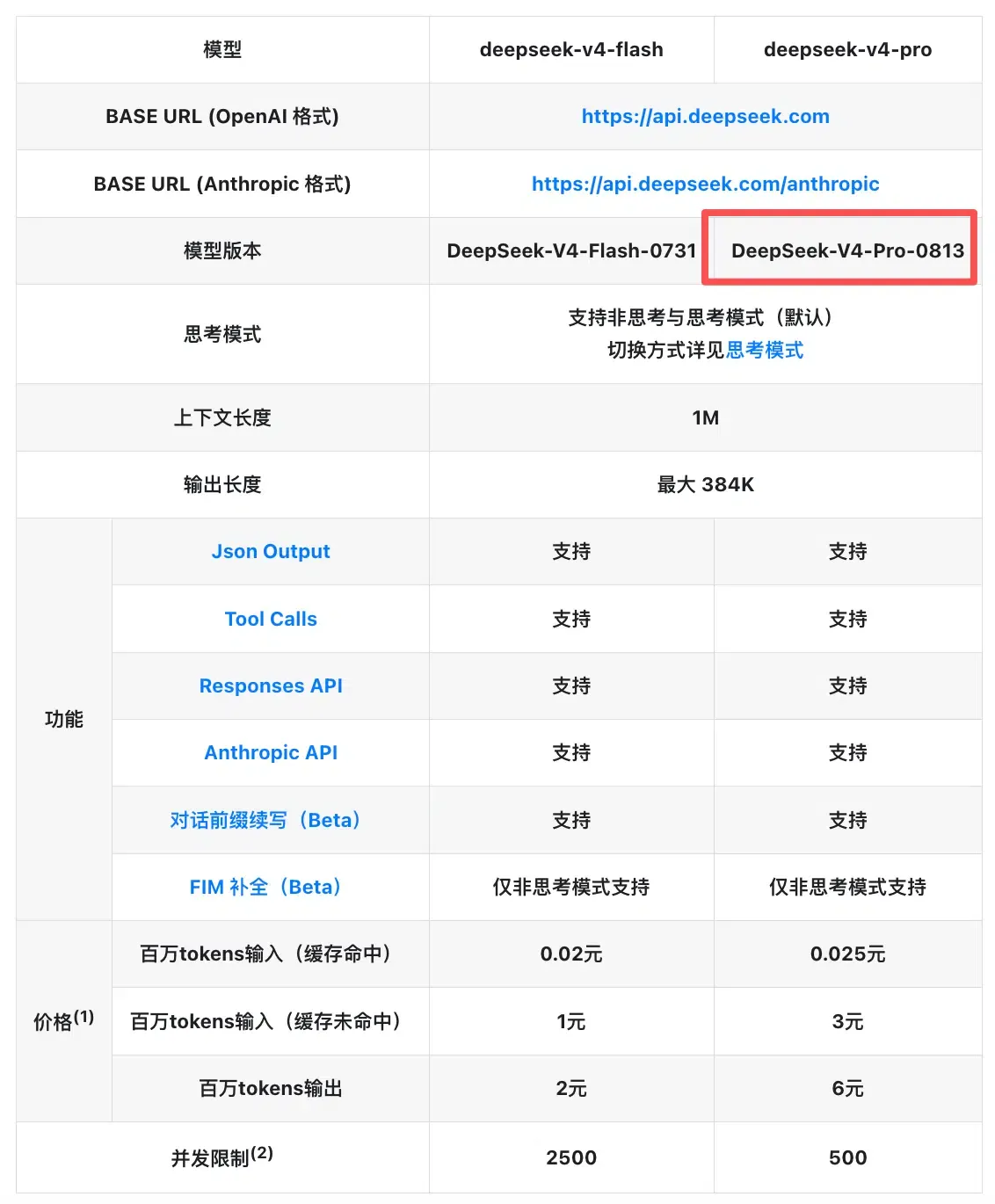
DeepSeek launched the DeepSeek-V4-Pro-0813 API update with a 1,000,000-token context window and 384,000 max output tokens.
-
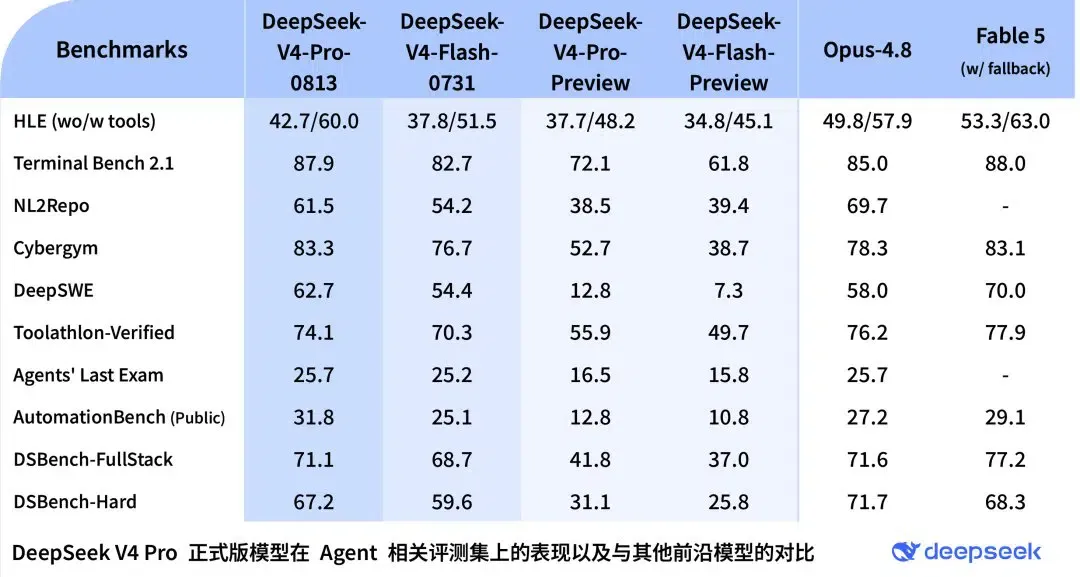
Reported DeepSWE results improved significantly, rising from 12.8 on the V4 Preview build to 62.7 on the V4 Pro 0813 release.
-
Output pricing is $0.87 per million tokens, with separate cache-miss and cache-hit input rates.
Lower API pricing changes the economics of running long-context and agentic workloads. For production-grade agentic workflows, token consumption and inference costs have remained significant deployment constraints. As reasoning loops execute multiple tool calls, retrieve external context, and self-correct code errors, total token usage can increase rapidly, making API pricing an important factor in production deployment costs. For developers building long-running agents, API bills could consume a large portion of software operating budgets, making full-scale deployment difficult.
The V4 Pro API update alters the cost structure for long-context and agentic workloads. The commercial significance of the release extends beyond benchmark gains: its combination of near-frontier agent performance and substantially lower token pricing gives engineering teams more room to evaluate long-running, long-context workloads for production use. As detailed in the DeepSeek API pricing documentation, the model sets input pricing at $0.435 per million tokens for cache misses ($0.003625 for cache hits) and output pricing at $0.87 per million tokens. Compared with APIs priced as high as $50 per million output tokens, this rate structure alters how engineering teams calculate agent operating costs.
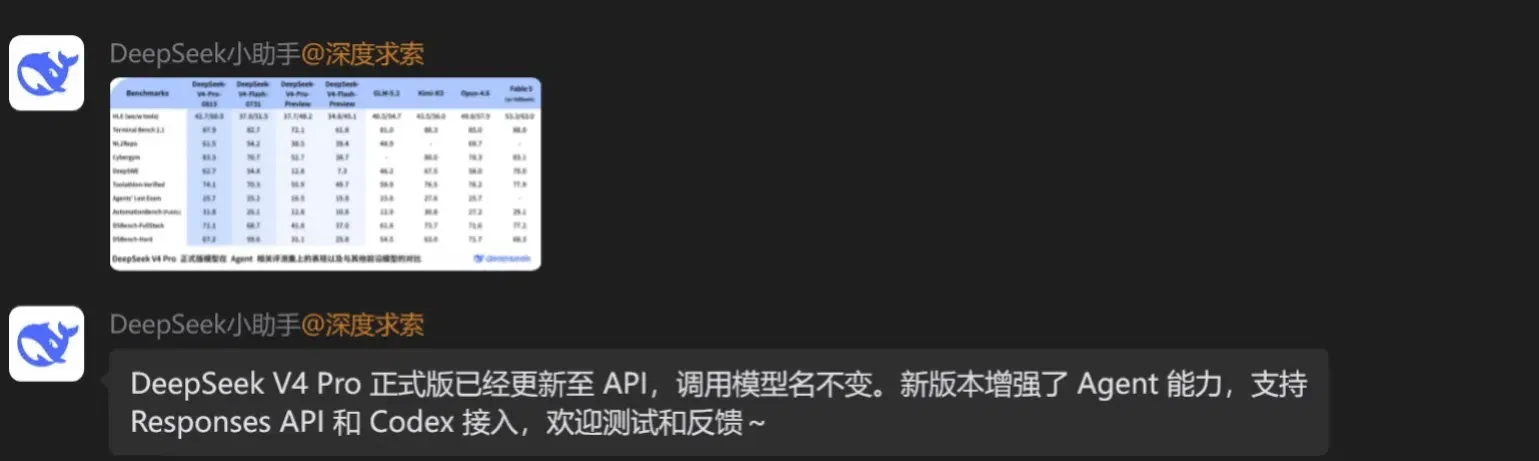
While output token costs are reduced substantially, developers must evaluate operational parameters alongside unit pricing. Official benchmark evaluations reported in ITHome technical coverage demonstrate that DeepSeek V4 Pro achieves scores comparable to top-tier models on benchmark suites like Cybergym and Terminal Bench 2.1. However, the API enforces an initial account concurrency limit of 500 requests, which requires high-throughput applications to manage queue routing and rate-limiting carefully.
 Under-the-Hood Mechanics: High-Concurrency Inference and KV Cache Efficiency
At the architectural level, DeepSeek V4 Pro utilizes a Mixture-of-Experts (MoE) design comprising 1.6 trillion total parameters, with 49 billion parameters activated per token. Trained on over 32 trillion tokens, the architecture incorporates inference-memory optimizations that reduce key-value (KV) cache requirements. According to DeepSeek, V4 Pro reduces the KV-cache footprint to about 10% of that required by DeepSeek V3.2 at a one-million-token context window, representing a claimed 90% reduction in KV-cache footprint relative to V3.2.
This memory efficiency can reduce memory pressure when processing large prompt prefixes. In thinking mode, the model performs additional reasoning before generating its final output, while supporting multi-step tool-use workflows through the API.
1M Context Window
│
├── 49B Active / 1.6T Total Parameters
│
└── KV-Cache Footprint: 10% of DeepSeek V3.2
This optimization can lower memory pressure during long-context inference and may improve the serving economics of concurrent requests.
How DeepSeek V4 Pro API Changes AI Application Development Costs
Lower API prices can change how developers evaluate long-running agent workloads and model selection. In an environment where automated agents perform multi-step tasks across complex codebases, evaluating cost-to-performance metrics is a primary engineering priority. Teams must evaluate how different model pricing tiers impact total cost of ownership.
Public API pricing at the time of publication is detailed in the comparison table below:
| Model Endpoint | Input Price / 1M | Output Price / 1M | Context Window | Positioning |
|---|---|---|---|---|
| Anthropic’s Claude Fable 5 | $10.00 | $50.00 | 1,000,000 | Frontier Agent Performance |
| DeepSeek V4 Pro 0813 | $0.435 / $0.003625* | $0.87 | 1,000,000 | Low-Cost Agentic Inference |
*Public API pricing at the time of publication. Input rates reflect cache-miss / cache-hit pricing.
By combining its low output price with prompt-cache discounts, developers can deploy multi-turn agentic workflows that execute continuous code review, automated testing, and long-context document analysis at lower operating costs.
Integration Checklists: Operational Considerations for High-Throughput Agentic API Integration
To adapt data infrastructure as high-throughput, low-cost reasoning models become standard backend components, engineering teams must establish clear operational protocols.
Developer Implementation Checklist
-
Optimize Prompt Caching Strategy: Structure system prompts and tool definitions at the beginning of API payloads to maximize prompt-cache hits and reduce input token costs.
-
Implement Rate-Limit Queue Management: Build client-side retry logic and exponential backoff algorithms to handle the 500-concurrency account limit effectively.
-
Configure Thinking Effort Modes: Map application tasks to appropriate thinking effort settings based on task complexity.
Product & Engineering Governance Checklist
-
Audit Unit Economics for Agent Loops: Re-evaluate multi-step agent features to identify opportunities for expanding context windows while maintaining cost controls.
-
Monitor API Latency and Fallback Routes: Track model response times across thinking and non-thinking modes to route time-sensitive tasks to appropriate endpoints.
-
Test Benchmark Reproducibility: Verify model performance against in-house task evaluations before switching production traffic.
Frequently Asked Questions (FAQ)
How does DeepSeek V4 Pro handle long-context reasoning with lower memory overhead?
What is the difference between prompt cache hits and KV cache efficiency?
How does DeepSeek V4 Pro compare with Claude Fable 5 on agent benchmarks?
Key Takeaways for Engineering Teams
The launch of DeepSeek V4 Pro gives developers a new combination of long-context capacity, agentic performance, and lower API pricing to evaluate against existing frontier models. For engineering teams, the practical question is no longer simply whether V4 Pro can match a frontier model on selected benchmarks, but whether its performance, pricing, context capacity, and concurrency limits fit the economics of their specific workloads.
Share this article