What is the difference between deterministic and probabilistic attribution? Deterministic attribution uses an exact shared identifier, verified token, authenticated account key, or store-mediated referral record to join touchpoints directly. Probabilistic attribution estimates likely conversion-source relationships without an exact shared key, introducing model uncertainty into the attribution decision.
Deterministic attribution establishes direct conversion joins using verified, unique identifiers or platform-provided tokens across marketing touchpoints. Probabilistic attribution evaluates statistical correlations across contextual signals to estimate conversion distribution without establishing a verified individual identity.
| Term | Definition |
|---|---|
| Deterministic Attribution | Exact record joins powered by shared unique identifiers, verified tokens, or store referral metadata. |
| Probabilistic Attribution | Modeled attribution that estimates likely conversion-source relationships without an exact shared identifier or verified token. |
| Aggregate Statistical Measurement | Campaign- or cohort-level estimation that measures performance without attempting to assign an individual conversion to a specific device. |
| Attribution Model | The mathematical or programmatic framework used to allocate conversion value across marketing touchpoints. |
| Contextual Parameter Routing | First-party transmission of campaign metadata linked to user-initiated onboarding sessions. |

Defining Deterministic and Probabilistic Attribution in Modern Mobile Architecture
The Technical Anatomy of Deterministic Matching: Exact Key Joins across Touchpoints
Deterministic attribution operates as an exact primary-key join between an engagement event and an application installation. When an ad interaction occurs, the publisher or ad platform captures a specific identifier or passes an explicit transaction token. When the application is subsequently installed and opened, the mobile client or app store infrastructure retrieves that identical identifier or token.
The attribution engine executes an exact equality join:
Deterministic matching removes ambiguity from the join itself. However, deterministic matching does not guarantee that the attribution decision is free from fraud, misconfigured lookback windows, stale referral tokens, or multi-touch credit overlap.
The Statistical Mechanics of Probabilistic Modeling: Aggregate Estimation vs Device-Level Matching
Probabilistic attribution departs from exact identifier joins, relying instead on statistical inference. In modern architecture, non-deterministic measurement divides into distinct disciplines:
- Probabilistic Attribution (Modeled Association): Estimating conversion distribution across touchpoints when exact keys are absent. When evaluated at the device or session level, attempting to link an individual web click to an app install using environmental signals carries significant technical and platform compliance risks.
- Aggregate Statistical Measurement: Estimating macro channel contribution and media mix efficiency using econometric regression or cohort-level volume counts without attempting device-level identification.
- Causal Incrementality Measurement: Running randomized holdout experiments (e.g., PSA or geo-split lift tests) to isolate net incremental conversions.
When evaluating multi-signal correlation conceptually, a statistical model computes a continuous confidence metric (
This equation is conceptual and illustrates how device-level probabilistic matching is commonly modeled; it is not an implementation recommendation for iOS attribution.
The Structural Transition: Why Modern Measurement Stacks Require Multiple Methodologies
The mobile advertising ecosystem has evolved from a single deterministic tracking model into a multi-layered measurement stack. Modern architectures allocate measurement responsibilities across distinct frameworks:
- Platform/Store-Mediated Signals: Utilizing privacy-preserving aggregate attribution frameworks (such as Apple AdAttributionKit and SKAdNetwork) alongside deterministic store referral records (such as the Google Play Install Referrer API).
- First-Party Contextual Restoration: Employing explicit first-party tokens to preserve user intent, deep links, and referral incentives during onboarding.
- Aggregate Modeling & Causal Measurement: Applying statistical estimation and incrementality testing to evaluate upper-funnel media channels where platform-native links are unavailable.
See Also: Probabilistic Modeling ──> Mobile Attribution Model
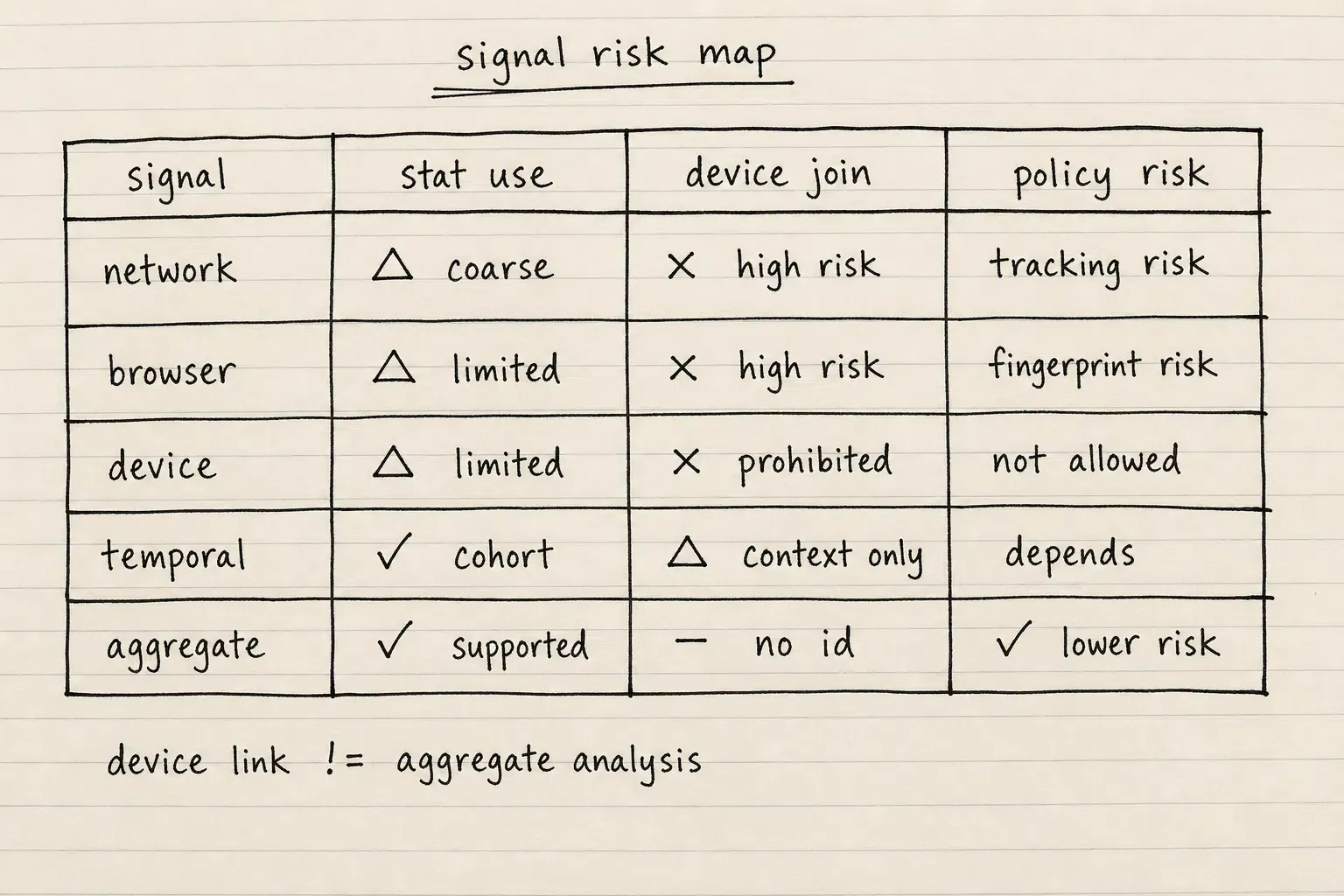
Signals Commonly Associated with Probabilistic Matching and Their Policy Risks
Categorizing Environmental Signals
Systems attempting statistical correlation evaluate non-persistent metadata vectors across touchpoints:
- Network Context: IP addresses evaluated at coarse subnet or regional gateway levels.
- Browser & Environment Metadata: Coarse platform family, browser family, and rendering capabilities.
- Locale and System Configuration: Language preferences, regional timezone offset, and screen dimensions.
- Temporal Proximity: Elapsed duration (
) between click registration and app initialization.
Risk Evaluation: Signal Categories vs Regulatory & Platform Impact
| Signal Category | Primary Statistical Use | Platform & Privacy Policy Risk |
|---|---|---|
| Network / IP Context | Coarse gateway correlation | High Risk if used to identify or link a device across apps or websites. |
| Browser Environment | Compatibility filtering | High Risk under browser privacy standards and fingerprinting rules. |
| Device Configuration | Hardware family calibration | Prohibited by Apple if combined to derive a unique device representation. |
| Temporal Proximity | Lookback decay modeling | Low Risk when used for aggregate cohort analysis; high risk if used for device joins. |
| Aggregate Campaign Metrics | MMM & cohort reporting | Lower Policy Risk when built without device-level identification or prohibited upstream tracking. |
Uniqueness and Stability: Why Environmental Context Decays Rapidly
Deterministic identifiers or signed tokens provide a stable join key for as long as the identifier remains valid and available. Conversely, environmental signals are non-unique and their discriminative value degrades rapidly as network gateways shift, mobile carriers cycle IP pools, and privacy-focused browsers standardize client headers.
The schema below illustrates an internal governance decision model and is not an Apple, Google, or OpoInstall API specification:
{
  "measurement_decision_record": {
    "evaluation_id": "eval_20260820_decision_001",
    "timestamp_utc": "2026-08-20T07:15:00Z",
    "campaign_metadata": {
      "channel_type": "mobile_web_to_app",
      "campaign_id": "cmp_fall_launch",
      "intended_workflow": "first_party_onboarding_and_deep_linking"
    },
    "governance_and_policy_checks": {
      "att_tracking_classification": "REQUIRES_POLICY_REVIEW",
      "cross_company_data_linking": false,
      "device_fingerprinting_allowed": false,
      "retention_policy": "minimum_necessary_duration"
    },
    "routing_primitive_selection": {
      "macro_ad_measurement": "PLATFORM_NATIVE_API_OR_STORE_REFERRER",
      "user_onboarding_restoration": "FIRST_PARTY_CONTEXTUAL_TOKEN",
      "device_level_probabilistic_join": "DISALLOWED_FOR_THIS_IOS_POLICY_PROFILE"
    },
    "audit_trail": {
      "persistent_identity_graph_created": false,
      "hardware_telemetry_collected": false,
      "data_disposition": "EPHEMERAL_FIRST_PARTY_SESSION"
    }
  }
}
Privacy and Regulatory Boundaries Under Apple ATT and Google Policies
Apple’s Explicit Prohibition on Fingerprinting Regardless of ATT Status
Under Apple’s User Privacy and Data Use documentation, fingerprinting—defined as using signals from a device to identify or track the device or user—is strictly prohibited.
Crucially, Apple’s policy enforces this prohibition regardless of whether the user grants tracking permission under the App Tracking Transparency (ATT) framework. Prohibited fingerprinting signals explicitly include combinations of device configuration, browser characteristics, network connection data, and location telemetry.
Google Play Policies on Advertising Identifiers and Persistent Linking
According to Google Play Developer Policies, the Google Advertising ID (commonly called GAID/AAID) is a user-resettable and user-deletable identifier. When an Android user deletes their advertising ID, or when an app targeting Android 13 (API level 33) or higher omits the com.google.android.gms.permission.AD_ID permission, the API returns a string of zeroes.
Google Play restricts the use and linking of persistent device identifiers for advertising purposes and prohibits reconnecting a reset or deleted advertising identifier to previously associated advertising data except where policy explicitly permits it.
Why Short Retention and Missing IDs Do Not Create an Automatic Safe Harbor
A critical engineering misconception is that omitting a persistent identifier or enforcing short retention windows automatically makes device matching compliant.
Under platform policies:
- The Intent Determines Tracking: If non-persistent signals are combined to link a user or device across apps or websites owned by different companies, that practice constitutes tracking.
- No Blanket Exemption: Neither Apple nor Google provides a blanket regulatory exemption for probabilistic matching solely because data is labeled as transient.
- Data Minimization Hygiene: Enforcing purpose-limited retention and deleting unnecessary unmatched session records are data-minimization practices that reduce privacy and security risk, but they do not convert a prohibited tracking mechanism into a permitted one.
Differentiating Product Onboarding from Cross-App Tracking
A technical distinction exists between first-party onboarding context and third-party advertising tracking:
- First-Party Onboarding Context: Transmitting an explicit referral code, promo token, or deep link route through a user-initiated link to fulfill an immediate in-app destination.
- Cross-App Advertising Tracking: Combining device telemetry to link an ad engagement on a third-party app or website with an install event to measure advertising performance or build user profiles.
Comparative Decision Matrix: Deterministic versus Probabilistic Frameworks
Evaluating mobile attribution methodologies requires balancing join precision, latency, and platform policy constraints:
| Functional Dimension | Deterministic ID Matching | Platform Privacy APIs (AdAttributionKit / SKAN) | Aggregate Statistical Measurement | First-Party Contextual Routing |
|---|---|---|---|---|
| Join Mechanism | Exact shared identifier match | Platform-verified cryptographic postback | Statistical regression & cohort estimation | Exact first-party token restoration |
| Identifier Dependency | Requires a shared identifier, authenticated key, verified token, or store record | No developer-accessible cross-app identifier required | None (Cohort/aggregate data) | Explicit token or platform-supported referral context |
| Measurement Latency | Low once both keys are present | Delayed by randomized platform timers | Batch or periodic processing | Available at launch depending on platform transport |
| Primary Use Case | Cross-app retargeting (with consent) | Macro paid ad network measurement | Media mix modeling, cohort estimation & aggregate channel trends | In-app onboarding & deep linking |
| Platform Policy Impact | Strictly governed by ATT & AD_ID | Native OS-supported framework | Avoids device-level identification | Depends on transport, data use, and first-party scoping |
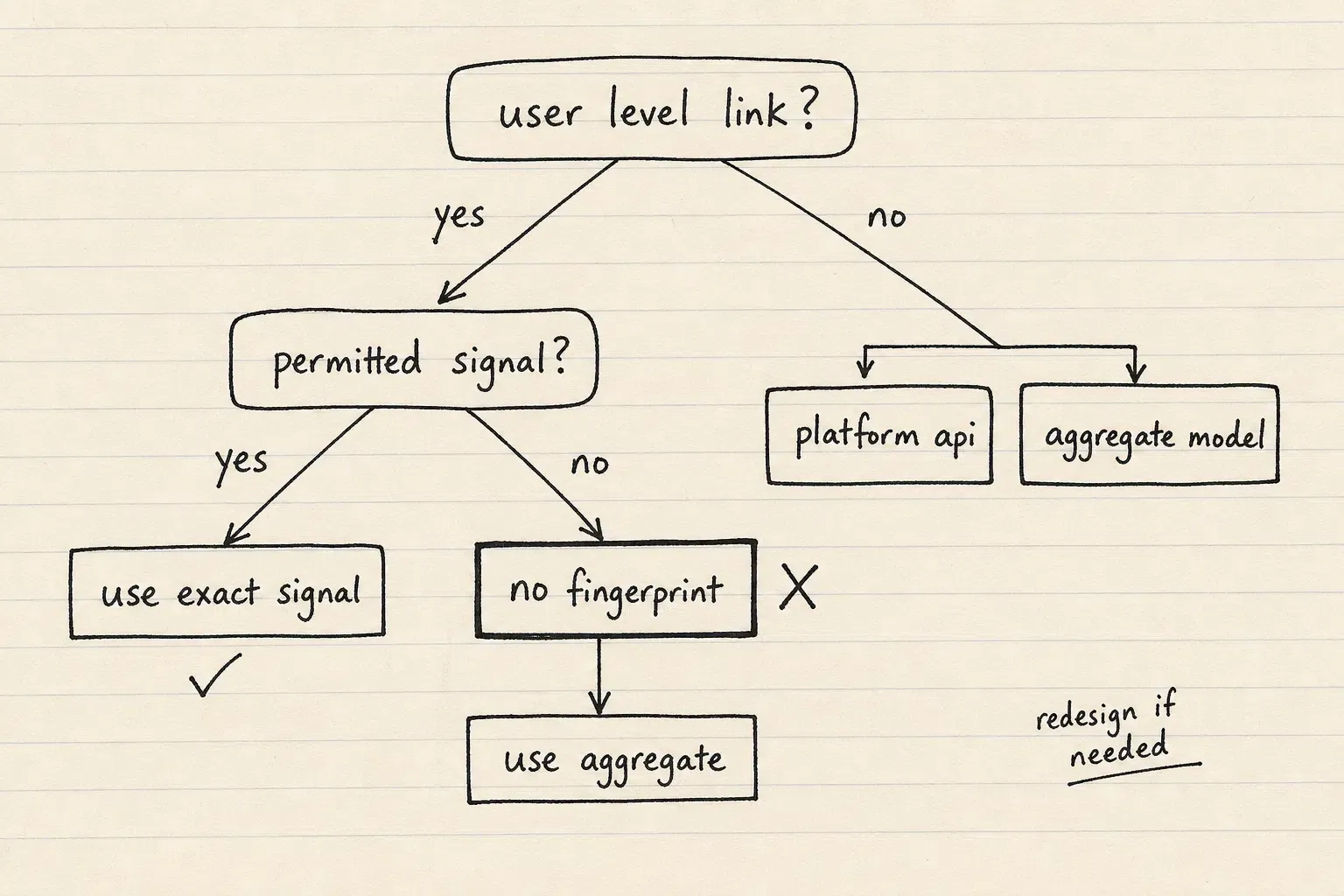
Architectural Decision Framework: Selecting the Right Measurement Primitive
Evaluating Campaign Goals: Macro Ad Spend Optimization versus In-App Onboarding Personalization
Engineering and growth teams must separate macro campaign measurement from micro user onboarding. Evaluating ad network ROAS requires aggregate, platform-verified conversion data. Conversely, personalizing the user’s initial app experience requires the delivery of routing tokens to the client SDK via approved channels.
The decision flowchart below illustrates the architectural routing process:
Is user/device-level web-to-app linkage required?
              │
       ┌──────┴──────┐
       ▼             ▼
      YES            NO
       │             │
Is there a platform-         Use the applicable platform-
and policy-permitted         or store-mediated measurement
direct signal?               primitive and aggregate modeling
       │
 ┌─────┴─────┐
 ▼           ▼
YES          NO
 │           │
Use exact    Do not synthesize a device fingerprint;
permitted    redesign measurement around aggregate
signal       or platform-native primitives
When Verified Deterministic Evidence Is Required
Deterministic verification must be deployed whenever an operational workflow requires verified transactional evidence:
- Financial & In-App Purchase Operations: Verifying store purchase receipts, managing digital subscriptions, or applying wallet balances.
- Account-Level Referral Rewards: Crediting an existing user’s account upon the confirmed registration of an invited contact using signed referral tokens and server-side validation.
- Authenticated Account Synchronization: Linking pre-existing web account profiles with native mobile app instances upon login.
When Aggregate Statistical Measurement Is Appropriate
Aggregate statistical measurement provides significant value when applied at the cohort or campaign level:
- Media Mix Modeling (MMM): Evaluating the macro efficiency of multi-channel ad spend across television, web display, and influencer marketing without tracking individuals.
- Causal Incrementality Measurement: Measuring the true conversion lift generated by specific ad networks using randomized geographic or audience holdout groups.
- Validating Delayed Platform Reporting: Analyzing directional conversion trends while awaiting multi-day Apple AdAttributionKit or SKAdNetwork postbacks.
Cross-Platform Transport Mechanisms for First-Party Contextual Routing
How Tokens Cross the Install Boundary Across Platforms
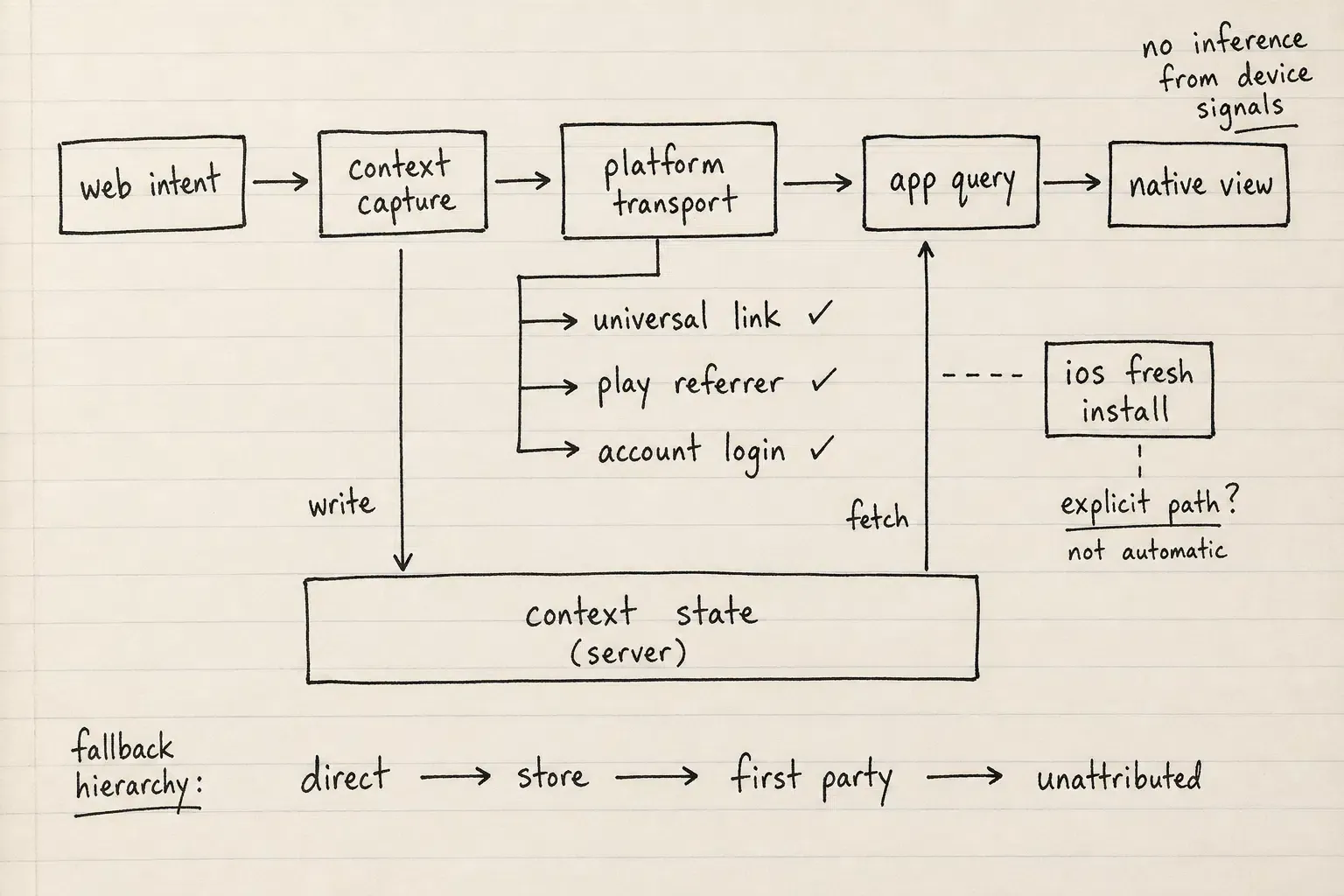
Explicit first-party tokens are deterministic only when an approved transport mechanism or authenticated state carries the token across the platform boundary:
- Installed iOS Applications (Universal Links): The operating system delivers the incoming HTTPS URL directly to the app’s
NSUserActivityhandlers, preserving query parameters deterministically. - Android Fresh Installs (Google Play Install Referrer): When campaign metadata is encoded into the Google Play referral flow, the Play Store exposes the resulting install-referrer record to the app through the Install Referrer API after installation.
- Authenticated User Workflows (Server State): When users create or log into accounts on the web prior to downloading the app, account tokens link the web session to the app session upon login.
- iOS Fresh Installs via the App Store: The standard App Store flow does not provide arbitrary web-query pass-through. Any deferred-context mechanism must rely on an explicit, platform-permitted or user-mediated transport mechanism. If no such token or authenticated state reaches the installed app, the system should not infer device identity from browser, network, or device characteristics.
Platform Boundary Transport Primitives:
├── Installed App (iOS/Android): Universal Links / App Links (Deterministic)
├── Android Fresh Install: Google Play Install Referrer (Store-Mediated)
├── Authenticated Flow: User Account / OAuth Login (First-Party Server State)
└── iOS Fresh Install: Requires explicit platform-compliant handling
Preserving User Intent from Web Clicks to Native App Views
When supported by platform-permitted transport mechanisms, contextual routing fulfills direct user intent:
- Eliminating Promo Code Friction: When a valid referral token survives the platform boundary and passes server-side verification, the app can apply the corresponding onboarding benefit without manual code entry.
- Direct Content Deep Linking: Prospective users browsing a specific product on the web land directly on that product view inside the native app immediately after installation.
- Decoupled from Advertising Identifiers: This routing pattern can avoid dependence on advertising identifiers when the workflow remains genuinely first-party and does not perform tracking as defined by Apple.
The Resilient Fallback Hierarchy
An enterprise mobile routing architecture implements a multi-tier fallback pipeline:
- Tier 1: Direct Universal Links / App Links: Immediate native app wake-up when the application is already installed on the device.
- Tier 2: Store-Mediated Parameter Passing: Retrieval of campaign parameters via platform APIs (such as Google Play Install Referrer) when available.
- Tier 3: Explicit First-Party Context Restoration: Restore context only when the app receives a valid session or referral token through a platform-permitted or authenticated mechanism.
- Tier 4: Clean Unattributed State: Default onboarding flow when no valid first-party context or platform attribution signal exists.
Frequently Asked Questions (FAQ)
Does deterministic attribution always mean the attribution decision is correct?
Does Apple allow device-level probabilistic attribution as an ATT workaround?
When should mobile apps use verified deterministic identifiers instead of probabilistic models?
Summary and Decision Framework
The transition away from legacy device identifiers requires engineering teams to separate macro advertising measurement from micro user onboarding. Modern growth architectures deploy platform-mediated attribution APIs (such as Apple AdAttributionKit and Google Play Install Referrer) for ad campaign reporting, while leveraging first-party contextual routing layers for in-app onboarding and user intent preservation.
By establishing clear boundaries between aggregate statistical modeling and first-party parameter restoration, engineering teams can build more privacy-conscious architectures that respect platform sandbox and tracking boundaries.
For product-specific routing and attribution behavior, review the OpoInstall documentation and evaluate the implementation against the applicable platform privacy requirements.
Related Materials
-
Concepts: Deterministic Matching, Probabilistic Modeling, Contextual Routing, App Tracking Transparency, Data Minimization
-
Technologies: Apple AdAttributionKit, Google Play Install Referrer API, StoreKit Framework, OpoInstall Mobile SDK
-
Standards: IETF RFC 8259 JSON Specification
-
APIs: Apple ATTrackingManager API, Google Play Install Referrer API, OpoInstall Context API
Official Documentation
Share this article