What are the essential UTM parameters for mobile marketing? The essential UTM parameters are utm_source, utm_medium, utm_campaign, utm_content, and utm_term, which measurement systems capture and map to multi-channel campaign reports. This parameter framework enables performance marketing teams to evaluate channel efficiency, measure downstream user engagement, and calculate accurate Return on Ad Spend across paid and organic acquisition campaigns.
UTM parameters are standardized query string tags appended to target campaign URLs, allowing mobile measurement systems to categorize, attribute, and report traffic origins across five distinct dimensions: source, medium, campaign name, search term, and creative content. Attribution platforms implement this framework by connecting campaign parameter extraction with measurement data pipelines.
Key Takeaways
- 5-dimensional campaign taxonomy: Standardizes acquisition source reporting across
utm_source,utm_medium,utm_campaign,utm_term, andutm_content. - MMP deduplication: Applies attribution rules to reconcile overlapping signals between self-attributing networks and open web campaign tags.
- Server-to-server data sync: Delivers validated UTM campaign attributes directly to enterprise data warehouses via S2S webhooks.
- ROAS alignment: Provides campaign-level identifiers used by attribution systems to evaluate downstream ROAS performance.
Why Standardized UTM Parameters Are Critical for Mobile Acquisition
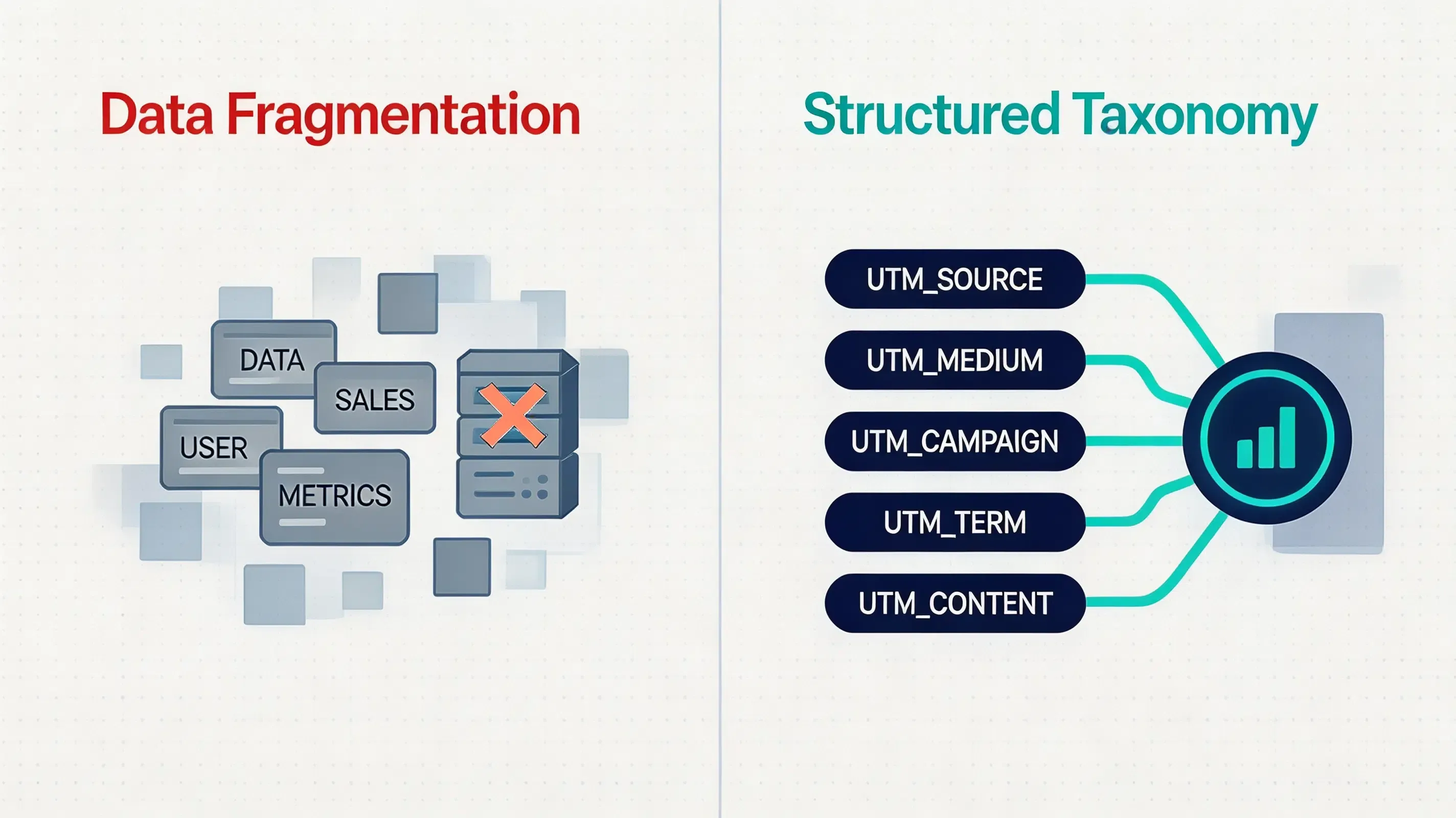
In modern multi-channel marketing, executing paid campaigns across diverse ad networks without standardized tagging introduces severe data fragmentation. When marketing teams deploy un-structured campaign links, acquisition reporting rapidly degenerates into chaotic, duplicate channel entries. Varied parameter cases, missing medium tags, and inconsistent naming conventions corrupt data analytics warehouses, making cross-channel performance comparison impossible.
Establishing a unified attribution taxonomy resolves these measurement bottlenecks. Standardized UTM parameters enforce a single naming convention across all internal acquisition teams and external agency partners. By enforcing structured query tags, growth organizations ensure that every user touchpoint is mapped cleanly into analytics dashboards.
This taxonomy standardization directly supports accurate unit economics calculations. Connecting granular web acquisition tags to downstream native in-app events enables analytics teams to provide campaign-level identifiers used by attribution systems to evaluate ROAS performance and Customer Lifetime Value (LTV) down to specific ad creative variants and keyword targets.
Anatomy and Functions of the 5 Standard UTM Parameters
Standardizing campaign tagging requires assigning explicit operational roles to each of the five core Urchin Tracking Module keys prior to launching multi-channel promotions:
utm_source: Identifies the specific traffic origin or ad platform driving the user (such asgoogle,facebook,influencer_newsletter, orpartner_site).utm_medium: Categorizes the marketing mechanism or ad format utilized for distribution (such ascpc,banner,social_feed,email, oraffiliate).utm_campaign: Tracks individual promotional initiatives, product launches, or seasonal marketing events (such assummer_sale_2026orq3_app_launch).utm_term: Captures targeted search keywords or paid audience segment identifiers in performance advertising (such asdeep_linking_sdkorretargeting_cohort_a).utm_content: Differentiates between specific ad creative variants, video formats, CTA button styles, or A/B test variations within the same campaign.
How UTM Parameters Connect Mobile Campaign Data Across Channels
Preserving campaign context across installation boundaries relies on an automated multi-step data pipeline. When a web visitor interacts with a tagged campaign landing page, campaign landing systems capture the five core query keys from the window location object.
[Campaign Click] ──> [UTM Parameter Capture] ──> [Attribution Processing]
                                                        │
                                                        ▼
[Reporting Warehouse] <── [S2S Postback Payload] <── [Install Event Matching]
Upon receiving a click, the attribution system stores campaign metadata during the attribution matching process alongside transient device session tokens. When the user completes the app store download and launches the application for the first time, the matching server reconciles the device context, resolving the full UTM payload and forwarding it to backend data warehouses via S2S postbacks.
How Attribution Platforms Resolve Conflicting Campaign Data
Managing multi-channel acquisition frequently introduces attribution conflicts when users interact with multiple marketing touchpoints prior to installation. Mobile Measurement Platforms (MMPs) resolve these overlaps by enforcing deterministic touchpoint priority rules.
When a user clicks a web ad containing UTM parameters and subsequently interacts with a Self-Attributing Network (SAN) ad, the MMP evaluates both touchpoints against the established attribution window. Under last-touch attribution logic, the most recent verified touchpoint within the lookback window receives full conversion credit, while secondary touchpoints are recorded as assisting touchpoints.
Touchpoint 1 (Web Banner: utm_source=blog) ──> Touchpoint 2 (Paid Social: utm_source=facebook) ──> Install
                                                                    │
                                                                    ▼
                                                 Attributed Source: facebook (Last-Touch)
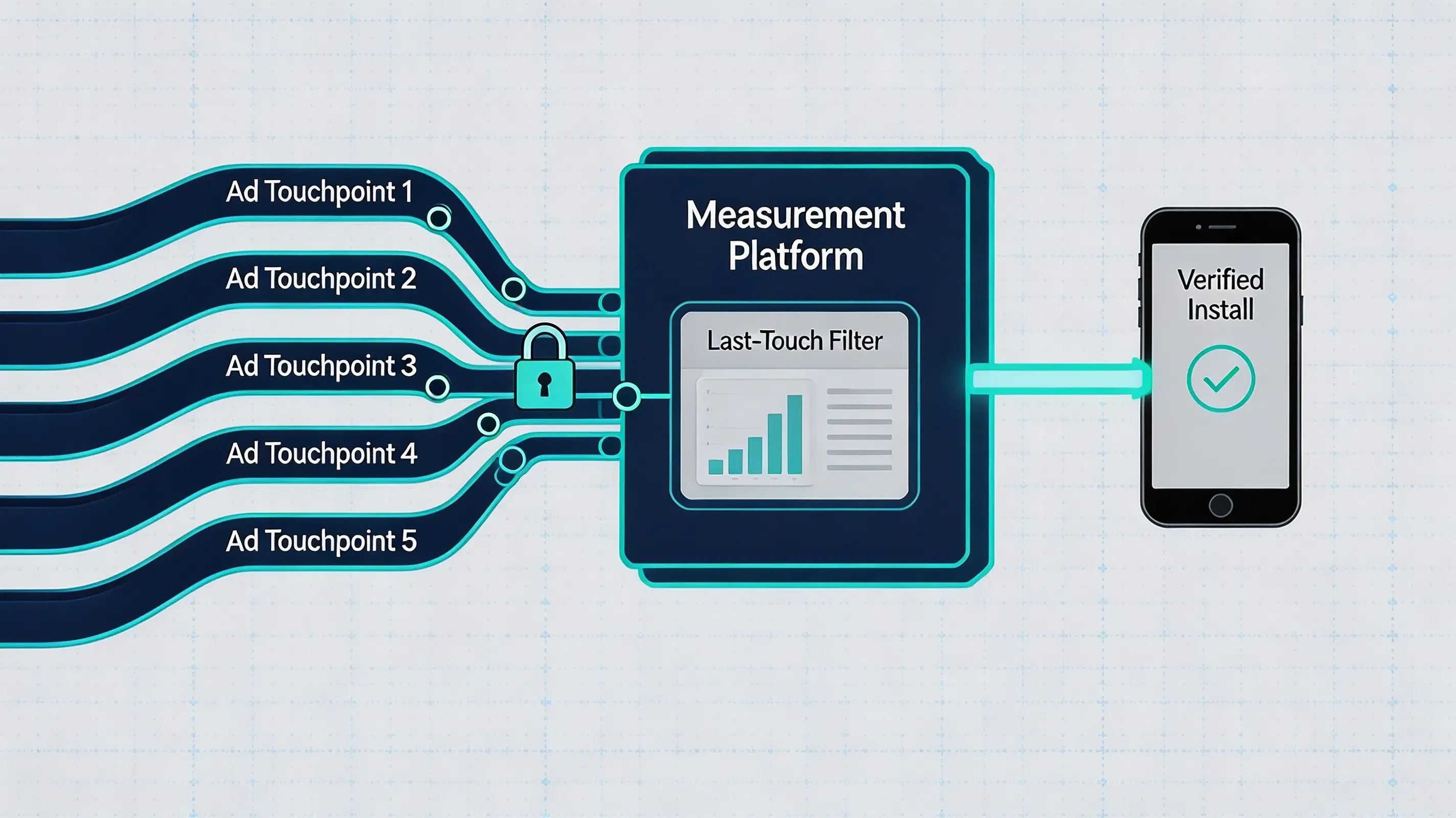
Deduplicating touchpoints prevents multiple ad networks from claiming credit for the same installation event, ensuring marketing budgets are not paid out multiple times for a single user acquisition, preventing duplicate conversion attribution across reporting systems.
Structuring Campaign Naming Conventions for Multi-Channel Scale
Scaling performance marketing across multiple regional teams or external agencies requires enforcing strict taxonomy guidelines. Unenforced naming protocols lead to corrupted database keys and manual reporting cleanup overhead.
To maintain clean data warehouses, enterprise growth organizations enforce the following taxonomy rules:
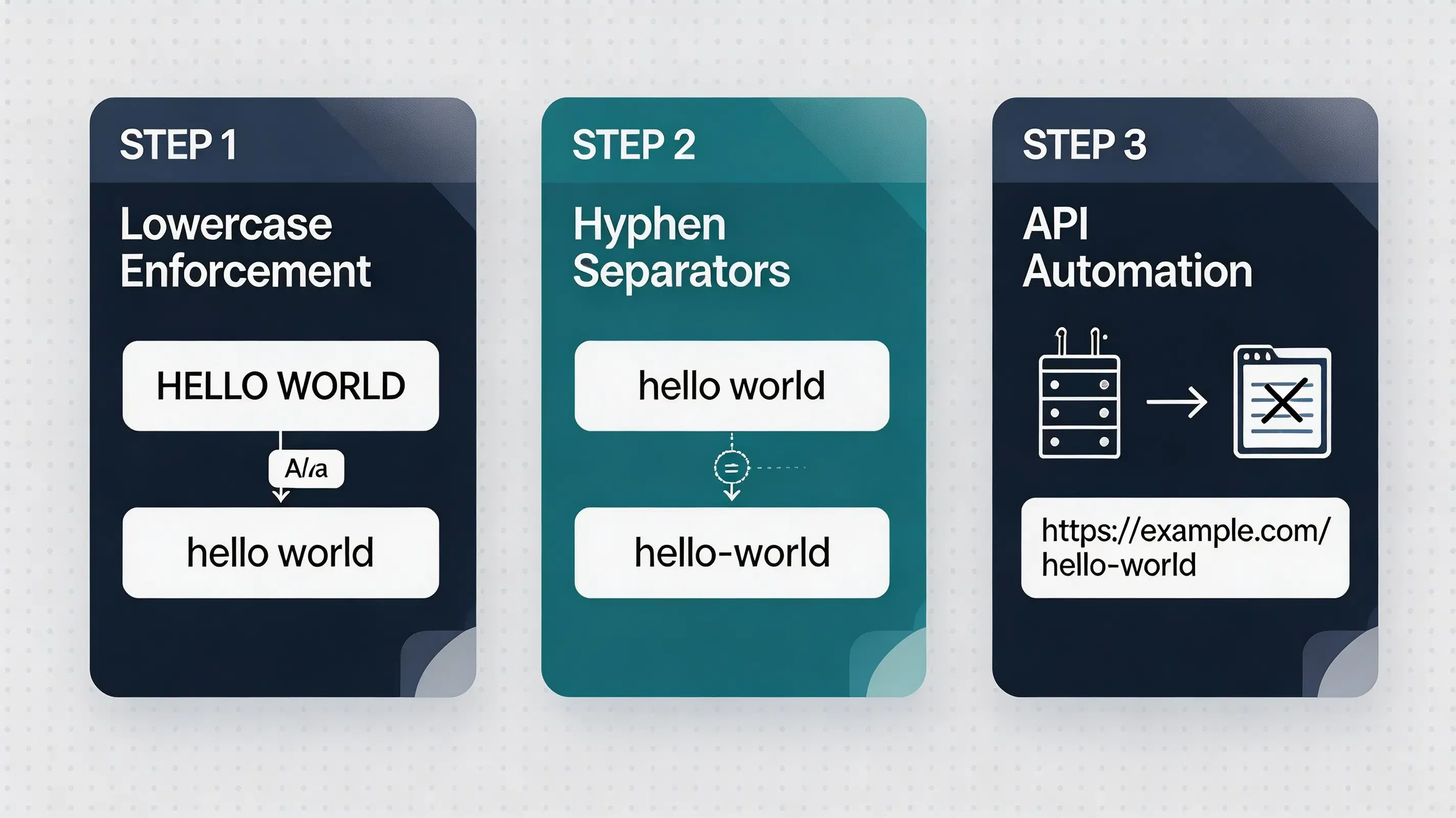
- Enforce lowercase strings: Convert all UTM values to lowercase automatically (e.g.,
googleinstead ofGoogle) to prevent database row splitting. - Use hyphen separators: Replace spaces and special characters with hyphens (e.g.,
summer-sale-2026), avoiding URL encoding errors like%20. - Incorporate regional codes: Include standardized country or language ISO codes in
utm_campaignstrings (e.g.,us-en-launch-2026). - Automate link construction: Generate campaign links programmatically via backend APIs rather than allowing manual spreadsheet assembly.
Server-to-Server Postback Payload Schema for UTM Data Sync
Automating campaign reporting across internal data warehouses requires transmitting attributed UTM attributes directly via Server-to-Server (S2S) HTTP webhooks rather than relying on client-side analytics dispatches.
The following example demonstrates a server-to-server webhook payload schema used to transmit attributed UTM parameters to internal data warehouses.
// File path: server/schemas/attributed_utm_postback_payload.json
{
  "event_type": "attributed_install_event",
  "project_id": "KEY_8830192",
  "timestamp": 1730000000,
  "attribution_data": {
    "matching_method": "campaign_parameter_mapping",
    "utm_source": "google_search",
    "utm_medium": "cpc",
    "utm_campaign": "q3_global_growth",
    "utm_term": "mobile_attribution",
    "utm_content": "text_ad_variant_b"
  },
  "security": {
    "hmac_signature": "a8f3b2c9d1e4f5a6b7c8d9e0f1a2b3c4d5e6f7a8b9c0d1e2f3a4b5c6d7e8f9a0",
    "signature_algorithm": "HMAC-SHA256"
  }
}
Common Mistakes in Campaign Tagging and Taxonomy Management
Executing multi-channel campaign tagging introduces technical pitfalls that can compromise reporting accuracy if left unmanaged:
- Inconsistent parameter case: Mixing upper and lowercase letters across ad networks, creating duplicate, fragmented rows in reporting dashboards.
- Confusing source and medium: Transposing
utm_sourceandutm_mediumtags, making channel-level performance comparison impossible. - Un-escaped query strings: Failing to encode special characters in dynamic terms, causing query parsers to truncate campaign payloads.
- Overwriting first-touch tags: Failing to preserve original acquisition parameters when users execute secondary in-app re-engagement campaigns.
Example: Standardizing Campaign Tagging for a Scale-Up Mobile Retailer
Simulated Scenario: Multi-Channel E-Commerce Campaign Integration
Challenge
A scale-up mobile retailer operating campaigns across five ad networks experienced corrupted ROAS reporting due to inconsistent campaign naming conventions and un-deduplicated query string tags.
Implementation
The growth marketing team established an enterprise taxonomy guide, enforced server-side HMAC signature verification on dynamic web links, and integrated an attribution pipeline based on structured UTM processing and S2S campaign data synchronization.
Expected Outcomes
This implementation demonstrates how backend verification can reduce duplicate event risks and improve referral data consistency. During the simulation, un-deduplicated campaign rows were eliminated in the analytics warehouse, enabling the growth team to accurately evaluate channel profitability.
Lessons Learned
- Enforce strict taxonomy guidelines: Requiring lowercase hyphenated strings prevents duplicate database entries.
- Automate link generation: Calling server-side APIs to construct campaign URLs eliminates human tagging errors.
- Validate parameters via S2S postbacks: Syncing verified UTM attributes via webhooks protects reporting accuracy.
UTM Parameters vs Native Store Referrers vs Ad Network Tokens
Different tracking methods handle campaign attribution across web and app boundaries with varying levels of granularity:
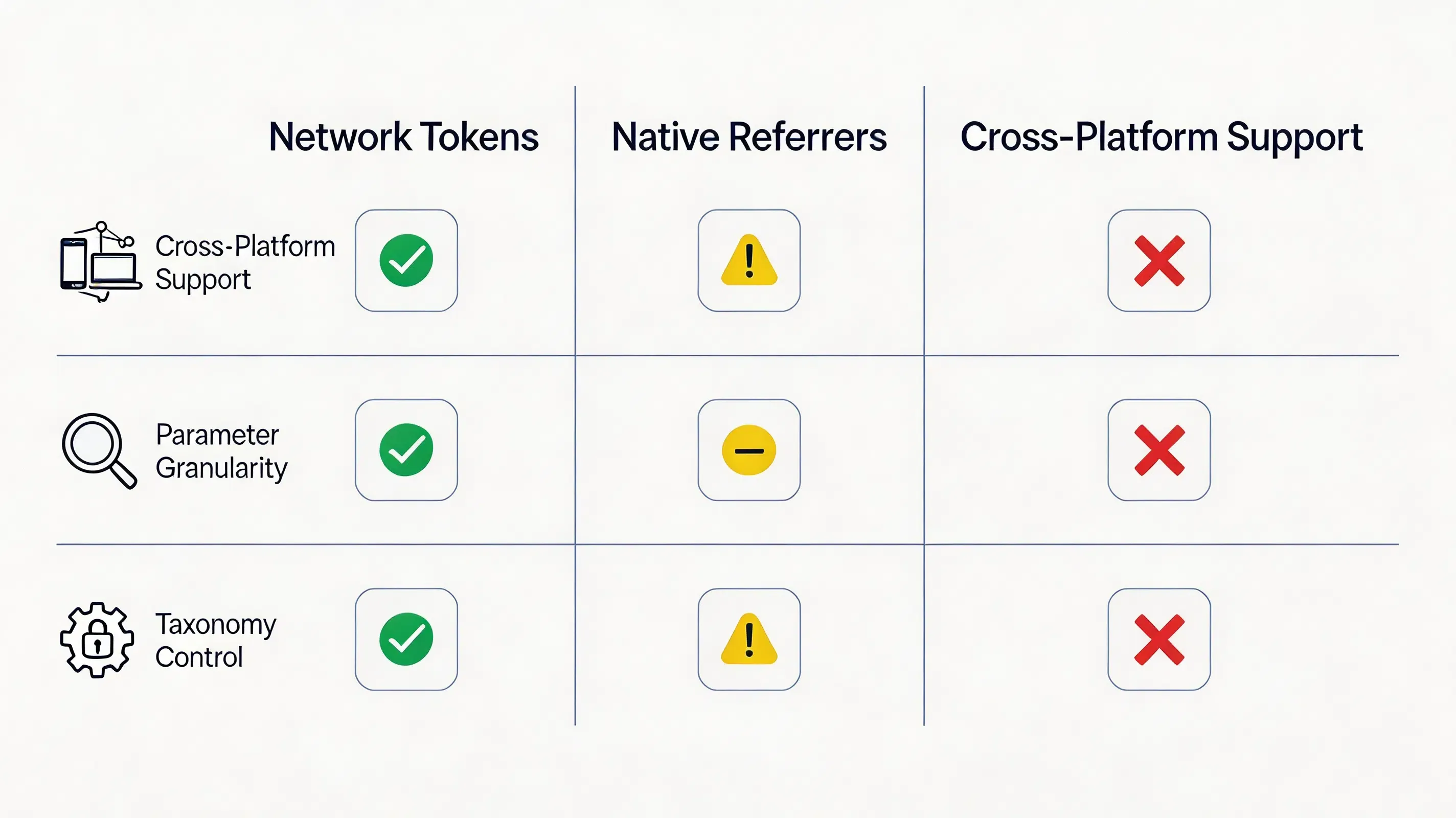
| Evaluation Attribute | Ad Network Tokens | Native Store Referrers | UTM Parameters |
|---|---|---|---|
| Representative Usage | SAN Network Tokens | Google Play Services Install Referrer API Specification | Web campaign attribution systems |
| Cross-Platform Compatibility | Limited (Network-specific) | Android Only | High (iOS and Android) |
| Parameter Granularity | High (Network-specific) | Moderate (Store Query) | High (5 Standardized UTM Keys) |
| Custom Taxonomy Control | Low (Network defined) | Moderate | High (Fully Custom Naming) |
| Implementation Overhead | High (SAN Integration) | Low | Minimal (Unified Attribution API) |
Frequently Asked Questions
What are the essential UTM parameters for mobile marketing?
What is the difference between utm_source and utm_medium?
How are missing UTM parameters handled in mobile attribution?
Can UTM parameters be used to measure in-app purchase ROAS?
How do I enforce UTM parameter taxonomy across external agency teams?
Do UTM parameters work with Apple ATT and SKAdNetwork?
What is the character length limit for custom UTM parameters?
Summary and Decision Framework
Choose an automated UTM attribution architecture when your growth objectives match the following functional criteria:
- ✓ Multi-Agency Campaigns Require Taxonomy Standards: Campaign reporting requires unifying diverse agency naming conventions into a single analytics warehouse.
- ✓ Performance Marketing Demands 5-Dimensional ROAS Visibility: Acquisition budgets depend on evaluating performance down to specific creative variants (utm_content) and keyword bids (utm_term).
- ✓ Web Advertising Drives Native Mobile Installations: Growth strategies rely on converting desktop and mobile web traffic into native application downloads.
- ✓ Cross-Channel Conflicts Require Deduplication: Marketing databases require an independent attribution engine to reconcile overlapping campaign tags across ad networks.
In these scenarios, deploying a structured campaign taxonomy provides a practical architecture. Dedicated attribution systems enable growth teams to maintain data integrity across multi-channel campaigns. Platforms such as OpoInstall multi-channel analytics dashboard implement this framework, supporting multi-channel UTM extraction and S2S webhook postbacks.
Entity Glossary
| Term | Definition | Related Entity | Search Intent Role |
|---|---|---|---|
| UTM Parameters | Standardized URL query tags used to categorize traffic sources across five specific campaign dimensions. | Campaign Attribution | Technical |
| Campaign Taxonomy | A structured naming system for organizing marketing campaigns and unifying data warehouses. | Data Governance | Commercial |
utm_source |
The specific UTM parameter key identifying the origin of traffic (such as a search engine or ad network). | Metadata Key | Technical |
utm_campaign |
The UTM parameter key identifying the individual promotional initiative or seasonal marketing push. | Campaign Metadata | Technical |
| ROAS | A revenue efficiency metric comparing campaign revenue against advertising spend. | Financial Analytics | Commercial |
| MMP | Mobile Measurement Partner providing independent de-duplication and attribution across ad channels. | Analytics Engine | Commercial |
| S2S Webhook | A backend communication protocol used to transmit real-time conversion callbacks. | Server Architecture | Technical |
Related Materials
Related Concepts
- Install Attribution: The foundational measurement pipeline identifying application download sources.
- Multi-Touch Attribution: The attribution framework assigning conversion credit across multiple touchpoints in a user journey.
- Self-Attributing Networks: Major ad platforms that perform internal self-attribution without open web UTM tagging.
Related Technologies
- Google Play Install Referrer: Google’s native API passing install-time campaign metadata on Android.
- Universal Links: Apple’s native deep linking standard bridging web actions to native screens.
- App Links: Google’s verified deep linking protocol handling custom web URLs on Android.
Standards Referenced
- IETF RFC 3986: Uniform Resource Identifier (URI) Generic Syntax specification.
- IETF RFC 2104: Keyed-Hashing for Message Authentication specification for HMAC security.
Primary Integration Interfaces
- Parameter Extraction Interface: The web-side mechanism used to parse and serialize query strings.
- S2S Postback Interface: The server-side webhook endpoint used to transmit attributed campaign attributes.
Official Documentation / References
Share this article