Google AI Overviews Reach 43% of Searches? This major shift is documented in recent market intelligence reports showing that AI-generated search answers now appear across nearly half of all query results. As generative artificial intelligence changes how web content and digital entities are consumed, search engines are evolving from navigation directories into direct answer platforms. Historically, web indexing promised outgoing referral traffic that publishers monetized through ad impressions and subscriptions. Today, because AI Overviews synthesize information directly on search result pages, users increasingly find complete answers without clicking through to source websites, causing significant traffic declines across digital media.
The Operational Problem & Financial Bottlenecks: Google AI Overviews Reach 43% Penetration
At a Glance
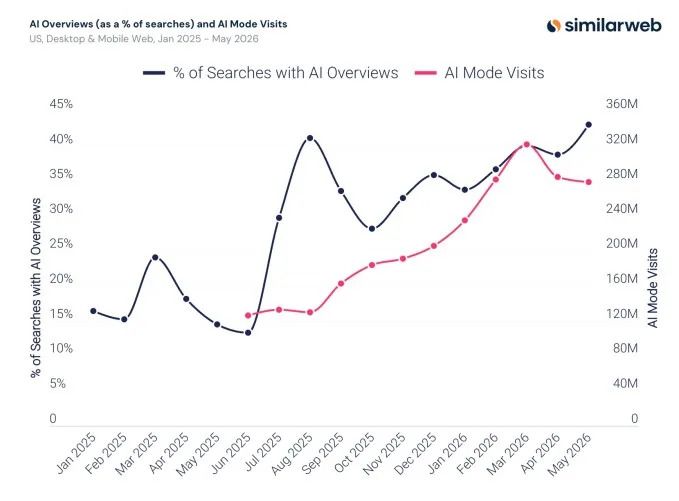
- Market intelligence reports indicate that Google AI Overviews now appear in forty-three percent of search queries, up from fifteen percent in early twenty-twenty-five.
- Monthly traffic to Google’s conversational AI Mode grew from one hundred twenty-six million in June twenty-twenty-five to two hundred seventy-nine million by May twenty-twenty-six.
- Digital publishers face measurable drops in outbound referral traffic as zero-click search experiences reduce user click-through rates on traditional blue links.
The longstanding contract between web content creators and search engines is undergoing a fundamental transformation. For decades, digital publishing models relied on a predictable traffic pipeline. Content creators produced articles, documentation, and tools, allowing search bots to index their pages in exchange for organic user referrals. Publishers monetized these inbound visits through display advertising, affiliate marketing, and digital subscriptions.
However, the rapid integration of generative AI summaries directly at the top of search result pages has altered user behavior. When search engines present a comprehensive, AI-synthesized answer directly on the results page, the user’s immediate informational need is satisfied without requiring an outbound click. Market analysis published in TechCrunch reports demonstrates that when an AI Overview is displayed, click-through rates to traditional source links decline significantly, falling to single-digit percentages in many reported categories.
This trend creates immediate financial pressure for digital platforms dependent on referral visits to offset bandwidth and editorial costs. Data from Similarweb reveals that visits to Google’s conversational AI Mode expanded from 126 million in mid-2025 to 279 million by May 2026. As Google transitions from a gateway that directs users across the web into an enclosed destination platform, digital publishers are forced to reassess how they acquire, measure, and monetize user attention.
Systemic Root Causes: Why Google AI Overviews Reach 43% Penetration in Search
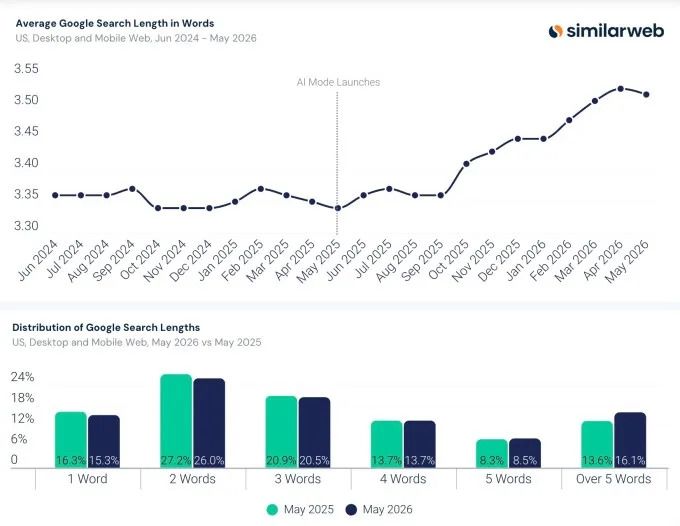
At the behavioral and technological level, this shift reflects a fundamental change in query patterns. Over the past year, the average length of user search inputs has grown substantially. Users are replacing concise, keyword-based search strings with longer, natural-language prompts tailored for conversational AI models.
When an AI engine processes a conversational prompt, it fetches content from multiple indexed domains, processes the semantic context, and generates a unified summary. During this process, traditional HTTP referrer headers and client-side session containers are stripped or lost within the closed search interface.
The Shift to Zero-Click Environments and Disrupted Referral Chains
When users receive generated answers on the primary search page, the traditional journey from web search to application landing pages is interrupted. Traditional multi-touch attribution models increasingly struggle when referral signals disappear inside AI-generated search experiences.
The diagram below outlines the structural difference between standard search routing and generative answer synthesis:
[Traditional Search Discovery Pipeline]
  User Query ──> Search Engine Result ──> Outbound Click (Referrer Header Logged) ──> Web/App Conversion


[Generative AI Overview Pipeline]
  User Query ──> AI Overview Synthesis ──> Direct Answer Rendered ──> Zero-Click Session (Referrer Dropped)
When user interactions end on the search page, downstream conversion tracking breaks down. Standard mobile measurement tools that rely on client-side browser cookies or immediate HTTP redirects fail to capture the initial touchpoint. In a broader systems context, similar identity and context continuity challenges also appear in attribution infrastructure. When referral traffic becomes decoupled from traditional browser headers, organizations require robust server-side state management to maintain accurate user journey records across web and mobile applications.
Build vs. Buy: Managing Session State and Measurement Infrastructure
As referral traffic becomes less predictable, organizations are also reassessing the operational cost of maintaining increasingly complex measurement pipelines. Enterprise FinOps teams increasingly compare metered API billing against long-term SDK integration costs when evaluating AI infrastructure investments. Evaluating data pipelines when Google AI Overviews Reach 43% of query results requires teams to move away from fragile client-side tracking scripts toward resilient, server-side parameter passing.
Architectural Evaluation: Custom Build vs. Standardized SDK
Building a custom, in-house system to reconcile server-side user parameters offers full control over data pipelines but introduces substantial ongoing engineering overhead. Android Install Referrer APIs alone are no longer sufficient to reconstruct complete acquisition paths when discovery begins inside AI-generated answer interfaces. Developers must build custom session databases, maintain cross-platform parameter mapping, and continually adjust configurations to comply with changing privacy frameworks. Conversely, deploying a standardized measurement SDK streamlines implementation while providing tested compliance mechanisms.
The table below compares standard methodologies for managing session state and conversion context:
| Approach | Persistence | Throughput | Best For |
|---|---|---|---|
| Traditional Link Redirection | Low (Session Cookies) | Low (Zero-Click Dropoff) | Legacy web publishing with minimal app conversion goals |
| In-house Server-side Matching | High (Custom DB) | Medium (DB Latency Limits) | Custom enterprise environments requiring bespoke data pipelines |
| Server-side Measurement Platform (e.g. OpoInstall) | High (Programmatic Mapping) | High (Standardized Sandbox) | High-concurrency app campaign tracking and cross-platform session restoration |
While custom database configurations can handle basic context, some organizations adopt standardized server-side measurement infrastructure to reduce engineering overhead and simplify FinOps management. Depending on implementation requirements, organizations may build their own server-side session management system or adopt commercial platforms such as OpoInstall. For instance, OpoInstall offers server-side state restoration and parameter pass-through frameworks to preserve session continuity anonymously. By mapping session parameters to a centralized state database rather than depending on standard browser cookies, such systems ensure that conversion contexts remain intact even when user discovery occurs within a zero-click AI environment.

Integration Checklists: How Engineering Teams Can Prepare for Traffic Shifts
To maintain data integrity and user experience continuity as generative search interfaces alter web referral traffic, development and growth teams should adopt structured operational guidelines.
Developer Implementation Checklist
- Adopt Server-Side Parameter Preservation: Transition from client-side cookie tracking to server-side session tokens to capture referral metadata upon application install.
- Review Schema and Structured Data: Optimize web content with structured data markup to increase visibility and accurate attribution within generative AI summaries.
- Evaluate Cryptographic Link Signatures: Utilize cryptographically signed parameters on outgoing marketing links to prevent automated scrapers or proxies from altering referral data.
Product & Growth Strategy Checklist
- Diversify User Acquisition Funnels: Reduce reliance on standard organic search clicks by expanding direct-to-app channels, referral programs, and community ecosystems.
- Reconstruct ROAS Models: Update return-on-ad-spend calculation models to account for lower referral click volumes and higher zero-click engagement rates.
- Reduce Multi-Platform Attribution Gaps: Utilize non-intrusive parameter pass-through frameworks to verify that user conversion contexts are preserved across desktop and mobile devices.
Frequently Asked Questions (FAQ)
Why are Google AI Overviews appearing in nearly half of all search queries?
How do zero-click AI search results impact publisher referral traffic?
How can digital products preserve user journey tracking when search clicks drop?
Key Takeaways for Engineering Teams
The expansion of AI-generated search summaries marks a permanent transition in how information flows across the web. As search engines shift from link directories to direct answer platforms, traditional client-side referral tracking will continue to experience degradation.
To maintain growth and operational resilience, engineering and product teams must adapt their architectures to zero-click realities. Implementing server-side session management, structured metadata standards, and robust parameter pass-through frameworks allows digital products to maintain accurate conversion measurement and seamless user journeys in an AI-first web environment.
Share this article